Broadband Policy Cornerstone: Affordability
States can help ensure that publicly funded networks deliver lasting benefit to households and providers

This analysis is part of a series exploring policy cornerstones that states can adopt to pursue universal broadband connectivity.
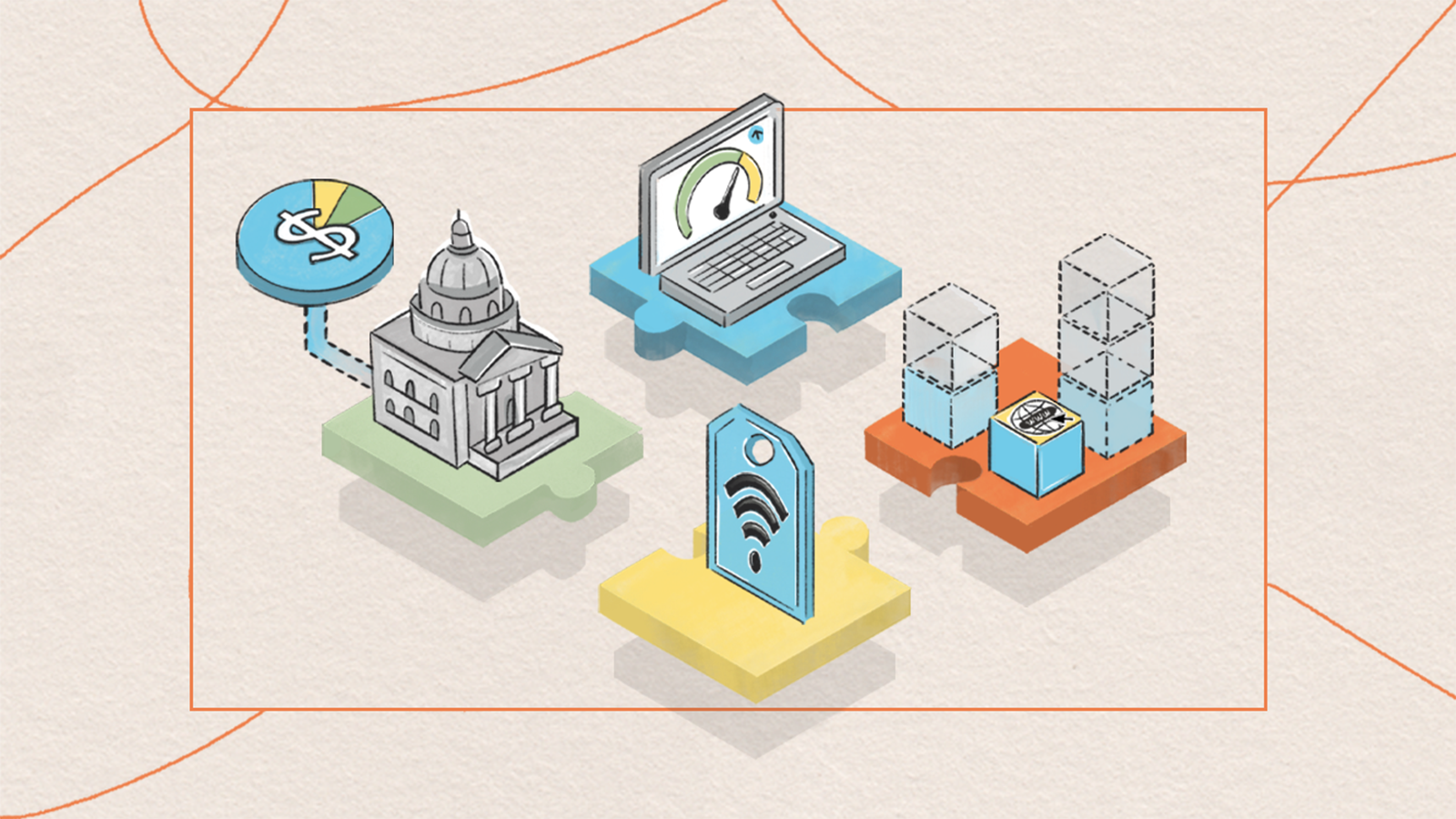
To help states achieve universal high-speed internet connectivity, The Pew Charitable Trusts has identified four cornerstones of a lasting, comprehensive broadband policy framework. Affordability—along with dedicated deployment funding and speed and scalability requirements—is a key factor for policymakers to address as they seek to ensure that broadband service reaches all communities.
States have already recognized the need to prioritize affordability policies, particularly as many Americans struggle with rising costs of living. Such policies can help households subscribe to and maintain broadband connections while also offering internet service providers (ISPs) the security of a stable customer base to support a return on their capital investment.
During the planning stages of the federal Broadband Equity, Access, and Deployment (BEAD) program, which was enacted as part of the bipartisan Infrastructure Investment and Jobs Act of 2021, every state identified affordability as a barrier to broadband adoption. With limited federal assistance following the lapse of the Affordable Connectivity Program in 2024, states are increasingly responsible for filling the gap.
This analysis examines how states can approach affordability, given the variation in geographic, socioeconomic, and market conditions across the country. The analysis explains why affordability is a core component of Pew’s broadband policy framework and introduces the three main approaches that states have used to seek and sustain universal access.
How affordability fits within the cornerstones
Affordability is the cornerstone that connects network deployment to actual household use. It works in tandem with deployment funding: Infrastructure investments can expand broadband availability, but their benefit depends in part on whether households can subscribe to service when it becomes available. Affordability policies similarly complement speed and scalability requirements, which help ensure that broadband networks remain capable of supporting evolving community needs, from remote work and telehealth to economic development. Network affordability helps households obtain and maintain connections, while network standards help confirm that the service households pay for is worth keeping.
Why affordability matters
For states to ensure affordable broadband service, policies must help set the conditions that allow all residents, regardless of income, to remain connected to high-quality internet. Networks that are built with public dollars and price out low-income households deliver only partial public benefit. According to one study, low- and moderate-income households in cities spend more than 4.5 times as much of their monthly income on broadband as wealthier residents do. For many low-income households, paying for broadband service is a question not only of price, but alsohousehold budget trade-offswhen unexpected expenses arise or incomes drop. Without affordable options, neither households nor communities will realize the potential benefits of connectivity.

Further, the economic gains associated with broadband access are at risk when service is financially out of reach. Research on the Affordable Connectivity Program found that the economic returns generated for consumers by the subsidy exceeded the cost of the initiative. For rural areas in particular, the benefits of broadband adoption have been found to include improvements in business growth rates, per capita income, and GDP growth.
Affordability policies also matter for ISPs. ISPs, particularly in high-cost areas, depend on a stable subscriber base to remain operational. When households cannot afford broadband service because of income-based disparities, network sustainability for ISPs is at risk. Because expected subscriber demand influences providers’ willingness and ability to invest in network deployment and upgrades, affordability policies can help businesses operate and expand in regions historically left behind.
State approaches to broadband affordability
For consumers, affordability depends on factors such as household income and the price and quality of available service. For providers, affordability strategies must account for differences in operating costs, geography, population density, and competition. As a result, no single approach is appropriate for every state.
States have responded by adopting a range of policies. Broadly, these approaches fall into three categories: low-cost plan requirements, state universal service fund reform, and direct subsidies to consumers.
Low-cost plan requirements
States can choose to require ISPs to offer a minimum service tier at a set price point, although programmatic rules and eligibility vary. In 2025, Connecticut established the Net Equality Program, which provides a low-cost plan for eligible households capped at $40 per month, with minimum download speeds of 100 megabits per second (Mbps) and upload speed requirements that increase over time. However, rather than requiring all providers to participate, the low-cost plan measure applies only to providers “doing business” with a state agency in Connecticut, including through state procurement contracts.
In New York, the Affordable Broadband Act, in effect since January 2025 after a multiyear legal challenge, requires ISPs to offer eligible households one of two service tiers: $15 per month for download speeds of at least 25 Mbps, or $20 per month for at least 200 Mbps. Unlike the Connecticut provision, the New York law applies to all fixed broadband providers in the state, with exemptions for smaller, regional providers serving no more than 20,000 households. The law’s survival through judicial review demonstrated that low-cost service requirements can be a viable policy tool, although future changes to federal broadband regulation couldreopen questions about the scope of state authority.
These examples illustrate the factors—eligibility, service levels, and provider participation, among others—that states must consider when designing low-cost plan requirements. Both Connecticut and New York rely on existing public assistance programs to verify eligibility and pair affordability requirements with performance standards to ensure that lower-cost plans remain suitable for modern uses.
Unlike direct subsidy programs, low-cost plans generally do not depend on ongoing appropriations or dedicated funding streams. Their long-term durability depends on continued provider compliance and participation—an important consideration for states amid the risk of legal and industry challenges—as well as statutory design and mechanisms allowing prices to adjust over time as operating costs change. For that reason, low-cost plan requirements can offer states a way to embed affordability expectations directly into law rather than relying on recurring appropriations.
State universal service fund reform
Policymakers can support broadband affordability through existing state universal service funds (USFs), which provide funding to expand access to telecommunications at affordable rates. Universal service programs were originally designed for telephone service, but reforms in 2016 expanded the federal Lifeline program, a subsidy that helps eligible low-income households pay for communications service, to cover broadband. This $9.25 per month discount may be applied to internet or bundled internet and telephone services, or to telephone-only service at $5.25 per month, but only with participating companies. Notably, federal and most state USF benefits are not consumer vouchers—providers receive the benefit and apply the savings directly to an eligible customer’s bill.
States can adapt these same universal service funding mechanisms to promote affordability. However, while a majority of states operate their own USFs, relatively few have updated their programs to support broadband-only subscriptions, with many continuing to require bundled telephone and broadband service.

For state USF reform to be effective, states must make broadband an eligible use of the fund, establish eligibility criteria for consumers and broadband providers, and ensure that any fees used to finance the fund can sustain affordability initiatives over time. Many programs use enrollment in the Supplemental Nutrition Assistance Program, Medicaid, or Lifeline as a proxy for eligibility, reducing administrative burdens while targeting support to households most likely to face affordability barriers.
To outline in statute the scope and control of the subsidy, states have generally taken three routes:
- Delegating rate-setting authority to the state’s public utility commission. Since 1987, Oregon’s Public Utility Commission (PUC) has been authorized to set a discount rate for low-income consumers. Oregon reformed its existing affordability initiative in 2025, renaming the program Oregon Lifeline. (Eligible residents can receive state benefits in addition to federal support offered by the Federal Communications Commission.) Rather than setting a specific discount in statute, lawmakers authorized the reallocation of funds to the program and empowered the PUC to determine and increase the monthly benefit for eligible households. Through a combination of state and federal funds, Oregon currently provides discounts of up to $24.25 per month or $49.25 per month on Tribal lands, as well as a $100 benefit toward an internet-enabled computer or tablet.
- Embedding a broadband subsidy directly into the existing state USF. New Mexico offers the most recent example of this strategy. In 2026, the state created the Low-Income Telecommunications Assistance Program, funded by fees gathered through the State Rural Universal Service Fund. The program provides a broadband subsidy of up to $30 per month for eligible households and $70 per month for those on Tribal lands, with the Public Regulation Commission tasked with overseeing implementation and eligibility rules. By leveraging the state USF, New Mexico paired a new affordability program with an existing source of recurring revenue, creating a mechanism to continue supporting low-income households.
- Capping the subsidy amount in statute. States including Vermont and Michigan set specific limits—$4.25 per month and $8.25 per month, respectively—on the amount their state-funded Lifeline programs can offer and limit those benefits to telephone service. In this instance, if a state wished to adjust and expand the benefit, new legislative action would be necessary.
Because providers typically receive reimbursement for discounts rather than absorbing costs directly, USF-based approaches often place a smaller financial burden on participating ISPs than low-cost plan requirements do. In this way, the USF-based methods allow states to support affordability while offering providers predictable reimbursement through an existing universal service framework. However, the long-term viability of these programs depends on maintaining a stable revenue base, which remains challenging as traditional telecommunications revenues that fund many USF programs continue to decline.
Direct subsidies to consumers
Direct consumer subsidies have played a more limited role in state policy. In 2021, Colorado authorized a direct reimbursement program covering up to one-half of eligible household broadband costs, capped at $600 annually. The program, which ultimately was not implemented, was supported with federal pandemic relief dollars and was time-limited by design, sunsetting in September 2026. While replicating the initiative would require a state to identify a dedicated state funding source, the program offers a useful example of how a subsidy could be structured to reduce consumer costs without requiring providers to offer specific low-cost plans. Several other states and municipalities have explored targeted affordability programs focused on specific populations, such as residents of public housing. Although targeted subsidies may help address affordability challenges for specific groups, policymakers must consider eligibility requirements and the long-term sustainability of funding sources.
A note on affordability in state broadband grant scoring
Pew does not consider grant-scoring preferences to satisfy the affordability cornerstone—they apply only to a particular grant program and may expire when that funding ends—but states have increasingly used affordability measures in broadband grant programs. For example, Florida incorporated affordability and adoption assistance into its scoring criteria, and Louisiana awards points based in part on proposed consumer prices. Although such approaches can incentivize provider policies and Pew recommends their usage, statutory requirements offer greater consistency and durability.
Conclusion
States face different affordability conditions, both for consumers and ISPs, and have, accordingly, pursued different policy approaches. Policymakers must make decisions about eligibility, provider participation, and long-term funding sustainability. Programs that rely on existing assistance programs or verification systems may reduce administrative burdens, while affordability policies embedded in statute are generally better positioned to endure beyond individual grant programs or funding cycles.
Federal broadband programs can support affordability goals, but program requirements and funding availability may change over time. State statutory affordability policies, by contrast, can provide a more durable framework: They offer certainty for ISPs, particularly in high-cost regions, while ensuring that households throughout the state can access connections when networks are built.
Affordability policies should not operate in a vacuum; pursued in connection with deployment funding and speed and scalability requirements, they can help ensure that the households they are meant to serve have access to networks adequate for modern use. Ultimately, states that pair affordability commitments with the other cornerstones will be most prepared to translate one-time investments into lasting universal access.
Colby Humphrey leads research for The Pew Charitable Trusts’ broadband access initiative.
People


