Land Contracts Emerge as a Tool for Thousands of Iowans to Buy Homes
A review of the state’s land contract market and consumer protections

Overview
Land contracts have emerged as an alternative to mortgages for thousands of Iowans looking to finance homes—especially inexpensive smaller, older, and rural homes. Land contracts, unlike mortgages, do not involve a bank or lender, but instead rely on the seller extending credit directly to the homebuyer. For homebuyers who do not qualify for a traditional mortgage—or who are buying properties that don’t meet bank requirements—land contracts can serve as an accessible, low-barrier form of credit.
However, while many buyers report positive experiences with land contracts, they come with risks. Some of those risks are because of the lack of consumer protection laws for land contract buyers in Iowa.
Land contract usage in Iowa declined sharply from 2015 to 2019 but began rising again in 2020. In 2022, the number of land contracts used to buy homes reached an all-time high of 1,705.
This fact sheet provides an overview of Iowa’s land contract market. Researchers from The Pew Charitable Trusts analyzed county-level property transaction records in Iowa from 2005 to 2024 to identify geographic regions where land contracts are most common, the size and age of homes purchased with land contracts, and how land contract use varies across different housing markets.
What is a land contract?
A land contract is a form of alternative financing in which a buyer purchases a home or other piece of real estate directly from the seller rather than through a mortgage lender. Typically, the buyer makes a down payment to the seller, who finances the remaining balance of the purchase price. The buyer makes installment payments over time at a specified interest rate until the debt is fully repaid.
Unlike mortgage borrowers, land contract buyers do not receive legal title to the property until the final payment is made. As a result, buyers assume many of the responsibilities of homeownership—such as maintenance, repairs, and property taxes—without the same legal protections and tax advantages enjoyed by mortgage borrowers.
Pew’s prior research shows that in some jurisdictions, land contract buyers who miss payments can be removed from their homes more quickly than mortgage borrowers, because courts treat land contracts more like rental agreements than traditional homeownership.1 Without the protections of the foreclosure process, land contract buyers risk losing all their equity in a home, even if they have been making payments for years.
Facts about Iowa’s land contract market
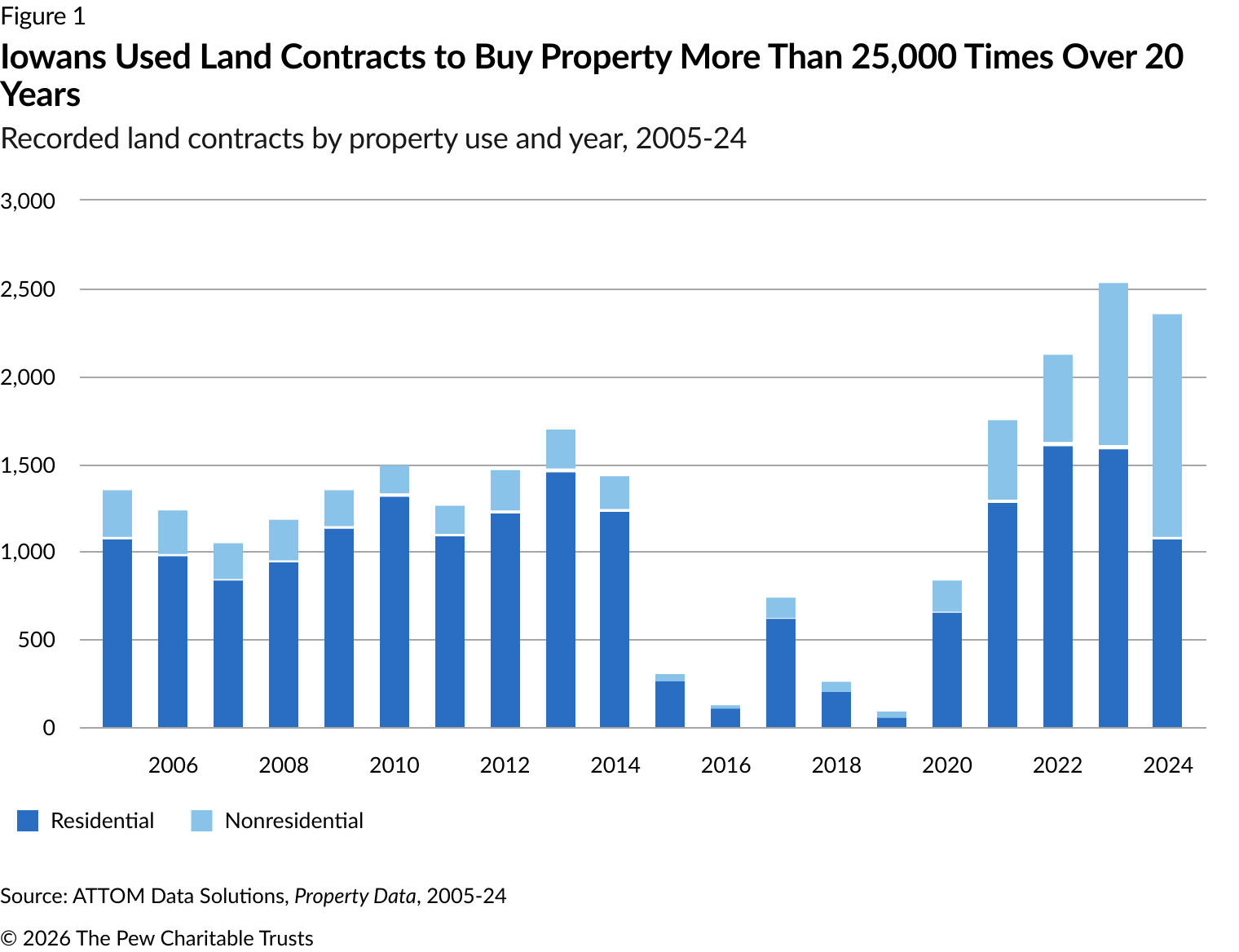
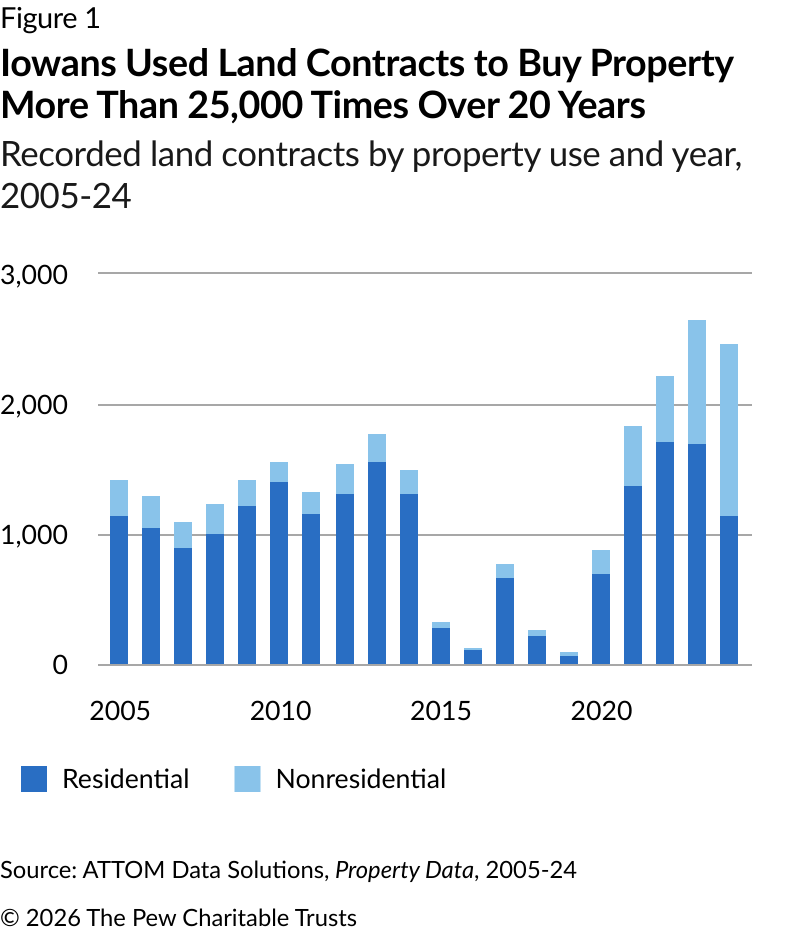
Land contracts are relatively common in Iowa. From 2005 to 2024, county governments in Iowa recorded 25,725 land contracts—the ninth most of any state, even though Iowa ranked 32nd in population in 2024. Of those contracts, 19,929 (77%) were used to acquire residential property, while the remainder financed businesses, farms, or vacant land. (See Figure 1.) The number of recorded land contracts in Iowa initially peaked at 1,770 in 2013 and declined to a low of 94 in 2019, then climbed to an all-time high of 2,650 in 2023. Iowa counties recorded 2,459 land contracts in 2024.
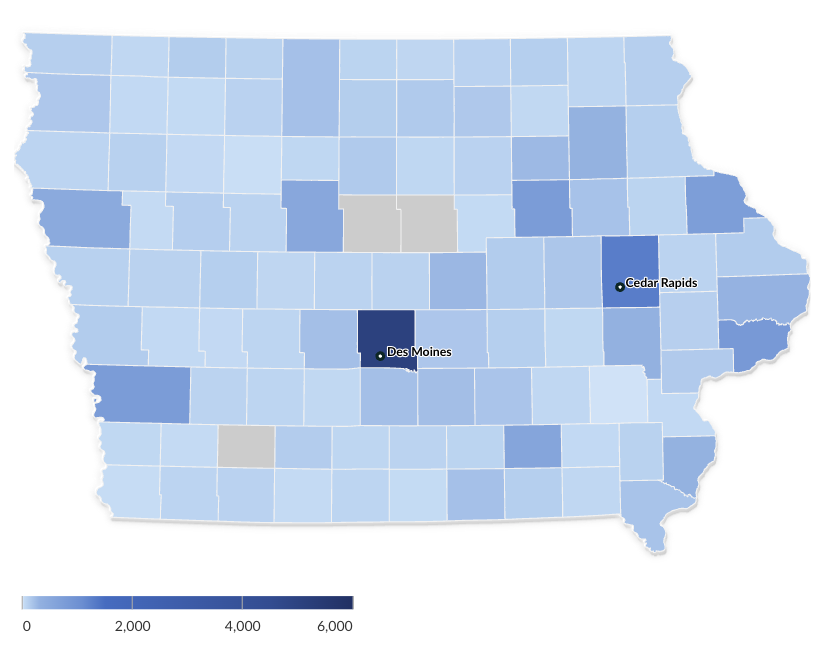
More than one-fourth of all residential land contracts were concentrated in one Iowa county. Iowa’s most populous county, Polk—where Des Moines is located—registered more than one-fourth of all residential land contracts recorded between 2005 and 2024 (5,091). Linn County in eastern Iowa (home to Cedar Rapids) had the next highest total, with 1,282 registered land contracts in that period, followed by Scott County, which is home to Davenport (834 recorded land contracts).
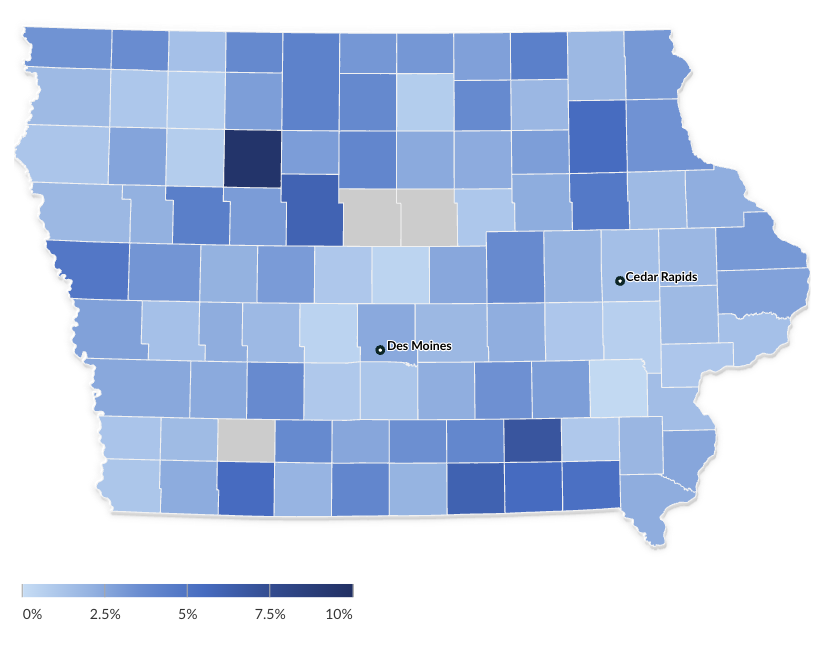
Although Polk County registered the most residential land contracts, they were used in a larger share of home sales in Iowa’s rural, less-populated areas. (See Figure 3.) From 2005 to 2024, land contracts were used in 9.6% of all home sales in Pocahontas County, which has around 7,000 residents, and 6.9% of all home sales in Wapello County, which has about 35,000 residents. By contrast, in Polk County only 2.4% of all home sales used land contracts from 2005 to 2024. Overall, 41% of all residential land contracts were used to purchase a home in a rural area.
Land contracts were primarily used to purchase low-cost homes. The median sale price of a home purchased between 2005 and 2024 using a land contract in Iowa was about $131,000 (inflation-adjusted to 2024 dollars), much lower than the $225,000 median sale price of all single-family homes sold in Iowa over the same period. Previous Pew research has shown that potential homebuyers throughout the country often face challenges obtaining a mortgage for homes priced below $150,000. When smaller mortgages are unavailable, some homebuyers opt for alternative financing methods, such as land contracts, to fund their purchase.
Most land contracts in Iowa involved individual buyers and sellers. In the vast majority of land contracts recorded in Iowa from 2005 to 2024 (88%), the buyer was an individual, rather than a business or corporation. Roughly one-third of sellers (34%) were corporate entities.
Land contracts were often used to finance smaller, older homes. The median year of construction for a home purchased with a land contract in Iowa during the study period was 1930—36 years older than the statewide median for all homes sold (1966). The median size of a home purchased with a land contract was 1,388 square feet, compared with a median of 1,553 square feet for all homes sold in Iowa from 2005 to 2024.
Land contracts were more expensive than mortgages. Land contracts had a median interest rate of 6.9% from 2005 to 2024, compared with a median interest rate of 4.6% for mortgages. However, land contract down payments were smaller: 5% of the total sales price, compared with a median of 12.6% for mortgage-financed home sales. For some land contract buyers, the smaller down payment is part of the appeal.
Facts about Iowa’s land contract laws
Iowa law requires certain disclosures in some land contracts, but the state does not have a single, comprehensive law that fully addresses the risks and complexities of land contracts.
Some—but not all—land contract sellers must disclose information about the property before a land contract is signed. Under Iowa law, certain sellers must provide buyers with a series of written disclosures before entering into a land installment contract. These disclosures include the current assessed value of the real estate, a complete description of property taxes due and unpaid (including whether taxes are delinquent or if a tax sale lien for unpaid taxes has been issued), and a full accounting of any mortgages or liens encumbering the real estate.
In addition, certain sellers must provide a complete amortization schedule of payments, details about any required balloon payment, and the annual interest rate. Sellers are also required to tell the buyer if the contract contains a forfeiture clause, which details the conditions under which the seller would be able to reclaim the property without a foreclosure process (typically, when the buyer misses some number of payments). If a seller does not provide these required disclosures within one year of executing the contract, the buyer may have the right to file a court case to cancel the agreement.
However, these disclosure requirements apply only to sellers who have entered into four or more residential real estate contracts in the previous 365 days. In 2024, this applied to only 1.7% of all sellers and 15% of all residential contracts. As a result, most land contract buyers in 2024 were not protected by these provisions.
Sellers must give buyers notice before attempting to take back a property. Sellers must provide buyers with 30 days’ notice when seeking forfeiture, the legal process by which a land contract seller voids a land contract and reclaims the property.
Land contract sellers must record all contracts with the county in which the property is located. All land contract sellers are required to record the contract within 90 days of signing, with the risk of paying a $100 daily fine. Sellers may not pursue a forfeiture until a contract is recorded.
Buyers are usually responsible for assuring that a property is habitable. Unless otherwise specified in the contract, land contract buyers bear the responsibility of making sure that the property meets general habitability requirements. This situation is different from a rental agreement, which usually makes landlords responsible for such requirements.
Encumbrances. Iowa does not bar land contract sellers from having preexisting liens on the property. Homebuyers are therefore exposed to the risk that the seller could default on a loan backed by the property.
Endnotes
- Adam Staveski, Linlin Liang, and Tara Roche, “Land Contracts Pose 5 Major Risks for Homebuyers,” The Pew Charitable Trusts, 2024, https://www.pewtrusts.org/en/research-and-analysis/issue-briefs/2024/07/land-contracts-pose-5-major-risks-for-homebuyers.
People


