New Reports Provide Resources for States to Tackle Deferred Maintenance of Public Infrastructure
Pew-supported research offers practical steps to help states measure and manage backlog of maintenance and repair
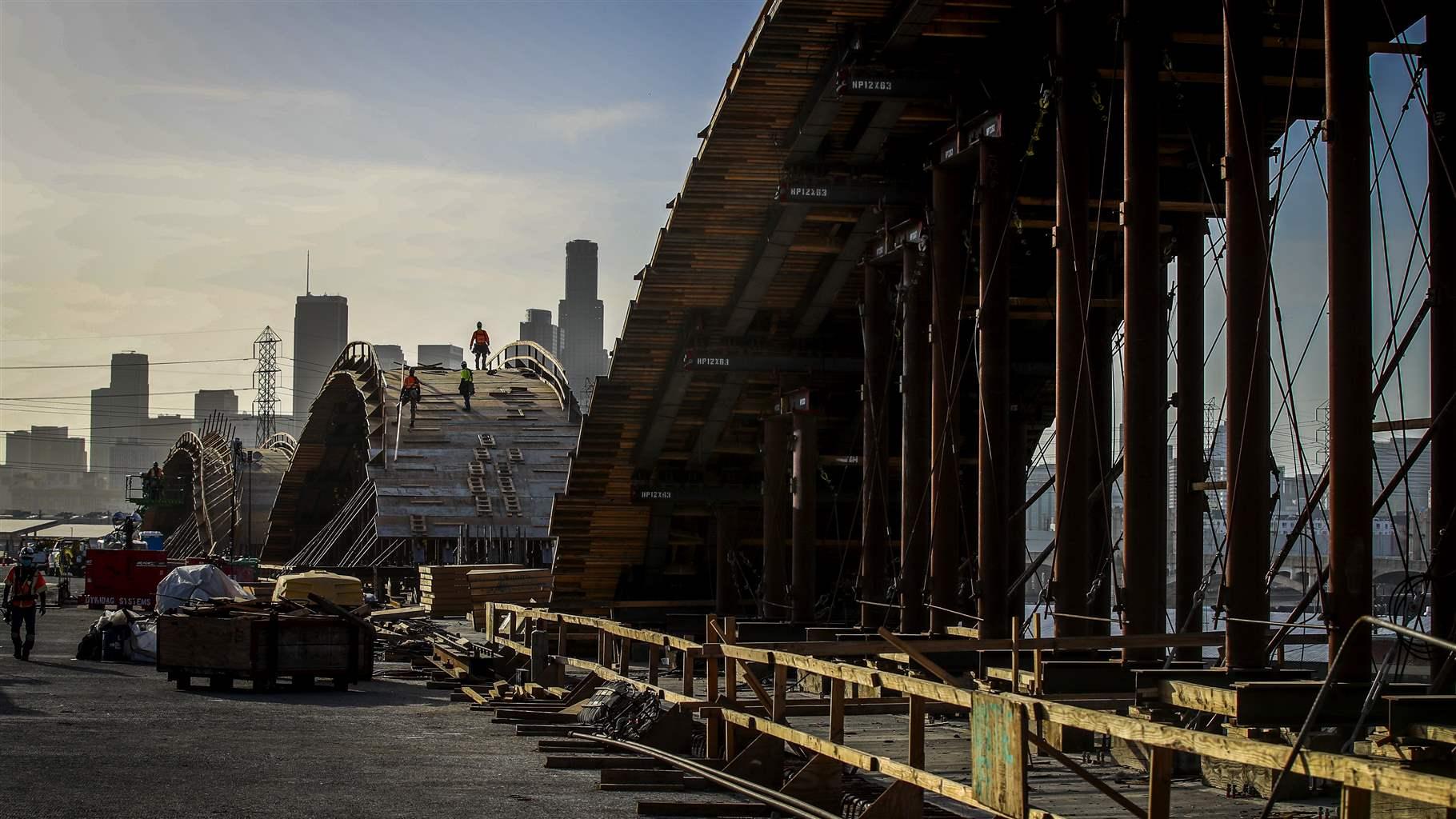
Deferred maintenance of the nation’s vast public infrastructure—the roads, bridges, drinking water systems, sewers, government buildings, and other publicly owned assets that Americans rely on every day—represents an enormous fiscal burden for every level of government. Research estimates the accumulated cost of deferred maintenance in the U.S. at $1 trillion. And the burden is growing: A recent report from The Pew Charitable Trusts estimated the states’ combined annual shortfall for road and bridge maintenance to be at least $8.6 billion.
But the true costs of deferred maintenance—the accumulated gap between what should have been invested to preserve, maintain, and repair public infrastructure and what was actually spent—are difficult to determine because most states don’t consistently define, measure, or report deferred maintenance in their budgets or capital planning documents. And without clear data, policymakers lack the necessary information to understand how current policies might fall short, allocate resources effectively, and mitigate long-term or unexpected costs.
To help policymakers better understand and address these challenges, Pew provided support for The Volcker Alliance, a nonprofit, nonpartisan research organization, to examine how all 50 states plan and budget for deferred maintenance of infrastructure. The Volcker team partnered with researchers at the University of Minnesota’s Hubert H. Humphrey School of Public Affairs. Together they reviewed capital budgeting documents and centralized capital improvement plans (CIPs) from all the states, performed case studies of 10 states, and developed a resource guide of promising approaches to help policymakers measure deferred maintenance. Volcker published this research in October 2025 as a series called “Meeting the Trillion-Dollar Challenge.”
Volcker’s analysis found that while many states acknowledge deferred maintenance for at least some types of infrastructure, only a handful provide comprehensive or consistent data. The studies together highlight three areas in which states can improve and help policymakers make more data-driven, evidence-based decisions:
1) Measure the deferred maintenance gap.
2) Develop a plan for shrinking the gap.
3) Report regularly on progress.
Many states acknowledge deferred maintenance, but few disclose the full costs
Researchers found references to deferred maintenance of public infrastructure in 30 states’ capital budgeting documents and in the centralized capital improvement plans of 14 states (with some states mentioning deferred maintenance in both). Most references related to educational facilities such as schools and universities. Other important categories, such as transportation, were disclosed less frequently, since this type of infrastructure generally has a separate budget and dedicated revenue streams, such as gas taxes and tolls.
However, few states provided actual totals for the costs of their deferred maintenance needs. Only six disclosed a total estimated cost of deferred maintenance across multiple asset classes in their capital budget or centralized CIP, and just three identified sources of funding to address deferred maintenance. And four disclosed accumulated amounts over time: Illinois and Minnesota in their budgets, and Arizona and California in centralized CIPs.
California stands out for reporting an accumulated $84 billion in deferred maintenance needs in its 2022 five-year plan, most of it ($61 billion) attributable to the Department of Transportation. The University of California ($7.3 billion), the judicial branch ($5 billion), and the Department of Water Resources ($5 billion) also showed large deferred maintenance costs.
Arizona has tracked deferred maintenance for most state-owned buildings for more than three decades, publishing annual cost estimates since at least 1989. In fiscal year 2026, the Arizona Department of Administration disclosed $863 million of accumulated “deferred costs” for the state’s buildings.
Although many states recognize and acknowledge deferred maintenance, reporting is inconsistent and often incomplete. Without comprehensive reporting, policymakers are left with an incomplete picture of infrastructure needs, which often results in short-term decisions that leave deferred maintenance backlogs to grow larger and more expensive.
States that track deferred maintenance needs share common approaches
Researchers also took a closer look at 10 states that have attempted to assess deferred maintenance statewide: Alaska, California, Hawaii, Idaho, Illinois, Massachusetts, Montana, Oklahoma, Pennsylvania, and Tennessee. Researchers found several shared practices, including:
- These states have a clear definition of deferred maintenance. They specify when maintenance is considered to be deferred, what infrastructure assets or categories should be included in assessments, and which entities within the state are responsible for gathering and maintaining information about each category of assets.
- A process for the assessment of deferred maintenance costs is defined in law or policy. Legislative statutes or executive policies usually guide how agencies are to collect data and submit reports.
- States have systems for prioritizing deferred maintenance needs. Metrics such as a Facility Condition Index help states track the physical condition of their infrastructure and estimate the cost of deferred maintenance. Some states use statewide ranking frameworks to help guide the investment of limited state funds.
- Preventative maintenance strategies are common among this cohort of states. Several states emphasized the importance of addressing issues early by including preventative maintenance costs in their operating budgets to avoid higher costs later. Still, better coordination with the state’s capital planning processes is needed to be sure that these strategies also reduce long-term maintenance backlogs.
States differ in how they provide money to pay for deferred maintenance. Some use general funds; others rely on bonds. A few have special revenue funds. Actual appropriations, however, have often covered only a fraction of identified needs. For instance, as of 2023, Alaska reported $2.1 billion in deferred maintenance of the state’s infrastructure. But annual appropriations—which on average covered about 1.5% of the state’s total deferred maintenance needs in fiscal years 2015-23—addressed only a small portion of that backlog.
States that use consistent definitions, assessment processes, and prioritization criteria are in a better position to manage deferred maintenance systematically and avoid costly surprises in the long term.
Table 1
How 10 States Approach Deferred Maintenance
Definitions, enabling policy, delegation of responsibility, prioritization, and funding are keys to management of deferred maintenance
| State | Where deferred maintenance is defined | Enabling policy for reporting | Lead reporting agency or entity | Is inventory publicly available? | Statewide prioritization process | Funding sources |
|---|---|---|---|---|---|---|
|
Alaska |
Legislative Fiscal Division; Office of Management and Budget |
House Bill 364 |
Office of Management and Budget
Department of Transportation and Public Facilities |
No |
Yes |
Capital Budget Funds; General Fund |
|
California |
Legislative Analyst’s Office; |
None (but reported in Infrastructure Plan) |
None |
No |
No |
Capital Budget Funds; General Fund; Bond Financing |
|
Hawaii |
Act 150 (SB 254—June 26, 2015) |
Act 150 (SB 254) |
Department of Budget and Finance |
No |
No |
None specified |
|
Idaho |
Capital Assets Deferred Maintenance Liability Report |
Executive order 2021-10 |
Department of Administration Division of Public Works, in collaboration with the Permanent Building Fund Advisory Council |
No |
Yes |
Capital Budget Funds |
|
Illinois |
Capital Budget |
None (but reported in capital budget) |
None |
No |
No |
Capital Budget Funds; Bond Financing |
|
Massachusetts |
No definition |
General law, chapter 7C, sec. 9 |
Division of Capital Asset Management and Maintenance |
No |
Yes |
Bond Financing |
|
Montana |
Statewide Facility Inventory & Condition Assessment Report |
SB 43 |
Department of Administration |
Yes |
No |
Capital Budget Funds |
|
Oklahoma |
Capital Planning and Assets Management Report; Office of Management and Enterprise Services website |
Capital Improvement Planning Act, title 62, sec. 901 |
Long-Range Capital Planning Commission |
Yes |
Yes |
Capital Budget Funds; Bond Financing |
|
Pennsylvania |
No definition |
Title 8 § 1309 |
None |
No |
No |
None specified |
|
Tennessee |
Infrastructure Needs Report |
Code §4-10-109 |
Tennessee Advisory Commission on Intergovernmental Relations |
Yes* |
No |
None specified |
* Tennessee’s publicly available inventory summarizes state and local infrastructure needs but currently does not report deferred maintenance.
Sources: The Volcker Alliance, “Meeting the Trillion-Dollar Challenge: Case Studies” (2025) and “Meeting the Trillion-Dollar Challenge: Took Kit” (2025)
Promising practices can help states build stronger systems
Drawing on lessons from the team’s 50-state scan and 10 case studies, researchers from the Humphrey School and The Volcker Alliance developed a number of recommendations for policymakers. The recommendations fall into three categories:
1) Design a process to track deferred maintenance. States should adopt clear definitions, decide which assets to track, set thresholds for reporting, and establish roles for agencies. Policies should also specify where deferred maintenance is reported, such as in budget documents or multiyear capital improvement plans.
2) Implement systematic tracking. States should build or expand asset inventories of public infrastructure that capture key details such as age, location, and physical condition. By tracking the physical condition of state assets, assessing how critical each piece of infrastructure is to the state’s systems, and accounting for vulnerability to climate effects and natural disasters, states can develop transparent prioritization frameworks that help determine which deferred maintenance projects should be tackled first. Montana, Oklahoma, and Tennessee already publish statewide inventories of some infrastructure assets for public use. Alaska, Idaho, Massachusetts, and Oklahoma disclose their approaches to prioritization.
3) Report results consistently to track progress. States should report deferred maintenance totals in a consolidated section of budget documents, with agency-level details, and publish how much funding was appropriated each year. Alaska and California provide useful models, reporting both accumulated needs and annual appropriations in their budget and planning documents.
These recommendations can help states move from fragmented and incomplete data toward a clear, systematic approach that improves accountability and planning.
Why tackling deferred maintenance matters
Deferred maintenance of public infrastructure is not just a fiscal issue. It directly affects the safety and reliability of essential systems that Americans rely on every day. Without proper maintenance, roads become unsafe, bridges collapse, and sewer systems fail.
The Volcker Alliance’s research demonstrates how states can make meaningful progress in shrinking the nation’s $1 trillion infrastructure maintenance gap. With clearer definitions, stronger planning, and transparent reporting, policymakers can take concrete steps to decrease the backlog of overdue repairs and help protect their public infrastructure for years to come.
Fatima Yousofi is a senior officer and Andrea Wales is a principal associate on Pew’s state fiscal policy project.
People