Breaking the Plastic Wave 2025
An Assessment of the Global System and Strategies for Transformative Change
Editor’s note: This page was updated on Feb. 6, 2026, to correct the modelled years of healthy life lost from open burning and to fix other minor errors and typos.
Preface
In 2020, The Pew Charitable Trusts and Systemiq published a groundbreaking report, “Breaking the Plastic Wave,” amid significant data gaps on plastic pollution, substantial debate over the scale of the plastic pollution problem and various proposals to meet the challenge. With that report, Pew and our partners sought to move the global discourse forward by identifying a credible roadmap for addressing the problem using existing solutions.

Thanks to countless scientists, academics, organizations and others in the five years since “Breaking the Plastic Wave” was released, the available data and the world’s understanding of how plastic affects people and the planet are vastly improved. In particular, researchers are paying more attention to the serious potential risks that plastic poses for human health and to its significant contributions to global greenhouse gas emissions. And this wealth of information has fueled a significant increase in efforts and policies to reduce plastic pollution around the world. However, global efforts to address these and other risks of plastic and plastic pollution have not been enough, and the scale of the challenge remains significant.
In this update, “Breaking the Plastic Wave 2025,” we draw on this improved information landscape to provide a deeper understanding of the environmental, economic, health and social impacts of plastic. We also explore the global plastic system’s influence on efforts to address some of the world’s greatest challenges. Our aim is to support and encourage decision makers as they respond to critical global issues, evaluate trade-offs and implement solutions. We hope this work will help them seize the opportunities that tackling plastic pollution offers and provide impetus for urgent and ambitious action.
The first “Breaking the Plastic Wave” invigorated and empowered conversations around preventing plastic pollution, and the companion paper published in the journal Science has been cited in subsequent research more than 1,000 times.1 Just as crucial, the report spurred policy and business decisions to tackle this global problem.
Pew also has taken significant steps to ensure that the report’s findings translated into action. Over the past five years, Pew has worked within the European Union to tackle microplastic pollution from tyres and plastic pellets; with negotiators seeking to develop an international, legally binding instrument on plastic pollution, commonly referred to as the U.N. plastics treaty; with the World Trade Organization on efforts to end plastic pollution; and with stakeholders in India, South Africa, the United States and Zambia to analyse plastic waste flows and assess various policy options. We hope that these efforts will not only make a meaningful difference to people and the environment, but also serve as a blueprint for other initiatives to tackle plastic pollution.
In addition, Pew convened Minderoo Foundation, the Ellen MacArthur Foundation and World Wildlife Fund to support CDP, a nonprofit that runs the world’s only independent environmental disclosure system, in developing the Scaling Plastics Disclosure initiative, which empowers companies to disclose their plastic-related activities and provides comprehensive and comparable data to decision makers across the global economy. In the initiative’s first year, almost 3,000 companies embraced reporting on plastic through CDP, and in year two, that number nearly doubled to over 5,500.2
Further, Pew is embarking on new work aimed at reducing Americans’ exposure to harmful endocrine-disrupting chemicals, which are known to interfere with human hormone systems. Many of these chemicals are found in plastic products, and a growing body of evidence links their effects with infertility, cancer, diabetes and other health issues. Pew’s initiative focuses on effectively distilling and communicating the science around these chemicals and developing, securing and helping to implement public policies and market actions to better protect human health.3
With the health of people and the planet as our guiding concern, Pew and ICF undertook the research for this new report, in collaboration with the Ellen MacArthur Foundation, Imperial College London, Systemiq and the University of Oxford, drawing on major publications, analyses and reports. A 21-member expert panel and an advisory committee consisting of panel members from the first report and others brought diverse opinions and experiences, with backgrounds including plastic policy, human health, community impacts, microplastics and business.
The results are stark. The global plastic system puts people worldwide at risk, with the most vulnerable bearing the brunt of the impacts. Without action, by 2040, the amount of plastic polluting the environment will more than double; plastic-related greenhouse gas emissions will undermine global efforts to stem planetary warming; and plastic production and waste will threaten the health of growing numbers of people around the world.
However, hope remains. The global community can remake the plastic system and solve the plastic pollution problem in a generation, but decision makers will need to prioritize people and the planet. The path forward will not be easy. Achieving these ambitious goals will require leveraging existing solutions, innovative technologies and collaborations among business, workers and government to deliver transformative shifts in the ways products are manufactured, chemicals are developed and people receive, use and dispose of their products. But the challenges of this effort are far outweighed by its promise – of healthier people, a cleaner environment and a more sustainable global economy.
Tom Dillon
Senior Vice President, Environment and Cross-Cutting Initiatives
The Pew Charitable Trusts
Executive summary
In 2020, amid rising concerns over the scale and impacts of plastic pollution, The Pew Charitable Trusts, Systemiq and their partners published “Breaking the Plastic Wave” (BPW1), which found that the amount of plastic that would enter the ocean each year from municipal solid waste would nearly triple by 2040, increasing from 11 million metric tons (Mt) in 2016 to 29 Mt, unless the global community undertook the ambitious actions identified in the report.
Despite that urgent call, progress towards that study’s vision of coordinated measures across the entire plastic system to reduce pollution has yet to be realized, and in the intervening five years, 570 Mt of plastic pollution has entered the land, air and water worldwide.
To help illuminate the consequences and implications of that slow progress, we conducted a new, more comprehensive analysis of plastic pollution in Earth’s waters, land and air. (All figures in this report are rounded to two significant digits, and any apparent inconsistency is the result of this rounding. For complete data see the technical appendix.)
This resulting report is an update to and expansion of BPW1 that builds on the better data that has become available over the past five years to examine all major sectors of the global plastic system. For more information on data advancements, see Appendix D.
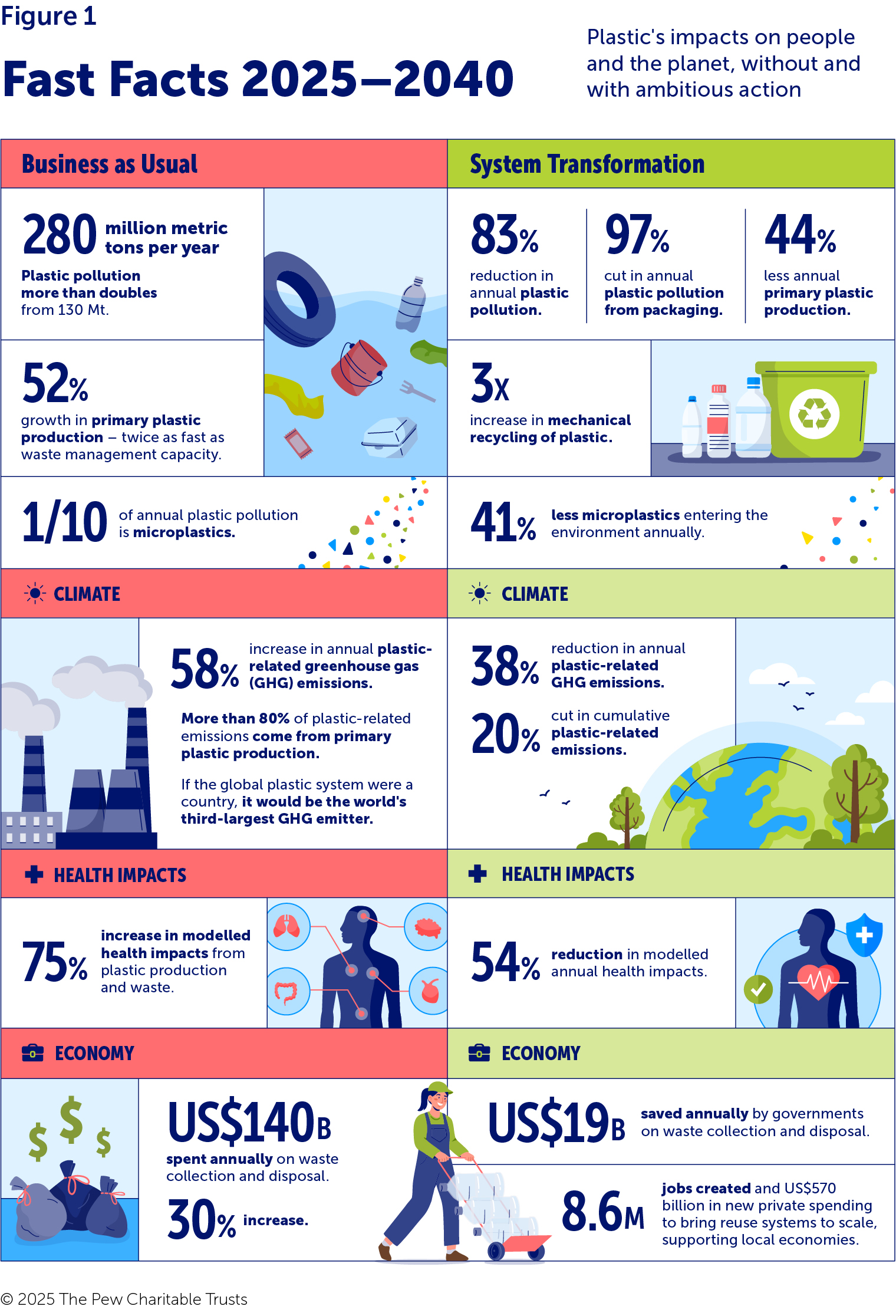
Our analysis also finds that plastic is interconnected with other global challenges, and that solving the plastic pollution problem will have broad implications for improving the health of people, the planet and the global economy. (See Figure 1.) With the added urgency created by five more years of growing plastic pollution, we renew and amplify the call for ambitious action and transformative strategies to address not only plastic pollution but also the far-reaching consequences of the plastic system.
Our assessment of the global plastic problem yielded the following nine key findings:
1. Plastic pollution will more than double over 15 years. As of 2025, 130 Mt of plastic pollutes the environment – land, air and water – each year. Without ambitious global action, that figure will rise to 280 Mt by 2040 – equivalent to dumping nearly a garbage truck worth of plastic waste every second. This increase will be primarily driven by rapidly growing production and use of plastic – particularly in packaging and textiles – that will further overwhelm already inadequate waste management systems.
2. Growth in plastic production will outpace waste management capacity. Absent urgent international efforts, annual primary plastic production will rise 52% from 450 Mt in 2025 to 680 Mt in 2040, growing twice as fast as waste management, which, even with considerable investment, will expand by only 26%. By 2040, annual costs to collect and dispose of plastic would increase by 30% to US$140 billion, requiring additional public funds and posing a financial risk to businesses. Despite this increased spending, the share of plastic waste that is uncollected will nearly double by 2040 from 19% to 34%.
3. Plastic can harm human health at every stage of its life cycle. Barring robust global action, health impacts from plastic production, waste and pollution, before accounting for use, will increase by 75% over the next 15 years, primarily because of new polymer production and open burning, with the most vulnerable communities bearing the brunt.4 A growing number of studies have linked plastic pollution and chemicals used in plastic products to health problems, including cancer, cardiovascular disease, asthma, decreased fertility and cognitive and developmental issues.5 Research has conservatively estimated the annual costs of health effects from plastic chemicals alone to be as high as US$1.5 trillion globally.6 That figure will only grow as plastic production, use and pollution increase, and as understanding of the health impacts expands.
Because of data gaps, we did not include the health impacts of plastic use or microplastics in our analysis, but those effects are likely to be significant, as are the potential human health benefits of reducing plastic use.7 To date, more than a quarter of the more than 16,000 chemicals used in plastic products have been identified as possible sources of harm to human health.8 Among the topics of growing concern are endocrine-disrupting chemicals – which affect the hormones that regulate human health and are widely used in food packaging, cookware, toys and cosmetics – and microplastics, which are increasingly being found throughout people’s bodies and have been linked to potential risks to digestive, reproductive and cognitive function.9
4. Greenhouse gas emissions will surge. Unless the plastic system is transformed, by 2040, annual greenhouse gas (GHG) emissions from the global plastic system will increase by 58% to 4.2 gigatons of carbon dioxide equivalents (GtCO2e) – a metric used to standardize the measurement of emissions of different GHGs – equivalent to the emissions from one billion gasoline-powered cars.10 Achieving the commitments made by the global community under the Paris Agreement – the legally binding international treaty adopted in 2015, which pledges to keep global temperature rise below 2°C and ideally under 1.5°C – will require rapid declines in annual emissions, especially from plastic production, which accounts for 86% of plastic-associated emissions in 2025.11
5. Ambitious global action can dramatically reduce pollution. Our “System Transformation” scenario reflects ambitious, complementary actions using existing solutions across the plastic system to cut production and use and improve waste management, which together could reduce annual plastic pollution by 83% by 2040. The myriad benefits of this scenario include lower GHG emissions, reduced harm to human health, as well as more efficient use of public funds and the creation of new business markets and opportunities. This report shows that an integrated approach to plastic that touches all the modelled economic sectors is crucial, with actions needed before, during and after plastic product use. (See Figure 2.)

A key finding from this scenario is the importance of reducing production levels of “primary plastic” – plastic made from raw materials for the first time – to decrease plastic pollution and the impacts of production on human health and climate. The recommended actions could cut annual production of new plastic by 44% by 2040, compared with current projections, achieving a 14% reduction from 2025 levels, all while maintaining the same level of service for consumers and businesses. Reaching these reductions could also unlock new opportunities for sustainable solutions, a market already valued in the trillions of dollars.12
Although implementing and rapidly scaling policies across the plastic life cycle worldwide will require unprecedented global collaboration and commitment, doing so would have substantial benefits, including a 38% reduction in annual GHG emissions from plastic, a 54% reduction in modelled annual health impacts, and a US$19 billion decrease in yearly government spending on plastic collection and disposal by 2040.
6. Packaging pollution can be virtually eliminated. Pollution from plastic packaging, the largest source of plastic waste, can be nearly eradicated by 2040, decreasing 97% from 66 Mt under BAU to less than 1.7 Mt by 2040. System Transformation could reduce primary plastic production for packaging by 76% compared with BAU and by 66% relative to 2025. Reuse accounts for two-thirds of the total decrease by 2040, demonstrating the central role that reuse will play in transforming how products are delivered and used.
In particular, the scale of reuse required for these reductions will entail shifting nearly US$570 billion in annual private sector spending away from single-use and towards reuse, which highlights the many new economic opportunities that System Transformation presents, especially for early adopters and innovators. These investments would also support other substantial benefits, including 48% lower GHG emissions from packaging production and hundreds of thousands of new jobs.
7. Solving microplastic pollution will require innovative solutions. Microplastics make up 13% of global plastic pollution in 2025, with the largest sources being tyre wear and paint (10 Mt each), agriculture (3 Mt) and recycling (2 Mt). Under BAU, microplastic pollution will grow from 17 to 26 Mt annually by 2040. In high-income economies, microplastic pollution will make up 79% of overall plastic pollution by 2040.
By contrast, under System Transformation, the annual flow of microplastics entering the environment could be cut by 41% by 2040 through a suite of actions to reduce production and use, improve product design and scale solutions for capture and treatment of microplastics. Although these targeted policy actions can achieve meaningful reductions in microplastic pollution, more than half of it remains unaddressed. This limitation highlights the need for other innovative solutions to deliver more substantial decreases in microplastic pollution.
8. System Transformation offers opportunities for workers and communities. Reimagining the plastic system would support 8.6 million additional jobs and create new business opportunities. But in the near term, it would also have consequences for millions of people worldwide whose livelihoods will require dedicated attention as the new plastic economy takes shape. Effective policies to tackle plastic pollution can create jobs, help alleviate poverty and safeguard the well-being of the world’s most vulnerable people.
More than three-quarters of all plastic that is recycled globally is collected and sorted by waste pickers, most of whom are from marginalized parts of society.13 Our analysis shows that waste pickers could make up nearly two-thirds of the plastic workforce by 2040. Despite providing an important service, these workers are not paid fairly or properly recognized for their contributions and are often exposed to hazardous conditions.14 Participatory approaches to waste management and governance that provide waste pickers with safe working conditions and economic opportunities and fully integrate them into broader waste management improvement strategies will be key to ensuring that the plastic system’s transition is equitable and aligned with efforts to address global poverty.
Furthermore, a shift away from linear economic models, based on production, use and disposal, and towards circular models that prioritize reusable and repairable products will shift the landscape of jobs across the plastic system. Under System Transformation, production accounts for 19% of plastic sector jobs by 2040, down from 30% under BAU, recycling jobs increase by 39% from 2025 to 2040 and expanded reuse systems create nearly 620,000 new jobs by 2040. Additional opportunities may also arise from thoughtful integration of waste pickers – who already play a substantial role in the recycling economy – as part of future waste management and reuse systems. Applying waste pickers’ knowledge and expertise could facilitate a successful and socially responsible transition.
9. Delay is costly. Waiting just five years to initiate System Transformation would result in 1,100 Mt more primary plastic being produced, 540 Mt more plastic entering the environment and 5.3 GtCO2e more GHG emissions between 2025 and 2040. A five-year delay would increase governments’ annual costs for plastic collection and disposal by an estimated 23% annually (US$27 billion) and add US$6.1 billion in annual capital expenditures by 2040 for open-loop mechanical recycling and incineration capacity for plastic alone. But these technologies also would be at growing risk of obsolescence as the economy becomes more circular. So this same five-year delay could lead to overinvestment in solutions that do not align with the future plastic system and, in turn, sizeable financial losses for companies and inefficient use of the limited public funding available for addressing the global plastic problem.
Opportunities for policymakers, researchers and businesses
The global community can make significant strides towards eradicating plastic pollution by 2040, despite the slow progress to date, by using existing solutions to transform the global plastic system, making ongoing investments in innovation and adopting a renewed sense of urgency. Although this is a sizeable challenge, the opportunities are substantial. Transforming the global plastic system will provide workers with better jobs and working conditions and build the business models of the future – ones that are built on sustainability and fostering innovation to provide better-designed materials and products.
This amount of system-level change will require coordinated action by policymakers, businesses and researchers to tackle the foundational challenges that hinder progress – rebalancing manufacturing, design, governance and consumer decisions to prioritize people and the environment. This report outlines four strategic pillars with associated opportunities for government, the research community and business to achieve this lofty goal:
1. Establish measures to reduce plastic production and use.
- Implement policy measures to ensure that market prices reflect the true costs of plastic and other materials.
- Complement pricing measures with targeted policies to reduce plastic production and use to sustainable levels, such as eliminating subsidies, enacting reduction targets and restricting new production facilities.
- Phase out low-utility, avoidable plastic through bans, product design standards and voluntary corporate actions to reform supply chains.
2. Rethink chemical, plastic product and system design.
- Adopt pre-market policies that assess the safety of chemical additives used in plastic, to safeguard human health and the environment.
- Establish and enforce a list of comparatively safer chemicals to promote material innovation and product safety.
- Implement policies that support the shift from single-use to reusable products, such as targets, standards, investment in shared infrastructure and financial incentives for consumers and businesses.
- Establish consistent product design requirements and standards for safe reuse and recycling and to reduce microplastic emissions.
- Simplify polymers and polymer compositions, such as by restricting problematic polymers – those that are difficult to recycle or pose health risks.
- Adopt measures to reduce microplastic shedding across key sectors, including plastic production, recycling, agriculture, marine, textile, transport and construction.
- Promote innovation in sustainable materials development, promising recycling technologies and reusable products.
- Establish public-private partnerships and provide incentives for open and transparent collaborations across industries to accelerate development of innovative solutions.
3. Expand participatory waste management systems.
- Implement policies to scale waste collection, including collection and recycling targets, deposit return schemes, design and labelling standards and, where appropriate, increased separate collection.
- Expand environmentally sound waste management systems by integrating waste pickers and other informal workers into waste management planning and extended producer responsibility (EPR) schemes to finance waste collection and management.
- Incorporate informal workers into census protocols to improve understanding of their contributions to existing waste management and improve long-term strategies.
- Develop targeted funding for groups that lack access to traditional financing to create cooperatives, offer training opportunities and support participation in governance.
- Establish enhanced filtration at recycling and wastewater facilities to minimize microplastic leakage to the environment and identify long-term, safe disposal options for contaminated waste sludge.
4. Unlock transparency of the plastic supply chain and its impacts.
- Invest in research into and monitoring of the impacts of the global plastic system, particularly on human health.
- Develop targeted research into impacts of exposure to plastic on vulnerable populations, including communities adjacent to production and waste management facilities, waste pickers and workers across the plastic supply chain.
- Disclose data on plastic-related commerce, impacts, risks and opportunities through reporting platforms, such as CDP.
- Establish a global chemical reporting and disclosure framework to help improve supply chain transparency, evaluate chemical risks and assess progress towards global targets.
- Increase interdisciplinary research and monitoring to provide a fuller picture of the extent of the plastic system’s environmental and health impacts.
Urgent action is needed to transform the global plastic system and curb the worst effects of plastic pollution on the environment and human health, and to ensure efficient use of financial resources. A coordinated, ambitious effort by the global community can substantially reduce plastic pollution overall and virtually eliminate pollution from plastic packaging in the next 15 years, while reducing costs, supporting millions of jobs and bolstering efforts to protect human health, address climate change and alleviate poverty.
Introduction
In 2020, humanity crossed an ominous tipping point: For the first time, the total mass of all human-made objects – totalling 1.2 trillion metric tons – surpassed the total biomass of all living things on Earth.15 And humanity only made the vast majority of all that human-made mass, including all of the billions of tons of plastic, in the past 100 years. Although plastic is still a relatively novel material – having only existed for about 80 years – it has become ubiquitous, with production growing from 2 Mt in 1950 to nearly 500 Mt in 2025.16
Among human-made materials, plastic’s low cost, light weight, durability and other attractive properties have led to its proliferation across every sector of the world economy.17 Plastic is credited with enabling expansion of people’s access to clean drinking water, medical supplies and cost-effective food, and with substantial improvements in automobile fuel efficiency, renewable energy technologies and reduced GHG emissions through reduced product weights across many sectors.18
Yet the same qualities that have delivered plastic’s many benefits have also led to pollution on an unprecedented scale. The elimination of plastic pollution is an era-defining global challenge.
How is plastic connected to other global challenges?
Despite the promise of greater sustainability, the world's predominately linear "take-make-waste" economy and the low cost of plastic have stymied progress towards more thoughtful design and a circular “reuse, repair and recycle” economic system of products and materials.19 Efforts to achieve sustainability must extend beyond simply more efficient use and recycling of materials or more circular business models to reduce overall plastic production; business demand for plastic; and the impacts of plastic and its associated chemicals on biodiversity, climate change, human health and the world economy.20 (See Figure 3.)
In recognition of plastic’s wide-ranging implications for people and the planet, this report builds on the model and analyses developed in BPW1, provides a first-of-its-kind scenario-based analysis of the human health effects of plastic at a global scale and offers some of the first estimates for microplastic generation from agriculture and paint. With these more expansive analyses, we aim to deepen the evidence base for decision makers across government, business, civil society and academia as they respond to the plastic problem, evaluate trade-offs and implement solutions.

Climate change
Primary plastic production accounts for more than 80% of GHG emissions from across the plastic life cycle, reflecting the high carbon generation from two key parts of the plastic production process: chemical manufacturing and fossil fuel extraction.21 This makes the plastic industry particularly challenging to decarbonize (i.e., to reduce or eliminate GHG emissions from industrial and other processes), which will be essential to meeting the ambitious global GHG emissions targets in the Paris Agreement. Should production continue to increase at current rates, annual GHG emissions from plastic would triple by 2050 from 2019 levels, accounting for nearly one-third of the global carbon budget – the total amount of GHG emissions allowable to keep long-term planetary warming within 1.5°C.22
These emissions also undermine the meaningful contributions that plastic has made to decarbonization in other areas of the global economy, particularly as a light weight and flexible material that requires less energy to transport than heavier options – and so generates fewer emissions during shipment – and has enabled important innovations in renewable energy technologies.
Human health
Research into specific health outcomes associated with human exposure to plastic is nascent and ongoing, but early findings indicate that every stage of the plastic life cycle has human health implications. Plastic products contain more than 16,000 intentionally added chemicals as well as myriad unintentionally added contaminants.23 Studies have already linked many of these chemicals to a range of health effects, such as hormone disruption, decreased fertility, low birth weights, cognitive and other developmental changes in children, diabetes and increases in cardiovascular and cancer risk factors.24
What Are Plastic Products Made Of?
Plastic is a type of organic polymer, meaning it is made up of various monomers – certain types of small molecules.25 As part of the plastic production process, manufacturers add a range of chemicals, such as solvents, catalysts or lubricants, called processing aids that facilitate reactions among the monomers and polymers. Other additives impart or enhance functions in the plastic itself, including plasticizers to improve flexibility, flame retardants for fire resistance, antioxidants to slow or prevent decay from contact with oxygen and colorants to add pigments. Non-intentionally added substances are another set of chemicals that can also be present in plastic, usually resulting from chemical by-products or breakdown or from contaminants introduced during manufacturing of the polymer or product. These additives and non-intentionally added substances can be released during the plastic life cycle, putting humans and the environment at risk.
People can be exposed to potentially harmful chemicals when plastic materials and products are produced, while using plastic products and when those products become waste and are recycled or disposed of. These dangers are especially acute for communities located near facilities that produce, manufacture, recycle and dispose of plastic, as well as for workers at those sites. These exposures can disproportionately affect women, children and underprivileged populations and have been found to increase risks of asthma, childhood leukaemia, cardiovascular disease and lung cancer.26 Despite these risks, fewer than 6% of the known plastic-associated chemicals are subject to any form of regulation globally.27
Another area of concern is the continued proliferation of microplastics in the environment and, increasingly, in human bodies.28 Early research points to potential risks to digestive systems, including cancer, and to reproductive systems.29
Social and community impacts
Transitioning away from plastic use where feasible and appropriate will require participation and buy-in from all sectors of society to understand and address the potential follow-on effects of system change. As part of these efforts, decision makers will need to consider several key segments of society to ensure that the transformation of the plastic system aligns with global endeavors to tackle broader social challenges:
“Fenceline communities” are populations situated adjacent to high-polluting industrial facilities that often bear the brunt of the health and social impacts from those operations.30 Estimates suggest that these communities house at least 50 million people worldwide, predominately from low-income and other marginalized populations.31 One study of six countries found that lung cancer risk was 19% higher in fenceline communities near petrochemical plants than in the general population.32

Waste pickers are informal workers who collect, sort and sell materials for recycling or reuse and are responsible for approximately 60% of plastic recycling globally.33 They are a key segment of the global “informal sector” that plays a critical role in managing waste and that millions of people rely on for their livelihoods.34 But despite waste pickers’ significant contributions, their role is largely unrecognized. Many face hazardous working conditions and receive low wages.35
Biodiversity
The alarming and highly visible impacts on marine life first brought the problem of plastic pollution’s effects on biodiversity into the public consciousness. And more recent research offers no less cause for concern. Plastic pollution affects almost every species group in the ocean, from turtles, seabirds and mammals to the plankton that underpin the marine food web.36 Scientists have identified a new fibrotic disease in seabirds called “plasticosis” characterized by inflammation and scar tissue in the digestive tract resulting from ingestion of plastic; other effects of ingestion can include intestinal blockage, organ damage and mortality.37
Further, although global figures for entanglements in abandoned, lost and discarded fishing gear – collectively known as “ghost gear” – are hard to come by, they are estimated at roughly 136,000 seals, sea lions and large whales killed every year.38
Concerning impacts of plastic pollution on biodiversity are also emerging on land and in freshwater environments – affecting soil, organisms, plants and even livestock, with microplastic pollution potentially affecting food crops.39 In fact, although research on plastic pollution in terrestrial ecosystems is still emerging, recent studies estimate the total stock of microplastic debris in the top metre of soil worldwide at between 1.5 and 6.6 Mt which are one and two orders of magnitude, respectively, greater than the estimated microplastic stock at the ocean surface.40
A changing policy landscape
In the five years since BPW1 was published, a clear scientific consensus has emerged that no or delayed action to combat plastic pollution would have severe consequences for people and the planet.41 The U.N. plastics treaty negotiations, initiated by U.N. Environment Assembly resolution 5/14 in 2022, could provide a pathway towards ending plastic pollution.42 But to date, negotiations are ongoing, with political differences remaining on key elements.
Meanwhile, national and regional policy initiatives have continued and even accelerated, with governments enacting at least 200 new measures from 2020 to 2023.43 Additionally, policy efforts have increasingly shifted away from a narrow focus on single-use plastic bags and towards single-use plastic broadly.44 Further, India, the Philippines, the United Kingdom, the European Union, and multiple U.S. states have enacted new EPR policies for plastic packaging.45 And, in 2024, the EU adopted its ambitious Packaging and Packaging Waste Regulation, which, among other things, requires that all packaging be recyclable by 2030; restricts certain single-use plastic, such as for pre-packed fruits and vegetables; sets goals for reusable beverage containers and refills; and limits per- and polyfluoroalkyl substances (PFAS) in packaging.46
Overall, however, policies and business actions still tend to be narrowly focused and have not adopted the full life-cycle approaches emphasized in BPW1 and other studies.47 Microplastics continue to be underrepresented in policy efforts (although new measures on tyres, pellets and textiles are being adopted and implemented in the EU), and in most cases, policies do not consistently consider the broader implications of plastic pollution on people, nature or the climate.48 The political, economic and behavioral inertia built into the existing linear economy plays a big role in stymieing the broader policy discussions that could meaningfully challenge the status quo.49
Against this backdrop of evolving but still insufficient policies at all governmental levels, this report seeks to help embed the broader impacts of plastic into decision-making and to support policymakers and businesses as they weigh plastic’s role in the economy of the future.
This project builds on the work of BPW1 – a global scenario analysis of plastic flows and pollution resulting from municipal solid waste – to incorporate new data, provide a more comprehensive analysis of the sources and impacts of plastic pollution and enable deeper evaluation of policy interventions. This report expands the scope of economic sectors, plastic types and life-cycle stages modelled, accounting for plastic production and use as well as waste management stages and end-of-life outcomes. It also assesses climate, economic and human health effects linked to the plastic life cycle and includes modelling of alternative materials, supporting evaluation of the trade-offs involved in substituting these materials for single-use plastic. For more discussion of the modelling approach, see Appendix B.
In contrast to BPW1, in this report, we define plastic pollution as the mass of macro- and microplastics that enter terrestrial and aquatic environments and the mass of macroplastics that is disposed of through “open burning” – in which plastic waste is burnt in uncontrolled fires either for heat or as waste management – resulting in air pollution.50
Modelled scenarios
For this report, we analysed two scenarios for global plastic pollution from 2025 to 2040. For more detail on data sources and assumptions, see Appendices B and C.
Business as Usual
BAU estimates annual plastic production, use, waste management and end-of-life fates in the absence of additional policy measures to reduce plastic pollution. And it assumes that waste management for macroplastics – including for collection and sorting, recycling and managed disposal – is constrained by expected limitations in capacity growth (i.e., waste management capacity increases roughly in tandem with population or per capita gross domestic product [GDP]). For microplastics, BAU assumes different rates of pollution growth by source, with the mass of microplastics from pellets, recycling, agriculture and textile production derived from the macroplastic modelling.
System Transformation
System Transformation explores the impacts of policy levers targeting macroplastic production, use and waste management. The included policies are either currently under consideration in national, regional and global contexts – including by the Intergovernmental Negotiating Committee on Plastic Pollution, the body responsible for crafting the text for a U.N. plastics treaty – or have been examined in previous studies.51
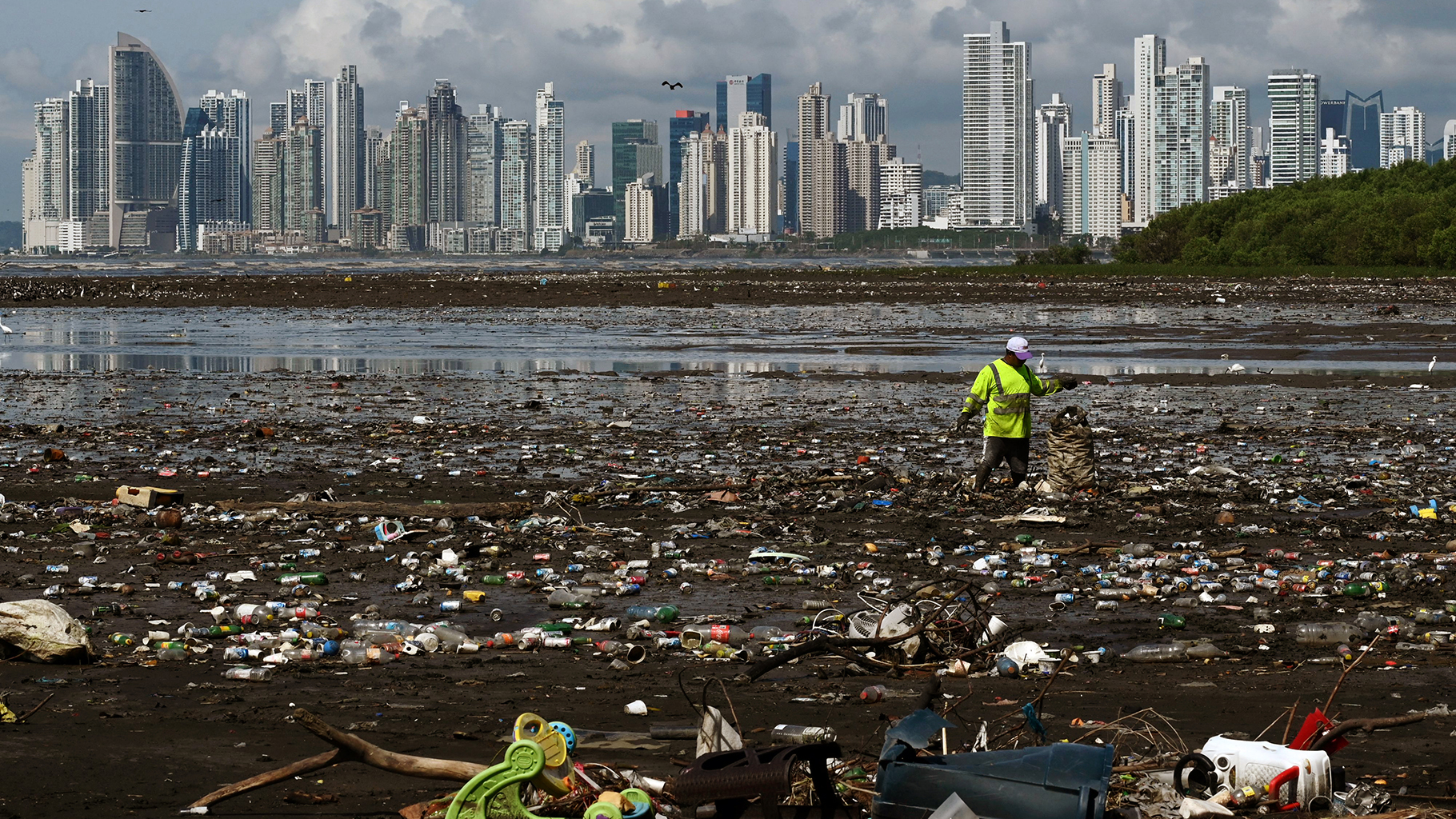
Business as Usual: An untenable trajectory
The world is not on a path towards stopping the escalating tide of plastic pollution. Without action, global plastic production will increase at rates that substantially outpace the growth of an already overburdened waste management system. This, in turn, will lead to a rapid increase in plastic pollution that will pose a growing threat to human health, biodiversity and efforts to reduce global GHG emissions; disproportionately affect marginalized communities; and exacerbate vulnerabilities for millions of people working in the informal waste management sector and living in fenceline communities.
All figures in this chapter are projections based upon our modelling, unless otherwise cited.
All plastic types
Business as Usual will cause annual plastic pollution to more than double from 2025 to 2040
Under BAU, annual plastic pollution jumps from 130 Mt per year in 2025 to 280 Mt in 2040. (See Figure 4.) This rapid growth will harm human health and livelihoods through increased levels of land, water and air pollution, exposure to toxic chemicals, and risk of disease, and lead to higher rates of ingestion and entanglement among other species, resulting in more animals suffering illness, injury and death.

Rising production and use, coupled with an overburdened waste management system, are the main causes of growth in plastic pollution
The doubling of plastic entering the environment under BAU is driven mainly by rapidly increasing production and use of plastic across all sectors worldwide as well as a widening gap between the scale of plastic waste generated and the capacity of waste management systems.
Global annual primary plastic production will rise by 52% under BAU, from 450 Mt in 2025 to 680 Mt in 2040, but waste management capacity will expand by only 26%, despite considerable investment. Upper-middle- and high-income economies account for nearly 80% of global virgin plastic production in 2025, and they will continue to dominate production in 2040. Production in lower-middle- and low-income economies, while still substantially below that in higher-income economies, will more than double between 2025 and 2040.
Primary plastic use also increases across all sectors under BAU, driven by plastic’s low cost, light weight and versatility compared with other materials. (See Figure 5.) The packaging sector uses more primary plastic than any other sector in 2025 and will continue to do so in 2040, while the textile sector will have the largest growth in plastic use as the ongoing “fast fashion” trend spurs a proliferation of low-cost, synthetic fabrics.52 Under BAU, the use of plastic in sectors such as transportation and building and construction will also rise, but more slowly.

In 2025, annual per capita plastic waste generation in high-income economies is 160 kilograms (kg), 12 times the 13 kg of low-income economies. Under BAU, waste generation remains highest in the high-income economies, but substantial increases in the per capita plastic waste generation rate are seen in all economies, regardless of income level, over the 15-year period. (See Figure 6.)

Waste management systems are already unable to keep pace with plastic waste. And in some parts of the world, waste management systems simply do not exist: An estimated 1.5 billion people live without access to waste collection services.53 Under BAU, waste infrastructure capacity will grow in line with global GDP, based on historical spending levels, reaching US$140 billion annually by 2040, but it still will not keep pace with rising plastic waste generation, widening the gap between the amounts of waste that are generated versus managed. In particular, the amount of plastic waste that is uncollected will increase sharply, nearly tripling from 2025 to 2040. (See Figure 7.) And this uncollected waste will flow into the environment as pollution or be disposed of via open burning, leading to additional air pollution.

Within the waste management system, stagnating recycling rates – the share of collected plastic waste that is sent to recycling facilities – and constrained remaining landfill capacity compound the problem. (See Figure 8.) Although local governments and businesses continue to invest in new recycling infrastructure, plastic recycling – conversion of waste into raw materials for use in new products – still is only technically and economically viable for a small subset of polymers, such as polyethylene terephthalate (PET) and high-density polyethylene (HDPE).54 Furthermore, mechanical recycling reduces the strength, flexibility and other properties of plastic with each cycle, limiting the number of possible cycles and, in some cases, requiring that new primary material be added to the recycled material to maintain the desired quality.55 Recycling alone, therefore, can only slow, but not prevent, exponential growth of primary plastic production.56
Recycling Technologies
This report assesses three technologies for the recycling of plastic:
Closed-loop mechanical: Plastic is reprocessed into material (recyclate) that is used to make another product in the same category, such as when PET bottles are recycled to create new PET bottles.57
Open-loop mechanical: Plastic is reprocessed into recyclate that is then used in a different product application, including those that might otherwise not use plastic, such as benches or asphalt.58
Plastic-to-plastic chemical conversion: Plastic is chemically reprocessed into petrochemical feedstock that can be used to produce primary-like plastic. Some output from chemical conversion is refined into alternative fuels such as diesel, which we classify as plastic-to-fuel rather than recycling. Like mechanical recycling, chemical conversion can result in closed-loop or open-loop outcomes depending on the specific technology used.59


Annual plastic-related GHG emissions will increase by nearly 60% from 2025 to 2040
Under BAU, we estimate that the global plastic system’s annual GHG emissions will rise from 2.7 GtCO2e in 2025 to 4.2 GtCO2e in 2040, an increase of 58%. If the plastic system were a country, it would be the third-largest GHG emitter by 2040, behind only China and the United States.60
Our analysis includes GHG emissions from multiple stages of the plastic life cycle: primary production, formal waste collection and sorting, mechanical recycling and chemical conversion, controlled landfills, incineration, international trade in plastic waste and mismanagement of waste.61 Because of data limitations, we do not quantify emissions associated with several other key life-cycle stages, including plastic use and informal waste collection and sorting.
The production stage contributes by far the largest share (86% in 2025) of the plastic system’s emissions and, under BAU, those emissions will increase by 53% from 2025 to 2040. (See Figure 9.) Of the emissions occurring in later stages of the plastic system, open burning contributes the largest share (43% in 2025 and 59% in 2040), followed by incineration (33% in 2025, 23% in 2040). Emissions from open burning will increase by about 160% from 2025 to 2040 because of limited waste collection and mismanagement of increasing amounts of plastic waste.

Global climate projections indicate that to have a 50% chance of limiting planetary warming to 1.5°C, the world has a remaining carbon budget of 130 GtCO2e, as of 2025, and to limit warming to 2°C, the remaining budget is 1,050 GtCO2e.62 We estimate cumulative emissions from the global plastic system from 2025 to 2040 to be 54 GtCO2e (see Figure 10), equal to 42% of the remaining budget to limit warming to 1.5°C and 5.2% of the remaining budget for 2°C.63 Even with ambitious decarbonization efforts across the global economy, cumulative emissions would be 29 GtCO2e, still more than one-fifth of the remaining carbon budget for 1.5°C, a clear signal that BAU is incompatible with the goals of the Paris Agreement.64

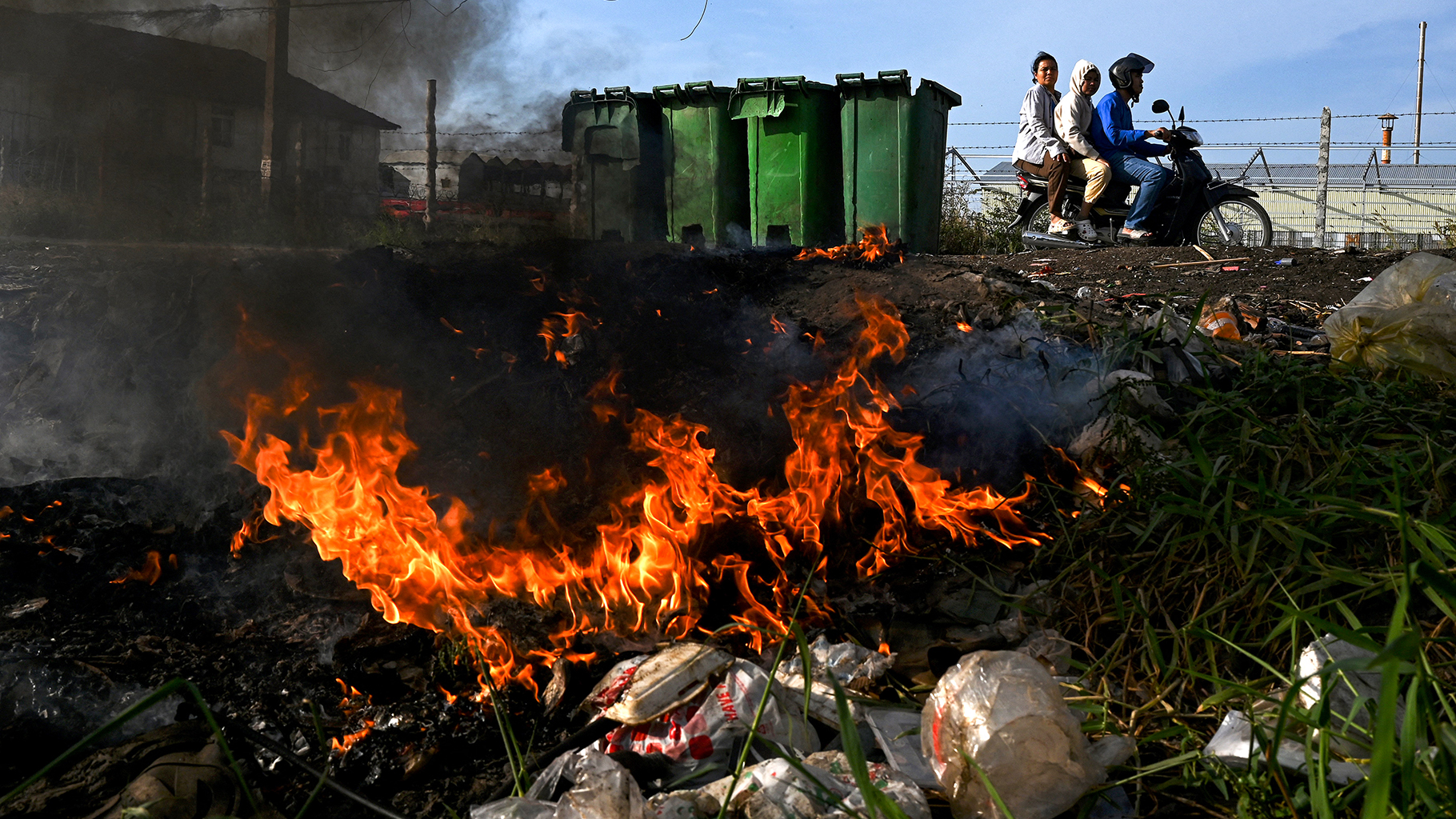
Health impacts from primary plastic production and post-consumer stages will increase by 75% by 2040
Our analysis explores human health effects at a high level to improve global understanding of the health implications of the plastic system, including from particulate matter formation, carcinogenic and non-carcinogenic toxicity, water consumption and climate change.65 We modelled global health impacts associated with macroplastic production, waste management and end-of-life for all sectors. Occupational hazards and the effects of using plastic products were beyond the scope of our analysis. Although we measured health effects using “disability-adjusted life years” (DALYs), with one DALY equivalent to the loss of one year of full health, we provide the results in years of healthy life lost, instead of DALYs, for ease of understanding.66 For more information on this modelling, see Appendix B.
Under BAU, we estimate the modelled health impacts to be 5.6 million years of healthy life lost in 2025 and 9.8 million in 2040. (See Figure 11.)
Of all the life-cycle stages we modelled, primary polymer production accounts for most human health impacts (62% in 2025 and 55% in 2040), including cancers and respiratory diseases and climate-associated illnesses, such as heat stroke. Among all other stages of the plastic life cycle, open burning accounts for the largest share of health effects (73% in 2025 and 82% in 2040). Studies have shown that open burning’s health effects occur primarily through inhalation of particulate matter, which is associated with respiratory and cardiovascular disease and lung cancer and has important consequences for vulnerable communities and workers globally, but particularly in countries where open burning is most common.67
Because our analysis omits health impacts associated with the use of plastic products as well as other key life-cycle stages and exposures, it underestimates the reality of global health burdens, as well as the inequity of their distribution. Use-stage health effects could increase some impacts by an order of magnitude, particularly because of chemical exposures from plastic materials.68

Health impacts from exposure to fine particulate matter occur disproportionately across populations, often affecting the most disadvantaged communities.69 Our analysis found that most health effects in lower-middle- and low-income economies come from particulate matter inhalation and associated cardiopulmonary disease and lung cancer. Further, 75% of these estimated health effects are attributed to open burning, which is often used in the absence of adequate infrastructure or space for waste collection and management or for fuel.70 Under BAU, the health impacts of open burning will rise by nearly 130% from 2025 to 2040 to 3.6 million years of healthy life lost. As such, growth in open burning of plastic will have substantial implications for people’s long-term health, especially because the impacts could exceed those we modelled, such as through the accrual of toxic chemicals in soil and water sources.
Chemical exposures from plastic products could lead to additional health impacts
People are already exposed to thousands of chemicals through daily use of and contact with plastic.71 Certain groups of chemicals commonly found in plastic polymers and products are of major concern because of their known toxicity and high likelihood of human exposure through ingestion, inhalation or skin contact.72 To examine the relative hazard of chemical classes commonly used in plastic products and assess people’s likelihood of exposure, we estimated chemical exposures from toys and food packaging using data from USEtox, an internationally recognized model for the health impacts of chemicals.73
Although, because of gaps in the available data about chemicals used in plastic and plastic products, this analysis is only illustrative – a snapshot of potential hazards – it can still offer plastic producers, consumer goods companies and policymakers a glimpse of the potential risks and inform future decisions on chemical use and product design. For more detail on these methods, see the technical appendix.
Plastic toys
We modelled the health impacts on a 2-to-3-year-old child of playing with a plastic doll and other toys for one year to illustrate the potential range of health effects from toys. Studies have identified 71 chemicals, including plasticizers, fragrances and flame retardants, in soft polyvinyl chloride (PVC) plastic toys.74 Of those chemicals, 15 have potential carcinogenic effects, and 62 have possible reproductive or developmental non-carcinogenic effects.75
The hypothetical doll for this model is composed of eight chemicals selected from the 71 identified chemicals: PVC polymer, a plasticizer, a stabilizer, a catalyst, a flame retardant, a pigment, a lubricant and a fragrance. Based on this model, we find that the health effects will vary substantially depending on the chemical additives used for each function, ranging from an estimated one hour to a few weeks of healthy life lost, and that, together, the flame retardant and plasticizer account for about three-quarters of the potential health impacts. These findings underscore the importance of design and formulation decisions in creating safer products.
Additional research is needed to better understand the chemical compositions of different types of toys and other daily-use plastic products and provide policy-relevant insights that could limit children’s chemical exposure. Such research could also help companies identify the most harmful chemicals, such as the flame retardant and plasticizer in our modelled toy, as well as safer alternatives to replace them.
Plastic food packaging
We modelled human exposure to 30 chemicals identified in PET bottles and found that the health effects were approximately one second of healthy life lost per bottle.76 However, this estimate is most likely conservative because it omits non-intentionally added substances that are probably also present but cannot be assessed as their properties are unknown.77
Although the effect of using a single PET bottle may be trivial, it illustrates the potential for harm from frequent bottle use, which for many people around the globe is often avoidable. Furthermore, most people interact with myriad products made of plastic every day, and the cumulative exposure and potential health consequences can add up.
Microplastics
By 2040, annual microplastic pollution from modelled sources will grow 50% under BAU
For this report, we modelled microplastic pollution from seven sources: tyre wear; washing of plastic at recycling facilities; mishandling of pellets during transport and at recycling and production facilities; washing of synthetic textiles; personal care products; application, wear and tear, and removal of paint; and agricultural products and practices.
Microplastic pollution from these sources will grow by 50% from 17 Mt in 2025 to 26 Mt by 2040, with cumulative pollution from the sources reaching 340 Mt. These seven sources account for roughly a tenth of global plastic pollution annually.
The largest sources of microplastic pollution are tyres and paint, followed by agriculture and recycling. (See Figure 12.) Tyres and paint both generate microplastics through everyday use and wear and tear over time. Although tyres with lower microplastic shedding rates are already on the market, decision maker attention on tyres as a major source of microplastics has only ramped up in recent years, and policies to reduce shedding have yet to be implemented.78 The countless uses of paint across economic sectors require tailored formulations to meet specific performance needs, resulting in a range of opportunities for microplastic releases – during application, weathering and removal – in diverse settings.79

Agricultural plastic is the fastest growing source of microplastic pollution
This analysis provides some of the first estimates of global microplastic pollution from agricultural plastic and finds that, under BAU, microplastic pollution from short-term agricultural plastic, such as those used in seed and fertiliser coatings, plastic mulch and silage films, will grow from 1.9 Mt in 2025 to 3.2 Mt in 2040.
Agricultural microplastic pollution is also the fastest growing of the modelled sources, increasing by 66% over the next 15 years. Farmers use short-term agricultural plastic to increase crop yields and reduce pesticide use, but as that plastic degrades through weathering or is broken down by plowing and other practices, it generates microplastics that can harm soil quality, introduce contaminants and reduce plant growth and harvests.80 Products such as plastic mulch pose particular challenges because of their high soil contamination rates and the difficulty in removing them once applied.81
Smaller sources of microplastic pollution are still a significant concern
The remaining microplastic sources – pellets, textiles and personal care products – contribute far smaller amounts to the overall BAU microplastic pollution estimates, at a combined 0.2 Mt in 2025 and 0.3 Mt in 2040.
Microplastics added to personal care products are relatively straightforward to address and have received substantial attention in policy discourse, with many countries having already banned their use.82
Microplastic pollution from pellets occurs as a result of accidental spills and mismanagement. Although the volumes are much lower than those from tyres and paint, they remain substantial, with up to 7,300 truckloads of pellets lost into the environment each year in the EU alone.83
Further, microplastic pollution from the washing of textiles is likely to be higher than the modelled estimates when factoring in airborne emissions (which are not included in the scope of our analysis). One study estimated that up to 65% of textile microplastics may be emitted to aerial environments during the drying and wearing of garments.84 Although microplastics from textiles represent a relatively small portion of total microplastic pollution by mass, a single gram can contain 3.7 million individual fibres, and research has identified their elongated shape as particularly harmful.85
Plastic packaging
Pollution from plastic packaging will more than double from 2025 to 2040
Under BAU, packaging is the largest source of macroplastic waste among all sectors modelled, accounting for about one-third of all macroplastic waste generated. In this analysis, we disaggregate packaging flows by polymer and product type to evaluate how each affects the likelihood that plastic waste will be collected, be recycled or become pollution. PET and polypropylene (PP) are used in all of the six types of plastic packaging we modelled, and HDPE, low-density polyethylene/linear low-density polyethylene (LDPE/LLDPE), and PVC are each used in five types. (See Table 1.) Across packaging types, LDPE/LLDPE and PP are the most-used polymers, together accounting for more than half of the sector’s plastic use in 2025.
Table 1: The Most-Used Polymers in Plastic Packaging Are LDPE/LLDPE and PP, Followed by HDPE and PET
Composition of plastic packaging by polymer in Mt, 2025
| Product | Polymer | Total | ||||||
|---|---|---|---|---|---|---|---|---|
| HDPE | LDPE/ LLDPE | PET | PP | PS/EPS | PVC | Other | ||
| PET bottles | 5.6 | 0.0 | 11 | 0.38 | 0.0 | 0.0 | 0.0 | 17 |
| Other bottles | 9.1 | 0.62 | 2.5 | 0.73 | 0.0 | 0.15 | 0.0 | 13 |
| Rigid food packaging | 3.6 | 0.62 | 4.5 | 15 | 2.3 | 0.33 | 0.092 | 27 |
| Rigid non-food packaging | 14 | 1.1 | 1.8 | 12 | 2.2 | 0.41 | 0.026 | 32 |
| Multilayer packaging | 0.0 | 6.1 | 0.32 | 0.38 | 0.0 | 1.2 | 0.048 | 8.1 |
| Flexible packaging | 3.9 | 35 | 1.1 | 15 | 0.69 | 1.5 | 0.40 | 58 |
| Total | 37 | 44 | 22 | 44 | 5.1 | 3.7 | 0.57 | 150 |
Notes: “PET bottles” include polymers other than PET in the caps and sleeves. “Other bottles” include some PET components, but the bottles themselves are made of other polymers. Any inconsistency in the figures is the result of rounding. For complete data, see the technical appendix.
The format of plastic packaging influences its fate within waste management systems; flexible and multilayer materials pose a particular challenge
Although under BAU most global packaging waste is collected (85% in 2025 and 70% in 2040), only a small portion of that collected waste is sent for recycling (21% in 2025, 19% in 2040); most goes to landfills (54% in 2025, 57% in 2040) or incinerators (12% in 2025, 13% in 2040).
Further, despite the prevalence of flexible and multilayer packaging, 96% of plastic packaging waste that is sent for recycling in formal systems is rigid because flexible and multilayer packaging present special challenges for waste collection, sorting and recycling. Flexible materials can get caught in recycling facilities’ sorting machinery, which is mostly intended for rigid plastic. Multilayer packaging typically consists of multiple sheets of plastic, made from various polymers and other materials, that are difficult to separate, and because it is often used in flexible formats, it also can pose the same issues as flexible packaging. Both packaging types are frequently used for food and personal care products, including as small packets or sachets to hold sample and travel-sized products and condiments, and can be soiled by the products inside. These characteristics of flexible and multilayer packaging make them more difficult and costly to recycle than rigid packaging, and the recyclate produced from flexible and multilayer materials is typically of low value and in limited demand.86
The informal waste management sector contributes about 60% of the plastic packaging waste sent for recycling
Nearly 12 million waste pickers in the informal sector are engaged in the collection and sorting of plastic waste in 2025, preventing substantial quantities of plastic from entering the environment. Of the 28 Mt of plastic packaging that recycling facilities receive globally in 2025, 61% (17 Mt) came via the informal sector, including virtually all plastic packaging sent for recycling in middle- and low-income economies.87 In contrast, high-income economies rely almost exclusively on formal waste collection and management systems.

System Transformation: A full-life-cycle approach to tackle plastic pollution
At the root of the plastic pollution problem are system-wide failures to match production and use of plastic to the design and capacity of the systems meant to manage the resulting waste. Current levels of production and consumption – particularly for single-use or short-lived packaging, textiles and consumer goods – overwhelm the waste management system and generate cascading impacts on human health and the environment. To be effective, solutions must therefore be system-wide.
The System Transformation scenario explores the potential of deploying existing policy strategies and tools to tackle plastic pollution through upstream (i.e. the pre-consumer phase of a product or material life cycle) measures that reduce plastic production and downstream (i.e. the post-consumer phase) measures that increase collection, sorting and recycling. And it draws on the discussions surrounding the U.N. plastics treaty negotiations to highlight the benefits of international cooperation to rapidly bring solutions to scale worldwide. All figures in this chapter are projections based upon our modelling unless otherwise cited.
Our analysis included two versions of System Transformation – high impact and low impact – which differ in the time and impact assumptions used for each policy lever. To emphasize the vast potential of substantial global collaboration and commitment, this chapter presents the results of high-impact System Transformation.88
System Transformation cuts plastic pollution by more than three quarters
Under System Transformation, by 2040, annual combined macroplastic and microplastic pollution falls by 83%, from 280 Mt per year under BAU to 47 Mt per year. (See Figure 13.) The mass of macroplastic that is disposed of via open burning decreases by 85% by 2040 relative to BAU, substantially reducing health impacts of air pollution from the burning of plastic waste.

The reductions in environmental pollution achieved under System Transformation stem from an overall decrease in plastic production coupled with improved waste management. By 2040, annual primary macroplastic production decreases to 390 Mt, a 44% cut versus BAU (680 Mt) and 14% from 2025 (450 Mt).
Although substantial, these results fall well short of recent calls – such as those made by the Rwandan and Peruvian delegations during the fourth session of the U.N. plastics treaty negotiations – to achieve a 40% reduction by 2040 from 2025 levels and of the more drastic cuts that studies indicate are necessary to align with the Paris Agreement.89 To reach those targets, the global community will need to identify additional opportunities to reduce primary production in the non-packaging sectors. These could include eliminating subsidies for plastic production, taking strategic pauses on building new infrastructure in places where excess production capacity exists, and providing policy and financial support to encourage new reuse business models. We provide more discussion of relevant strategies to address production and use in the chapter titled, “4 strategic pillars can drive plastic system transformation.”
System Transformation requires improvements in material circularity
System Transformation also involves significantly improved waste management, as well as higher rates of reuse – which is explored in detail for packaging later – and recycling. By 2040, compared with BAU, the collection rate for macroplastics grows from 66% to 97% and the recycling rate increases from 17% to 34%. In particular, the share of plastic waste that is recycled via closed-loop mechanical recycling rises substantially, resulting in a nearly three-fold increase in the amount of recycled plastic material used to make plastic products compared with BAU. Although the amount of plastic waste reprocessed via chemical conversion increases more than 20-fold based on industry-projected growth rates, it still totals only 0.056 Mt in 2040, suggesting that capacity and cost barriers – such as those related to sourcing quality materials that prevent many existing facilities from operating at full capacity – may be difficult to overcome.90 For more information, see the later section of this report on chemical conversion.
The growth in use of recycled plastic in new products reflects a shift away from open-loop mechanical recycling and incineration, which both begin to decline around 2035 in System Transformation. Whether this shift can be achieved will depend on the policy priorities of local, regional and national governments and on whether the private sector makes meaningful product design changes over the next few years. Unlike landfills, incinerators require continuous feedstock to be cost effective, and because their lifetime is 25 years or longer, incinerators can block newer technologies and compete for material that could otherwise be recycled.91 For example, Sweden does not generate enough waste domestically to supply its incinerators and relies on imported waste, putting incineration in competition with efforts to improve sorting and recycling of plastic, not only in Sweden, but also in neighboring countries.92
Therefore, investments in open-loop mechanical recycling and incineration made now risk becoming barriers to alternative technologies that could play a longer-term role in reducing plastic pollution. We estimate that over the 15-year time frame of System Transformation, capital expenditures for open-loop mechanical recycling and incineration will total US$430 billion (discounted at 3.5%) – investments in technologies that risk becoming obsolete as the world transitions to a more streamlined circular plastic economy.
System Transformation benefits the climate and human health
The dramatic changes that occur under System Transformation have important implications for the climate and human health. By 2040, System Transformation achieves a 38% reduction in annual GHG emissions relative to BAU, mostly from decreased primary plastic production. Cumulative emissions fall to 44 GtCO2e, accounting for 33% of the remaining overall carbon budget for a 1.5°C climate target or 4% of the budget for a 2°C target. (See Figure 14.)
When global decarbonization efforts are included, cumulative GHG emissions under System Transformation total 23 GtCO2e by 2040, with annual emissions declining to less than 1 GtCO2e per year. And further reductions in plastic production and use could deliver long-term net-zero GHG emissions for the plastic system. However, the plastic sector’s heavy reliance on fossil fuels for primary plastic feedstock presents a significant barrier to decarbonizing the plastic system enough to realize net-zero GHG emissions.93

The results of System Transformation highlight the importance of addressing the full plastic life cycle, including use of alternative materials and new business models, to reduce climate impacts. Annual GHG emissions from production decline by 38% from 3.5 GtCO2e to 2.2 GtCO2e per year by 2040, while emissions from open burning fall 86% from 0.42 to 0.06 GtCO2e. Modelled human health impacts – which do not include effects from the use stage or chemical exposures – also decrease substantially. By 2040, System Transformation is associated with an estimated 4.5 million years of healthy life lost, which is 54% below the BAU figure of 9.8 million years, largely as a result of the projected decreases in primary production and open burning. (See Figure 15.)

Reductions in health impacts from open burning are most noticeable in upper-middle- and lower-middle-income economies – the largest contributors to open burning under BAU – where a decrease of 119 Mt annually in the amount of open burned plastic waste yields an 86% drop in health effects. Achieving such a big decline in open burning would take a concerted global effort, but it would yield substantial health benefits.
System Transformation will require shifts in investments and jobs across the plastic system
Under System Transformation, annual plastic system costs are US$2.3 trillion in 2040. Although that figure is just 4% (US$89 billion) less than BAU, the distribution of spending and jobs across the system changes substantially between the two scenarios. Annual spending on primary plastic production under System Transformation decreases – because of lower production – by 40% (US$790 billion) compared with BAU. And less production means less waste generation, which leads to public spending decreases for plastic collection, sorting and disposal of US$19 billion, a 13% reduction relative to BAU. However, because more plastic will be recirculated in the economy, spending on recycling is 39% higher – US$76 billion more a year – under System Transformation than under BAU.
Despite this shift in spending, the total number of plastic waste management jobs is virtually the same under System Transformation and BAU. (See Figure 16.) However, improved waste management under System Transformation results in a shifting of jobs across the system by 2040 versus BAU, with formal waste collection jobs decreasing by 340,000 (18%), formal sorting jobs growing by 68,000 (75%) and recycling facility jobs increasing by 360,000 (39%).
Overall, System Transformation results in 40% fewer plastic production jobs and 6% fewer total jobs compared with BAU in 2040. However, some of the losses are offset by increased jobs associated with substitute materials (930,000) and reuse systems (620,000). Moreover, we only modelled substitution and reuse, and their associated employment impacts, for the packaging sector, but use of these levers in other sectors would probably further compensate for production job losses. Ultimately, System Transformation still reflects 8.6 million more jobs than in 2025.

The largest concentration of plastic waste-related jobs is in the informal sector, which we estimate at about 19 million jobs under both BAU and System Transformation in 2040, reflecting waste pickers’ critical role in meaningfully reducing global plastic pollution and in the economic opportunities and development of their local communities. This is particularly true in lower-middle-income and low-income economies, where informal sector jobs will increase by more than 1.6 million (16%) in 2040 under System Transformation.
The costly consequences of delay
The results presented in this chapter assume that action to implement system-wide changes begins in 2025 and takes 15 years. A five-year delay in starting that effort would increase cumulative environmental pollution by 540 Mt by 2040 versus System Transformation as modelled. (See Figure 17.)

Compared with starting System Transformation in 2025, a five-year delay would:
- Increase annual public costs by 23%, or US$27 billion by 2040, to curb 1,100 Mt more primary plastic that would be produced cumulatively over the next 15 years.
- Add 5.3 GtCO2e in cumulative plastic system GHG emissions by 2040.
- Increase the risk of overinvestment in activities focused on disposing of the additional plastic waste. For example, some countries are struggling to manage public spending decisions, such as between new but underutilized incineration plants and efforts to improve sorting and recycling that would further divert materials from those plants.94
Urgent action is required not only to curb the worst effects of plastic pollution and the broader effects of the plastic system on the environment and human health, but also to ensure the efficient use of limited global funding.

Microplastics
Policy measures to reduce microplastic pollution have evolved substantially over the past decade. The Netherlands led the way in 2014 when it introduced the first ban on microbeads in personal care products, which was followed by similar rules in several other countries.95 The following year, the U.S. enacted the Microbead-Free Waters Act of 2015 that prohibits the use of microbeads in rinse-off cosmetics and over-the-counter health care products, such as toothpaste.96 In 2023, the EU restricted the intentional addition of microplastics in cosmetics, personal care, detergents and other products and is in the process of enacting regulations on tyres, pellets and textiles.97 Multinational organizations such as the International Maritime Organization and the U.N. Food and Agriculture Organization are also beginning to act, and measures to target microplastics have been included in drafts of the U.N. plastics treaty.98
System Transformation includes upstream and downstream policy actions tailored to each of the seven modelled sources of microplastic pollution. (See Figure 18.) The upstream actions broadly involve reducing the intentional use of microplastics in products and improving product design to reduce the amount of microplastics they shed. Downstream actions include installing water filters in industrial and household settings and reducing agricultural use of sewage sludge. For a detailed list of the recommended policies, see Appendix C. For more information on data and methods, see the technical appendix.

System Transformation cuts microplastic pollution by 41% by 2040 relative to BAU
By 2040, System Transformation reduces microplastic pollution entering the environment from the modelled sources by 41%, from 26 Mt under BAU to 15 Mt. (See Figure 19.) Although this result shows that targeted action can substantially cut microplastic pollution, it also is only about half of System Transformation’s effects on macroplastic pollution, highlighting the need for additional dedicated policies for microplastics, especially in high-income economies, where microplastic pollution makes up 92% of total plastic pollution under System Transformation in 2040.

Microplastic pollution is generated at multiple stages across product life cycles and requires a multipronged solution. (See Figure 20.) Reducing overall use of microplastics and improving product design can decrease microplastic shedding. And providing more and better water filtration and wastewater treatment can increase the capture of emitted microplastics.
System Transformation achieves the largest absolute reductions in microplastic pollution by 2040 relative to BAU from tyres (-5.6 Mt), with smaller declines from the other six sources. However, the greatest percentage reductions are from pellet releases (-96%), recycling (-88%), textiles (-85%) and personal care products (-91%). Pollution from these sources could be almost eliminated if governments require the relevant industries to act.
Overall, however, System Transformation cuts cumulative microplastic pollution from 2025 to 2040 from the seven sources modelled by just 20% from 340 Mt under BAU to 270 Mt. More substantial reductions will require policies beyond those analysed in this report, such as ongoing updates to product design requirements across sectors. Paint is a particularly challenging source of microplastic pollution; the interventions modelled in System Transformation only reduce pollution from paint by 1.2 Mt, or 13%, making this sector a priority for additional research and innovation.
Although this analysis models more microplastic sources than BPW1, many sources that may substantially contribute to pollution are still unaccounted for, including artificial turf; fishing gear; packaging; detergents; automobile brake systems; geosynthetic materials used in civil engineering; oil and gas production and drilling processes; industrial abrasives (to remove paint from surfaces); and mismanaged macroplastic waste.99 We estimate annual macroplastic pollution at 260 Mt by 2040 under BAU, and as that material degrades, it will inevitably contribute to microplastic pollution.100

By 2040, System Transformation reduces microplastic pollution from tyres by 5.6 Mt, or 55%, relative to BAU
Using three policy levers – enhancing product design to reduce shedding rates, reducing overall tyre usage via broader transformations in the transportation system and installing drainage systems on roads to capture tyre particles – System Transformation reduces microplastic pollution from tyres by 55% by 2040 relative to BAU. (See Figure 21.)
Of these levers, improving product design – for instance, to lower abrasion rates – is the most effective in cutting microplastic pollution from tyres, delivering 44% of the reductions in this sector. Tyre abrasion rates vary widely across products on the market. For example, for one type of tyre, rates range from 35 milligrams (mg) to 126 mg of abrasion per kilometre travelled per vehicle ton.101 Importantly, the low end of that range demonstrates that manufacturers already can produce tyres that meet safety and performance standards and have wear rates well below what other products offer. Establishing abrasion limits that increase in stringency over time will remove the most polluting tyres from the market.102
Yet, even with the reductions from these levers, tyre wear remains a substantial source of microplastic pollution in 2040 and further action – such as making abrasion limits stricter over time – will be needed to progressively reduce pollution.

System Transformation cuts microplastic pollution from textiles by 85% relative to BAU by 2040
System Transformation targets microplastic pollution from textiles through multiple policy levers that reduce microplastic generation at the source and improve the capture in households and wastewater treatment plants of what remains. The levers targeting microplastic generation employ best practices in fibre and fabric manufacturing to produce textiles with lower shed rates and filter production wastewater, both of which can substantially reduce the creation and loss of microplastic over a garment’s life cycle.
Improving product design is the most effective policy lever in this sector, accounting for 52% of the cuts in microplastic pollution from textiles. (See Figure 22.) Product design requirements could include maximum shedding thresholds and use of cutting and weaving processes that reduce microfibre generation and could help encourage innovation in low-shedding textiles.103
Reducing demand for new fabric – such as by increasing the durability of clothing and discouraging fast fashion – or substitution with natural fibres can also help decrease microplastic pollution from textiles.
Further, although we do not model the use of recycled content in textiles, studies have shown that textiles made with recycled PET release more microfibres during wear and laundering than those made with primary PET, highlighting the need for a nuanced assessment of textile recycling practices in relation to microplastic pollution.104
And all policies introduced to reduce microplastic pollution also must ensure that new solutions do not introduce new harms, such as using toxic coatings, dyes or additives.

Under System Transformation, microplastic pollution from personal care products declines by 91% relative to BAU by 2040
System Transformation models upstream and downstream policy levers targeting microplastic pollution from personal care products, including banning the intentional addition of microplastics to wash-off products, reducing the use of microplastics in leave-on products and improving the capture of microplastics from wastewater.
Banning the intentional addition of microplastics in wash-off personal care products is the most effective lever, accounting for 65% of the total microplastic pollution reductions in this sector. (See Figure 23.) By preventing microplastics from entering the wastewater stream to begin with, the policy avoids pollution and the need for later remediation measures. Multiple countries have already banned intentionally added microplastics in wash-off personal care products, but more action is needed to expand the bans to include leave-on products.

In addition, although not modelled here, intentionally added microplastics exist in many other everyday products, including detergents, waxes and polishes, and those could be addressed through similar bans or restrictions.
System Transformation nearly eliminates microplastic pollution from pellets by 2040
Solutions already exist to prevent virtually all plastic pellets loss. But uptake of those solutions in the pellet supply chain has been lacking. Governments will need to take policy action to boost implementation of transport and manufacturing best practices and require regular monitoring and disclosure of spills and other mishaps, as well as reporting on plastic production data as a whole.
System Transformation delivers reductions in generation of pellet microplastics through decreased use of pellets and implementation of best practices to prevent spills and mishandling of pellets across the supply chain. These policies reduce microplastic pollution from pellets by 96% by 2040 relative to BAU.105 (See Figure 24.)

By 2040, System Transformation reduces microplastic pollution from recycling by 88% relative to BAU
Although the mass of macroplastics sent to recycling and generated during the recycling process both increase under this scenario, using a downstream policy lever to capture microplastics at recycling facilities using filters, System Transformation ultimately reduces annual microplastic pollution from recycling by 88% relative to BAU by 2040. (See Figure 25.) However, to maximize the benefits of those results, captured microplastics must also be securely disposed of, for example through landfills or incineration, which, though not optimal, is preferable to their leakage into the environment. Under System Transformation, the amount of microplastics from recycling that needs to be managed increases to 13 Mt by 2040.
Further reductions in microplastic pollution from recycling may be possible through the redesign of materials, given the difference in microplastic shedding rates among polymers, or via improvements in recycling technologies, but these levers were beyond the scope of our modelling.106

Importantly, we do not model the costs associated with microplastic policy levers, including filtration in recycling facilities, which could be substantial and should be considered as part of the development of EPR schemes and related policies targeting recycling. But filter technologies are also a priority for research and innovation, particularly as regards retrofitting industrial and small-scale recycling facilities.
System Transformation reduces microplastic pollution from agriculture by 48% relative to BAU by 2040
Plastic is deeply embedded in modern agricultural practices, but its use is poorly quantified and remains largely unregulated. Through upstream policy levers that reduce the use of short-term agricultural plastic, System Transformation can achieve a 48% reduction in microplastic pollution from this sector relative to BAU by 2040. (See Figure 26.)
These policies include banning intentionally added microplastics, such as polymer-coated fertilisers, plant pods and seeding plugs, and substituting products such as plastic mulch with non-plastic alternatives.107 Companies and governments will need to test alternative materials to ensure that they do not adversely affect food production or generate more waste.

Although transitioning away from agricultural plastic has costs, alternative materials may offer long-term benefits and cost savings through enhanced soil health and improved crop yields. Decision makers will also need to ensure that the near-term costs of these policies are not borne by farmers alone and instead are distributed across the food production industry.108
To address the remaining microplastic pollution from agriculture; drive more sustainable farming practices; and safeguard food security, nutrition and ecosystem health, policy makers must act to integrate the principles of refuse, redesign, reduce, reuse, recycle and recover into agricultural policy.109
The U.N. Food and Agriculture Organization has published a voluntary code of conduct on sustainable use and management of plastic in agriculture that encourages governments and other stakeholders to develop policies and highlights actions, such as improving the design of agricultural plastic to enhance durability or reusability; promoting environmentally friendly and nature-based alternatives; implementing product standards and labelling requirements; and increasing the collection, recycling and management of plastic waste.110
System Transformation reduces microplastic pollution from paint by 13% relative to BAU by 2040
System Transformation includes upstream and downstream policy levers targeting microplastic pollution from paint, including product design changes to reduce microplastic particle loss during application, improve the durability of paint and remove polymers from paint formulas, decrease wear and tear of painted surfaces and increase capture of degraded and removed paint. However, these levers together only reduce microplastic pollution from paint by 13% compared with BAU by 2040. (See Figure 27.)
Policies to improve design, such as requiring that road markings be inlaid rather than applied on the road surface and reformulating paint to be more durable, are the most effective for addressing microplastic pollution from paint, accounting for 56% of the reductions under System Transformation. In contrast, policies to decrease the loss of paint particles during removal, especially during dry docking of boats, contribute the balance of the pollution reductions.

Overall, the System Transformation reductions in microplastic pollution from paint are much smaller than those from other sources. Paint poses a particular challenge because so many different types of paint exist across a wide variety of industries, every stage of a paint product’s life cycle generates microplastics, regulation and awareness of microplastics from paint is lacking and evidence on the efficacy of potential solutions is limited. Additionally, regulating microplastic pollution from paint is especially difficult because many painting processes – such as applying and sanding – occur at the consumer level, and current regulations for these processes only exist for workplaces, primarily for health and safety reasons. Furthermore, many paints, such as those for wood and boats, cannot be readily substituted with available non-polymer products.
However, precedents for regulating paint to protect human health do exist and could provide a roadmap for restricting plastic-based components in paint. For example, several countries have limited the use of volatile organic compounds in paint to improve air quality. Similar product design standards could be used to curb the use of certain plastic polymers in paint and to improve paint durability to reduce flaking.111 Policies could also promote efficient application technologies and enclosed systems to minimize overspray and environmental release and, critically, incorporate best practices for paint maintenance and end-of-life treatment to prevent microplastic pollution.
Cross-cutting interventions
Alongside policy levers targeting specific sources of microplastic pollution, other interventions can reduce pollution from multiple sources, for example, through wastewater treatment and changes in infrastructure and transport systems.
In 2025, 22% of microplastics that enter waterways – from drains, run-off or direct spills – are collected through wastewater treatment and are then either spread on land, incinerated or put in landfills. The sludge by-product from treated wastewater contains captured microplastics from nearly all the sources we modelled.
In many jurisdictions, wastewater treatment sludge is used as an agricultural fertiliser, reintroducing captured microplastics into the environment. Microplastics applied to agricultural lands can alter soil structure; harm fauna, such as earthworms, that are essential for healthy soils; and reduce photosynthesis in plants leading to lower food crop yields.112 As a result, these impacts may pose a threat to food supply and long-term food security.
System Transformation includes a cross-cutting policy lever to reduce this use of wastewater treatment sludge by 50% from 2025 to 2040 in high-income countries, which yielded an 8% cut to terrestrial microplastic pollution by 2040. These reductions could be expanded by applying this policy to lower-income economies or by banning rather than only decreasing the agricultural use of sludge.
Such policies, which already exist in several jurisdictions in Europe and the United States and are being considered elsewhere, may have the additional benefit of reducing the contamination of agricultural soils and crops with chemical pollutants present in wastewater, including “forever chemicals” such as PFAS.113 However, decision makers will need to carefully consider how and when to implement the policies to avoid potential unintended consequences, such as increased fertiliser use and emissions or chemical leaching from the disposal of sewage sludge.
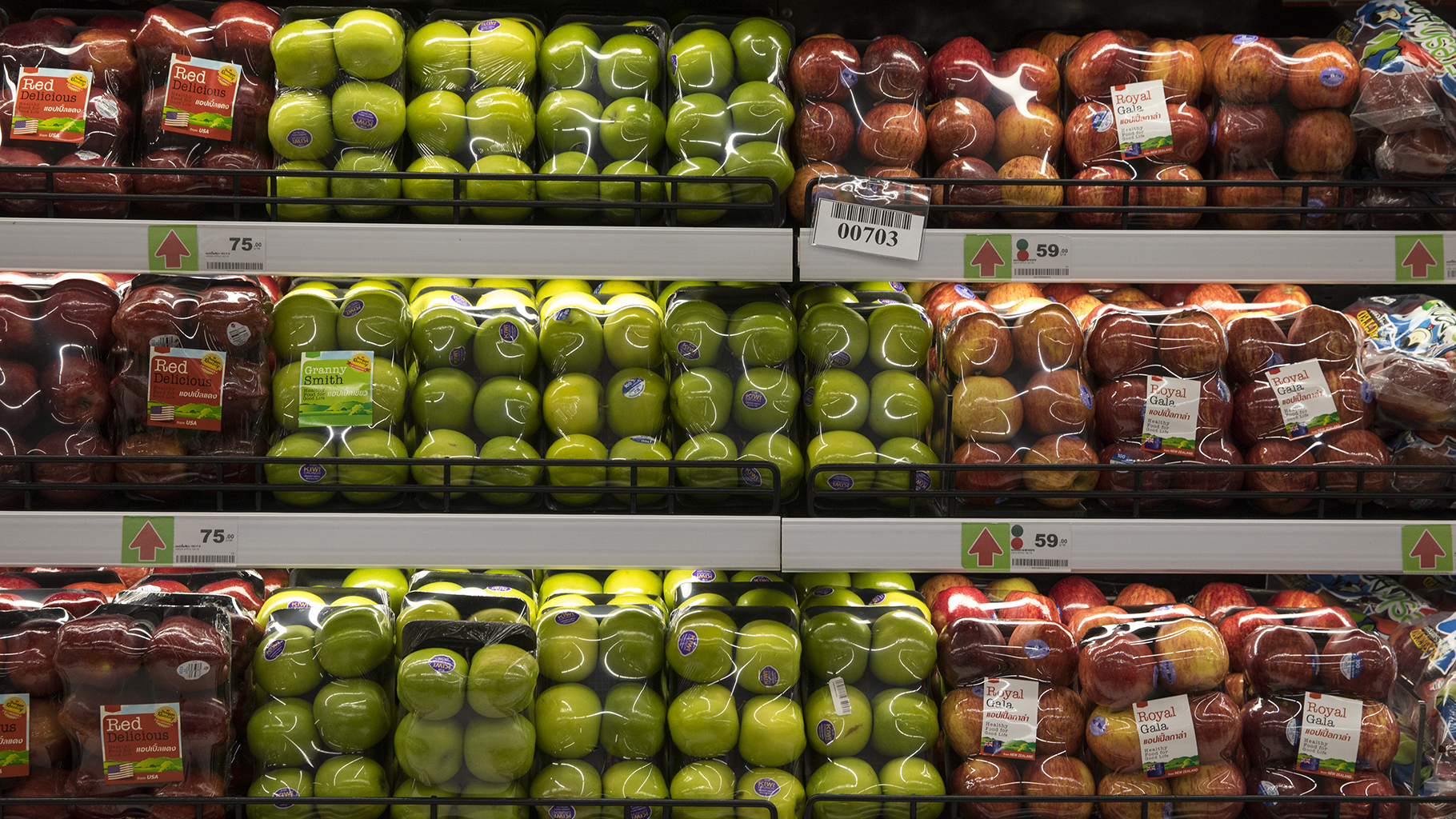
Packaging
Plastic from packaging is a major source of the plastic pollution challenge, but it is one that can be solved. Under System Transformation, plastic pollution from packaging declines by 97% by 2040 relative to BAU and by 94% versus 2025. Return- and refill-based reuse systems are central to these outcomes, contributing to nearly two-thirds of the reductions in packaging waste generated, with complementary actions to improve collection, sorting and recycling helping to provide a more circular system in which increasing shares of generated waste are used to create new products.
Given packaging’s huge contributions to plastic use and pollution, it has increasingly become a priority for policy reform. National and regional policies targeting plastic packaging have evolved substantially in recent years, shifting from banning individual single-use products to setting binding targets for reduction, repair, reuse and refill.114 Other policies have focused on driving product redesign by establishing recycled content targets and introducing fee levels within EPR schemes based on the characteristics or end-of-life outcomes for given packaging types.115 These policies target some of the root causes of plastic pollution, such as over-reliance on single-use models and inadequate waste collection, but they also reflect a broader understanding that, to reduce costs and create a more sustainable future, effective plastic waste management must be accompanied by strategies to reduce production and consumption in the first place.
System Transformation includes a series of upstream and downstream policy levers, not only to determine which interventions are most effective at minimizing plastic packaging leakage into the environment, but also to assess the impact of the various levers across the plastic life cycle. The levers are:
- Ban polystyrene (PS), expanded polystyrene (EPS) and PVC in packaging.
- Eliminate unnecessary plastic in packaging.
- Scale up return-based reuse systems.
- Scale up refill-based reuse systems.
- Transition from single-use materials to more recyclable plastic polymers.
- Increase collection.
- Improve sorting and recycling.
- Increase capacity of controlled disposal.
We apply the levers in line with the waste hierarchy articulated in BPW1 – reduce, reuse, repair, refurbish, repurpose, recycle and dispose – across all upstream and downstream phases of the plastic packaging system. For a detailed description of the levers, see Appendix C.
Annual plastic packaging pollution could be nearly eliminated by 2040
System Transformation achieves a 97% cut in annual pollution from plastic packaging by 2040 compared with BAU through efforts to minimize production and use of single-use plastic and increase capacity and infrastructure for managing plastic packaging waste and recirculating secondary plastic materials. (See Figure 28.) For example, the elimination of unnecessary plastic and the shift from single-use to return- and refill-based reuse systems reduce the overall amount of plastic and other materials used each year, and redesigning products improves the likelihood of collection and recycling. Downstream efforts to increase collection coverage and invest in recycling and disposal capacity help cut the amount of material that is uncollected or dumped.
Such pairing of upstream and downstream measures to address plastic pollution is appearing more frequently in international, regional and state-level regulatory efforts, most notably in negotiations for the U.N. plastics treaty, but also in the EU Packaging and Packaging Waste Regulation, California’s Plastic Pollution Prevention and Packaging Producer Responsibility Act, and the Republic of Maldives’ Single Use Plastic Phase-Out Plan.116

By 2040, System Transformation reduces annual primary plastic production for packaging by 76% compared with BAU and by 66% versus 2025
Across all sectors, System Transformation reduces annual primary plastic production by 14% by 2040 relative to 2025, which falls well short of recent calls for a 40% reduction.117
However, within the packaging sector, System Transformation delivers a much more robust impact, cutting annual primary production for the sector to 48 Mt in 2040, a 66% decline versus 2025 (140 Mt) and a 76% reduction compared with BAU (200 Mt). These results also underscore the potential of comprehensive, upstream-focused strategies that integrate multiple policy and business approaches to meaningfully reduce primary plastic production.
High-income economies see the largest per capita reductions in plastic packaging waste under System Transformation
Across geographies, annual per capita plastic packaging waste decreases substantially by 2040 relative to BAU, declining 68% from 23 kg per person to 7 kg per person globally. The greatest reductions occur in high-income economies, where System Transformation reduces annual per capita plastic packaging waste by 80%, from 58 kg per person to 12 kg per person. (See Figure 29).

Return- and refill-based reuse shows the greatest potential to reduce plastic packaging waste and support a transformative shift towards a circular system
Of all the upstream policy levers modelled, return- and refill-based reuse systems have the greatest effects on plastic packaging waste, accounting for 34% and 32%, respectively, of the annual reductions from the upstream levers by 2040. (See Figure 30.) Together, these business models drive nearly two-thirds of the total cuts to plastic packaging waste, with most of the reductions occurring for single-use plastic and in upper-middle- and high-income countries.
However, reuse models will necessarily be context-specific. For example, whereas existing business models in Western Europe may align better with centralized, shared infrastructure for packaging return logistics, such as washing and bottling, in India and other countries where waste pickers are prevalent, models built around repurposing existing collection and sorting activities from recycling to reuse may work better and be more cost effective.118 The dominance of e-commerce in certain parts of the world would similarly lend itself to different logistics than in regions where smaller, in-person stores are more common.

Bringing reuse systems to scale worldwide could spur substantial private sector investment and job creation
Implementing return- and refill-based reuse systems at this scale would support US$570 billion in annual private sector spending by 2040, accounting for a quarter of the modelled system-wide expenditures. Operational costs, such as for transportation and labour, make up most (66%) of the spending associated with reuse. The prominence of labour costs, such as to collect materials from return sites and wash containers, and reduced dependence on global commodities for packaging material reflect the important contributions reuse systems could make to local jobs and economies, particularly if designed in collaboration with waste pickers and other informal workers.119 Our modelling estimates that these systems, if rolled out at scale, could support 620,000 jobs annually in the packaging sector alone.
Complementing reuse with other upstream levers delivers additional reductions in plastic packaging waste
The remaining upstream levers – ban and eliminate, and substitution – have important but smaller effects on plastic packaging waste under System Transformation, achieving 22% and 13% of total waste reductions, respectively. Although the effect of ban and eliminate is not at the same scale as reuse, its value should not be underestimated because reducing certain polymers and product categories that are less amenable to reuse or other waste reduction and recycling strategies is crucial for enabling System Transformation. However, ban and eliminate also is not impactful enough to be the sole approach to addressing pollution from plastic packaging, which further emphasizes the need to rethink product delivery mechanisms and transition to reuse as a core tenet of System Transformation.
We also examined the upstream policy levers’ effects on rigid versus flexible plastic packaging waste. Refill-based reuse systems are the most effective for flexible packaging waste, providing 59% of the reductions delivered by the upstream levers for this product category by 2040 because of their potential to replace single-use packaging of a wide variety of packaged goods, such as shampoos, soaps, laundry detergents and cleaning solutions. On the other hand, return-based systems are most effective for rigid packaging waste, accounting for 52% of the reductions delivered for this category by the upstream levers in 2040. The effectiveness of large-scale return-based systems has already been demonstrated for laundry detergents, which typically use rigid materials.120
System Transformation bans PS, EPS and PVC in packaging and substantially reduces use of other polymers through reuse and substitution
System Transformation phases out the use of three polymers – PS, EPS and PVC – in packaging by 2040. (See Table 2.) Multiple national policies and voluntary pacts already target these polymers because of concerns about the safety of chemicals they contain, recycling challenges, microplastic pollution and their propensity to contribute to litter.121
For the remaining polymers – PP, LDPE/LLDPE, HDPE and PET – we assessed the upstream levers for food and non-food rigid packaging. Single-use PET packaging declines most relative to BAU (-82%) because its primary applications, PET bottles and rigid packaging, are highly conducive to replacement with reusable products. However, the modelling also highlights technological and commercial limitations for further reductions in specific applications, such as LDPE and LLDPE in multilayer packaging, that will require innovations and new collaborations at scale to transition those product types to reuse systems or substitute those polymers with more collectable and recyclable materials.
Table 2: Targeted Policies Can Eliminate PVC, PS and EPS, and Dramatically Reduce Use of Other Polymers in Packaging
Change in use of single-use plastic in Mt, 2025 and by scenario 2040
| Polymer | Business as Usual | System Transformation | Percent change |
|---|---|---|---|
| HDPE | 49 | 16 | -67% |
| LDPE/LLDPE | 58 | 21 | -64% |
| PET | 29 | 5.2 | -82% |
| PP | 59 | 18 | -69% |
| PS/EPS | 7.0 | 0.0 | -100% |
| PVC | 5.0 | 0.0 | -100% |
| Other | 0.75 | 1.3 | 68% |
| Total | 210 | 62 | -70% |
Note: Any inconsistency in the figures is the result of rounding. For complete data, see the technical appendix.
System Transformation has a lower material footprint than BAU
The reuse levers shift most single-use plastic in packaging to reusable products made of plastic, glass and metal, while the substitute lever moves the sector towards the use of glass, metal, paper and compostables for the remaining single-use packaging products and from hard-to-recycle flexible plastic types to more manageable rigid ones.122 As a result, System Transformation reduces the mass of materials used in packaging from 210 Mt under BAU to 160 Mt in 2040. (See Figure 31.) Across the reuse and substitute levers, System Transformation effectively replaces 70% (148 Mt) of the single-use plastic required in 2040 under BAU with a combined 95 Mt of glass, metal, reusable plastic, paper and compostables.
Of all the materials modelled for packaging, glass use increases the most under System Transformation, reflecting its potential as an alternative to plastic in single-use and reusable packaging. Because glass is heavier than plastic, the amount required for reuse and substitute policies (63 Mt) is substantial. For context, current global glass production is estimated at 130 Mt a year.123 Producing enough glass to enable the reuse and substitute policy levers will therefore require considerable and deliberate redirection of resources, including significant investment in the management and recycling of glass waste.
Businesses should carefully evaluate possible alternatives to single-use plastic for packaging applications for their sustainability in sourcing raw materials and managing waste, their health impacts and their GHG emissions. For food-contact packaging, for instance, relatively inert materials such as glass provide a higher level of chemical safety (and simplicity) and can dramatically lower potential harm to human health.124

By 2040, the recycling rate for plastic packaging waste increases from 19% under BAU to 46% under System Transformation
System Transformation increases the share of plastic packaging waste that is collected, sorted and recycled. Under this scenario, 98% of waste is collected, compared with 70% under BAU, and improved collection and sorting within formal and informal settings boosts the amount of plastic packaging that is sent to recycling in 2040 from 19% under BAU to 46%.
Although enhancing recycling rates is key to extending material life, recycled plastic must also be safe for human health and the environment. Packaging materials often contain a range of chemical additives – some of which are endocrine disruptors or carcinogens – that may accumulate during recycling processes, resulting in higher levels of harmful chemicals in products made with recycled plastic. To prevent this problem, particularly in food-contact materials, recycling strategies must incorporate chemical safety measures, including increasing the transparency about chemical content, phasing out harmful additives and verifying the safety of recycled material.125
As recycling technologies shift, so too does the proportion of recycled plastic processed via closed-loop mechanical recycling, rising from 36% under BAU to 57% under System Transformation. On the other hand, the proportion processed in open-loop mechanical recycling facilities declines from 64% in 2025 to 42% in 2040.
Chemical conversion addresses only a small share of plastic packaging waste and may be outweighed by trade-offs
In recent years, investors and chemical companies have shown substantial interest in various plastic-to-plastic (P2P) chemical conversion technologies as potential solutions for hard-to-recycle plastic materials and chemical impurities in recycled content.126 Based on the chemical industry’s annual growth forecasts, P2P conversion for packaging plastic could increase nearly 40-fold over the 15 years.127 However, even if this rapid growth occurs, P2P conversion would still account for less than 0.1% of all reprocessed plastic by 2040, which, although well short of some industry projections, is in line with evidence indicating that many P2P technologies are not yet sufficiently cost-efficient or mature to be effective at a commercial scale.128
And even if the technological hurdles can be overcome, chemical conversion presents trade-offs, particularly compared with closed-loop mechanical recycling, related to costs, human health and GHG emissions. Our modelling finds that, in high-income economies, P2P chemical conversion emits nearly three times the GHGs per ton of plastic recycled, on average, as mechanical recycling (though this is still about 50% less than primary plastic), corroborating a recent review, which found that P2P conversion generates consistently worse climate impacts than closed-loop mechanical recycling.129
The 2023 Basel Convention meeting calls for more evidence before a decision is made on whether P2P conversion could be part of environmentally sound management.
By shifting away from single-use packaging, System Transformation generates a 58% cut in GHG emissions from packaging relative to BAU
Because of its reductions in plastic production and use, especially of single-use materials, System Transformation yields substantial climate benefits by 2040, reducing annual GHG emissions from packaging by 0.68 GtCO2e, or 58%, even after accounting for increased annual emissions from reusable (+0.08 GtCO2e) and substitute (+0.13 GtCO2e) materials.

4 strategic pillars can drive plastic system transformation
This report and other research conducted over the past five years show that harms from plastic extend far beyond pollution. By transforming the plastic system through urgent action across the plastic life cycle, the global community can cut annual plastic pollution by more than 80% in 15 years; create new jobs and business opportunities; help to alleviate poverty; improve working conditions for millions of people; and deliver better outcomes for the climate, biodiversity and human health, especially among the world’s most vulnerable communities.
But these lofty goals will require policy strategies that challenge the status quo and address the causes of harm, not merely the symptoms. Our analysis has identified four strategic pillars that can enable the policy levers modelled in System Transformation to restructure the plastic system. (See Figure 32.)

The recommendations in this chapter illustrate the types of strategies necessary to make System Transformation a reality. They should not be understood as exhaustive or geographically prescriptive.
Pillar 1: Establish measures to reduce plastic production and use
A future with substantially less plastic pollution will require deep cuts in overall plastic production and use. Many policy discussions and initiatives emphasize reducing demand for plastic through product bans and levies, expansion of recycling and mandates for recycled content for specific products.
To date, product bans typically have targeted a small set of problematic and avoidable items, such as straws and takeaway food containers. They also often allow, or even encourage, substituting a plastic product with a non-plastic alternative – such as replacing single-use plastic cutlery with single-use paper or wood products, which may have higher GHG emissions per ton and other pollution and health impacts – instead of discouraging production or use of single-use items altogether. Meanwhile, the overall growth in plastic use under BAU means that increasing the supply of recycled plastic does little to offset the upward trajectory in primary plastic production. What has been missing from these discussions is targeted efforts to reduce primary production in the first place.
Fortunately, momentum on this front does exist. Various parties to the U.N. plastics treaty negotiations have called for explicit decreased production targets, often highlighting as their rationale what economists call “externalities,” which are potential impacts to the environment and society that receive limited consideration in commercial and consumer decision-making.131
In keeping with these calls, we estimate some of the societal costs of plastic externalities and explore two common policy options for transferring those costs to plastic and product manufacturers: environmental levies and tradable allowance schemes. In both cases, we follow standard economic theory whereby price increases caused by accounting for the true costs of plastic would put downward pressure on consumption and thus production, with a range of possible effects on the plastic system, including:
- Reduction or elimination of low-utility plastic products, beyond those targeted by product bans, because of higher prices and therefore lower demand for those products.
- Changes to the design of plastic products to improve recyclability and increase the use of recycled content because of lower prices and therefore higher demand for recycled plastic material.
- Design and use of more durable and repairable products because business and consumer spending would shift in favor of longer-lived products, which would have lower lifetime costs.
- Shifts to reuse systems because increased material prices shift costs in favor of packages and products that can be used multiple times.
- Substitution of plastic with other materials in situations where plastic becomes relatively more expensive.
Externalities associated with plastic
Several recent studies have sought to estimate plastic’s global health costs and have found them to be between US$592 billion and US$1.5 trillion per year in 2015 values.132 Studies that assess the impact of plastic pollution on marine ecosystems have placed the annual cost at between US$500 billion and US$2.5 trillion in 2019 values.133
This report builds on these previous studies to estimate the externalities associated with GHG emissions from plastic production, which account for more than 80% of plastic system GHG emissions.134 For more information on the methods and for detailed results, see the technical appendix. Our estimates place the societal costs of GHG emissions from primary plastic production between US$1,600 to US$2,400 per metric ton of plastic by 2040 in 2021 values, depending on the polymer. Under BAU, this would result in GHG-related costs of more than US$1.2 trillion a year by 2040 in 2021 values, considerably more per metric ton than the traded prices for the polymers themselves, as of this writing.135
By comparison, externalities associated with GHG emissions from producing polymers via mechanical recycling are between US$420 and US$610 lower per metric ton, depending on the polymer, giving mechanically recycled materials a GHG emissions advantage compared with primary plastic. Accounting for this in market decisions could shift production decisions.
A similar advantage is apparent when evaluating reuse, which contributes two-thirds of overall upstream reductions for packaging under System Transformation. Studies generally indicate that refill-based reuse systems are beneficial from a GHG emissions standpoint, and even when accounting for transport and washing of returned items, return-based reuse systems still reduce net GHG emissions and associated externalities, on average, compared with single-use plastic.136 (See Figure 33.)
The impact of reuse on GHG emissions, however, can vary depending on product function and design, material type and the anticipated number of uses. For example, total GHG emissions externalities from using glass would be higher when replacing beverage bottles, at about US$780 per metric ton, than when replacing single-use flexible or multilayer plastic, which would be just US$200 per metric ton. This highlights the importance of strategically targeting reuse systems towards single-use contexts that offer the greatest gains in material efficiency and externalities.
These findings indicate that a tax or levy on GHG emissions that reflects per-ton costs could help bring the cost of primary plastic more in line with alternative materials. This policy tool – also known as carbon pricing – has been applied in other sectors and can be a positive force for businesses, driving innovation and efficiency, enhancing the competitiveness of more sustainable models and creating new market opportunities.137
These results suggest that accounting for plastic’s externalities through new levies and related policies could, over time, provide the financial impetus needed to support the changes envisaged in System Transformation, particularly those for packaging, depending on the substitute materials used. Consideration of a broader set of societal costs, such as those from chemical hazards, could provide further momentum.

A globally agreed levy would be effective in realizing the societal costs of plastic production and could help shift the plastic system towards reuse, recycling and materials substitution.
Because GHG emissions from plastic occur across the plastic life cycle, levies could be applied at different points. The relatively low number of businesses involved in primary plastic production means that, at the global level, a tax or levy on production might be simpler to administer than one targeted towards later stages of the plastic life cycle, which involve more companies and even consumers.138 Additionally, because production is the biggest source of plastic GHG emissions, a tax or levy on production should lead to substantial reductions in overall plastic use. This approach might be the simplest and most efficient option assuming all countries were on board so that the levy would apply to all producers.
In the absence of a global measure, countries could introduce their own levies at the national level or in coalition. However, this would necessitate a range of approaches. Countries that are not home to plastic producers would not have the option of placing a levy on production, but they could instead implement a levy, somewhat like an excise duty or tariff, on the creation or importation of plastic products. Such a levy could be designed to reflect externalities from GHG emissions that are generated domestically (e.g., through transport, use and end-of-life management), or it could extend to all externalities associated with imported products thereby sending a price signal to producers whether domestic or overseas.
One key challenge to these efforts will be ensuring adequate traceability of products and materials across production processes and national borders. Setting the correct price for a given plastic product or material will require accurate tracking of polymer content.
Tradable allowance schemes
Another approach to coordinating global action on plastic externalities could be tradable allowance or cap-and-trade schemes.139 These models can be especially effective for externalities that are difficult to quantify or attribute, such as the mismanagement of plastic waste. Tradable allowance schemes set targets based on agreed policy objectives and require polluters to purchase allowances on a competitive market to cover the externalities they cause.
Unlike imposing a levy, where the key policy decision is the levy’s size, the main variable for tradable allowances is the desired extent of pollution reduction. In the case of plastic, a global scheme could require producers to hold allowances for each unit of primary polymer they produce, with the number of available allowances falling over time, in line with the targeted limit on production. However, despite the existence of numerous national and regional-level schemes that tackle different types of air pollutants (including GHGs), no precedent exists for such a global approach.
In the absence of a global scheme, we explore two possible configurations: a country-level approach and an approach where certain countries collaborate to reduce the aggregate amount of plastic placed on their markets. Such cooperative approaches could also evolve from individual country-level schemes as countries build political will.
Scheme 1: Country-level approach
A certain quantity of allowances would be made available annually, with each allowance representing, for example, one metric ton of primary plastic. Companies would have to acquire allowances equivalent to the amount of primary plastic they place on the market.
Scheme 2: Collaborative approach
Coalitions of nations could develop collaborative schemes that make a set number of allowances available to participating countries and enable trading of those allowances across national borders. Our model demonstrates substantial variability at the global level in per capita plastic use across country income types. Given this variability, participating countries might consider allocating allowances using equal per capita shares. This approach could give middle- and low-income economies, which generally have less per capita plastic use than high-income economies, excess allowances that they could sell to high-income economies, which would probably need more allowances than they receive in their allocation. Such a scheme could facilitate the transfer of financing from higher- to lower-income economies to support investment in System Transformation.
In principle, this system allows each country to tailor its domestic policy approach based on local contexts – such as through a national tradable allowance scheme, a primary polymer levy or subsidies for investment in reuse systems with lower GHG emissions – while still requiring participating nations to account for the plastic placed on their national markets to ensure alignment with their allowance allocations. An independent entity could be responsible for periodic inspections, audits and verification of trading and reductions in plastic production and use.
Externalities of other materials
Many of the plastic system impacts on people and the environment are not unique to plastic, and a policy approach that solely targets plastic risks creating unintended consequences, such as substitution with materials that cause greater harm to the environment or human health or rapid land-use changes to support use of single-use compostable materials. A more efficient policy approach would be to expand the scope of pricing schemes to cover the externalities of all materials and products, rather than just plastic.
Accounting for the true cost of producing products and packaging across the economy would increase costs, decrease demand and potentially cause production and consumption of all materials to fall. Importantly, however, to be most successful, this approach will also require a long-term vision and strategy with clear timelines to enable thoughtful transitions for affected economic sectors and workers.
Alignment with other policy approaches
Efforts to incorporate societal costs should be compatible with policy and business actions to eliminate the most harmful or wasteful uses of plastic, end subsidies that promote overproduction and institute a precautionary pause on the expansion of new plastic production facilities.140
EPR schemes are also not explicitly considered in our model. But they provide a mechanism for ensuring that businesses that place plastic on the market are made responsible for their share of the costs of externalities associated with managing the waste, especially where waste management systems are inadequately funded. Other tools – such as landfill and incineration taxes – could also address externalities in the downstream portion of the plastic life cycle, though they would require careful consideration of local contexts to avoid unintended consequences.
Finally, although we have focused on externalities from production, policies to shift demand – such as procurement incentives and tax credits for establishing reuse infrastructure – are also essential.
Pillar 2: Rethink chemical, product and system design
Historically, material and product design has focused on meeting performance requirements and minimizing costs. Strategies to reduce the plastic footprint, such as the tools explored in Pillar 1, must be coupled with a rethinking of the design of materials, products and systems that prioritizes environmental and human health considerations in decision-making. Leading companies have a role to play in proactively crafting the future of sustainable design and will benefit as first-movers when more stringent policy frameworks are put in place. Although some studies have highlighted the importance of design for a circular economy, very few have examined the need to rethink the chemistry of the materials used in any redesign.

Promotion of safer chemistry
Most chemicals, including those used to produce plastic and found in plastic products, are either entirely unreported or have unknown health impacts.141 With so many chemicals in use, little or no transparency around their use and resource-constrained agencies, effective regulation of individual chemicals or classes of chemicals is very difficult. For instance, despite having one of the world’s most stringent regulatory frameworks, the EU has extensively characterized the hazards and exposures for only 500 of the roughly 100,000 chemicals on its market.142
A potential next step to protect human health and the environment could be the development of lists of safer chemicals to support a transition away from the use of toxic chemicals. This approach would align with various national and multinational standards, such as the precautionary principle in use in the EU and elsewhere, which requires that, rather than having to show that a chemical is problematic before it can be regulated, chemicals and materials must be proved safe and sustainable before being allowed on the market.143 The process could begin with development and implementation of new protocols and requirements for pre-market testing of new chemicals, particularly for health effects that do not follow traditional assumptions on toxicity, such as endocrine disruption, and for reactivity with other chemicals already in use. Although pre-market testing can increase the costs of new chemical development, public-private partnerships and targeted funding can help cover those expenditures while also promoting innovation.
Global Chemical Regulation in 2025
Global chemical regulation relies on three main international policy frameworks: general instruments covering a range of applications (e.g., the Stockholm Convention, which requires parties to take steps to eliminate or reduce the release of persistent organic pollutants into the environment), regulations concerning specific sectors or life-cycle stages (e.g., the Rotterdam Convention, which governs international trade of certain hazardous chemicals) and regulations for specific chemicals (e.g., the Minamata Convention on Mercury).144 Two recent initiatives build on these frameworks and are likely to shape future policies for plastic and plastic-associated chemicals: the Global Framework on Chemicals and the Intergovernmental Science-Policy Panel on Chemicals, Waste and Pollution.
The U.N. adopted the Global Framework on Chemicals in 2023 to promote the safe and sustainable management of chemicals and waste.145 As a voluntary programme, the framework lacks regulatory power, but it can serve as a mechanism for convening stakeholders. Target D6 of the framework, which sets an ambitious date of 2030 for implementation of sustainable chemical and waste management strategies across major economic sectors, provides an opportunity for collaboration across countries and supply chains.146
The new Intergovernmental Science-Policy Panel on Chemicals, Waste and Pollution, formed in 2025, is akin to multinational panels created to address climate change and biodiversity loss and is tasked with integrating science into global policy processes.147 Although still in its early stages, the panel offers an important opportunity to apply the findings of this report and the growing science on plastic, chemicals and human health.
A list of safer chemicals developed through collaboration among academia, industry and government could help avoid substitutions with similarly harmful chemicals and put the health and well-being of people and the environment at the forefront of decision-making around plastic. Further, participating in the list’s development would give businesses confidence in the safety of the chemicals in their products, reducing legal risk and financial liabilities.
Some businesses and policymakers already employ certain aspects of this approach, such as through certification schemes and assessments of alternative chemicals. These efforts could serve as starting points for discussions about a broader list of safer chemicals. Many of these organizations have developed safer chemical lists and hazard assessment tools and have worked alongside businesses to evaluate the hazard profiles of chemicals and help identify safer options for specific functions.148
Key Conditions for the Creation of a Safer Chemicals List
Development of a list that enables policymakers and businesses to better protect human health and the environment and offers value to and lowers risk for businesses would require thoughtful collaboration across industry, academia, government and civil society; strategic time-limited exemptions for chemical producers during a phase-in period; and financial incentives to encourage innovation and commercialization of safer chemicals and materials. Activities that could catalyse development of a list include:
- Establishing technical committees to guide development by defining the hazard criteria for list eligibility and providing guidance on how to determine whether a chemical is essential. The recent launch of the Intergovernmental Science-Policy Panel on Chemicals, Waste and Pollution offers an opportunity to jump-start these conversations.
- Harmonizing reporting on chemicals and plastic production to ensure that information about the additives, processing aids and monomers used in manufacturing chemicals throughout the plastic life cycle is comprehensive, consistent and publicly available and provides politicians and businesses with a common understanding of the scope of the challenge so they can make informed decisions.
- Supporting pre-competitive collaboration – in which companies share sensitive information and work together to solve a common challenge – across sectors and throughout the supply chain to bring additional resources, knowledge and creativity to the creation of new substances that can meet the most rigorous thresholds for safety and sustainability.
- Enabling innovations in predictive approaches to chemical design and assessment, such as using artificial intelligence (AI), which can lower the cost of assessing chemical safety as part of the design process, and which – when coupled with stringent regulation and enforcement – could support the shift towards making consideration of safety and sustainability a norm in chemical design. AI is already being used by the pharmaceutical industry to predict the safety of novel drugs.149
Harmonize best practices for product design
The physical dimensions and material properties of products are crucial for determining the collection, reuse, recycling, repurposing and end-of-life management of the materials used to make them. Several organizations have developed design principles, technical guidance and standards for circularity, particularly for enhancing recyclability, that target various aspects of the plastic life cycle.150 For example, several design principles focus on how including various materials and polymers in flexible packaging – which is a major challenge to circularity – affects recyclability.151 However, designing for recyclability will not be enough to achieve System Transformation. To truly transform the plastic system, materials themselves need to be designed for safe reuse to decrease microplastic shedding and to reduce the potential for recycling to exacerbate chemical hazards and exposures.152
Our analysis demonstrates that improved product design is crucial for reducing microplastic pollution, and recently established regulations that limit microplastic emissions from products show that opportunities for redesign exist. For example, the EU is setting maximum limits for tyre abrasion and plans to create requirements within its Ecodesign for Sustainable Products Regulation to improve circularity and reduce products’ environmental footprints, with a priority on textiles.153
Further, a variety of policy tools are available to promote eco-design, including EPR schemes and “eco-modulation” – differential fees applied to encourage sustainable design – bans on individual polymers, design standards or requirements, and dedicated funding for public-private partnerships to stimulate innovation. These approaches all present opportunities to reimagine and simplify product and material design to improve their reusability and recyclability.
Scaling Material Circularity Through Product and Polymer Simplification
The thousands of chemicals already identified in plastic could yield countless possible material formulations, creating complexity that threatens the economic and technical feasibility of plastic recycling at scale. Simplifying the types of plastic that are made – such as by eliminating hard-to-recycle polymers and unnecessary additives – would boost material homogeneity and cleanliness and thus substantially increase sorting and recycling efficiencies. Simplification would also improve material quality and price, lower recycling costs, reduce health concerns related to reuse and recycling, streamline chemical regulations and decrease the resources needed to monitor health impacts.154
We explored the potential of simplification using a hypothetical case study of redesigning each packaging category – rigid food, rigid non-food, bottles and flexible – to use just one polymer, with a resulting reduction in the types of plastic packaging in 2040 from 34 under BAU to just four. This simplification substantially increases the amount of plastic packaging waste sent for recycling, compared with BAU, via formal (from 3% to 47%) and informal (from 14% to 18%) collection systems. (See Figure 34.) Further, under this case study, recycled plastic accounts for 57% of feedstock for making new plastic packaging by 2040, driving a 36% reduction in GHG emissions associated with product manufacturing. For more detail on the modelling approach, see the technical appendix.

Market opportunities for products and chemicals made with health and environmental safety as a priority have grown substantially faster than for other products (11% versus 0.9% annual growth) in recent years, driving some businesses and policymakers to embrace aspects of material simplification and the elimination of certain polymers.155 For example, numerous Plastics Pacts – country-level partnerships among industry and civil society convened by WRAP and the Ellen MacArthur Foundation – have agreed to eliminate PVC and PS in packaging because they are problematic for recycling and incineration, and some pact members are moving towards using only PET, PE and PP for packaging.156
Of course, simplification is much easier to model than to do. In reality, different product applications will require different polymers, and decisions about which to use will need to be made collaboratively. Some businesses have made substantial investments in supply chains for certain polymers or additives and will want regulatory certainty about alternatives so they can make informed decisions. Additionally, the innovation necessary for simplification – such as designing materials and products for circularity and durability and developing novel additives with improved safety profile – will require supportive policies and funding.

Rethink product systems to shift from single use to reuse
System Transformation shows that reuse is critical, delivering as much as two-thirds of the reductions in plastic waste generation. In addition, reusable packaging – when adopted at scale – could substantially cut GHG emissions, even after accounting for the need for different, often heavier, materials.157 But with thoughtful material selection that fits local contexts, reuse can provide these environmental benefits. For example, although glass and metal containers are durable and highly reusable, they also are heavier than plastic, and that weight could offset their environmental advantages if the materials or finished containers must be transported long distances. These materials, therefore, may be best suited for local reuse systems with shorter distribution ranges, and businesses should consider lighter-weight materials for geographically dispersed systems where transport efficiency is a larger consideration.
To date, financial mechanisms to support infrastructure and logistics – localized or not – are underdeveloped, and upfront capital costs often deter businesses from adopting reuse models. Shifting from single-use plastic to reuse at scale will require a major change in investment and in business models, but it will also create new business opportunities, especially at local and regional levels.158
The policy tools outlined in Pillar 1 can help make reuse attractive and economically competitive by lowering the prices for reusable products relative to single-use products. But additional tools will probably be necessary, including financial measures to help with transition costs and investment in shared infrastructure; health and hygiene standards; incentives for reverse logistics and consumer return of products; alignment with EPR schemes; reuse targets; and support for small and medium businesses.159 Innovative digital technologies should routinely be applied and adapted to reuse systems to create efficiencies and identify creative solutions.
However, addressing the challenges of plastic will also require innovations in product formats and delivery. As new reuse systems are tested in real-world conditions, knowledge-sharing can help identify and solve common problems. Open Reuse is an early knowledge-sharing platform that aims to support implementation of reuse systems, and networks such as PR3 are working to establish standards and best practices for reuse.160 With public financial support for transition and infrastructure, reusable packaging can deliver significant business benefits, such as improved brand loyalty and reputation, better user experiences and lower costs.
Pillar 3: Expand participatory waste management systems

Common approaches to the scaling up of waste management often prioritize rapid privatization and costly technologies, which can sideline the informal sector and raise the costs of waste-picking, threatening the livelihoods of millions of waste pickers worldwide. Waste pickers and other informal sector workers serve communities and industry by collecting plastic waste, sorting recyclable from non-recyclable plastic and other materials and creating new products.
System Transformation envisions a more thoughtful balance between formal and informal systems, empowering informal workers to create cooperatives or other mechanisms for scaling their own activities. And although the informal sector’s share of plastic collected for recycling declines under System Transformation, the overall amount of plastic collected by the formal and informal sectors grows dramatically, which will support additional job opportunities across the system.
In navigating this growth and transformation, decision makers will need to position socioeconomic and cultural considerations, such as employment and human health, alongside environmental goals. Policy efforts and private investments to fill the collection gap and achieve environmentally sound waste management must, to the extent possible, avoid negatively affecting vulnerable people and communities, such as by marginalizing informal workers, and provide investment and infrastructure to redress any detrimental effects that do occur.
Social and Community Impacts of Economic Transition
The environmental, social and economic dimensions of efforts to address environmental challenges while also minimizing harm, especially to vulnerable populations, are collectively referred to within global environmental policy discussions as a “just transition.” The International Labour Organization states that a just transition “needs to be well managed and contribute to the goals of decent work for all, social inclusion and the eradication of poverty.”161 In the context of this report and for addressing plastic pollution, a just transition refers to an approach to System Transformation that provides opportunities for gainful work conducted in safe conditions; considers the health, economic and environmental impacts of system change on all communities affected by that change; and broadly contributes to societal goals of poverty eradication.162
These efforts also require accounting for human rights in plastic pollution discussions. Although the United Nations Human Rights Council has officially recognized that plastic pollution affects human rights, including of “coastal fishing communities, remote and island communities, and marginalized urban populations, worsening poverty and threatening livelihoods,”163 policies targeting plastic pollution have yet to reflect or include solutions for these concerns.
Support the informal sector’s participation in governance and decision-making
Growth in formal waste management could substantially reduce opportunities for the informal sector to benefit from the growth in collection and recycling and to have a voice in decision-making, exacerbating waste pickers’ economic vulnerability. In contrast, a participatory approach to expanding waste management will require planning, engagement and collaboration by waste pickers.
Governments should establish decision-making processes that engage the informal sector. In particular, facilitating the establishment of grass-roots cooperatives, such as by providing early funding, could improve the informal sector’s ability to negotiate contracts with municipalities, meaningfully participate in decision-making and determine their own pathways to integration into formal waste management systems.164 For instance, Kagad Kach Patra Kashtakari Panchayat – a trade union representing waste pickers in Pune, India – has empowered pickers to negotiate directly with governments to secure social protection benefits and a guaranteed role within the broader waste management system.165
Incorporate informal sector knowledge
Waste pickers have extensive knowledge about the plastic waste system – such as about the services they provide, the demand for different plastic materials and which markets purchase collected plastic – that could provide a fuller picture of waste flows and the probable impacts of systemic changes. Despite their insights and importance, however, these workers remain largely ignored and undervalued by planners and policymakers. And that neglect creates substantial knowledge gaps. For instance, decision makers generally do not grasp waste pickers’ numbers, prevalence, collection capacity or network structures.
Engaging with waste pickers to share their knowledge would help decision makers better understand the full structure and scale of the plastic waste management system, facilitate organization or semi-formalization of the informal sector, improve waste pickers’ trust and participation in the broader waste management system and integrate informal workers’ perspectives into planning and governance.
Improve remuneration for the informal sector’s services
Ensuring appropriate remuneration for the contributions of the informal sector is key to addressing these unpaid services and helping alleviate poverty and other social and community challenges.166 One readily available mechanism for this would be contracts, potentially collectively bargained via waste picker cooperatives, that enumerate clear rules for calculating the true value of the work provided. Contracts would also establish better working conditions and provide added financial stability to make the informal sector more secure and effective.
Such contracts could also give informal workers access to developing reuse systems, enabling them to help shape the processes and adapt them to local consumer norms and collection logistics. Recent discussions in India have focused on aligning new reuse systems with waste pickers’ existing sorting and recycling activities, such as is already done for beer bottles: Waste pickers collect and bring the bottles to warehouses where they are washed and sorted, with intact bottles sent for reuse and the remainder sent for recycling.167
In addition, price guarantees, particularly for collected materials, would further support informal workers’ long-term market stability. Further, price guarantees and negotiated contracts could fit naturally into EPR schemes and efforts to improve the profitability of plastic collection and recycling and shift economic risk away from waste pickers.
Provide economic development opportunities for the informal sector
Other than improving remuneration, international discussions have included little about funding to support informal sector workers. The informal sector faces many challenges that prevent it from accessing traditional financing, including the lack of formal recognition and therefore eligibility for funding; limited data on collection volumes, recycling rates and financial transactions; the perception by potential investors that the sector is high risk; and competition from the formal sector.
The funding gap could be addressed by establishing country-level funds targeted for the informal sector that, in turn, could build critical relationships with waste pickers on the ground. These funds could also partner with waste picker cooperatives to offer education and training to help waste pickers improve their capacity to organize, access economic opportunities and overcome barriers to funding.168

Pillar 4: Unlock transparency of the plastic supply chain and its impacts

The plastic industry is notoriously opaque. Governments, producers, manufacturers, brands and consumers are often in the dark about how much plastic is being made, what chemicals are in it and the pollution it creates. A sustainable future free of plastic pollution will require a radical increase in transparency in which businesses disclose and report on a common set of metrics, including not only plastic manufacturing but also the chemicals and additives used or disposed of across the supply chain.
Report on plastic production and use
Reporting and disclosure of plastic manufacturing and consumption – particularly of different polymers and product formats, where production is occurring and clearly defined and time-bound sustainability targets – could help companies rethink design and reduce the plastic footprint across the system and illuminate how plastic is used and managed. For example, companies would be able to leverage data about their supply chains to identify bottlenecks, such as recycling capacity constraints. And companies and governments could use reported data to establish baselines against which to assess outcomes of policy changes and other interventions, set appropriate pollution reduction and other targets and identify which industries are associated with what types of plastic.
In 2022, Pew, Minderoo Foundation and the Ellen MacArthur Foundation – later joined by the World Wildlife Fund – partnered with CDP to launch a plastic disclosure and reporting initiative with the goal of adding questions about plastic to CDP’s first-of-its-kind voluntary global environmental disclosure system. CDP’s approach is to align its questions with existing standards, such as the Ellen MacArthur Foundation’s Global Commitment, and increase the value of the data for decision-making.169 Over time, the granularity of CDP’s metrics and the type and number of companies and jurisdictions reporting data will need to increase to support System Transformation, and reporting will need to be mandated, such as via the U.N. plastics treaty or other national and regional mechanisms.
Chemical reporting
No international instrument requires plastic and plastic product manufacturers to disclose the chemicals or additives they use or what they may know about the potential hazards posed by those chemicals. This lack of transparency limits even the manufacturers’ own knowledge of their products’ chemical compositions, the potential for non-intentionally added substances, possible toxicity from plastic production and waste management, or the risks to their consumers. Amid growing awareness and understanding of the impacts of plastic-associated chemicals on human health and the environment, development of a robust chemical composition reporting mechanism is crucial for evaluating the potential harm posed by plastic products.
A global reporting and disclosure framework for chemicals would help companies improve the safety of their products and supply chains and help governments safeguard public health. Such a framework would need guidelines for how data should be reported to ensure that the collected information can effectively inform manufacturing in the plastic system. Once established, this framework and the resulting database would be critical for assessing safety, improving regulations and establishing lists of safer chemicals. Greater transparency about plastic-related chemicals and the resulting supply chain decisions would also support the development and use of safer alternative chemicals and materials.
Fortunately, some data already exists on which to build a reporting scheme. This includes several government databases, such as the EU’s Registered Substances Factsheets, the Organisation for Economic Co-operation and Development’s Existing Chemicals Database, and the International Council of Chemical Associations’ Plastic Additives Database, though these resources would need to be improved to include more details on quantities produced and other insights, such as the potential mixing of additives that may contribute to health risks.170
Developing the necessary framework and database and requiring and enforcing disclosure will take engagement by a diverse set of stakeholders. In the long run, transparency could be further strengthened through the implementation of “no data, no market” or “no data, no trade” requirements, such as those in the EU’s Registration, Evaluation, Authorisation and Restriction of Chemicals Regulation and the U.S.’ documentation requirements for fisheries imports.171 These mandates compel manufacturers and importers to register all substances they produce and market and to assume the responsibility for managing risks linked to those substances.
Human health impacts
Despite substantial knowledge gaps and modelling limitations, the scientific literature clearly demonstrates harm associated with plastic and plastic chemicals. Furthermore, the substantial health impacts we model in this report point to the need for a more holistic approach to assessing and monitoring health effects from plastic and plastic-associated chemicals. Although most of the health impacts modelled were attributable to plastic production and open burning, our modelling could not account for differing exposure intensities or health risks at the community level; impacts and exposure during use of plastic products; or occupational hazards in plastic production, manufacturing and waste management.
Although modelling approaches, such as the one used in this report, are improving, continued investment in research and direct assessments of the health impacts of plastic, microplastic and plastic-associated chemicals are critical.172 Much of the strongest evidence of the health effects of plastic-associated chemicals has come from biomonitoring efforts, which measure the concentration of chemical pollutants in human tissues and body fluids to understand population-level exposures.173 These have typically focused on chemicals such as bisphenol A, commonly known as BPA, brominated flame retardants and phthalates, which are all commonly used in plastic products. Additional biomonitoring and research are needed to assess the effects of the remaining plastic-related chemicals, particularly the exposure and health risks for vulnerable groups and communities, and to identify the main paths of exposure for the general population, such as from food contact materials, toys or building materials.174 Additional research also is needed to examine and understand the health effects of cumulative exposures to multiple chemical classes and mixtures.175 This enhanced understanding would not only inform policy decisions, but also enable ongoing learning and policy adaptation while avoiding unintended consequences in a complex and constantly evolving field.
Conclusion
Under the current global trajectory, the amount of plastic pollution entering the environment each year will more than double from 130 Mt to 280 Mt over the next 15 years – the equivalent of one garbage truck load per second – driven by rising production and use worldwide at levels that outpace the growth of already overwhelmed waste management systems. The consequences of this unchecked growth in plastic extend beyond simply plastic pollution and jeopardize progress on other global goals, notably preventing the worst effects of climate change, stemming biodiversity loss and safeguarding human health.
But nearly eliminating plastic pollution from the packaging sector and reducing plastic pollution from all major economic sectors by 83% by 2040 is possible with international political attention, commitment of resources and existing technologies, continued innovation, and strategic policy approaches. The vision for System Transformation involves upstream and downstream solutions working in tandem to significantly cut plastic pollution to the environment while also maintaining a level of service, convenience and utility similar to what people enjoy today; meaningfully lowering greenhouse gas emissions; reducing harm to human health; cutting costs; creating jobs and business opportunities; and supporting a transition that protects the most vulnerable and alleviates poverty.
The global community can achieve these goals by reducing plastic production; rethinking chemical, product and system design; placing the onus on producers to demonstrate chemical and product safety before coming to market; thoughtfully integrating the informal sector and other communities into the rapid systemic transitions; and increasing the transparency of the plastic system for governments, businesses and consumers.
One of the most critical solutions will be to lower production of primary plastic to sustainable levels – those at which the amount of waste generated matches what can be managed. This balance will also be essential to reducing the global plastic system’s GHG emissions and human health impacts. Return- and refill-based reuse systems will be a cornerstone of right-sizing primary production and transforming how businesses and consumers think about and use packaging and other plastic products.
This transformation is possible if policymakers, businesses and other decision makers around the world act quickly, not only to reduce the threats posed by plastic pollution – to people, the planet and efforts to overcome other urgent global challenges – but also to seize the opportunities that sustainable solutions present. With international collaboration, ambition and urgency, System Transformation can deliver a cleaner, safer, healthier and more prosperous world in a single generation.
Authors and Contributors
The Pew Charitable Trusts
- Tom Dillon, senior vice president, environment and cross-cutting initiatives
- Steve Ganey, vice president, environment
- Elizabeth Wilson, senior director, environmental policy
Pew project team
- Jim Palardy, director, conservation science
- Simon Reddy, director, international environment
- Winnie Lau, project director, preventing plastic pollution
- Sarah Baulch, senior officer, preventing plastic pollution
- Kevin He, officer, conservation science
- Andrea Schnitzer, officer, preventing plastic pollution
- Chloe Aust, manager, communications
- Leah Mupas Segui, principal associate, preventing plastic pollution
This report was produced by Pew with support from ICF International
ICF is a leading global solutions and technology provider with approximately 9,000 employees. At ICF, business analysts and policy specialists work together with digital strategists, data scientists and creatives. We combine unmatched industry expertise with cutting-edge engagement capabilities to help organizations solve their most complex challenges. Since 1969, public and private sector clients have worked with ICF to navigate change and shape the future. Learn more at icf.com.
ICF is a non-partisan, non-political professional services firm, not an advocacy organization. We provide unbiased, objective analysis free of political positions, and interpretation of the analysis is the purview of our clients. This report should not be construed as ICF’s endorsement of any policy, advocacy position or political party.
ICF project team
- Margaret Black, director, policy analysis
- Kelly-Anne Moffa, senior economic analyst
- Isabelle Morin, vice president, environmental policy
- Mary Sluder, senior environmental policy analyst
- Sam Ennett, senior environmental policy analyst
- Hunter Parker, environmental policy analyst
External reviewers
This study benefited from the insights of Taylor Uekert, senior researcher, National Renewable Energy Laboratory; Mateo Cordier, associate professor in ecological economics, Université de Versailles-Saint-Quentin-en-Yvelines; Nihan Karali, assistant leader of sustainable energy and environmental systems, Lawrence Berkeley National Laboratory; Lakshmi Narayanan, co-founder, Kagad Kach Patra Kashtakari Panchayat; Fredric Bauer, associate senior lecturer, Lund University; Jane Muncke, managing director and chief scientific officer, Food Packaging Forum; Sedat Gündoğdu, professor, Çukurova University; Theresa Kjell, head of policy, ChemSec; Andrés del Castillo, senior attorney, Center for International Environmental Law; Jessica Vandenberg, research associate, University of Rhode Island; and Steve Fletcher, director, Revolution Plastics Institute, University of Portsmouth. Although they reviewed the report’s methods, analysis and drafts, neither they nor their institutions necessarily endorse its findings or conclusions.
Acknowledgements
The project teams thank Pew and ICF colleagues Judith Abraham, Selene Álvarez Peña, Louisa Barnes, Jim Bradley, Justine Calcagno, Natalie Dixon, Jennifer V. Doctors, David East, Shamyra Edmonds, Tamara El-Waylly, Reyna Gilbert, Carol Hutchinson, Isabel Jarrett, Isabelle Kramer, David Lam, Aesah Lew, Deanna Lizas, Nicola Manomaiudom, KerriLynn Miller, Briana Okebalama, Razan Santrisi, Courtney Durham Shane, Zoe Stevenson, J.R Taylor, Natacha Claire Tullis, and Josh Wenderoff for creative, research, digital, communications, editing, and writing support for this report. Thanks also to Fiona Curtin of Communications INC and freelance designer Bailey Gregory for their significant editorial and creative contributions.
We also thank the many experts who provided technical, data or analytical assistance: Sarah Perreard, EA – Earth Action and Plasteax; Josh Cottom, University of Leeds and Spatio-temporal quantification of Plastic pollution Origins and Transportation model; Yvette Arellano, Fenceline Watch; Ruben Bibas and Elena Buzzi, Organisation for Economic Co-operation and Development; Maureen Cropper, University of Maryland; Richard Gower, independent consultant; Lei Huang, California Department of Toxic Substances Control; Jenna Jambeck, University of Georgia; Rachel Karasik, Norwegian Institute for Water Research; Laurent Kimman, InnoEnergy; Tobias Muellers, Yale University; Sirine Rached and Doun Moon, Global Alliance for Incinerator Alternatives; and Tibor Vegh and John Virdin, Duke University.
Advisory committee
The project team also warmly thanks the members of the advisory committee for their invaluable input during project scoping, model development and drafting:
- Thomas Baker, WRAP
- Julien Boucher, EA – Earth Action
- Jill Boughton, Waste2Worth Innovations
- Malti Gadgil, Plastic Solutions Fund
- Linda Godfrey, Council for Scientific and Industrial Research
- Jutta Gutberlet, University of Victoria
- Amy Larkin, PR3
- Crispian Lao, Philippine Alliance for Recycling and Materials Sustainability
- Allison Lin, Mars
- Ellie Moss, Perpetual
- Daniella Russo, Think Beyond Plastic
- Ussif Rashid Sumaila, University of British Columbia
- Richard Thompson, University of Plymouth
- Christopher Corbin, United Nations Environment Programme
Thought partners
The Pew Charitable Trusts gratefully acknowledges the contributions of our thought partners whose sustained engagement and critical feedback were instrumental in ensuring the rigor and relevance of this work:
Ellen MacArthur Foundation
The Ellen MacArthur Foundation is a global charity accelerating the transition to a circular economy – one that eliminates waste, keeps materials in use and regenerates nature to create a resilient system that benefits business, people and the environment.
Launched in 2010, we work with global leaders to mobilize bold, evidence-based business and policy action that transforms how markets operate and which deliver circular economy solutions at scale.
The current system for making, using and disposing of plastic is a primary driver of waste and pollution. By addressing today’s most pressing challenges, our goal is to deliver systemic change in the areas of plastic and packaging, critical minerals, and retail by 2030.
Further information: ellenmacarthurfoundation.org | LinkedIn
Imperial College London
Imperial College London is a world-leading university for science, technology, engineering, medicine and business, where scientific imagination leads to world-changing impact. Across nine campuses and throughout a global network, students, staff and partners work together on scientific discovery, innovation and entrepreneurship. Their work navigates some of the world’s toughest challenges in global health, climate change, artificial intelligence, business leadership and more.
Founded in 1907, Imperial College’s future builds on a distinguished past, having pioneered penicillin, holography and fibre optics. Today, Imperial College combines exceptional teaching, world-class facilities and a habit of interdisciplinary practice to unlock scientific imagination.
Costas Velis’ team at the Department of Civil and Environmental Engineering focuses on interdisciplinary research enabling and quantifying a circular economy, recovering value from waste and preventing plastic pollution. They are behind multiple major plastic pollution baselining and forecasting methodologies and models, which work at a systems level and have been applied worldwide. Among other work, they pioneered understanding of the damage from open uncontrolled burning, linking sources, pathways and fates of plastic pollution and advancing a just transition for informal waste workers in the Global South.
Systemiq
Systemiq is a systems change company that works with businesses, policymakers, investors and civil society organizations to reimagine and reshape the systems that sit at the heart of society – energy, nature and food, materials, built environment and finance – to accelerate the shift to a more sustainable and inclusive economy. Founded in 2016, Systemiq is a certified B Corporation with offices in Brazil, France, Germany, Indonesia, the Netherlands, the United Kingdom and the United States. Find out more at https://www.systemiq.earth or via LinkedIn.
University of Oxford
University of Oxford ranks among the top universities in the world and is widely known for research excellence and impact across the arts, humanities and sciences.
Richard Bailey is professor of environmental systems at the School of Geography and the Environment, and fellow of St. Catherine’s College. He and his multidisciplinary research group (CoHESys-Lab) develop computer simulations of large coupled human-environmental systems, addressing questions of sustainability and resilience in the face of global- and local-scale change. Bailey’s main responsibility in this project was to build the numerical model of the various plastic flows and associated economic impacts, running the simulations and generating the data summaries used in the report. He also helped design aspects of the empirical data analysis and approaches to data handling.
Expert panel
This work was developed in partnership with an expert panel representing relevant disciplines and geographies:
|
Amila Abeynayaka |
Jo Banner |
|
Vikas Chhajer |
Ed Cook |
|
Megan Deeney |
Sonia Maria Dias |
|
Peter Fantke |
Tim Grabiel |
|
Marcus Gover |
Dominic Hogg |
|
Esperanza Huerta Lwanga |
Nandini Kumar |
|
Tristanne Martini |
José Manuel Moller |
|
Griffins Ochieng |
Ed Shepherd |
|
Li Shuo |
Christos Symeonides |
|
Jolanda van de Sande - de Rooij |
Alethia Vázquez Morillas |
|
Mohammed Asid Zullah |





















Support for ‘Breaking the Plastic Wave 2025’

Jessika Roswall
Commissioner for Environment, Water Resilience and a Competitive Circular Economy
European Union
We all have the responsibility to solve one of the most existential problems of our time: plastic pollution. We owe this to our children and future generations. There are more than 100 million metric tons of plastic in our rivers and more than 30 million metric tons in our oceans. No country can fix this on its own, and Europe will stay engaged to find global solutions to this global problem. This report confirms the urgency to do so.

Sivendra Michael
Permanent Secretary
Ministry of Environment and Climate Change, Fiji
Small Island Developing States such as Fiji face the brunt of the global plastic pollution crisis. Our shores tell the story – plastic debris carried from distant places and discarded across our constrained landmass undermines not only the health of our marine environment, but our natural heritage, cultural identity and community livelihoods. The “Breaking the Plastic Wave 2025” report lays bare how this crisis spans the entire plastic life cycle, from production and consumption through to disposal and pollution, and how it further interlinks with biodiversity loss, climate change and human health. The evidence is both stark and necessary. Yet it also shows that the solutions are available now: Reducing plastic production to sustainable levels must be elevated as a global priority. We urge the international community to unite and act with urgency and purpose so that we may protect the seas, safeguard our island nations and secure a more resilient future for all.

Albert A. Magalang
Chief of Climate Change Service
Department of Environment and Natural Resources, The Philippines
The Philippines recognizes the significance of the “Breaking the Plastic Wave 2025” report, which amplifies our country's advocacy for addressing plastic pollution holistically and comprehensively throughout its full life cycle. The production of plastics – including chemicals and polymers of concern, and problematic and avoidable plastics – should be addressed if we are to successfully prevent its release into the environment as pollution. As the report notes, products have to be designed with global standards suitable for our interconnected and interdependent economies. This new frontier of plastic waste management is what the global plastics treaty is particularly suited for. Ambitious cooperation with governments, development partners and organizations, like Pew, could facilitate the mobilization of incentives for the private sector and resources for developing countries, particularly those that are environmentally vulnerable and geographically disadvantaged, like the Philippines.

Sherry Madera
CEO
CDP
This new research from Pew is a powerful reminder of the scale and urgency of the plastic challenge – from rising greenhouse gas emissions to mounting health impacts and growing economic risks.
Tackling plastic pollution must be a shared priority for governments, companies and investors. Meaningful progress starts with high-quality, comparable data on plastic production and use. Without it, decision makers cannot act to support both the planet and profit at speed.
CDP is proud to partner with Pew, the Ellen MacArthur Foundation, World Wildlife Fund and Minderoo Foundation to accelerate credible disclosure on plastic. Together, we can equip markets with the insight needed to transform production systems and build a more resilient, circular and Earth-positive global economy.

Steve Trent
CEO and Founder
Environmental Justice Foundation
Plastic now impacts every aspect of our lives – the food we eat, the air we breathe, even our bodies before we are born. It is choking wildlife, making us sick and accelerating the climate crisis. Plastic is poisoning us, and we cannot recycle our way out of this. We need urgent, systemic change to deliver near-term, large-scale reductions in plastic production and a swift move to clean, non-toxic, sustainable alternatives. Any government failing to make this a top priority now is failing us all.

Mark Watts
Executive Director
C40 Cities
We urgently need to reduce the amount of waste we produce globally and the proliferation of single-use plastic, in particular, is overwhelming the ability of cities’ waste management systems to manage it. Action is needed now to protect the health and well-being of people and the planet, which will take systems-level change to shift towards more sustainable choices and make our global economy more circular, creating good green jobs in the process. This latest update of “Breaking the Plastic Wave” not only underscores the key implications facing us but also outlines a path forward on how we can reduce our reliance on plastic and make our communities more resilient and liveable where no one is left behind.

Minna Epps
Director, Global Ocean Policy Centre for Policy and Law
International Union for Conservation of Nature (IUCN)
The updated “Breaking the Plastic Wave 2025” report brings remarkable clarity to one of the most complex and urgent environmental challenges of our time. By weaving together a well-stitched puzzle of data, modelling and policy analysis, it provides a comprehensive and balanced understanding of the plastic pollution crisis across its full life cycle. This rigorous assessment demonstrates that although the challenge is immense, the pathways to significantly reducing plastic pollution are known and within reach – if backed by strong policy ambition, adequate financing and coordinated action from governments, industry and society. As countries work towards an ambitious global agreement on plastic pollution, this report offers a vital evidence base to guide decision makers and accelerate progress. IUCN welcomes this important contribution and urges all stakeholders to use its insights to drive the systemic changes needed for a healthy, resilient and plastic-free ocean.

Melissa Aguayo
Interim Global Co-Coordinator
Break Free From Plastic
“Breaking the Plastic Wave 2025” underscores that the time for ambitious global action is now, and only urgent, systemic action can solve the plastic crisis. This updated assessment reinforces what Break Free From Plastic members have long advocated: real solutions that prioritize transformative reduction, radical transparency and a just transition to reuse systems. While the report highlights system change and explores a range of interventions, we strongly support switching to truly circular systems built on reuse that safeguard community health and bring local jobs. At the same time, we vehemently denounce false solutions – such as incineration, overreliance on recycling or unchecked material substitution – that only entrench the plastic pollution crisis instead of addressing its root causes. We hope to see policymakers, businesses and investors use this report to chart a path to break free from plastic that is rooted in equity and accountability for the health of our communities, climate and planet.
Appendix A: Glossary
Additives
Plastic is usually made from one or more polymers mixed with a complex blend of materials known as additives. These additives, which include flame retardants, plasticizers, pigments, fillers and stabilizers, are used to improve the different properties of the plastic or to reduce its cost.176
Capital expenditures
Funds used by an organization to acquire or upgrade assets such as property, buildings, technology or equipment.
Carbon dioxide equivalent (CO2e)
A unit of measurement used to standardize the emissions from various greenhouse gases based on their global warming potential.
Chemical conversion
A process that breaks down polymers into individual monomers or other hydrocarbon products that can then serve as building blocks or feedstock to produce polymers again.
- Plastic-to-fuel is the process by which the output material of chemical conversion is refined into alternative fuels such as diesel.
- Plastic-to-plastic (P2P) is when the output material of chemical conversion is petrochemical feedstock that can produce primary-like plastic.
Circular economy
A circular economy is one that is restorative and regenerative by design. It looks beyond the take-make-waste extractive industrial model and aims to redefine growth, focusing on positive society-wide benefits.177 It is based on three principles: design out waste and pollution, keep products and materials in use, and regenerate natural systems.
Closed-loop mechanical recycling
When plastic is physically reprocessed and the material produced, called “recyclate,” is used to make another product in the same category, such as when PET bottles are recycled to create new PET bottles.178
Compostable materials
Materials, including compostable plastic and non-plastic materials, that are approved to meet local compostability standards (for example, the European industrial composting standard EN 13432, where industrial-equivalent composting is available).179
Controlled disposal
Places where collected waste has been deposited in a central location and there exists different forms of management and protection – such as through daily, intermediate or final cover – to prevent water, soil and air pollution.180
Decarbonization
Approaches across the economy to reduce or eliminate the emission of greenhouse gases during industrial processes and other economic activities. The term also encompasses broader transformation of global economic models, such as reducing consumption or deploying renewable energy technologies, to achieve substantial reductions in global greenhouse gas emissions to align with climate priorities.
Design for recycling
The process by which companies design their products and packaging to be recyclable.
Disability-adjusted life years (DALYs)
A measure of the combined mortality and morbidity burden of disease. One DALY represents the loss of one year of full health, considering premature death and the effects of living with a disability.
Disposal
Refers to two end-of-life fates for plastic: controlled landfills and incineration.
Downstream
The post-consumer phase of a product or material life cycle, including waste management (e.g., collection, sorting, recycling and disposal) and mismanagement (e.g., aquatic pollution, open burning and dumping).
Eco-modulation
A policy approach in which fees are assigned based on stated criteria, with the intention of encouraging greater sustainability in product and material design, production or disposal.
End-of-life
A generalized term to describe the final fates, be they disposal, recycling or pollution, for waste products.
Extended producer responsibility (EPR) schemes
Systems of financial incentives and constraints that enable producers to contribute to the end-of-life costs of products they place on the market.
Externalities
Costs or benefits of economic activities that are not borne or received by the entity engaged in the economic activity and instead experienced by an unrelated third party or society broadly.
Feedstock
Any bulk raw material that is the principal input for an industrial production process.181
Formal waste sector
An established system of public or privately managed collection and disposal, often organized or funded by local governments.
Geographic archetype
Geographic archetypes are parts of the world with similar characteristics when it comes to plastic waste. The archetypes are divided into four groups depending on country income, according to World Bank definitions: high income, upper-middle income, lower-middle income and low income.182 The rural and urban settings for each of the four income groups are also analysed separately to create the eight geographic archetypes.
Human biomonitoring
The collection of saliva, urine and other samples from humans to measure chemical exposures, including the presence of the chemicals themselves or of other markers, and to assess cumulative exposures to complex mixtures and exposure pathways to chemicals in the environment.183
Incineration
Destruction and transformation of material to energy by combustion.
Informal waste sector
Individuals or enterprises who are involved in private-sector recycling and waste management activities that are not sponsored, financed, recognized, supported, organized or acknowledged by the formal solid waste authorities. Often referred to as “waste pickers.”
Mechanical recycling
The process for physically converting plastic waste into secondary raw materials or products without substantially changing its chemical structure, such as by crushing, shredding, washing and extruding.
Microfibres
Microplastic released via shedding during textile production or use.
Microplastics
Plastic particles of less than 5 mm in size.
- Primary microplastics are intentionally produced tiny plastic particles, such as pellets and microbeads.
- Secondary microplastics are tiny plastic particles produced during the degradation of larger plastic products during use or when exposed to oxygen, heat or other forces.
Mismanaged waste
Rubbish or excess material that has been intentionally or otherwise released in a place from where it can move into the natural environment, such as uncontrolled landfills that do not receive daily cover to prevent their contents from interacting with the air or with surface water.
Mt
Millions of metric tons.
Municipal solid waste
Includes all residential and commercial waste but excludes industrial waste.
Non-intentionally added substances
Chemical impurities, by-products or breakdown products that may be within plastic products.184
Open burning
Incineration of unwanted materials, whether done outdoors or indoors, that releases smoke and emissions directly into the air.
Open-loop mechanical recycling
Mechanical reprocessing after which the recyclate is used in a different product application, including those that might otherwise not use plastic, such as benches or asphalt.185
Operating expenditures
Costs incurred during the course of regular business, such as general and administrative, sales and marketing, or research and development.
Pathway
A course of action that combines system interventions across geographic archetypes to achieve a desired system outcome.
Pellets
Microplastics, usually cylinders or disks, produced as a raw material for the manufacture of plastic products.
Plastic
A synthetic material consisting of polymers; additives, such as plasticizers, stabilizers and pigments; and other chemicals that are often impurities, by-products or breakdown products.186
Plastic-associated chemicals
Compounds in a plastic product, including monomers, plasticizers, fillers, colorants, stabilizers, flame retardants, impurities, by-products or breakdown products.187
Plastic life cycle
Consecutive and interlinked stages of the life of plastic material.188
Plastic pollution
Plastic that ends up in the natural environment through land, water or air. In our modelling, this is reflected in annual mass of micro- and macroplastic in terrestrial pollution, aquatic pollution or opening burning.
Polymers
Material made up of various monomers – certain types of small molecules – that is the building blocks of plastic. Some specific plastic polymers discussed in this report include:
- PET – polyethylene terephthalate
- HDPE – high-density polyethylene
- LDPE – low-density polyethylene
- LLDPE – linear low-density polyethylene
- PP – polypropylene
- PVC – polyvinyl chloride
- EPS – expanded polystyrene
- PS – polystyrene
Precautionary principle
The idea that full scientific proof of risk should not be a barrier to action if the threat of harm to people or the environment is suspected.189
Primary plastic production
The manufacturing of plastic materials from synthetic polymers produced from raw materials for the first time; also known as virgin production.
Product application
Categories of plastic that serve similar functions or are in similar formats, such as water bottles or rigid food packaging.
Recyclable
For something to be deemed recyclable, the system must be in place for it to be collected, sorted, reprocessed and manufactured back into a new product or packaging – at scale and economically.
Recycling rate
The mass of plastic waste that is processed via mechanical recycling or plastic-to-plastic chemical conversion.
Resin
An organic polymer used as the basis of plastic, adhesives, varnishes and other products.
Short-term/long-term agricultural plastic
Plastic products used in the agricultural sector. Considered to be “short term” if used for less than a year, such as plastic mulch, pesticide/fertiliser containers, polymer-coated fertilisers, seeding plugs and plastic ties, or “long term” if used for more than a year, for example pond liners, irrigation tubes and greenhouse films.
Single-use plastic
A product that is made wholly or partly from plastic and that is not conceived, designed or placed on the market to accomplish, within its lifespan, multiple trips or rotations by being returned to a producer for refill or reused for the same purpose for which it was conceived.
Social welfare
Social welfare measures the overall well-being of people in an economy; it is the summation of all individual welfare in a society, where individual welfare is the sum of satisfactions obtained from the use of goods and services.
Stochastic model
A tool for estimating probability distributions of potential outcomes by allowing for random variation in inputs over time.
Substitute
Alternative materials to plastic, including glass, metal, paper and compostables.
System map
A visual illustration of the main flows and stocks of the global plastic system. System maps can be found in the technical appendix. For the purposes of this project, we have collected, calculated or estimated values for each of the arrows and boxes in each of the system maps on a global level, per geographic archetype and per plastic category.
Tyre wear
Release of micro-particles through mechanical abrasion of tyres.
Uncontrolled disposal
Places where collected waste has been deposited in a central location but where there is no protection – such as through daily, intermediate or final cover – to water, soil and air pollution, thus leaving the top layer free to escape into the natural environment through wind and surface water.
Upstream
The portion of the plastic life cycle that includes raw material extraction, production and use of chemical feedstock, monomers, polymers and products.
Urban vs. rural
Our classification of urban versus rural is in alignment with the United Nations Statistics Division, which allows countries to use their own approaches for distinguishing urban and rural areas according to their individual circumstances.190
Waste pickers
Individuals within the informal waste sector who “collect reusable and recyclable materials (either segregated or mixed) from residential and commercial waste bins, large generators, dumpsites and public spaces to repurpose or direct these materials to recycling and earn their living.”191
Appendix B: Model and scope
This report modelled the plastic system from 2021 through 2040 under two scenarios: Business as Usual, which broadly assumed that the international community makes no systemic reforms to address the global impacts of plastic, and System Transformation, which assumed worldwide reform across the plastic life cycle, including production, use and waste. The model also considered the effects of varying national income levels, economic sectors and waste management capacity. (See Table B.1.) Within each scenario, outcomes were measured across four categories of impact: human health, GHG emissions, costs and employment. (See Table B.2.)
For detail on the methods, data and assumptions underlying the modelling, as well as a comparison of the scope of the modelling for BPW1 versus this report, see the technical appendix.
Table B.1: Scope of the Modelled System and Impacts
|
Modelling parameter |
Description and details |
|
Time period |
2021–2040 |
|
Life-cycle stages |
For a complete modelling system map, see the technical appendix. |
|
Geographic resolution |
Results span urban and rural classifications for four income categories:
|
|
Macroplastic sectors |
Estimates of global macroplastic flows cover 10 sectors:
|
|
Macroplastic resolution |
Macroplastics in the packaging sector are disaggregated by format (rigid and flexible), product (rigid food, rigid non-food, PET bottles, other bottles, flexibles and multilayer) and seven polymer categories:
|
|
Microplastic sectors |
Estimates of global microplastic flows cover seven categories of primary microplastics:
|
|
Reuse business models and materials |
Global flows from return- and refill-based reuse in the packaging sector, for three materials:
|
|
Substitute materials |
Global flows of four substitute materials:
|
|
Impacts |
Four major impact categories associated with macroplastics using an estimated unit impact per Mt of plastic at a given plastic life-cycle stage (see Table B.2):
|
Notes: Because of data limitations, macroplastics in the consumer and institutional goods sector are disaggregated by polymer but not by product type, and in all remaining sectors and for all microplastic sources, they are modelled as individual plastic types. DALY is a measure of the burden of disease that combines mortality and morbidity, with one DALY equivalent to the loss of one year of full health, considering premature death and the impact of living with a disability. CO2e is a metric used to standardize the measurement of emissions of different greenhouse gases. For information on how we transformed the International Energy Agency’s Net Zero Emissions by 2050 Scenario, see the technical appendix.
Source: GHG models based on data from International Energy Agency, World Energy Outlook 2024, 2024
Table B.2: Macroplastic’s Effects on People and the Planet by Plastic Life-Cycle Stage
|
Life-cycle stage |
GHG emissions (expressed as GtCO2e with and without decarbonization) |
Human health effects (expressed as DALYs) |
Costs (capital and operating expenditures) |
Direct employment |
|
Primary production |
✔ | ✔ | ✔ | ✔ |
|
Formal collection and sorting |
✔ | ✔ | ✔ | ✔ |
|
Informal collection and sorting |
- |
- |
✔ | ✔ |
|
Waste trade |
✔ | ✔ |
- |
- |
|
Mechanical recycling |
✔ | ✔ | ✔ | ✔ |
|
Chemical conversion |
✔ | ✔ | ✔ | ✔ |
|
Incineration |
✔ | ✔ | ✔ | ✔ |
|
Controlled landfills |
✔ | ✔ | ✔ | ✔ |
|
Uncontrolled landfills |
✔ | ✔ |
- |
- |
|
Open burning |
✔ | ✔ |
- |
- |
|
Aquatic pollution |
✔ | ✔ |
- |
- |
|
Terrestrial pollution |
✔ | ✔ |
- |
- |
Notes: DALY is a measure of the burden of disease that combines mortality and morbidity with one DALY equivalent to the loss of one year of full health, considering premature death and the impact of living with a disability. CO2e is a metric used to standardize the measurement of emissions of different greenhouse gases.
Scope of human health impacts
The analysis of human health impacts in this report was designed to explore human health impacts at a high level and contribute to a better understanding of the health implications of the plastic system.192 We measure human health impacts using DALYs and following an environmental life-cycle analysis approach developed by expert panelist Megan Deeney.193 The results are provided in years of healthy life lost, instead of DALYs, for ease of understanding. For more information, see the technical appendix.
What health impacts from plastic were examined?
We model human health impacts resulting from particulate matter formation, carcinogenic and non-carcinogenic toxicity, water consumption and climate change. However, because of data limitations, we could not model health impacts from:
- Plastic product manufacturing.
- Chemicals present in plastic, including additives and non-intentionally added substances.
- The use phase of the plastic life cycle (i.e., plastic product use by consumers). We do, however, include a case study of health effects associated with chemicals in plastic and consumer use of specific plastic products.
- Occupational health impacts and chemical exposures, including exposures during plastic production, mechanical recycling and waste collection, especially among people working in and living near facilities. Nor does the analysis account for health impacts among people in the informal waste sector who handle plastic waste.
Scenarios
Business as Usual
The BAU scenario estimates annual plastic production, use, waste management and end-of-life fates in the absence of additional policy measures to reduce plastic pollution. The BAU results include annual macroplastic and microplastic mass flows from 2021 through 2040 for each modelled life-cycle stage, by geography and sector, as well as estimates of the human health impacts, GHG emissions, costs and jobs associated with those flows.
We based the BAU macroplastic production and use projections on a combination of population growth, economic growth and technological change, drawing on data from the Organisation for Economic Co-operation and Development’s “Global Plastics Outlook” (2024), Minderoo Foundation’s “Plastic Waste Makers Index” and other recent modelling efforts.194 The assumptions regarding macroplastic waste flows, from collection through end-of-life fates, are based on various data sources, including the Spatio-temporal quantification of Plastic pollution Origins and Transportation (SPOT) model, the U.N. Commodity Trade Statistics Database (U.N. Comtrade) and the BPW1 modelling assumptions.195
The BAU scenario includes constrained waste management pathways in which growth in collection and sorting, recycling and managed disposal reflects expected limitations in capacity growth (i.e., waste management increases at similar rates to population or per capita GDP growth).
Growth assumptions in the BAU scenario differ for each microplastic source, with the mass of microplastics from pellets, recycling, agriculture and textile production based on outputs of the macroplastic modelling.
For more information on the BAU modelling methodology and data sources, see the technical appendix.
System Transformation
The System Transformation scenario explores the impacts of policy levers targeting macroplastic production, use and waste management in the 10 sectors analysed, and microplastic use, design and capture for the seven sources modelled. (See Appendix C.) For more detailed information on the modelling methodology and data sources, see the technical appendix.
Model limitations and uncertainty
As with any model of global material flows and impacts, the results outlined here are subject to data and modelling limitations. The model is necessarily a simplification of reality that does not capture all the components and complexities inherent in the global plastic system or the complex relationship between the plastic system and the broader global economy. Our pathways model is a scenario analysis tool – asking and seeking to answer several “what if?” questions – and is not predictive.196 As we did for BPW1, we employed the best available data to inform global plastic mass flows and impacts and engaged expert judgment to develop the assumptions for each scenario.
Data gaps exist for all stages of the plastic life cycle, and as a result, governments and businesses should supplement these results with additional national and local data where available to better apply these conclusions to their contexts.
Because microplastics is an area of ongoing and emerging research, it is subject to heightened levels of uncertainty. In this report, we model seven of the most prominent sources of microplastic pollution – including those that have been the focus of research thus far – but many other sources are not included in the analysis. We do not, however, evaluate the physics of microplastic movement and therefore do not model airborne microplastic pollution, though evidence suggests this can occur.197
The stochastic modelling results in the executive summary include 95% confidence intervals to show the potential variability in the outcomes reported. Elsewhere in the report we present results without confidence intervals for ease of reading. For more detail on the uncertainty calculations, see the technical appendix.
Appendix C: Policy levers modelled for System Transformation
The System Transformation scenario features a set of policy levers to address plastic pollution and proliferation. The modelling placed particular emphasis on solutions for microplastics (see Table C.1) and plastic packaging (see Table C.2).
Table C.1: Policy Levers Modelled by Microplastic Source and Plastic Life-Cycle Stage
Stage |
Lever |
Modelling approach summary |
Example policies |
Tyres | |||
|---|---|---|---|
Upstream |
Reduce use |
Cut kilometres driven to reduce shedding of microplastics from tyre use. |
|
Improve design |
Reduce tyre shedding rates for each tyre type modelled. |
|
|
Downstream |
Improve capture |
Install sustainable drainage systems (SUDs) to catch microplastics from roadways. |
|
Textiles | |||
Upstream |
Reduce use |
Decrease demand for synthetic textiles. |
|
Improve design |
Reduce shedding rates during industrial, machine and hand washing of textiles. |
|
|
Downstream |
Improve capture |
Increase filtration of wastewater from production facilities and require filters on domestic washing machines. |
|
Increase the amount of household wastewater that is collected and treated to minimize release of water containing microplastics. |
|
||
Personal care products | |||
Upstream |
Reduce use |
Prohibit or reduce intentional addition of microplastics in wash-off and leave-on personal care products. |
|
Downstream |
Improve capture |
Increase the amount of household wastewater that is collected and treated to minimize release of water containing microplastics. |
|
Pellets | |||
Upstream |
Improve design |
Reduce pellet loss from spills and other mishaps during production, recycling and at-sea transportation. (Transport on land was not modelled.) |
|
Recycling | |||
Downstream |
Improve capture |
Install wastewater filters at recycling facilities. |
|
Agriculture | |||
Upstream |
Reduce use |
Decrease use of short-term agricultural plastic. |
|
Paint | |||
Upstream |
Improve design |
Reduce loss from overspray during application and from industrial paint. |
|
Reduce the loss of road markings and marine paint. |
|
||
Reduce use |
Reduce the use of interior and exterior concrete paint. |
|
|
Downstream |
Improve capture |
Reduce the loss of marine paint from the commercial sector during dry docking. |
|
Note: System Transformation also includes a cross-cutting policy lever to minimize pollution by reducing the use of wastewater treatment sludge as fertiliser on agricultural lands.
Table C.2: Packaging Policy Levers Modelled by Plastic Life-Cycle Stage
Policy lever |
Modelling approach |
Example policy instruments |
Upstream | ||
|---|---|---|
Ban and eliminate |
Phase out low-utility, avoidable plastic as well as PS, EPS and PVC in packaging by 2040, shifting to other polymers and based on assessments of feasibility within each product category. |
|
Return-based reuse |
Expand and scale up business models in which customers return plastic, metal or glass reusable containers to centralized collection points rather than using single-use plastic. |
|
Refill-based reuse |
Expand and scale up business models in which customers use their own refillable plastic, metal or glass containers rather than single-use plastic ones in stores. |
|
Substitute |
Shift from single-use plastic packaging to single-use packaging made of metal, glass, compostables, paper and more recyclable plastic polymers. |
|
Downstream | ||
Collection |
Increase the share of plastic packaging waste that gets collected and sent to recycling or managed disposal. |
|
Recycling |
Increase the shares of plastic packaging waste that gets recycled and of recycled material that goes to closed-loop mechanical P2P chemical conversion. |
|
Note: The Basel Convention calls for further evidence before chemical conversion technologies can be considered part of environmentally sound management – a core tenet of System Transformation. Expansion of chemical conversion should be contingent upon a clear demonstration of its safety, technological viability and lower GHG emissions relative to available alternatives. See: United Nations Environment Programme, Basel Convention: Technical Guidelines on the Environmentally Sound Management of Plastic Wastes (Version of 12 May 2023), 2023.
Appendix D: Key updates since 2020
In the five years since the publication of BPW1, governments and researchers have made substantial improvements in the quality and quantity of available data on plastic and in the understanding of the movement of plastic through the system. Because of differences in the scope of modelling, the results in BPW1 are not directly comparable with those in this report. But four high-level findings provide important insights:
- In this report, we estimate that plastic pollution has increased 21% from 2021 to 2025, from 105 Mt to 127 Mt annually, which is in line with the findings in BPW1 of a 21% increase from 104 Mt to 126 Mt. We estimate that a greater share of total plastic waste is managed (i.e., sent to controlled landfills or incinerated), reflecting higher rates of plastic waste management in sectors not covered by municipal solid waste systems, such as building and construction, and refined collection rates in newer data sets.198 However, the proportion of plastic waste that is managed continues to decrease, in line with the findings in BPW1.
- In both BPW1 and this report, open burning of plastic waste is the single largest form of mismanagement and poses substantial environmental and health hazards. Confirming this core finding from BPW1 with newer and more comprehensive data emphasizes the need for targeted action on this major source of mismanagement.
- Both studies find that microplastics make up a substantial portion of total plastic pollution. Because this report includes more microplastic sources, the estimate of microplastic pollution in 2025 (17 Mt) is larger than in BPW1. This analysis also reaffirms the BPW1 finding that in 2025 microplastics are the predominant form of plastic pollution from high-income economies.
- The climate implications of BAU are more dire in this report at twice the annual GHG emissions in 2040 compared with BPW1 (4.2 GtCO2e versus 2.1 GtCO2e).
Endnotes
- Winnie W. Y. Lau et al., “Evaluating Scenarios Toward Zero Plastic Pollution,” Science 369, no. 6510 (2020): 1455-61, https://www.science.org/doi/abs/10.1126/science.aba9475.
- “Plastics Disclosure Data,” CDP, https://www.cdp.net/en/insights/disclosure-data.
- “Safer Chemicals,” The Pew Charitable Trusts, 2025, https://www.pew.org/en/projects/safer-chemicals.
- Megan Deeney et al., “Global Health Impacts of Addressing the Plastic Pollution Crisis: A Life Cycle Approach” (working paper, 2023), https://papers.ssrn.com/sol3/papers.cfm?abstract_id=4629311.
- Philip J. Landrigan et al., “The Minderoo-Monaco Commission on Plastics and Human Health,” Annals of Global Health 89, no. 1 (2023): 36969097, https://pubmed.ncbi.nlm.nih.gov/36969097/.
- Maureen Cropper et al., “The Benefits of Removing Toxic Chemicals From Plastics,” Proceedings of the National Academy of Sciences 121, no. 52 (2024): e2412714121, https://doi.org/10.1073/pnas.2412714121.
- Megan Deeney, Lei Huang, and Peter Fantke, “6.01-T04: Screening of Human Health Impacts From Exposure to Endocrine Disrupting Substances” (presentation, Society of Environmental Toxicology and Chemistry 9th World Congress, Johannesburg, South Africa, 2025), https://setac.secure-platform.com/johannesburg2025/solicitations/102011/sessiongallery/94489/application/10357. Maureen Cropper et al., “The Benefits of Removing Toxic Chemicals.” California State Policy Evidence Consortium, “Microplastics Occurrence, Health Effects, and Mitigation Policies: An Evidence Review for the California State Legislature,” 2023, https://uccs.ucdavis.edu/sites/g/files/dgvnsk12071/files/media/documents/CalSPEC-Report-Microplastics-Occurrence-Health%20Effects-and-Mitigation-Policies.pdf.
- Laura Monclús et al., “Mapping the Chemical Complexity of Plastics,” Nature 643 (2025): 349-55, https://doi.org/10.1038/s41586-025-09184-8.
- California State Policy Evidence Consortium, “Microplastics Occurrence, Health Effects, and Mitigation Policies.” Nicholas Chartres et al., “Effects of Microplastic Exposure on Human Digestive, Reproductive, and Respiratory Health: A Rapid Systematic Review,” Environmental Science & Technology 58, no. 52 (2024): 22843-64, https://doi.org/10.1021/acs.est.3c09524. Alexander J. Nihart et al., “Bioaccumulation of Microplastics in Decedent Human Brains,” Nature Medicine 31 (2025): 1114-19, https://doi.org/10.1038/s41591-024-03453-1.
- “Greenhouse Gas Equivalencies Calculator,” United States Environmental Protection Agency, November 2024, https://www.epa.gov/energy/greenhouse-gas-equivalencies-calculator.
- “The Paris Agreement,” United Nations Framework Convention on Climate Change, https://unfccc.int/process-and-meetings/the-paris-agreement.
- Lindsay Hooper and Paul Gilding, “Competing in the Age of Disruption: A Business Briefing by the University of Cambridge Institute for Sustainability Leadership,” University of Cambridge Institute for Sustainability Leadership, 2025, https://www.cisl.cam.ac.uk/files/competing_in_the_age_of_disruption_full.pdf.
- Umut Kuruüzüm et al., “Reducing Waste Towards a Just Transition: Work, Labour, and Value in the Informal Recycling Chain,” International Labour Organization, 2023, https://www.ilo.org/sites/default/files/wcmsp5/groups/public/@ed_emp/@gjp/documents/publication/wcms_905814.pdf. “Submission From the International Alliance of Waste-Pickers for INC-2 on Plastic Pollution,” International Alliance of Waste-Pickers, Jan. 13, 2023, https://apps1.unep.org/resolutions/uploads/230113_international_alliance_of_waste-pickers.pdf.
- Umut Kuruüzüm et al., “Reducing Waste Towards a Just Transition.”
- Emily Elhacham et al., “Global Human-Made Mass Exceeds All Living Biomass,” Nature 588 (2020): 442-44, https://doi.org/10.1038/s41586-020-3010-5.
- Philip J. Landrigan et al., “The Minderoo-Monaco Commission.”
- Roland Geyer, Jenna R. Jambeck, and Kara Lavender Law, “Production, Use, and Fate of All Plastics Ever Made,” Science Advances 3, no. 7 (2017): e1700782, https://dx.doi.org/10.1126/sciadv.1700782. Anthony L. Andrady and Mike A. Neal, “Applications and Societal Benefits of Plastics,” Philosophical Transactions of the Royal Society B 364 (2009): 1977-84, https://royalsocietypublishing.org/doi/10.1098/rstb.2008.0304.
- “Plastic & the Automobile Trifecta: Performance, Fuel Efficiency, and Safety,” American Chemistry Council, May 23, 2024, https://www.americanchemistry.com/better-policy-regulation/transportation-infrastructure/automotive-circularity/resources/plastic-the-automobile-trifecta-performance-fuel-efficiency-and-safety. “What Are Those Massive Wind Turbine Blades Made Of?” America’s Plastic Makers, Jan. 24, 2022, https://plasticmakers.org/what-are-those-massive-wind-turbine-blades-made-of/. Plastics Europe, “Plastics Save Energy,” news release, October 2019, https://plasticseurope.org/wp-content/uploads/2021/10/201910-Plastics-Save-Energy-OnePager.pdf. Anthony L. Andrady and Mike A. Neal, “Applications and Societal Benefits of Plastics.”
- “China’s Plastics Boom Is Set to Create Another Trade Headache,” Bloomberg News, July 1, 2024, https://www.bloomberg.com/news/articles/2024-07-01/china-s-plastics-boom-is-set-to-create-another-trade-headache. Jamie Hailstone, “What Role Can Incentive Schemes Play in Tackling the Plastic Crisis?” Forbes, April 4, 2022, https://www.forbes.com/sites/jamiehailstone/2022/04/04/what-role-can-incentive-schemes-play-in-tackling-the-plastic-crisis/. “What Is the Meaning of a Circular Economy and What Are the Main Principles?” Ellen MacArthur Foundation, https://www.ellenmacarthurfoundation.org/topics/circular-economy-introduction/overview.
- Secretariat of the Convention on Biological Diversity, “Marine Debris: Understanding, Preventing and Mitigating the Significant Adverse Impacts on Marine and Coastal Biodiversity,” 2016, https://www.cbd.int/doc/publications/cbd-ts-83-en.pdf. World Animal Protection, “Fishing’s Phantom Menace: How Ghost Fishing Gear Is Endangering Our Sea Life,” 2014, https://www.worldanimalprotection.us/siteassets/reports-programmatic/fishings-phantom-menace-report.pdf.
- Nihan Karali, Nina Khanna, and Nihar Shah, “Climate Impact of Primary Plastic Production,” Lawrence Berkeley National Laboratory, 2024, https://escholarship.org/uc/item/12s624vf. The Pew Charitable Trusts and Systemiq, “Breaking the Plastic Wave,” 2020, https://www.pewtrusts.org/-/media/assets/2020/10/breakingtheplasticwave_mainreport.pdf.
- Nihan Karali, Nina Khanna, and Nihar Shah, “Climate Impact of Primary Plastic Production.”
- Laura Monclús et al., “Mapping the Chemical Complexity of Plastics.”
- Bhedita J. Seewoo et al., “The Plastic Health Map: A Systematic Evidence Map of Human Health Studies on Plastic-Associated Chemicals,” Environment International 181 (2023): 108225, https://doi.org/10.1016/j.envint.2023.108225. Charlotte Henkel, Thorsten Hüffer, and Thilo Hofmann, “The Leaching of Phthalates From PVC Can Be Determined With an Infinite Sink Approach,” MethodsX 6 (2019): 2729-34, https://doi.org/10.1016/j.mex.2019.10.026. Sara Hyman et al., “Phthalate Exposure From Plastics and Cardiovascular Disease: Global Estimates of Attributable Mortality and Years Life Lost,” eBioMedicine 117 (2025): 105730, https://doi.org/10.1016/j.ebiom.2025.105730. Christos Symeonides et al., “An Umbrella Review of Meta-Analyses Evaluating Associations Between Human Health and Exposure to Major Classes of Plastic-Associated Chemicals,” Annals of Global Health 90, no. 1 (2024): 52, https://doi.org/10.5334/aogh.4459. Leonardo Trasande, Buyun Liu, and Wei Bao, “Phthalates and Attributable Mortality: A Population-Based Longitudinal Cohort Study and Cost Analysis,” Environmental Pollution 292 (2022): 118021, https://pmc.ncbi.nlm.nih.gov/articles/PMC8616787/pdf/nihms-1740070.pdf. Leonardo Trasande et al., “Estimating Burden and Disease Costs of Exposure to Endocrine-Disrupting Chemicals in the European Union,” The Journal of Clinical Endocrinology & Metabolism 100, no. 4 (2015): 1245-55, https://doi.org/10.1210/jc.2014-4324. Leonardo Trasande et al., “Chemicals Used in Plastic Materials: An Estimate of the Attributable Disease Burden and Costs in the United States,” Journal of the Endocrine Society 8, no. 2 (2024): bvad163, https://doi.org/10.1210/jendso/bvad163. Julia Malits, Mrudula Naidu, and Leonardo Trasande, “Exposure to Endocrine Disrupting Chemicals in Canada: Population-Based Estimates of Disease Burden and Economic Costs,” Toxics 10, no. 3 (2022): 146, https://doi.org/10.3390%2Ftoxics10030146. Andrea C. Gore et al., “EDC-2: The Endocrine Society’s Second Scientific Statement on Endocrine-Disrupting Chemicals,” Endocrine Reviews 36, no. 6 (2015): E1-E150, https://doi.org/10.1210/er.2015-1010. Vladislav Obsekov, Linda G. Kahn, and Leonardo Trasande, “Leveraging Systematic Reviews to Explore Disease Burden and Costs of Per- and Polyfluoroalkyl Substance Exposures in the United States,” Exposure and Health 15 (2023): 373-94, https://doi.org/10.1007/s12403-022-00496-y. Martin Wagner et al., “State of the Science on Plastic Chemicals: Identifying and Addressing Chemicals and Polymers of Concern,” PlastChem, 2024, https://plastchem-project.org/.
- Martin Wagner et al., “State of the Science on Plastic Chemicals.” United Nations Environment Programme and Secretariat of the Basel, Rotterdam, and Stockholm Conventions, “Chemicals in Plastics: A Technical Report,” 2023, https://digitallibrary.un.org/record/4023718/files/1385560EN.pdf. The categories of chemical substances used in plastic are described in: Helene Wiesinger, Zhanyun Wang, and Stefanie Hellweg, “Deep Dive Into Plastic Monomers, Additives, and Processing Aids,” Environmental Science & Technology 55, no. 13 (2021): 9339-51, https://doi.org/10.1021/acs.est.1c00976.
- Martin Wagner et al., “State of the Science on Plastic Chemicals.” United Nations Environment Programme, “Neglected: Environmental Justice Impacts of Marine Litter and Plastic Pollution,” 2021, https://www.unep.org/resources/report/neglected-environmental-justice-impacts-marine-litter-and-plastic-pollution.
- Kathrin Fenner and Martin Scheringer, “The Need for Chemical Simplification as a Logical Consequence of Ever-Increasing Chemical Pollution,” Environmental Science & Technology 55, no. 21 (2021): 14470-72, https://doi.org/10.1021/acs.est.1c04903. Martin Wagner et al., “State of the Science on Plastic Chemicals.”
- The Parliamentary Office for Scientific and Technological Assessment, “The Impact of Plastics on Human Health,” 2024, https://www.senat.fr/fileadmin/Office_et_delegations/OPECST/Synthese_en_anglais/Synthese_Plastiquesante_EN_VF.pdf.
- California State Policy Evidence Consortium, “Microplastics Occurrence, Health Effects, and Mitigation Policies.” Nicholas Chartres et al., “Effects of Microplastic Exposure.” Chenming Zhang et al., “Microplastics May Be a Significant Cause of Male Infertility,” American Journal of Men’s Health 16, no. 3 (2022): https://doi.org/10.1177/15579883221096549.
- “Frontline and Fenceline Communities,” The Climate Reality Project, https://www.climaterealityproject.org/frontline-fenceline-communities. Veronica Herrera and Daniel Coffee, “What Defines a Plastic-Burdened Community? An Environmental Justice Framework for Identifying Exposure Disparities and Informing Mitigation Investment,” UCLA Luskin Center for Innovation, 2024, https://escholarship.org/content/qt938916qf/qt938916qf.pdf. Álvaro Fernández‐Llamazares et al., “A State‐of‐the‐Art Review of Indigenous Peoples and Environmental Pollution,” Integrated Environmental Assessment and Management 16, no. 3 (2020): 324-41, https://pmc.ncbi.nlm.nih.gov/articles/PMC7187223/pdf/IEAM-16-324.pdf. Max Liboiron and Riley Cotte, “Review of Participation of Indigenous Peoples in Plastics Pollution Governance,” Cambridge Prisms: Plastics 1 (2023): e16, https://doi.org/10.1017/plc.2023.16.
- Ali Abbas et al., “Every Breath You Take: Air Pollution Risks From Petrochemicals Production for the Plastics Supply Chain,” Greenpeace International, 2025, https://www.greenpeace.org/international/publication/77208/every-breath-you-take/. Mary Kate M. Lane et al., “Green Chemistry as Just Chemistry,” Nature Sustainability 6 (2023): 502-12, https://doi.org/10.1038/s41893-022-01050-z.
- Philip J. Landrigan et al., “The Minderoo-Monaco Commission.”
- International Alliance of Waste Pickers, “IAWP’s Vision for a Just Transition for Waste Pickers Under the U.N. Plastics Treaty,” 2023, https://globalrec.org/document/just-transition-waste-pickers-un-plastics-treaty/. “Waste Pickers Are the Hidden Heroes Tackling the World’s Plastic Pollution,” Richard Gower, Greenpeace, March 22, 2024, https://www.greenpeace.org.uk/news/waste-picker-hidden-heroes-tackling-the-worlds-plastic-pollution/. Jutta Gutberlet, “Global Plastic Pollution and Informal Waste Pickers,” Cambridge Prisms: Plastics 1 (2023): e9, https://doi.org/10.1017/plc.2023.10.
- Jutta Gutberlet, “Global Plastic Pollution and Informal Waste Pickers.”
- International Alliance of Waste Pickers, “IAWP’s Vision for a Just Transition.” “Waste Pickers Are the Hidden Heroes,” Richard Gower, Greenpeace. Jutta Gutberlet, “Global Plastic Pollution and Informal Waste Pickers.”
- Wei Huang et al., “Microplastics in the Coral Reefs and Their Potential Impacts on Corals: A Mini-Review,” Science of the Total Environment 762 (2021): 143112, https://doi.org/10.1016/j.scitotenv.2020.143112. Laura J. Zantis et al., “Assessing Microplastic Exposure of Large Marine Filter-Feeders,” Science of the Total Environment 818 (2022): 151815, https://doi.org/10.1016/j.scitotenv.2021.151815. Avelyno H. D’Costa, “Microplastics in Decapod Crustaceans: Accumulation, Toxicity and Impacts, a Review,” Science of the Total Environment 832 (2022): 154963, https://doi.org/10.1016/j.scitotenv.2022.154963. Matthew Cole et al., “Microplastic Ingestion by Zooplankton,” Environmental Science & Technology 47, no. 12 (2013): 6646-55, https://pubs.acs.org/doi/10.1021/es400663f. Mine B. Tekman et al., “Impacts of Plastic Pollution in the Oceans on Marine Species, Biodiversity and Ecosystems,” World Wildlife Fund Germany, 2022, http://www.wwf.de/plastic-biodiversity-report. Himanshu Jangid et al., “Microplastic Contamination in Fish: A Systematic Global Review of Trends, Health Risks, and Implications for Consumer Safety,” Marine Pollution Bulletin 219 (2025): 118279, https://doi.org/10.1016/j.marpolbul.2025.118279. Khalida Jabeen et al., “Microplastics and Mesoplastics in Fish From Coastal and Fresh Waters of China,” Environmental Pollution 221 (2017): 141-49, https://doi.org/10.1016/j.envpol.2016.11.055. Amy Lusher, Matthew McHugh, and Richard C. Thompson, “Occurrence of Microplastics in the Gastrointestinal Tract of Pelagic and Demersal Fish From the English Channel,” Marine Pollution Bulletin 67, no. 1-2 (2013): 94-99, https://doi.org/10.1016/j.marpolbul.2012.11.028. Chris Wilcox, Erik Van Sebille, and Britta Denise Hardesty, “Threat of Plastic Pollution to Seabirds Is Global, Pervasive, and Increasing,” Proceedings of the National Academy of Sciences 112, no. 38 (2015): 11899-904, https://pmc.ncbi.nlm.nih.gov/articles/PMC4586823/pdf/pnas.201502108.pdf.
- Hayley S. Charlton-Howard et al., “‘Plasticosis’: Characterising Macro- and Microplastic-Associated Fibrosis in Seabird Tissues,” Journal of Hazardous Materials 450 (2023): 131090, https://doi.org/10.1016/j.jhazmat.2023.131090. Alix M. de Jersey et al., “Seabirds in Crisis: Plastic Ingestion Induces Proteomic Signatures of Multiorgan Failure and Neurodegeneration,” Science Advances 11, no. 11 (2025): https://doi.org/10.1126/sciadv.ads0834.
- World Animal Protection, “Fishing’s Phantom Menace.”
- “Investigation Launched Into Impact of Plastic Pollution on Livestock and Working Animals,” University of Portsmouth, June 21, 2023, https://www.port.ac.uk/news-events-and-blogs/news/investigation-launched-into-impact-of-plastic-pollution-on-livestock-and-working-animals. Lianzhen Li et al., “Effective Uptake of Submicrometre Plastics by Crop Plants Via a Crack-Entry Mode,” Nature Sustainability 3 (2020): 929-37, https://doi.org/10.1038/s41893-020-0567-9. Ekta Tiwari and Seeta Sistla, “Agricultural Plastic Pollution Reduces Soil Function Even Under Best Management Practices,” PNAS Nexus 3, no. 10 (2024): pgae433, https://pmc.ncbi.nlm.nih.gov/articles/PMC11495371/pdf/pgae433.pdf. “Plastic Planet: How Tiny Plastic Particles Are Polluting Our Soil,” United Nations Environment Programme, Dec. 21, 2021, https://www.unep.org/news-and-stories/story/plastic-planet-how-tiny-plastic-particles-are-polluting-our-soil. Susy Urli et al., “Impact of Microplastics and Nanoplastics on Livestock Health: An Emerging Risk for Reproductive Efficiency,” Animals 13, no. 7 (2023): 1132, https://pmc.ncbi.nlm.nih.gov/articles/PMC10093235/pdf/animals-13-01132.pdf.
- Mikaël Kedzierski et al., “Continents of Plastics: An Estimate of the Stock of Microplastics in Agricultural Soils,” Science of the Total Environment 880 (2023): 163294, https://doi.org/10.1016/j.scitotenv.2023.163294. French National Institute for Agriculture, Food, and Environment and French National Center for Scientific Research, “Plastics Used in Agriculture and for Food: Uses, Properties, and Impacts,” 2025, https://esco-plastiques-agri-alim.colloque.inrae.fr/.
- Systemiq, “Towards Ending Plastic Pollution by 2040: 15 Global Policy Interventions for Systems Change,” Nordic Council of Ministers, 2023, https://pub.norden.org/temanord2023-539. Organisation for Economic Co-operation and Development, “Policy Scenarios for Eliminating Plastic Pollution by 2040,” 2024, https://www.oecd.org/en/publications/policy-scenarios-for-eliminating-plastic-pollution-by-2040_76400890-en.html. A. Samuel Pottinger et al., “Pathways to Reduce Global Plastic Waste Mismanagement and Greenhouse Gas Emissions by 2050,” Science 386, no. 6726 (2024): 1168-73, https://doi.org/10.1126/science.adr3837.
- United Nations Environment Programme, UNEP/EA.5/RES.14, End Plastic Pollution: Towards an International Legally Binding Instrument (March 7, 2022), https://digitallibrary.un.org/record/3999257?v=pdf.
- “Plastics Policy Inventory,” Rachel Karasik et al., Duke University Nicholas Institute for Energy, Environment & Sustainability, https://nicholasinstitute.duke.edu/plastics-policy-inventory.
- “Plastics Policy Inventory,” Rachel Karasik et al., Duke University Nicholas Institute for Energy, Environment & Sustainability. “Global Plastic Policy Reviews,” University of Portsmouth Global Plastics Policy Centre, https://plasticspolicy.port.ac.uk/policy-reviews/.
- “Plastics Policy Inventory,” Rachel Karasik et al., Duke University Nicholas Institute for Energy, Environment & Sustainability.
- European Parliament and Council of the European Union, Regulation (EU) 2025/40 of the European Parliament and of the Council of 19 December 2024 on Packaging and Packaging Waste, Amending Regulation (EU) 2019/1020 and Directive (EU) 2019/904, and Repealing Directive 94/62/EC, 2025/40 (2025), https://eur-lex.europa.eu/eli/reg/2025/40/oj/eng.
- Systemiq, “Towards Ending Plastic Pollution by 2040.” Organisation for Economic Co-operation and Development, “Policy Scenarios for Eliminating Plastic Pollution.” A. Samuel Pottinger et al., “Pathways to Reduce Global Plastic Waste Mismanagement.” Winnie W. Y. Lau et al., “Evaluating Scenarios.”
- Rachel Karasik et al., “Annual Trends in Plastics Policy: A Brief,” Nicholas Institute for Environmental Policy Solutions, 2022, https://nicholasinstitute.duke.edu/sites/default/files/publications/Annual-Trends-in-Plastics-Policy-A-Brief_2.pdf.
- Shaye Wolf et al., “Scientists’ Warning on Fossil Fuels,” Oxford Open Climate Change 5, no. 1 (2025): kgaf011, https://doi.org/10.1093/oxfclm/kgaf011. “Global Petrochemicals Pathways,” C-THRU Project, https://www.c-thru.org/publications/. Tara Olsen et al., “Legally Binding Reduction Targets for Primary Plastics Production: A Necessity to End Plastic Pollution,” One Earth 8, no. 5 (2025): 101282, https://doi.org/10.1016/j.oneear.2025.101282. Peter Dauvergne et al., “The Petrochemical Historical Bloc: Exposing the Extent and Depth of Opposition to a High-Ambition Plastics Treaty,” Cambridge Prisms: Plastics 3 (2025): e16, https://doi.org/10.1017/plc.2025.10010. Joseph J. Merz et al., “World Scientists’ Warning: The Behavioural Crisis Driving Ecological Overshoot,” Science Progress 106, no. 3 (2023): https://doi.org/10.1177/00368504231201372.
- Costas A. Velis and Ed Cook, “Mismanagement of Plastic Waste Through Open Burning With Emphasis on the Global South: A Systematic Review of Risks to Occupational and Public Health,” Environmental Science & Technology 55, no. 11 (2021): 7186-207, https://doi.org/10.1021/acs.est.0c08536.
- Organisation for Economic Co-operation and Development, “Policy Scenarios for Eliminating Plastic Pollution.” Systemiq, “Towards Ending Plastic Pollution by 2040.” A. Samuel Pottinger et al., “Pathways to Reduce Global Plastic Waste Mismanagement.”
- Leilei Dai et al., “Revolutionize Textile Recycling,” Science 388, no. 6748 (2025): 713-14, https://doi.org/10.1126/science.adw0473.
- Joshua W. Cottom, Ed Cook, and Costas A. Velis, “A Local-to-Global Emissions Inventory of Macroplastic Pollution,” Nature 633 (2024): 101-08, https://pmc.ncbi.nlm.nih.gov/articles/PMC11374682/pdf/41586_2024_Article_7758.pdf.
- Macarena Larrain et al., “Techno-Economic Assessment of Mechanical Recycling of Challenging Post-Consumer Plastic Packaging Waste,” Resources, Conservation, and Recycling 170 (2021): 105607, https://doi.org/10.1016/j.resconrec.2021.105607. Taylor Uekert et al., “Technical, Economic, and Environmental Comparison of Closed-Loop Recycling Technologies for Common Plastics,” ACS Sustainable Chemistry & Engineering 11, no. 3 (2023): 965-78, https://pubs.acs.org/doi/10.1021/acssuschemeng.2c05497.
- Ayah Alassali et al., “Towards Higher Quality of Recycled Plastics: Limitations From the Material’s Perspective,” Sustainability 13, no. 23 (2021): 13266, https://doi.org/10.3390/su132313266. Zoé O. G. Schyns and Michael P. Shaver, “Mechanical Recycling of Packaging Plastics: A Review,” Macromolecular Rapid Communications 42, no. 3 (2020): 2000415, https://doi.org/10.1002/marc.202000415.
- “Is Recycling Plastics to Protect Oceans an Illusion in the Face of Overproduction?” Romain Tramoy, Jean-François Ghiglione, and Marie-France Dignac, Zenodo, June 5, 2025, https://doi.org/10.5281/zenodo.15680480
- “Closed and Open Loop Plastic Recycling,” British Plastics Federation, June 10, 2021, https://www.bpf.co.uk/press/closed-and-open-loop-plastic-recycling.aspx.
- “Closed and Open Loop Plastic Recycling,” British Plastics Federation.
- For example, depolymerization technologies can generate virgin-quality monomers that enable closed-loop recycling. See: “What Is Chemical Recycling, Why Does It Have So Many Different Names, and Why Does It Matter?” Paula Luu, Closed Loop Partners, Aug. 15, 2023, https://www.closedlooppartners.com/what-is-chemical-recycling/.
- Nihan Karali, Nina Khanna, and Nihar Shah, “Climate Impact of Primary Plastic Production.” “Historical GHG Emissions,” Climate Watch, World Resources Institute, https://www.climatewatchdata.org/ghg-emissions.
- Production processes included in this analysis are hydrocarbon refining and processing, monomer production, polymerization, and product shaping.
- Intergovernmental Panel on Climate Change, “Sixth Assessment Report,” 2023, https://www.ipcc.ch/assessment-report/ar6/. Piers M. Forster et al., “Indicators of Global Climate Change 2024: Annual Update of Key Indicators of the State of the Climate System and Human Influence,” Earth System Science Data 17, no. 6 (2025): 2641-80, https://doi.org/10.5194/essd-17-2641-2025.
- A recent study estimates the remaining carbon budget, beginning in 2025, for a 50% probability of avoiding warming greater than 1.5°C at 130 GtCO2e and 1,050 GtCO2e for a 50% probability of avoiding warming greater than 2.0°C. See: Piers M. Forster et al., “Indicators of Global Climate Change 2024.”
- Decarbonization assumptions are based on the International Energy Association’s net-zero emissions scenario. See: International Energy Agency, “World Energy Outlook 2024,” 2024, https://www.iea.org/reports/world-energy-outlook-2024. For a detailed description, see the technical appendix.
- Megan Deeney et al., “Global Health Impacts of Addressing the Plastic Pollution Crisis.”
- “Global Health Estimates: Leading Causes of DALYs—Disease Burden, 2000-2021,” World Health Organization, https://www.who.int/data/gho/data/themes/mortality-and-global-health-estimates/global-health-estimates-leading-causes-of-dalys.
- Gauri Pathak et al., “The Open Burning of Plastic Wastes Is an Urgent Global Health Issue,” Annals of Global Health 90, no. 1 (2024): 3, https://annalsofglobalhealth.org/articles/10.5334/aogh.4232. Costas A. Velis and Ed Cook, “Mismanagement of Plastic Waste Through Open Burning.” Prakash Thangavel, Duckshin Park, and Young-Chul Lee, “Recent Insights Into Particulate Matter (PM2.5)-Mediated Toxicity in Humans: An Overview,” International Journal of Environmental Research and Public Health 19, no. 12 (2022): 7511, https://doi.org/10.3390/ijerph19127511.
- “Global Health Estimates: Leading Causes of DALYs,” World Health Organization. Philip J. Landrigan et al., “The Minderoo-Monaco Commission.” Maureen Cropper et al., “The Benefits of Removing Toxic Chemicals.”
- Ihab Mikati et al., “Disparities in Distribution of Particulate Matter Emission Sources by Race and Poverty Status,” American Journal of Public Health 108 (2018): 480-85, https://ajph.aphapublications.org/doi/abs/10.2105/AJPH.2017.304297.
- Costas A. Velis and Ed Cook, “Mismanagement of Plastic Waste Through Open Burning.” Gauri Pathak et al., “The Open Burning of Plastic Wastes.” Gauri Pathak et al., “Plastic Pollution and the Open Burning of Plastic Wastes,” Global Environmental Change 80 (2023): 102648, https://doi.org/10.1016/j.gloenvcha.2023.102648.
- Martin Wagner et al., “State of the Science on Plastic Chemicals.” United Nations Environment Programme and Secretariat of the Basel, Rotterdam, and Stockholm Conventions, “Chemicals in Plastics.” For a description of the categories of chemical substances used in plastic, see: Helene Wiesinger, Zhanyun Wang, and Stefanie Hellweg, “Deep Dive Into Plastic.”
- United Nations Environment Programme and Secretariat of the Basel, Rotterdam, and Stockholm Conventions, “Chemicals in Plastics.” Philip J. Landrigan et al., “The Minderoo-Monaco Commission.”
- “The USEtox Model,” USEtox, https://usetox.org/model. Torbjørn Bochsen Westh et al., “The USEtox Story: A Survey of Model Developer Visions and User Requirements,” International Journal of Life Cycle Assessment 20 (2015): 299-310, https://doi.org/10.1007/s11367-014-0829-8. Peter Fantke et al., “Exposure and Toxicity Characterization of Chemical Emissions and Chemicals in Products: Global Recommendations and Implementation in USEtox,” International Journal of Life Cycle Assessment 26 (2021): 899-915, https://doi.org/10.1007/s11367-021-01889-y. Nicolò Aurisano et al., “Probabilistic Points of Departure and Reference Doses for Characterizing Human Noncancer and Developmental/Reproductive Effects for 10,145 Chemicals,” Environmental Health Perspectives 131, no. 3 (2023): 037016, https://pubmed.ncbi.nlm.nih.gov/36989077/. Nicolò Aurisano et al., “Probabilistic Reference and 10% Effect Concentrations for Characterizing Inhalation Non-Cancer and Developmental/Reproductive Effects for 2,160 Substances,” Environmental Science & Technology 58, no. 19 (2024): 8278-88, https://doi.org/10.1021/acs.est.4c00207.
- Nicolò Aurisano et al., “Estimating Mouthing Exposure to Chemicals in Children’s Products,” Journal of Exposure Science & Environmental Epidemiology 32 (2022): 94-102, https://doi.org/10.1038/s41370-021-00354-0.
- Nicolò Aurisano et al., “Estimating Mouthing Exposure to Chemicals.”
- Spyridoula Gerassimidou et al., “Unpacking the Complexity of the PET Drink Bottles Value Chain: A Chemicals Perspective,” Journal of Hazardous Materials 430 (2022): 128410, https://doi.org/10.1016/J.JHAZMAT.2022.128410. Yu-Qi Huang et al., “Disposable Plastic Waste and Associated Antioxidants and Plasticizers Generated by Online Food Delivery Services in China: National Mass Inventories and Environmental Release,” Environmental Science & Technology 58, no. 7 (2024): 3098-107, https://doi.org/10.1021/ACS.EST.3C06345. Mi Jang et al., “Hazardous Chemical Additives Within Marine Plastic Debris and Fishing Gear: Occurrence and Implications,” Journal of Cleaner Production 442 (2024): 141115, https://doi.org/10.1016/J.JCLEPRO.2024.141115. Helene Wiesinger, “Investigating Hazardous Chemicals in Plastics in a Linear and Circular Economy” (doctoral thesis, Eidgenössische Technische Hochschule Zürich, 2024), https://doi.org/10.3929/ETHZ-B-000673657.
- Spyridoula Gerassimidou et al., “Unpacking the Complexity of the PET Drink Bottles Value Chain.” Yu-Qi Huang et al., “Disposable Plastic Waste and Associated Antioxidants.” Mi Jang et al., “Hazardous Chemical Additives Within Marine Plastic.” Thant Zin Tun et al., “Polymer Types and Additive Concentrations in Single-Use Plastic Products Collected From Indonesia, Japan, Myanmar, and Thailand,” Science of the Total Environment 889 (2023): 163983, https://doi.org/10.1016/j.scitotenv.2023.163983. Helene Wiesinger, “Investigating Hazardous Chemicals in Plastics.”
- Barouch Giechaskiel et al., “Contribution of Road Vehicle Tyre Wear to Microplastics and Ambient Air Pollution,” Sustainability 16, no. 2 (2024): 522, https://doi.org/10.3390/su16020522.
- Zoie T. Diana, Yuying Chen, and Chelsea M Rochman, “Paint: A Ubiquitous Yet Disregarded Piece of the Microplastics Puzzle,” Environmental Toxicology and Chemistry 44, no. 1 (2025): 26-44, https://doi.org/10.1093/etojnl/vgae034.
- Thilo Hofmann et al., “Plastics Can Be Used More Sustainably in Agriculture,” Communications Earth & Environment 4 (2023): 332, https://doi.org/10.1038/s43247-023-00982-4. United Nations Food and Agriculture Organization and United Nations Environment Program, “Global Assessment of Soil Pollution: Summary for Policy Makers,” 2021, https://doi.org/10.4060/cb4827en. Ruijie Zhu et al., “A Global Estimate of Multiecosystem Photosynthesis Losses Under Microplastic Pollution,” Proceedings of the National Academy of Sciences 122, no. 11 (2025): e2423957122, https://doi.org/10.1073/pnas.2423957122.
- Simon Hann et al., “Conventional and Biodegradable Plastics in Agriculture for the European Commission DG Environment: Project Conducted Under Framework Contract No Env.B1/Fra/2018/0002 Lot 1,” Eunomia Research and Consulting, 2021, https://environment.ec.europa.eu/system/files/2021-09/Agricultural%20Plastics%20Final%20Report.pdf.
- “Beat the Microbead,” Plastic Soup Foundation, https://www.beatthemicrobead.org/.
- Council of the European Union, “Plastic Pellet Losses: Council and Parliament Agree on New Rules to Reduce Microplastic Pollution,” news release, April 8, 2025, https://www.consilium.europa.eu/en/press/press-releases/2025/04/08/plastic-pellet-losses-council-and-parliament-agree-on-new-rules-to-reduce-microplastic-pollution/.
- “Microplastics From Textiles: Towards a Circular Economy for Textiles in Europe,” European Environment Agency, Feb. 9, 2022, https://www.eea.europa.eu/en/analysis/publications/microplastics-from-textiles-towards-a-circular-economy-for-textiles-in-europe. Organisation for Economic Co-operation and Development, “Policies to Reduce Microplastics Pollution in Water: Focus on Textiles and Tyres,” 2021, https://doi.org/10.1787/7ec7e5ef-en. Organisation for Economic Co-operation and Development, “Workshop on Microplastics From Synthetic Textiles: Knowledge, Mitigation, and Policy,” 2020, https://web-archive.oecd.org/2020-03-02/547210-Workshop_MP_Textile_Summary_Note_FINAL.pdf.
- The fibres-per-gram estimate is based on calculations conducted by Systemiq as part of BPW1 and references Katerina Vassilenko et al., “Me, My Clothes and the Ocean: The Role of Textiles in Microfiber Pollution,” Ocean Wise, 2019, https://oceanwi.se/microfibersreport. Francesca De Falco et al., “The Contribution of Washing Processes of Synthetic Clothes to Microplastic Pollution,” Scientific Reports 9 (2019): 6633, https://doi.org/10.1038/s41598-019-43023-x. The concerns about fibre shape are noted in Kennedy Bucci and Chelsea M. Rochman, “Microplastics: A Multidimensional Contaminant Requires a Multidimensional Framework for Assessing Risk,” Microplastics and Nanoplastics 2 (2022): 7, https://doi.org/10.1186/s43591-022-00028-0.
- Ellen MacArthur Foundation, “Plastic Flexibles: Design and Recycling in the Formal Sector,” 2022, https://www.ellenmacarthurfoundation.org/plastic-flexibles-design-and-recycling-in-the-formal-sector.
- Plastic waste sent for recycling by the informal sector includes waste collected from dumpsites and sorted by waste pickers.
- The low-impact version reflects narrower pollution-reduction targets and longer timelines in recognition of barriers that could hinder progress. For those results, see the technical appendix. Additionally, we did not include our modelling of health impacts associated with the use of plastic in toys and food packaging in System Transformation because of their limited scope.
- Intergovernmental Negotiating Committee on Plastic Pollution, Conference Room Paper on Behalf of Rwanda and Peru: Global Target for the Production of Primary Plastic Polymers https://resolutions.unep.org/incres/uploads/rwanda_and_peru_crp_on_ppp.pdf. Tanzir Chowdhury et al., “Plastic Money: Turning Off the Subsidies Tap—Phase 2 Summary Report,” Eunomia Research and Consulting and Quaker United Nations Office, 2024, https://eunomia.eco/reports/plastic-money-turning-off-the-subisides-tap-phase-2-summary-report/. Mateo Cordier et al., “Reducing Plastic Production: Economic Loss or Environmental Gain?” Cambridge Prisms: Plastics 2 (2024): e2, https://doi.org/10.1017/plc.2024.3. Juan Baztan et al., “Primary Plastic Polymers: Urgently Needed Upstream Reduction,” Cambridge Prisms: Plastics 2 (2024): e7, https://doi.org/10.1017/plc.2024.8. Simon Hann, “Aligning the Global Plastics Treaty With <1.5°C: Investigating a 40x40 Plastic Reduction Target and Its Impact on Plastics Carbon Reduction Pathways,” Eunomia Research and Consulting, 2024, https://eunomia.eco/wp-content/uploads/2024/11/Aligning-the-Global-Plastics-Treaty-with-1.5-40x40-V4.0.pdf.
- For more information on the constraints on chemical conversion annual capacity growth, see the technical appendix. That discussion was informed by: Grand View Research, “Chemical Recycling of Plastics Market (2024-2030): Size, Share & Trends Analysis Report by Type (Depolymerization, Dissolution), by Product (PE, PET), by End-Use (Packaging, Automotive), by Region, and Segment Forecasts,” https://www.grandviewresearch.com/industry-analysis/chemical-recycling-plastics-market-report. Future Market Insights, “Chemical Recycling Service Market Growth—Trends & Forecast 2024-2034,” 2024, https://www.futuremarketinsights.com/reports/chemical-recycling-service-market. Knowledge Sourcing Intelligence, “Chemical Recycling Market Size, Share, Opportunities, and Trends by Process Type (Depolymerization, Pyrolysis, Gasification, Solvolysis, Others), by Product (Monomers, Oligomers, Syngas, Oil and Wax), by End-User (Chemical, Automotive, Packaging, Construction, Textile, Others), and by Geography—Forecasts From 2025 to 2030,” 2025, https://www.knowledge-sourcing.com/report/chemical-recycling-market. MarkNtel Advisors, “Global Chemical Recycling Market Research Report: Forecast (2024-2030),” 2024, https://www.marknteladvisors.com/research-library/chemical-recycling-market.html. Douglas S. Thomas, Joshua D. Kneifel, and David T. Butry, “The U.S. Plastics Recycling Economy: Current State, Challenges, and Opportunities,” National Institute of Standards and Technology, U.S. Department of Commerce, 2024, https://doi.org/10.6028/NIST.AMS.100-64. State of California Department of Justice, Office of the Attorney General, “Attorney General Bonta Sues ExxonMobil for Deceiving the Public on Recyclability of Plastic Products,” news release, Sept. 23, 2024, https://oag.ca.gov/news/press-releases/attorney-general-bonta-sues-exxonmobil-deceiving-public-recyclability-plastic.
- “Why Solid Waste Incineration Is Not the Answer to Your City’s Waste Problem,” C40 Cities Climate Leadership Group and C40 Knowledge Hub, July 2019, https://www.c40knowledgehub.org/s/article/Why-solid-waste-incineration-is-not-the-answer-to-your-city-s-waste-problem?language=en_US.
- “Sweden Opens State-of-the-Art Plant for Sorting Plastics for Recycling,” David Keyton, Associated Press, Nov. 15, 2025, https://apnews.com/article/plastic-recycling-sweden-environment-climate-238f64f201ad89c5c97ed6719cad3665. “Sweden Runs Out of Garbage: Importing Waste From Other Countries,” Feb. 2, 2023, https://umatechnology.org/sweden-runs-out-of-garbage-imports-waste-from-other-countries/. Nordic Council of Ministers, “Waste Incineration in the Nordic Countries: A Status Assessment With Regard to Emissions and Recycling,” 2024, https://pub.norden.org/temanord2024-524/temanord2024-524.pdf.
- Systemiq, “Reshaping Plastics: Pathways to a Circular, Climate Neutral Plastics System in Europe,” 2022, https://www.systemiq.earth/systems/circular-materials/reshaping-plastics/. Fredric Bauer et al., “Plastics and Climate Change—Breaking Carbon Lock-Ins Through Three Mitigation Pathways,” One Earth 5, no. 4 (2022): 361-76, https://doi.org/10.1016/j.oneear.2022.03.007. Jakob Skovgaard et al., “Finance for Fossils—The Role of Public Financing in Expanding Petrochemicals,” Global Environmental Change 80 (2023): 102657, https://doi.org/10.1016/j.gloenvcha.2023.102657.
- “Four Years of Waste Sorting Leaves China’s Incinerators Short of Fuel,” Li Jiacheng,, Dialogue Earth, Sept. 4, 2023, https://dialogue.earth/en/pollution/four-years-of-waste-sorting-leaves-chinas-incinerators-short-of-fuel/. Global Alliance for Incinerator Alternatives, “Waste Incinerators: Bad News for Recycling and Waste Reduction,” 2013, https://www.no-burn.org/wp-content/uploads/Bad-News-for-Recycling-Final.pdf.
- Emma Watkins et al., “Policy Approaches to Incentivise Sustainable Plastic Design” (working paper, Organisation for Economic Co-operation and Development, 2019), https://doi.org/10.1787/233ac351-en.
- “The Microbead-Free Waters Act: FAQs,” United States Food and Drug Administration, Feb. 25, 2022, https://www.fda.gov/cosmetics/cosmetics-laws-regulations/microbead-free-waters-act-faqs.
- European Commission, Commission Regulation (EU) 2023/2055 of 25 September 2023 Amending Annex XVII to Regulation (EC) No 1907/2006 of the European Parliament and of the Council Concerning the Registration, Evaluation, Authorisation and Restriction of Chemicals (REACH) as Regards Synthetic Polymer Microparticles (Text With EEA Relevance), 2023/2055 (2023), http://data.europa.eu/eli/reg/2023/2055/oj. The Pew Charitable Trusts, “Pew Applauds EU’s First-of-Its-Kind Legislation to Tackle Microplastics Emissions From Tyres,” news release, March 14, 2024, https://www.pew.org/en/about/news-room/press-releases-and-statements/2024/03/14/pew-applauds-eus-first-of-its-kind-legislation-to-tackle-microplastics-emissions-from-tyres. International Maritime Organization, “IMO Agrees New Guidance for Safe Transport of Plastic Pellets on Ships,” news release, Feb. 23, 2024, https://www.imo.org/en/mediacentre/Pages/WhatsNew-2043.aspx. “Ecodesign for Sustainable Products Regulation,” European Commission, https://commission.europa.eu/energy-climate-change-environment/standards-tools-and-labels/products-labelling-rules-and-requirements/ecodesign-sustainable-products-regulation_en.
- Food and Agriculture Organization of the United Nations, “A Provisional Voluntary Code of Conduct on the Sustainable Use and Management of Plastics in Agriculture,” 2025, https://doi.org/10.4060/cd3004en. International Maritime Organization, “IMO Agrees New Guidance.”
- European Commission Directorate-General for Environment, “EU Action Against Microplastics,” 2023, https://data.europa.eu/doi/10.2779/917472. Lisa Zimmermann et al., “Food Contact Articles as Source of Micro- and Nanoplastics: A Systematic Evidence Map,” npj Science of Food 9 (2025): 111, https://doi.org/10.1038/s41538-025-00470-3. Joint Group of Experts on the Scientific Aspects of Marine Environmental Pollution, “Sea-Based Sources of Marine Litter: GESAMP Working Group 43,” http://www.gesamp.org/site/assets/files/2213/rs108e.pdf
- Matthias C. Rillig et al., “The Global Plastic Toxicity Debt,” Environmental Science & Technology 55, no. 5 (2021): 2717-19, https://doi.org/10.1021/acs.est.0c07781.
- “Task Force on Tyre Abrasion: TF TA Session 13,” United Nations Economic Commission for Europe, 2023, https://wiki.unece.org/display/trans/TF+TA+session+13.
- Barouch Giechaskiel et al., “Environmental and Health Benefits of Reducing Tyre Wear Emissions in Preparation for the New Euro 7 Standard,” Sustainability 16, no. 24 (2024): 10919, https://doi.org/10.3390/su162410919.
- Elisabeth Allen et al., “Designing Out Microplastic Pollution Released From Textiles and Apparel During Laundering,” Cambridge Prisms: Plastics 2 (2024): e20, https://doi.org/10.1017/plc.2024.20.
- İlkan Özkan and Sedat Gündoğdu, “Investigation on the Microfiber Release Under Controlled Washings From the Knitted Fabrics Produced by Recycled and Virgin Polyester Yarns,” The Journal of the Textile Institute 112, no. 2 (2021): 264-72, https://doi.org/10.1080/00405000.2020.1741760.
- Simon Hann et al., “Investigating Options for Reducing Releases in the Aquatic Environment of Microplastics Emitted by (but Not Intentionally Added in) Products: Final Report,” Eunomia Research and Consulting and ICF, 2018, https://eunomia.eco/reports/investigating-options-for-reducing-releases-in-the-aquatic-environment-of-microplastics-emitted-by-products/.
- Michael J. Stapleton et al., “Evaluating the Generation of Microplastics From an Unlikely Source: The Unintentional Consequence of the Current Plastic Recycling Process,” Science of the Total Environment 902 (2023): 166090, https://doi.org/10.1016/j.scitotenv.2023.166090.
- “Microplastics,” European Commission, https://environment.ec.europa.eu/topics/plastics/microplastics_en.
- Valentina E. Tartiu et al., “Addressing the Environmental Sustainability of Plastics Used in Agriculture: A Multi-Actor Perspective,” Cambridge Prisms: Plastics 3 (2024): e5, https://doi.org/10.1017/plc.2024.34.
- Jane Gilbert, Marco Ricci, and Richard H. Thompson, “Assessment of Agricultural Plastics and Their Sustainability: A Call for Action,” Food and Agriculture Organization of the United Nations, 2021, https://openknowledge.fao.org/server/api/core/bitstreams/d1b18314-562a-48bc-83d6-90610cdd6257/content. Food and Agriculture Organization of the United Nations, “A Provisional Voluntary Code of Conduct.”
- Food and Agriculture Organization of the United Nations, “A Provisional Voluntary Code of Conduct.”
- M. Faber et al., “Paints and Microplastics: Exploring Recent Developments to Minimise the Use and Release of Microplastics in the Dutch Paint Value Chain,” The Netherlands National Institute for Public Health and the Environment, 2021, https://www.rivm.nl/bibliotheek/rapporten/2021-0037.pdf.
- Dunmei Lin et al., “Microplastics Negatively Affect Soil Fauna but Stimulate Microbial Activity: Insights From a Field-Based Microplastic Addition Experiment,” Proceedings of the Royal Society B: Biological Sciences 287, no. 1934 (2020): 20201268, https://doi.org/10.1098/rspb.2020.1268. Anderson Abel de Souza Machado et al., “Impacts of Microplastics on the Soil Biophysical Environment,” Environmental Science & Technology 52, no. 17 (2018): 9656-65, https://doi.org/10.1021/acs.est.8b02212. Esperanza Huerta Lwanga et al., “Microplastics in the Terrestrial Ecosystem: Implications for Lumbricus Terrestris (Oligochaeta, Lumbricidae),” Environmental Science & Technology 50, no. 5 (2016): 2685-91, https://doi.org/10.1021/acs.est.5b05478. Ruijie Zhu et al., “A Global Estimate of Multiecosystem Photosynthesis Losses.”
- “Residuals, Sludge and Composting,” Maine Department of Environmental Protection, https://www.maine.gov/dep/waste/residuals/. “Per- and Polyfluoroalkyl Substances (PFAS) in Municipal Wastewater Treatment Facilities,” Connecticut Department of Energy and Environmental Protection, Feb. 11, 2025, https://portal.ct.gov/DEEP/Municipal-Wastewater/Municipal-PFAS. Martyna Buta et al., “Sewage Sludge in Agriculture—The Effects of Selected Chemical Pollutants and Emerging Genetic Resistance Determinants on the Quality of Soil and Crops—A Review,” Ecotoxicology and Environmental Safety 214 (2021): 112070, https://doi.org/10.1016/j.ecoenv.2021.112070.
- “Plastics Policy Inventory,” Rachel Karasik et al., Duke University Nicholas Institute for Energy, Environment & Sustainability. “Global Plastic Policy Reviews,” University of Portsmouth Global Plastics Policy Centre. European Parliament and Council of the European Union, Regulation (EU) 2025/40.
- Jakob T. Pruess and Rachael D. Garrett, “Potential Effectiveness of Extended Producer Responsibility: An Ex-Ante Policy Impact Analysis for Plastic Packaging Waste in Belgium, France, and Germany,” Resources, Conservation, and Recycling 219 (2025): 108297, https://doi.org/10.1016/j.resconrec.2025.108297. Reid Lifset et al., “Restoring the Incentives for Eco-Design in Extended Producer Responsibility: The Challenges for Eco-Modulation,” Waste Management 168, no. 189-201 (2023): https://doi.org/10.1016/j.wasman.2023.05.033.
- United Nations Environment Programme, UNEP/EA.5/RES.14. European Parliament and Council of the European Union, Regulation (EU) 2025/40. “SB 54 Plastic Pollution Prevention and Packaging Producer Responsibility Act Permanent Regulations,” CalRecycle, State of California, 2025, https://calrecycle.ca.gov/Laws/Rulemaking/SB54Regulations/. Republic of Maldives Ministry of Tourism and Environment, “Single-Use Plastic Phase-Out Plan: 2020-2023,” 2021, https://www.environment.gov.mv/v2/en/download/11572.
- Intergovernmental Negotiating Committee on Plastic Pollution.
- Ellen MacArthur Foundation, “Unlocking a Reuse Revolution: Scaling Returnable Packaging—Design Pathways Appendix,” 2023, https://content.ellenmacarthurfoundation.org/m/49f8aa7dcd1cb8b4/original/Design-pathways-appendix-Scaling-Returnable-Packaging.pdf.
- “The Potential Impact of Reusable Packaging,” McKinsey & Company, April 5, 2023, https://www.mckinsey.com/industries/packaging-and-paper/our-insights/the-potential-impact-of-reusable-packaging.
- Closed Loop Partners, “Algramo Introduces State-of-the-Art Refill Model to Deliver Affordable Cleaning Product Without Waste in New York City,” news release, Aug. 25, 2020, https://www.closedlooppartners.com/algramo-introduces-state-of-the-art-refill-model-to-deliver-affordable-cleaning-product-without-waste-in-new-york-city/.
- Nordic Council of Ministers, “Global Criteria to Address Problematic, Unnecessary and Avoidable Plastic Products,” 2024, https://www.norden.org/en/publication/global-criteria-address-problematic-unnecessary-and-avoidable-plastic-products.
- Compostable materials are currently most suitable for single-use food service applications, but their potential applications could expand with development of specific recycling technologies for these materials as described in: Julia B. Curley et al., “Closed-Loop Recycling of Mixed Polyesters Via Catalytic Methanolysis and Monomer Separations,” Nature Chemical Engineering 2 (2025): 568-80, https://doi.org/10.1038/s44286-025-00275-x. Additionally, although the concept of biodegradability must be approached carefully to avoid encouraging litter, it is nevertheless a desirable feature as a fail-safe in the event that single-use products do enter the environment as packaging litter or microplastics or during production and transport. Innovation is needed to create materials that can break down fully and safely in multiple environments without causing harm – according to strict standards – while also maintaining their utility.
- “Glass Waste Facts and Statistics,” Graham Matthews, Business Waste, July 31, 2025, https://www.businesswaste.co.uk/your-waste/glass-recycling/glass-waste-facts-and-statistics/.
- “What Is the UP Scorecard?” Understanding Packaging Scorecard, https://upscorecard.org/.
- Birgit Geueke et al., “Hazardous Chemicals in Recycled and Reusable Plastic Food Packaging,” Cambridge Prisms: Plastics 1 (2023): e7, https://www.cambridge.org/core/product/BBDE514AAFE9F1ABB3D677927B343342. Sedat Gündoğdu et al., “Review of Microplastics and Chemical Risk Posed by Plastic Packaging on the Marine Environment to Inform the Global Plastics Treaty,” Science of the Total Environment 946 (2024): 174000, https://www.sciencedirect.com/science/article/pii/S0048969724041482.
- Chemical conversion could play a role in removing accumulated additives and harmful substances in mechanically recycled plastics, which could enable the production of food-grade recycled content. Continued innovation could help address limitations in recycling technologies by making processes more energy efficient, improving handling of mixed plastic waste streams and reducing operating costs, as could shifting towards more easily recyclable plastics, such as polyesters. See: Julia B. Curley et al., “Closed-Loop Recycling of Mixed Polyesters.” Mark Peplow, “Can This Revolutionary Plastics-Recycling Plant Help Solve the Pollution Crisis?” Nature 638 (2025): 22-25, https://doi.org/10.1038/d41586-025-00293-y. “Chemical Recycling,” Plastics Europe, https://plasticseurope.org/sustainability/circularity/recycling/chemical-recycling/.
- For more information on the constraints on chemical conversion annual capacity growth, see the technical appendix. That discussion was informed by: Grand View Research, “Chemical Recycling of Plastics Market (2024-2030).” Future Market Insights, “Chemical Recycling Service Market Growth.” Knowledge Sourcing Intelligence, “Chemical Recycling Market Size, Share, Opportunities, and Trends by Process Type.” MarkNtel Advisors, “Global Chemical Recycling Market Research Report.”
- Mark Peplow, “Can This Revolutionary Plastics-Recycling Plant Help?” “Chemical Recycling,” Plastics Europe. “2025 Global Chemical Recycling Plant Counter,” The Last Beach Cleanup, May 17, 2025, https://www.lastbeachcleanup.org/globalchemicalrecyclingplantcounter. “Breaking Down Chemical Recycling,” Marissa Heffernan, Plastics Recycling Update, March 22, 2025, https://resource-recycling.com/plastics/2025/03/22/breaking-down-chemical-recycling/. State of California Department of Justice, Office of the Attorney General, “Attorney General Bonta Sues Exxonmobil.”
- The differences among chemical conversion technologies have implications for their viability and environmental impacts. Although pyrolysis is the most technologically mature form of chemical conversion, other processes, including depolymerization (such as methanolysis, glycolysis and hydrolysis), that also break down polymers into monomers may offer lower GHG emissions than pyrolysis because they operate at lower temperatures. See: “What Is Chemical Recycling?” Paula Luu, Closed Loop Partners. Cheng-Yao Zhang and Jun Nakatani, “Implications of Chemical Recycling of Plastic Waste for Climate Change Impacts: A Critical Review,” Sustainable Production and Consumption 48 (2024): 301-23, https://doi.org/10.1016/j.spc.2024.05.016.
- United Nations Environment Programme, “Basel Convention: Technical Guidelines on the Environmentally Sound Management of Plastic Wastes (Version of 12 May 2023),” 2023, https://www.basel.int/Portals/4/download.aspx?d=UNEP-CHW-WAST-GUID-ESM-PlasticWastes-20230512.English.pdf.
- Fredric Bauer et al., “Limits to Plastic Growth: Towards a Global Cap on Primary Plastics Production,” Environmental and Energy Systems Studies, Lund University, 2024, https://portal.research.lu.se/en/publications/73167432-e428-4381-a53d-ba3ddb3604c8. Hadeel Al-Zawaidah et al., “Opportunities and Challenges of a Cap-and-Trade System for Plastics,” Environmental Science & Technology 59, no. 4 (2025): 1887-96, https://doi.org/10.1021/acs.est.4c04931. Tara Olsen et al., “Legally Binding Reduction Targets for Primary Plastics Production.” Intergovernmental Negotiating Committee on Plastic Pollution. Tanzir Chowdhury et al., “Plastic Money.”
- Philip J. Landrigan et al., “The Minderoo-Monaco Commission.” Maureen Cropper et al., “The Benefits of Removing Toxic Chemicals.”
- Nicola J. Beaumont et al., “Global Ecological, Social and Economic Impacts of Marine Plastic,” Marine Pollution Bulletin 142 (2019): 189-95, https://doi.org/10.1016/j.marpolbul.2019.03.022. Mateo Cordier et al., “Reducing Plastic Production.”
- “Green Book Supplementary Guidance: Valuation of Energy Use and Greenhouse Gas Emissions for Appraisal,” United Kingdom Department for Energy Security and Net Zero, Nov. 30, 2023, https://www.gov.uk/government/publications/valuation-of-energy-use-and-greenhouse-gas-emissions-for-appraisal. United States Environmental Protection Agency, “EPA Report on the Social Cost of Greenhouse Gases: Estimates Incorporating Recent Scientific Advance,” 2023, https://www.epa.gov/system/files/documents/2023-12/epa_scghg_2023_report_final.pdf.
- As of spring 2025, traded prices for polyethylene and polypropylene were roughly US$1,000 per metric ton, and for PET, about US$1,200 per metric ton, which demonstrate that the commodity nature of these polymers leads to price fluctuations and that quoted prices can vary by geographical market. However, these figures also indicate the size of the GHG-related impacts relative to price. See: “Propylene Price Index,” Business Analytiq, https://businessanalytiq.com/procurementanalytics/index/propylene-price-index/.
- “Refill-on-the-Go,” Plastic IQ Database, Systemiq, 2021, https://plasticiq.org/solutions/refill-on-the-go/.
- Sijeong Lim and Aseem Prakash, “Does Carbon Pricing Spur Climate Innovation? A Panel Study, 1986-2019,” Journal of Cleaner Production 395 (2023): 136459, https://doi.org/10.1016/j.jclepro.2023.136459. Jeroen van den Bergh and Ivan Savin, “Impact of Carbon Pricing on Low-Carbon Innovation and Deep Decarbonisation: Controversies and Path Forward,” Environmental and Resource Economics 80 (2021): 705-15, https://doi.org/10.1007/s10640-021-00594-6.
- Dominic Charles and Patrick Cumming, “The Polymer Premium: A Fee on Plastic Pollution,” Minderoo Foundation, 2024, https://cdn.minderoo.org/content/uploads/2024/04/21232940/The-Polymer-Premium-a-Fee-on-Plastic-Pollution.pdf.
- The approach is considered in Jonas J. Monast and John Virdin, “Pricing Plastics Pollution: Lessons From Three Decades of Climate Policy,” Connecticut Law Review 524 (2022): https://digitalcommons.lib.uconn.edu/law_review/524/. Fredric Bauer et al., “Limits to Plastic Growth.” Hadeel Al-Zawaidah et al., “Opportunities and Challenges of a Cap-and-Trade.”
- The Organisation for Economic Co-operation and Development has noted that no internationally agreed definition of an environmentally harmful subsidy exists. The World Trade Organization has a definition, but it has limitations in relation to plastic pollution. See: Organisation for Economic Co-operation and Development, “Overview of Key Methods Used to Identify and Quantify Environmentally-Harmful Subsidies With a Focus on the Energy Sector: Draft Report,” 2012, https://one.oecd.org/document/ENV/EPOC/EAP(2012)2/en/pdf. Tanzir Chowdhury et al., “Plastic Money.”
- Martin Wagner et al., “State of the Science on Plastic Chemicals.” Laura Monclús et al., “Mapping the Chemical Complexity of Plastics.”
- European Commission, “Communication From the Commission to the European Parliament, the Council, the European Economic and Social Committee and the Committee of the Regions: Chemicals Strategy for Sustainability Towards a Toxic-Free Environment,” 2020, https://eur-lex.europa.eu/resource.html?uri=cellar:f815479a-0f01-11eb-bc07-01aa75ed71a1.0003.02/DOC_1&format=PDF. Hedwig Braakhuis and Wouter Fransman, “The Future of Chemicals Is Safe and Sustainable by Design,” TNO, 2024, https://publications.tno.nl/publication/34642452/bu85An/TNO-2024-future.pdf.
- Sangwon Suh et al., “Conceptual Framework for Identifying Polymers of Concern,” Frontiers in Sustainability 5 (2024): https://doi.org/10.3389/frsus.2024.1399431. In theory, chemicals rated in Tier 4 in a recent study on plastic food contact materials could be considered for listing as safer options. See: “Food Contact Chemicals Priority (FCCprio) List,” Helene Wiesinger et al., Zenodo, March 25, 2025, https://doi.org/10.5281/zenodo.14881618.
- “Article 3 on Plastic Products: What Are the Benefits of Regulating Chemicals of Concern?” Andrea Bonisoli Alquati et al., Zenodo, 2025, https://doi.org/10.5281/zenodo.15639078. “Minamata Convention on Mercury (Text and Annexes),” Minamata Convention on Mercury, 2024, https://minamataconvention.org/en/documents/minamata-convention-mercury-text-and-annexes. “Rotterdam Convention on the Prior Informed Consent Procedure for Certain Hazardous Chemicals and Pesticides in International Trade,” Secretariat of the Rotterdam Convention, 2024, https://www.pic.int/TheConvention/Overview/TextoftheConvention/tabid/1048/language/en-US/Default.aspx.
- “Welcome to the Global Framework on Chemicals Website,” United Nations Environment Programme, https://www.chemicalsframework.org/.
- “Strategic Objectives and Targets,” United Nations Environment Programme, https://www.chemicalsframework.org/page/strategic-objectives-and-targets.
- “Ad Hoc Open-Ended Working Group on a Science-Policy Panel on Chemicals, Waste and Pollution Prevention,” United Nations Environment Programme, July 14, 2025, https://www.unep.org/oewg-spp-chemicals-waste-pollution.
- “Promote Safer Chemicals and Products With GreenScreen,” GreenScreen for Safer Chemicals, https://www.greenscreenchemicals.org/. “Turning Chemical Hazard Data Into Positive Impact,” ChemFORWARD, https://www.chemforward.org/.
- “Confidence and Caution as AI Predicts Drug Safety,” Vijay Shankar Balakrishnan, BioSpace, Oct. 30, 2023, https://www.biospace.com/confidence-and-caution-as-ai-predicts-drug-safety.
- “APR Design® Guide Overview,” Association of Plastic Recyclers, https://plasticsrecycling.org/apr-design-hub/apr-design-guide-overview/. “Plastic Packaging Design: CGF Golden Design Rules,” The Consumer Goods Forum, https://www.theconsumergoodsforum.com/environmental-sustainability/plastic-waste/key-projects/packaging-design/. WRAP, “Textiles 2030 Circular Design Toolkit: An Introduction to Design for Circularity,” 2023, https://www.wrap.ngo/sites/default/files/2023-10/WRAP_Design_for_Circularity_Toolkit.pdf. “New Guide for Principles for Circular Product Design,” ASTM International, Sept. 28, 2022. “New Series of ISO 59000 Standards for Circular Economy,” Global Factor, July 26, 2023, https://www.globalfactor.com/en/new-series-of-iso-59000-standards-for-circular-economy/.
- Ethan C. Quinn et al., “Mono-Material Product Design With Bio-Based, Circular, and Biodegradable Polymers,” One Earth 6, no. 6 (2023): 582-86, https://doi.org/10.1016/j.oneear.2023.05.019. “Hitting a Plateau: Circular Packaging Designers Face Flexibles Hurdle,” Shefali Kapadia, Packaging Dive, March 31, 2025, https://www.packagingdive.com/news/packaging-design-remainder-portfolio-recyclable-reusable-compostable-2025/743150/.
- “Plastic Recycling: Hazardous Chemicals and Strategies to Tackle Them,” Lisa Zimmermann, Food Packaging Forum, Feb. 24, 2025, https://foodpackagingforum.org/news/plastic-recycling-hazardous-chemicals-and-strategies-to-tackle-them.
- The Pew Charitable Trusts, “Pew Applauds EU’s First-of-Its-Kind Legislation.” “Ecodesign for Sustainable Products Regulation,” European Commission.
- “Plastic Recycling,” Lisa Zimmermann, Food Packaging Forum.
- Jay Golden et al., “Green Chemistry: A Strong Driver of Innovation, Growth, and Business Opportunity,” University of Massachusetts Lowell, 2021, https://www.stern.nyu.edu/sites/default/files/2023-05/Green%20Chemistry%20Report.pdf.
- “The Plastics Pact Network,” Ellen MacArthur Foundation, Feb. 11, 2021, https://www.ellenmacarthurfoundation.org/the-plastics-pact-network.
- Ellen MacArthur Foundation, “Unlocking a Reuse Revolution.”
- Ellen MacArthur Foundation, “Unlocking a Reuse Revolution.” Judith Hilton et al., “Making Reuse a Reality: A Systems Approach to Tackling Single-Use Plastic Pollution,” University of Portsmouth Global Plastics Policy Centre, 2023, https://plasticspolicy.port.ac.uk/wp-content/uploads/2023/05/Making-reuse-a-reality-report_GPPC.pdf.
- Ellen MacArthur Foundation, “Unlocking a Reuse Revolution.” “The PR3 Standards,” PR3, https://www.pr3standards.org/the-pr3-standards.
- “Let’s Make Reuse Happen," Open Reuse, https://openreuse.org/. “PR3: The Global Alliance to Advance Reuse,” RESOLVE, https://www.resolve.ngo/projects/pr3.
- International Labour Organization, “Guidelines for a Just Transition Towards Environmentally Sustainable Economies and Societies for All,” 2015, https://www.ilo.org/sites/default/files/wcmsp5/groups/public/@ed_emp/@emp_ent/documents/publication/wcms_432859.pdf.
- Our working definition for just transition is informed by: International Alliance of Waste Pickers, “IAWP’s Vision for a Just Transition.”
- United Nations Human Rights Council, A/HRC/RES/58/16, The Human Right to a Clean, Healthy and Sustainable Environment: The Ocean and Human Rights (April 4, 2025), https://docs.un.org/en/A/HRC/RES/58/16.
- “Programa Pró Catador: Entenda Como Funciona e o Que Muda na Legislação,” Portal Sustentabilidade, Feb. 3, 2023, https://portalsustentabilidade.com/2023/03/02/programa-pro-catador-entenda-como-funciona-e-o-que-muda-na-legislacao/. Poornima Chikarmane and Lakshmi Narayanan, “Statistics on Waste Pickers: A Case Studies Guide,” Women in Informal Employment: Globalizing and Organizing, 2024, https://www.wiego.org/wp-content/uploads/2024/05/wiego-statistical-brief-no-39_0.pdf.
- Poornima Chikarmane and Lakshmi Narayanan, “Pune Waste Pickers’ Innovative Efforts to Fund the Extension of Decent Work and Social Protection,” Women in Informal Employment: Globalizing and Organizing, 2023, https://www.wiego.org/wp-content/uploads/2023/04/wiego-resource-document-33_0.pdf.
- Examples include: Many cities in Brazil have established contracts with waste picker cooperatives. In Bogotá, Colombia, the Constitutional Court guarantees a worker’s right to payment for their services. And Pune, India, established a hybrid formal-informal model in which waste pickers work under contract with the city to gather more than 50% of municipal waste. Other examples can be found at “Occupational Groups in the Informal Economy: Waste Pickers,” Women in Informal Employment: Globalizing and Organizing, https://www.wiego.org/informal-economy/occupational-groups/waste-pickers/.
- Lakshmi Narayanan, co-founder, Kagad Kach Patra Kashtakari Panchayat, email to The Pew Charitable Trusts, Jan. 9, 2025. Ambily Adithyan, Pinky Chandran, and Sherma Benosa, “Unpacking Reuse in Asia: A Brief Report Featuring Select Case Studies on Reuse Systems for Packaging,” Global Alliance for Incinerator Alternatives, 2025, https://plasticsmartcities.org/wp-content/uploads/2025/04/Upacking-Reuse-in-Asia.pdf.
- Jutta Gutberlet and Isabella de Carvalho Vallin, “Waste Picker Rights and Social Inclusion: The Creation of a University With Knowledge Democracy,” Detritus Journal 26 (2024): 114-22, https://doi.org/10.31025/2611-4135/2024.18358.
- CDP, “CDP Technical Note on Plastics Disclosure: CDP Corporate Questionnaire,” 2024, https://cdn.cdp.net/cdp-production/cms/guidance_docs/pdfs/000/004/194/original/CDP-technical-note-plastic-disclosure.pdf.
- “REACH—Registration, Evaluation, Authorisation, and Restriction of Chemicals Regulation,” European Chemicals Agency, https://echa.europa.eu/information-on-chemicals/registered-substances. “OECD Existing Chemicals Database,” Organisation for Economic Co-operation and Development, https://hpvchemicals.oecd.org/ui/Default.aspx. “ICCA Plastic Additives Database,” International Council of Chemical Associations, https://plasticscircularity.org/additives/.
- “REACH,” European Chemicals Agency. “Seafood Import Monitoring Program Essential Forms and Documents,” NOAA Fisheries, Aug. 19, 2019, https://www.fisheries.noaa.gov/international/international-affairs/seafood-import-monitoring-program-essential-forms-and-documents.
- Ewa Winiarska, Marek Jutel, and Magdalena Zemelka-Wiacek, “The Potential Impact of Nano- and Microplastics on Human Health: Understanding Human Health Risks,” Environmental Research 251, no. 2 (2024): 118535, https://doi.org/10.1016/j.envres.2024.118535.
- World Health Organization, “Human Biomonitoring: Assessment of Exposure to Chemicals and Their Health Risks: Summary for Decision Makers,” 2023, https://www.who.int/europe/publications/i/item/WHO-EURO-2023-7574-47341-69480.
- Leonardo Trasande et al., “Chemicals Used in Plastic Materials.” Jutta Gutberlet, “Global Plastic Pollution and Informal Waste Pickers.”
- Eduardo de Paula Nunes, Badr Abou Dehn Pestana, and Boscolli Barbosa Pereira, “Human Biomonitoring and Environmental Health: A Critical Review of Global Exposure Patterns, Methodological Challenges and Research Gaps,” Journal of Toxicology and Environmental Health, Part B (2025): 1-19, https://doi.org/10.1080/10937404.2025.2529845.
- World Economic Forum, Ellen MacArthur Foundation, and McKinsey & Company, “The New Plastics Economy: Rethinking the Future of Plastics,” 2016, https://www.ellenmacarthurfoundation.org/the-new-plastics-economy-rethinking-the-future-of-plastics.
- “What Is the Meaning of a Circular Economy” Ellen MacArthur Foundation.
- “Closed and Open Loop Plastic Recycling,” British Plastics Federation.
- European Bioplastics, “EN 13432 Certified Bioplastics: Performance in Industrial Composting,” 2015, https://docs.european-bioplastics.org/publications/bp/EUBP_BP_En_13432.pdf.
- Our definitions for “controlled” and “uncontrolled” landfills are informed by the U.N. Human Settlements Programme (U.N.-Habitat) and are in line with U.N.-Habitat’s distinction between controlled and uncontrolled disposal facilities under Sustainable Development Goal 11.6.1 and with the “full control” and “improved control” categories within its ladder of control levels. See: United Nations Human Settlements Programme, “Waste Wise Cities Tool: Step by Step Guide to Assess a City’s Municipal Solid Waste Management Performance Through SDG Indicator 11.6.1 Monitoring,” 2021, https://unhabitat.org/sites/default/files/2021-02/Waste%20wise%20cities%20tool%20-%20EN%207%20%281%29.pdf.
- World Economic Forum, Ellen MacArthur Foundation, and McKinsey & Company, “The New Plastics Economy.”
- “How Does the World Bank Classify Countries?” World Bank, https://datahelpdesk.worldbank.org/knowledgebase/articles/378834-how-does-the-world-bank-classify-countries.
- Human Biomonitoring for Europe, “About HBM4EU,” 2017, https://www.hbm4eu.eu/about-us/about-hbm4eu/.
- Bhedita J. Seewoo et al., “The Plastic Health Map.”
- “Closed and Open Loop Plastic Recycling,” British Plastics Federation.
- Bhedita J. Seewoo et al., “The Plastic Health Map.”
- Bhedita J. Seewoo et al., “The Plastic Health Map.”
- International Organization for Standardization, “ISO 59004:2024: Circular Economy—Vocabulary, Principles, and Guidance for Implementation,” 2024, https://www.iso.org/standard/80648.html.
- Principle 15 of the 1992 Rio Declaration defined the precautionary principle as “where there are threats of serious or irreversible damage, lack of full scientific certainty shall not be used as a reason for postponing cost-effective measures to prevent environmental degradation.” See: “The Ten Principles of the UN Global Compact—Principle Seven: Environment,” United Nations Global Compact, https://unglobalcompact.org/what-is-gc/mission/principles/principle-7.
- “Population Density and Urbanization,” United Nations Department of Economic and Social Affairs, https://unstats.un.org/unsd/demographic/sconcerns/densurb/densurbmethods.htm.
- “Occupational Groups in the Informal Economy,” Women in Informal Employment: Globalizing and Organizing.
- This analysis does not examine distributional questions about health impacts at national or sub-national levels, and all aspects of the analysis have a high degree of uncertainty. See: Megan Deeney et al., “Global Health Impacts of Addressing the Plastic Pollution Crisis.”
- Megan Deeney et al., “Global Health Impacts of Addressing the Plastic Pollution Crisis.”
- Organisation for Economic Co-operation and Development, “Global Plastics Outlook: Economic Drivers, Environmental Impacts and Policy Options,” 2022, https://doi.org/10.1787/de747aef-en. Dominic Charles and Laurent Kimman, “Plastic Waste Makers Index 2023,” Minderoo Foundation, 2023, https://cdn.minderoo.org/content/uploads/2023/02/04205527/Plastic-Waste-Makers-Index-2023.pdf.
- Joshua W. Cottom, Ed Cook, and Costas A. Velis, “A Local-to-Global Emissions Inventory.” “SPOT: A First-of-a-Kind Plastic Pollution Inventory and Hotspot Model to Address a Critical Global Challenge,” University of Leeds, https://plasticpollution.leeds.ac.uk/home/toolkits/spot/. “Commodity Trade Statistics Database,” United Nations Statistics Division, July 10, 2025, https://data.un.org/DataMartInfo.aspx. Winnie W. Y. Lau et al., “Evaluating Scenarios.”
- “Breaking the Plastic Wave Pathways Tool,” Richard M. Bailey et al., Zenodo, Nov. 8, 2023, https://zenodo.org/records/10082987.
- Costas A. Velis and Ed Cook, “Mismanagement of Plastic Waste Through Open Burning.”
- Joshua W. Cottom, Ed Cook, and Costas A. Velis, “A Local-to-Global Emissions Inventory.”


