Converting Obsolete Offices to Small Co-Living Apartments Could Help Ease U.S. Housing Shortage
Low-cost microapartments could provide affordable housing in the heart of American cities, reduce homelessness
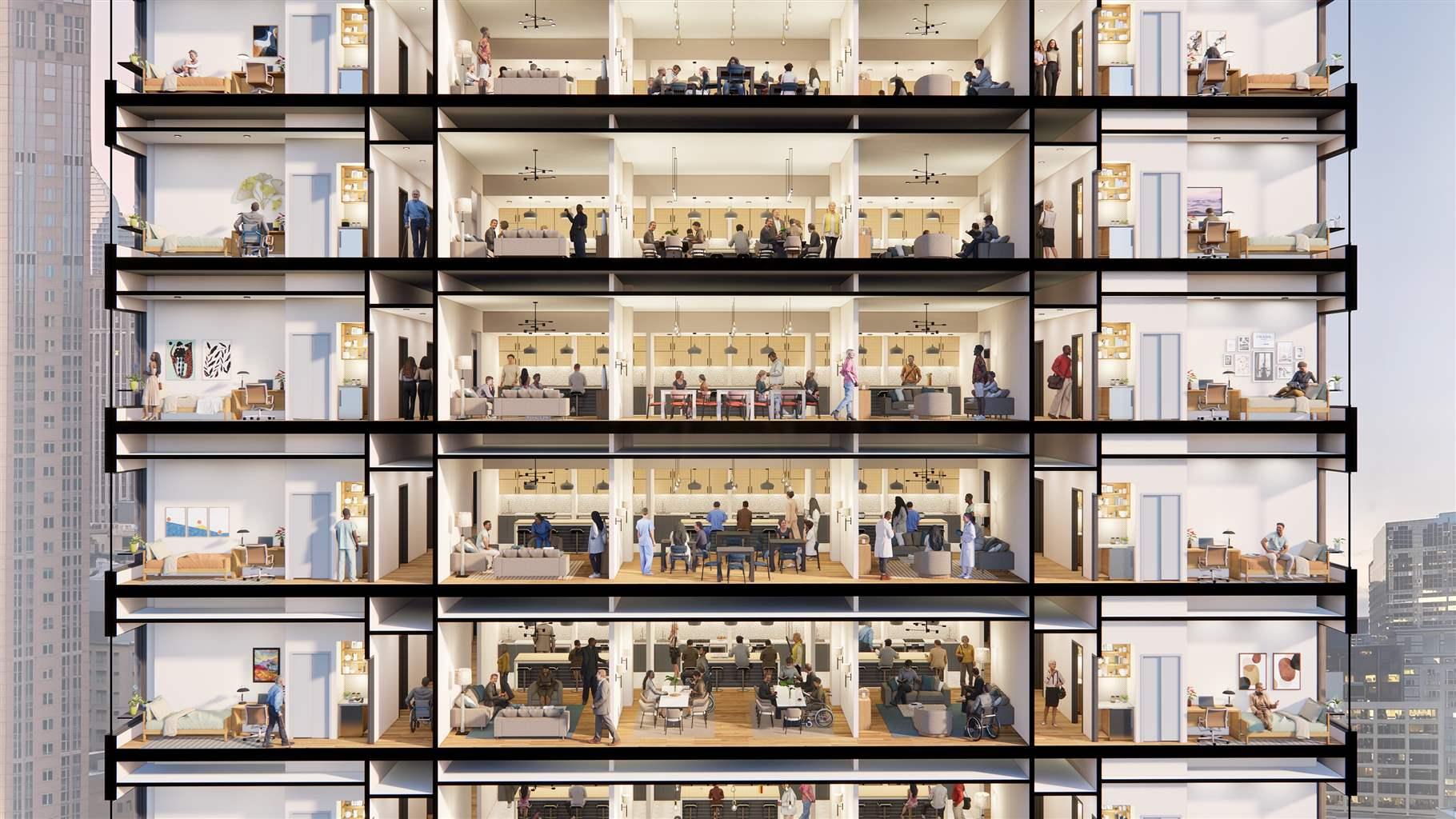
Throughout 2025, The Pew Charitable Trusts collaborated with Gensler, a global architecture, design, and planning firm, to explore the feasibility of transforming vacant office buildings into co-living microapartments in 10 U.S. cities: Denver; Minneapolis; Seattle; Los Angeles; Houston; Chicago; Washington, D.C.; Albuquerque and Santa Fe, New Mexico; and Phoenix. This emerging model takes its cues from single-room occupancy (SRO) dwellings that once provided flexible, extremely low-cost housing before they were largely zoned out of existence. Research estimates that more than 1 million SRO apartments were destroyed or converted to other uses from 1970 to 1980 alone. Their demise was a major factor in driving up homelessness.
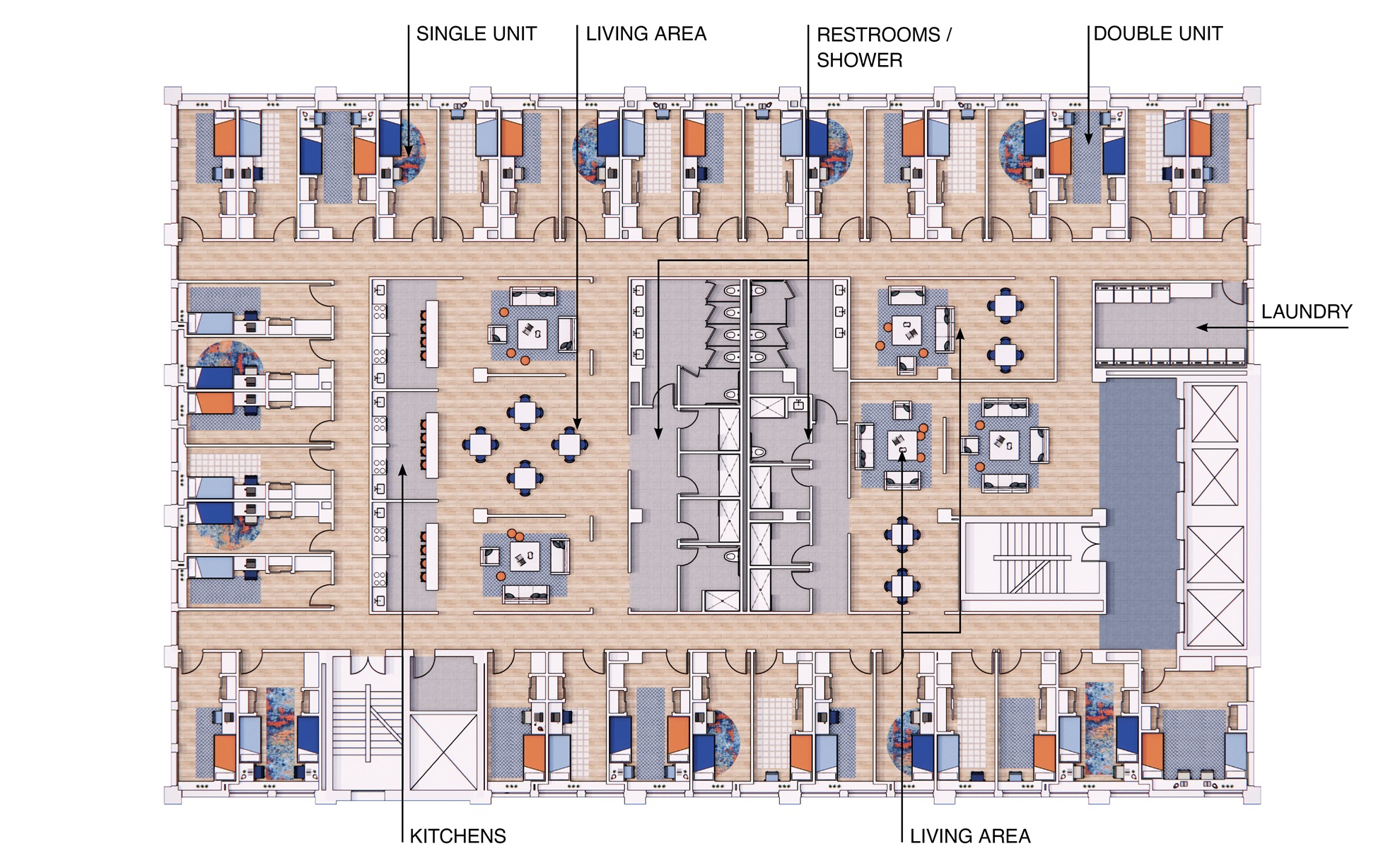
The key innovation of the Gensler design is to locate fully furnished rooms on a building’s perimeter, with windows. It also envisions shared kitchens, bathrooms, and laundry near the building’s core, where an office building’s plumbing already exists.
Although some hurdles to office conversions remain, this Pew/Gensler research demonstrates that this model could deliver much-needed housing to downtowns in a cost-effective and impactful manner.
Strong demand for affordable downtown housing inspires the co-living model
The United States continues to struggle with a severe shortage of homes, including those that Americans with modest incomes can afford. The country faces a shortage of 4 million to 7 million homes, a reality driven especially by restrictive local zoning codes. In the 10 cities studied by the Pew/Gensler team, approximately half of all renter households are considered to be cost-burdened, spending more than 30% of their incomes on rent. In 2024, the Department of Housing and Urban Development reported a record 771,000 people experiencing homelessness in the U.S., an 18% increase from the prior year.
There’s also a mismatch between the housing that is available and what renters need: There is not enough housing near jobs and amenities that is affordable for most workers. Many renters earn less than half the area median income and struggle to find housing in job-rich downtowns where median rents often exceed $2,000 per month. In addition, 40% of renter households nationwide consist of just one person; that figure was closer to 50% in many of the cities studied and reached 56% and 58% in Washington, D.C., and Seattle.
Because of efficient sizes and lower conversion costs, co-living microapartments can be rented at prices that are affordable to people who earn half or less of the area median income—from about $700 a month in Houston and Albuquerque to $1,000 a month in Los Angeles, Seattle, and Washington, D.C. These rents are significantly lower than current housing options.
Development costs per unit are cut by more than half
Working with Turner Construction Company, Gensler found that small co-living apartments could be developed for $123,300 to $238,700 each, including acquisition, design, construction, furnishing, and, where needed, seismic retrofitting. In all but one city—Houston—costs ranged from one-third to half the price of developing new traditional studio apartments, which often run $400,000 each in large, high-cost cities.
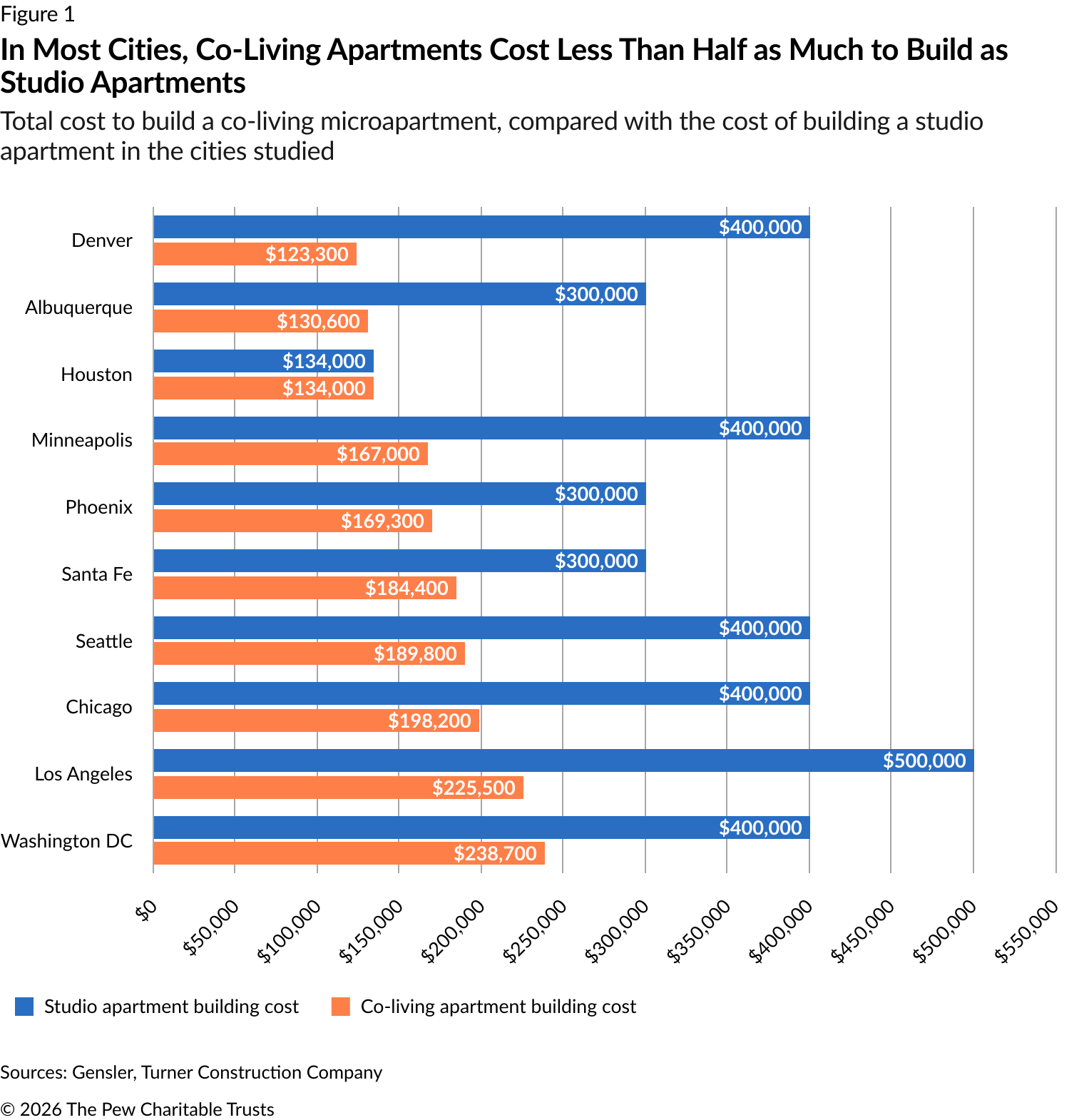
Additionally, converting office space to co-living reduces construction costs by 25% to 35%, on a per-square-foot basis, compared with the cost of a conventional office-to-residential apartment conversion. The savings stem primarily from leaving the office plumbing in the center of each floor, rather than expanding it into each separate apartment.
Stretching scarce housing subsidy dollars
Although this co-living model significantly reduces development costs, public funding would be needed to make projects financially viable. Financial projections suggest that upfront subsidies ranging from $25,000 to $120,000 per microapartment would be needed to attract private developers. But once the conversion is completed, no ongoing operating subsidies would be required. By contrast, each similarly affordable new studio apartment requires subsidies of $200,000 to $300,000 or more in many cities.
This relatively low subsidy means that every dollar of public investment would produce far more housing with the co-living model than a traditional apartment project. In Phoenix, for example, a $25 million subsidy would produce 294 co-living apartments, compared with only 116 studio apartments—roughly 2.5 times as many homes for the same public investment. In Seattle, the “multiplier” would be 4.2; in Chicago, 3.6.
Across the 10 cities studied, co-living conversions would deliver an average of 3.9 times more affordable homes per dollar of subsidy compared with studio apartments.
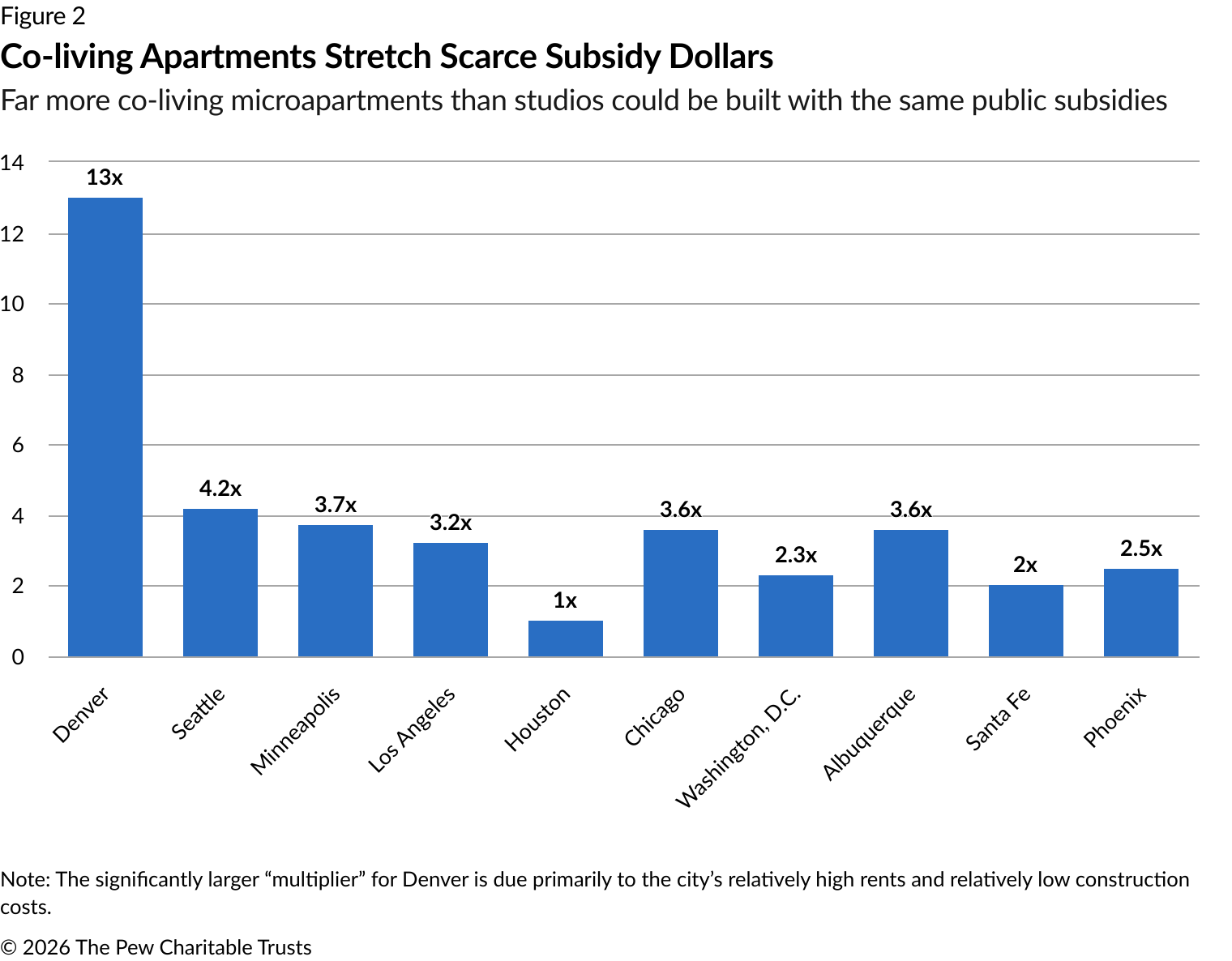
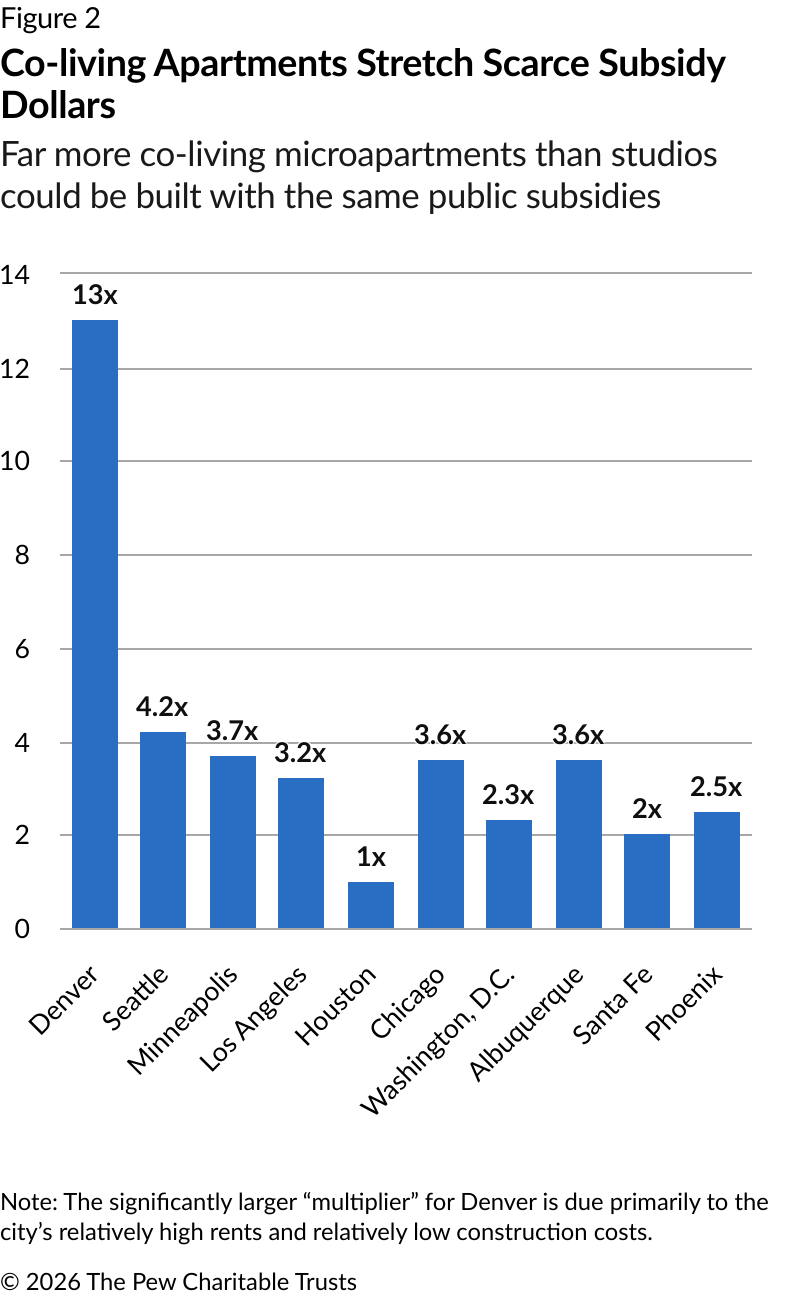
Spending public funds on co-living microapartments rather than studios serves as a kind of efficiency multiplier. It makes co-living conversions particularly attractive in light of the enormous gap between most cities’ needs for affordable housing and the available subsidies. The same public investment can house nearly four times as many residents, dramatically accelerating progress toward housing goals.
States and cities are clearing the regulatory path
In the 10 cities analyzed by the Pew/Gensler team, there were few regulatory barriers to prevent co-living conversions. And many cities have undertaken reforms to facilitate office-to-residential conversions in general. Houston, for example, waived parking requirements in its Central Business District. Denver’s Adaptive Reuse Pilot Program provides dedicated project management to expedite applications for converting offices to housing.
But in many other cities, barriers remain. Simple regulatory reforms could address them: reducing or eliminating requirements for minimum unit size and parking; allowing mechanical ventilation in buildings where operable windows aren’t feasible; removing caps on the number of units per building or acre; and making such conversions “by-right” projects, so no variance or rezoning is necessary.
“Problem buildings” are perfect for co-living
Six years after the COVID-19 pandemic decimated the U.S. office rental market—and sparked early talk about office-to-housing conversions—some 20% of all office space remains vacant nationwide. There has been an uptick in office-to-residential conversions in high-cost cities such as New York City and Washington, D.C., especially for older office buildings. However, not every office building converts well into traditional apartments. Buildings with large floor plates, deep cores, and irregular layouts pose significant design challenges, primarily because traditional apartment designs struggle to make use of windowless space near a building’s core.
These features that challenge traditional apartment conversions don’t inhibit co-living conversions. These buildings can accommodate shared bathrooms, kitchens, living spaces, and storage, with microapartments around the building’s exterior to take advantage of natural light. And large buildings can be subdivided into separate communities, each with keycard access to only its own side.
Appeal for many types of tenants
Another virtue of the microapartment co-living model is its versatility—it could serve a variety of populations. Students seeking low-cost housing near a downtown university would benefit from communal study spaces. Seniors on fixed incomes would benefit from shared dining and socializing areas, with the potential for on-site medical services. The concept could serve as workforce housing for nurses, caregivers, airline workers, and consultants. Employers might sponsor a building or sign a master lease for a whole floor as an employee benefit to attract workers.

A path forward for developers, policymakers, and employers
Although Pew and Gensler’s published research generated significant interest in the co-living conversion concept, the unproven nature of this model poses financing and insurance challenges. However, the extraordinary subsidy efficiency and workforce housing potential create compelling opportunities for collaborative action.
Developers could reduce risk and improve the feasibility of projects by pursuing strategic partnerships and taking a phased approach:
- Target underperforming office buildings with low occupancy rates and low valuations.
- Start with one or two floors as proof of concept before pursuing a full building conversion.
- Engage early with potential employers or institutional sponsors who could provide occupancy guarantees.
- Maximize use of local incentives through office conversion and adaptive reuse incentive programs.
Policymakers could champion co-living conversions because they would make extraordinarily efficient use of public subsidies, rendering them an ideal candidate for public-private development partnerships. With the same affordable housing budget, policymakers could house nearly four times as many residents as they would by subsidizing studio apartments, dramatically accelerating progress toward creating more affordable housing. States and cities could consider:
- Establishing dedicated funding streams or competitive grant programs specifically for co-living office conversions.
- Creating expedited permitting pathways and reducing fees for co-living conversion projects.
- Providing credit enhancements, such as loan guarantees or risk-sharing mechanisms, to help secure insurance for early projects.
- Pursuing pilot projects in publicly owned buildings to demonstrate feasibility and attract private-sector participation.
For organizations that struggle to attract and retain workers or to house students—such as hospitals, airlines, and universities—co-living conversions present a unique opportunity. Conversions could serve as powerful workforce development and retention tools.
Universities and employers could explore:
- Sponsoring or operating entire floors of a converted building to serve as dedicated workforce or student housing near major employment centers or universities.
- Forming employer consortiums to share development and operating costs for multiemployer workforce housing.
- Partnering with developers to guarantee occupancy for a number of units, reducing project risk.
- Providing recruitment and retention incentives that include access to affordable downtown housing.
America’s dire housing shortage demands innovative approaches and solutions that current housing models cannot provide. Office-to-co-living conversions offer a rare convergence of benefits: affordable homes for those who need them most, efficient use of scarce public dollars, workforce housing, and revitalization of downtown areas plagued by office vacancies. For developers, policymakers, and employers who are ready to collaborate, the opportunity is ripe.
Tushar Kansal is a senior officer and Alex Horowitz is a project director with The Pew Charitable Trusts’ housing policy initiative.
People


