Building Homes Near Jobs, Stores, and Transit Saves Public Dollars
New research shows advantages of adding housing in established areas
Amid a national housing shortage, momentum is growing at the state and local levels to make it easier to build more homes—a proven way of reducing unaffordable rents and home prices. A key question facing policymakers is where to allow more homebuilding and what the fiscal impact of that new housing might be.
New research led by experts at the World Resources Institute (WRI) and ECOnorthwest, with support from The Pew Charitable Trusts, shows that building homes near existing jobs, stores, and transit saves public dollars, in both up-front infrastructure and ongoing maintenance costs, and produces more revenue in property taxes per acre than local governments can expect from development at the edge of town. Although communities need more housing of all types, the study demonstrates the advantages of removing outdated, inflexible regulations that block homebuilding in established areas—as well as the benefits of giving residents greater choice in where to live.
The research offers a key insight: Development patterns have real fiscal consequences. New housing built near existing workplaces, retail, and transit entails lower infrastructure construction and maintenance costs because these new homes generally rely on roads and utility connections that are already in place. Housing built at the urban fringe, on the other hand, often requires new roads, sewer and water lines, and other public services. Adding homes around existing amenities maximizes per-acre property tax revenue by making efficient, compact use of land.
This research used economic modeling to estimate the fiscal impact of new housing in 10 states of vastly different sizes and geography: Arizona, Florida, Maryland, Minnesota, Montana, New Hampshire, North Carolina, Pennsylvania, Texas, and Washington. For each state, researchers modeled the number of new homes needed to relieve housing shortages over the next decade and how public costs and revenues would vary according to the type, location, and density of housing. (See methodology appendix.) This analysis did not account for differences among the funding sources—private, local, state, and federal—that support infrastructure development and maintenance.
Key findings include:
- The up-front cost to government and taxpayers of building roads, water and sewer lines, and other public utilities to serve new homes near existing jobs, stores, and transit is approximately $21,000 lower per home than the infrastructure costs associated with building homes at the outer edge of cities and towns.
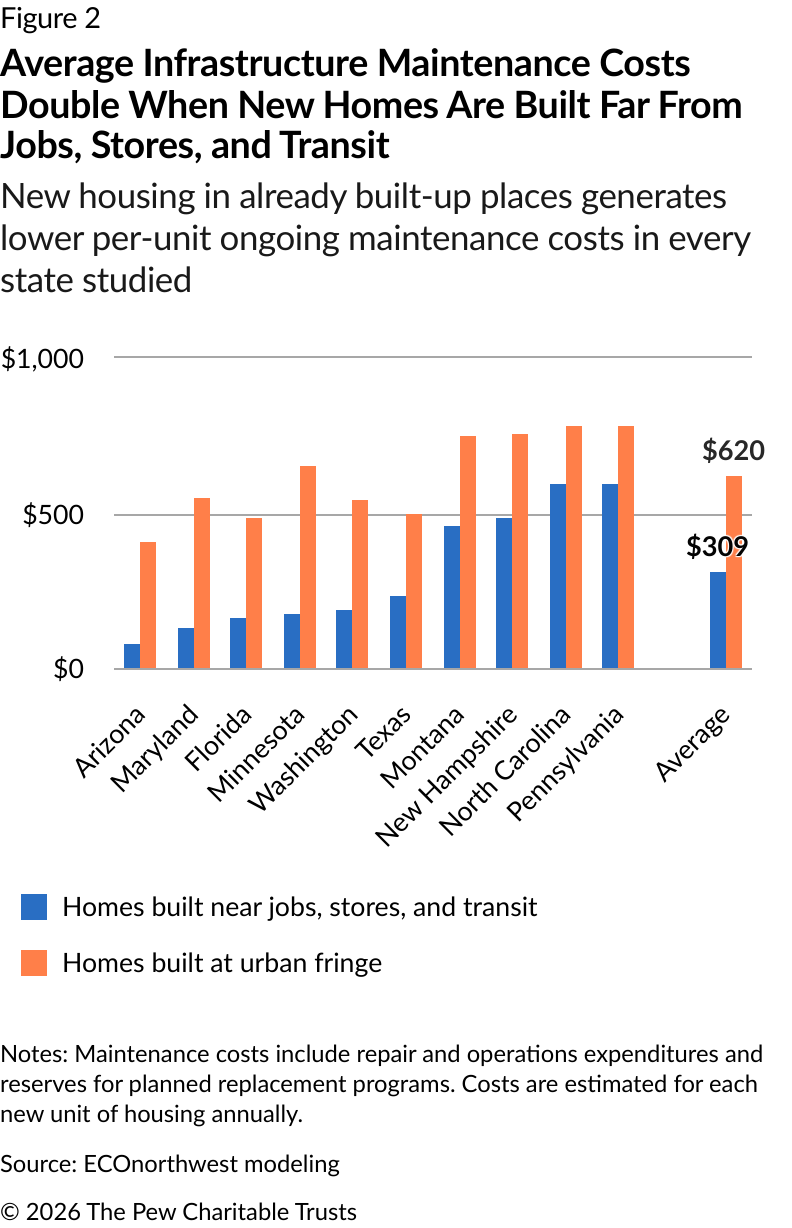
- The ongoing costs to government and taxpayers of maintaining roads and utilities that serve new homes are 50% lower, on average, when those homes are built near existing jobs, stores, and transit.
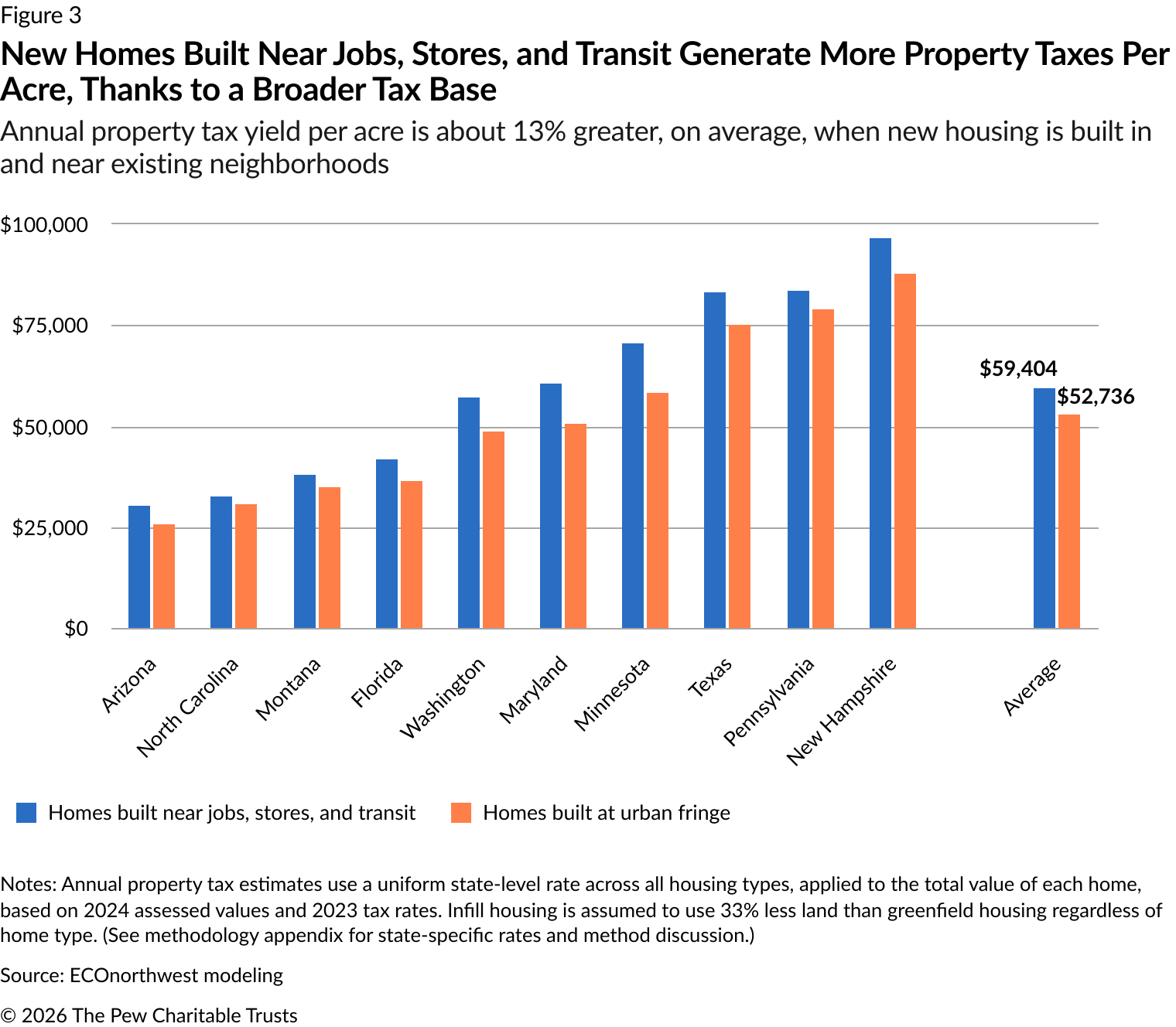
- Property taxes generated per acre are 13% higher, on average, when new homes are built near jobs, stores, and transit.
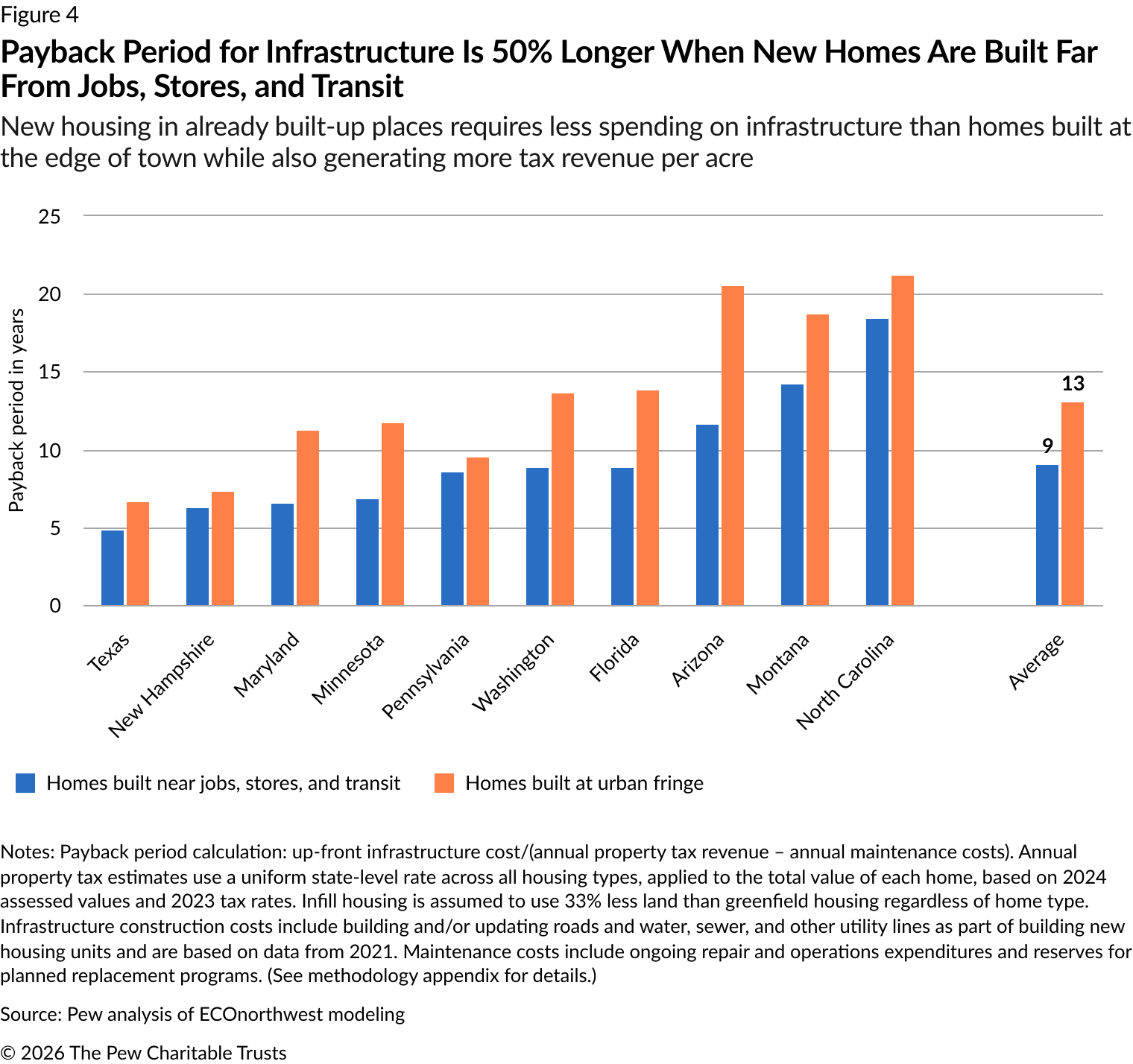
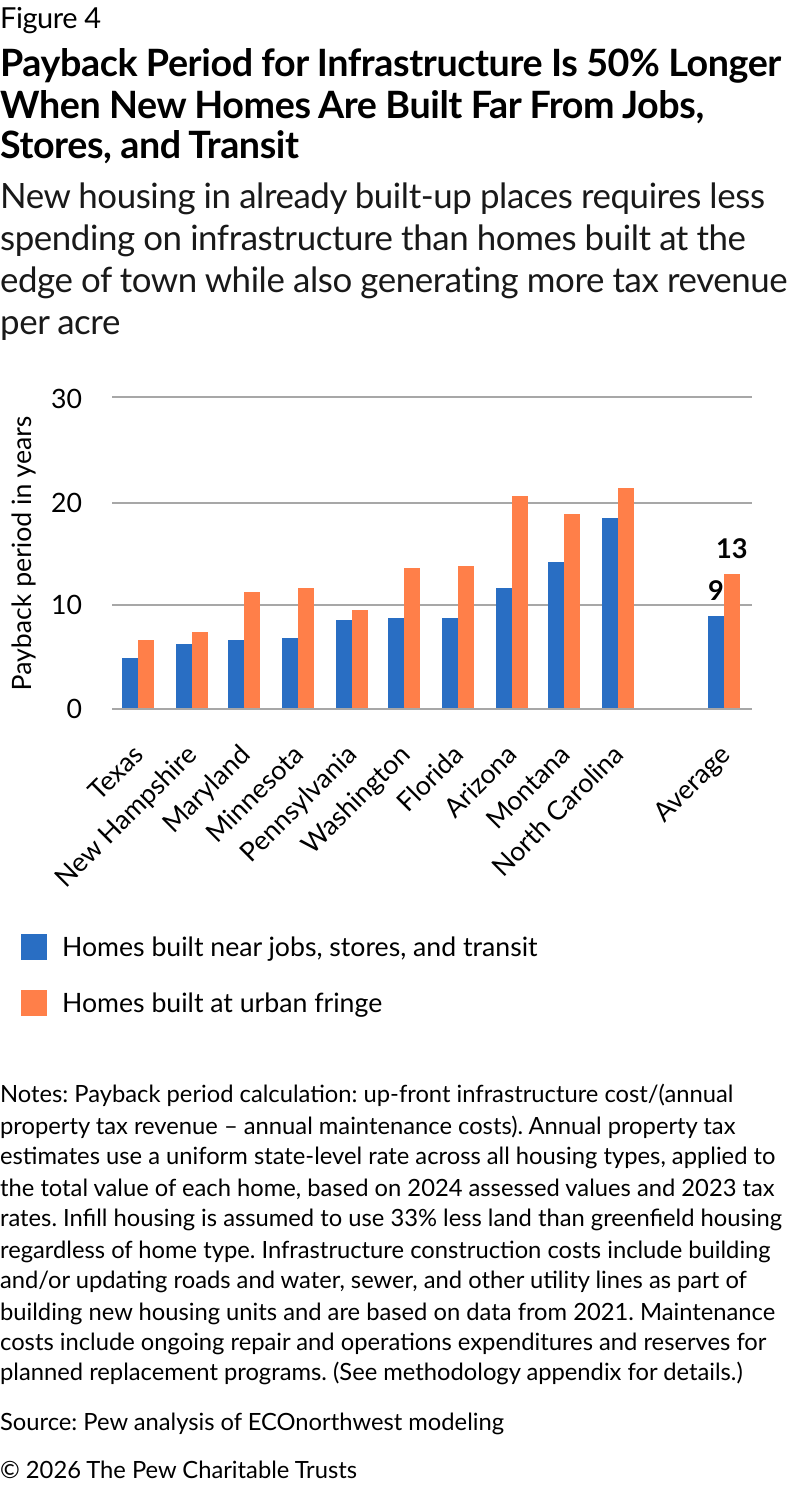
- On average, the payback period for infrastructure associated with new homes is 50% longer when those homes are built in outlying areas than when they are built near existing jobs, stores, and transit.
- Local government can keep property tax rates down while maintaining healthy balance sheets when more housing is built in established areas.
Up-front infrastructure construction costs are lower when new housing is built near jobs, stores, and transit
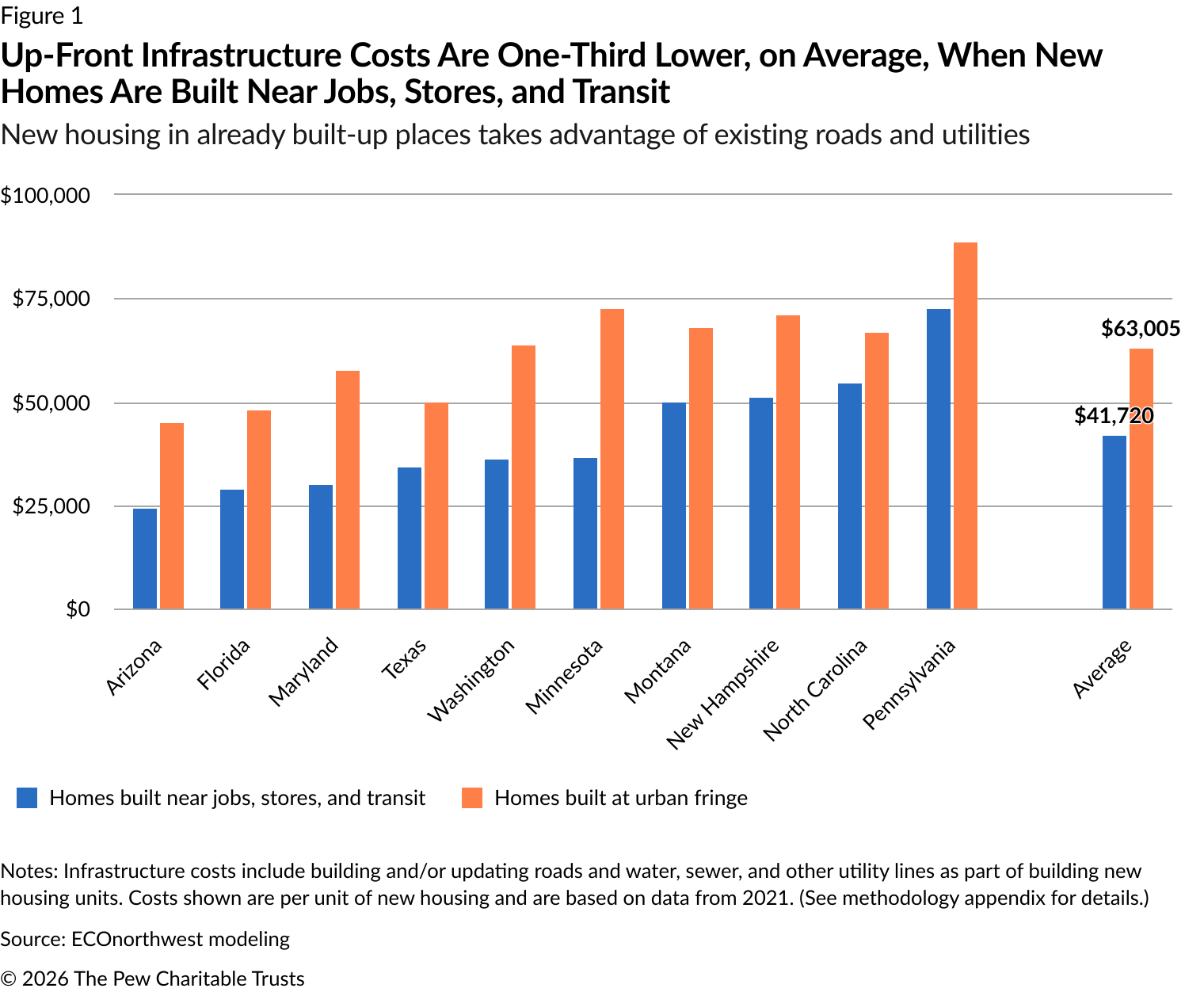
In all states included in this study, up-front infrastructure costs were substantially lower (approximately $21,000 less per home, on average) when new housing was built near existing workplaces, retail, and transportation, as opposed to outside cities and towns. (See Figure 1.) Infrastructure cost differences were largest in states like Minnesota and Washington, which already build compact housing such as apartment buildings in established areas, and smallest in states including North Carolina and Texas, which tend to favor detached single-family homes in undeveloped areas. (Because apartment buildings require fewer miles of roads and sewer and water lines per home, their up-front infrastructure costs are lower per unit than those for detached single-family homes.)
Ongoing infrastructure maintenance costs are lower when new housing is built near jobs, stores, and transit
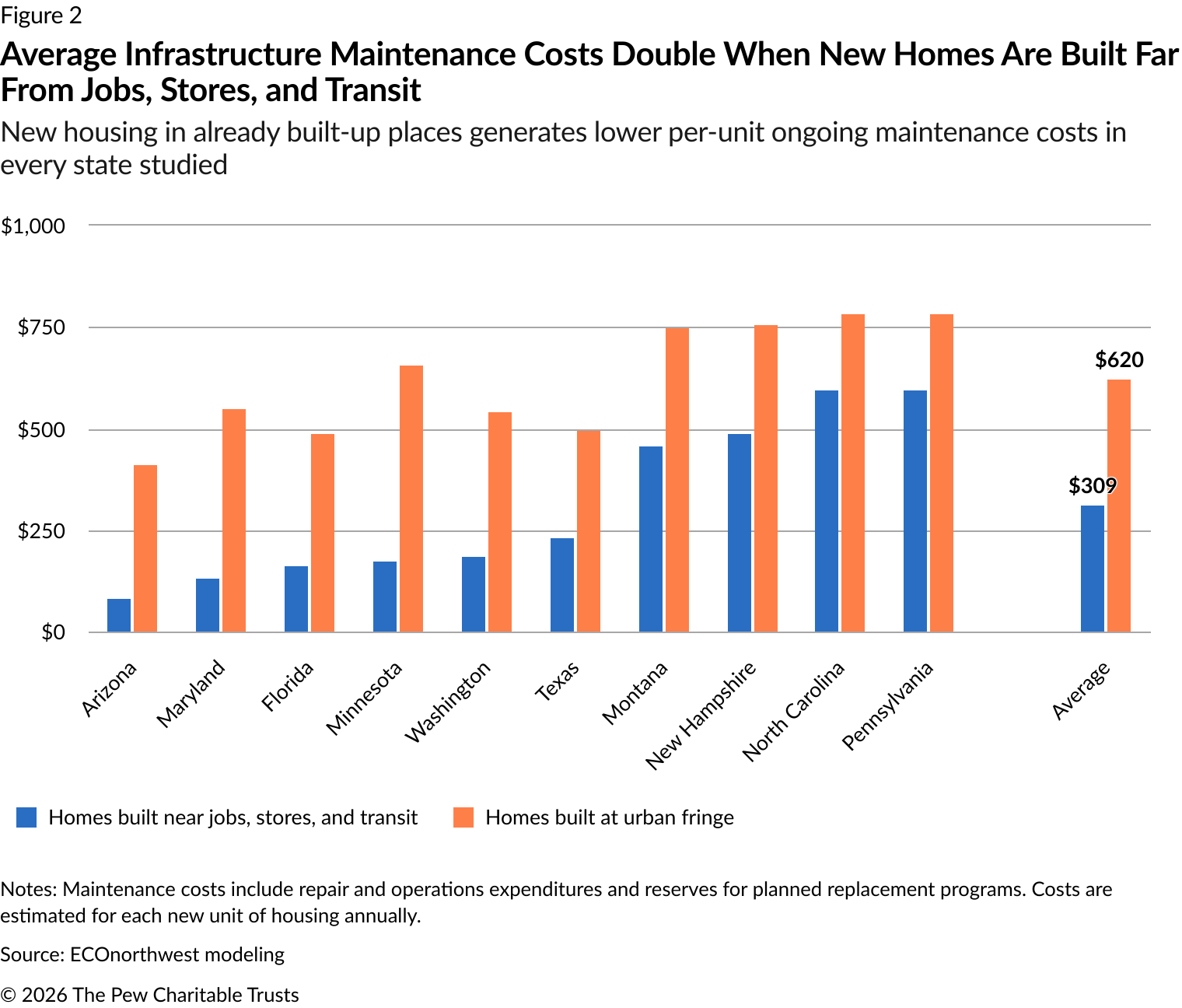
Infrastructure maintenance costs associated with homes built near jobs, stores, and transit are considerably and consistently lower than those of housing built at the fringes of cities and towns. Home construction in established areas relies primarily on existing infrastructure and often includes apartment buildings, duplexes, townhomes, and accessory dwelling units (ADUs), all of which require less infrastructure per unit than detached single-family homes. As a result, ongoing maintenance obligations and planned infrastructure replacement costs are lower—on average, $309 annually per home in areas near jobs, stores, and transit, compared with $620 per home on the edge of town. (See Figure 2.)
Property taxes generated per acre are higher when new homes are built near jobs, stores, and transit
Property taxes are among the largest revenue sources for state and especially local governments. Cities and towns, counties, and school districts all rely on property taxes to fund their operating and capital budgets. This new research shows that new homes built near everyday destinations generate greater property taxes per acre, thanks to a broader tax base, than more dispersed development in the same region. While the total tax yield per acre varies across the 10 states studied, the housing built near jobs, stores, and transit generated 13% more property taxes per acre, on average. These estimates are consistent with previous case study research across numerous cities, regions, and states, which has generally found that more compact development yields higher tax revenue per acre than more dispersed development.
Government can keep property tax rates down, while maintaining fiscal health, by making it easier to build new homes in established areas
Compared with housing built at the edge of cities and towns, new homes near jobs, stores, and transit cost taxpayers less in infrastructure construction and maintenance while also generating more property tax revenue per acre. As a result, property taxes raised from housing in established areas repay infrastructure investment, including ongoing maintenance, within nine years on average. In contrast, new homes built on the urban fringe repay those costs within 13 years on average. (See Figure 4.) This combination of lower infrastructure costs and higher tax revenues per acre allows cities and towns to control property tax rates or spend more on key services for residents. An example may be seen in the American Enterprise Institute’s case study of Palisades Park, New Jersey, which suggests that allowing more compact development in established areas can help spread infrastructure costs across more residents and support lower property tax rates. In addition, with careful planning, property tax revenue can be set aside for reserves to fund the eventual replacement of already built infrastructure.
Adding housing in already developed areas aids long-term budgetary stability
The research shows that adding housing in already developed areas, especially those near jobs, stores, and transit, decreases initial infrastructure costs, reduces ongoing maintenance liabilities, and yields more property taxes per amount of land used. Local budgets benefit, as initial infrastructure is paid off more quickly than it is with development outside cities and towns, and property tax revenue can be used for long-term maintenance, for other societal purposes, or to lower tax rates.
However, despite the fiscal benefits of allowing homes to be built in already developed areas, current municipal finance incentives may lead localities to give preference to development on the urban fringe. For example, there are multiple sources—federal, state, local, and private—of funding for initial infrastructure investment and fewer sources of funding for maintaining infrastructure. Some transportation funding structures favor building new roads and bridges over repairing or expanding existing ones. Yet the long-term costs of maintaining and replacing new infrastructure often fall to local governments and property owners.
Also, many localities finance major infrastructure, such as roads or water and wastewater treatment plants or pumping stations, with long-term debt or large capital investment on the assumption of continued tax revenue and utility connection growth. These large investments for utility capacity are often made by cities, while developers pay for incremental piping and connections to properties. Because cities often rely on future development to repay the cost of infrastructure improvements, they have an incentive to approve new homes that can be permitted and built quickly—and which frequently are sited on untouched land near the urban fringe—to generate short-term tax and utility connection benefits. That development, however, comes with increased long-term maintenance obligations.
These factors help explain the current tendency in many places toward housing development outside cities and towns. However, investing in places with existing infrastructure can concentrate maintenance needs, reduce long-term costs, and alleviate budgetary pressure on local governments—all while providing much-needed housing in areas with high demand.
Reforms to build more housing improve affordability, support local economies, and build the tax base
Many state and local governments are already reforming rules and regulations to address housing supply shortages. Houston, for example, reduced its minimum lot size from 5,000 square feet to as little as 1,400 square feet in the city center in 1998 and citywide in 2013. This change helped to spur construction of nearly 80,000 new townhouses or other small-lot homes, many of which were affordable to middle-income households. Minneapolis simplified permitting for apartment buildings near commercial areas, allowed taller buildings downtown and near transit stations, and reduced and then eliminated parking requirements to meet local needs. These reforms helped the city to increase its housing stock by 12% from 2017 to 2022. Rents rose only 1% during that period, compared with 14% on average in the rest of Minnesota and 30% nationwide.
Jurisdictions that have achieved strong housing growth and improved affordability have done so largely by making it easier to build apartments near commerce and transit. Fifteen states have passed laws to allow apartments in those locations.
Other successful reforms include limiting costly parking mandates and allowing homebuilders and property owners the flexibility to determine the amount of parking that residents actually need, an approach adopted for some housing types in Illinois, Texas, Washington, Montana, Colorado, and New Hampshire. North Carolina, Utah, and Rhode Island have scaled building code requirements for three-to-four-unit apartment buildings instead of applying standards designed for large apartment complexes. California, Arizona, and Florida have streamlined permitting processes to reduce delays and costs.
The benefits of building new homes near jobs, stores, and transit are clear. Modernizing regulations so that it is easier to build housing in amenity-rich, well-connected areas improves affordability, gives people more choices in where to live, strengthens public finances, and helps communities thrive.
Seva Rodnyansky is the research manager and Tushar Kansal is a senior officer for The Pew Charitable Trusts’ housing policy initiative. Ben Holland is a senior manager, Justyn Huckleberry is a projects and research associate, and Jyot Chadha is Deputy Director for the New Urban Mobility Alliance hosted by the WRI Ross Center for Sustainable Cities. Ian Carlton is a senior economic adviser and Natalie Walker is a project manager for ECOnorthwest.
People


