Federal Share of State Budgets Continues Decline From Pandemic Highs
Editor's note: On May 28, the source note for the second chart was updated to reflect that the data came from the 2024 Annual Survey of State Government Finances.
The share of states’ total revenue coming from federal funds declined again in fiscal year 2024, continuing a drop from pandemic-era peaks. The decrease largely reflects an uptick in state-generated revenue—particularly from taxes and other funds—alongside the phaseout of federal COVID-19 aid. Looking ahead, the federal share is likely to remain below pandemic highs, although changes in federal policy and fluctuations in state tax collections could swing it in either direction.
Trends in federal funding
In fiscal 2024, federal dollars accounted for 34.2% of total state revenue, marking the third consecutive annual decrease, down from 36% in fiscal 2023, 36.4% in fiscal 2022, and a record 36.7% in fiscal 2021. Despite the ongoing declines, the federal share remained above pre-pandemic levels, reflecting the continued influence of historic federal support during and after the COVID-19 recession and other major legislation that sent funding to states, including the Infrastructure Investment and Jobs Act and the Inflation Reduction Act.
In fiscal 2024, despite falling by $23 billion—or about 2.1%—compared with the year before, total federal grants to states topped $1 trillion for the third straight year. Meanwhile, states’ general revenue increased by $90.1 billion from fiscal 2023, thanks to record amounts from service charges and local sources—such as local government contributions to the “financial support of programs administered by the state”—as well as higher tax collections, which are the largest single revenue source for most states.
Fiscal 2024 data is the most recent available from the U.S. Census Bureau and does not reflect the potential impacts on state finances of significant recent shifts in federal policy and spending or changes to programs such as Medicaid and the Supplemental Nutrition Assistance Program (SNAP) that were enacted under the budget reconciliation bill last year.
Historically, federal dollars have accounted for about a quarter to a third of state revenue. Before the pandemic, the highest share occurred just after the 2007-09 Great Recession, when a temporary influx of federal dollars and falling state tax revenue pushed the federal share to 35.5% in fiscal 2010 and 34.7% in fiscal 2011. The fiscal 2024 share was 0.7 percentage points higher than the 15-year average of 33.5% starting in fiscal 2010 and 5.6 percentage points higher than the 50-year average of 28.6% since fiscal 1975.
In the period between the Great Recession and the COVID-19 pandemic, Medicaid was a major driver of the long-term growth of the federal share as state participation in the program expanded under the Affordable Care Act (ACA) and overall enrollment increased. As of March, 40 states and Washington, D.C., had adopted the ACA expansion.
The federal share of state revenue reflects the amount of funding states receive from the U.S. government to help pay for services, such as healthcare, education and training, transportation, and infrastructure, but does not include federal spending on contracts, wages, direct payments, and other items that also flow into state economies. This indicator measures the combined effects of swings in state and federal funds. A higher or lower percentage does not necessarily indicate a problem for state budgets. Other measures, such as federal funding per capita and as a percentage of state gross domestic product, can offer additional context on how federal dollars affect states.
Nationwide, states received 55% more in federal grants in fiscal 2024 than they did just before the pandemic in fiscal 2019—with increases ranging from 96.8% in Oklahoma to 34.2% in California. The three states with the largest percentage increases—Oklahoma, South Dakota, and Virginia—all expanded Medicaid since 2019, which contributed significantly to the growth in their federal funding shares. The federal government enacted six laws during the pandemic that together awarded states more than $800 billion in COVID-19 relief, much of which began to wind down starting in fiscal 2023.
Fiscal 2024 also marked the third straight year that states were eligible for the nearly $770 billion authorized through the Infrastructure Investment and Jobs Act and the Inflation Reduction Act—funds that are likely to keep federal grants to states slightly elevated as pandemic aid expires.
State highlights
Federal shares vary across the country. Fiscal 2024 data shows that:
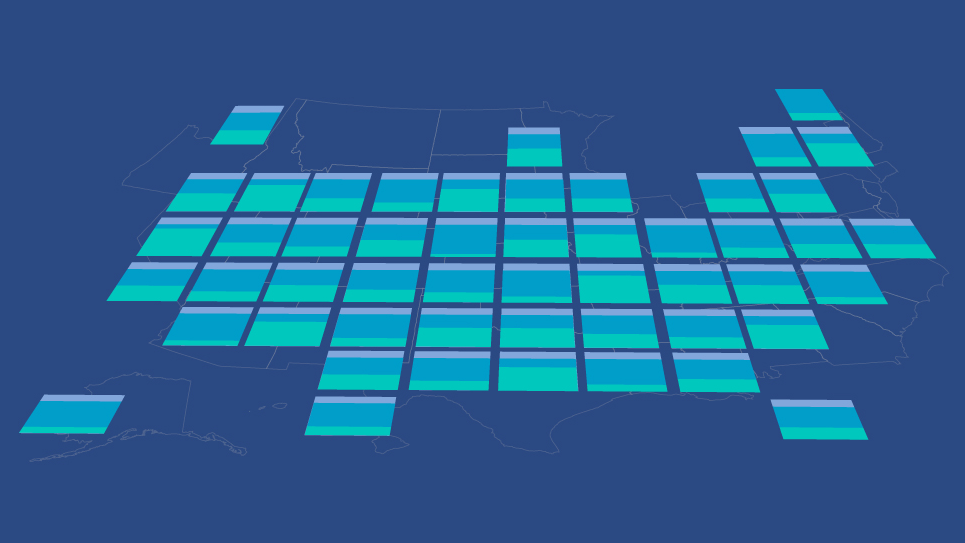
- Louisiana reported the highest percentage of revenue from federal funds for the third consecutive year (50.7%).
- North Dakota reported the lowest percentage (23.9%).
- The percentages of revenue from federal funds in states with the largest federal shares—Louisiana (50.7%), Alaska (48.8%), and Arizona (46.4%)—were roughly double that of states with the lowest shares: North Dakota (23.9%), Hawaii (24%), and Kansas (24.9%), as they had been in fiscal 2023.
- In 13 states, federal funds—rather than state tax dollars—were the largest source of revenue in fiscal 2024, the same as in fiscal 2023 but up from five states in fiscal 2019. The recent peak—also the most on record—was in fiscal 2020, when federal funds made up the largest share in 18 states.
- Only two states—Colorado and Indiana—reported their largest shares of revenue from federal funds of any year in the past 50 years, down from four states in fiscal 2023 and 20 in fiscal 2022.
- Alaska experienced the biggest annual percentage-point increase in the federal share of state revenue at 3.8 points above fiscal 2023. The amount of federal funds the state received actually declined 3.8% from fiscal 2023, but state tax revenue was down 39.3% over the same period because of a major decline in severance tax revenue, translating to an increase in the federal share.
- South Carolina experienced the biggest annual percentage-point decline in its federal share, which fell by 6.7 percentage points from fiscal 2023, driven by the state having the nation’s second-highest growth in tax revenue (15.2%) and the second-highest decline in federal funding revenue (14.3%), both versus fiscal 2023.
Federal funds compared with other revenue sources
Federal dollars remained the second-largest source of state revenue in fiscal 2024, totaling about 34.2% of the roughly $3.1 trillion that state governments collected. Taxes remained states’ leading source, making up 46.9% of state revenue.
Why Pew assesses the federal share of state revenue
State revenue comes from a wide range of sources, including taxes, federal funds, service charges, local funds, and miscellaneous fees. Federal grants are a key funding source for states across an array of policy areas, most notably Medicaid, which accounted for 68.8% of federal grants in fiscal 2024. Income security, transportation, and education make up smaller shares. Because state and federal budgets are inseparably linked, policy changes, major legislation, or disruptions in funding at the federal level can affect state finances. How federal policy changes will affect state finances remains a key concern among state officials amid ongoing questions about the level and stability of federal support that states can anticipate going forward. For instance, changes to Medicaid, SNAP, and other programs, are likely to reduce the revenue flowing from the federal government to states, while recent federal tax legislation will affect collections for items such as tips, overtime, and car loan interest in states that conform.
To better manage these risks, states can use budgeting tools, particularly long-term budget assessments and stress tests, to evaluate their exposure to federal shifts, assess whether their savings are sufficient to weather short-term gaps, and bolster their planning. These analyses should be updated regularly to reflect evolving fiscal conditions. States can also take steps to ensure that they promote transparency, capacity, and strategic coordination in administering federal funding.
Rebecca Thiess is a manager and Samuel Pittman is an associate with The Pew Charitable Trusts’ managing fiscal risks project. Justin Theal is a senior officer with Pew’s Fiscal 50 project.