States Need Broadband Cornerstones to Strengthen Gains and Drive Progress
Lasting network availability, affordability, performance, and quality require state-driven solutions

This issue brief is part of a series exploring policy cornerstones that states can adopt to pursue universal broadband connectivity.
Overview
In the last two decades, broadband, or high-speed internet access, has evolved from a luxury consumer good into essential infrastructure, underpinning Americans’ ability to work, learn, access healthcare, and participate fully in civic and economic opportunities. Like other systems that people rely on every day—including electricity, roads, and water treatment—broadband requires durable policies to make and keep access available, affordable, and reliable. While rising consumer demand, competition, and public and private funding for network expansion have helped make broadband available for most Americans, millions of households and businesses across the country still lack access to this indispensable tool.
Policymakers may pursue different ways of expanding connectivity, but actions at every level of government demonstrate broad bipartisan recognition of the importance of universal broadband service. For The Pew Charitable Trusts’ broadband access initiative, universal access means access to high-speed, reliable, and affordable broadband for every household and business, regardless of location or income.1 States play an essential role in creating the policy framework to achieve this goal.
For The Pew Charitable Trusts’ broadband access initiative, universal access means access to high-speed, reliable, and affordable broadband for every household and business, regardless of location or income. This goal reflects the federal principle of universal service, which holds that all households and businesses should have access to quality telecommunications services, including broadband, at affordable rates.2
A durable state broadband policy framework will address four interdependent challenges:
- Availability: ensuring that networks are built and expanded to reach all households and businesses.
- Affordability: ensuring that households and businesses can pay for connections to those networks over time.
- Performance: ensuring that broadband speeds can support modern applications.
- Long-term quality: ensuring that networks use technologies that can be adapted to deliver the necessary levels of service into the future.
These are supply-and-demand challenges that cannot be addressed in isolation. Networks built without attention to quality and affordability risk low consumer adoption and unsustainable business models. Conversely, affordability policies are effective only if reliable, high-quality connections are available.
Since 2020, when the COVID-19 pandemic accelerated the digitalization of government services, education, healthcare, and commerce, states have emerged as central actors in the effort to expand broadband access. State policymakers have created and empowered state broadband offices (SBOs) to lead statewide broadband planning and investment, and those offices are now serving as the primary implementers of major federal broadband programs. The Broadband Equity, Access, and Deployment (BEAD) program, which was enacted as part of the bipartisan Infrastructure Investment and Jobs Act of 2021, placed states at the center of a historic federal investment in deployment, a decision that reflects their capacity to design and administer programs responsive to local conditions.3
But federal investment alone cannot guarantee universal access. Federal broadband programs are time‑limited, and their rules and priorities can shift. By enacting BEAD, Congress created a one‑time $42.45 billion program to connect all unserved and underserved locations using high‑speed, future‑proof networks—effectively favoring fiber in most locations because of its durability and potential for upgrades.4 But challenges in the succeeding years altered the program’s trajectory. Stalled by complex planning processes and, more recently, shifting funding requirements, BEAD-funded projects began breaking ground only in May 2026, more than four years after the program’s enactment.5 Further, changes instituted in 2025, including an emphasis on lower-cost technologies, are expected to cut total deployment awards roughly in half and to shift many locations away from fiber to technology that will require earlier updates.6
A combination of sustained private investment and government funding programs has driven measurable progress, with the number of unserved and underserved locations falling from an estimated 12 million in 2022 to roughly 4 million today.7 BEAD is expected to connect many of the remaining locations, but estimates suggest 1 million to more than 2 million locations will remain without broadband even after BEAD funds are spent.8 Some of these gaps may emerge with the construction of new homes and businesses in unserved areas; others may persist because of shortcomings in other federal programs. But any gaps in coverage are a reminder that universal access is not a fixed endpoint, and that the task of sustaining coverage over time will increasingly fall to states.
Taken together, these dynamics place broadband policy at a critical crossroads. BEAD still offers an unprecedented chance to expand broadband availability, but states will continue to face challenges, including affordability, upgrades to legacy networks, and population growth and development. State leaders cannot assume that another federal program of BEAD’s scale will become available. They will need to shift their broadband approach away from a reliance on one-time investments and toward sustainable policies that can be adapted to each state’s political, market, and geographic realities.
History provides an example of similar state-level action. Following the enactment of the Rural Electrification Act of 1936, state-level institutions, including public utility commissions and state-supported cooperatives, built on federal investment to expand and sustain service beyond a single funding program.9 Broadband progress will similarly depend on state policies that maintain and build on the gains made through federal investments. This issue brief aims to support state lawmakers, governors’ offices, and broadband policymakers as they develop the policy frameworks capable of safeguarding recent success and driving continued progress toward universal, affordable, high-speed internet access.
A state framework for sustaining broadband progress
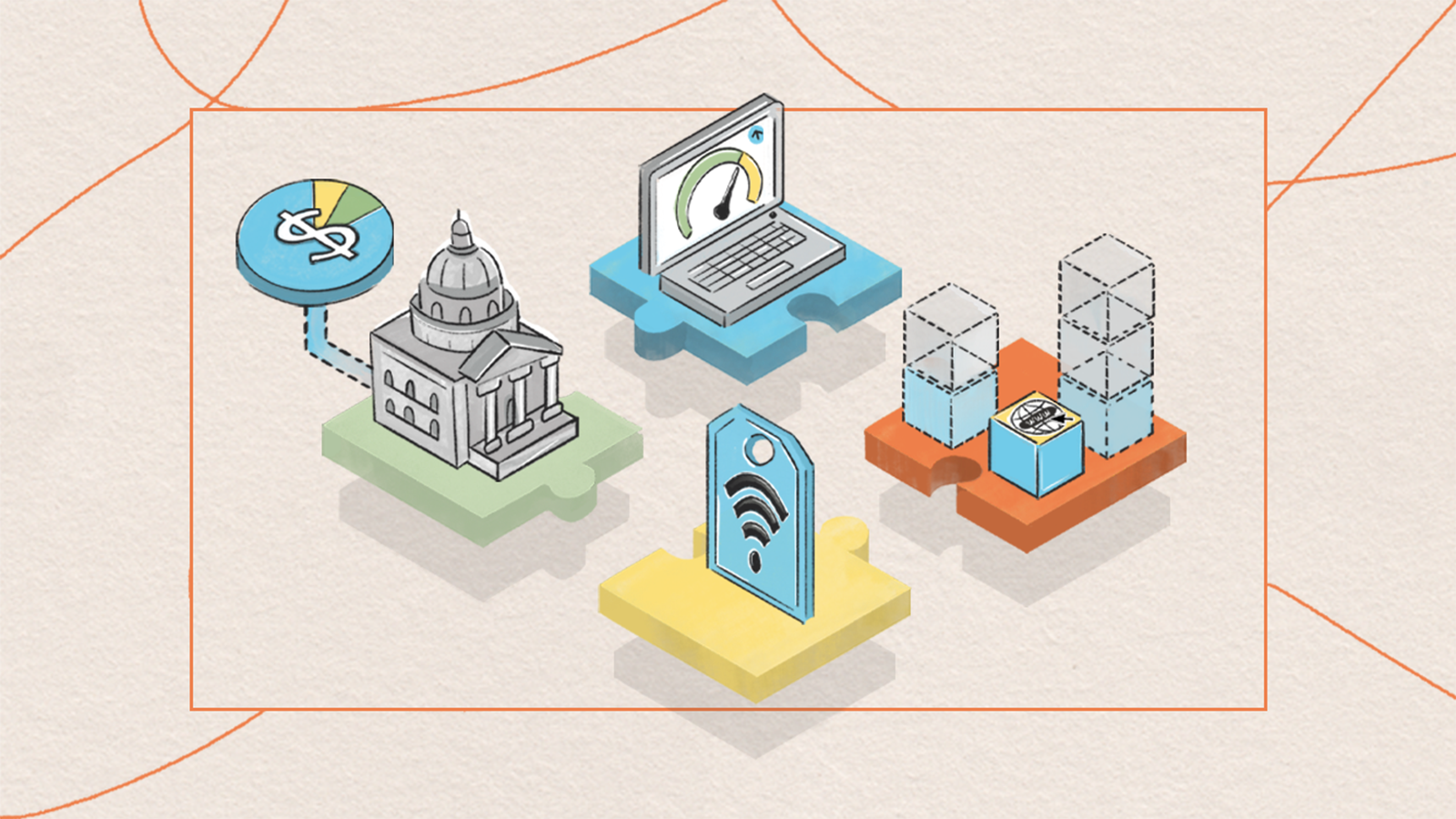
This issue brief identifies four cornerstones of a state‑level policy framework that, when pursued together, create the conditions necessary for universal broadband access:
- Dedicated broadband deployment funding.
- Affordability requirements for broadband service.
- Minimum speed standards.
- Network scalability requirements.
These cornerstones are not a prescriptive model that states must adopt in identical ways. Rather, they are a foundational set of policies that can be adapted to each state’s needs and that together address availability, affordability, performance, and long-term quality, creating the conditions for universal access. States should still consider ways of building on these cornerstones, including policies to sustain SBOs, alleviate barriers to broadband deployment, enable program evaluation, and help residents get online and make effective use of their connections, including through digital skills training and access to devices such as computers and tablets. Research indicates that such policies help safeguard affordable access and support competition, investment in scalable broadband infrastructure, and economic return.10

Unlike many essential services, broadband is delivered primarily through private-sector providers. States have generally advanced broadband goals through funding programs, affordability requirements, and network performance standards rather than through direct regulation of prices or service. The cornerstones presented in this issue brief build on these established approaches and elevate options that account for differing political environments. They are designed to help states advance universal access on an ongoing, consistent basis, moving away from the boom-and-bust cycle of public investment. As they apply cornerstone recommendations, states can craft policies that reflect their specific needs and account for the progress and expertise their broadband offices have achieved in recent years. Pew recommends that such policies apply statewide, but, at a minimum, they can be embedded in state-funded broadband programs to ensure that public investments deliver lasting public benefit.
This issue brief examines the historical precedent for these cornerstones to explain what each policy does, why they are mutually reinforcing, and why states are positioned to enact them.
4 Policy Cornerstones for Universal Broadband Access
Together, these foundational approaches can help states assure connectivity

Cornerstone 1: State broadband deployment funding
Definition: State broadband deployment funding refers to recurring, state-appropriated funds established by statute to support last-mile broadband deployment to homes and businesses. Because the funding is independent of federal programs, it provides state policymakers the flexibility to set their own priorities, standards, and program rules.
Why it matters: Major state-led investments—totaling $1.3 billion in 2025 alone—have raised standards and expanded access beyond what federal programs have provided.11 But annual state-level spending varies significantly, ranging from $461.8 million in Texas to $11 million in Wisconsin.12
Cost of inaction: Without dedicated funding, states risk losing the flexibility needed to close remaining access gaps and maintain network standards, stalling progress toward statewide access to reliable, affordable broadband service.

Cornerstone 2: Affordability approaches as a part of state law
Definition: Affordability approaches refer to state policies designed to ensure that households can subscribe to and maintain broadband connections, as well as to help secure a return on investment for providers building public networks.
Why it matters: Every state has identified affordability as a barrier to access, and Pew’s research shows that affordability levels vary across states. Given the limited regulatory tools available, addressing this problem will require flexibility in state solutions.
Cost of inaction: Without state affordability policies, low-income households risk being priced out of service even as new networks are built with public dollars, and internet service providers (ISPs) will face increased uncertainty around their investments.

Cornerstone 3: Higher speed minimums
Definition: Speed measures the rate, expressed in Megabits per second (Mbps), at which a device sends or receives data and is used in public policy to determine whether a location has access to quality internet service.
Why it matters: Modern realities such as remote work and telehealth appointments require fast, reliable connections, and minimum speed standards help ensure that public investment funds infrastructure capable of supporting those applications.
Cost of inaction: Without codified state-level speed requirements, communities risk being locked into inadequate infrastructure that cannot support consumer needs or attract future investment.

Cornerstone 4: Network scalability
Definition: Scalability refers to a network’s ability to handle more users and deliver higher speeds over time without reconstruction of underlying infrastructure.
Why it matters: Network demands from consumers and businesses often evolve more quickly than networks can be replaced. Networks that cannot scale may quickly become obsolete, putting communities at risk of being left behind.
Cost of inaction: States that do not have scalability requirements may fund networks that cannot keep pace with future speed and performance demands across the state.
What we have learned
Over the past decade, research and evaluation of federal and state broadband policies have identified key lessons that will help achieve and sustain universal access. The Affordable Connectivity Program (ACP), a federal program that provided discounts on internet service for eligible households, demonstrated that demand-side supports can benefit both consumers and industry.13 ACP helped increase broadband adoption among low-income Americans and minimized the risk of customers dropping service, thus improving the economics for ISPs managing networks in high-cost areas of the country.14 After exhausting its initial appropriation, ACP ended in 2024 without additional congressional funding. The program’s expiration resulted in millions of households downgrading or disconnecting their service, underscoring the reality that time-limited subsidies cannot guarantee sustainable affordability.15
State broadband grant programs have demonstrated that dedicated broadband deployment funding can extend networks into previously unserved areas, while funding requirements can reinforce a state’s emphasis on network quality and scalability. In Tennessee, for example, the state invested $25 million across the first two years of a grant program (fiscal years 2018 and 2019).16 That effort leveraged $30 million in private matching funds but received more than $128 million in grant requests in the program’s second year—revealing the scale of unmet need across the state.17
State funding has also given policymakers the flexibility to solve discrete, community-specific coverage gaps. For example, line extension programs in eight states, funded through a mix of state appropriations and federal funds, connected individual homes and businesses sitting just beyond existing last-mile infrastructure, where construction costs had limited private investment.18
In 2024, the Federal Communications Commission (FCC) updated its definition of broadband speed to 100/20 Mbps, the first such update in nine years.19 But the FCC made clear that speed alone is an insufficient measure of broadband connectivity. The federal standard functions as a floor rather than a ceiling, and states are free to adopt higher benchmarks.
However, speed measurements do not capture whether service is sufficient for households. Although some states had established speed benchmarks that met or exceeded the FCC definition, others awarded grants tied to outdated speed standards, and their investments quickly fell short of modern needs.20 States such as Minnesota, which had formalized speed and availability goals in statute ahead of the federal update, could align their grant programs with higher standards from the outset and avoid funding networks that risked being quickly outdated.21
With the development of new broadband transmission technologies, decisions for policymakers, who must weigh the benefits and limitations of each option, have become increasingly complex. Some states, including Maine, have taken steps to ensure that investments prioritize long-term network sustainability over short-term cost savings.22 A Pew-supported analysis by Cornell University in 2023 examined 724 state grants across 17 states from 2014 to 2020 and found that 57% funded fiber, primarily in low-density metro and nonmetro areas—an indication that many states were already working to prioritize speed and scalability over upfront costs.23

Scalability requirements are often viewed as a preference for fiber and in practice have directed more investment toward it. However, scalability, not technology selection, is the underlying goal of those funding preferences. As other technologies, including fixed wireless and low-earth-orbit satellite, continue to advance, more options can help meet scalability objectives, particularly in high-cost, low-density areas where fiber is most difficult to deploy.24 The relevant question for policymakers is not which technology to choose but whether a funded network can continue meeting performance expectations over its service life.
These lessons illustrate the interdependent nature of funding, affordability, speed, and scalability requirements in broadband policy. Demand-side supports like ACP benefit both consumers and industry but are unsustainable without durable funding; state grant programs can extend networks where private investment falls short but work best with clear performance requirements; and speed and scalability standards ensure that public dollars fund infrastructure built for both current and future needs. Pew’s work on broadband access over the past eight years, including field-wide diagnostic assessments and engagement with SBOs, industry experts, nonprofit leaders, and researchers, has consistently confirmed that only together can the four cornerstones help achieve universal access.
The 4 cornerstones
Individually, each of the four broadband policy cornerstones addresses one of the four distinct barriers to universal access: availability, affordability, performance, and long-term quality. Together, they represent a multifaceted approach that responds to the economic realities of deployment for ISPs and adoption among consumers—an approach that will endure beyond any single funding program or federal initiative, and that will evolve to provide lasting, meaningful access for households and businesses across a state.
Deployment funding helps close access gaps where market incentives are weak, and state resources can help pick up where previous programs left off.25
Affordability policies accomplish two needs: First, they help ensure that the benefits of new and upgraded networks reach households that otherwise would be priced out of service, particularly in rural areas.26 Second, they stabilize the customer base that ISPs need to operate.27 Because of the significant up-front costs of building new networks, providers need a stable subscriber base to keep their networks financially viable.28 An analysis by Pew in 2024 reinforced the need for affordability solutions, finding that every state had identified cost to consumers as a leading barrier to adoption.29 Persistent subscription disparities and stagnating adoption in home broadband also point to affordability challenges.30
Speed standards help states properly target investments and protect against investment in networks that will fail to keep pace with evolving technological applications and consumer needs.31
Scalability requirements safeguard publicly funded networks against technological obsolescence, helping to prevent network performance limitations, including issues with speed and latency, that can worsen over time. While Pew recommends that states prioritize fiber deployments, advancements in alternative technologies, such as low-earth-orbit satellite and fixed wireless, have improved and expanded the range of options for high-cost areas.32 Scalability requirements provide a standard that applies across the technology mix chosen by states, ensuring that publicly funded networks can meet rising demand without costly rebuilds.33
Beyond the cornerstones, states should continue to focus on program administration, consumer outreach and support networks, technical assistance, digital skills, deployment barriers, and coordination with local governments and anchor institutions in communities. However, as state lawmakers begin to consider how to alleviate gaps left by federal programs or natural market dynamics, Pew’s research indicates that the four policy cornerstones represent a minimum foundation for access; together, they address the full range of conditions necessary for universal access in a way that no individual policy can.

How the 4 cornerstones fit together
Experience across states shows that the four cornerstones work in tandem. Minimum speed standards and network scalability requirements, together, help protect the long‑term value of infrastructure investments. A speed standard sets a baseline expectation for service quality, ensuring that publicly funded networks can support uses such as remote work, telehealth, and online education.34 Scalability requirements ensure that network infrastructure can be upgraded cost-effectively as usage and applications grow.35 Together, speed and scalability help ensure that networks funded today remain functional, relevant, and cost‑effective over their full life cycle.
Deployment funding and affordability policies are similarly linked. Dedicated state funding provides the resources needed to expand and upgrade networks, particularly in high‑cost or hard‑to‑reach areas where market incentives alone are insufficient or that federal programs have not served. But network construction does not guarantee adoption, and price remains the leading barrier, particularly for low-income households.36 Research links broadband use—not just availability—to gains in economic and societal outcomes, including improvements in employment, income, and health outcomes.37 Those benefits materialize only when households can afford to get and stay online.
If connections are priced at rates higher than what low-income households can afford, the public benefit is only partially realized, and the ISPs that build networks with public funds risk an unsustainable operating environment.38 Pew recommends that states adopt affordability policies statewide, so that they serve all communities. As a stopgap measure, states should pair affordability requirements with publicly funded broadband programs, ensuring that networks built with state dollars reach the communities that need them. Pew’s research reinforces this point, finding that the simple existence of a connection is not sufficient.39 Cost and quality—speed, reliability, latency—all influence a consumer’s choice to purchase service. When paired with deployment funding, affordability requirements help safeguard both public investment and long‑term service viability.
The interdependencies of these four policies underscore a central finding of Pew’s research: Partial approaches address specific barriers to availability or alleviate short-term connectivity gaps, but they fall short of sustaining universal access over time. Pew’s examination of state broadband programs found that the most effective approaches rely on a set of mutually reinforcing practices, as opposed to isolated interventions.40 The cornerstones are adaptable to states’ needs and differences, but their shared purpose remains: creating the policy conditions for universal access that last beyond individual funding programs or political cycles.
Why states must act
The challenge facing states is not only to expand broadband access but also to sustain progress once investments have been made. Networks will require ongoing maintenance and upgrades, affordability barriers will persist, and new homes and businesses will create demand for service.
As private investment and public programs continue to narrow the gap, these challenges will become increasingly localized. In 2025 alone, states enacted more than 160 broadband-related bills and resolutions.41 Such state-level activity demonstrates the variance in the remaining barriers to universal access. A growing community may need to connect newly built homes, while a rural household just beyond existing infrastructure may need a line extension or targeted extension. Connections may be available for low-income households or those with fixed incomes, such as aging Americans, but they may be unaffordable.
Wide variability also exists within the broadband industry: While most Americans receive service from the 10 largest providers, more than 2,000 ISPs operate across the country, each with different cost structures, geography, topography, and consumer needs.42 Pew’s research has found that these conditions range not only across states but also within them, requiring policy action and choices that address local geography, consumer affordability, market structure, and future growth.43 State-level policies can account for these considerations in ways that national policy alone cannot.

As states move toward implementing the final tranche of federal deployment funds through BEAD, they must also ensure that the policy conditions that support broadband expansion persist after federal funding is spent down and as federal policy evolves. The ACP, which was helping more than 23 million low-income households to maintain service, lapsed in 2024.44 The federal Universal Service Fund (USF), another funding support option that has long subsidized broadband deployment and adoption in high-cost and low-income communities, faces declining revenues and an uncertain future.45 Congressional working groups have been established to modernize USF, but the ultimate outcome and timing of any changes are unclear.46 While additional federal programs are available for broadband deployment, they are more limited in geographic scope or intent.
With responsibility for sustaining broadband progress increasingly shifting to states, policymakers will need durable policies capable of addressing these local challenges. SBOs, deployment programs, and affordability initiatives, many of which predate recent federal activity, have helped establish the institutional foundation that states can use to translate time-limited federal broadband investments into long-term policy solutions. This shift mirrors similar transitions in state policy related to other essential infrastructure: State resources and expertise now play a critical role in maintaining the nation’s transportation networks, water systems, and electric grid.47
BEAD provides significant deployment resources while also embedding affordability and service quality requirements into a law aimed at expanding access, protecting consumers, and providing greater certainty for ISPs participating in the program. But BEAD was never intended to be a silver-bullet solution. It was, by design, a one-time intervention to help states pay the high costs of deployment and ensure that all currently unserved and underserved Americans have access to a minimum standard of service. As BEAD funds are committed and spent, the question facing states is not whether a new federal program will follow but how to cement the gains made through federal programs and sustain state-level progress toward guaranteeing high-speed, reliable, and affordable broadband for every household.
Conclusion
No single policy or program can achieve universal broadband access on its own. Sustained investment, affordability requirements, speed standards, and scalable networks each address different barriers to connectivity.48 When combined, these four cornerstone policies reinforce one another, helping states protect public investment, meet evolving demands from consumers and businesses, and expand.
Underlying these cornerstones is a shift in how state leaders think about broadband. While one-time federal investments are helping close connectivity gaps, they have also revealed the limits of what any single program can achieve. Like other essential services, broadband infrastructure requires continuous investment and maintenance to remain operational and available to all households and businesses. Sustainable investment is paramount as Americans continue to rely ever more on connectivity for work, education, healthcare, and economic opportunity, and states can take the lead in creating lasting solutions.
As of 2026, 34 states have adopted at least two of the four cornerstones for universal broadband access, and two have adopted all four. As BEAD implementation begins in earnest, every state has an opportunity to review its broadband policies and enshrine a foundational framework in law, establishing clear expectations for providers and programs while creating the continuity needed to support ISPs as well as consumers—and ensuring lasting access to universal, affordable high-speed internet service across the states.
Methodology
In preparing this brief, Pew examined state adoption of four identified policies that research suggests can help support long-term access, affordability, and network performance. The four cornerstone policies are:
- Dedicated state funds for broadband infrastructure that incentivize ISPs to continue expanding and upgrading networks.
- Requirements that ISPs receiving public funding provide affordable options for consumers.
- Speed minimums of at least 100/20 Mbps.
- Preferences for scalable technology that can keep pace with evolving technologies and market forces.
Pew’s research relies exclusively on publicly available state statutes and does not incorporate program implementation data or funding outcomes. This methodology is designed to capture the presence and structure of these cornerstone policies, rather than to evaluate a state program’s effectiveness or outcomes.
For each cornerstone, Pew assessed each state’s statutory language to determine whether the state maintained the required standards. Following are the selection criteria for each cornerstone:
Dedicated state funds for last-mile broadband deployment that incentivize ISPs to continue expanding and upgrading networks
Pew assessed states on whether they maintain a dedicated broadband infrastructure fund. Any state that had established a broadband deployment or maintenance program in statute was classified as meeting this cornerstone. Where applicable, Pew distinguishes between states that make ongoing state-level contributions to these funds and those that rely primarily on one-time or federal funding sources.
Requirements that ISPs receiving public funding provide affordable options for consumers
Pew assessed affordability policies using three established policy approaches: a requirement that ISPs provide low-cost plans across the state; reform of state Universal Service Fund programs to include broadband in the service subsidies they provide to low-income households; and direct subsidies to consumers. States were classified as meeting the affordability cornerstone if they had at least one of these mechanisms codified in statute.
Affordability provisions that appeared only as grant-scoring criteria, rather than as enforceable requirements, were not counted.
Speed minimums of at least 100/20 Mbps
Pew identified whether a state statute defined broadband service at 100/20 Mbps or explicitly defaulted to the FCC’s current broadband definition. States were classified as meeting this cornerstone if either condition was met. Moving forward, if the FCC updates its broadband speed benchmark, state classifications will be revisited to reflect those changes.
Preferences for scalable technology that can keep pace with evolving technologies and market forces
Pew reviewed statutory language for references to network scalability or equivalent concepts. Because states use varied vocabulary, researchers accounted for terms including “future-proof technology” and “scalable networks,” as well as language requiring infrastructure to be capable of meeting future performance needs. States were classified as meeting this cornerstone when statutory language emphasized investment in technologies designed to support higher speeds over time, regardless of the specific language used.
Endnotes
- “Broadband Access Initiative,” The Pew Charitable Trusts, 2026, https://www.pew.org/en/projects/broadband-access-initiative.
- United States Code, Universal Service, 47 U.S.C. § 254 (2020), https://www.govinfo.gov/content/pkg/USCODE-2020-title47/html/USCODE-2020-title47-chap5-subchapII-partII-sec254.htm.
- 117th Cong., Infrastructure Investment and Jobs Act, Public Law No: 117-58, (2021), https://www.congress.gov/bill/117th-congress/house-bill/3684/.
- “Broadband Equity Access and Deployment Program,” National Telecommunications and Information Administration, 2026, https://broadbandusa.ntia.gov/funding-programs/broadband-equity-access-and-deployment-bead-program.
- Government Accountability Office, “Applicability of the Congressional Review Act to Broadband Equity, Access, and Deployment Program Restructuring Policy Notice,” 2025, https://www.gao.gov/assets/890/882701.pdf. Nextlink, “Nextlink Activates First Bead-Funded Tower in the United States, Connecting Rural Louisiana,” news release, May 13, 2026, https://nextlinkinternet.com/nextlink-activates-first-bead-funded-tower-in-the-united-states-connecting-rural-louisiana/.
- Sophia Bock and Kathryn de Wit, “What’s Next for Broadband Expansion?,” The Pew Charitable Trusts, Jan. 13, 2026, https://www.pew.org/en/research-and-analysis/articles/2026/01/13/whats-next-for-broadband-expansion.
- Johannes M. Bauer et al., “Assessing the Effects of the Infrastructure Investment and Jobs Act (IIJA),” Quello Center at Michigan State University, 2026, https://quello.msu.edu/iija-assessment/. National Telecommunications and Information Administration, “Written Statement of Arielle Roth Before the House Committee on Energy & Commerce Subcommittee on Communications & Technology,” news release, June 30, 2026, https://www.ntia.gov/speech/testimony/2026/written-statement-arielle-roth-house-committee-energy-commerce-subcommittee-communications.
- Kelcie Lee, “Expert Says Millions of Areas Remain Unserved in Spite of BEAD and Other Programs,” Broadband Breakfast, April 8, 2026, https://broadbandbreakfast.com/expert-says-millions-of-areas-will-remain-unserved-after-bead-other-federal-programs/. Alex Karras and Michael Santorelli, “One Million Locations Might Remain Unserved Post-BEAD. Leftover Funds Should Be Used to Connect Them,” Broadband Expanded, 2025, https://broadbandexpanded.com/posts/unservedafterbead.
- Tim Sablik, “Electrifying Rural America,” Econ Focus, First Quarter 2020 (2020), Federal Reserve Bank of Richmond, https://www.richmondfed.org/publications/research/econ_focus/2020/q1/economic_history.
- Wolfgang Bock et al., “The Economic Case for Bringing Broadband to the Rural US,” The Boston Consulting Group, 2018, https://web-assets.bcg.com/img-src/BCG-The-Economic-Case-for-Bringing-Broadband-to-the-Rural-US-June-2018_tcm9-193836.pdf. Christopher G. Reddick et al., “Determinants of Broadband Access and Affordability: An Analysis of a Community Survey on the Digital Divide,” Cities 106, no. 2020 (2020): 102904, https://doi.org/10.1016/j.cities.2020.102904.
- Jake Varn, “The Role of State Broadband Policy in 2026,” The Pew Charitable Trusts, March 10, 2026, https://www.pew.org/en/research-and-analysis/articles/2026/03/10/the-role-of-state-broadband-policy-in-2026.
- Texas Legislature, S.B. No. 1 General Appropriations Acts Eighty-Ninth Legislature (2025), https://capitol.texas.gov/tlodocs/89R/billtext/pdf/SB00001F.pdf. Wisconsin State Legislature, Senate Bill 45, (2025), https://docs.legis.wisconsin.gov/2025/proposals/reg/sen/bill/sb45.
- “Affordable Connectivity Program,” Federal Communications Commission, 2024, https://www.fcc.gov/acp.
- John B. Horrigan, “Estimating the Impacts of the Affordable Connectivity Program: The ACP Boosted Rural Adoption and Helped to Keep the Subscription Vulnerable Online” (presentation, TPRC 53: The 53rd Research Conference on Communication, Information and Internet Policy, July 31, 2025), https://papers.ssrn.com/sol3/papers.cfm?abstract_id=5374183. Kelsey Clark et al., “Closing the Digital Divide Benefits Everyone, Not Just the Disconnected,” Common Sense, 2022, https://www.commonsensemedia.org/sites/default/files/research/report/2022-cs-bcg-closing-digital-divide_final-release-3-for-web.pdf.
- John B. Horrigan, “Leaving Money on the Table: The ACP’s Expiration Means Billions in Lost Savings,” Benton Institute for Broadband & Society, 2024, https://www.benton.org/sites/default/files/ACP-survey1.pdf. Coleman Bazelon, Paroma Sanyal, and Yong Paek, “Paying for Itself: How the Affordable Connectivity Program Delivers More Than It Costs,” The Brattle Group, 2025, https://www.brattle.com/wp-content/uploads/2025/02/Paying-for-Itself-How-the-Affordable-Connectivity-Program-Delivers-More-Than-It-Costs.pdf?ref=broadbandbreakfast.com.
- “Tennessee Broadband Accessibility Act,” Tennessee Department of Economic and Community Development, 2026, https://www.tn.gov/ecd/rural-development/tennessee-broadband-grant-initiative/tennessee-broadband-accessibility-act-article.html.
- The Pew Charitable Trusts, “How States Are Expanding Broadband Access,” 2020, https://www.pew.org/-/media/assets/2020/03/broadband_report0320_final.pdf.
- The Pew Charitable Trusts, “How 8 States Are Using Line Extension Programs to Connect Unserved Residents to Broadband,” 2023, https://www.pew.org/en/research-and-analysis/issue-briefs/2023/06/how-8-states-are-using-line-extension-programs-to-connect-unserved-residents-to-broadband.
- Federal Communications Commission, “2024 Section 706 Report,” 2024, https://docs.fcc.gov/public/attachments/FCC-24-27A1.pdf.
- Benton Institute for Broadband and Society, “How the FCC Got to 100/20,” 2024, https://www.benton.org/blog/how-fcc-got-10020.
- Minnesota Legislature, Minnesota Statutes, 116J.395 (2025), https://www.revisor.mn.gov/statutes/cite/116J.395#:~:text=An%20applicant%20for%20a%20grant,benefit%20from%20the%20proposed%20project.
- Maine Revised Statutes, State Broadband Policy, 35‑A M.R.S. § 9202‑A (2015), https://www.mainelegislature.org/legis/statutes/35-A/title35-Asec9202-A.html.
- Natassia A. Bravo and Mildred E. Warner, “Closing the Broadband Infrastructure Gap: State Grant Funds and the Digital Divide,” Cornell University, 2023, https://labs.aap.cornell.edu/sites/aap-labs/files/2023-10/StateBroadbandReportFinal.pdf.
- Ellis Scherer and Joe Kane, “BEAD Needs All Technologies to Succeed,” Information Technology & Innovation Foundation, 2025, https://itif.org/publications/2025/01/21/bead-needs-all-technologies-to-succeed/.
- Colby Leigh Rachfal, “State Broadband Initiatives: Selected State and Local Approaches as Potential Models for Federal Initiatives to Address the Digital Divide,” Congressional Research Service, 2020, https://www.congress.gov/crs_external_products/R/PDF/R46307/R46307.1.pdf.
- Colin Rhinesmith, Bianca Reisdorf, and Madison Bishop, “The Ability to Pay for Broadband,” Communication Research and Practice 5, no. 2 (2019): 121-38, https://doi.org/10.1080/22041451.2019.1601491. Brian Whitacre, “Research and Analysis: Rural Internet Subscribers Pay More, New Data Confirms,” The Daily Yonder, Nov. 28, 2023, https://dailyyonder.com/research-and-analysis-rural-internet-subscribers-pay-more-new-data-confirms/2023/11/28/.
- John B. Horrigan, “One More Thing: The ACP Boosted Rural Adoption and Helped to Keep the Subscription Vulnerable Online,” Benton Institute for Broadband & Society, 2025, https://www.benton.org/sites/default/files/One-More-Thing.pdf. Summer Boucher-Robinson and Jake Varn, “States Reckon With Lapse of the Broadband Affordable Connectivity Program,” The Pew Charitable Trusts, Sept. 20, 2024, https://www.pew.org/en/research-and-analysis/articles/2024/09/20/states-reckon-with-lapse-of-the-broadband-affordable-connectivity-program.
- National Telecommunications and Information Administration, “Economics of Broadband Networks: An Overview,” 2022, https://broadbandusa.ntia.gov/sites/default/files/2022-03/Economics%20of%20Broadband%20Networks%20PDF.pdf. Brian E. Humphreys, “Demand for Broadband in Rural Areas: Implications for Universal Access,” Congressional Research Service, 2019, https://www.congress.gov/crs-product/R46108.
- Kelly Wert, “Every State Identifies Broadband Affordability as Primary Barrier to Closing Digital Divide,” The Pew Charitable Trusts, Oct. 4, 2024, https://www.pew.org/en/research-and-analysis/articles/2024/10/04/every-state-identifies-broadband-affordability-as-primary-barrier-to-closing-digital-divide.
- John Horrigan, “The End of Progress: New Data Raises the Alarm That No Progress May Be the New Normal for the Digital Divide,” Benton Institute for Broadband & Society, 2025, https://www.benton.org/blog/end-progress-new-data-raises-alarm-no-progress-may-be-new-normal-digital-divide. Pew Research Center, “Internet, Broadband Fact Sheet,” 2025, https://www.pewresearch.org/internet/fact-sheet/internet-broadband/.
- Colby Humphrey, “To Improve Broadband Deployment, Enhanced Data Collection Is Key,” The Pew Charitable Trusts, 2025, https://www.pew.org/en/research-and-analysis/reports/2025/07/to-improve-broadband-deployment-enhanced-data-collection-is-key.
- Federal Communications Commission, “2024 Communications Marketplace Report,” 2024, https://docs.fcc.gov/public/attachments/FCC-24-136A1.pdf. Congressional Research Service, “Fixed Technologies Used to Deliver Broadband Service: A Primer and Considerations for Congress,” 2023, https://www.congress.gov/crs_external_products/IF/PDF/IF12441/IF12441.1.pdf.
- The Fiber Broadband Association, “Fiber Broadband Scalability and Longevity,” 2024, https://fiberbroadband.org/wp-content/uploads/2024/02/FBA-0018E_ScalabilityLongevity_WhitePaper_lv2.pdf. Doug Dawson, “The Rural Broadband Industry,” CCG Consulting, 2021, https://www.pew.org/-/media/assets/2021/09/white_paper_rural_broadband_industry_final.pdf.
- Christina Biedny, Brian E. Whitacre, and Andrew J. Van Leuven, “Do Gigabits Mean Business? ‘Ultra-Fast’ Broadband Availability’s Effect on Business Births,” Information Economics and Policy 68 (2024): 101094, https://doi.org/10.1016/j.infoecopol.2024.101094. Maysam Rabbani, “Internet Price, Speed, and Disparity: The Case of Rural Healthcare Providers in the United States,” Telecommunications Policy 48, no. 2 (2024): 102674, https://doi.org/10.1016/j.telpol.2023.102674.
- The Fiber Broadband Association, “Fiber Broadband Scalability and Longevity.”
- Colby Humphrey, Elizabeth A. Mack, and John B. Horrigan, “Moving Toward a Continuum Model of Broadband Affordability for Low-Income Households,” Telecommunications Policy 49, no. 9 (2025): https://doi.org/10.1016/j.telpol.2025.103027.
- Jed Kolko, “Broadband and Local Growth,” Journal of Urban Economics 71, no. 1 (2012): 100-13, https://doi.org/10.1016/j.jue.2011.07.004. National Conference of State Legislatures, “Connection for a Cure: How Broadband Access Supports Telehealth Use,” 2026, https://www.ncsl.org/technology-and-communication/connection-for-a-cure-how-broadband-access-supports-telehealth-use.
- National Telecommunications and Information Administration, “Economics of Broadband Networks: An Overview.” Augusto Espín and Christian Rojas, “Bridging the Digital Divide in the U.S.,” International Journal of Industrial Organization 93 (2024): https://doi.org/10.1016/j.ijindorg.2024.103053. George W. Zuo, “Wired and Hired: Employment Effects of Subsidized Broadband Internet for Low-Income Americans,” American Economic Journal: Economic Policy 13, no. 3 (2021): 447-82, https://www.aeaweb.org/articles?id=10.1257/pol.20190648.
- Kelly Wert, “Together, Broadband Deployment and Digital Inclusion Programs Support Increased Internet Adoption,” The Pew Charitable Trusts, Jan. 28, 2025, https://www.pew.org/en/research-and-analysis/articles/2025/01/28/together-broadband-deployment-and-digital-inclusion-programs-support-increased-internet-adoption.
- The Pew Charitable Trusts, “How States Are Expanding Broadband Access.”
- Jake Varn, “The Role of State Broadband Policy in 2026.”
- Federal Communications Commission, “2024 Communications Marketplace Report.”
- The Pew Charitable Trusts, “How States Are Expanding Broadband Access.”
- “ACP Enrollment and Claims Tracker,” Universal Service Administrative Co., 2021-2024, 2024, https://www.usac.org/about/affordable-connectivity-program/acp-enrollment-and-claims-tracker/.
- Patricia Moloney Figliola, “The Universal Service Fund and Related FCC Broadband Programs: Overview and Considerations for Congress,” Congressional Research Service, 2026, https://www.congress.gov/crs_external_products/R/PDF/R47621/R47621.9.pdf.
- Office of Senator Ben Ray Luján, “Luján, Fischer Announce Bipartisan, Bicameral Universal Service Fund Working Group,” news release, June 12, 2025, https://www.lujan.senate.gov/newsroom/press-releases/lujan-fischer-announce-bipartisan-bicameral-universal-service-fund-working-group/.
- National Conference of State Legislatures, “Electric Transmission Development: The Role of States,” 2026, https://www.ncsl.org/energy/electric-transmission-development-the-role-of-states. Congressional Budget Office, “Public Spending on Transportation and Water Infrastructure, 1956 to 2023” (presentation, Feb. 26, 2025), https://www.cbo.gov/publication/60874.
- Zhu Ling, “The Broadband Equity, Access, and Deployment (BEAD) Program: Issues for the 119th Congress,” Congressional Research Service, 2025, https://www.congress.gov/crs-product/R48666.
People


