Distributed Energy Can Unleash the Resilient, Affordable Grid of the Future
A policy playbook for bringing critical technology resources to scale across the U.S.

Overview
The U.S. power system is at a pivotal moment. Rapidly growing electricity demand from manufacturing, data centers, and electrification is straining the aging grid, and extreme weather and prolonged outages are causing reliability concerns. To address these challenges, utilities throughout the country are proposing significant capital expenditures to modernize power grid systems, but that spending is also putting upward pressure on the rates customers pay.
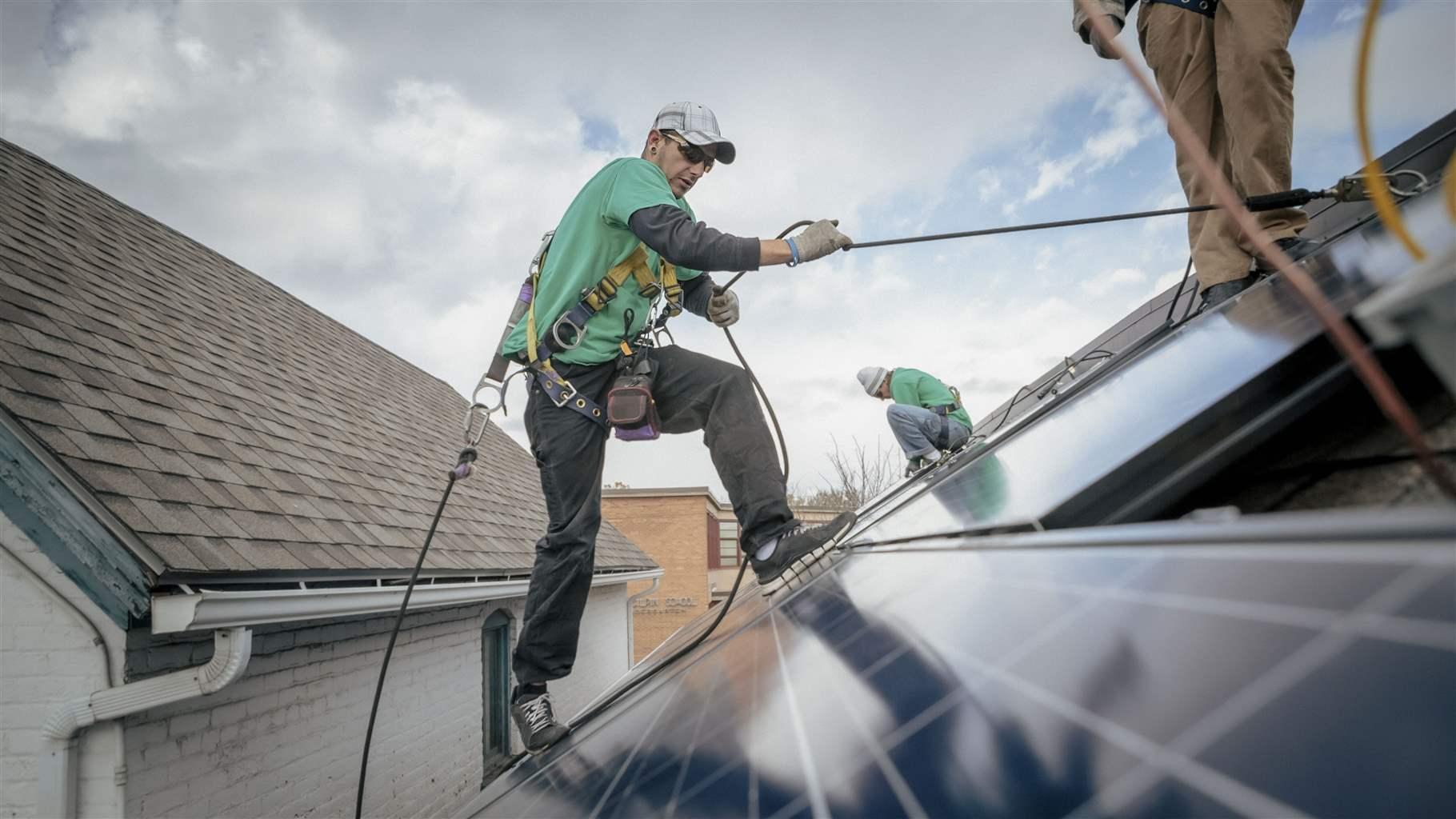
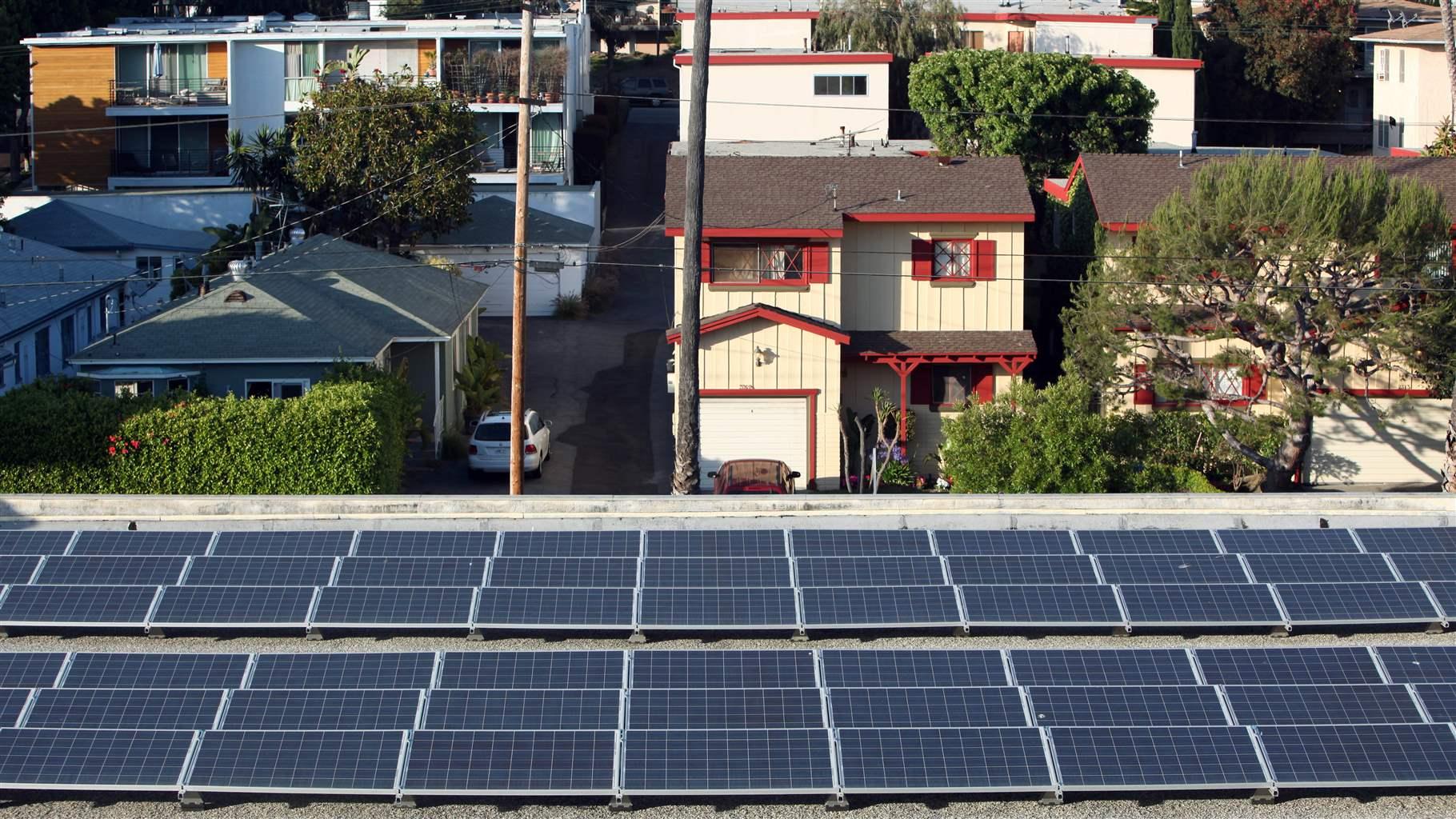
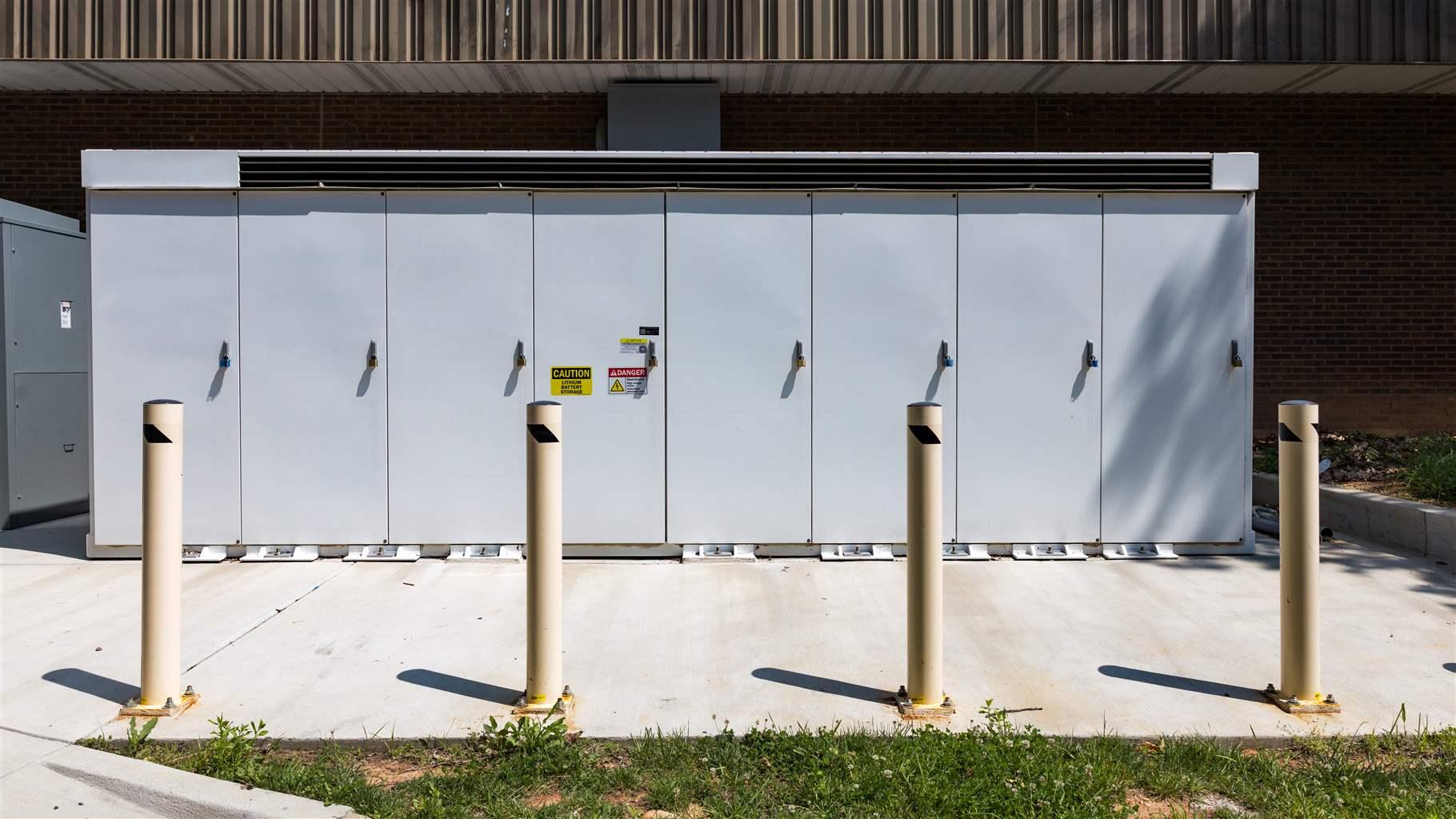
Distributed energy resources (DERs)—energy generation and storage technologies including rooftop solar, battery storage, smart appliances, and “managed” electric vehicle charging, which involves controlling when EVs are charged to account for demand on the grid—offer a low-cost, readily available, scalable solution. Unlike costly and slow traditional approaches, such as building new large power plants or high-voltage power lines, DERs are typically installed at the home, business, or industrial site where the electricity is needed, enabling customers to participate in smart management of energy use, helping them reduce their electricity bills, and increasing power grid resilience and reliability to prevent outages.
When connected together into virtual power plants (VPPs), which remotely orchestrate distributed resources to enable more efficient and flexible operations of the broader shared grid, DERs can help reduce electricity demand at peak times. This approach allows for better balancing of supply and demand across the grid and can enable utilities to defer or even avoid costly, traditional infrastructure investments.
Homeowners and companies are already buying and installing DERs, and as electricity prices increase and DER technology improves, that trend will only grow. In addition to providing power for their own homes and businesses, DER owners can provide valuable services to the larger grid and be paid for doing so. Fully leveraging these existing and future DERs through VPPs, including providing appropriate compensation for DER owners, could deliver power during peak demand at 40%-60% of the cost of traditional solutions.1
In contrast, failing to maximize DER and VPP deployment risks over investment in traditional grid infrastructure, higher electricity bills for consumers, and missed opportunities for cleaner, more reliable electricity. And one of the most significant barriers to successfully unlocking the full potential of distributed energy is the fragmented structure of U.S. electricity policy and regulation.
To help address this challenge, The Pew Charitable Trusts, with input and guidance from a wide range of practitioners in the field and an advisory council of experts representing diverse viewpoints, identified three core DER policy goals and specific recommendations that can help decision-makers, including state elected officials and public utility regulators, begin the work of bringing DERs to scale nationwide:
Goal: Integrate DERs as core grid resources into utility planning, investment, and procurement decisions.
Recommended actions:
- Require DER optimization as part of distribution grid planning
- Establish targets for VPP capacity and customer participation.
- Align utilities’ financial interests with DER deployment.
Goal: Reduce administrative, technical, and regulatory barriers to allow DERs to be permitted and granted grid access faster and at lower cost.
Recommended actions:
- Automate and streamline permitting processes.
- Automate and streamline interconnection, the process for connecting energy generators and batteries to the grid.
Goal: Strengthen community resilience by using DER solutions to improve grid reliability.
Recommended action:
- Leverage DER capacity to reduce the frequency and duration of outages and to provide homes and communities with backup power during blackouts.
These recommendations are designed to be applicable to the range of market, regulatory, and grid infrastructure realities that exist in the U.S. today and can be tailored to fit individual jurisdictions’ needs and circumstances. Together, they provide a way forward for policymakers, industry, and regulators to collaboratively build a reliable, resilient grid that can power American homes and businesses into the future.

Rising electricity demand and outdated systems threaten reliability, raise costs
After decades of flat or low growth, nationwide electricity demand is forecast to increase by 78% between 2023 and 2050.2 (See Figure 1.) This rapid growth stems from the expansion of data centers, increased domestic manufacturing, and the electrification of transportation and buildings. As a result, electricity costs are increasing sharply nationwide with many people struggling to pay their utility bills.
.png)
.png)
At the same time, the grid is ill-prepared to meet this rising demand—or to contend with increasingly severe and frequent extreme weather, such as hurricanes, heat and cold waves, wildfires, and floods. Much of the nation’s electricity infrastructure, which was largely built in the 1960s and 1970s, is approaching the end of its designed service life.3 For instance, 70% of transmission lines were at least 25 years old by 2023.4
A 2025 analysis from the North American Electric Reliability Corp. (NERC)—the international regulatory entity that oversees the reliability of the continent’s power systems—found that this combination of rising demand and aging infrastructure increased the risk of winter power outages in several parts of the country, including the Northwest, Texas, parts of the Southeast, and New England.5 In its 2025 report, “Long-Term Reliability Assessment,” NERC warned of declines in grid reliability and the sufficiency of available generation over the next decade.6
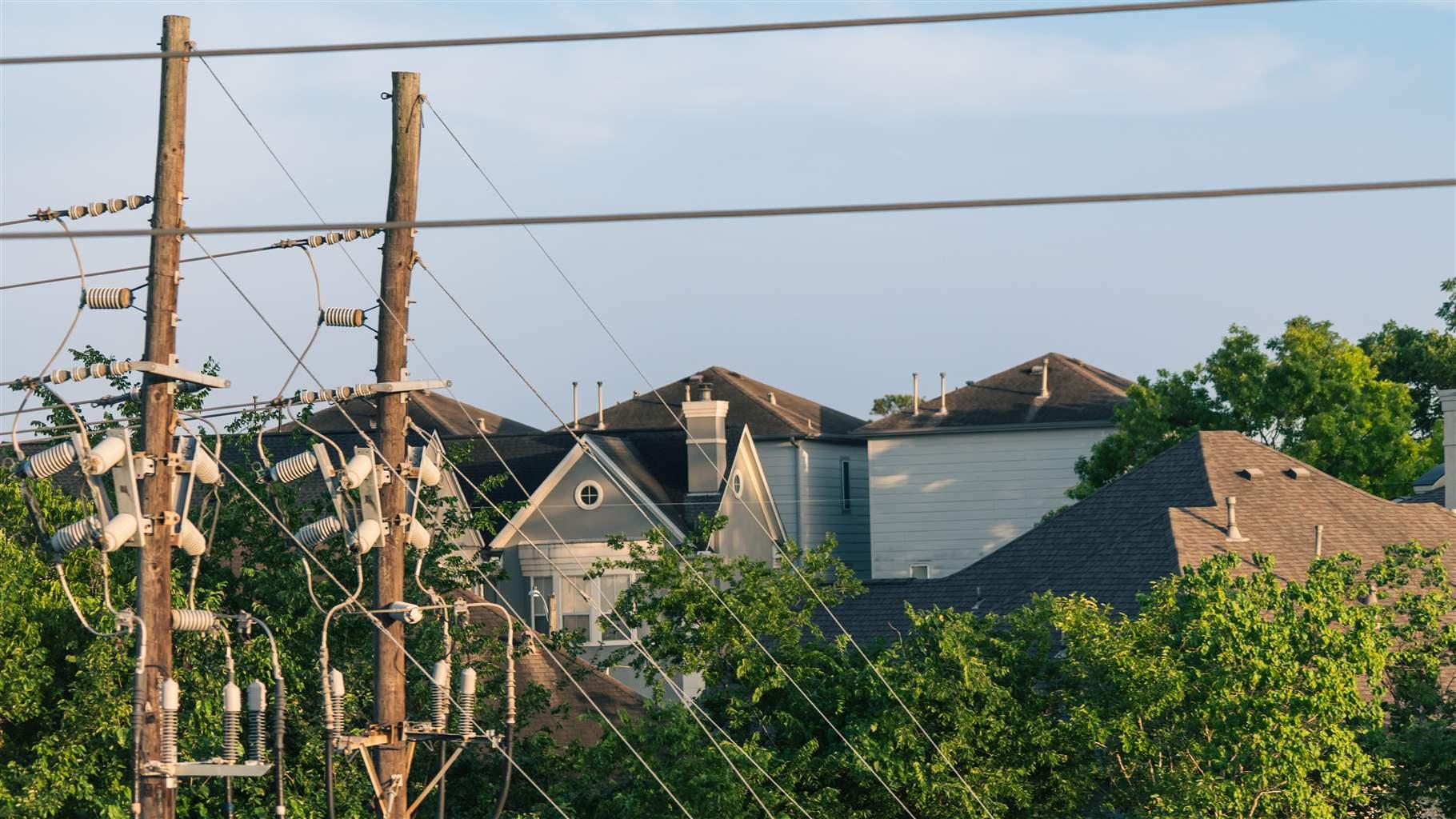
To address rising demand, extreme weather, and outdated systems, utilities will need to make significant new investments. Investor-owned electric companies expect to spend more than $1.1 trillion from 2025 through 2029 to enhance and expand the grid.7 As utilities make these needed investments, a large portion of their spending will probably be for upgrades to distribution systems—the low-voltage poles, wires, transformers, and other equipment that deliver electricity to utility customers.8
These expenditures, in turn, will put even more pressure on already rising utility rates. From December 2024 to December 2025, electric rates increased more than 6% nationally, with some areas of the country experiencing double-digit rate growth.9 These higher costs are squeezing customers’ tight budgets. According to a 2026 study, approximately 1 in 6 households was behind on utility bills.10 As a result, energy affordability has become a frontline issue: About 40% of Americans identify the cost of electricity as a source of stress in their lives.11
DERs and VPPs deliver value to customers and the grid
DERs and VPPs can provide affordable, reliable, clean, and readily available solutions to meet America’s energy challenge.
DERs are readily available, low cost, and underused
DERs provide a relatively small portion of U.S. electricity, particularly compared with their use in Australia and several European countries. However, that share is growing. Nearly 77% of U.S. households had smart electric meters in 2023 compared with 60% just five years before. Smart meters can be helpful in measuring and communicating about DER performance, particularly when the DER device cannot be directly metered.12 As of December 2025, 24 states and Washington, D.C., have policies that enable community solar-shared solar projects that give subscribing customers credits on their electricity bills.13 And as costs continue to decline, millions of homes and businesses are adding rooftop solar, batteries, and EVs each year.14
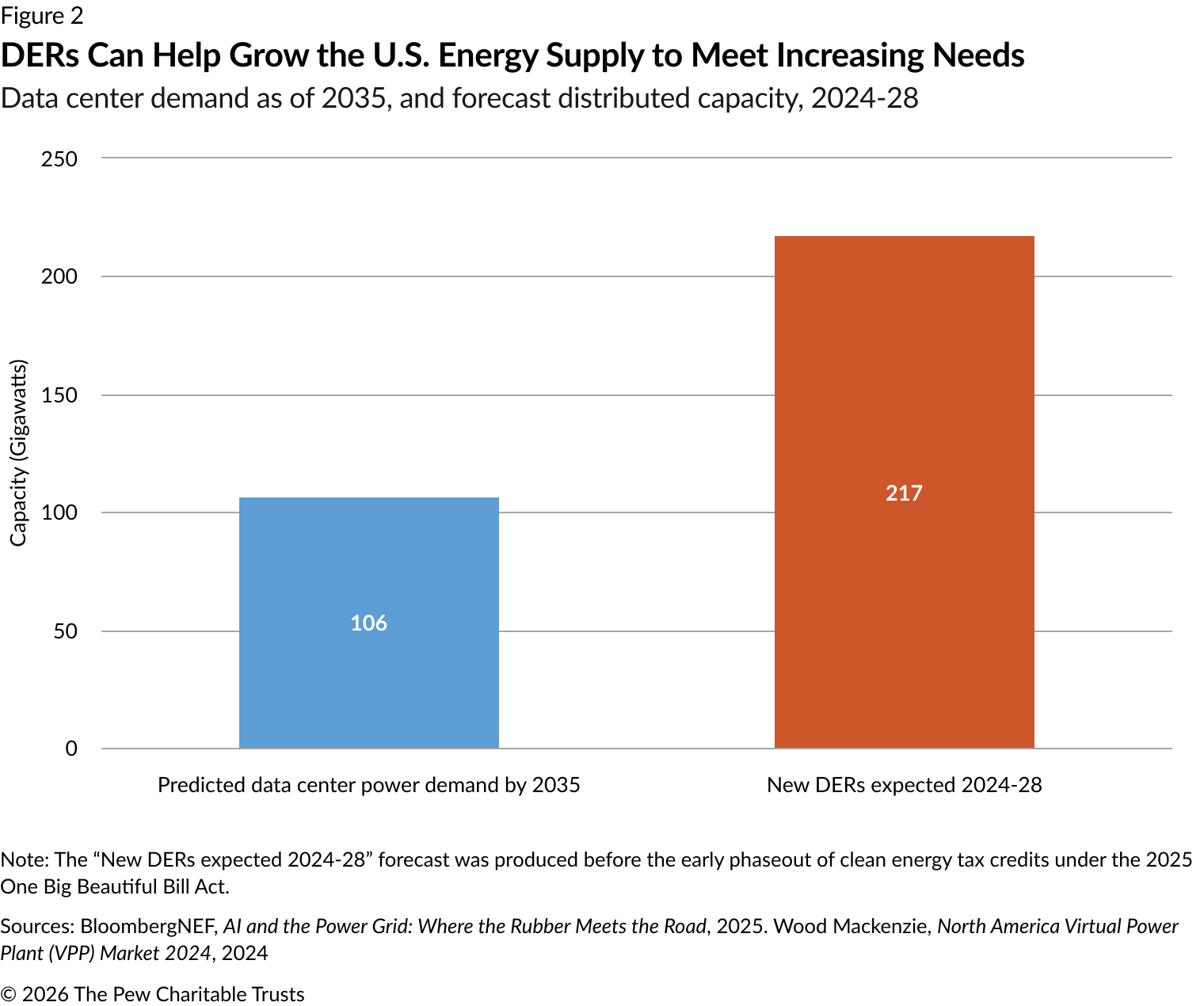
Research projects that the U.S. will add 217 gigawatts (GW) of DER capacity from 2024 to 2028. This growth almost equals the power generated by all U.S. coal-fired power plants and is more than twice the forecast additional power demand from data centers through 2035.15 (See Figure 2.) Although this means DERs have the potential to offset some data center power needs, the extent to which that potential is realized will ultimately depend on how much electricity those DERs can generate daily and how effectively they are integrated into the grid to maximize the energy resources they provide.
Further, DER technologies are commercially available now, affordable for many consumers, and can be installed in a matter of months compared with at least five years for new large gas-fired power plants or high-voltage transmission lines.
How DERs Work
DERs are technologies that generate, store, or manage electricity close to where it is used, such as batteries, rooftop solar panels, community solar, managed electric vehicle charging, smart thermostats and appliances, and advanced building controls (systemwide automation that monitors and manages energy use in buildings). These technologies connect to the distribution system to help homes and businesses produce or control their electricity and to provide surplus power to the grid. (See Figure 3.)
Some DERs can be installed on the customer’s side of a utility’s electric meter, referred to as “behind the meter,” enabling consumers to control their energy bills, reduce their draw from the electric grid, or stay powered during grid outages. For example, rooftop solar panels can offset consumption from the centralized grid, reducing the customer’s utility bill and, in most areas of the country, displacing fossil-fuel-generated electricity. And a home battery system can keep a house running during a storm-related blackout.
Other DERs are installed “in front of the meter”—on the utility’s side of the electric meter—and are typically larger in scale than behind-the-meter technologies. They provide electricity to the grid as well as services that utilities need, such as reducing pressure on the system during high-stress periods and helping to balance supply and demand to improve efficiency. Community solar, for example, can be connected in front of the meter and allows customers who do not install their own DERs to participate

How VPPs Work
A VPP, also called a “distributed power plant,” is a collection of DERs networked together and coordinated through software management systems to act as a single controllable resource that utility operators can tap to help balance the electrical system. (See Figure 4.) For example, a VPP could signal to a group of distributed resources to reduce their collective draw on the grid, such as by adjusting a smart thermostat, discharging a behind-the-meter battery, or delaying an EV charge, to reduce demand on the system during peak periods.
Customers who participate in VPP programs typically receive incentive payments for configuring their DER to provide services to the grid, helping to reduce utilities’ capital needs and keep costs down for consumers, essentially putting money back into customers’ pockets.

DERs can be better leveraged to provide grid services
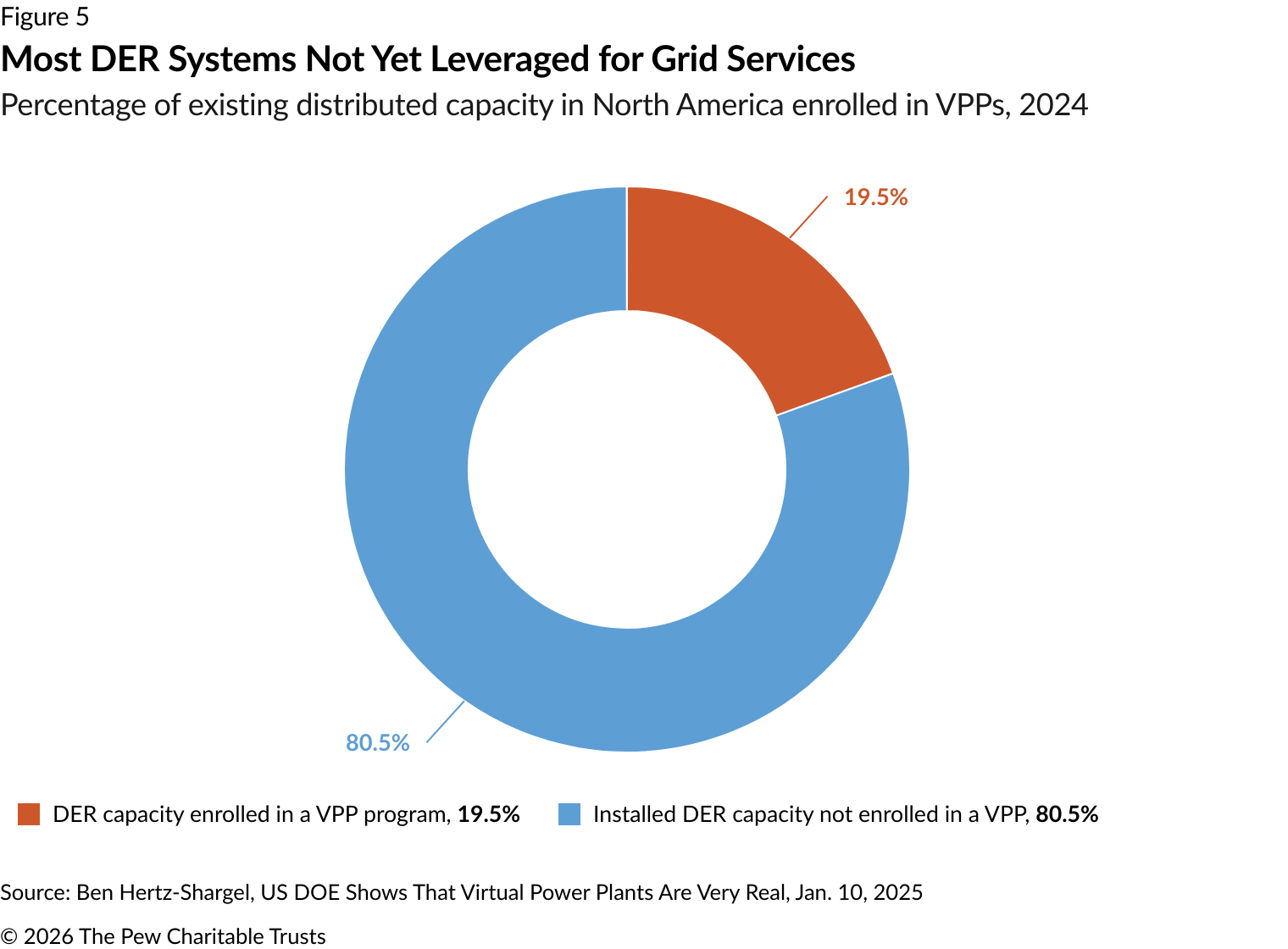
Experts estimate that the North American VPP market was a modest 37.5 GW in 2025 and had less than 20% of DER capacity enrolled in 2024.16 (See Figure 5.) This underutilization hurts customers’ bottom lines because VPPs can deliver peak power needs at 40%-60% of the cost of conventional resources.17 By organizing and motivating homeowners and businesses to configure their DERs to support the grid, VPPs can obviate the need for expensive new utility-scale infrastructure, delivering savings that help curb growing electric rates.18
Bringing DERs and VPPs to scale requires new policy approaches
Most U.S. states now offer some form of net metering—the mechanism for compensating customers who generate their own electricity, most often through rooftop solar, established in the 1980s to spur private investment in renewable energy.19 And although those policies have largely succeeded in unlocking the market for distributed generation, they are not necessarily sufficient to take DERs to the next level—in which their widespread use contributes value to the grid by addressing reliability issues and bringing down costs.
Rather, to capitalize on DER potential to meet rising demand, address the challenge of aging infrastructure, improve affordability, and enhance reliability, policymakers will need to look beyond net metering toward policies that recognize and fairly value DERs as a supply-side resource alongside traditional utility investments. These policies also will better align the compensation that DER owners receive with the value they provide to the grid, creating a more predictable market environment.
Bringing DERs and VPPs to scale nationwide would deliver an affordable, reliable, clean, and fast solution to the country’s growing energy challenge. Delaying action risks unnecessary investment in traditional infrastructure, higher bills, and missed opportunities for cleaner, more resilient power.
This playbook offers clear, practical steps that decision-makers can take to help make DER adoption an achievable national priority
Recommendations
The goals and corresponding recommended actions outlined here are designed to unlock the potential of DERs by addressing barriers for behind-the-meter and front-of-the-meter DER applications. (See Figure 6.) The U.S. electricity system is a patchwork of thousands of utility providers; 52 regulatory bodies across the states, D.C., and Puerto Rico; and myriad market structures, making a one-size-fits-all DER policy impossible. To address this variability, the recommendations are adaptable to the full range of market, regulatory, and infrastructure realities and can be tailored to fit each jurisdiction’s individual needs.
Coordinated action across all the recommendations is essential to fully realize DERs as an affordable, reliable, clean, and readily available energy solution.

In addition to outlining a policy effort and its objectives, each recommendation identifies the types of policy action (legislative, regulatory, or executive) that can be used to implement them, the entities that may have authority to take the described action (the federal government, a state utility regulator, a state executive agency such as a governor’s office, or a local government agency), and which of three market and regulatory structures the policy is appropriate for:
- Integrated system operator (ISO)/regional transmission operator (RTO): An independent entity that administers the transmission grid and the wholesale electricity markets in which power plants compete to provide electricity.
- Vertically integrated utilities: Retail markets served by a single provider that owns or controls the flow of electricity, including generation, transmission, and distribution to customers.
- Retail competition: Retail markets with multiple providers from which consumers may choose.
The applicable action authorities, action types, and applicable market structures for each recommendation are summarized in Table 1.
Table 1
DER Policies Can Meet the Needs of Many Types of Jurisdictions
Recommended actions and relevant authorities, types, and market structures
| Require DER optimization as part of distribution grid planning | Establish targets for VPP capacity and customer participation | Align utilities' financial interest with DER deployment | Automate and streamline permitting processes | Automate and streamline interconnection | Leverage DER capacity to reduce the frequency and duration of outages | ||
|---|---|---|---|---|---|---|---|
| Action authority | Utility regulator | X | X | X | X | ||
| State or local government | X | X | X | X | X | X | |
| Federal government | X | ||||||
| Action type | Regulatory | X | X | X | X | X | |
| Legislative | X | X | X | X | X | ||
| Executive | X | X | |||||
| Market structure | ISO/RTO | X | X | X | X | X | X |
| Vertically integrated | X | X | X | X | X | X | |
| Retail competition | X | X | X | X | X |
DER Goal: Integrate DERs into utility planning and procurement
The utility grids and regulatory schemes must evolve to successfully unleash DER potential to support the nation’s economic, security, and environmental future. Three targeted policy changes can reorient utility business models and planning to become more distributed energy-friendly.
Recommendation 1: Require DER optimization as part of distribution grid planning
Require utilities to develop robust, transparent, long-term plans that quantify system needs and proactively consider DERs as an affordable alternative to traditional utility distribution infrastructure or large-scale generation or transmission investments.
Action authority: Utility regulator, state or local government
Action type: Regulatory, legislative
Market structure: ISO/RTO, vertically integrated utility
Objectives
- Utilities, regulators, and other stakeholders evaluate how DERs can be used to meet electric grid system requirements.
- Utilities and regulators use plans to develop deployment targets, customer programs, and procurement mechanisms that incorporate DERs as a foundational resource on the grid.
- Regulators create a framework for investments in DERs that compensates DER owners for the capacity and energy value their assets provide toward efficiently meeting grid needs.
- Regulators use transparent analytical methods and stakeholder engagement to build public and regulator confidence in infrastructure plans.
Policy
Historically, if addressed at all in state utility commission proceedings, distribution planning has been opaque, typically undertaken by the local utility on its own rather than as part of the comprehensive, long-term integrated resource plan (IRP) processes that most utilities conduct every few years. This recommendation aims to coordinate distribution planning and IRP processes to leverage DERs, where cost-effective, as a supply-side option. Although distribution planning can be addressed outside of the IRP, DER deployment will be more effective if the utility has a regulator-approved plan that treats DERs commensurately with utility-scale projects.
To achieve this goal, states will need to boost their coordination with their regional transmission operators, where relevant, and require utilities to provide significantly greater transparency when modeling and assessing resource needs and options.
To implement this recommendation for vertically integrated utilities, regulators should consider these policy options:
- Require that IRPs include a distribution plan, treat DERs as a foundational building block to meet system demands, and use the best available forecasting methods to predict where customers will install DERs under current market conditions.
- Establish an integrated system plan (ISP) that incorporates resource and distribution planning into one comprehensive process.
To implement this recommendation in states where utilities have responsibility only for electric grid infrastructure and not for integrated resource planning, state commissions would need to require utilities to develop robust distribution plans, using the Australian Energy Market Operator (AEMO)—Australia’s independent electricity system operator—as a model. (See, for example, the case study “Australia implements integrated planning for DER optimization.”) The plans should account for anticipated customer-led DER investments and determine the level of DER adoption that would enable the utility to avoid other, more costly investments. When customer adoption falls below that level, utilities should consider establishing additional mechanisms during subsequent planning efforts to procure and install DERs at key locations identified in the distribution plan.
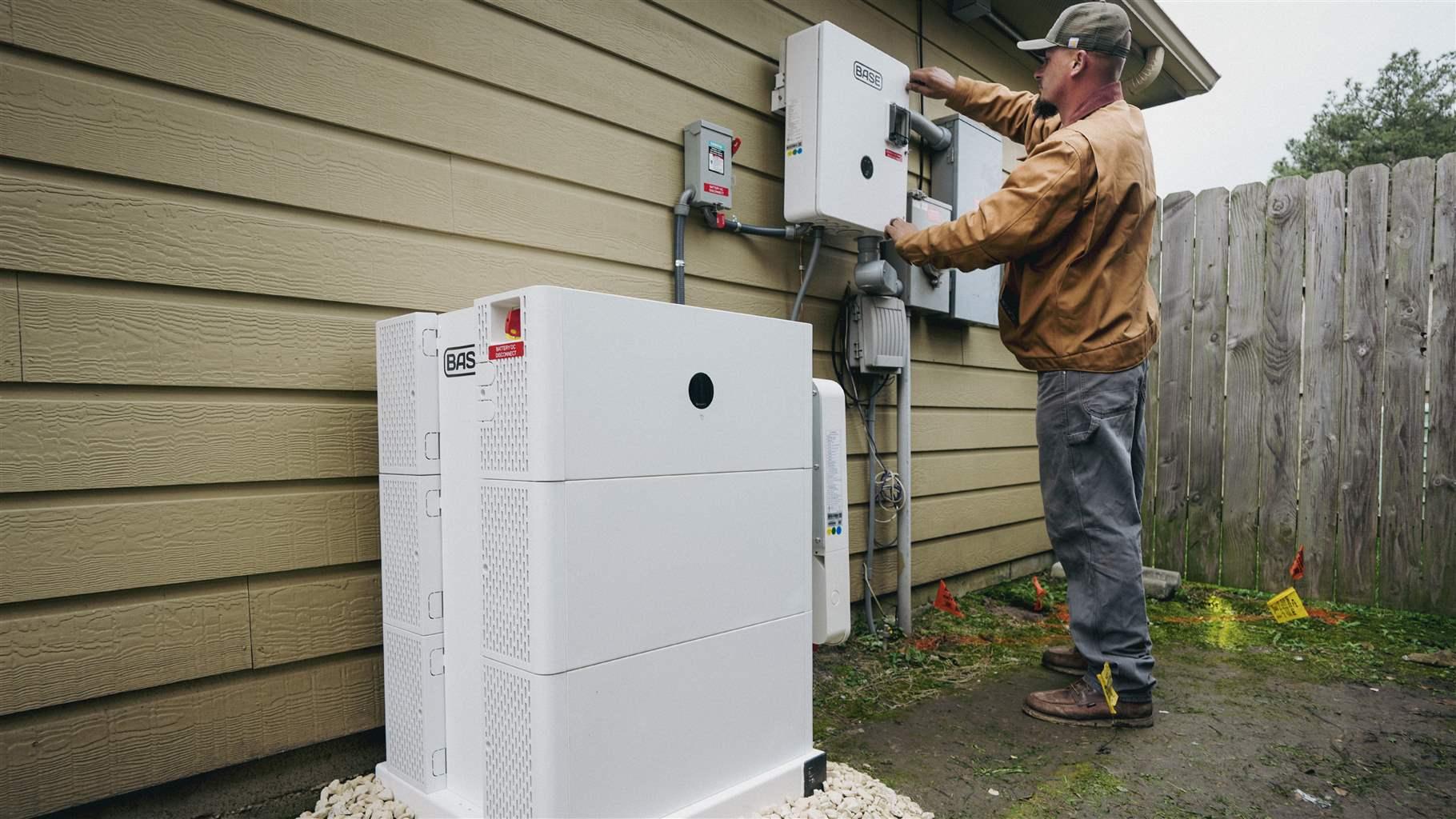
In addition, to ensure that DER providers prioritize installations in areas of greatest need, plans and planning initiatives should ensure access to timely data on locational constraints and distribution grid hosting capacity— the amount of distributed energy generation that can be connected to the existing grid without negatively impacting system reliability.
Further, distribution plans should improve upon current practices by using detailed bottom-up modeling and distribution system optimization to determine the appropriate mix of traditional and DER investments. In the current era of rapid load growth and VPP-enabling technologies, effective distribution planning and DER procurement targets require granular data on distribution system infrastructure and demand forecasts.
In developing legislative and regulatory policies for this recommendation, decision-makers should consider:
- Requiring that distribution planning be integrated into IRPs.
- Establishing transparent processes to collect and review stakeholder input on assumptions and final plans.
- Requiring that utilities model the distribution system based on granular forecasts of demand and DER adoption. Where possible, require utilities to use data from the local distribution transformer level to reveal which locations have the highest demand constraints and would get the most value from DERs, analyze multiple DER and VPP adoption scenarios informed by stakeholder input, and quantify DER procurement targets.
- Including systemwide benefits—such as lower prices, improved reliability and resilience, better grid infrastructure in underserved communities, reduced effects on climate, and other state-mandated environmental targets—as relevant criteria when weighing DERs vs. traditional investments.
Furthermore, in states with comparatively low levels of DER adoption or limited experience with distribution planning, state commissions can direct utilities to begin by increasing transparency on load and DER forecasts, mapping hosting capacity, and providing clear justification for proposed distribution investment.20
Action steps
Legislature
- Provide general guidance to the state commission to evaluate utilities’ planning processes to ensure that DERs are fully leveraged to maintain or improve affordability of electric rates while also meeting projected increases in demand.
State commission
- Within a new or existing proceeding, outline a process for updating distribution plan methodologies, developing consensus on increasing DER deployment scenarios, and conducting distribution system needs analyses and formal plan reviews.
- Use informal processes, such as technical workshops or information meetings, to review and update distribution plan methodologies with stakeholder input and engagement.
- Assess each utility’s distribution planning methodology, using the AEMO ISP and scenario analysis methodology as a model (see, for example, the case study “Australia implements integrated planning for DER optimization”), identify gaps between the utilities’ and the AEMO’s methodologies, and review critical gaps with commission staff and stakeholders.21
- Issue guidance on expectations, including timelines, for utilities to update their distribution planning methodologies, the results of their distribution system needs analyses, and their proposed investments.
- Engage independent facilitators and technical experts to review utilities’ analyses and draft plans.
- Require utilities to file final plans for formal review by stakeholders in the proceeding and the state commission, including at a minimum:
- Various scenarios featuring increasing levels of DER deployment.
- Distribution capacity procurement targets that rightsize needed investment by treating DERs as a viable alternative to traditional wire solutions.
- Avoided costs for energy, capacity, ancillary services such as frequency control and voltage support, and deferring distribution investments.
- Network augmentation costs.
- For vertically integrated utilities only, plans should also include:
- Assessment of DER potential to reduce the cost and land-use footprint of bulk-power generation and transmission.
- Progress toward system-level VPP capacity and ancillary services targets.
- Review and issue final orders on distribution plans.
- Conduct ongoing oversight of utilities’ implementation of their plans, with stakeholder review.
- Regularly update the planning process with lessons learned from previous plans.
Case study: Australia implements integrated planning for DER optimization

Australia’s energy market transformed dramatically starting in the 2010s, shifting from a heavy reliance on coal to the world’s highest adoption of DERs, or “consumer energy resources” as they’re called in that country. Australia’s aging coal-fired power plants had become increasingly unreliable and expensive to operate, leading the country to rapidly build out new renewable generation, which it identified as the most affordable and reliable option to meet growing energy needs and near- and long-term environmental goals.22 Rooftop solar installations began growing rapidly in the mid-2010s, driven by customers’ desire to save on electricity bills, and was followed by an uptick in battery storage installations in the early 2020s.23 By 2025, rooftop solar contributed nearly 13% of Australia’s total energy generation.24
In 2020, AEMO projected that by 2040, 63% of Australia’s coal-fired generation would be retired and that DER capacity would have doubled or tripled.25 Then, in its 2022 ISP, AEMO forecast even greater levels of DER adoption. These projections, along with rising costs and the complexity of transmission lines, led the Australian Energy Market Commission to make a rule change in December 2024 and require AEMO to consider DERs as an optimized input to ISPs.26 To satisfy this requirement, AEMO’s analysts now evaluate the level of DER deployment that will be most cost-effective for the country’s electric system as a whole, rather than modeling grid scenarios with an expected level of customer DER adoption, or uptake rate.27
The new rule also requires that AEMO assess all investment options for managing and enhancing the national electric system, including what it calls “distribution network opportunities,” which improves AEMO’s analysis and decision-making by including cost-effective DER development pathways in planning efforts. This positions distribution resources as central to Australia’s efforts to not only expand its electric system but also transition it away from its historical reliance on coal facilities.
Other case studies
Regulators and utilities in Colorado, Illinois, and Massachusetts, directed by state legislation, are also revising their distribution planning processes to better integrate DERs. (See Appendix A.)
Recommendation 2: Establish targets for VPP capacity and customer participation
At the direction of the state legislature, state commissions can set specific VPP capacity targets for utilities to lower electricity costs for all customers and can authorize the use of a range of mechanisms to facilitate deployment of VPPs at scale. Setting specific capacity targets and clarity on VPP participation mechanisms will create certainty and market demand.
Action authority: Utility regulator, state or local government
Action type: Regulatory, legislative
Market structure: ISO/RTO, vertically integrated utility, retail competition
Objectives
- Lower customers’ utility costs by replacing or delaying traditional infrastructure investments using VPP capacity.
- Reduce unnecessary requirements for building and siting large infrastructure.
- Build durable markets for VPPs with certainty for participants and DER providers.
Policy
State legislatures can direct state commissions to determine optimal targets for VPP capacity based on the robust planning process described in the first recommendation. When setting these targets, the state commission should identify which hardware and software tools are required to cost-effectively enable VPPs, the priority locations for deployment, and the specific grid services to be provided by the VPPs. If this information is not available from recent distribution plans or is out of date, the state commission would solicit stakeholder guidance to help set the initial targets and identify the highest-value VPP uses.
To achieve the VPP targets, utilities should be allowed to use various mechanisms, including bilateral contracts with VPP providers, programs that allow customers to receive compensation for subscribing or opting into a VPP, or distribution system operator tariffs that create a market-based payment structure for customers who participate in VPPs. The state commission should set terms for each procurement mechanism, such as price and VPP performance and capacity requirements.
Further, commissions should require that utilities’ solicitations for VPP providers fully leverage the capabilities of independent third-party companies that aggregate and manage DERs to provide VPP services, including unregulated utility-affiliated companies. Utilities should be obliged to prioritize contracts with third-party VPP providers whose bids meet the commission-approved terms up to the VPP target. If the VPP target cannot be met by eligible third-party VPP providers, then the balance can be provided by VPPs procured and owned by utilities.
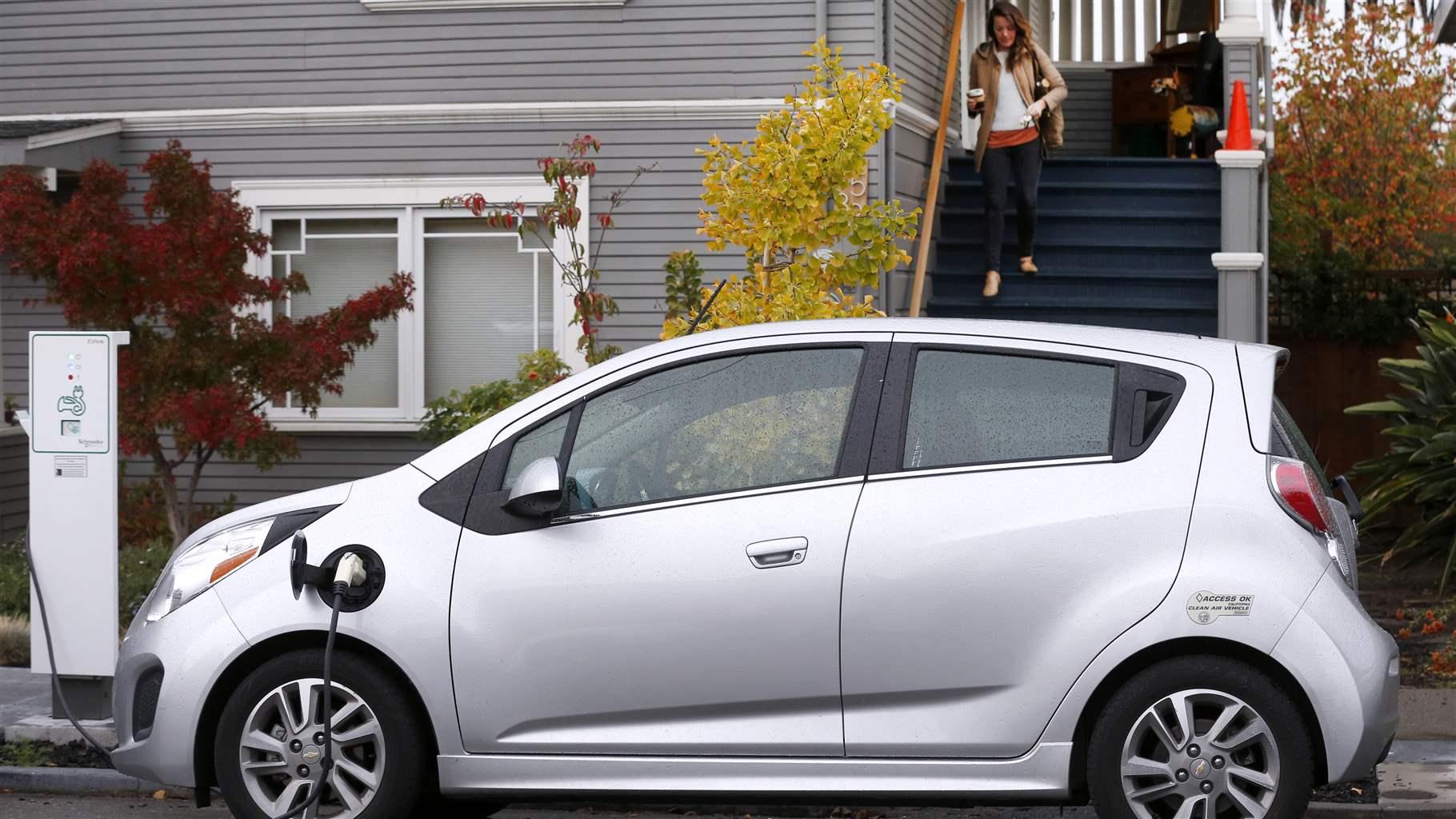
And finally, state commissions should ensure fairness by appointing an independent monitor to oversee the solicitation process, certify that solicitations meet all requirements, and verify the amount of VPP capacity provided by the third-party market.
Setting VPP targets, especially when combined with the other recommendations in this playbook, removes financial and institutional barriers to VPP adoption and can spur cost-effective deployment, which helps reduce costs for utilities and consumers.
Additionally, the legislative directive should require state commissions and utilities to transparently value VPP grid services to ensure that the mechanisms utilities use to achieve the VPP targets are cost-effective and attractive to DER owners.28 Without this, regulatory proceedings to establish targets and associated tariffs or procurement mechanisms will miss opportunities to incentivize customer participation, lower consumer costs, and meet the urgent demand for new electricity resources.
Action steps
Legislature
- Direct the state commission to develop, within one year, annual VPP procurement targets, with incremental increases to a specified cumulative total within a specified time. (Consider five years.)
- Provide general guidance to the state commission to establish targets for maintaining or improving the affordability of electric rates and meeting projected increases in demand.
- Provide general guidance to the state commission to allow utilities to recover reasonable costs for establishing VPP programs.
State commission
- Using relevant data from recent utility plans, set VPP targets that improve grid flexibility and offer opportunities to improve system efficiency and safety.
- Allow qualifying VPPs to provide a range of potential grid services, but prioritize immediately available, high-value services such as peak load shifting (moving electricity consumption from high-demand, high cost hours to lower demand hours) and emergency dispatch (providing energy to the grid during critical shortages or high-stress events).
- Direct utilities to make a compliance filing with a proposed tariff, customer program, or utility procurement framework for achieving the commission’s VPP target.
Case study: Virginia enacts VPP pilot legislation

On May 2, 2025, Virginia enacted H.B. 2346, a landmark law requiring the state’s largest utility, Dominion Energy, to propose a pilot program aimed at optimally managing demand through use of VPPs.29 Drawing from model legislation, the law mandates that the pilot include DER aggregations of up to 450 megawatts (MW), incorporating technologies such as battery storage, smart thermostats, and managed EV charging.30 Further, H.B. 2346 explicitly allows third-party aggregators to participate in the pilot alongside the utility and, to promote innovation and broad DER industry engagement, requires that third parties be given full access to necessary customer and grid data.31
The legislation also sets clear timelines and accountability measures. In accordance with those requirements, Dominion submitted its pilot proposal Dec. 1, 2025, and must develop a VPP tariff by Nov. 15, 2026, that sets out the terms and conditions under which residential, commercial, and industrial customers will be compensated for grid services they provide.32
Dominion will operate the pilot through summer 2028 to gain experience managing a VPP, collect actionable data for subsequent program development, and be better positioned to evaluate options for DER integration at scale. At the end of the pilot, the Virginia State Corporation Commission will assess the pilot’s success in delivering grid services during peak demand periods and will establish a permanent program with defined procurement targets and metrics.
Virginia’s legislation sets a new national benchmark by formalizing utility-scale VPP targets and performance-based compensation. It combines ambitious scale, technology diversity, and structured evaluation to ensure that benefits flow to customers and to the grid. By prioritizing VPP development within regulatory policy, Virginia has positioned itself at the forefront of the transition to distributed, market-enabled energy systems.
Other case studies
Colorado, Illinois, and Texas also have taken action to stimulate VPP programs and establish compensation mechanisms. (See Appendix A.)
Recommendation 3: Align utilities’ financial interest with DER deployment
States should work to address structural financial barriers within the regulatory frameworks governing utility earnings that discourage electric utilities from leveraging DERs and VPPs.
Action authority: Utility regulator, state or local government
Action type: Regulatory, legislative
Market structure: ISO/RTO, vertically integrated utility, retail competition
Under conventional cost-of-service regulatory approaches, a utility’s capital expenditures, such as for traditional infrastructure, largely determine the amount of profit that the regulator allows it to earn from customers and pass on to its shareholders. On the other hand, regulators typically categorize the integration of customer-owned DERs and management of VPPs as operating expenses, which do not generally earn utilities financial returns even when they deliver needed system benefits at lower cost than major capital investments. This lack of profit potential discourages utilities from spending resources on cost-effective VPP solutions. State commissions can correct this bias by treating DER and VPP investments, including those using third-party-owned DERs, on par with capital expenditures for traditional infrastructure.
Multiple states have already established performance-based regulations (PBRs) or performance-incentive mechanisms (PIMs), which can be tailored to each state’s policy priorities and determine utilities’ compensation or penalties based on specific performance targets and timelines. These targets may cover a range of services, such as those that improve reliability, offer resilience solutions, cut emissions, increase efficiency of the grid, or defer or avoid costly infrastructure upgrades.
Objectives
- Remove the financial bias toward traditional capital investments to make deployment of DERs and VPPs at scale similarly attractive for utilities.
- Encourage further deployment of DERs through PBRs and PIMs.
Policy
State commissions can address the bias against DER investment and deployment by reviewing and adjusting the existing financial frameworks for utilities. Commissions should consider several approaches, including:
- Establishing DER-related performance metrics with associated incentives and penalties for utilities.
- Allowing utilities to earn a profit on direct DER investments (including software) and on the value of services procured from third-party DER providers.
- Creating a “shared savings” mechanism to distribute the cost savings created by DERs among utility shareholders and customers.
Removing utilities’ disincentive to invest in DERs by equalizing the revenue potential from DERs with that of traditional infrastructure would represent a major step toward comprehensively addressing the financial barriers inhibiting DER adoption. Using cost-benefit analyses to inform the design and calibration of these financial mechanisms can help ensure that the incentives and penalties are proportionate to the anticipated expenditures and returns associated with the desired outcome.
Performance incentive mechanisms
As of 2024, 28 states had established or explored PIMs to align utility revenue with the utility’s performance toward policy objectives as measured by specified metrics.33 A PIM creates a financial reward for achieving the metric, a penalty for failing to achieve the metric, or both. The structure of each PIM should be based not only on existing regulatory frameworks but also on priority energy needs and goals within the state or region. One state, for example, may place high value on DER services that support emissions reduction goals, while another may emphasize VPPs to serve communities’ energy security needs.
Utility earnings
State commissions can consider a range of mechanisms to bring utilities’ earnings potential from DER investments in line with that of traditional infrastructure expenditures. First, commissions could simply allow utilities to earn the same regulated rate of return on direct DER investments and/or the annualized value of grid services from eligible third-party-owned DERs (as identified in the utility’s distribution plan) that they receive on large capital expenditures.
Further, to encourage utilities to enter into long-term contracts with VPP providers, state commissions could allow utilities to earn additional returns for contracts with at least a 10-year term. In states where ISOs or RTOs make “resource adequacy” payments—compensation to energy resource owners for providing capacity during peak demand periods—commissions should also consider allowing utilities to retain a portion of the resource adequacy payments made to utility-contracted VPPs to help facilitate the integration of DERs into wholesale markets.
Another important option for commissions to consider is allowing utilities to earn a return on nontraditional digital infrastructure investments that directly enable or leverage the integration of DERs into operations and planning, such as spending for DER management systems and interconnection tools, including software.
Shared savings
Where DERs displace traditional infrastructure at lower cost, state commissions can explore allowing shared savings mechanisms, in which utilities retain a portion of the savings and return the balance to customers. Some shared savings approaches may only give utilities a modest portion of the savings, while others may offer a higher share to encourage investor-owned utilities to opt for VPPs over large capital infrastructure investments.
Action steps
Legislature
- Authorize the state commission to allow incentives and penalties for utility performance on VPP and DER procurement targets.
- Require commissions to conduct cost-benefit analyses when creating new utility earnings mechanisms.
State commission
- Develop a stakeholder process to align utility financial incentives with DER deployment through a collaborative process with concrete deadlines for proposed commission action. Start the process with a commission-issued white paper that includes recommended methods for required cost-benefit analyses and utility earnings mechanisms and review the white paper informally with stakeholders.
- Issue guidance on new or revised utility earnings mechanisms, including cost-benefit analysis methodology, ahead of formal review and adoption, which could occur during a rate case, contested case, or distribution system plan review.
Case study: New York creates the Reforming the Energy Vision regulatory framework

In 2016, the New York Public Service Commission (PSC) approved a landmark regulatory framework called Reforming the Energy Vision (REV) to overhaul the state’s utility business model. The PSC recognized that traditional cost-of-service regulation rewarded capital investment in utility poles and wires rather than efficiency or innovation, putting DERs at a disadvantage compared with the standard methods of supplying and delivering power. REV was designed to shift utilities away from this traditional model and toward a market- and performance-based revenue model that could set DERs on an equal footing with standard systems within the utility financial structure.
Where the state’s old regulatory structure allowed utilities to earn revenue only by expanding physical infrastructure, REV authorized utilities to generate income by optimizing distributed solutions that improve the reliability, efficiency, and affordability of electric service for consumers. This approach aligned utilities’ and customers’ interests and encouraged utilities to treat DERs as core assets for modernizing New York’s electric grid.
That same year, the PSC issued its Track Two order, which redefined how utilities can earn revenue, introducing a suite of tariff, market, and incentive structures that rewarded DER adoption and system efficiency enhancements.34 Central to this effort is the “share of net benefits” incentive, which encourages utilities to pursue DERs and other “non-wires alternatives” (NWAs) to traditional infrastructure by enabling them to share in the savings generated from choosing those alternatives, such as from lower capital and operational costs, environmental gains, and improved grid reliability.
The share-of-net-benefits approach was implemented in the 2020 New York State Electric & Gas Corp./ Rochester Gas & Electric Corp. rate case, which allowed those utilities to realize up to 30% of the net benefits from approved NWA projects, with the remaining 70% returned to customers.35 This mechanism gives the utilities a clear pathway to profit from DER investments in the same way they do from traditional assets.
REV demonstrates why financial reform is essential to DER adoption at scale. By embedding DER incentives within utility revenue models, New York created a model for grid modernization, bridging the gap between public policy goals—such as reliability, affordability, and decarbonization—and utility economics. The result is a system that treats distributed resources as foundational elements of a resilient, efficient, and customer-centric energy future.
Other case studies
Minnesota, North Carolina, and the U.K. have also used financial mechanisms to equalize the economics for DER investments. (See Recommendation 5 and Appendix A.)
DER Goal: Reduce barriers to DER permitting and grid access
The price of DERs has declined dramatically since 2010, driven mostly by reductions in costs for the hardware components that make up DER systems.36 However, DERs remain relatively expensive in the U.S. compared with many other countries, such as Australia.37 To make DERs more affordable, policymakers must target the “soft costs” of DER deployment, including permitting, interconnection, and associated labor costs, which have remained stagnant and can be 78% of the total price of a residential system.38 Reducing these soft costs falls squarely on state and local policymakers, and innovative software and utility financial solutions are available.
Recommendation 4: Automate and streamline permitting processes
Permitting processes for residential and commercial DER projects can be lengthy, unpredictable, and duplicative. State and local governments can directly address these issues by automating and streamlining processes, allowing third-party review and inspection of applications, and clarifying siting authority for commercial projects.
Action authority: State or local government
Action type: Executive
Market structure: ISO/RTO, vertically integrated utility, retail competition
Objectives
- Make permitting timelines and costs more certain and transparent.
- Lower soft costs—nonhardware expenses such as permitting, labor, and customer acquisition—for DER installations.
- Improve the customer experience when installing DERs.
Policy
Residential
State and local governments can improve permitting of residential DER systems by automating permit reviews, using industry-standard software, and striving toward instant permitting where feasible, and can allow qualified third-party professionals to review homeowners’ DER installation plans and conduct inspections.
Online, automated permitting software, such as SolarAPP+, is available—and has been adopted by many local jurisdictions—to review standard residential solar permit applications. A 2023 independent assessment of SolarAPP+ found that it expedited permit reviews, reduced staff time, standardized safety checks, and accurately verified code compliance.39
In addition, allowing third-party reviews and inspections with final approval by local authorities will speed up reviews while ensuring that local standards are met efficiently and safely. Legislation authorizing third-party inspections should clarify liability and provide protections and clarifications.
Commercial
In many states, commercial DER projects face inconsistent local permitting requirements that often jeopardize projects. States can work with regional, county, and municipal authorities to consolidate disparate requirements into a collaborative, efficient master review process with consistent standards, fewer conflicting guidelines, and streamlined timelines. (See, for example, the Massachusetts case study in Appendix A.)
Alternatively, state governments might consider creating a permit appeal process conducted by a state entity, such as a state energy facilities siting board, for commercial projects denied by local authorities. (See, for example, the Michigan case study in Appendix A.)
This recommendation can significantly cut permitting timelines for DER projects and standardize processes across jurisdictions, lowering installation costs, expanding customer access to DERs, providing greater consistency for commercial projects within a state, and helping states rapidly scale programs such as community solar.
Action steps
State executive
- Provide guidance that directs or encourages local authorities to use online, automated permitting software.
- Fund department staff and information technology needs to support software adoption.
Legislature
- For residential DERs, allow local permitting departments to use automated permitting software and licensed third-party reviewers and inspectors.
- Require third-party professionals to adhere to all local regulatory guidelines and protocols.
- Allow third-party professionals to use an automated permitting platform.
- Set a time limit for local regulatory authorities to issue permits after receiving inspection documentation from a third-party professional. (Texas uses three business days. See the case study later in this recommendation.)
- Provide guidance on plan review, inspection, and permit fees.
- For commercial DERs, establish a state energy facilities siting board to review permit applications.(Massachusetts defines such facilities as 25 MW or less. See the case study in Appendix A.)
- Authorize the board to issue one master permit that consolidates, to the fullest extent possible, all local and state requirements.
- Set a sufficient but reasonable permit review timeline. (Massachusetts uses 12 months. See the case study in Appendix A.)
- Provide guidelines for state and local permitting agencies’ participation in the master review process.
- Include provisions for community engagement.
- Establish a reasonable appeal process.
Case study: Texas adopts third-party inspections and automated permit reviews for residential DERs

In 2025, Texas passed S.B. 1202, a landmark law designed to streamline the inspection and permitting process for residential DERs.40 The law, which passed with bipartisan support and became effective Sept. 1, 2025, offers a compelling model for other states seeking to accelerate DER deployment, reduce permitting bottlenecks, and lower costs for customers while maintaining rigorous safety and compliance standards.
The legislation targets systems that provide power to one- or two-family dwellings, including solar, energy storage, and standby power equipment, and addresses long-standing barriers in the permitting process. By reducing administrative hurdles and shortening review timelines, the law aims to lower the soft costs of DER deployment, making clean energy technologies more accessible and affordable for homeowners across the state.
S.B. 1202 authorizes licensed professionals, such as master electricians, to review DER installation plans and conduct inspections. The law requires third-party reviewers to comply with local permitting requirements and submit documentation for local authority approval, ensuring that safety and compliance standards are maintained while accelerating approval timelines. This approach lightens local government workloads and creates a more efficient path for standard DER permit approvals.
The law also authorizes third-party reviewers to use online automated permitting platforms to digitally submit and certify electrical code compliance. Automated review software provides instant plan review, offers site-specific corrections when needed, and creates checklists to facilitate thorough inspections. Leveraging these digital solutions as a complement to professional oversight can enable faster, safer, and more predictable permitting timelines.
Further, S.B. 1202 also provides clarity around fees, deadlines, posting requirements for documentation, and professional accountability, ensuring that local permitting processes are transparent and reliable.
Other case studies
California also enacted a law authorizing use of an online, automated permitting platform for residential solar systems, and Massachusetts and Michigan took steps to streamline large DER permitting processes. (See Appendix A.)
Recommendation 5: Automate and streamline interconnection
Achieving widespread DER adoption requires predictable, customer-friendly, and flexible interconnection processes that combine performance standards for utilities regarding timely efficient review of interconnection applications with advanced technologies, such as smart electrical panels, to safely and efficiently connect a broad range of residential and commercial DERs to the distribution grid.
Action authority: Utility regulator, state or local government
Action type: Regulatory, legislative
Market structure: ISO/RTO, vertically integrated utility, retail competition
Objectives
- Create safe, customer-friendly interconnection processes.
- Use advanced technologies to improve interconnection timelines and reliability.
Policy
Streamlined and transparent interconnection processes are critical to improving customers’ experience and integrating DERs at scale to meet increasing electricity demand. A key piece of creating such processes is establishing metrics for utilities to improve their DER interconnection performance beyond simply complying with established procedures.
At the same time, streamlining safe interconnection of DERs requires collaboration among utilities, DER developers, and customers to quickly implement advanced technologies and flexible interconnection processes. Flexible interconnection allows DERs to interconnect quickly, without waiting for significant grid upgrades, in exchange for operating limitations during high grid stress periods. State commissions should lead on these efforts with specific priorities for residential and commercial DER interconnection.
Residential
State commissions should set deadlines for utilities to automate residential DER interconnection application reviews and shorten interconnection timelines. To support these goals, commissions should also consider establishing performance incentives and penalties, with appropriate phase-in periods for utilities to meet the targets. The U.S. Department of Energy (DOE) has recommended a 2030 target for interconnecting small-scale DERs within one business day.41
Achieving streamlined interconnection timelines will require key DER-enabling technologies. State commissions can establish working groups, with representation from utilities and DER developers, to create and implement technology roadmaps as well as targets and phase-in periods for performance standards and automation.
Commercial
As with residential installations, state commissions should also establish target interconnection timelines for commercial DERs and consider performance incentives and penalties for utilities. These timelines will need to address complex reliability and operational requirements related to the larger potential grid effects of commercial-scale DER systems.
DOE has recommended interconnection targets of 75 days for DER systems of 50 kilowatts (kW) to 5 MW and 140 days for systems larger than 5 MW by 2030.42 Similar to the residential interconnection recommendations, commissions and utilities should establish appropriate timelines through a collaborative stakeholder process.
In addition, flexible interconnections are another critical tool for commercial DERs that can help meet the urgent need for new energy supply and grid flexibility and reduce risk for DER developers. Utilities can use a range of control approaches, such as smart inverters—devices that enable DERs to provide grid support functions—to enable more DERs to come online quicker and lower the interconnection costs for individual projects.43 Flexible interconnections address a major barrier for DER developers by allowing them to connect their products to the grid and generate revenue while they review the scope and costs of grid upgrades necessary for a “firm,” or full, connection in the longer term.
State commissions should direct utilities to develop and implement flexible interconnections for commercial scale DERs within a set timeline—perhaps one year. Some U.S. utilities are already gaining experience with flexible interconnections, meaning the practice is ready to be brought to scale.
Action steps
Legislature
- Authorize the state commission to set goals for automated and instant interconnection and for interconnection timelines with associated performance incentives and penalties.
- Direct state commissions to allow utilities to recover reasonable costs to support DER interconnection.
State commission
- Track and publicly report interconnection queue information, including timelines to interconnect and timelines and costs for review and analysis of interconnection requests.
- Develop goals to automate the interconnection process for residential DERs, including target interconnection timelines, with an ultimate goal of instant interconnection where feasible and safe.
- Form an interconnection working group to address, on an ongoing basis, technical topics related to DER interconnection, such as standards for inverters, energy storage systems, flexible interconnection, and cost allocation for network upgrade costs. Working groups should also discuss data sharing needs and making hosting capacity information publicly transparent.
- Develop incentives and penalties for utilities based on the interconnection timeline goals.
Case study: UK Power Networks achieves timely interconnection of DERs through innovation and supportive regulatory framework

UK Power Networks (UKPN) is the U.K.’s largest distribution operator (by customers served), covering London and portions of eastern and southeastern England.44 Ofgem, the regulatory authority for the U.K., recently rated UKPN as the U.K.’s best distribution system operator, in part for its performance interconnecting renewable energy projects and low-carbon technologies.45 In the same review, UKPN also received the highest customer satisfaction scores among distribution operators.
The U.K.’s distribution utilities operate under a performance-based regulatory framework known as RIIO (Revenue = Incentives + Innovation + Outputs), which, among other objectives, supports timely and safe interconnection of renewable energy projects and customer-owned, low-carbon technologies through a combination of incentives, penalties, and customer-satisfaction ratings.46 RIIO also supports VPPs by providing an operator incentive and allowing utilities to retain savings from VPP deployments that cost less than comparable traditional capital investments.
Under this framework, UKPN invested in its distribution system operator model and implemented flexible connections using transparent tools for 47 residential customers, UKPN automates the review of approximately 80% of the 60,000 annual requests it receives for DER connections to its low voltage networks through its online “Smart Connect” portal.48 Most requests are approved within minutes, indicating that the majority of projects present few technical problems and can proceed quickly after an online review.49 Automating these routine reviews frees the utility’s technical staff to focus on complex requests that require more time and oversight.
Allowing flexible interconnections gets larger DERs onto the distribution grid an average of five years faster than waiting for a firm connection.50 Generators can either operate under a temporary flexible interconnection while waiting to upgrade to a firm connection or forgo the upgrade and constrain their operations in perpetuity. Using this process, UKPN interconnected more than 200 MW of generation in 2024 and has several gigawatts’ worth of requests for new flexible interconnections.
UKPN has achieved these rapid interconnection timelines for residential and large DERs while maintaining the U.K.’s high reliability standards for distribution operators and consistently spending less than their regulator-approved annual budgets.
Other case studies
Hawaii also enacted regulations that encourage utilities to interconnect DERs more efficiently. (See Appendix A.)
DER Goal: Strengthen community resilience with DER solutions
Electricity is the backbone of modern society, and people’s health and safety, as well as the nation’s economic productivity, depend on reliable energy. When the utility grid is disrupted by extreme weather or equipment failures, communities feel the effects. Distributed energy resources offer communities a clean backup solution to reduce the risk of outages and support critical infrastructure when they do occur.
Recommendation 6: Leverage DER backup capacity to reduce the frequency and duration of outages
DERs can strengthen local energy security and keep communities powered through outages and extreme weather. States should prioritize community-based programs that deploy DERs to meet local resilience needs.
Action authority: Utility regulator; federal, state, or local government
Action type: Regulatory, legislative, executive
Market structure: ISO/RTO, vertically integrated utility, retail competition
Objectives
- Prioritize installation of DERs for microgrids (small local networks that typically provide dedicated power for critical facilities and infrastructure) and at community-based resilience hubs (publicly accessible buildings used to provide shelter and other services during a blackout or disaster).
- Use VPPs to support resilience.
- Expand the network of resilience hubs within a specified time frame with sufficient funding and coordination across executive agencies.
Policy
As storms and extreme weather increase in frequency and severity, state and local governments should prioritize investment in DER programs that can deliver critical power when outages occur, supporting community resilience and safety. These programs may take several forms. For instance:
- VPPs can prevent a grid outage by activating aggregated DERs to inject power to or reduce demand on the grid when it is under stress, such as during extreme weather or unexpected central power plant outages. This approach can provide critical flexibility needed to maintain grid reliability and reduce the magnitude and duration of outages.
- Community resilience hubs use on-site DER systems to deliver emergency services for residents during grid outages. Hubs may be owned by local governments, faith-based institutions, or nonprofit relief organizations and provide shelter, food, and emergency relief to a community. Hub investments should target high-risk locations to increase the number of facilities that are able to serve communities during extreme events; ensure continued operation of critical facilities, such as hospitals or water utilities; and minimize the impact of grid stress events on residents.
- Microgrids are powered by DERs and most commonly set up and used by customers who place a premium on electricity reliability and security, such as campuses, critical public facilities, and rural communities vulnerable to grid outages. When the main grid is operating normally, the DERs in a microgrid can offset the customer’s electricity consumption and store energy for later use, but during a grid outage, the microgrid automatically disconnects, or “islands,” from the grid to meet on-site needs and keep the connected customers energized.
Action steps
State and local executives
- Develop a microgrid roadmap for the state or local jurisdiction that defines and evaluates various types of microgrids, sets parameters for priority projects, recommends policies to enable broader use of microgrids, and identifies strategies for addressing common barriers, such as cost, interconnection standards, and legal considerations.52
- Include microgrids and community resilience hubs as priority measures in state and local resiliency plans
- Establish a community resilience hub program:
- Outline the target number of projects, development timeline, and funding allocation necessary for hub construction and operation.
- Convene agency leadership to implement the program and engage with the public and other stakeholders to identify high-risk areas and other priority locations for hubs.
- Authorize the agency operating the hubs to retain any energy cost savings realized through the use of DERs and to allocate those funds to additional community support or other budget needs.
Legislature
- Authorize an appropriate state agency to develop the state’s microgrid roadmap that enumerates and compares different kinds of microgrids, develops criteria for priority projects, and articulates key policies to facilitate microgrid deployment.
- Issue policy guidance defining community resilience hubs and prioritize installing the hubs at government facilities designated for use in emergency response.
- Provide funding to agencies and authorize procurement and contracting mechanisms as necessary to develop microgrids and community resilience hubs.
State commission
- Prioritize deployment of solar and storage systems in high-risk zones, such as areas prone to storms or wildfires.
- Direct utilities to prioritize interconnection of DERs for community resilience hubs.
- Use deployment targets or carve-outs to support DERs for hubs in low- to moderate-income and historically underserved communities.
- Coordinate with state leadership to implement priority actions in the microgrid roadmap.
Case study: In storm’s aftermath, Puerto Rico launches program to bolster energy security

In 2017, after Hurricane Maria devastated Puerto Rico and left more than half a million people without power for months, many residents turned to rooftop solar and home battery systems to improve their energy security.53 Rooftop solar now supplies more than 10% of Puerto Rico’s electricity—enough to make distributed storage a cornerstone of the island’s energy mix.54
This grassroots shift laid the groundwork for the island’s grid operator, LUMA Energy, to develop the Customer Battery Energy Sharing (CBES) program—which aggregates privately owned DERs into a VPP to create a coordinated, community-based grid resource. CBES allows residential and commercial customers with solar-connected batteries to contribute stored energy to the grid during peak demand or emergencies. Third-party aggregators manage customer participation in the program, setting terms through private contracts with DER owners and overseeing enrollment, compensation levels, and grid event notifications.
Puerto Rico’s program demonstrates how DERs can be leveraged for resilience by turning individual solar generation and batteries into a systemwide resource capable of responding to grid emergencies. For instance, on July 8, 2025, more than 70,000 batteries discharged simultaneously, providing 48 MW to the grid and averting a widespread blackout.55 The event showcased how aggregated DERs can respond to and help stabilize a stressed grid faster and more flexibly than centralized generation.
Other case studies
Louisiana, North Carolina, and Oregon are developing community-based resilience programs that deploy DERs to support the grid and serve customers during system outages. (See Appendix A.)
Conclusion
The U.S. power system stands at a critical juncture. Rising electricity demand, aging infrastructure, and increasingly severe weather events are straining the grid, while traditional solutions—such as building centralized power plants or expanding transmission— can be costly and slow.
DERs offer a practical, low-cost, and scalable solution that enables customers and utilities to manage energy use, reduce costs, increase resilience, and, by aggregating these resources through VPPs, deliver efficient and flexible grid operations.
To realize DERs’ potential to help meet rising demand, enhance grid reliability, and defer expensive infrastructure investments, local, state, and federal decision-makers must act now to scale DERs through innovative and targeted policy approaches. Pew’s six recommended actions can help state and federal leaders integrate DERs into utility capacity planning and procurement, reduce barriers to permitting and grid access, and leverage DERs to strengthen local communities’ resilience to power outages. Coordinated action across these areas is essential to unlock DERs’ full value and transform the nation’s electricity system for the benefit of all users.
Bringing DERs and VPPs to scale represents a critical opportunity to deliver an affordable, reliable, clean, and flexible energy future.
Appendix A: Additional case studies
These case studies supplement those in the recommendations to further illustrate how the recommended policies have been put into practice throughout the U.S.
California
Automated residential solar and solar-plus-storage permitting — Recommendation 4
Recognizing that rooftop solar and storage must increase dramatically if California is going to meet its clean energy goals, the state Legislature passed S.B. 379, which was signed into law in 2022, to contain solar project soft costs using online, automated permitting.56 Specifically, the law:
- Requires most local permitting authorities to implement an online, automated permitting platform to verify electric code compliance and instantly issue permits and sets compliance deadlines and reporting requirements.57
- Applies to residential solar and solar-plus-storage systems up to 38.4 kW.
A complementary program, funded through a 2021 budget appropriation, provides state grants to help local authorities with the cost of implementing the automated platforms.58
Colorado
Distribution system plans—Recommendation 1
Since the state Legislature enacted S.B.19-236 in 2019, Colorado has required investor-owned utilities to prepare distribution system plans that evaluate relevant capital investments, consider NWAs, and provide transparency into key system characteristics.59 Specifically, the state requires that:
- Investor-owned utilities file distribution system plans with the state commission every two years on a staggered cycle (see, for example, Xcel Energy’s 2025-29 plan and Black Hills Energy’s 2025 60
- Plans include:61
- 10-year visions for distribution grid capabilities and services, evolving factors, and how demand-side management and DERs could be used to meet system needs.
- Forecasts and assessments of grid needs.
- NWA suitability and cost-benefit analysis methodologies
- Model procurement contracts.
- Cost recovery proposals.
- Cybersecurity assessments.
- A hosting capacity web portal proposal.
- Descriptions of stakeholder engagement processes.
- Engagement plans for disproportionately affected communities.
VPP customer program—Recommendation 2
As a part of legislation aimed at modernizing electricity distribution systems (S.B. 24-218), Colorado in 2024 directed its largest utility, Xcel Energy, to create a VPP program that includes a tariff and performance-based compensation structure.62 The law also authorized Xcel to recover its program costs through a grid modernization bill rider.
In December 2025, the state commission approved Xcel’s 2025-29 Distribution System Plan, which includes a VPP program that:63
- Targets approximately 125 MW of capacity by 2031.
- Includes battery storage, smart thermostats, smart water heaters, smart heat pumps, and EV chargers connected behind the meter.
- Allows only third-party (nonutility) management of VPPs for the first two years of the program.
- Prioritizes the most constrained distribution circuits for VPP deployment.
- Requires that at least 5 MW of the VPP capacity be acquired through competitive solicitations.
- Includes plans for a VPP tariff with established compensation rates for generation, transmission, and distribution services in the program’s first year. The compensation for individual VPPs will be prorated based on their performance.
Hawaii
Interconnection approval performance incentive mechanism— Recommendations 3 and 5
In 2020, Hawaii’s state commission approved a comprehensive performance-based regulatory framework for electric utilities, which sought, among other goals, to reduce DER system interconnection times and improve customers’ experiences. The following year, the commission set a PIM that enables electric utilities to realize additional earnings for meeting interconnection targets and imposes penalties for missing them.64 Specifically, the mechanism:
- Requires utilities to complete all interconnection steps for DER systems of less than 100 kW in 85 business days on average. (The target began at 115 days and reduced over a two-year period.)
- Provides three tiers of financial rewards and penalties, depending on utility size, to promote faster completion of interconnection steps that are directly within the utilities’ control. For example, utilities began earning rewards in 2023 for completing these steps in 21 days on average, and they started incurring penalties when the steps took 30 days or more on average. These timeline targets ratchet down each year.
- Requires utilities to report annually to the state commission on their progress toward meeting the targets.
Results from the first three years of implementation indicate that Hawaii’s utilities have met most of the top-tier, best-in-class timelines. The state commission has also recognized that certain interconnection steps fall outside utility control, which may limit further timeline reductions, raising questions about diminishing returns from the PIM. As a result, the mechanism is under review as part of the broader assessment of the performance-based regulatory framework after its first five years of implementation.65
Illinois
Multiyear integrated grid plans—Recommendation 1
Illinois’ Climate and Equitable Jobs Act of 2021 requires large electric utilities to implement distribution system planning to accelerate progress toward the state’s clean energy goals and to increase accountability for utility performance.66 Specifically, the law requires that:
- Electric utilities with more than 500,000 retail customers submit plans every four years. The state approved the first plans, from Ameren and ComEd, in December 2024.67
- Utilities conduct stakeholder workshops led by independent, third-party facilitators, to review past and future distribution system capital investment plans, consider programs and policies to achieve legislative goals, and receive stakeholder input before filing plans with the state commission.68
- Plans must include:69
- Five-year distribution system capital investment projections.
- Summaries of plans to meet forecast need.
- Reports on grid performance by location.
- Summaries of recent capital projects.
- Program and policy proposals
- Data to support baseline grid assessment audits
- Justification when designating as confidential any materials containing potentially required data, along with public, redacted versions of those materials.
VPP compensation—Recommendation 2
In 2026, Illinois enacted S.B. 25, the Clean and Reliable Grid Affordability Act—the third in a series of landmark energy laws passed since 2016.70 Among several provisions, the law establishes a VPP compensation program to leverage customer-sited resources for grid reliability and customer savings. Specifically, the law:
- Creates a guaranteed, upfront minimum rebate, called a “base rebate,” and an ongoing performance-based compensation system that rewards DER owners not only for their ownership or installation, but also for providing dispatchable—that is, remotely controllable by the utility or VPP aggregator—and verifiable grid contributions.
- Applies to customer batteries, solar systems paired with energy storage, and “demand response” assets— devices that enable customers to adjust their energy use away from times of high demand.
- Requires technology-neutral programs that are open to third-party aggregators and include standard terms, such as price and performance, for aggregators’ participation.
- Requires that large electric utilities submit VPP proposals to the state commission by the end of 2027, that the commission approve the proposals by 2028, and that programs be fully implemented by 2029
Louisiana
Community resilience through microgrids and VPPs—Recommendation 6
In light of its history of devastating extreme weather and frequent power outages, Louisiana has developed ambitious plans to deploy solar and energy storage resilience hubs throughout the state.
Together New Orleans—a coalition affiliated with the nonprofit Together Louisiana—developed the initial vision for a network of hubs after major outages caused by Hurricane Ida in 2021. With philanthropic support and engagement from various religious congregations in the area, Together New Orleans set up initial pilot projects, and numerous hubs were ready to provide assistance when Hurricane Francine shut out the lights in 2024.71 These facilities, known as “community lighthouses,” leverage DERs integrated as microgrids to provide shelter, cooling, device charging, meals, and refrigerated medication storage for residents during severe weather, power outages, and other times of grid stress.72 The program now operates 16 lighthouse sites and is continuing its work in hopes of establishing a community lighthouse within a 15-minute walk of every resident across New Orleans.
This community-led initiative is happening alongside two other programs managed by the state and local governments. The 2024 Louisiana Priority Climate Action Plan, backed by a grant from DOE and state matching funds, laid out a program to establish 385 carbon-free and strategically located microgrids to deliver power to community resilience hubs and critical facilities, such as hospitals, levee protection systems, and water treatment plants, throughout the state by 2031.73 And the Hubs for Resilient Energy Operations program, managed by the Louisiana Department of Conservation and Energy, aims to deliver at least 40 MW of distributed solar and 251 megawatt-hours (mwh) of energy storage to support “resilient-in-place hubs” in shelters, churches, campuses, and other community centers.74 The program also plans to set up “evacuation route hubs” and provide additional microgrid capacity for critical facilities.
In addition, the city of New Orleans is looking to deploy VPPs to build resilience. In December 2025, the City Council approved a $28 million Neighborhood Power Plan to support installation of batteries on approximately 1,500 homes and up to 250 community facilities and businesses across the city.75 Over the next several years, the program will tie solar panels to the batteries and aggregate them as a VPP to provide backup power, reduce peak demand, and help support resilience hubs.
Massachusetts
Electric sector modernization plans—Recommendation 1
Under its 2022 General Law, Massachusetts requires utilities to produce electric sector modernization plans, identifying how the utilities intend to upgrade the electric grid to improve reliability; enable DERs, storage, and electrification; and meet other state policy goals.76 Specifically, the state requires that:
- Each electric company operating in Massachusetts submits a plan every five years, first to an 18-member stakeholder advisory council for review and comment and then to the state commission. (The commission approved the first plans in August 2024.77)
- Plans include:
- Summaries of all proposed investments and alternatives.
- Anticipated customer benefits from proposed utility investments
- Three electric demand forecasts.
- Descriptions of the recommendations received from the stakeholder advisory council.
Consolidated permitting for large DERs—Recommendation 4
Massachusetts’ 2024 Climate Act created a consolidated permitting process for large clean energy infrastructure—projects of 25 MW and larger—as well as certain smaller clean energy infrastructure of less than 25 MW.78
- For large infrastructure, the law:
- Consolidates all state, regional, and local permitting requirements into one master permit issued by the Massachusetts Energy Facilities Siting Board.
- Sets a 15-month permit review deadline and clear criteria and rules for appeals.
- Grants all state and local permitting agencies the ability to participate in the consolidated reviews and authorizes them to offer recommendations for permit conditions.
- For small infrastructure, the law:
- Allows local agencies to retain permitting authority with the option to refer a project to the state siting board.
- Requires local agencies to issue permit decisions within 12 months. After 12 months, if the local agency does not issue a decision, the permit application is automatically approved.
- The law also includes requirements for community engagement, pre-application notification, intervenor funding for resource-constrained organizations, and a state agency review if more than 50% of small clean energy infrastructure applications receive automatic approval in a 24-month period.
In addition, the state is creating a standard municipal permit application and a uniform set of baseline health, safety, and environmental standards for local permitting agencies to use for smaller infrastructure projects. The Energy Facilities Siting Board has developed regulations to implement the consolidated permitting requirements of the Climate Act, which went into effect in February 2026.
Michigan
State-Level Siting Backstop for Large DERs—Recommendation 4
In 2023, the Michigan Legislature passed Public Act 233, a landmark law creating a process for commercial solar, wind, and storage projects to seek land-use permits from the state commission when local processes stall or fail to meet statutory requirements.79 Specifically, the law:
- Applies to commercial projects that generate electricity for sale or off-site use, including solar of 50 MW or more and wind of 100 MW or more, as well as energy storage of 50 MW/200 mwh or more.
- Preserves local government authority to site qualifying infrastructure if the locality has a “compatible” renewable energy ordinance.80
- Establishes triggers for state commission review if a local government:
- Requests one.
- Lacks a siting ordinance.
- Fails to respond to siting requests within required timelines.
- Denies a compliant project.
- Changes its zoning rules to impose more restrictive requirements on a project after notifying the applicant that the zoning rules adhere to the state requirements.
In 2024, the Michigan state commission established rules and procedures for eligible projects under Public Act 233 that:81
- Create a contested-case review process for referred projects and application filing instructions.82
- Require applicants to provide funds for local government participation in the state commission process.
- Require the state commission to issue decisions within one year of receipt of completed project applications.
As of January 2026, five projects were under review by the state commission.83
Minnesota
Shared savings mechanism promotes demand-side management—Recommendation 3
Passed in 2021, Minnesota’s Energy Conservation and Optimization Act updated the state’s energy conservation policy framework for electric utilities to include load management and beneficial electrification programs.84 Then in 2024, the state commission incorporated these programs into an existing shared savings mechanism that rewards utilities with a percentage of the net benefits created by their conservation programs.85
The net benefits calculation includes avoided greenhouse gas emissions, which was added as a benefit during a recent update to the incentive. A utility must conserve at least 1.5% of its average retail sales over the preceding three years to qualify for the shared savings benefit; and the more it conserves, the greater the percentage of the net benefits it receives, from a base of 1.3% to a maximum of 5.5%.
North Carolina
Active load management incentive—Recommendation 3
The North Carolina Utilities Commission in 2024 approved a shared savings mechanism, the Active Load Management Incentive, to financially motivate utilities to seek innovative grid-balancing approaches. The incentive, which became effective on Jan. 1, 2025, rewards utility-developed programs or measures that allow aggregated control of DERs up to 20 MW either directly by the utility or by a third party and splits verified net savings between the utility (30%) and ratepayers (70%).86 Proposed programs or measures must undergo stakeholder review and be approved by the state commission to be eligible for the incentive. The Active Load Management program will use the aggregated DERs for “nonpeak shaving” applications, such as managing renewable energy curtailment and grid congestion or shifting electric loads at the distribution level.
Encouraging microgrid deployments—Recommendation 6
Hurricane Helene caused 107 deaths and more than $60 billion in damage when it swept through North Carolina in 2024.87 The following year, state leaders took several steps to leverage DERs to bolster the electric system and reduce future grid outages, including:
- Updating the state’s Energy Security Plan to align planners, utilities, policymakers, and emergency responders around energy resiliency. The plan prioritizes microgrids at critical infrastructure facilities to address impacts from disturbances to the electric grid.88
- Securing $5 million in federal funding to build up to 24 stationary microgrids across six counties affected by Hurricane Helene, as well as two additional mobile “beehive” microgrid hubs—one each to serve the western and eastern parts of the state. The beehive microgrids will act as “no-cost lending libraries” offering free solar and battery equipment to community organizations on a temporary basis for emergency preparedness and response. The microgrid effort is led by the State Energy Office, in collaboration with state and regional partners, and is expected to be completed in 2027.89
Oregon
Microgrid regulatory framework—Recommendation 6
In July 2025, Oregon’s governor signed into law H.B. 2066 and its companion bill, H.B. 2065, directing the state commission to establish a regulatory framework that allows local communities to plan, build, own, and value local microgrids.90 Specifically, the laws:
- Allow local governments to establish special land-use regulations for “microgrid zones”— areas that localities designate as priority targets for microgrid development.
- Require updates to state building codes to support the integration of existing buildings into community microgrids.
- Require the state commission to establish the regulatory framework within 18 months.
- Allow third-party consultants to evaluate microgrid application requests.
Texas
VPP pilot in a wholesale market—Recommendation 2
Texas manages one of the nation’s only functioning wholesale VPP pilot programs. The state commission established the Aggregate Distributed Energy Resource (ADER) project in 2022 as an 80 MW pilot to evaluate the participation of aggregated DERs in Texas’ wholesale electricity market, the Electric Reliability Council of Texas (ERCOT), and to test how customer-sited resources can support grid reliability, reduce peak stress, and help defer transmission and distribution investments.91
The pilot, which allows VPPs to bid into ERCOT to provide energy and ancillary services, applies to any combination of distribution-level generation, storage, or controllable load less than 1 MW that can be aggregated across multiple premises to respond to wholesale market dispatch instructions. As ADER developed, the Texas commission requested clarifications in law to better enable VPP participation in the wholesale market, which the state Legislature passed in 2023.
Then in 2025, ADER was transferred to ERCOT oversight to broaden VPP participation and improve coordination with other market projects.92 Participation models, caps on total MW enrollment, and telemetry and qualification requirements were modified during later phases of the pilot. As of November 2025, seven VPPs were participating in the ADER pilot, offering a combined 179 MW of energy capacity and backup services.93
Appendix B: Methodology
Pew and Gridworks conducted research along six tracks to develop this playbook:
- Literature review. Gridworks reviewed recent studies and reports examining aspects of DER adoption and VPP development, summarizing policy themes and emerging solutions. The literature review served as the foundation to inform the other research tracks. Studies included in the review are listed in Appendix C.
- Advisory council. Pew convened a bipartisan council of experts, who drew on their decades of experience to guide the development of the recommendations in this playbook and to support Pew in exploring and refining policy priorities. The full advisory council met on four occasions, and members also participated in numerous smaller working group meetings.
- Expert interviews. Gridworks conducted hour-long focused conversations with 10 industry professionals, including DER providers, advocates, and former regulators in spring 2025 to gather their insights and perspectives about the opportunities for and barriers to DER and VPP adoption and to test potential solutions.
- Roundtables. Pew conducted a roundtable discussion with utility leaders to explore the barriers identified by the advisory council, gain insight into other barriers, and gauge potential solutions. Additionally, Pew, in partnership with the National Conference of State Legislatures, convened a two-day workshop with lawmakers from throughout the country to discuss various facets of DERs and policies to increase their deployment.
- Focus groups. Pew worked with New Bridge Strategy to conduct 11 focus groups with voters from a mix of states to assess their perceptions of DERs. Pew also conducted in-depth interviews with state commissioners to gain perspectives on policy proposals developed by the advisory council and identify additional barriers and solutions the council may not have explored.
- External review. Pew sought external subject matter experts to review the draft playbook and provide candid, critical comments on the methods and analyses used. Reviewers were not asked to endorse the conclusions or recommendations, nor did they see the final draft before its release.
Appendix C: Recommended resources
Australian Energy Market Operator, 2025 Electricity Network Options Report, August 2025.
Australian Energy Market Operator, 2020 Integrated System Plan, July 2020.
Australian Energy Market Operator, ISP Methodology, June 2025.
Associated Press-NORC Center for Public Affairs Research, “Most Say Their Financial Situation Is Holding Steady, but It’s Tenuous,” October 2025
Baldwin, Diane et al., “Distributed Energy Resource Interconnection Roadmap,” U.S. Department of Energy, January 2025.
Becker, Jacob et al., “Power Shift: How Virtual Power Plants Unlock Cleaner, More Affordable Electricity Systems,” RMI and VP3, September 2024.
Bieler, Stephanie et al., “Aggregated Distributed Energy Resources in 2024: The Fundamentals,” RMI for the National Association of Regulatory Utility Commissioners, July 2024.
Brehm, Kevin and Tobin, Mary, “Virtual Power Plant Flipbook,” RMI, July 2024.
Brehm, Kevin et al., “Virtual Power Plants, Real Benefits,” RMI, January 2023.
Celebi, Metin et al., “A Review of Coal-Fired Electricity Generation in the U.S.,” The Brattle Group for The Center for Applied Environmental Law and Policy, April 2023.
Clack, Christopher T.M. et al., “A Plan for Economy-Wide Decarbonization of the United States,” Vibrant Clean Energy, October 2021.
Colorado Energy Office, “Colorado Microgrid Roadmap 1.0,” January 2025.
Columbia University School of International and Public Affairs, “At the Edge of Grid Innovation: Great Britain’s Flexibility Markets,” spring 2024.
Davis, Cody Sr., “Distribution Planning With Distributed Energy Resources,” U.S. Department of Energy, December 2024.
Davis, Cody Sr., “Distribution Planning Modeling,” U.S. Department of Energy, December 2024.
De Martini, Paul et al., “Distribution System Evolution,” U.S. Department of Energy, Nov. 2023.
De Martini, Paul et al., “Distribution System Evolution,” U.S. Department of Energy, April 2024.
De Martini, Paul et al., “TSO-DSO-Aggregator Market and Operational Coordination Requirements,” U.S. Department of Energy, April 2024.
Downing, Jennifer et al., “Pathways to Commercial Liftoff: Virtual Power Plants,” U.S. Department of Energy, September 2023.
Drehoble, Ariel et al., “How High Are Household Energy Burdens?” American Council for an Energy-Efficient Economy, September 2020.
Edison Electric Institute, “Strengthening America’s Energy Infrastructure to Increase Reliability & Lower Costs,” 2025.
Everett, Margot and Lawrie, Chris, “Forecasting Loads and Distributed Energy Resources,” U.S. Department of Energy, December 2024.
Federal Energy Regulatory Commission, “FERC Order No. 2222 Explainer: Facilitating Participation in Electricity Markets by Distributed Energy Resources,” January 2025.
Federal Energy Regulatory Commission, “Order No. 2222: Participation of Distributed Energy Resource Aggregations in Markets Operated by Regional Transmission Organizations and Independent System Operators,” September 2020.
Flaherty, Matt et al., “Inclusive Utility Investment Guide for Distributed Energy Resources,” Smart Electric Power Alliance, March 2025.
Forrester, Sydney P. and O’Shaughnessy, Eric, “A Review of Value of Solar Studies in Theory and in Practice,” Lawrence Berkeley National Laboratory, January 2025.
Forrester, Sydney P. et al., “State Regulatory Opportunities to Advance Distributed Energy Resource Aggregations in Wholesale Markets,” National Renewable Energy Laboratory, Argonne National Laboratory, and Lawrence Berkeley National Laboratory, January 2025.
Frick, Natalie Mims, “Considering Equity and Engaging Stakeholders,” U.S. Department of Energy, December 2024.
Frick, Natalie Mims and Satchwell, Andy, “Distribution Planning for Building Electrification,” U.S. Department of Energy, December 2024.
Garren, Sean et al., “Low-Income Solar Policy Guide,” GRID Alternatives, Vote Solar, and the Center for Social Inclusion, March 2017.
Herter, Karen B. and Situ, Gavin, “Analysis of Potential Amendments to the Load Management Standards,” California Energy Commission, December 2021.
Hledik, Ryan et al., “California’s Virtual Power Potential: How Five Consumer Technologies Could Improve the State’s Energy Affordability,” The Brattle Group for GridLab, April 2024.
Hledik, Ryan et al., “The National Potential for Load Flexibility,” The Brattle Group, June 2019.
Hledik, Ryan and Peters, Kate, “Real Reliability: The Value of Virtual Power,” The Brattle Group, May 2023.
Horan, Casey et al., “Let’s Get Flexible,” Environmental Defense Fund, February 2025.
Kiesling, L. Lynne et al., “Innovating Future Power Systems: From Vision to Action,” American Enterprise Institute, February 2025.
Kunkel, Cathy, “Rooftop Solar in Puerto Rico Reaches 10% as Grid Reliability Continues to Wane,” Institute for Energy Economics and Financial Analysis, September 2025.
Lazar, Jim and Gonzalez, Wilson, “Smart Rate Design for a Smart Future,” Regulatory Assistance Project, July 2015.
Lydic, Brian and Baldwin, Sara, “Making the Grid Smarter: Primer on Adopting the New IEEE Standard 1547-2018,” Interstate Renewable Energy Council, January 2019.
Maggio, David, “Aggregate Distributed Energy Resource (ADER) Pilot Project,” Electric Reliability Council of Texas, March 2023.
Marriele, Mango and Tym, Olivia, “Equitable Resilience,” Clean Energy Group, January 2025.
McDonnell, Matt et al., “Distributed Energy Resource (DER) Integration Framework,” Lawrence Berkeley National Laboratory, January 2025.
National Academies of Sciences, Engineering, and Medicine, “The Role of Net Metering in the Evolving Electricity System,” 2023.
National Energy Assistance Directors Association, “Energy Hardship Report,” August 2024.
National Laboratory of the Rockies, “Community Solar,” June 2025.
Nethercutt, Elliott J., “Demand Flexibility Within a Performance-Based Regulatory Framework,” National Association of Regulatory Utility Commissioners, January 2023.
Neumann, Ingrid and Lyon, Erik, “Senate Bill 846 Load-Shift Goal Report,” California Energy Commission, May 2023.
Norris, Tyler H. et al., “Rethinking Load Growth: Assessing the Potential for Integration of Large Flexible Loads in U.S. Power Systems,” Nicholas Institute for Energy, Environment & Sustainability, February 2025.
Proudlove, Autumn et al., “50 States of Virtual Power Plants & Supporting Distributed Energy Resources,” NC Clean Energy and Smart Electric Power Alliance, February 2025.
Razdan, Sonali et al., “Pathways to Commercial Liftoff: Virtual Power Plants 2025 Update,” U.S. Department of Energy, January 2025.
Reeve, Hayden M. et al., “Distribution System Operator With Transactive (DSO+T) Study: Main Report,” Pacific Northwest National Laboratory, January 2022.
Relf, Grace, “Coordination Across Planning Processes,” U.S. Department of Energy, December 2024.
Relf, Grace, “Effectively Considering the Distribution System in Integrated Resource Planning: National Association of State Utility Consumer Advocates Annual Meeting,” Lawrence Berkeley National Laboratory, November 2025.
Rhodes, Joshua D., “The Economic Impact of Renewable Energy and Energy Storage Investments Across Texas,” IdeaSmiths LLC, January 2025.
Ryan, Nancy, “Distribution Planning for Transportation Electrification,” U.S. Department of Energy, December 2024.
Satchwell, Andy, “Electric Vehicle Rate Design,” U.S. Department of Energy, December 2024.
Schwartz, Lisa C. et al., “Integrated Distribution System Planning 2.0,” Lawrence Berkeley National Laboratory, December 2024.
Schwartz, Lisa C. et al., “State Requirements for Electric Distribution System Planning,” Lawrence Berkeley National Laboratory, December 2024.
Shipley, Jessica A., “Proactive Regulatory Approaches to Electrification and Load Growth,” Pacific Northwest National Laboratory, July 2024.
Smith, Adam B., “2024: An Active Year of U.S. Billion-Dollar Weather and Climate Disasters,” National Oceanic and Atmospheric Administration, January 2025.
Stears, Elizabeth et al., “Breaking the Bottleneck: Industry Insights on Barriers to DER Adoption,” Advanced Energy United and DNV, April 2025.
Synapse Energy Economics Inc. et al., “Avoided Energy Supply Components in New England: 2024 Report,” February 2024.
Tierney, Susan F., “The Value of ‘DER’ to ‘D,’” Analysis Group, March 2016.
Tym, Olivia, “Solar+Storage+Electrification: A Clean Energy Equity Model for Massachusetts,” Clean Energy Group, March 2025.
UK Power Networks, “2024/25 DSO Performance Panel Report,” April 2025.
UK Power Networks, “Small Low Carbon Technologies.”
U.S. Department of Energy, “Distributed Energy Resource Interconnection Roadmap,” January 2025.
U.S. Department of Energy, “U.S. Atlas of Electric Distribution System Hosting Capacity Maps,” May 2024.
U.S. Energy Information Administration, “Grid Infrastructure Investments Drive Increase in Utility Spending Over Last Two Decades,” November 2024.
U.S. Energy Information Administration, “Frequently Asked Questions: How Many Smart Meters Are Installed in the United States, and Who Has Them?” October 2023.
U.S. Energy Information Administration, “U.S. Electricity Prices Continue Steady Increase,” May 2025.
Vaidya, Surhud et al., “Distribution Grid Orchestration,” U.S. Department of Energy, November 2024.
Villarreal, Chris and Worthington, Kerry, “Financial Toolbox Series: Cloud Computing Brief,” National Association of Regulatory Utility Commissioners, September 2020.
VP3 Regulatory and Policy Strategy Working Group, “VPP Policy Principles,” February 2024.
Wilson, John D. et al., “Strategic Industries Surging: Driving US Power Demand,” Grid Strategies, December 2024.
Wood Mackenzie, “North America Virtual Power Plant (VPP) Market 2024,” July 2024.
Wood Mackenzie, “U.S. Distributed Energy Resource (DER) Outlook 2024,” June 2024.
Wood Mackenzie, “2025 North America Virtual Power Plant Report,” September 2025.
Wood Mackenzie, “The Missing Money for DERs,” December 2024.
Wolske, Kim, “More Alike Than Different: Profiles of High-Income and Low-Income Rooftop Solar Adopters in the United States,” University of Chicago, January 2020.
Yu, Rosalie Dahyeon and De Martini, Paul, “Flexible DER & EV Connections,” U.S. Department of Energy, July 2024.
Zhou, Ella et al., “A Primer on FERC Order No. 2222: Insights for International Power Systems,” National Renewable Energy Laboratory, September 2021.
Endnotes
- Ryan Hledik and Kate Peters, "Real Reliability: The Value of Virtual Power," The Brattle Group, 2023, https://www.brattle.com/wpcontent/uploads/2023/04/Real-Reliability-The-Value-of-Virtual-Power_5.3.2023.pdf.
- Lalit Batra et al., "Rising Current: America's Growing Electricity Demand," ICF International, 2025, https://www.icf.com/insights/energy/impact-rapid-demand-growth-us.
- "The Aging US Power Grid: Navigating Toward Modernization," Cara Kuuskvere and Weston Dengler, Smart Electric Power Alliance, Sept. 19, 2024, https://sepapower.org/knowledge/the-aging-us-power-grid-navigating-toward-modernization.
- American Society of Civil Engineers, "2025 Report Card for America's Infrastructure," 2025, 70–85, https://infrastructurereportcard.org/wp-content/uploads/2025/03/Full-Report-2025-Natl-IRC-WEB.pdf.
- North American Electric Reliability Corp., "2025-2026 Winter Reliability Assessment," 2025, https://www.nerc.com/globalassets/ourwork/assessments/nerc_wra_2025.pdf.
- North American Electric Reliability Corp., "Long-Term Reliability Assessment," 2026, https://www.nerc.com/globalassets/our-work/assessments/nerc_ltra_2025.pdf.
- Edison Electric Institute, "Strengthening America's Energy Infrastructure to Increase Reliability & Lower Costs," 2025, https://www.eei.org/-/media/Project/EEI/Documents/Issues-and-Policy/Finance-And-Tax/IndustryCapexReport.pdf.
- Edison Electric Institute, "Strengthening America's Energy Infrastructure." "Grid Infrastructure Investments Drive Increase in Utility Spending Over Last Two Decades," U.S. Energy Information Administration, Nov. 18, 2024, https://www.eia.gov/todayinenergy/detail.php?id=63724.
- U.S. Bureau of Labor Statistics, "Economic News Release: Consumer Price Index Summary," news release, Feb. 13, 2026, https://www.bls.gov/news.release/cpi.nr0.htm. U.S. Department of Labor, "Consumer Price Index: 2025 in Review," 2026, https://www.bls.gov/opub/ted/2026/consumer-price-index-2025-in-review.htm. "What's Really Driving Up US Electricity Prices? We Unpack the Numbers," Michelle Levinson and Ian Goldsmith, World Resources Institute, Dec. 15, 2025, https://www.wri.org/insights/whats-driving-us-electricity-prices.
- "U.S. Electricity Prices Continue Steady Increase," U.S. Energy Information Administration, May 14, 2025, https://www.eia.gov/todayinenergy/detail.php?id=65284. Mark Wolfe, "The Cost of Power: How Soaring Electric Rates Are Deepening Energy Poverty in America," National Energy Assistance Directors Association, 2025, https://neada.org/wp-content/uploads/2025/08/costofpower.pdf. National Energy Assistance Directors Association, "Energy Hardship Report," 2026, https://neada.org/energy-affordability-project.
- "Most Say Their Financial Situation Is Holding Steady, but It's Tenuous," Associated Press-NORC Center for Public Affairs Research, Oct. 19, 2025, https://apnorc.org/projects/most-say-their-financial-situation-is-holding-steady-but-its-tenuous.
- "2025 Assessment of Demand Response and Advanced Metering," Federal Energy Regulatory Commission, 2025, https://www.ferc.gov/news-events/news/ferc-staff-issues-2025-assessment-demand-response-and-advanced-metering.
- "Community Solar," National Laboratory of the Rockies, Dec. 7, 2025, https://www.nrel.gov/state-local-tribal/community-solar. "State Policies and Programs for Community Solar," National Laboratory of the Rockies, https://data.nlr.gov/submissions/249.
- Allison Feeney, Max Issokson, and Gaby Ackermann, "US Energy Storage Monitor," Wood Mackenzie, 2025, https://www.woodmac.com/industry/power-and-renewables/us-energy-storage-monitor/thank-you-ESM. Wood Mackenzie, "North America Virtual Power Plant (VPP) Market 2024," 2024, https://www.woodmac.com/reports/power-markets-north-america-virtual-power-plant-vpp-market-2024-150297409. "How Many Electric Cars Are There in the U.S.?" Ronald Montoya, Edmunds, April 3, 2025, https://www.edmunds.com/electric-car/articles/how-many-electric-cars-in-us.html.
- Wood Mackenzie, "US Distributed Energy Resource (DER) Outlook 2024," 2024, https://www.woodmac.com/reports/power-markets-us-distributed-energy-resource-der-outlook-2024-150283684. Metin Celebi et al., "A Review of Coal-Fired Electricity Generation in the U.S.," The Brattle Group, 2023, https://www.brattle.com/wp-content/uploads/2023/04/A-Review-of-Coal-Fired-Electricity-Generation-in-the-U.S..pdf. Bloomberg NEF, "AI and the Power Grid: Where the Rubber Meets the Road," 2025, https://about.bnef.com/insights/clean-energy/ai-and-the-power-grid-where-the-rubber-meets-the-road.
- Wood Mackenzie, "North America Virtual Power Plant." Wood Mackenzie, "2025 North America Virtual Power Plant Report," 2025, https://www.woodmac.com/press-releases/virtual-power-plant-capacity-expands-13.7-year-over-year-to-reach-37.5-gw.
- Ryan Hledik and Kate Peters, "Real Reliability."
- Ryan Hledik and Kate Peters, "Real Reliability." Configuring devices to seamlessly communicate requires technical standards that support a plug-and-play environment across a wide array of DER technologies and manufacturers. The industry is working to develop such interoperability standards. See, for example, EPRI, "Mercury Consortium Launched to Boost Adoption of Clean Energy Tech," news release, Dec. 5, 2024, https://www.epri.com/about/media-resources/press-release/qxpp9egqnwuldbnvtvkj2ljuwoas8dgc.
- National Academies of Sciences, Engineering, and Medicine, "The Role of Net Metering in the Evolving Electricity System," 2023, https://www.nationalacademies.org/read/26704.
- Paul De Martini et al., "Distribution System Evolution," U.S. Department of Energy, Office of Electricity, 2023, https://www.energy.gov/sites/default/files/2024-01/2023-11-01%20Distributed%20System%20Evolution%20nov%202023%20r1_optimized2.pdf.
- Australian Energy Market Operator, "ISP Methodology," 2025, https://www.aemo.com.au/-/media/files/stakeholder_consultation/consultations/nem-consultations/2024/2026-isp-methodology/isp-methodology-june-2025.pdf.
- "Renewable Energy," Australia Department of Climate Change, Energy, the Environment, and Water, Feb. 3, 2026, https://www.dcceew.gov.au/energy/renewable.
- Clean Energy Council, "Rooftop Solar and Storage Report: January–June 2025," 2025, https://cleanenergycouncil.org.au/getmedia/4bb1033a-e903-4dd7-a30c-5de488de1b97/cec_rooftop-solar-and-storage-report_jan_june2025.pdf. "Rooftop Solar Uptake Booms in 2024: New Report Sparks Call for National Home Battery Rebate," Clean Energy Council, March 17, 2025, https://cleanenergycouncil.org.au/news-resources/rooftop-solar-uptake-booms-in-2024-new-report-sparks-call-for-national-home-battery-rebate.
- Clean Energy Council, "Rooftop Solar and Storage Report."
- Australian Energy Market Operator, "2020 Integrated System Plan," 2020, https://www.aemo.com.au/-/media/files/major-publications/isp/2020/final-2020-integrated-system-plan.pdf.
- "Improving Consideration of Demand-Side Factors in the ISP," Ashwin Raj and Alisa Toomey, Australian Energy Market Commission, Dec. 19, 2024, https://www.aemc.gov.au/sites/default/files/2024-12/erc0396_info_sheet_-_improving_consideration_of_demand-side_factors_in_the_isp.pdf.
- Australian Energy Market Operator, "2025 Electricity Network Options Report," 2025, https://www.aemo.com.au/-/media/files/stakeholder_consultation/consultations/nem-consultations/2025/2025-electricity-network-options-report/final/2025-electricity-network-options-report.pdf.
- For an example of how to transparently compensate DER owners for the services their resources provide, see: "The Value Stack," New York State Energy Research and Development Authority, https://www.nyserda.ny.gov/All-Programs/NY-Sun/Contractors/Value-of-Distributed-Energy-Resources.
- Virginia General Assembly, Virtual Power Plant Pilot Program; Each Phase II Utility Shall Petition SCC for Approval to Conduct, H.B. 2346 (May 5, 2025), https://lis.virginia.gov/bill-details/20251/HB2346.
- Model Legislation for Distributed Power Plant Program, Solar United Neighbors, 2024, https://solarunitedneighbors.org/wp-content/uploads/2024/08/Solar-United-Neighbors_DPP-Model-Legislation_v1-June-24.pdf.
- Virtual Power Plant Pilot Program.
- Case Summary for Case Number: PUR-2025-00211, Virginia State Corporation Commission, 2025, https://www.scc.virginia.gov/docketsearch#/caseDetails/146609.
- "Performance-Based Regulation State Tracking Map," July 31, 2024, National Association of Regulatory Utility Commissions, https://www.naruc.org/core-sectors/energy-resources-and-the-environment/valuation-and-ratemaking/performance-based-regulation-state-tracking-map.
- Order Adopting a Ratemaking and Utility Revenue Model Policy Framework, CASE 14-M-0101, New York State Public Service Commission, 2016, https://documents.dps.ny.gov/public/Common/ViewDoc.aspx?DocRefId=%7BD6EC8F0B-6141-4A82-A857-B79CF0A71BF0%7D.
- Order Approving Electric and Gas Rate Plans in Accord With Joint Proposal, With Modifications, Case 19-E-0378, Case 19-G-0379, Case 19-E-0380, Case 19-G-0381, New York State Public Service Commission, 2020, https://documents.dps.ny.gov/public/Common/ViewDoc.aspx?DocRefId=%7B4E457600-A932-4843-9EBA-CEEE6CAA6457%7D.
- National Laboratory of the Rockies, "Documenting a Decade of Cost Declines for PV Systems," news release, Feb. 10, 2021, https://www.nlr.gov/news/detail/program/2021/documenting-a-decade-of-cost-declines-for-pv-systems.
- Talor Gruenwald, "As Cheap as Our Peers: How Cutting Red Tape Can Lower the Cost of Rooftop Solar and Offset Rising Utility Bills," Permit Power, 2025, https://permitpower.org/wp-content/uploads/sites/35/2025/10/Cheap-as-our-peers-1.pdf.
- Talor Gruenwald, "As Cheap as Our Peers."
- Jeff Cook et al., "SolarAPP+ Performance Review (2023 Data)," National Renewable Energy Laboratory, 2024, https://docs.nlr.gov/docs/fy24osti/89618.pdf.
- Texas Senate, Relating to Third-Party Review of Property Development Documents and Inspections of Improvements Related to Those Documents, Including Home Backup Power Installations, S.B. 1202 (2025), https://legiscan.com/TX/bill/SB1202/2025.
- Diane Baldwin et al., "Distributed Energy Resource Interconnection Roadmap: Transforming Interconnection by 2035," U.S. Department of Energy, 2025, https://www.energy.gov/sites/default/files/2025-01/i2X%20DER%20Interconnection%20Roadmap.pdf.
- Diane Baldwin et al., "Distributed Energy Resource Interconnection Roadmap."
- Rosalie Dahyeon Yu and Paul De Martini, "Flexible DER & EV Connections," U.S. Department of Energy, Office of Electricity, 2024, https://www.energy.gov/sites/default/files/2024-08/Flexible%20DER%20%20EV%20Connections%20July%202024.pdf.
- "UK Power Networks in Numbers," UK Power Networks, https://annualreview2020.ukpowernetworks.co.uk/annualreview2020/ourbusiness/about-us.
- Ofgem, "RIIO-2 Electricity Distribution Summary Annual Report: 2023–24," 2024, https://www.ofgem.gov.uk/sites/default/files/2025-04/RIIO-2%20Electricity%20Distribution%20Annual%20Report%202023%20to%202024.pdf.
- "Energy Network Price Controls," Ofgem, https://www.ofgem.gov.uk/energy-regulation/how-we-regulate/energy-network-price-controls.
- UK Power Networks, "2024/25 DSO Performance Panel Report," 2024, https://d1lf1oz5vvdb9r.cloudfront.net/app/uploads/2025/04/UK-Power-Networks-DSO-Performance-Panel-Report-2024-25.pdf. "Flexible Connection: Distributed Energy Resources (DER) and Generation," UK Power Networks, https://www.ukpowernetworks.co.uk/new-electricity-connections/distributed-energy-resources-der-generation/flexible-connections. "Curtailment and DERMS," UK Power Networks, https://dso.ukpowernetworks.co.uk/curtailment-and-derms.
- "Small Low Carbon Technologies," UK Power Networks, https://www.ukpowernetworks.co.uk/our-connections-business/small-low-carbon-technologies.
- "Small Low Carbon Technologies," UK Power Networks.
- "Flexible Connection," UK Power Networks.
- Ofgem, "Annual Report: Electricity Distribution 2024/25," 2025, https://www.ofgem.gov.uk/sites/default/files/2026-01/ED-annual-report-2024-2025.pdf. Ofgem, "RIIO-2 Electricity Distribution Summary."
- See, for example, "Microgrid Roadmap 1.0," Colorado Energy Office, Department of Local Affairs, 2025, https://drive.google.com/file/d/1wKwW5Vo8hFu9XvIB_xWMNLc3F7q6g_sO/view.
- "Hurricanes Maria & Irma: January 17 Event Summary (Report #87)," U.S. Department of Energy, Jan. 17, 2018, https://www.energy.gov/sites/prod/files/2018/01/f46/Hurricanes%20Maria%20%20Irma%20Event%20Summary%20January%2017%2C%202018.pdf.
- "Rooftop Solar in Puerto Rico Reaches 10% as Grid Reliability Continues to Wane," Cathy Kunkel, Institute for Energy Economics and Financial Analysis, Sept. 11, 2025, https://ieefa.org/resources/rooftop-solar-puerto-rico-reaches-10-grid-reliability-continues-wane.
- LUMA Puerto Rico, "Celebramos Un Gran Logro Energético," X, July 9, 2025, https://x.com/lumaenergypr/status/1943040048451981380. "Booming Solar and Storage Are Propping Up Puerto Rico's Grid This Summer," Utility Dive, July 22, 2025, https://www.utilitydive.com/news/solar-storage-vpp-puerto-ricos-grid-luma-sunrun/753722.
- California General Assembly, Residential Solar Energy Systems: Permitting, S.B. 379 (2022), https://leginfo.legislature.ca.gov/faces/billNavClient.xhtml?bill_id=202120220SB379.
- "Residential Solar Permit Reporting Program: SB 379," California Energy Commission, https://www.energy.ca.gov/programs-and-topics/programs/residential-solar-permit-reporting-program-sb-379.
- "California Automated Permit Processing Program: CalAPP," California Energy Commission, https://www.energy.ca.gov/programs-and-topics/programs/california-automated-permit-processing-program-calapp.
- Colorado General Assembly, Sunset Public Utilities Commission, S.B. 19-236 (2019), https://leg.colorado.gov/bills/sb19-236.
- Xcel Energy, "Distribution System Plan: Public Service Company of Colorado," 2024, https://www.dora.state.co.us/pls/efi/efi_p2_v2_demo.show_document?p_dms_document_id=1034677. Black Hills Colorado Electric LLC, "2025 Distribution System Plan Application," 2025, https://www.dora.state.co.us/pls/efi/efi_p2_v2_demo.show_document?p_dms_document_id=1034948.
- Part 3: Rules Regulating Electric Utilities, Colorado Department of Regulatory Agencies and Public Utilities Commission, https://www.dora.state.co.us/pls/efi/efi_p2_v2_demo.show_document?p_dms_document_id=958377.
- Colorado General Assembly, Modernize Energy Distribution Systems, S.B. 24-218 (2024), https://leg.colorado.gov/bills/sb24-218.
- Commission Decision Granting Applications With Modifications, Requiring Filings, Addressing Motions, and Issuing Certain Directives to Guide Future Filings, C25-0903, Colorado Department of Regulatory Agencies and Public Utilities Commission, 2025, https://www.dora.state.co.us/pls/efi/EFI_Search_UI.Show_Decision?p_dec=32497.
- Instituting a Proceeding to Investigate Performance-Based Regulation, Docket No. 2018-0088, Hawaii Public Utilities Commission, 2021, https://shareus11.springcm.com/Public/DownloadPdf/25256/4ca1cb0d-700d-ee11-b83b-48df377ef808/381464d5-540e-ee11-b83b-48df377ef808.
- Order Addressing Performance Incentive Mechanisms Related to Distributed Energy Resources, Docket No. 2018-0088, Hawaii Public Utilities Commission, 2023, https://shareus11.springcm.com/Public/DownloadPdf/25256/b51197c3-4fa4-ee11-b83e-48df377ef808/5b8b6604-5aa4-ee11-b83e-48df377ef808.
- Illinois General Assembly, An Act Concerning Regulation, Public Act 102-0662 (2021), https://www.ilga.gov/documents/legislation/publicacts/102/PDF/102-0662.pdf.
- Illinois Commerce Commission v. Ameren Illinois Co.: Order on Refiling, Docket Nos. 22-0487/23-0082/24-0238 (Consol.), Illinois Commerce Commission, 2024, https://icc.illinois.gov/docket/P2022-0487/documents/359319/files/629463.pdf. Illinois Commerce Commission v. Commonwealth Edison Co.: Order on Refiling, Docket No. 24-0181 (Consol.), Illinois Commerce Commission, 2024, https://www.icc.illinois.gov/docket/P2024-0181/documents/359318/files/629460.pdf.
- "2025 Performance Metrics Workshops and Grid Plan Workshops," Illinois Commerce Commission, https://www.icc.illinois.gov/informal-processes/Performance-Metrics-and-Grid-Plan-Workshops.
- Part 475: Multi-Year Integrated Grid Plans, Illinois Commerce Commission, https://www.icc.illinois.gov/docket/P2021-0828/documents/318226/files/553938.pdf.
- Illinois General Assembly, Clean and Reliable Grid Affordability Act, S.B. 25 (2026), https://ilga.gov/documents/legislation/104/SB/PDF/10400SB0025lv.pdf.
- Wesley Muller, "Solar 'Lighthouse' Project Underwent First Real Test in Hurricane Francine," Louisiana Illuminator, Sept. 25, 2024, https://lailluminator.com/2024/09/25/solar-lighthouse-project-underwent-first-real-test-in-hurricane-francine. Isabella O'Malley and Jack Brook, "Climate Solution: In the Swelter of Hurricane Blackouts, Some Churches Stay Cool on Clean Power," Associated Press, Sept. 26, 2024, https://apnews.com/article/climate-microgrid-hurricane-solar-battery-1bd1762048d31e119b7acd1473b9785b. Beth Timmins, "Hurricane Blackouts: New Orleans' 'Lighthouse' Solution to Keep the Power on Through Floods and High Winds," BBC, Sept. 12, 2024, https://www.bbc.com/future/article/20240806-the-lighthouses-protecting-new-orleans-from-hurricane-blackouts. "Community Resilience Hubs: Infrastructure That Connects and Protects," Anita Tillman, Southeast Sustainability Directors Network, https://www.southeastsdn.org/news/community-resilience-hubs.
- "Community Lighthouse," Together New Orleans, https://www.togethernola.org/community-lighthouse.
- Louisiana Department of Conservation and Energy, "Louisiana DENR Granted $249 Million in Federal Energy Resilience Funding," https://www.dce.louisiana.gov/news/louisiana-denr-granted-249-million-in-federal-energy-resilience-funding. Louisiana Commissioner of Administration, "Louisiana Priority Climate Action Plan," 2024, https://www.epa.gov/system/files/documents/2024-02/louisiana-5d02f364-01-0-pcap-final-with-appendices.pdf.
- "Accelerating Louisiana's Power Resilience Through Affordable, Reliable Energy Resources," Louisiana HERO Program, https://louisianahero.org. Louisiana Commissioner of Administration, "Louisiana Priority Climate Action Plan."
- Anthony McAuley, "City Advances $28M Battery Plan: Initiative to Help Retain Power During Emergencies, Lower Bills," The Times-Picayune, Dec. 17, 2025, https://drive.google.com/file/d/16aL1LEPEDywIWC_Ok6u7B7XGhMzMPU7z/view. "New Orleans Council Unanimously Approves $30M Neighborhood Power Plan," Dec. 18, 2025, https://www.togethernola.org/news/70kf1mdwm9bnhhti5d2do6ohzu2hqo.
- Section 92B: Electric-Sector Modernization Plans, General Court of the Commonwealth of Massachusetts, https://malegislature.gov/Laws/GeneralLaws/PartI/TitleXXII/Chapter164/Section92B.
- "Electric Sector Modernization Plans Order Findings," Massachusetts Executive Office of Energy and Environmental Affairs, Sept. 19, 2025, https://www.mass.gov/info-details/electric-sector-modernization-plans-order-findings. Eversource, National Grid, and Unitil submitted their first plans to the state commission in January 2024, and they were approved with modifications in August 2024.
- Massachusetts Legislature, An Act Promoting a Clean Energy Grid, Advancing Equity and Protecting Ratepayers, S. 2967 (2024), https://malegislature.gov/Bills/193/S2967. "Energy Infrastructure Siting and Permitting Reforms," Massachusetts Executive Office of Energy and Environmental Affairs, https://www.mass.gov/info-details/energy-infrastructure-siting-and-permitting-reforms.
- Michigan Legislature, Enrolled House Bill No. 5120, Act No. 233 (2023), https://www.legislature.mi.gov/documents/2023-2024/publicact/htm/2023-PA-0233.htm.
- "Compatible renewable energy ordinance" requires that any ordinance providing for the development of energy facilities within the local unit of government may not include requirements that are more restrictive than the provisions included in state law Section 226(8). A local ordinance is considered not to be compatible if it effectively places a moratorium on the development of energy facilities within its jurisdiction. Clean and Renewable Energy and Energy Waste Reduction Act (Excerpt), Act 295, Section 460.1221, Michigan Legislature, 2008, https://www.legislature.mi.gov/Laws/MCL?objectName=mcl-460-1221.
- Order: A Docket to Implement the Provisions of Public Act 233 of 2023, Case No. U-21547, Michigan Public Service Commission, 2024, https://mi-psc.my.site.com/sfc/servlet.shepherd/version/download/068cs00000EuxDUAAZ.
- Michigan Public Service Commission, "PA 233 Siting Certification Process Summary," 2024, https://www.michigan.gov/mpsc/-/media/Project/Websites/mpsc/regulatory/facility-siting/ress/MPSC-RESS-Siting-Certification-Flowchart.pdf. Michigan Public Service Commission, Licensing and Regulatory Affairs, "MPSC Certificate for Solar Energy, Wind Energy, and Energy Storage Facilities," 2024, https://www.michigan.gov/mpsc/-/media/Project/Websites/mpsc/workgroups/2023-EnergyLegislation/Renewable-Energy-and-Energy-Storage-Siting/Application-Filing-Instructions-and-Procedures-10-10-24.pdf.
- "Renewable Energy and Storage Facility Siting," Michigan Public Service Commission, https://www.michigan.gov/mpsc/regulatory/facility-siting/renewable-energy-and-storage-facility-siting#Current-Apps.
- Chapter 2, H.F. No. 164: Minnesota Energy Conservation and Optimization Act, Minnesota Legislature, 2021, https://www.revisor.mn.gov/laws/2021/0/29.
- Order Adopting Modifications to Shared Savings Demand-Side Management Financial Incentive Plan, Docket No. E,G-999/CI-08-133, Minnesota Public Utilities Commission, Jan. 25, 2024, https://efiling.web.commerce.state.mn.us/documents/%7B90E1418D-0000-CF10-A989-6CCF85EAF967%7D/download.
- Order Approving Revisions to Demand Side Management and Energy Efficiency Cost Recovery and Utility Incentive Mechanisms, Dockets E-2, SUB 931, E-7, SUB 1032, North Carolina Utilities Commission, May 22, 2024, https://starw1.ncuc.gov/NCUC/ViewFile.aspx?Id=ca7d259d-b27b-4694-add5-0f6ae526e9b2.
- Andrew B. Hagen et al., "Tropical Cyclone Report: Hurricane Helene," National Hurricane Center, Feb. 17, 2026, https://www.nhc.noaa.gov/data/tcr/AL092024_Helene.pdf.
- North Carolina Department of Environmental Quality, "North Carolina Energy Security Plan," 2025, https://www.deq.nc.gov/stateenergy-office/2025-nc-energy-security-plan-final/open.
- North Carolina Department of Environmental Quality, "North Carolina Launches Clean Energy Microgrid Initiative to Boost Disaster Resilience," news release, Aug. 12, 2025, https://www.deq.nc.gov/news/press-releases/2025/08/12/north-carolina-launches-clean-energy-microgrid-initiative-boost-disaster-resilience.
- Oregon Legislative Assembly, An Act Relating to Microgrids, H.B. 2066 (2025), https://olis.oregonlegislature.gov/liz/2025R1/Downloads/MeasureDocument/HB2066/Enrolled. Oregon Legislative Assembly, An Act Relating to the Interconnection Process, H.B. 2065 (2025), https://olis.oregonlegislature.gov/liz/2025R1/Downloads/MeasureDocument/HB2065/Enrolled.
- "Aggregate Distributed Energy Resource (ADER) Pilot Project," Electric Reliability Council of Texas, https://www.ercot.com/mktrules/pilots/ader.
- Electric Reliability Council of Texas, "Aggregate Distributed Energy Resource Pilot Project Governing Document, Phase 3.1," 2025, https://www.ercot.com/files/docs/2024/02/28/ERCOT_Aggregate-Distributed-Energy-Resource-Pilot-Project-Phase-3.1-Governing-Document-.docx.
- "ADER Monthly Report," Electric Reliability Council of Texas, https://www.ercot.com/files/docs/2025/04/28/ADER_Monthly_Report_202409_202509.xlsx.
People