States Are Thinking Long Term to Prepare for Emerging Budget Risks
Practices for assessing and getting ahead of fiscal challenges

Overview
The risks to government finances of acute shocks, such as economic downturns, public health emergencies, and natural hazards, are well-established, and policymakers have a range of tools at their disposal to safeguard their states against these temporary disruptions. By contrast, emerging trends—profound and lasting economic and social shifts that take shape gradually—can alter the foundations of state budgets in ways that are less fully understood and more difficult to prepare for.
The demographic makeup and growth of a population, for example, influence unemployment and other economic indicators and demand for government services. Climate change has implications for housing, public health, employment, and infrastructure, among many other essential government functions. And technological advancements are transforming nearly all aspects of American life, from interpersonal interactions to economic development.
Such changes are inextricable from the assumptions that govern state fiscal policy, and policymakers and researchers alike have become more interested in identifying and understanding the trends that threaten long-term financial health—and with it, a state’s ability to serve its residents. To understand how states evaluate emerging risks and integrate that information into fiscal decision-making, The Pew Charitable Trusts examined assessment practices across the 50 states for a selected set of trends that present significant long-term challenges—demographic shifts, the changing climate, and technological advancement.
This research uncovered more than 400 practices that take different forms, are housed in different parts of state government, and vary in their depth of risk analysis. They also differ in the degree to which information on those risks is incorporated into budget development processes. But Pew’s analysis also revealed many commonalities in the questions state officials are asking and in how the answers are used to inform policymaking.
That review and previous Pew research surfaced five elements that characterize an “emerging risk assessment practice”:
- Consideration of key trends with widespread and lasting budgetary implications
- Forward-looking analysis that includes at least five years of potential impacts
- Primary focus on the fiscal implications of emerging trends
- Integration within the budget process to actively inform key decision-makers
- Routine identification and assessment of new and emerging fiscal risks
Pew’s analysis found that six states’ practices include all five elements: Colorado, Florida, Montana, New Mexico, Utah, and Virginia. Several other states use strategies or long-term analyses that can serve as models for certain types of risk assessments. In the current context of uncertainty and rapid change, states need to understand the fiscal hurdles they may face down the road and the holistic approaches to assessing the probable risks that include the elements identified in this research, which can help them be better informed and prepared.
Emerging trends present significant risks to state finances
Through research on state budget policy and collaboration with experts in the field, Pew identified demographics, climate change, and technology as the most timely and relevant emerging risks for state financial decision-makers. Trends in these areas are distinct for their potential to alter economic and social dynamics closely tied to state finances—for instance, labor supply and demand and where people choose to live—and have complex and often unclear relationships to public service demand and revenue generation, especially in the long term. Major demographic, environmental, and technological changes are already well underway and creating immediate policy challenges.1 But the full scope of these shifts, and the financial pressures they place on state governments, will play out over the coming decades.

Demographic pressures
Nationally, population growth—the difference between the number of newcomers to a population and the number who died or left—has been slowing for decades. Within this decline are other meaningful trends, each with its own implications for state policy and fiscal health.
First, the total fertility rate has fallen to 1.6 births per female, below the 2.1-births-per-female required to prevent the U.S. population from shrinking without increased immigration.2 A decreasing or slow-growing population means fewer residents contributing to economic activity, which limits tax collections from employment and consumer spending.3 Compounding this challenge, Americans age 65 and older make up a greater share of the population—and are living longer—than ever.4 An aging population could increase demand for government services and social supports, such as transportation and caretaking, while further shrinking the tax base of working-age residents.5
A combined effect of these two trends is that migration, domestic and international, is now the main driver of population change nationally and in most states. The factors that contribute to migration patterns are complex and often unpredictable, so the expanding role of migration in population change heightens the risk to state fiscal stability.

Climate pressures
As the physical effects of climate change, including sea-level rise, excessive heat, and worsening storms and wildfires, increase over time so too will the various fiscal risks they present for state governments.
In addition to their direct costs to states for damaged infrastructure or emergency response and other services, environmental trends affect individuals and markets in ways that may also have significant consequences for state revenue and fiscal stability.6 For instance, changes in weather patterns, such as prolonged heatwaves which have doubled in number over the past four decades, may affect food production and pose hazards for outdoor laborers.7 Extreme weather can also disrupt supply chains by damaging transportation infrastructure.
Further, long-term strategies designed to adapt the economy to the changing climate—such as transitioning from fossil fuels to renewable energy—often depend on government support and carry accompanying risks related to changes in tax policy and collection, the local energy sector, and consumer behavior.

Technological pressures
Despite the benefits of evolving technologies, such as artificial intelligence (AI) and digital communication networks, they nevertheless present new challenges and vulnerabilities for state budgets. Critical infrastructure sectors, such as energy, transportation networks, communications, financial services, and health care, depend on electronic systems, which are increasingly vulnerable to cyberattacks that could compromise states’ economic security and residents’ data privacy.8 Government agencies were the third-most-targeted sector for ransomware attacks in 2023, with the average data breach in the U.S. costing more than $9 million.9 Even if the state itself is not the victim, a cyberattack against local industry often requires a government response.
Most recently, generative AI has dominated conversations about economic and employment outlooks. The economic impact of this rapidly evolving technology is highly uncertain, with projections varying widely among industries. AI is also causing an increase in data center construction, which significantly heightens energy demand and local tax revenue growth.10 State leaders are now tasked with not only attempting to understand and prepare for the potential economic effects, but also deciding whether to invest state resources in AI implementation within government operations and services.
Barriers to long-term fiscal planning
Sustainable budgeting that accounts for long-term trends can help prevent future budget challenges. But the complex requirements of achieving balanced state budgets—estimating spending needs, predicting revenue trends, and compromising on competing funding priorities—as well as demands from voters and other stakeholders, often push fiscal leaders to prioritize immediate needs, limiting the opportunity to debate investments that can help the state adapt to long-term trends and risks.11
A growing number of states are implementing tools—long-term budget assessments and budget stress tests—to help them look beyond the near term to identify chronic budget deficits three or more years in the future and prepare for potential shocks that could lead to temporary budget shortfalls.12
Yet, even with the focus on the future that these tools provide, accounting for the eventual effects of ongoing trends can still be difficult. Adding emerging risk assessments to state budget strategies can supplement these tools by considering ongoing demographic, climate, and technological trends to help plan for fiscal changes five, 10, or 20 years down the road.
Emerging risk assessments take many forms
To understand the breadth of practices that states may be using to assess emerging risks, Pew researchers reviewed each state’s legislative and executive branch websites for published documents and other information on practices as of June 2025 that evaluated demographic, climate, or technological trends at least five years into the future. (Although Pew’s research yielded expansive results, some relevant state practices may have fallen outside the scope of the document searches. See the appendix for more detail.)
This research found a variety of state practices, such as creating dedicated offices or committees focused on long-term planning, commissioning analyses from higher education partners, statutorily requiring reports and strategic plans, and establishing stand-alone task forces to address specific risks. These approaches vary across several descriptive characteristics, including:
- Where the practice is housed, whether in a government agency, governor’s office, legislative office or committee, or special task force or commission—or with an external partner such as a university.
- How the practice is structured, whether as legislative hearings on specific issues, detailed reports to analyze fiscal risks, or conferences or convenings.
- How regularly the practice is performed, whether on a limited basis, such as a temporary task force or one-time report, or ongoing, in the form of a permanent group or recurring analysis.
- What scope the practice covers, whether focused on a single long-term risk or dedicated to identifying a variety of risks.
- How closely the practice is connected to the budget process, whether integrated directly into budget development, indirectly through fiscal analysis provided to support decision-making, or not at all.
Overall, Pew identified 418 practices for analyzing long-term demographic, climate, or technological trends across the 50 states. (See the accompanying dataset, available on Pew’s website, for the full list of identified practices.) Of these, 148 are one-time efforts, 269 are ongoing or recurring, and one has been discontinued; 284 (68%) are housed in the executive branch, 70 (17%) are in the legislative branch, 28 (7%) are joint between the branches, and 36 (9%) are based outside of the state government. At least 142 (34%) practices include analysis of potential fiscal effects, and their formats primarily fall into three categories: organizations, such as committees, offices, and working groups; planning documents; and reports. In all, 43 states use at least one of these practices. (See Figure 1.)

Elements of an emerging risk assessment
Because states take such diverse approaches to evaluating emerging risks, one purpose of this report is to establish a shared understanding of what an emerging risk assessment entails. To do this, Pew researchers sought common themes and qualities that connected practices of different forms with one another. By reviewing the commonalities among current state practices, talking with experts and practitioners, and building on previous research of long-term fiscal management tools, Pew has identified five elements that define an emerging risk assessment:
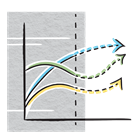 |
Consideration of risks: The practice accounts for the implications of key emerging challenges for the state’s fiscal health, and it includes gathering data and consulting with experts to understand which trends pose the greatest risk to each state’s particular circumstances, the magnitude of the potential consequences, and how the effects might change over time. |
 |
Forward-looking analysis: The practice analyzes the effect of emerging trends at least five years into the future, enabling proactive planning by providing important context about the conditions states may face in the future and how those conditions may change over time. |
 |
Fiscal focus: The practice’s primary purpose is assessing the fiscal implications of forward-looking trends to clarify how demographic, climate, technological, and other changes will affect long-term revenue and expenditure needs in a way that is more meaningful for budgeting than looking only at the trends’ broader policy implications. |
 |
Budget process integration: The practice has a clear connection to the budget process, either as a direct part of that process or through another formal mechanism, such that it actively informs fiscal decision-makers and long-term budget planning. |
 |
Routine risk identification: The practice is a regular effort to identify and assess potential fiscal risks, providing a more robust view of a state’s fiscal future than an ad hoc effort to analyze a single topic. |
Evaluating state approaches based on these elements provides valuable insight into how policymakers are preparing for the fiscal challenges ahead and revealed useful examples for states that wish to incorporate emerging risk assessment into their budget processes.
Some states have well-developed practices
Six states—Colorado, Florida, Montana, New Mexico, Utah, and Virginia—have established practices to identify and assess emerging fiscal risks that fit Pew’s definition of an emerging risk assessment. In addition, Kentucky previously had such a practice, but it is no longer active. States’ efforts take various forms, including legislative committees, conferences, and reports, but each provides considerable information and insights related to budget risks.
Legislative committees
Montana and New Mexico have joint legislative committees that are tasked with fiscal analysis and specifically consider emerging risks. Both committees have permanent analytical staff who update projections regularly to ensure that legislators always have access to current data. These committees provide important opportunities for legislators to engage in long-term fiscal planning and risk assessment.
Montana’s Modernization & Risk Analysis (MARA) Committee, established by law in 2023, is charged with studying “the long-term future budget and revenue needs of the state with changing economics and demographics.”13 The Legislative Fiscal Division (nonpartisan staff for the committee) compiles data from across the state for the MARA Data Project, helping policymakers understand emerging risks.14 Data is organized into topics such as population and personal income, health care, and education, and includes discussion of forward-looking trends and how they may affect state finances. The committee routinely invites subject matter experts to their meetings to provide additional analysis.
New Mexico’s Legislative Finance Committee (LFC) is a joint standing committee that includes the chairs of the House Appropriations and Finance, House Taxation and Revenue, and Senate Finance committees.15 Between legislative sessions, committee staff produce revenue forecasts and budget stress tests, prepare issue briefs on issues of significance to state finances, such as the state’s industrial profile and electric vehicle charging infrastructure, and organize expert testimony for committee hearings.16
LFC also conducts long-term fiscal analyses for New Mexico’s Revenue Stabilization and Tax Policy Committee, a statutorily created joint committee that sometimes examines emerging fiscal risks as part of its research agenda.17 For example, in 2024 the committee discussed options for addressing long-term risks associated with reliance on the oil and gas industry, as well as the tax implications of technology-driven change, such as growth in remote work and AI.18
Special convenings
Creating a space for decision-makers to learn about emerging trends and their potential fiscal impacts by bringing in experts and external analyses can contribute to a thoughtful risk assessment practice.
Utah convenes a Legislative Long-Term Planning Conference to “encourage the Legislature … to focus on long-term planning, policymaking, and budgeting.”19 The conference, typically held every two years, provides legislators with information on projected economic and demographic trends and the state’s long-term budgetary outlook. The September 2023 conference included in-depth discussions about challenges created by population growth, increasing housing costs, water shortages, and future revenue uncertainty.20
Similarly, Virginia’s Senate Finance and Appropriations Committee holds an annual meeting to discuss fiscal issues facing the commonwealth.21 Topics for the meeting, which has taken place before each General Assembly session since at least 2006, originate with committee staff and are discussed by panels of experts.22 Recent presentations have covered long-term risks to the budget including public education, Medicaid trends, extreme weather, and data center electricity demand.23
Required long-term budget planning
States can also make long-term thinking a routine part of their budget processes by incorporating forward-looking data into budget documents to help decision-makers consider emerging risks and to encourage better planning.

The Florida Legislature’s Office of Economic and Demographic Research (EDR) holds statutorily required consensus estimating conferences throughout the year.24 During these convenings, professional staff from the governor’s office, Senate, House of Representatives, and EDR create forecasts to provide key data for legislators and executive budget staff to better plan for long-term fiscal sustainability.25 These projections include 10-year economic indicators, five-year school enrollment, five-year state Medicaid share, and 25-year population projections and are used to develop the state’s “Long-Range Financial Outlook,” the governor’s budget recommendations, and the state’s General Appropriations Act.26 Additionally, all state agencies must use the results for planning and budget processes.
Since 2019, Colorado’s state agencies have submitted annual long-range financial plans along with their budget submissions to the Office of State Planning and Budgeting (OSPB). The plans provide the OSPB and the General Assembly with information on trends that influence each agency’s costs and revenue to inform long-term fiscal planning. Although the statute requiring this practice expired in 2024, OSPB continues to request the plans and recently hired additional staff to support their use in budgeting.27 OSPB summarizes key findings from the plans within the governor’s budget request, highlighting the state’s most significant long-term budget drivers. For fiscal year 2026–27, OSPB describes fiscal effects from demographic trends and caseloads, climate, energy, and natural resources.28
From 1992 until 2010, Kentucky had a Long-Term Policy Research Center, an agency of the General Assembly, that provided forecasts and analyses to help decision-makers consider “the long-term implications of policy and critical trends and emerging issues which are likely to have significant impact on the state.”29 The center, which had a 21-member board of directors made up of representatives from the executive and legislative branches, universities, local governments, and the community, produced various studies, such as a report on the long-term budgetary effects of demographic and economic trends and a policy memo on the future impact of nursing shortages.30
Additional models for action
Several states also had noteworthy practices, which did not encompass all five of Pew’s key elements but nevertheless stood out for the ways they substantially consider long-term emerging fiscal risks.
Long-term planning bodies
Some states have formed committees or other groups dedicated to long-term planning. And although they do not have an explicit fiscal focus, these groups do sometimes consider trends that affect fiscal sustainability, providing regular identification of possible emerging challenges, create a space for long-range planning, and produce valuable information for sustainable budgeting.
The Nebraska Legislature’s Planning Committee, created in 2009, identifies emerging trends and long-term challenges for purposes of understanding the factors that affect the welfare of Nebraskans and considering the future implications of policy decisions.31 The committee studies topics, such as “an ever-changing global economy, an aging population, outmigration of educated young people, and constantly expanding needs for services,” and works between legislative sessions with the University of Nebraska at Omaha’s Center for Public Affairs Research to analyze data on key trends selected through a legislator survey.32 Recent topics include state revenue and expenditure trends in the context of shifting demographics and how housing supply and child care scarcity affect migration and the workforce.33
Maine tackles long-term issues through an executive office with a similar charge: The Governor’s Office of Policy Innovation and the Future was created in 2019 “to help solve Maine’s most important long-term challenges utilizing data-driven, innovative policy solutions.”34 Office staff participate in a variety of initiatives tackling long-term risks such as Maine’s climate action plan, Cabinet on Aging, Artificial Intelligence Task Force, and Community Resilience Partnership, which helps communities prepare for the effects of climate change.35
Identification of high-risk state programs
Utah and California have laws that charge their auditors’ offices with identifying program areas that pose a substantial risk to states, including those that could cause fiscal harm.36 Although limited in scope, these practices can help surface long-term issues for state budgets and inform budget decision-makers.
Utah’s Office of the Legislative Auditor General (OLAG) regularly produces a “high-risk list,” reported to the Legislative Audit Subcommittee, that includes programs and operations that “threaten public funds or programs; are vulnerable to inefficiency, waste, fraud, abuse, or mismanagement; or require transformation.”37 OLAG’s 2025 report identifies 10 areas of concern, including the state’s aging water infrastructure, cybersecurity and data privacy, energy policy, and revenue diversification.38
Similarly, California’s State Auditor uses several criteria to determine risk and produces an audit report at least every two years with the most recent list of high-risk issues.39 The most recent report in 2025 noted that state management of federal COVID-19 funds, information security, water infrastructure and availability, and other issues continue to present significant risks to the state.40
Economic and revenue reports
Some states use the economic reports or revenue forecasts that are produced during their regular budget processes to identify long-term fiscal risks in the state. Although not routine, these practices integrate important emerging risk information into budgeting efforts and provide long-term context for policymakers.
The University of Kentucky’s Center for Business and Economic Research (CBER) is statutorily required to produce an annual economic report for the governor’s Financial Planning Council and state agencies that includes data describing the economic climate and the broader trends affecting the state’s future.41 The state’s 2026 report highlights several emerging risks, including uncertain economic and workforce shifts resulting from AI and key population trends that may affect the economy and budget.42
The University of Tennessee produces a similar annual economic report for interdepartmental consistency in planning and budgeting, and its 2025 edition includes sections on persistent trends such as the employment effects of an aging population and the economic implications of AI.43
Oregon’s Office of Economic Analysis, which resides in the Department of Administrative Services, produces quarterly economic and revenue forecasts that are used for budgeting and to inform decision-makers.44 The report includes a “Near- to Medium-Term Forecast Risks” section that, in May 2025, cited drought, wildfires, and AI as emerging budget concerns.45 The previous report, published in March 2025, included an “Aging and State Revenues” section that discussed the tax implications of an aging population.46
Long-term data gathering
Other states use fiscal agencies or other departments to gather data on long-term trends and their potential fiscal implications, which, while not integrated in the budget process, provide insightful information to help decision-makers understand emerging risks.
Washington’s Office of Financial Management tracks economic, demographic, and social trends that affect revenue and expenditures on its Washington Trends website.47 The publicly available information includes a budget drivers section with historical data on populations that affect state spending such as people requiring medical assistance, those in prison, and students enrolled in public schools.48 Other sections, such as population changes and revenue and expenditure trends, can also help decision-makers understand how long-term trends can shift state finances in the future.
Further, the Comptroller of Maryland produced a series of reports in 2025 that “explains state expenses and shares lessons learned from across the U.S. and the world about cost drivers of public goods projects that are essential to inclusive growth.”49 The April 2025 report, for instance, discussed how climate-related hazards create immediate and compounding economic impacts and highlighted the costs of inaction and funding options for resilience actions.50
Support for local emerging risk practices
Because many emerging threats will affect local as well as state budgets, some states have created practices that not only consider state fiscal impacts but also help local communities understand their risk.
For example, Colorado’s Resiliency Office (CRO), created by the governor in 2013 and codified in law in 2018, coordinates across state and local government and other partners to support community response to disruptive events such as natural disasters, and adaptation to long-term challenges such as economic uncertainty.51 The CRO created the Resiliency Framework in 2015 to outline future challenges and goals. Then in 2020 it updated the framework and identified four key vulnerabilities: climate change adaptation, risks from natural and other hazards, social equity and unique community needs, and economic diversity and vibrancy.52
Similarly, the Montana Ready Communities Initiative, which operates through the state Department of Commerce, addresses community challenges related to natural disasters and other environmental, social, and economic disruptions.53 In 2018 the initiative created the Montana Resilience Framework for Communities to help localities identify, assess, and adapt to emerging risks. As the framework’s executive summary explains, “Facing a future with new and emerging threats such as cyberattacks, climate change, social and political instability, and global pandemics, forward-thinking communities will address these challenges head-on.”54
Risk analyses can provide key data
Besides the promising practices described above, many states produce one-time analyses of specific emerging risks and long-term trends that can provide decision-makers with important long-term data if they are incorporated into the budget process. These analyses come in a variety of forms, and some include the fiscal impacts of the examined trends. (See Figure 2.) A full list of these resources can be found in the accompanying dataset, available on Pew’s website.

For example, some states create temporary task forces or produce one-time reports to study a trend and its potential fiscal impact. These practices provide legislators or executive budget staff with detailed analyses that can aid fiscal planning. For example, Minnesota’s 2023-24 Legislative Task Force on Aging and Oklahoma’s 2023 report “The Current State of Aging in Oklahoma” discussed fiscal impacts from long-term demographic shifts.55 Illinois’s 2024 Generative AI and Natural Language Processing Task Force and California’s 2023 “Benefits and Risks of Generative Artificial Intelligence Report” discuss the implications of evolving technology for those states.56 And Delaware’s “An Economic Analysis of the Impacts of Climate Change in the State of Delaware” and Massachusetts’ “Massachusetts Climate Change Assessment, Volume 2,” both from 2022, cover economic and fiscal impacts from long-term climate trends.57
Some states also create interactive tools for specific risk analyses to illuminate ongoing economic and fiscal risks from long-term trends. These tools, accessible to both decision-makers and the public, supply valuable information about changing conditions and their potential budget effects. Colorado’s Future Avoided Cost Explorer shows economic impacts from flood, drought, and wildfire through 2050 with a variable to adjust for population growth assumptions.58 Hawaii’s Generational Economy Dashboard details the economic implications of an aging population, and Louisiana’s Coastal Master Plan Data Viewer visualizes projected coastal change and associated damage over 50 years.59
Conclusion
Long-term trends and major changes in demographics, climate, and technology create challenges for state budgets, and although the demanding and fast-paced state budget process can make proactive planning difficult, states stand to benefit from more rigorous evaluation of these emerging risks and their potential fiscal impacts.
To varying degrees, states are already taking steps to conduct these assessments. Decision-makers wanting to strengthen existing strategies or begin incorporating long-term trends into their budget processes can learn from practices in other states that feature the five key elements identified in Pew’s research: consideration of key trends, forward-looking analysis, primary fiscal focus, integration within the budget process, and routine risk identification.
By considering emerging fiscal risks, state practitioners can make more sustainable budget decisions and safeguard the important functions of state government for the future.
Appendix: Methodology
To identify state practices related to recognizing, assessing, and addressing long-term trends and risks related to fiscal analysis and demographic changes, climate, and technology, Pew researchers examined public information from the 50 states through web searches and review of state government websites between January and May 2025. These searches included each state’s name (identified as [state]) and the following keywords (identified as [keywords]): technology, artificial intelligence, cybersecurity, aging, population, demographic trends, climate, disasters, mitigation, sea level, extreme heat, deficit, tax base, revenue, and finance.
- Web searches: [state] legislature economic outlook; [state] economic forecast; [state] long-term analysis; [state] [keywords] report; [state] climate plan; [state] aging plan
- Search of state’s legislative website for potentially relevant committees, task forces, or working groups: reviewed descriptions, reports, agendas for relevant activity to [keywords]
- Search of state’s legislative fiscal office websites for reports related to economic outlook, economic forecast, long-term analysis, [keywords]
- Search of state’s government website, using state agency directory if available to identify relevant individual agencies: technology, aging, natural resources, environment, resilience, disaster/emergency management, finance, taxation/revenue, executive budget, auditor
- Search of relevant state agency websites for programs, reports, initiatives related to [keywords]
- Search of state’s government website, using directory of task forces or work groups if available to identify task forces and work groups for reports and initiatives on [keywords]
Pew researchers then reviewed the data collected through these searches for relevance to a practice that examines demographic, climate, or technology trends and looks at least five years into the future. Individual researchers evaluated each practice for relevance and brought any questionable items to the group for a final decision.
During this review, the researchers also flagged practices that included comprehensive analysis and were incorporated in the state’s budget process. Researchers combined a review of these state practices with previous research into long-term fiscal management and discussion with budget practitioners to develop the five elements of an emerging risk assessment discussed in this report.
To verify the data, Pew emailed a state-level contact within either the executive or legislative budget office to ask for any missing practices for inclusion. In addition to the methods above, the researchers supplemented the data collection and verification with data received from informal conversations with state lawmakers and staff.
Although every effort was made to include all relevant practices across states, other practices that fell outside the search and verification process may exist.
About this report
This report was researched and written by Maureen Hilton, Peter Muller, and Caitlyn Wan Smith of The Pew Charitable Trusts’ managing fiscal risks project. Jimmy Einsiedler, Jad Maayah, Jasmine Ng, and Alan van der Hilst helped with the research. Catherine An, Rachel Bush, Jennifer V. Doctors, Ned Drummond, Tamara El-Waylly, Terri Law, and Avi Meyer provided communications, design, and editorial support.
Acknowledgements
This report benefited from the insights and expertise of outside reviewers Sharon Kioko, associate professor at University of Washington, and Lauren Larson, former Colorado state budget director and former president of the National Association of State Budget Officers. Although they have reviewed the draft, neither they nor their organizations necessarily endorse its findings or conclusions.
Endnotes
- “A Range of Emerging Fiscal Risks Could Disrupt State Budgets,” Peter Muller, The Pew Charitable Trusts, April 17, 2024, https://www.pew.org/en/research-and-analysis/articles/2024/04/17/a-range-of-emerging-fiscal-risks-could-disrupt-state-budgets.
- “5 Facts About Global Fertility Trends,” Sofia Hernandez Ramones, Skylar Thomas, and Manolo Corichi, Pew Research Center, Aug. 15, 2025, https://www.pewresearch.org/short-reads/2025/08/15/5-facts-about-global-fertility-trends/.
- “How Record-Low Fertility Rates Foreshadow Budget Strain,” Joanna Biernacka-Lievestro, Alexandre Fall, and Page Forrest, The Pew Charitable Trusts, July 8, 2025, https://www.pew.org/en/research-and-analysis/articles/2025/07/08/how-record-low-fertility-rates-foreshadow-budget-strain?fert_tile_mk=birthb19.
- John Scott, “The Aging States of America,” The Catalyst Fall 2024, no. 32 (2024): https://www.bushcenter.org/catalyst/the-great-gray-wave/the-aging-states-of-america.
- “Population Growth in Most States Outpaced Long-Term Trends in 2024,” Joanna Biernacka-Lievestro and Alexandre Fall, The Pew Charitable Trusts, March 5, 2025, https://www.pew.org/en/research-and-analysis/data-visualizations/2014/fiscal-50/population-change.
- Wenying Su et al., A.R. Crimmins et al., eds., “Chapter 2: Climate Trends,” in Fifth National Climate Assessment (Washington, D.C.: U.S. Global Change Research Program, 2023), https://toolkit.climate.gov/sites/default/files/2025-07/NCA5_2023_FullReport.pdf.
- Wenying Su et al., Crimmins et al., eds., Chapter 2: Climate Trends.
- “Cybersecurity,” U.S. Government Accountability Office, https://www.gao.gov/cybersecurity. U.S. Government Accountability Office, “High-Risk Series: Urgent Action Needed to Address Critical Cybersecurity Challenges Facing the Nation,” 2024, https://www.gao.gov/assets/gao-24-107231.pdf.
- U.S. House Committee on Homeland Security, “Cyber Threat Snapshot,” 2024, https://homeland.house.gov/wp-content/uploads/2024/11/11.12.24-Cyber-Threat-Snapshot.pdf.
- Virginia Joint Legislative Audit and Review Commission, “Data Centers in Virginia,” 2024, https://jlarc.virginia.gov/pdfs/reports/Rpt598.pdf.
- Soojin Kim and Qiushi Wang, “State Budget Periodicity and General Expenditure Volatility: An Empirical Analysis,” Journal of Public Budgeting, Accounting & Financial Management 27, no. 4 (2015): 419-454, https://dr.ntu.edu.sg/server/api/core/bitstreams/63e90307-d104-4070-968e-163a93c8ea71/content.
- The Pew Charitable Trusts, “Tools for Sustainable State Budgeting,” 2023, https://www.pewtrusts.org/en/research-and-analysis/reports/2023/11/tools-for-sustainable-state-budgeting.
- “Modernization & Risk Analysis (MARA) 2025 Biennium,” Montana State Legislature, 2025, https://archive.legmt.gov/lfd/mara/. Montana Legislature, Establishing Modernization and Risk Analysis Committee, H.B. 140 (2023), https://legiscan.com/MT/text/HB140/id/2795185/Montana-2023-HB140-Enrolled.pdf.
- “MARA Data Project,” Montana Legislative Fiscal Division, https://archive.legmt.gov/lfd/mara-data-project/.
- “Legislative Finance Committee,” New Mexico Legislature, https://www.nmlegis.gov/Entity/LFC/Default.
- Brendon Gray, “New Mexico Industry Cluster Analysis,” New Mexico Legislative Finance Committee, 2024, https://www.nmlegis.gov/Entity/LFC/Documents/Revenue_Reports/Hearing%20Brief%20-%20Economic%20Industry%20Cluster%20Study.pdf. New Mexico Legislative Finance Committee, “New Mexico’s Public Light-Duty Electric Vehicle Charging Infrastructure,” 2024, https://www.nmlegis.gov/Entity/LFC/Documents/Program_Evaluation_Reports/ALFC%20120924%20Item%2018%20Policy%20Spotlight%20EV%20Charging%20Infrastructure%20FINAL%20SUBMITTED.pdf. New Mexico Legislative Finance Committee, “General Fund Consensus Revenue Estimate,” 2025, https://www.nmlegis.gov/Entity/LFC/Documents/Revenue_Reports/General_Fund_Revenue_Forecast/2025/ALFC%20081925%20Item%201%20General%20Fund%20Consensus%20Revenue%20Estimate.pdf. Ismael Torres, “Balancing Mid- to Long-Term Revenues and Expenditures” (presentation, Presentation to the Legislative Finance Committee, Sept. 23, 2025), https://www.nmlegis.gov/Handouts/ALFC%20092325%20Item%203%20-Joint%20Presentation%20Long-Term%20Outlook.pdf.
- “Revenue Stabilization and Tax Policy Committee,” New Mexico Legislature, 2025, https://www.nmlegis.gov/Committee/Interim_Committee?CommitteeCode=RSTP.
- New Mexico Legislature Revenue Stabilization and Tax Policy Committee, “2024 Interim Final Report,” 2024, https://www.nmlegis.gov/Publications/Interim_Reports/RSTP24.pdf.
- Purpose of the Long-Term Planning Conference, JR3-3-102, Utah Legislature, https://le.utah.gov/xcode/TitleJR3/Chapter3/JR3-3-S102.html.
- Utah House of Representatives, “Long-Term Planning Conference Recap,” Oct. 6, 2023, in House Rules: Politics and Policy in Utah, podcast, https://open.spotify.com/episode/4BeaeZxotrLjTmfpxqC0co.
- “2025 Senate Finance and Appropriations Committee Annual Meeting: Fiscal Issues Facing the Commonwealth,” Virginia Senate Finance and Appropriations Committee, Nov. 20, 2025, https://sfac.virginia.gov/annual_retreat.shtml.
- “Annual Senate Finance Committee Retreat on Fiscal Issues Facing the Commonwealth,” Virginia Senate Finance and Appropriations Committee, Nov. 16, 2006, https://sfac.virginia.gov/annual_retreat_2006.shtml.
- Virginia Senate Finance and Appropriations Committee, “Annual Meeting 2024 Agenda,” 2024, https://sfac.virginia.gov/pdf/committee_meeting_presentations/2024%20Interim/Annual%20Meeting%20Harrisonburg/_Public%20Copy%20Agenda%20for%20Web.pdf.
- Florida Legislature, Consensus Estimating Conferences; General Provisions, 216.134 https://edr.state.fl.us/Content/conferences/statute.pdf.
- “Consensus Estimating Conferences,” Florida Office of Economic and Demographic Research, March 13, 2026, https://edr.state.fl.us/Content/conferences/index.cfm.
- “Consensus Estimating Conferences,” Florida Office of Economic and Demographic Research. Florida Office of Economic and Demographic Research, “Consensus Estimating Conference Process,” https://edr.state.fl.us/Content/conferences/confprocess.pdf. Florida Senate Committee on Appropriations, Florida House Appropriations Committee, and Florida Legislative Office of Economic and Demographic Research, “State of Florida Long-Range Financial Outlook: Fiscal Years 2025-26 Through 2027-28,” 2024, https://www.leg.state.fl.us/data/committees/joint/jlbc/Long-RangeFinancialOutlook2024-v2.pdf.
- Colorado General Assembly, State Agency Long-Range Financial Plan, H.B. 18-1430 (2018), https://leg.colorado.gov/bills/hb18-1430. Colorado Governor’s Office of State Planning and Budgeting, “FY 2025-26 Budget Request,” 2024, 71, https://drive.google.com/file/d/1Gzo70gGTmrAUzbrq5BTAVqIbhHhnS1sr/view.
- Colorado Governor’s Office of State Planning and Budgeting, “FY 2026-27 Budget Request,” 2025, 79-85, https://drive.google.com/file/d/1BDifqOqhaY9MkyOJl70mtgow92AWisN2/view.
- “Who We Are,” Kentucky Long-Term Policy Research Center, Dec. 4, 2002, https://web.archive.org/web/20021204193912/http://kltprc.net/WhoWeAre1.htm.
- Kentucky General Assembly, Kentucky Long-Term Policy Research Center—Status—Executive Director, 7B.020 (1992), https://apps.legislature.ky.gov/law/statutes/statute.aspx?id=506. Billie S. Dunavent and Mark Schirmer, “Purpose, Publications, and Products 2005,” Kentucky Long-Term Policy Research Center, 2005, https://web.archive.org/web/20060614073028/http://kltprc.net/books/Index_2005.pdf. Peter Schirmer, Michael T. Childress, and Charles C. Nett, “$5.8 Billion and Change: An Exploration of the Long-Term Budgetary Impact of Trends Affecting the Commonwealth,” Kentucky Long-Term Policy Research Center, 1996, https://lccn.loc.gov/95081884.
- “Legislature’s Planning Committee,” Nebraska Legislature, Jan. 3, 2024, https://news.legislature.ne.gov/lpc/. Nebraska Legislature, For an Act Relating to the Legislature; to Create the Legislature’s Planning Committee; to State Findings; to Provide Powers and Duties; and to Declare an Emergency, L.B. 653 (2009), https://nebraskalegislature.gov/FloorDocs/101/PDF/Slip/LB653.pdf.
- “Nebraska State Policy Initiative,” Center for Public Affairs Research, University of Nebraska at Omaha, https://www.unomaha.edu/college-of-public-affairs-and-community-service/center-for-public-affairs-research/programs/nebraska-state-policy-initiative.php. Nebraska Legislature, L.B. 653.
- Nebraska Legislature’s Planning Committee, “2023 Planning Committee Report,” 2023, https://nebraskalegislature.gov/pdf/reports/committee/select_special/lpc/lpc2023.pdf. Nebraska Legislature’s Planning Committee, “2024 Planning Committee Report,” 2024, https://govdocs.nebraska.gov/epubs/L3790/B075-2024.pdf.
- “Governor’s Office of Policy Innovation and the Future,” State of Maine, https://www.maine.gov/future/about.
- Maine Artificial Intelligence Task Force, “Maine Artificial Intelligence Task Force Report,” 2025, https://www.maine.gov/future/sites/maine.gov.future/files/2025-10/_AI%20Report_DIGITAL.pdf. Maine Climate Council, “Maine Won’t Wait: A Four-Year Plan for Climate Action,” 2024, https://www.maine.gov/climateplan/sites/maine.gov.climateplan/files/2024-11/MWW_2024_Book_112124.pdf. “Community Resilience Partnership: Working to Help Maine Communities Reduce Emissions and Prepare for the Effects of Climate Change,” Maine Governor’s Office of Policy Innovation and the Future, https://www.maine.gov/future/climate/community-resilience-partnership. “Cabinet on Aging,” Maine Governor’s Office of Policy Innovation and the Future, https://www.maine.gov/future/aging.
- California Legislature, Article 2: Powers and Duties, CA Govt Code 8546.5 (1993), https://leginfo.legislature.ca.gov/faces/codes_displaySection.xhtml?lawCode=GOV§ionNum=8546.5. Utah Legislature, Office of the Legislative Auditor General Established; Qualifications; Powers, Functions, and Duties; Reporting; Criminal Penalty; Employment, 36-12-13 (2023), https://le.utah.gov/xcode/Title36/Chapter12/36-12-S15.html.
- Utah Office of the Legislative Auditor General, “High-Risk List: Identifying and Mitigating Critical Vulnerabilities in Utah—2025,” 2025, 1, https://pf.utleg.gov/olag/reports/audits/2025/031c2af1-ade0-4e0b-8fee-1772dd77986a/2025-25_RPT.pdf.
- Utah Office of the Legislative Auditor General, “High-Risk List.”
- California State Auditor, “State High-Risk Audit Program: The California State Auditor’s Updated Assessment of Issues and Agencies That Pose a High Risk to the State,” 2025, 1, https://www.auditor.ca.gov/reports/2025-601/. California Legislature, CA Govt Code 8546.5.
- California State Auditor, “State High-Risk Audit Program, 2025.”
- Michael T. Childress, Michael W. Clark, and Katie Scott, “Kentucky Annual Economic Report 2025,” University of Kentucky Center for Business and Economic Research, 2025, xiii, https://gatton.uky.edu/sites/default/files/2025-02/2025-kentucky-annual-economic-report.pdf. Kentucky General Assembly, Annual Economic Report—Maintenance of State Economic Data by University of Kentucky, 164.738 (1986), https://apps.legislature.ky.gov/law/statutes/statute.aspx?id=4412.
- Michael T. Childress, Michael W. Clark, and Katie Scott, “Kentucky Annual Economic Report 2026,” University of Kentucky Center for Business and Economic Research, 2026, 262-289, https://cber.uky.edu/sites/default/files/2026-01/uk-cber-2026-kentucky-annual-economic-report.pdf.
- Lawrence M. Kessler et al., “An Economic Report to the Governor of the State of Tennessee, 2025,” The University of Tennessee Haslam College of Business, 2024, iii, https://haslam.utk.edu/publication/economic-report-to-the-governor-2025/.
- “Economic and Revenue Forecasts,” Oregon Office of Economic Analysis, https://www.oregon.gov/das/oea/pages/forecastecorev.aspx.
- Oregon Office of Economic Analysis, “Oregon Economic and Revenue Forecast: May 2025,” 2025, https://www.oregon.gov/das/oea/Documents/OEA-Forecast-0525.pdf.
- Oregon Office of Economic Analysis, “Oregon Economic and Revenue Forecast: March 2025,” 2025, https://www.oregon.gov/das/oea/Documents/OEA-Forecast-0325.pdf.
- “Washington Trends,” Washington State Office of Financial Management, https://ofm.wa.gov/data-research/washington-trends/.
- “Budget Drivers,” Washington State Office of Financial Management, https://ofm.wa.gov/data-research/washington-trends/budget-drivers/.
- “Research Reports: State Spending Series,” Maryland Office of the Comptroller, https://www.marylandcomptroller.gov/reports/research-reports.html.
- Maryland Office of the Comptroller, “State Spending Series: Climate Change Costs,” 2025, https://www.marylandcomptroller.gov/content/dam/mdcomp/md/reports/research/state-spending-series-climate-change-costs-april-2025.pdf.
- Colorado General Assembly, Update Colorado Disaster Emergency Act, H.B. 18-1394 (2018), https://leg.colorado.gov/bills/hb18-1394. “About the Colorado Resiliency Office,” Colorado Resiliency Office, https://coresiliency.colorado.gov/about-the-cro. Environmental Defense Fund, Environmental Council of the States, and National Emergency Management Association, “Instituting Resilience: Recommendations for Governors and Legislators on Establishing and Supporting Chief Resilience Officers,” 2021, https://www.edf.org/sites/default/files/documents/InstitutingResilience-FINAL-Web.pdf.
- “Colorado Resiliency Framework,” Colorado Resiliency Office, https://coresiliency.colorado.gov/colorado-resiliency-framework.
- “Montana Ready Communities Initiative,” Montana Department of Commerce, https://commerce.mt.gov/Infrastructure-Planning/Programs-and-Services/Montana-Ready-Communities-Initiative.
- Montana Department of Commerce, “Montana’s Resilience Framework for Communities,” 2018, 6, https://commerce.mt.gov/_shared/comdev/MRCI/docs/Montana-Resiliency-Framework.pdf.
- “Legislative Task Force on Aging,” Minnesota Legislative Coordinating Commission, https://www.lcc.mn.gov/aging/. Oklahoma Human Services, “The Current State of Aging in Oklahoma,” 2023, https://oklahoma.gov/content/dam/ok/en/okdhs/documents/okdhs-pdf-library/community-living-aging-and-protective-services/MPA%20CSR%20Current%20State%20Report%20FULL.pdf.
- California Government Operations Agency, “State of California: Benefits and Risks of Generative Artificial Intelligence Report,” 2023, https://www.govops.ca.gov/wp-content/uploads/sites/11/2023/11/GenAI-EO-1-Report_FINAL.pdf. Illinois Generative AI and Natural Language Processing Task Force, “Report of the Generative AI and Natural Language Processing Task Force,” 2024, https://doit.illinois.gov/content/dam/soi/en/web/doit/meetings/ai-taskforce/reports/2024-gen-ai-task-force-report.pdf.
- Industrial Economics, “An Economic Analysis of the Impacts of Climate Change in the State of Delaware,” 2022, https://documents.dnrec.delaware.gov/energy/Documents/Climate/Plan/Economic-Analysis-of-the-Impacts-of-Climate-Change-in-the-State-of-Delaware.pdf. Massachusetts Executive Office of Energy and Environmental Affairs, “Massachusetts Climate Change Assessment Volume II—Statewide Report,” 2022, https://www.mass.gov/doc/2022-massachusetts-climate-change-assessment-december-2022-volume-ii-statewide-report/download.
- “Future Avoided Cost Explorer (FACE: Hazards),” Colorado Water Conservation Board, Dec. 4, 2025, https://cwcb.colorado.gov/FACE.
- “Hawaii’s Generational Economy Dashboard,” Hawaii Department of Business, Economic Development, and Tourism, December 2024, https://dbedt.hawaii.gov/economic/hawaii-generational-economy-dashboard/. “Data Tools,” Louisiana Coastal Protection and Restoration Authority, 2023, https://coastal.la.gov/our-plan/2023-coastal-master-plan/data-tools/.
People