Drug Checking Equipment Can Reduce Overdose Deaths
Policymakers can increase access to tools that identify fentanyl and other substances in an unpredictable drug supply
Overview
Fentanyl—a powerful synthetic opioid up to 50 times stronger than heroin—remains a major factor in the nation’s overdose crisis.1 Nearly 60% of all overdose deaths between March 2024 and March 2025 involved this potent synthetic opioid, and fentanyl has contributed to a more than 750% increase in opioid overdose deaths from 2015 to 2023.2 Yet many people who use drugs don’t know how prevalent fentanyl is in the drug supply.3
Addressing fentanyl overdose deaths is a bipartisan priority in Congress and statehouses across the country. As a result, many policymakers are working to increase access to drug checking equipment—tools that can identify specific substances, such as fentanyl, in a drug sample—in tandem with greater access to treatment and services for people with substance use disorders.4
Drug checking equipment can save lives by alerting people to the presence of fentanyl or other contaminants in the drug supply.5 Such information is critically needed: Research has shown that people who use stimulants, such as methamphetamine and cocaine, are less knowledgeable about the potential for fentanyl in these drugs.6 At the same time, one study found that fentanyl was present in 12%-15% of methamphetamine and cocaine sampled.7
Despite declining youth drug use, more young people are also dying from overdoses due to the consumption of counterfeit pills of other substances, such as anxiety medications, that also contain fentanyl.8 Fentanyl has also led to a rapid increase in overdose death rates among adults over 65 and Black people.9
And new substances with harmful or unknown effects continue to enter the drug supply. Xylazine—a veterinary sedative that can cause painful skin ulcers that can lead to amputation— has been found in stimulants.10 Fentanyl-related overdose deaths associated with xylazine increased 276% between January 2019 and June 2022.11 Starting in 2024, medetomidine, another veterinary sedative that’s 100-200 times stronger than xylazine, and BTMPS, a chemical used in plastics manufacturing and adhesives, have increasingly been detected in regions across the country.12
These rapid changes have led people who use drugs to describe the drug supply as always unpredictable, and they report fear and concern about the potential for overdose.13 This is where drug checking equipment can be lifesaving—it can help people know exactly what is in the drug supply and help them lower their risk of overdose.14
Common drug checking equipment includes test strips that can detect the presence of a single substance, such as fentanyl or xylazine; portable machines that can identify almost all substances in a drug sample; and laboratory-based techniques that can identify nearly all substances in a sample, even in low doses, and provide concrete information on potency to individuals and information on trends and emerging harmful substances to the public.15
Most states have passed laws on drug checking equipment in recent years. A review of those laws found that 45 states allow individuals and organizations to possess, distribute, and sell at least one type of drug checking equipment, and 20 states permit people to possess, distribute, and sell all forms of drug checking equipment.16 But state policymakers can do more to advance access to these lifesaving tools and reduce overdose deaths. Lawmakers should consider passing laws and policies that:
-
Expand access to test strips:
- Make it legal to possess, distribute, and sell all drug checking equipment
- Make test strips available in community-based settings and programs that serve people who use drugs
- Provide test strips to people leaving hospital emergency departments
- Equip first responders to distribute test strips
- Increase access to portable drug testing machines at sites that provide comprehensive and targeted services to people who use drugs
- Support state or regional lab-based testing for drug samples and provide results to individuals and trends to the public
Expand access to test strips
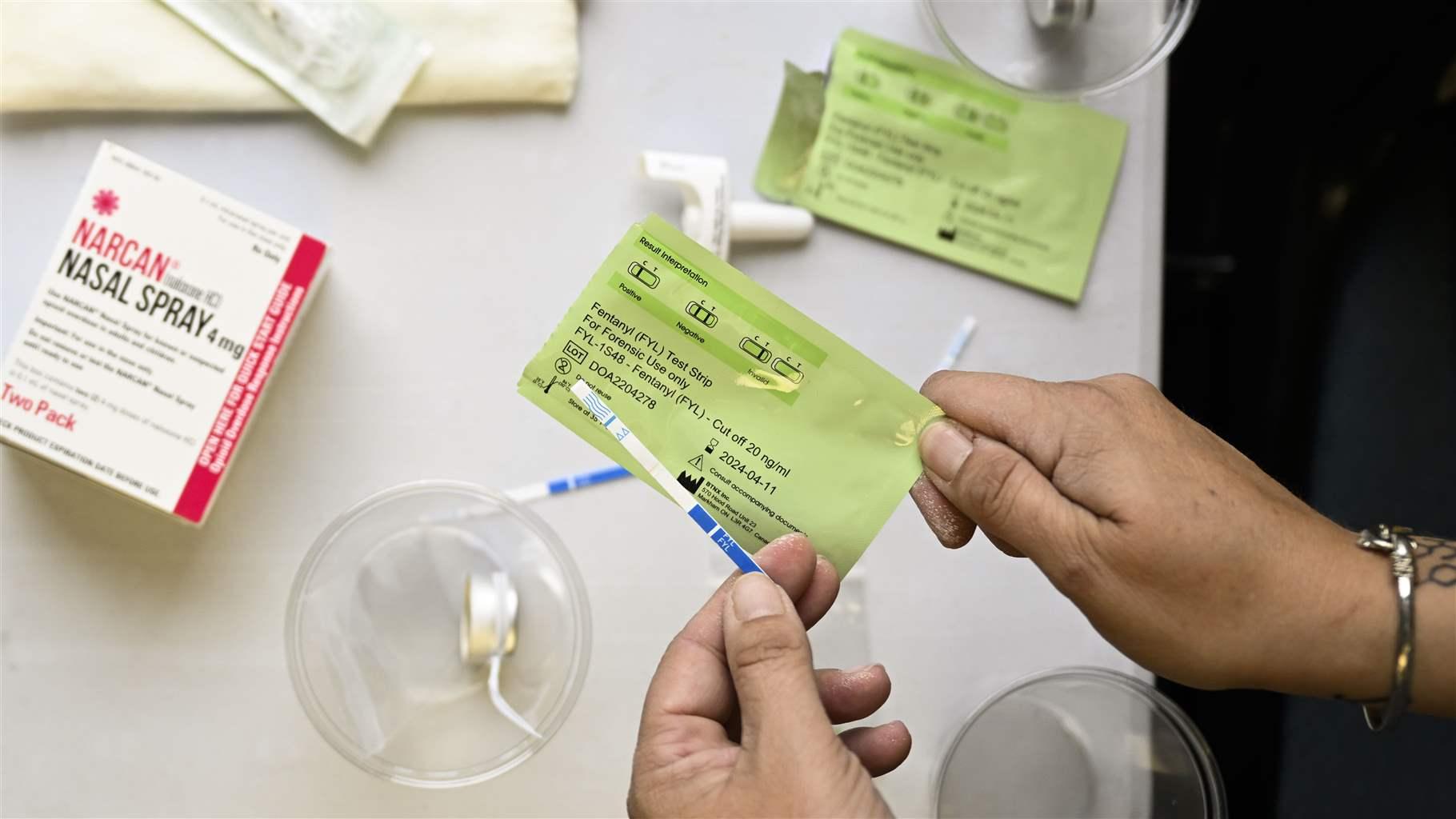
Fentanyl test strips identify the presence or absence of fentanyl in a liquid drug sample.17 (Powders or pills must be crushed and dissolved in water before the strips are dipped to test for fentanyl.)18 These strips can help people who use drugs—regardless of the substance they use—make decisions that could help reduce their risk of overdose, such as choosing to use less of a drug, consuming a drug more slowly, or using drugs in the presence of other people.19
People who use drugs have described fentanyl test strips as easy to use, and uptake among this population is high.20 These strips are also low-cost, about $1 each.21 When packaged with naloxone as part of overdose prevention kits, fentanyl test strips give people multiple tools to reduce the risk of fatal overdose.22
Xylazine test strips can also detect whether the drug is present in a sample, giving people critical information they can use to change drug use behaviors.24 These strips are newer and may not be able to detect small amounts of the drug, but individuals have said they would use such strips if they were available.25
Make it legal to possess, distribute, and sell all drug checking equipment
Many state laws have long classified drug checking equipment as drug paraphernalia.26 But since 2018, states have begun permitting some form of the equipment.27 To help reduce the risk of overdose, states should pass laws that allow individuals and entities to possess, distribute, and sell all types of drug checking equipment.
Some states have already done this. In 2019, Colorado enacted a law that excludes from its definition of drug paraphernalia “[t]esting equipment used, intended for use, or designed for use in identifying or in analyzing the strength, effectiveness, or purity of controlled substances.”28 This law exempts the use and possession of all kinds of drug checking equipment, including fentanyl and xylazine test strips, from criminal penalties and also drug checking equipment that may be developed in the future to respond to the changing drug supply.29
A 2023 Pennsylvania law is similar to Colorado’s, stating that drug paraphernalia “does not include testing products utilized in determining whether a controlled substance contains chemicals, toxic substances or hazardous compounds in quantities which can cause physical harm or death.”30
Make test strips available in community-based settings and programs that serve people who use drugs
Even if state laws allow test strips to be possessed, distributed, and sold, individuals still need to be able to access them. Community-based settings and programs that serve people who use drugs are well suited to provide test strips. Individuals have reported being comfortable obtaining strips from these programs, and others have noted that they learned about test strips because of these programs.31 These sites also have effective reach: One study found that a community-based program in Baltimore was able to distribute 17,000 fentanyl test strips in six months, with 70% of participants reporting they used the strips.32
These organizations can use congressionally authorized grant programs—including the Tribal Opioid Response Grants, the State Opioid Response Grants, and the Substance Use Prevention, Treatment, and Recovery Services Block Grant program—to purchase fentanyl and xylazine test strips.33
Organizations in Alabama have already done so. After the passage in 2022 of a law allowing fentanyl test strips to be possessed, distributed, and sold, the Addiction Prevention Coalition—an Alabama organization focused on substance use education and overdose prevention—used grant funds from the Substance Abuse and Mental Health Services Administration to purchase strips.34 Within a year, the coalition had distributed 7,300 of them.35
State policymakers can also allocate other funds. In Georgia, the state gave opioid settlement funds to 10 organizations that distribute fentanyl test strips.36 And in Pennsylvania, organizations that serve people who use drugs were given federal funds from the Centers for Disease Control and Prevention to distribute test strips and naloxone.37
Provide test strips to people leaving hospital emergency departments
Hospital emergency departments frequently provide care for people who use drugs. For example, it is estimated that in 2022 more than 7 million emergency department visits involved drugs, with opioids—including fentanyl—accounting for nearly 13% of these visits.38 And almost 43% of emergency department visits that involved methamphetamine also involved other substances, including fentanyl in 15% of cases.39 Making fentanyl testing strips available in emergency departments can help patients after discharge.40
A 2024 study found that patients would be receptive to receiving fentanyl test strips in emergency departments.41 In fact, more than 60% of emergency department patients in the study stated that they planned to dispose of or not use a drug that tested positive for fentanyl, showing how fentanyl test strips can support overdose risk reduction behaviors.42
Emergency department physicians, nurses, social workers, and certified recovery specialists also support making fentanyl test strips available, viewing them as an easy, valuable way to build trust and connections with patients, empower them, and reduce stigma.43
State agencies can help emergency departments provide fentanyl test strips and overdose prevention kits, which often pair naloxone with test strips.44 California’s Department of Health Care Services’ Naloxone Distribution Project, for example, provides hospitals with fentanyl test strips and naloxone.45
Equip first responders to distribute test strips
Law enforcement officers, firefighters, and emergency medical services (EMS) are often the first people to arrive on the scene of a substance-related emergency or overdose, so they are well positioned to distribute test strips.46 In fact, a study by six municipal police departments in Massachusetts found that police departments were willing to distribute fentanyl test strip kits, and officers found them valuable in initiating conversations on safety and developing relationships with community partners.47
Another study found that 30% of people who died from an unintentional opioid overdose had used EMS in the year before their death.48 Across the country, EMS have successfully initiated buprenorphine treatment for opioid use disorder and distributed naloxone and sterile supplies to reduce the transmission of infectious diseases.49 Allowing EMS to also provide test strips would further benefit patients.
State agencies can help by providing test strips to EMS, something Ohio has done. Thanks to a partnership among RecoveryOhio, the state Department of Health, and the Ohio Department of Mental Health and Addiction Services, the state distributed fentanyl test strips to public health and community-based programs and law enforcement.50 In Colorado, the state budget allocated funds to purchase fentanyl test strips for the Colorado Department of Public Health that were given to county health departments.51 And with specific requests from their local police departments, the Weld County, Colorado, Department of Health and Environment ordered test strips from the state that were given to local law enforcement agencies to distribute.52
Increase access to portable drug testing machines at sites that provide comprehensive and targeted services to people who use drugs
Portable drug testing machines are another proven way to help identify fentanyl and other substances in the drug supply. While test strips can identify one specific substance in a drug sample, drug testing machines test for many substances. Using a technique known as Fourier-transform infrared spectroscopy, these machines use infrared light and an electronic library of known compounds to identify the chemical composition of substances in a drug sample.53 The machines can test a wide range of drugs, including opioids and stimulants, but are unable to test organic matter like cannabis, mushrooms, or drugs mixed into foods or liquids.54 When operated by a trained technician, the machines can provide accurate results in five to 10 minutes.55 However, it takes significant training for the technicians, and each machine costs around $40,000.56 While these machines can be subscribed to electronic libraries of known compounds, the libraries may not get regular updates, so the machines may not be effective at recognizing new substances, a potential limitation given the evolving drug supply.57
These portable drug testing machines are another tool to help address the overdose crisis, and state leaders can make them available at sites that provide comprehensive and targeted services to people who use drugs. In New York state, for example, some community-based organizations that provide such services have portable machines on site to test residual amounts of drugs.58 These organizations have completed comprehensive training and met core competencies to operate drug checking programs.59 And in the first 11 months of New York state’s program, almost 900 samples were tested across eight sites.60
State policymakers can also allow organizations serving people who use drugs to purchase portable machines using state funds. In 2022, the North Carolina Legislature allocated $6 million from the Opioid Abatement Reserve allowing for equipment purchases “to enable rapid analysis of opioids and other drugs causing overdose outbreaks.”61 In Greensboro, the North Carolina Survivors Union uses these machines to test drug residue and shares the information, as well as education on the substances found, with patients who provide samples.62
Support state or regional lab-based testing of drug samples and provide results to individuals and trends to the public
Lab-based machines are able to identify almost any substance, including new ones, even in very low concentrations.63 The gold standard of laboratory testing is gas or liquid chromatography-mass spectrometry machines, which are often used to confirm or reject initial test results via more sensitive and specific methods—a process known as confirmatory testing.64 The University of North Carolina, Chapel Hill, for example, has set up a confirmatory testing program for community organizations and health departments.65 Like portable drug testing machines, lab-based machines come with significant training requirements and cost.66 And although lab-based machines can identify more substances than portable machines, the former require additional time for sample preparation and analysis.67 In community-based settings that provide access to lab-based testing, it can take two to three weeks after the lab receives the drug sample for someone to receive their results.68 These sites can provide results more quickly by having test strips or Fourier-transform infrared spectroscopy on-site, and the results from the lab-based testing can provide more detailed information to the individual and the public later.69
State agencies can set up statewide community drug checking programs to inform individuals on the contents of drug samples and keep the public updated on trends in the drug supply through alerts and bulletins.70 For instance, the Massachusetts Drug Supply Data Stream (MADDS)—funded by federal grants to the state health department—uses fentanyl test strips, portable testing machines, and lab-based machines to test drugs, drug residue, drug packaging, and drug paraphernalia.71 StreetCheck, a program supported by MADDS, allows people to submit samples to a participating organization for drug checking through MADDS at no cost.72 For each submitted sample, MADDS creates and provides an identification code to people submitting samples so they can check results.73 People also have the option of providing their email or phone number to receive results, or they can receive their results through their testing site if they don’t want to share their personal information.74
Conclusion
Drug checking equipment can provide vital information on the makeup of drugs and help people make important decisions that could help reduce their risk of overdose. New technologies for drug checking continue to be developed and research on their utility in providing individuals and communities with vital information continues to grow, so it’s imperative that state policymakers support access to these important tools. By removing legal and policy barriers to drug checking equipment and increasing their availability, policymakers can arm people with lifesaving information and help reduce overdose deaths.
Endnotes
- “Fentanyl,” U.S. Drug Enforcement Administration, https://www.dea.gov/factsheets/fentanyl.
- Farida B. Ahmad et al., “Provisional Drug Overdose Death Counts,” National Center for Health Statistics, 2023, https://www.cdc.gov/nchs/nvss/vsrr/drug-overdose-data.htm. “Legality of Drug Checking Equipment in the United States,” Network for Public Health Law, 2024, https://www.networkforphl.org/wp-content/uploads/2025/01/2024-50-State-DCE-Fact-Sheet.pdf.
- “Detecting Fentanyl. Saving Lives,” Bloomberg American Health Initiative, https://americanhealth.jhu.edu/fentanyl.
- Office of Representative Jasmine Crockett, “Crockett, Gooden Introduce Strip Act to Decriminalize Fentanyl Tests and Stop Overdoses,” news release, May 22, 2023, https://crockett.house.gov/media/press-releases/crockett-gooden-introduce-strip-act-decriminalize-fentanyl-tests-and-stop. “Legality of Drug Checking Equipment.” Anisha Kohli, “How Conservatives Are Changing Their Mind on Legalizing Fentanyl Test Strips,” Time, May 5, 2023, https://time.com/6277480/legalizing-fentanyl-test-strips.
- “Strengthening Public Health Surveillance of Illicit Drug Supplies Through the Power of Community Drug Checking Programs,” Henry Larweh and Danielle Nestadt, Johns Hopkins Bloomberg School of Public Health, https://opioidprinciples.jhsph.edu/drug-checking.
- Megan K. Reed et al., “‘I Probably Got a Minute’: Perceptions of Fentanyl Test Strip Use Among People Who Use Stimulants,” International Journal of Drug Policy 92 (2021): 103147, https://www.sciencedirect.com/science/article/pii/S0955395921000451. Kate LaForge et al., “Knowledge, Attitudes, and Behaviors Related to the Fentanyl-Adulterated Drug Supply Among People Who Use Drugs in Oregon,” Journal of Substance Abuse Treatment 141 (2022): 108849, https://pubmed.ncbi.nlm.nih.gov/35932759.
- Karla D. Wagner et al., “Prevalence of Fentanyl in Methamphetamine and Cocaine Samples Collected by Community-Based Drug Checking Services,” Drug and Alcohol Dependence 252 (2023): 110985, https://www.sciencedirect.com/science/article/pii/S0376871623012231.
- Joseph Friedman et al., “Trends in Drug Overdose Deaths Among US Adolescents, January 2010 to June 2021,” JAMA 327, no. 14 (2022): 1398-400, https://doi.org/10.1001/jama.2022.2847. Raminta Daniulaityte et al., “‘They Say It’s Fentanyl, but They Honestly Look Like Perc 30s’: Initiation and Use of Counterfeit Fentanyl Pills,” Harm Reduction Journal 19, no. 1 (2022): 52, https://doi.org/10.1186/s12954-022-00634-4.
- Ellen A. Kramarow and Betzaida Tejada-Vera, “Drug Overdose Deaths in Adults Aged 65 and Over: United States, 2000-2020,” National Center for Health Statistics, 2022, https://www.cdc.gov/nchs/products/databriefs/db455.htm. Joseph Friedman, Leo Beletsky, and Ayana Jordan, “Surging Racial Disparities in the U.S. Overdose Crisis,” American Journal of Psychiatry 179, no. 2 (2022): 166-69, https://psychiatryonline.org/doi/abs/10.1176/appi.ajp.2021.21040381.
- Rafael A. Torruella, “Xylazine (Veterinary Sedative) Use in Puerto Rico,” Substance Abuse Treatment, Prevention, and Policy 6, no. 1 (2011): 7, https://doi.org/10.1186/1747-597X-6-7. Karla D. Wagner et al., “Prevalence of Fentanyl.”
- Mbabazi Kariisa et al., “Illicitly Manufactured Fentanyl-Involved Overdose Deaths With Detected Xylazine—United States, January 2019-June 2022,” 72, no. 26, Morbidity and Mortality Weekly Report, June 30, 2023, 721-27, https://www.cdc.gov/mmwr/volumes/72/wr/mm7226a4.htm.
- Simon J. Ostrowski et al., “Notes From the Field: Severe Medetomidine Withdrawal Syndrome in Patients Using Illegally Manufactured Opioids—Pittsburgh, Pennsylvania, October 2024-March 2025,” 74, no. 15, Morbidity and Mortality Weekly Report, May 1, 2025, 269-71, https://www.cdc.gov/mmwr/volumes/74/wr/mm7415a3.htm. Samantha Huo et al., “Notes From the Field: Suspected Medetomidine Withdrawal Syndrome Among Fentanyl-Exposed Patients—Philadelphia, Pennsylvania, September 2024-January 2025,” 74, no. 15, Morbidity and Mortality Weekly Report, May 1, 2025, 266-68, https://www.cdc.gov/mmwr/volumes/74/wr/mm7415a2.htm. Amy Nham et al., “Overdoses Involving Medetomidine Mixed With Opioids—Chicago, Illinois, May 2024,” 74, no. 15, Morbidity and Mortality Weekly Report, May 1, 2025, 258-65, https://www.cdc.gov/mmwr/volumes/74/wr/mm7415a1.htm. Philadelphia Department of Public Health, “Health Update: Responding to Overdose and Withdrawal Involving Medetomidine,” news release, June 10, 2025, https://hip.phila.gov/document/5444/PDPH-HAN-SUPHR-Medetomidine-06.10.2025_1Zu1OZ4.pdf. Chelsea L. Shover et al., “UV Stabilizer BTMPS in the Illicit Fentanyl Supply in 9 US Locations,” JAMA 333, no. 11 (2025): 1000-03, https://doi.org/10.1001/jama.2024.27550. David T. Zhu, Alex J. Krotulski, and Joseph J. Palamar, “The Rapid Spread of a Novel Adulterant in the US Illicit Drug Supply—BTMPS,” JAMA Internal Medicine 185, no. 9 (2025): 1057-58, https://doi.org/10.1001/jamainternmed.2025.2307.
- Alexandra B. Collins et al., “‘I Don’t Go Overboard’: Perceptions of Overdose Risk and Risk Reduction Strategies Among People Who Use Drugs in Rhode Island,” Substance Use and Misuse 59, no. 5 (2024): 673-79, https://pubmed.ncbi.nlm.nih.gov/38124349. Thomas Quijano et al., “Xylazine in the Drug Supply: Emerging Threats and Lessons Learned in Areas With High Levels of Adulteration,” International Journal of Drug Policy 120 (2023): 104154, https://www.sciencedirect.com/science/article/pii/S0955395923002013.
- “Strengthening Public Health Surveillance,” Johns Hopkins Bloomberg School of Public Health, Henry Larweh and Danielle Nestadt. Maxwell S. Krieger et al., “Use of Rapid Fentanyl Test Strips Among Young Adults Who Use Drugs,” International Journal of Drug Policy 61 (2018): 52-58, https://pubmed.ncbi.nlm.nih.gov/30344005. Ju Nyeong Park et al., “Evaluation of Fentanyl Test Strip Distribution in Two Mid-Atlantic Syringe Services Programs,” International Journal of Drug Policy 94 (2021): 103196, https://www.sciencedirect.com/science/article/pii/S0955395921000943. Nicholas C. Peiper et al., “Fentanyl Test Strips as an Opioid Overdose Prevention Strategy: Findings From a Syringe Services Program in the Southeastern United States,” International Journal of Drug Policy 63 (2019): 122-28, https://pubmed.ncbi.nlm.nih.gov/30292493.
- Lea Gozdzialski, Bruce Wallace, and Dennis Hore, “Point-of-Care Community Drug Checking Technologies: An Insider Look at the Scientific Principles and Practical Considerations,” Harm Reduction Journal 20, no. 1 (2023): 39, https://doi.org/10.1186/s12954-023-00764-3. “Community Drug Supply Alerts,” Opioid Policy Research Collaborative, Heller School for Social Policy and Management at Brandeis University, https://heller.brandeis.edu/opioid-policy/community-resources/madds/community-drug-supply-alerts.html.
- “Drug Checking Equipment, Needles/Syringes, and Drug Paraphernalia: Summary of State Laws,” Legislative Analysis and Public Policy Association, 2024, https://legislativeanalysis.org/wp-content/uploads/2024/03/FTS-and-Paraphernalia-Laws-January-2024-updated.pdf. “Legality of Drug Checking Equipment.”
- “What You Can Do to Test for Fentanyl,” Centers for Disease Control and Prevention, April 2, 2024, https://www.cdc.gov/stop-overdose/safety.
- Allison Kannam et al., “Fentanyl Test Strip Distribution Acceptability and Use Among Substance-Related Emergency Department Visits,” Academic Emergency Medicine 31, no. 9 (2024): 925-28, https://onlinelibrary.wiley.com/doi/abs/10.1111/acem.14934.
- [1]Megan K. Reed et al., “‘I Probably Got a Minute.’” “What You Can Do to Test,” Centers for Disease Control and Prevention. Nicholas C. Peiper et al., “Fentanyl Test Strips.” Ju Nyeong Park et al., “Evaluation of Fentanyl Test Strip Distribution.” Maxwell S. Krieger et al., “Use of Rapid Fentanyl Test Strips.”
- Megan K. Reed et al., “‘If I Had Them, I Would Use Them Every Time’: Perspectives on Fentanyl Test Strip Use From People Who Use Drugs,” Journal of Substance Abuse Treatment 140 (2022): 108790, https://www.sciencedirect.com/science/article/pii/S0740547222000721.
- Megan K. Reed et al., “Pilot Testing Fentanyl Test Strip Distribution in an Emergency Department Setting: Experiences, Lessons Learned, and Suggestions From Staff,” Academic Emergency Medicine 30, no. 6 (2023): 626-35, https://onlinelibrary.wiley.com/doi/abs/10.1111/acem.14624.
- Allison Kannam et al., “Fentanyl Test Strip Distribution Acceptability.”
- Megan K. Reed et al., “‘If I Had Them, I Would Use Them.’”
- “Fentanyl and Xylazine Test Strips,” Substance Abuse and Mental Health Services Administration, Jan. 31, 2024, https://www.samhsa.gov/substance-use/treatment/overdose-prevention/fentanyl-xylazine-test-strips.
- Thomas Quijano et al., “Xylazine in the Drug Supply.” Megan K. Reed et al., “Perspectives of People in Philadelphia Who Use Fentanyl/Heroin Adulterated With the Animal Tranquilizer Xylazine: Making a Case for Xylazine Test Strips,” Drug and Alcohol Dependence Reports 4 (2022): 100074, https://www.sciencedirect.com/science/article/pii/S2772724622000488. Erin Thompson et al., “Pilot Findings on the Real-World Performance of Xylazine Test Strips for Drug Residue Testing and the Importance of Secondary Testing Methods,” Drug and Alcohol Dependence Reports 11 (2024): 100241, https://pubmed.ncbi.nlm.nih.gov/38808200.
- “Legality of Drug Checking Equipment.”
- “Legality of Drug Checking Equipment.”
- “Legality of Drug Checking Equipment.” Colorado, Rev. Stat. Annotated 18-18-426: Drug Paraphernalia—Definitions, Sec. 18-18-426(2)(b) (2019), https://advance.lexis.com/documentpage/?pdmfid=1000516&crid=456443c4-5328-42df-8e8b-9df21b840543&nodeid=AASABDAAFABN&nodepath=%2fROOT%2fAAS%2fAASABD%2fAASABDAAF%2fAASABDAAFABN&level=4&haschildren=&populated=false&title=18-18-426.+Drug+paraphernalia+-+definitions.&config=014FJAAyNGJkY2Y4Zi1mNjgyLTRkN2YtYmE4OS03NTYzNzYzOTg0OGEKAFBvZENhdGFsb2d592qv2Kywlf8caKqYROP5&pddocfullpath=%2fshared%2fdocument%2fstatutes-legislation%2furn%3acontentItem%3a61P5-WSW1-DYDC-J3KW-00008-00&ecomp=6gf59kk&prid=e32d3c63-cd66-48e7-9ee0-3faa59c1e26d.
- “Drug Checking Equipment, Needles/Syringes, and Drug Paraphernalia.”
- “Drug Checking Equipment, Needles/Syringes, and Drug Paraphernalia.” Pennsylvania, Controlled Substance, Drug, Device and Cosmetic Act, P.L. 233, No. 64 (2022), https://www.legis.state.pa.us/WU01/LI/LI/US/HTM/1972/0/0064..HTM.
- [1]Maxwell S. Krieger et al., “Use of Rapid Fentanyl Test Strips.” Megan K. Reed et al., “‘If I Had Them, I Would Use Them.’”
- Ju Nyeong Park et al., “Evaluation of Fentanyl Test Strip Distribution.”
- “What You Can Do to Test,” Centers for Disease Control and Prevention. “Fentanyl and Xylazine Test Strips,” Substance Abuse and Mental Health Services Administration. “FY24 Tribal Opioid Response Grants Notice of Funding Opportunity (NOFO) No. TI-24-009,” Substance Abuse and Mental Health Services Administration, 2024, https://www.samhsa.gov/sites/default/files/grants/pdf/fy-2024-tor-ti-24-009.pdf. “FY 2022 State Opioid Response Grants Notice of Funding Opportunity (NOFO) No. TI-22-005,” Substance Abuse and Mental Health Services Administration, 2022, https://www.samhsa.gov/sites/default/files/grants/pdf/fy-22-sor-nofo.pdf. “Substance Use Prevention, Treatment, and Recovery Services Block Grant (SUBG),” Substance Abuse and Mental Health Services Administration, 2023, https://www.samhsa.gov/grants/block-grants/subg.
- C. Greer McCollum et al., “Rapid Response to the Legalization of Fentanyl Test Strips in Alabama: An Academic–Community Partnership,” American Journal of Public Health 114, no. 8 (2024): 785-88, https://ajph.aphapublications.org/doi/abs/10.2105/AJPH.2024.307681. Alabama, Section 13A-12-260 Drug Paraphernalia; Use or Possession; Delivery or Sale; Forfeiture, https://alison.legislature.state.al.us/code-of-alabama?section=13A-12-260.
- C. Greer McCollum et al., “Rapid Response to the Legalization.”
- Amber Mack, “Georgia Opioid Settlement Update,” Georgia House Budget and Research Office, 2025, https://www.legis.ga.gov/api/document/docs/default-source/house-budget-and-research-office-document-library/newsandhighlights/2025/2025_policy_brief__opioid_settlement_funds.pdf?sfvrsn=50a644d7_2.
- Pennsylvania Department of Health, “Shapiro Administration Invests More Than $3.2 Million to Bolster Drug-Related Overdose Prevention Efforts in Pennsylvania,” news release, Oct. 22, 2024, https://www.pa.gov/agencies/health/newsroom/shapiro-administration-invests--3-2-million-to-bolster-overdose-.html.
- Substance Abuse and Mental Health Services Administration, “Findings From Drug-Related Emergency Department Visits, 2022,” Substance Abuse and Mental Health Services Administration, 2023, https://store.samhsa.gov/sites/default/files/pep23-07-03-001.pdf.
- Substance Abuse and Mental Health Services Administration, “Findings From Drug-Related Emergency Department Visits.”
- Megan K. Reed et al., “‘If I Had Them, I Would Use Them.’”
- Allison Kannam et al., “Fentanyl Test Strip Distribution Acceptability.”
- Allison Kannam et al., “Fentanyl Test Strip Distribution Acceptability.”
- Megan K. Reed et al., “Pilot Testing Fentanyl Test Strip Distribution.”
- “A New Approach to Fentanyl Test Strip Distribution,” Bloomberg American Health Initiative, Feb. 21, 2025, https://americanhealth.jhu.edu/news/new-approach-fentanyl-test-strip-distribution. “Distributing Fentanyl Test Strips in the Emergency Department,” Vital Strategies, Aug. 23, 2022, https://www.vitalstrategies.org/resources/distributing-fentanyl-test-strips-in-the-emergency-department. Allison Kannam et al., “Fentanyl Test Strip Distribution Acceptability.”
- Pomona Valley Hospital Medical Center, “Free Fentanyl Test Strip Kits Now Available at the Emergency Department, 24/7,” Aug. 1, 2024, https://www.pvhmc.org/blog/2024/august/free-fentanyl-test-strip-kits-now-available-at-t.
- Corey S. Davis et al., “Expanded Access to Naloxone Among Firefighters, Police Officers, and Emergency Medical Technicians in Massachusetts,” American Journal of Public Health 104, no. 8 (2014): e7-e9, https://doi.org/10.2105/AJPH.2014.302062.
- Rebecca Olson et al., “Law Enforcement and Community Provision of Fentanyl Test Strips to People Who Use Drugs for Engagement and Referral to Services,” Journal of Public Health Management and Practice 28, no. Suppl 6 (2022): S343-S46, https://pubmed.ncbi.nlm.nih.gov/36194804.
- Elizabeth H. Barefoot et al., “Opportunities for Emergency Medical Services Intervention to Prevent Opioid Overdose Mortality,” Prehospital Emergency Care 25, no. 2 (2020): 182-90, https://doi.org/10.1080/10903127.2020.1740363.
- Nicholas M.G. Friedman, Caitlin A. Molina, and Melody J. Glenn, “Harm Reduction and Emergency Medical Services: Opportunities for Evidence-Based Programming,” The American Journal of Emergency Medicine 72 (2023): 85-87, https://www.sciencedirect.com/science/article/pii/S0735675723003765. Becca M. Scharf et al., “Best Practices for a Novel EMS-Based Naloxone Leave Behind Program,” Prehospital Emergency Care 25, no. 3 (2021): 418-26, https://doi.org/10.1080/10903127.2020.1771490. Tessie Castillo, “Havelock, North Carolina Launches First-Ever Syringe Exchange Through Fire and EMS,” HuffPost, Dec. 14, 2017, https://www.huffpost.com/entry/havelock-north-carolina-launches-first-ever-syringe_b_5a329162e4b06a512dd69e20. “Syringe Services Program in North Carolina,” North Carolina Department of Health and Human Services, updated May 20, 2025, https://www.ncdhhs.gov/syringe-services-programs-north-carolina/download?attachment.
- Ohio Office of the Governor, “Governor DeWine Announces One Million Fentanyl Test Strips Distributed Statewide,” news release, March 26, 2024, https://governor.ohio.gov/media/news-and-media/governor-dewine-announces-one-million-fentanyl-test-strips-distributed-statewide.
- Weld County, Colorado, “Fentanyl Testing Strips Being Distributed to Law Enforcement Agencies,” news release, April 27, 2023, https://www.weld.gov/Newsroom/2023-News/Health-Department-to-distribute-Fentanyl-Testing-Strips-to-law-enforcement-and-other-local-agencies.
- Weld County, Colorado, “Fentanyl Testing Strips Being Distributed.”
- Chloe Grace Rose et al., “Contextual Factors Affecting the Implementation of Drug Checking for Harm Reduction: A Scoping Literature Review From a North American Perspective,” Harm Reduction Journal 20, no. 1 (2023): 124, https://doi.org/10.1186/s12954-023-00856-0. Jennifer J. Carroll et al., “The Bronze Age of Drug Checking: Barriers and Facilitators to Implementing Advanced Drug Checking Amidst Police Violence and COVID-19,” Harm Reduction Journal 19, no. 1 (2022): 9, https://doi.org/10.1186/s12954-022-00590-z.
- “Frequently Asked Questions on Drug Checking,” New York State Department of Health, February 2024, https://www.health.ny.gov/diseases/aids/consumers/prevention/oduh/faqs.htm.
- Emily R. Payne et al., “Development, Evaluation, and Initial Findings of New York State Department of Health Community Drug Checking Pilot Programs,” Journal of Public Health Management and Practice 31, no. 2 (2025): 317-27, https://journals.lww.com/jphmp/fulltext/2025/03000/development,_evaluation,_and_initial_findings_of.22.aspx.
- Jennifer J. Carroll et al., “The Bronze Age of Drug Checking.”
- Chloe Grace Rose et al., “Contextual Factors.” Jennifer J. Carroll et al., “The Bronze Age of Drug Checking.” Traci C. Green et al., “Implementation and Uptake of the Massachusetts Drug Supply Data Stream: A Statewide Public Health-Public Safety Partnership Drug Checking Program,” Journal of Public Health Management and Practice 28, no. Suppl. 6 (2022): S347-S54, https://pubmed.ncbi.nlm.nih.gov/36194805.
- “Drug Checking,” New York State Department of Health, October 2024, https://www.health.ny.gov/diseases/aids/consumers/prevention/oduh/drug_checking.htm.
- “Drug Checking,” New York State Department of Health. “Frequently Asked Questions,” New York State Department of Health.
- Emily R. Payne et al., “Development, Evaluation, and Initial Findings.”
- “Drug Checking: A Promising Public Health Response to a Tainted Drug Supply,” Orange County, North Carolina, July 24, 2023, https://www.orangecountync.gov/DocumentCenter/View/24668/Drug-Checking--A-Promising-Public-Health-Response-to-a-Tainted-Drug-Supply?bidId=. General Assembly of North Carolina, An Act to Modify the Current Operations Appropriations Act of 2021 and to Make Other Changes in the Budget Operations of the State, House Bill 103 (2021), https://webservices.ncleg.gov/ViewBillDocument/2021/55007/0/H103-PCCS20003-MLXR-9.
- “Drug Checking: A Promising Public Health Response,” Orange County, North Carolina.
- Chloe Grace Rose et al., “Contextual Factors.”
- Chloe Grace Rose et al., “Contextual Factors.” “Drug Testing,” National Institute on Drug Abuse, November 2023, https://nida.nih.gov/research-topics/drug-testing.
- “Because Life Is Precious,” UNC Street Drug Analysis Lab, https://www.streetsafe.supply.
- Chloe Grace Rose et al., “Contextual Factors.”
- Chloe Grace Rose et al., “Contextual Factors.”
- “How to Submit a Sample for Drug Checking,” StreetCheck, https://www.info.streetcheck.org/how-to-submit-a-sample.
- “How to Submit a Sample,” StreetCheck.
- “Community Drug Supply Alerts,” Heller School for Social Policy and Management at Brandeis University, Opioid Policy Research Collaborative. “Public Health Bulletins,” Opioid Policy Research Collaborative, Heller School for Social Policy and Management at Brandeis University, https://heller.brandeis.edu/opioid-policy/community-resources/madds/public-health-bulletins.html. “The Cut,” Opioid Policy Research Collaborative, Heller School for Social Policy and Management at Brandeis University, https://heller.brandeis.edu/opioid-policy/community-resources/madds/the-cut.html.
- Traci C. Green et al., “Implementation and Uptake.”
- “How to Submit a Sample,” StreetCheck.
- “How to Submit a Sample,” StreetCheck.
- “How to Submit a Sample,” StreetCheck.
People