Toward a More Perfect, and Continuing, Conversation
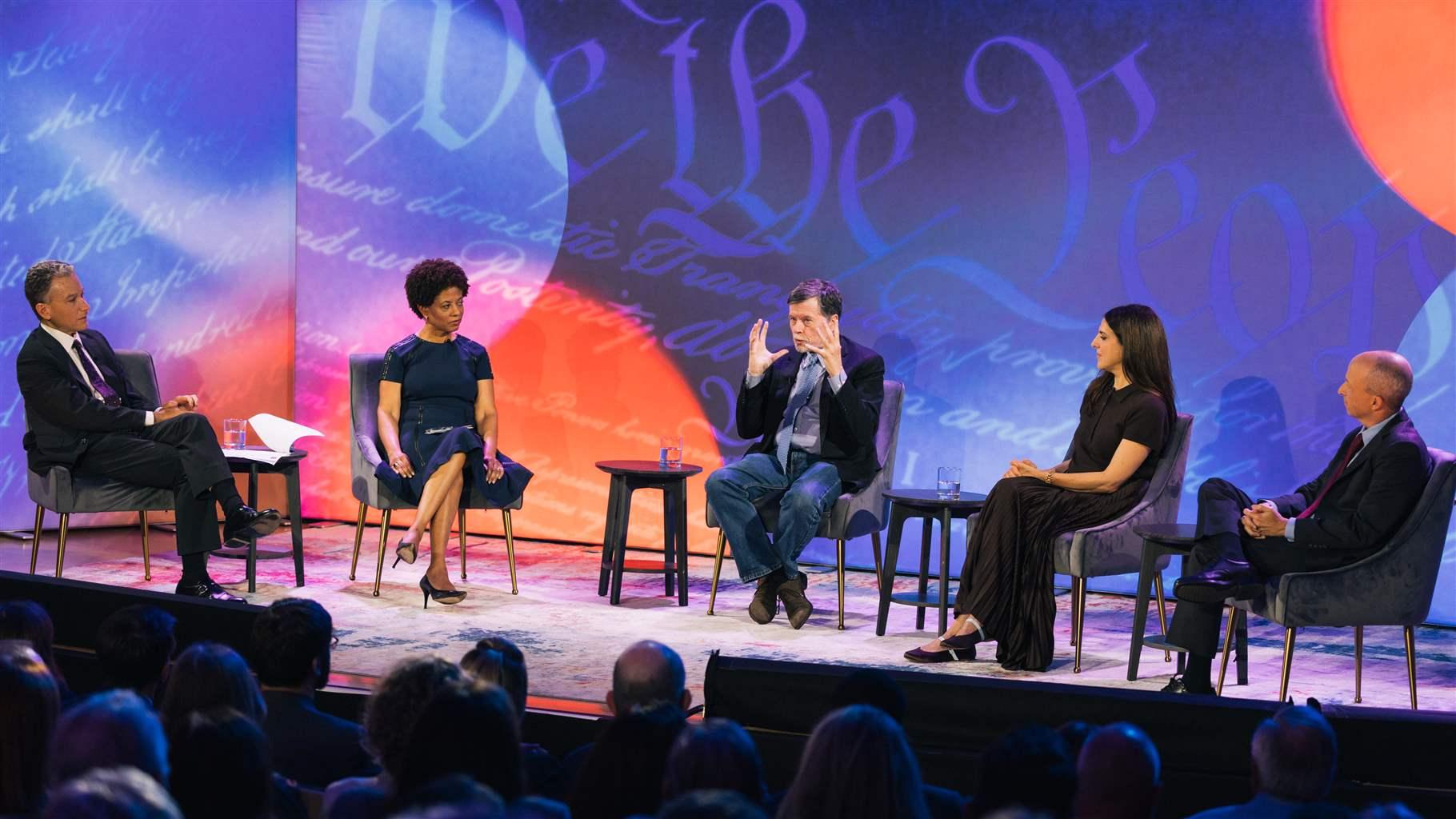
Two hundred and fifty years later, the American Revolution is as relevant as ever.
The values and the ideas discussed, debated, argued over, and ultimately written down in the Declaration of Independence and U.S. Constitution as 13 North American colonies broke from British rule in the 18th century remain essential to how we think about government today. Five prominent historians and filmmakers reflected on the war’s epic impact in a wide-ranging conversation at the National Constitution Center in Philadelphia in September that then aired as a national PBS special supported by The Pew Charitable Trusts in November.
Though the Revolution began with disagreements over taxes and land rights with the British, filmmaker Ken Burns told the audience, it evolved into a much larger argument about natural rights. “Underneath the relatively simplistic stories of disagreement is an amazing transformation. Everyone before the Revolution is essentially a subject. The people in the United States are now citizens with all of the responsibilities inherent in that," he said. “And that’s a really good story.”
It’s a story that Burns, along with co-directors Sarah Botstein and David Schmidt, brought to life in “The American Revolution,” a six-part PBS documentary, also supported by Pew, which premiered on November on PBS.
The country’s people were crucial to making the government work. The founders believed that the republic would fall if citizens had not “mastered their passions and governed themselves by reason,” Melody Barnes, executive director of the University of Virginia’s Karsh Institute of Democracy, said at the Philadelphia event.
The founding of the country also offers a hopeful vision now in politically polarized times, said Botstein. "To go back and understand how divided and different opinions people had, including the founders, and how they, over the course of a decade, came together to create this extremely interesting, important, and new kind of nation that we all have a great stake in and a lot to fight for," she said.
The founders not only had spirited and fundamental disagreements—such as the famous conflicts between states’ rights proponent Thomas Jefferson and Federalist Alexander Hamilton—over how the nation’s government should be formed, they anticipated and provided for it. “The expectation was that people in power would seek to maximize their power,” Yuval Levin, director of social, cultural, and constitutional studies at the American Enterprise Institute, told the audience. “But because they were set against each other, the system as a whole might be kept in some balance. That balance is dynamic. The branches are meant to fight each other. There’s intended to be conflict constantly in the system.”
And the founders knew that conflict was necessary. Jefferson, in fact, kept a bust of his greatest rival, Hamilton, at his home Monticello after Hamilton had died because he viewed him not as an enemy to be destroyed, but as a respected opponent to engage and debate, said Jeffrey Rosen, president and CEO of the National Constitution Center. “That’s the spirit that we’ve got to recover today … this recognition that we are here to engage each other, that truth can only emerge from the battle of ideas together.”
In the past, when presidents sought to keep their authority, Levin said, Congress pushed back. “And the question for us in the 21st century is whether that can happen now. Because a president who wants more power would not have surprised the founders," he said. “A Congress that doesn’t seem to want power would have surprised the founders. And I think in this moment, when all we’re seeing in our politics is a constant set of titanic struggles between the executive and judiciary, we should keep our eye on the dog that isn’t barking, on the institution that is absent from these thoughts.”
Ultimately, the creation of the American system of government was a combination of compromise and audacity. Neither states’ rights advocates nor those who believed in a strong central government formed a clear majority. Therefore, they compromised, saying “yes” to both and ended up building a “very, very complicated system that only works in practice, it doesn’t work in theory,” said Levin. “And it’s given our system this ability to shift its weight without losing its balance that I think has been very, very important to its durability.”
And worth remembering. Studying the American Revolution is particularly important now, Burns said, because “it’s possible for us to reinvigorate the sense of purpose that we have had … In this complicated story I think is the beginning of our salvation, of our recalibrating where we want to go, what our North Star might be."
Carol Kaufmann is a Trust staff writer.