Mortgage Lending Standards Are Too Tight
Federal policy favors risk reduction over mortgage access for financially ready homebuyers

Overview
Over the last two decades, homeownership has drifted out of reach for many Americans, especially young adults, racial minorities, low- and moderate-income households, and those who live in rural areas. Housing costs play a major role, with the median sale price of new homes in the United States near an all-time high.1 But there’s another important factor limiting the ability of Americans to buy a home that receives less attention: the mortgage lending standards set by the federal government as well as Fannie Mae and Freddie Mac, the two government-sponsored mortgage giants that together purchase more than one-third of all mortgages in the United States.2
In the aftermath of the 2007-09 Great Recession, federal policymakers significantly tightened mortgage lending standards, with the goal of minimizing financial losses and limiting risks to borrowers, lenders, and the broader mortgage system. From 2006 to 2013, standards tightened along four key dimensions: average credit score, debt-to-income ratio, loan-to-value ratio, and the share of loans that require little or no documentation of income. These changes helped to reduce delinquencies and defaults but also made it more difficult for many Americans to qualify for a mortgage.
Mortgage lending standards have remained tight overall since 2013. Although borrowers now take on more debt as a share of their income than ever before, they must have a pristine credit history to be approved for a loan. The average credit score of new mortgage borrowers reached 742 in 2024—the highest on record, and 29 points higher than the average credit score of consumers nationwide. Further, the best available research indicates that the mortgage market contains less risk today than it did in the mid-1990s, when Fannie Mae and Freddie Mac first adopted modern underwriting practices.
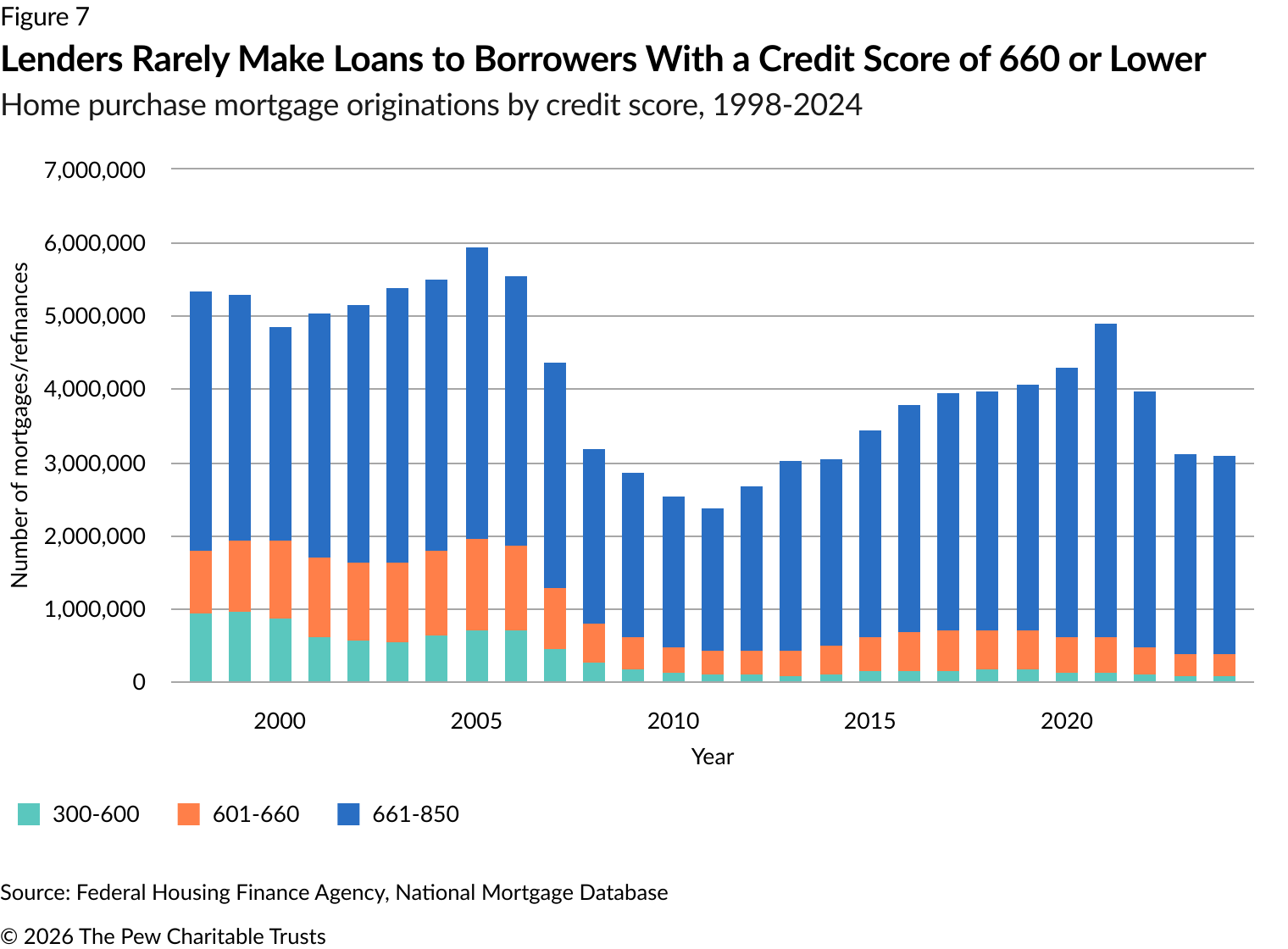
Americans with a moderate credit score—which The Pew Charitable Trusts defines as 600 to 699—have been hit especially hard. In 2000, banks and other lenders originated approximately 1.08 million home purchase mortgages to applicants with a credit score of 601 to 660; 25 years later, they issued just 293,000—a 73% decline that cannot be explained by improvements in the average credit score of the population. As a result, millions of potential borrowers have been shut out of the mortgage market. A large proportion of those would-be borrowers are young people, first-time homebuyers, low- and moderate-income individuals, racial minorities, and residents of rural areas.
Tight mortgage lending standards have reduced financial losses for lenders and borrowers. Delinquency rates have been held in check for more than a decade and are currently near 25-year lows. Default rates are also at their lowest level in recorded history, in large part because the federal government has adopted more flexible loss mitigation policies toward borrowers with government-backed loans who fall behind on payments. In recent years, just 4% to 5% of delinquent borrowers ultimately defaulted, sparing borrowers, lenders, and the federal government from the costliest consequences of nonpayment.
With the Great Recession now firmly in the past, it’s time for policymakers to reassess the standards that are preventing financially prepared homebuyers from obtaining a mortgage. Historically, lenders regularly issued loans to borrowers with credit scores of 600 to 699 in a way that did not saddle them with excessive payments and debt or hurt the American economy. But today, much of that lending has disappeared. Targeted changes to federal lending programs, loan pricing frameworks, and automated underwriting systems could help expand mortgage access and homeownership opportunities without destabilizing borrowers, housing markets, or the broader economy.
What are mortgage lending standards, and who is responsible for setting them?
Mortgage lending standards are the combination of underwriting parameters that determine whether an applicant qualifies for a loan. Those standards include the applicant’s credit score and debt-to-income ratio, the size of the applicant’s down payment and resulting loan-to-value ratio, income documentation, employment stability, and associated loan product features such as interest rate and fees. Together, these factors determine who can and cannot obtain a mortgage.
Although banks and other lenders formally establish their own underwriting standards, in practice those standards are heavily shaped by federal policy and loan acquisition standards established by Fannie Mae and Freddie Mac. Most lenders rely on federal mortgage programs to provide liquidity by purchasing loans (so lenders can offer more credit) or to limit financial losses when a borrower defaults. As a result, the standards set by Fannie Mae, Freddie Mac, and federal agencies often directly influence the behavior of private lenders.
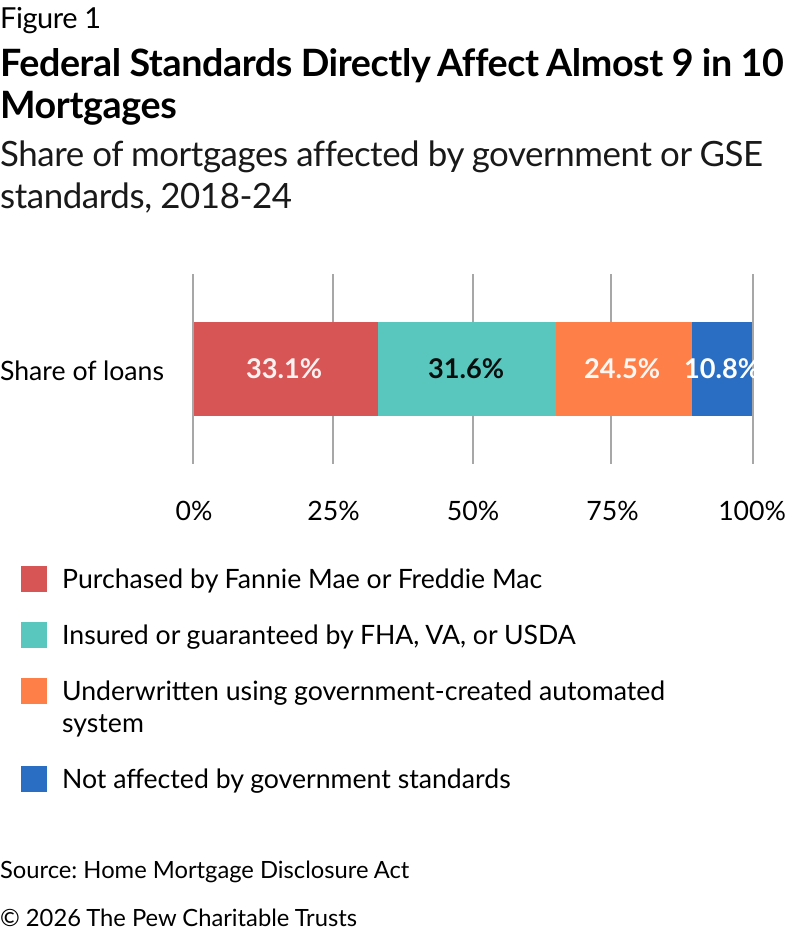
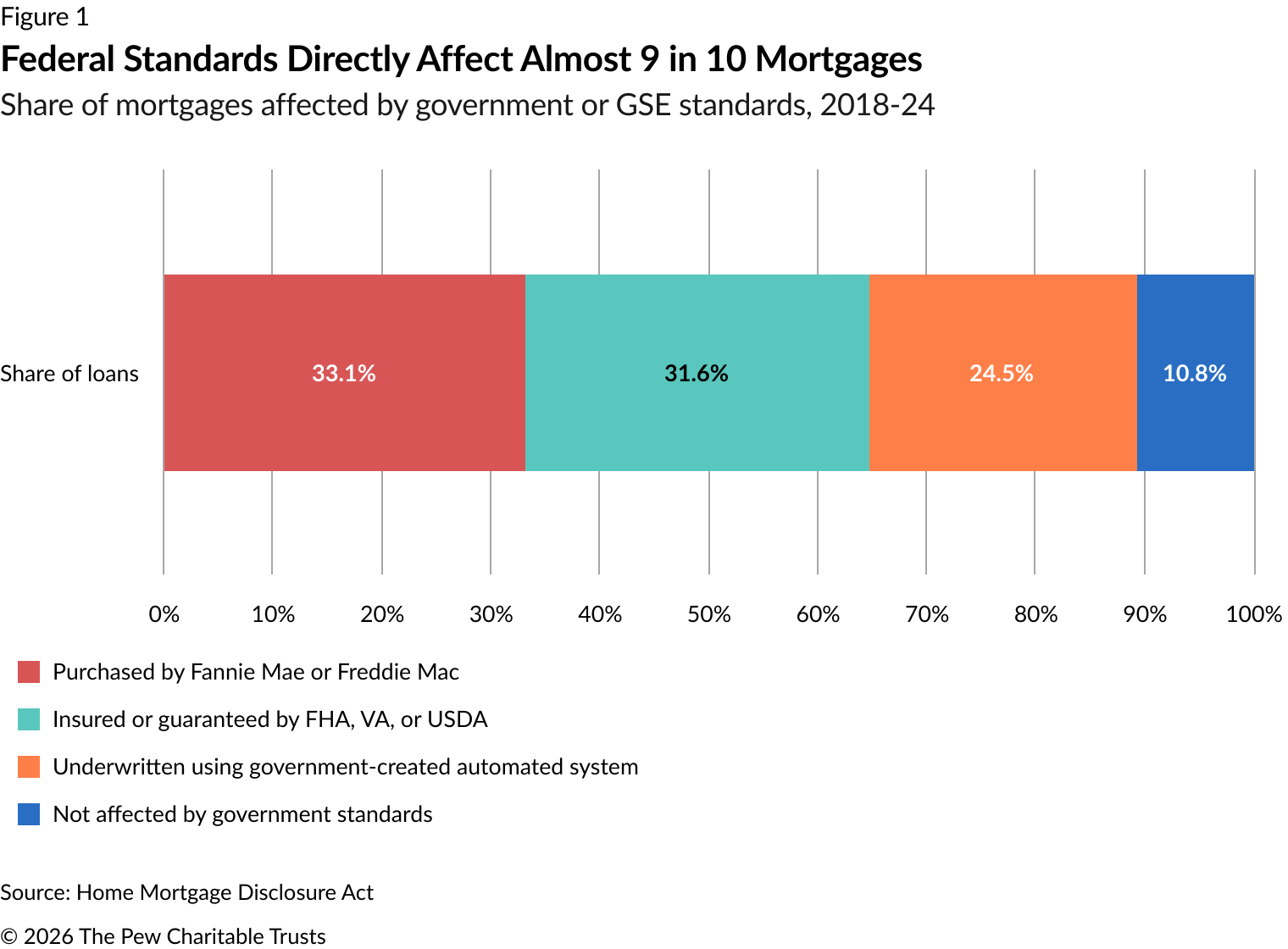
The federal government’s outsize role in the mortgage market is apparent from mortgage origination data. From 2018 to 2024, about 89% of mortgages used to purchase a home were directly influenced by government policy: Government-sponsored enterprises (GSEs) such as Fannie Mae and Freddie Mac bought 33%; 32% were issued through government loan programs run by the Federal Housing Administration (FHA), Department of Veterans Affairs (VA), or U.S. Department of Agriculture (USDA); and 25% were neither issued through a government program nor acquired by a GSE but were underwritten using automated systems developed for one of those programs. (See Figure 1.) The remaining 11% of loans were not directly affected by the federal government’s mortgage lending standards, but they were still subject to federal laws governing unfair, deceptive, and discriminatory practices, the use of consumer credit information, and requirements for clear disclosures of loan terms and costs.3
In periods of economic stress, mortgage lending standards tend to tighten as lenders and policymakers seek to minimize losses and preserve financial stability. In periods of sustained growth, boundaries often expand, enabling more borrowers to qualify for mortgages. Fannie Mae, Freddie Mac, and federal agencies shape credit standards in numerous ways, both directly and indirectly.
Program eligibility rules. Government-backed loan programs—including mortgage insurance and guarantee programs operated by the FHA, VA, and USDA and direct loan purchase programs operated by Fannie Mae and Freddie Mac—all establish baseline eligibility requirements. For example, the FHA requires a minimum 580 credit score for its standard loan, with a 3.5% down payment. Fannie Mae and Freddie Mac require documented income, two years of stable employment history, and adherence to debt-to-income limits. Most lenders rely heavily on government programs, so these eligibility rules often define the outer boundary of the risk lenders are willing to accept when issuing a mortgage.
Risk-based pricing. Even when a loan meets eligibility standards, federal pricing frameworks can discourage lending to individuals with low income or imperfect credit. Fannie Mae and Freddie Mac use what are known as risk-based pricing frameworks, charging higher fees for loans to borrowers with lower credit scores or with a higher loan-to-value ratio.4 Likewise, the FHA adjusts up-front fees and annual mortgage insurance premiums based on risk characteristics.5 While these pricing policies do not prohibit lending to higher-risk borrowers, they raise costs. In some cases, the lender passes fees on to the prospective borrower, making it more difficult to qualify for a loan. In other cases, a lender might assume some of the added cost, making it more expensive to issue such loans.
Automated underwriting systems. About 87% of all mortgages that were originated in the U.S. from 2018 to 2024 were evaluated using one of four automated underwriting systems developed by the federal government, Fannie Mae, or Freddie Mac: Desktop Underwriter (Fannie Mae), Loan Product Advisor (Freddie Mac), TOTAL Scorecard (FHA), and Guaranteed Underwriting System (USDA). These systems assess applicant risk using models calibrated to historical loan performance data, issue automated “approve/eligible” findings when risk falls within acceptable thresholds, and refer higher-risk applications to manual underwriting, which is slower and more costly to the lender. In addition to codifying and streamlining existing standards, federal entities use these automated systems to adjust the amount of credit risk they assume and influence the types of loans that receive automated approval.
Capital and liquidity requirements. Bank capital requirements shape mortgage lending by determining how much of a bank’s own funds must be held in reserve against each loan on its balance sheet. By requiring banks to rely on their own equity, rather than deposits or borrowed money, these rules put the bank’s own funds at risk when loans go bad, giving them a reason to lend more conservatively. This framework also rewards banks for originating loans they can sell to Fannie Mae or Freddie Mac, which removes the associated capital requirement, or loans backed by a government guarantee, which require banks to hold less capital in reserve than conventional loans. The net effect is to steer banks toward safer, well-collateralized credit and loans they can offload, rather than toward higher-risk mortgages they keep on their own books.6
Legal liability and federal enforcement. Federal oversight and enforcement actions can shape lender behavior beyond formal program rules. Lenders that sell loans to Fannie Mae and Freddie Mac face “putback” risk (the risk that they will have to repurchase the loan) if a loan fails to meet representation and warranty standards, which are legally binding assurances that a loan meets government requirements. And lenders that make FHA loans have faced significant liability for underwriting deficiencies under the federal False Claims Act.7 To limit legal and financial exposure, many lenders adopt additional internal standards—known as overlays—that exceed formal program requirements and further tighten standards for potential borrowers.8
How have mortgage lending standards changed over time?
Data limitations and marketwide changes in how loans are underwritten make it difficult to compare mortgage lending standards over time. However, the best available evidence suggests that credit risk is far lower today than it was at the peak of the 2000s housing boom, and mortgage lending standards are tighter than they were in the mid-1990s.
The era of modern mortgage underwriting began in the early 1990s, in large part because of two major developments. First was the incorporation of the Fair Isaac Corp. (“FICO”) credit score into mortgage underwriting decisions. Initially developed in 1989 and formally recommended for use by Fannie Mae and Freddie Mac in 1995, the FICO score gave lenders a standardized, quantitative way to assess the risk of making a loan to a specific buyer. FICO scores proved to be such an effective predictor of borrower default that lenders began issuing loans to borrowers with higher debt-to-income and loan-to-value ratios—as long as the borrower had a strong FICO score.9
The second change was the industrywide shift from manual underwriting to computerized automated underwriting, which lowered loan origination costs and accelerated the mortgage approval process.10 The first automated underwriting models were introduced in the early 1990s, but these systems did not reach the mainstream until 1995, when Fannie Mae and Freddie Mac publicly released their Desktop Underwriter and Loan Prospector systems. (Freddie Mac’s Loan Prospector is now called Loan Product Advisor.) By helping lenders more comprehensively assess a borrower’s financial characteristics, these systems helped lenders manage risk and extend credit to a wider set of borrowers.11
These changes were introduced during an era of weak data collection and standardization practices. For example, information on borrower credit scores was either not required or not systematically collected for much of the 1990s. There is no publicly available dataset that tracks borrower financial characteristics prior to 1998; the best available data—from the Home Mortgage Disclosure Act—didn’t add information about debt-to-income and loan-to-value ratios until 2018. As a result, it is difficult to compare current and historical credit standards, especially from the 1990s.
A 2019 research paper published by the Federal Housing Finance Agency (FHFA) used a combination of nonpublic and proprietary data to understand how mortgage lending standards changed from 1994 to 2019. Using a statistic called the stressed default rate, the authors estimated the share of mortgage originations each year that would default in the event of a financial crisis similar to the Great Recession.12 By that metric, the mortgage market had far less default risk in 2019 than in the mid-1990s; neither period was as risky as the early and mid-2000s. The authors estimated that 13.5% of borrowers would have defaulted in a crisis in 2019, compared with 18.4% in 1997. (See Figure 2.) A 2022 update to this FHFA report found that credit risk decreased further in 2020 and 2021, reaching its lowest level in modern history—a projected crisis-induced default rate of 10.4%.
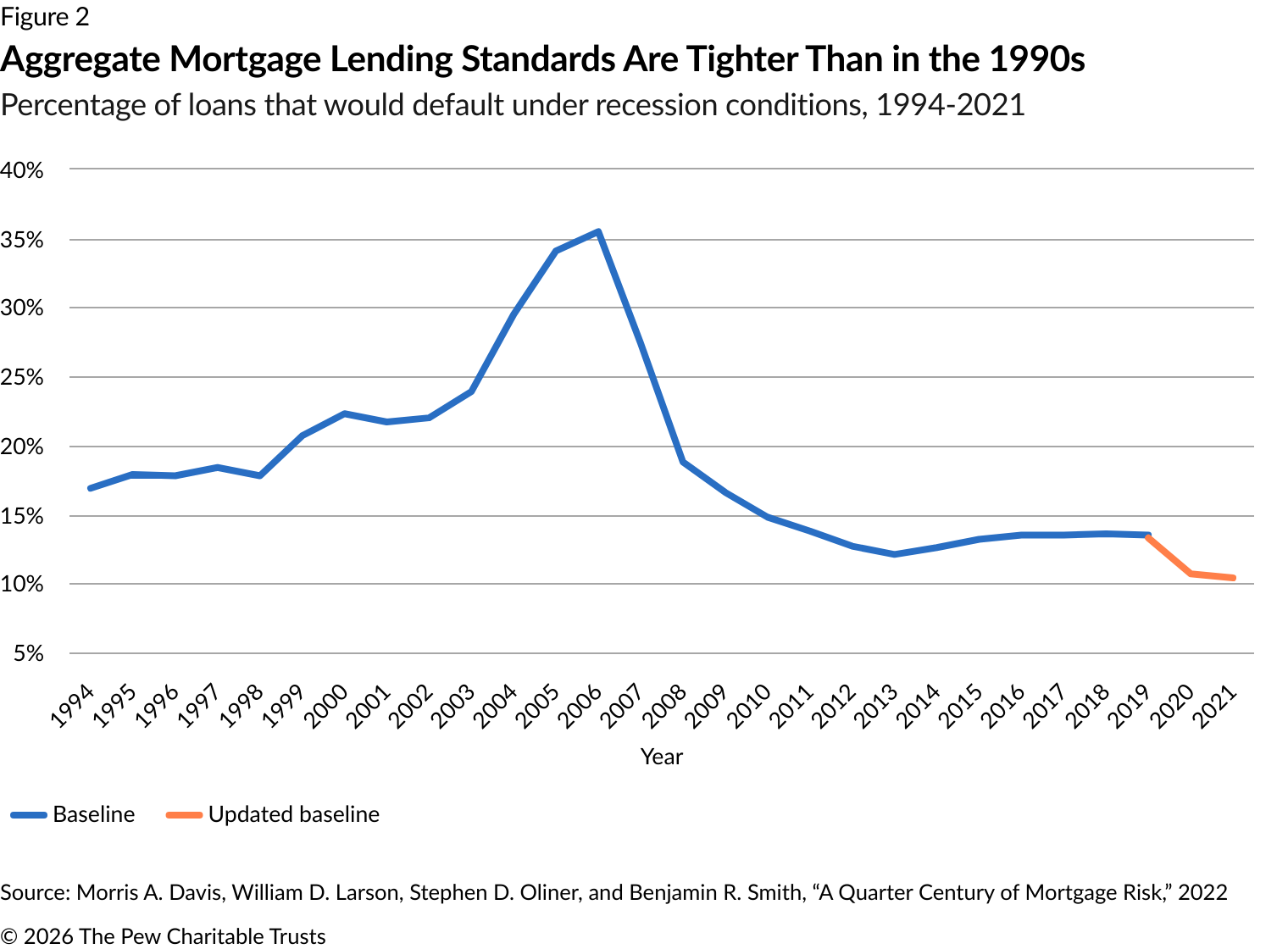
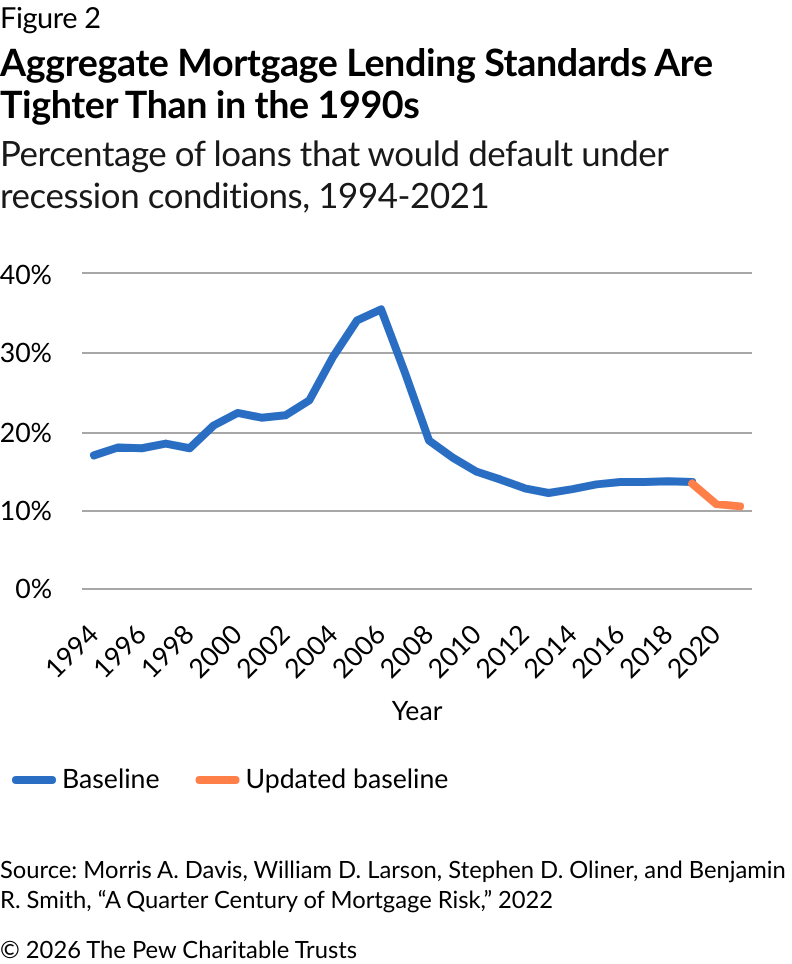
The findings of the FHFA report closely mirror those of the Urban Institute’s Housing Credit Availability Index, which estimates the share of newly originated home purchase loans that would be expected to default by blending two scenarios: a 90% weight on normal economic conditions and a 10% weight on a stressed scenario resembling the years that preceded the Great Recession.13 By this measure, the mortgage market carried substantially less default risk in 2024 than in 1999. Part of the reason is that risky mortgage products have largely disappeared, so borrowers are less likely to default if an economic shock hits. But the decline is not driven by a reduction in product risk alone: Risk attributable to borrower characteristics, rather than loan features, is also lower now than it was in 1999.
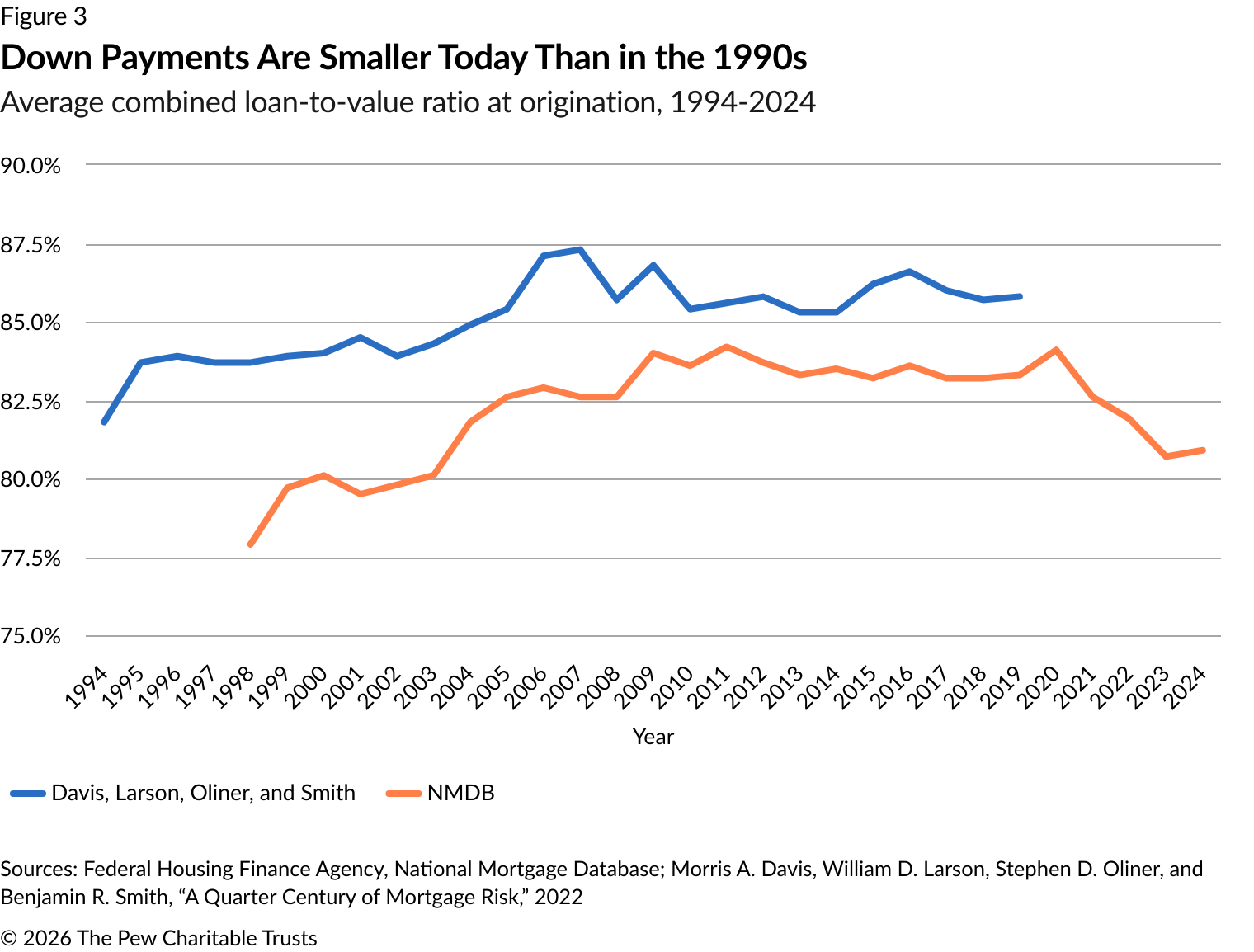
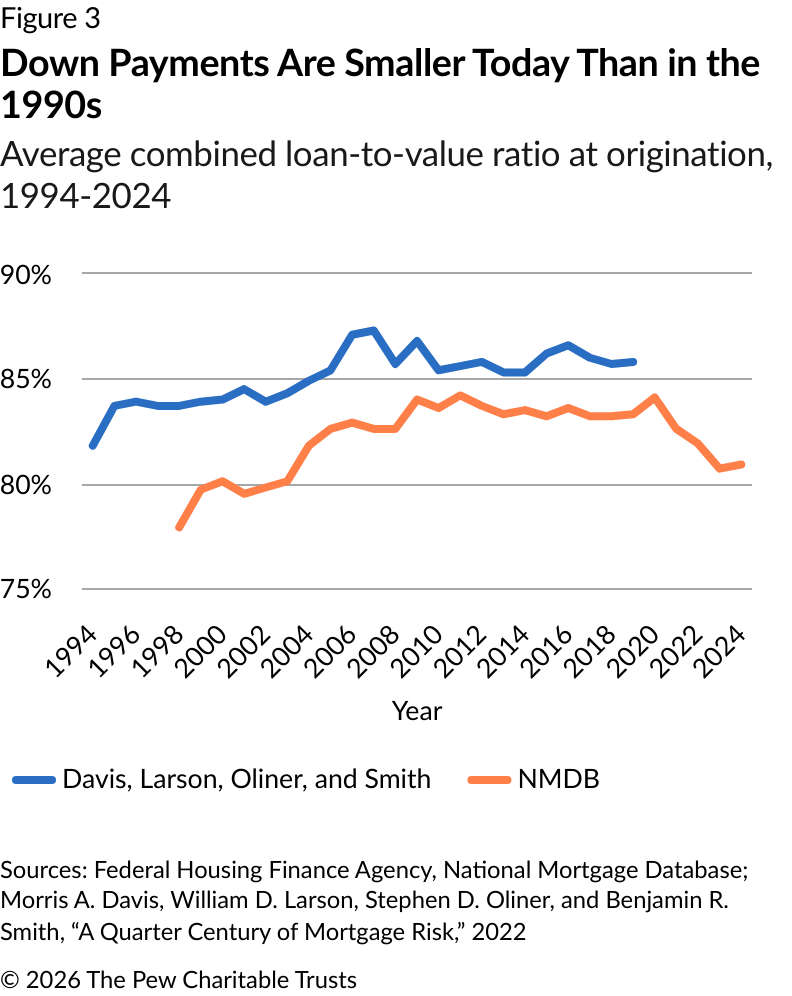
Although credit standards have become more stringent overall, some of the underlying metrics have tightened while others have gotten looser. For example, among loans used to purchase a home (rather than to refinance an existing mortgage), the average loan-to-value ratio has increased over time, indicating that borrowers have generally made smaller down payments relative to the size of their loan. The FHFA’s updated 2022 report showed an increase in the average loan-to-value ratio of 4 percentage points (81.8% to 85.8%) from 1994 to 2019. (See Figure 3.) Separate data from the National Mortgage Database shows the average loan-to-value ratio increasing by 6.2 percentage points from 1998 to 2019 (77.9% to 84.1%), but later declining, to 80.9% in 2024.
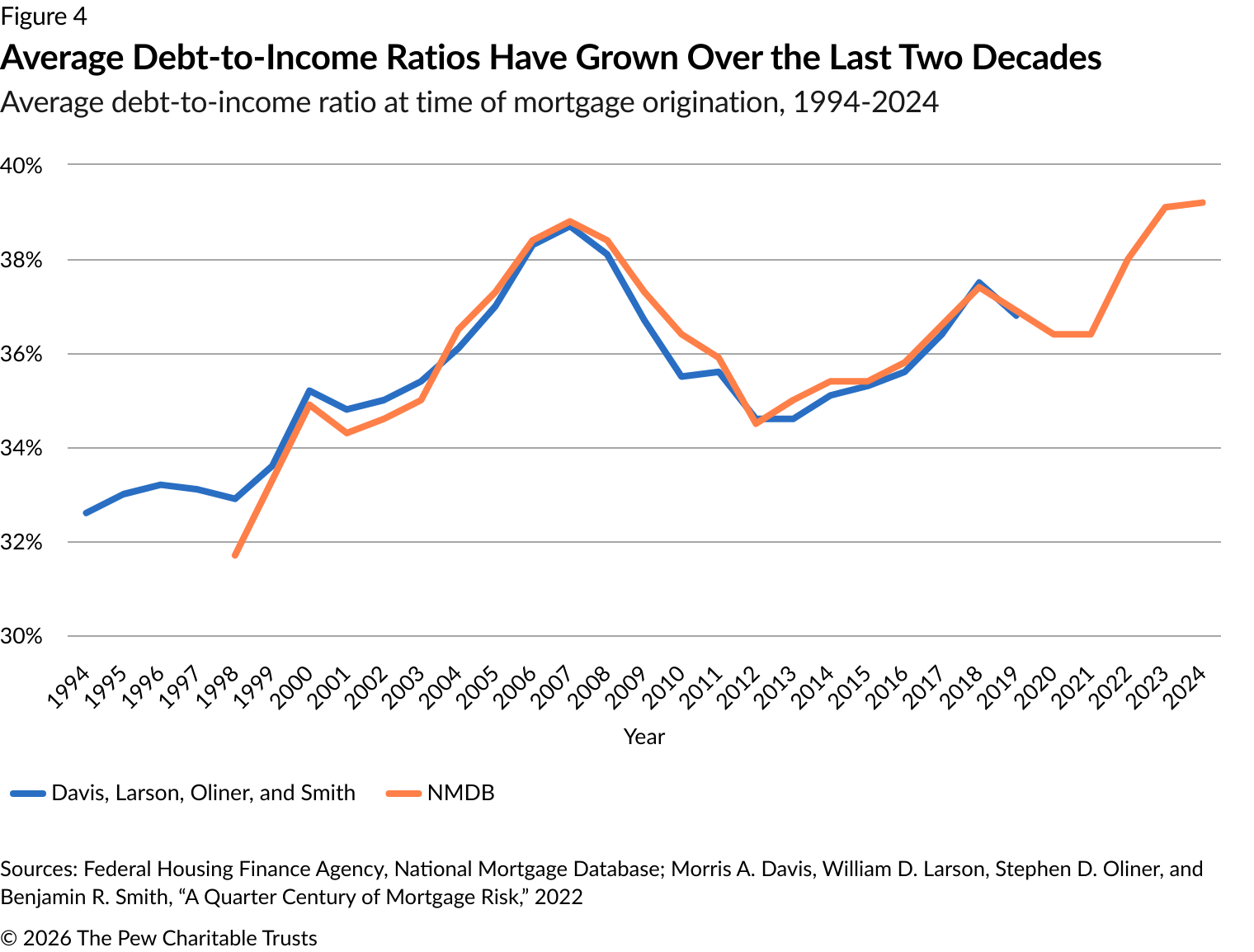
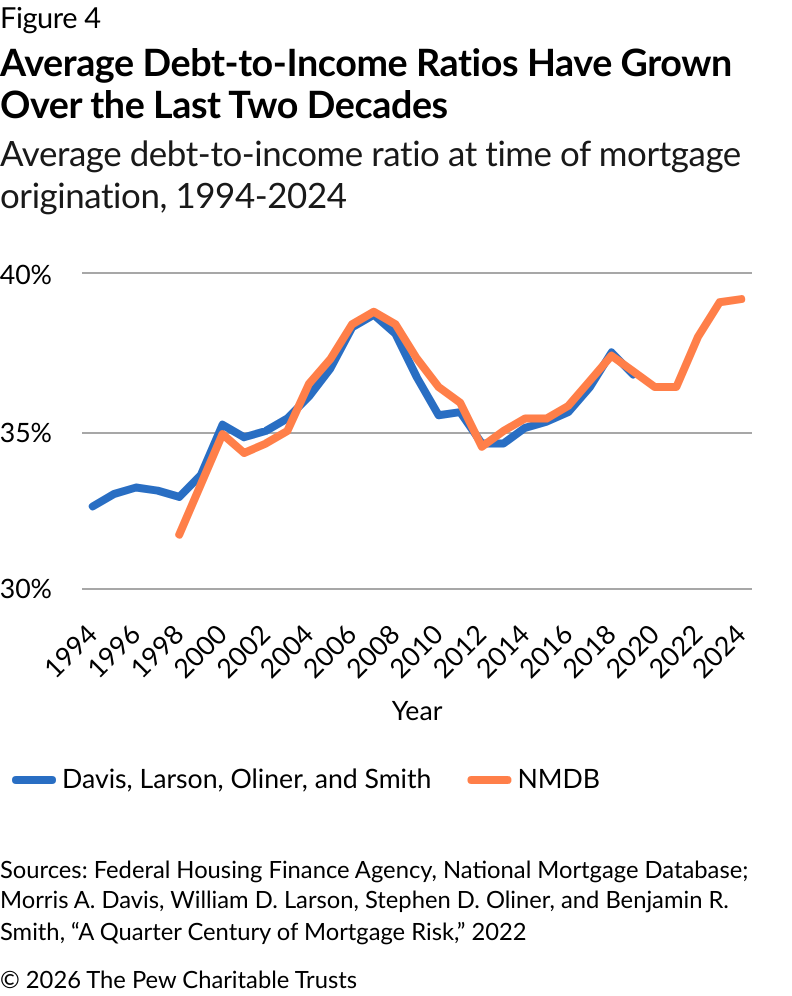
Debt-to-income ratios show a similar pattern. FHFA research estimates that the average debt-to-income ratio increased by 4.2 percentage points from 1994 to 2019—meaning that borrowers had more recurring debt relative to their income. Data from the National Mortgage Database shows a similar pattern, with the average debt-to-income ratio growing by 7.5 percentage points from 1998 to 2024. (See Figure 4.) This pattern suggests a loosening of credit standards along this dimension, since borrowers with higher debt-to-income ratios tend to default at higher rates than those with lower relative debt levels, especially when faced with a financial shock like a job loss or a large one-time expense.14
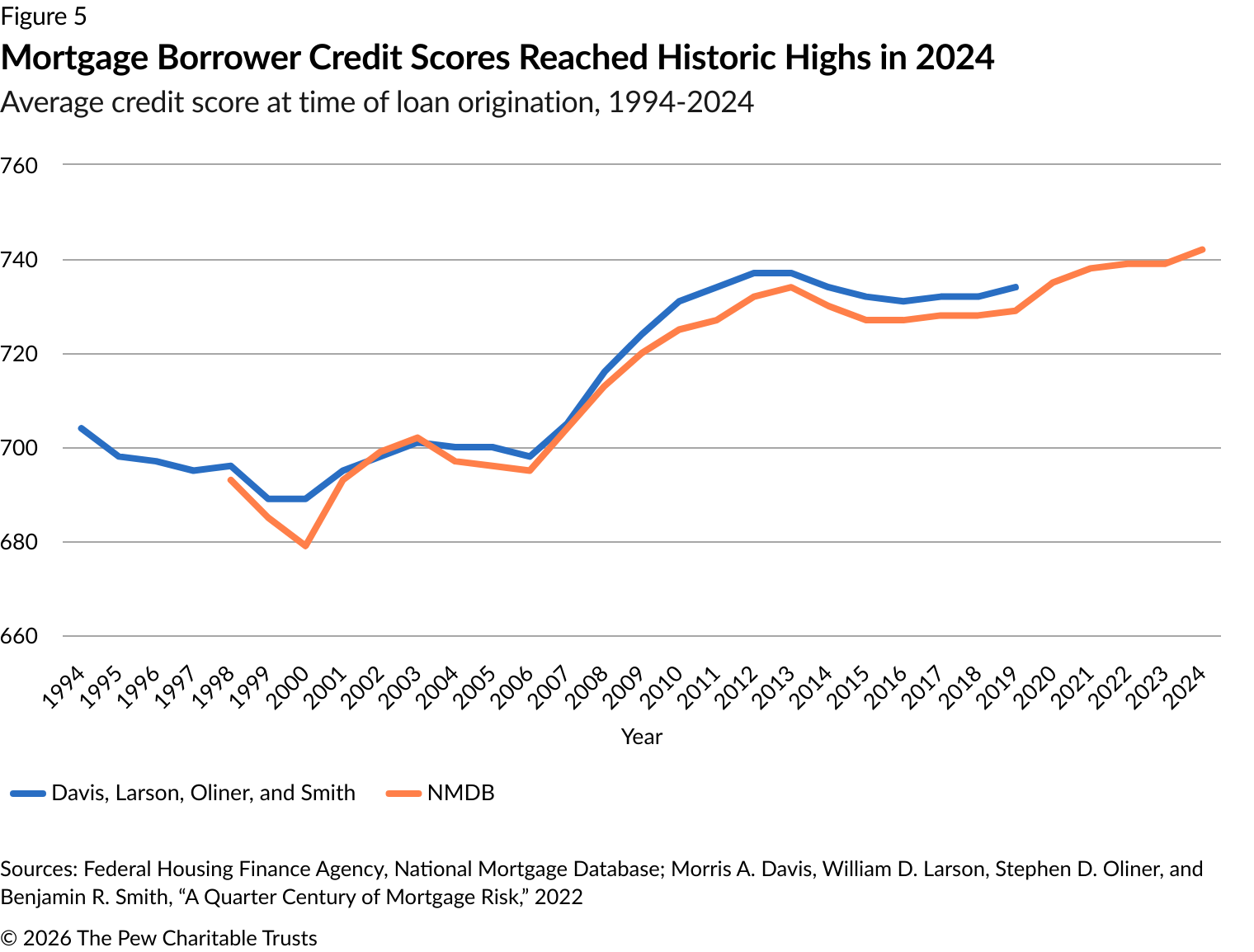
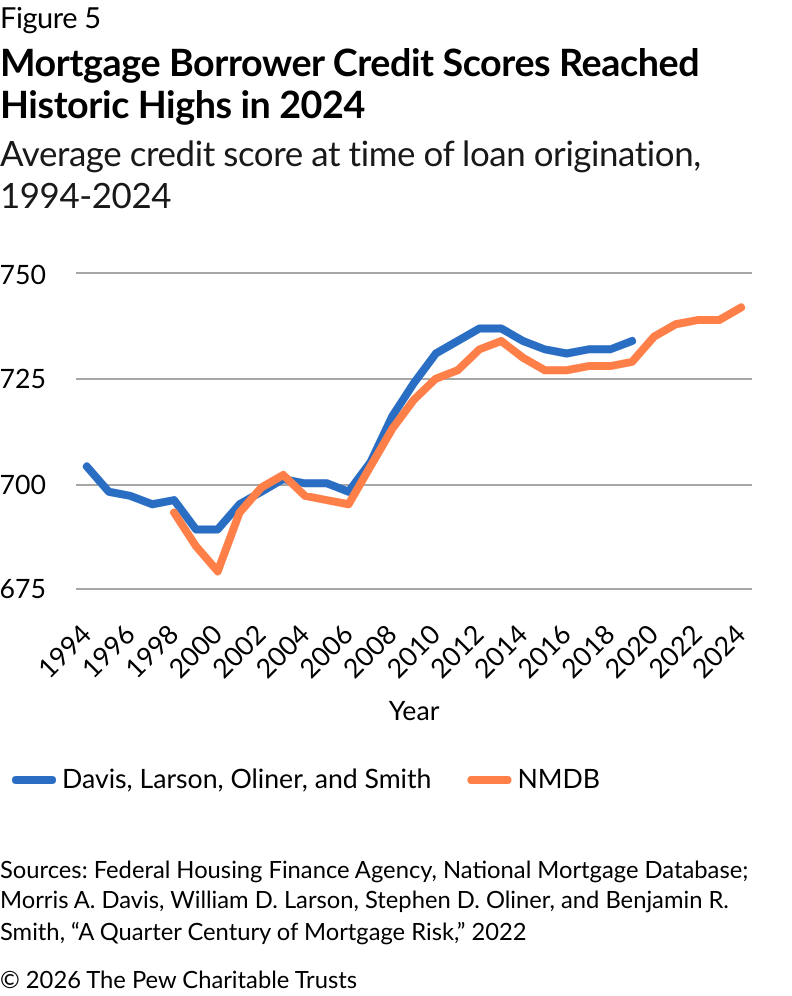
Credit scores tell a very different story. For home purchase loans, the National Mortgage Database shows that the average credit score of borrowers increased from 693 in 1998 to 742 in 2024, with most of the increase taking place from 2006 to 2010—precisely when the federal government was tightening mortgage lending standards during the Great Recession. (See Figure 5.) The FHFA’s research reached a similar conclusion, showing that the average credit score at the time of origination increased by 33 points from 2006 to 2010. Thus, while loan-to-value ratios and debt-to-income ratios have gradually returned to pre-recession levels, lenders have become more demanding about credit scores, with the average score at origination reaching an all-time high of 742 in 2024.
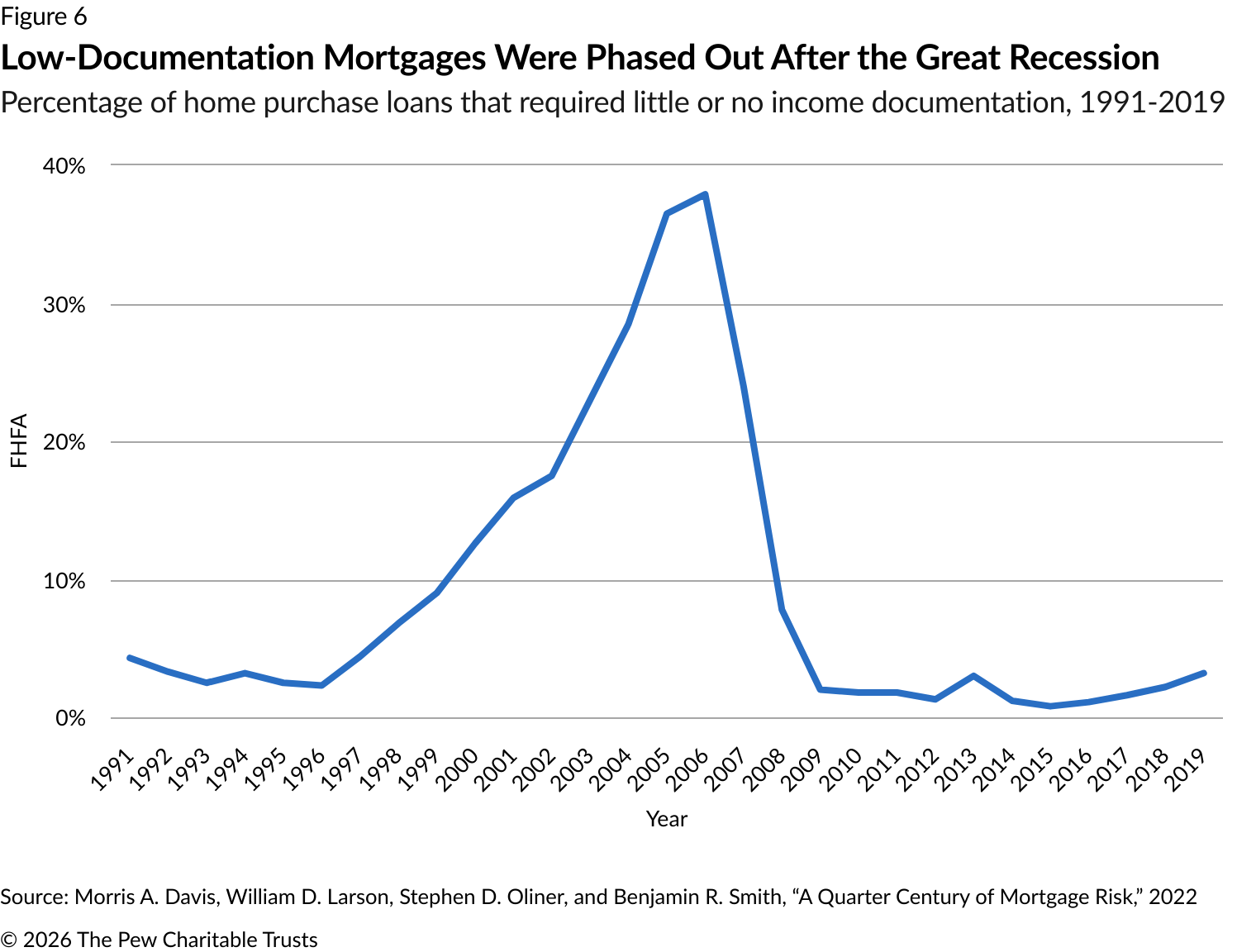
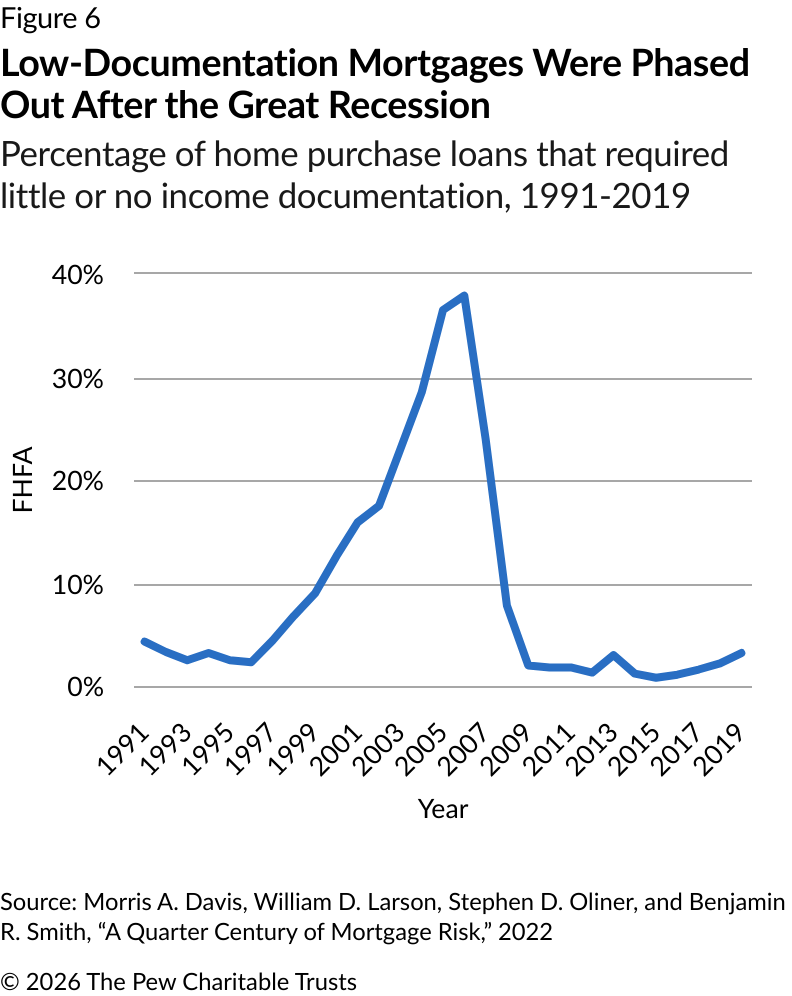
Another way of measuring the restrictiveness of mortgage lending standards is by looking at the documentation requirements and procedural steps that lenders and the government require before a loan is originated. Although it is difficult to measure these requirements, research from the Federal Housing Finance Agency estimated the share of mortgages originated from 1991 to 2019 that required little or no documentation of borrower income.
Such loans have always existed, primarily as a way of allowing self-employed workers, independent contractors, and gig workers to qualify for a mortgage without traditional income documentation. But this type of loan became increasingly common in the late 1990s and early 2000s as lenders sought to maximize the number of mortgages they originated. In the years before the Great Recession, almost 38% of new mortgages required little or no documentation. (See Figure 6.)
The expansion of low-documentation loans made it easier for qualified borrowers with a nontraditional source of income to obtain a mortgage. But it also enabled lenders to extend credit to borrowers who had no realistic chance of repaying their debt and allowed some unqualified borrowers to misrepresent their income so they could get a mortgage and buy a home. Rules implemented during the financial crisis strengthened income reporting requirements, which almost eliminated low- and no-documentation loans.
Taken together, these trends indicate that credit scores—or underwriting factors closely correlated with credit scores—are now a binding constraint on mortgage access, while average debt-to-income and loan-to-value ratios are at or near their most permissive levels in 30 years. Loans that require little or no documentation have essentially been eliminated, making it harder for contract workers and the self-employed to obtain a loan—but also ensuring that borrowers can afford the loans they are given. As a result, the overall level of financial risk in the U.S. mortgage market is at or near an all-time low.
Who is shut out of the mortgage market when credit standards rise?
Changes to mortgage lending standards have had a measurable effect on who qualifies for a mortgage. Low-income borrowers who have saved little for a down payment can benefit from the new standards—if they have a strong credit history, stable employment, and clearly documented sources of income. But potential borrowers with a damaged or missing credit history (also known as “thin file” consumers) or with a nontraditional source of income are often shut out of the mortgage market, regardless of how much they have saved or how small a loan they need.
The lack of credit access for individuals with a low to moderate credit score is evident in data from loan applications sorted by credit score. As part of its “Survey of Consumer Expectations,” the Federal Reserve Bank of New York surveys a small number of mortgage applicants each year.15 From 2013 to 2025, about 14% of all applicants were denied a mortgage. However, applicants with low and moderate credit scores were overrepresented in this rejected group: Among applicants with a sub-620 credit score, 65% were denied, as were 38% of those with a score of 620 to 679 and 20% of those with a score of 680 to 719.
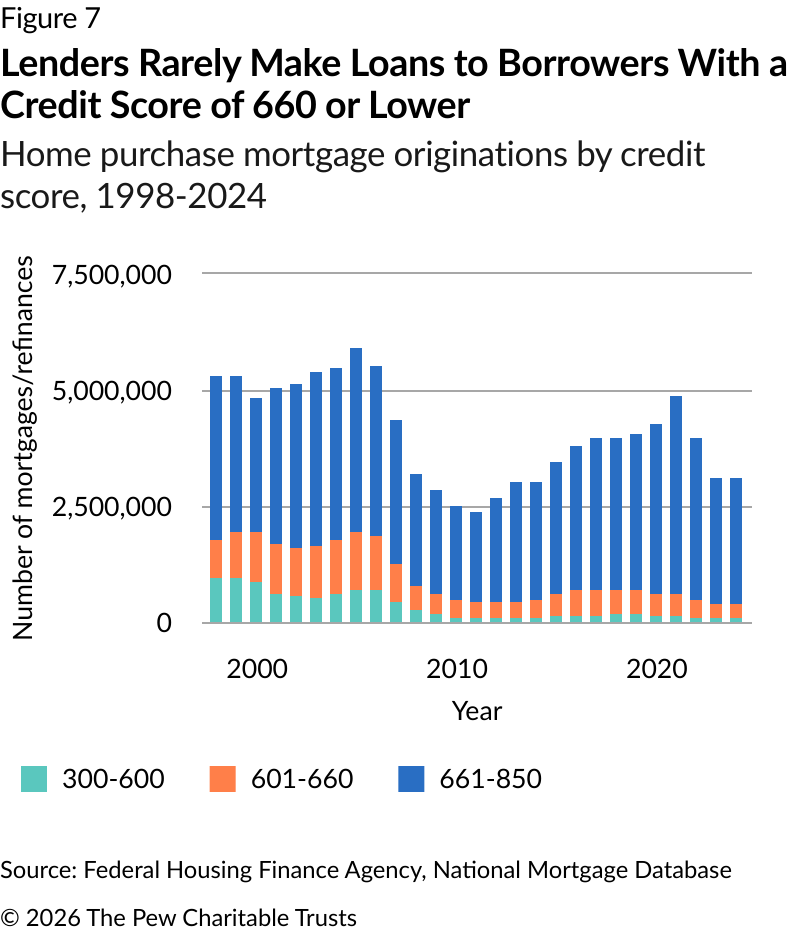
High mortgage denial rates mean few loan originations for individuals with a low or moderate credit score. The National Mortgage Database tracks new mortgage originations in five credit score buckets: 300-499, 500-600, 601-660, 661-780, and 781-850. In 2000, U.S. lenders originated 1.08 million home purchase loans for borrowers with credit scores of 601 to 660, amounting to 22.3% of all such loans originated in that year. (See Figure 7.) However, by 2024, this same group of borrowers received just 293,000 loans, or 9.5% of all mortgages used to purchase a home. This finding is consistent with research showing that tight lending standards prevented an estimated 1.1 million mortgage originations in 2015, with the majority of the projected shortfall concentrated among would-be borrowers who had a credit score below 660.16
Changes in the credit profile of the U.S. population partly explain the market shift toward higher-score borrowers. The average credit score of all consumers—not just mortgage borrowers—in the U.S. has steadily increased over the last decade, driven by steady income and employment growth, the removal of some adverse credit events from consumer credit files, and targeted policy changes that removed medical debt and paid collections from many Americans’ credit reports.17
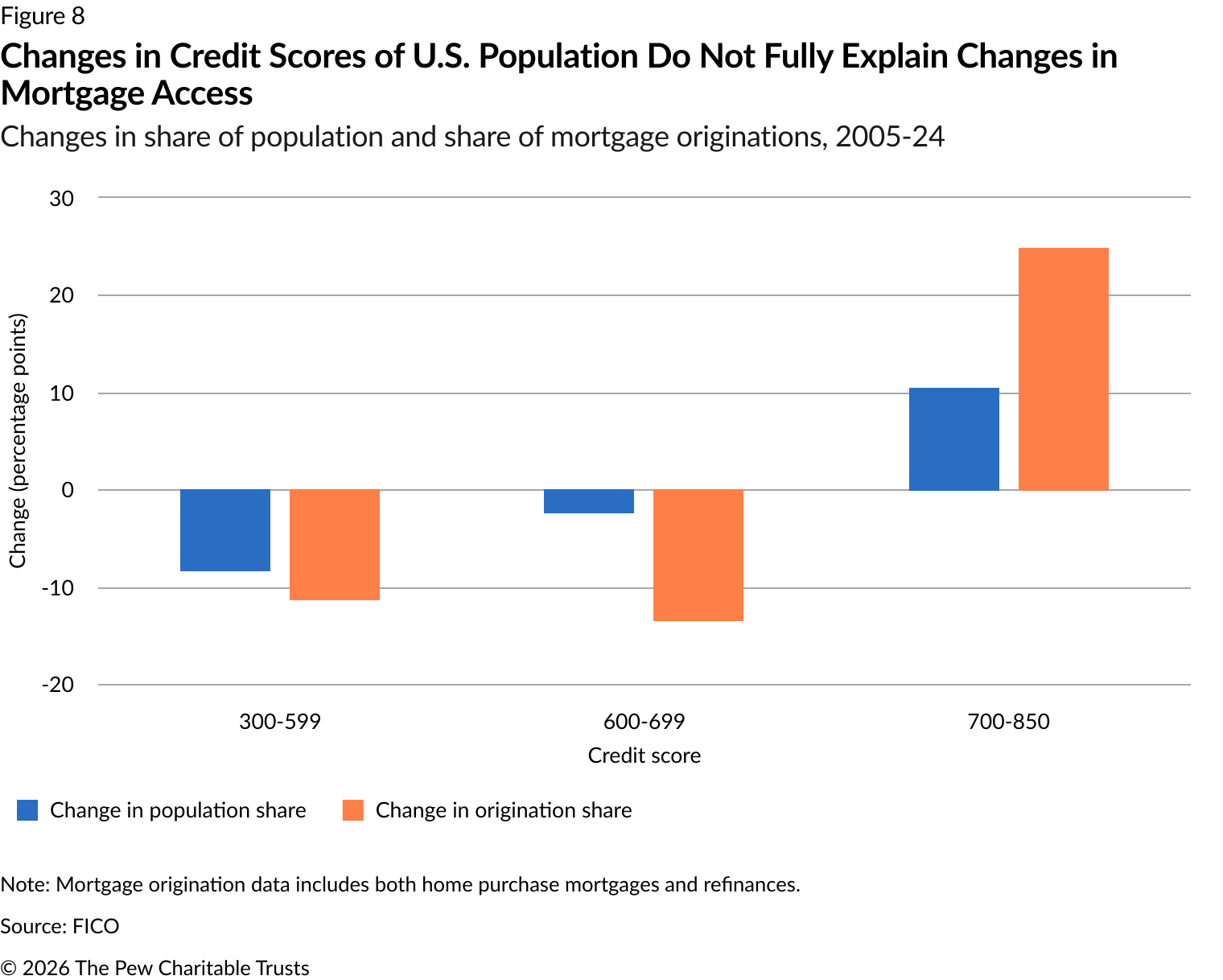
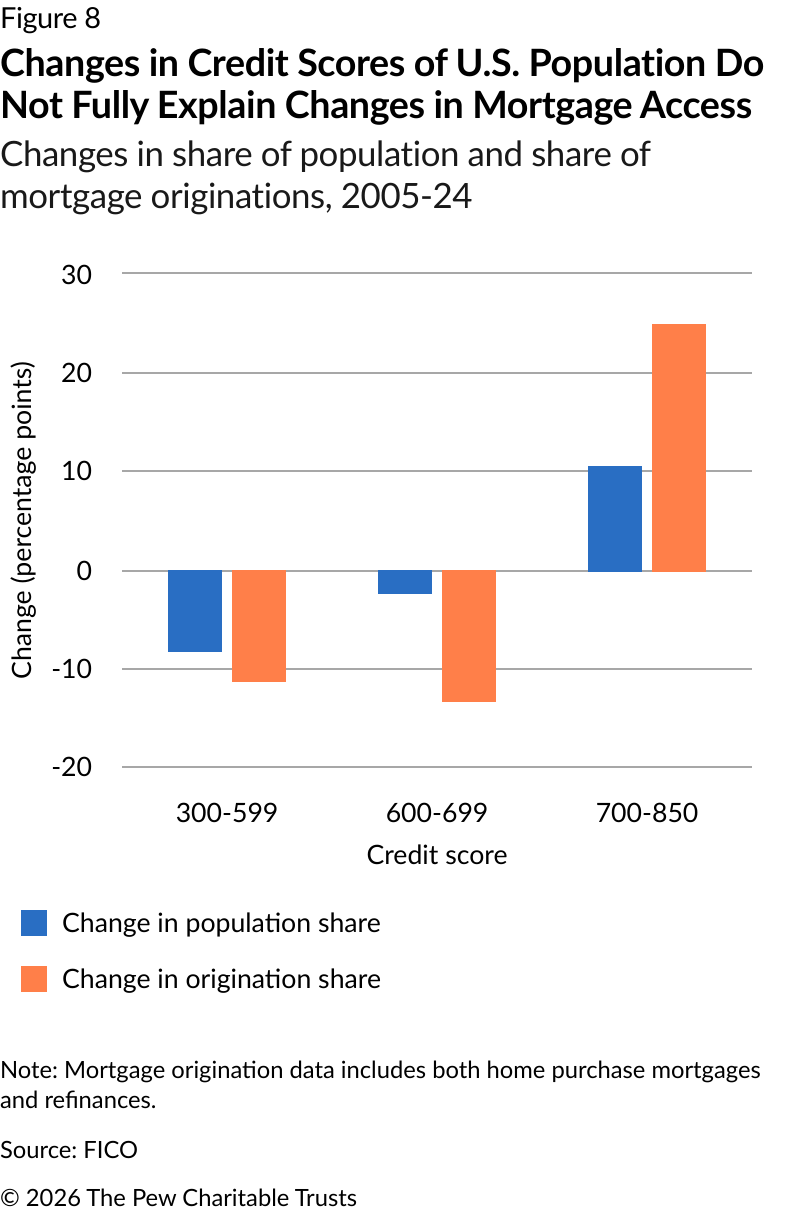
From 2005 to 2024, the share of American adults with a FICO credit score of 600 to 699 fell from 24.5% to 22.2%. Because there are fewer prospective borrowers in this range, it’s reasonable to expect a small decline in mortgage originations. But while the proportion of Americans with a 600-699 credit score declined by 2.3 percentage points, that group experienced a 13.3 percentage point decline in its share of mortgage originations, falling from 35.6% to 22.3% of home purchase and refinance loans combined. Over the same period, the proportion of Americans with a credit score of 700 or higher increased 10.5 percentage points, but that group’s share of mortgage originations rose 24.9 percentage points. (See Figure 8.)
Americans with low and moderate credit scores generally fall into two categories. The first group includes individuals with a damaged credit history, such as those who have missed loan payments, defaulted on prior obligations, or experienced other significant negative financial events. Some of these individuals have a persistently low or volatile income, a high debt burden, or unstable employment, which puts them at higher risk of not being able to make loan payments. But some individuals with a low or moderate credit score have experienced a temporary financial setback that is not representative of their ability to repay a 30-year mortgage. Nonetheless, because negative events can remain on a credit report for up to seven years, past hardship can continue to affect mortgage eligibility long after an individual’s circumstances have improved.18
Some Americans with a limited credit profile also fit in this category of potential borrowers for whom credit score does not fully reflect their ability to make mortgage payments. These individuals might lack a history of borrowing due to their age, limited access to traditional financial products, or lower accumulated wealth. Credit scores inherently reward longevity in the credit system, consistent use of mainstream financial products, and having a financial cushion, which allows for a higher credit maximum and lower credit utilization rates. As a result, credit scores are closely correlated with factors such as age, income, wealth, and whether someone lives in a rural area.
Data from the National Survey of Mortgage Originations illustrates this difference. Although roughly 19.5% of all mortgage borrowers had credit scores of 600 to 699 from 2013 to 2023, certain groups were overrepresented in this credit score range. (See Figure 9.) An estimated 37.5% of Black mortgage borrowers fell within this credit score range, as did 33.5% of borrowers under age 25; 26.9% of Hispanic borrowers; 26.8% of first-time homebuyers; 26.0% of borrowers with small mortgages; and 25.3% of rural borrowers. These findings are further substantiated by research showing that young, low-income, Black, and Hispanic consumers—not just mortgage borrowers—have lower credit scores than other groups.19
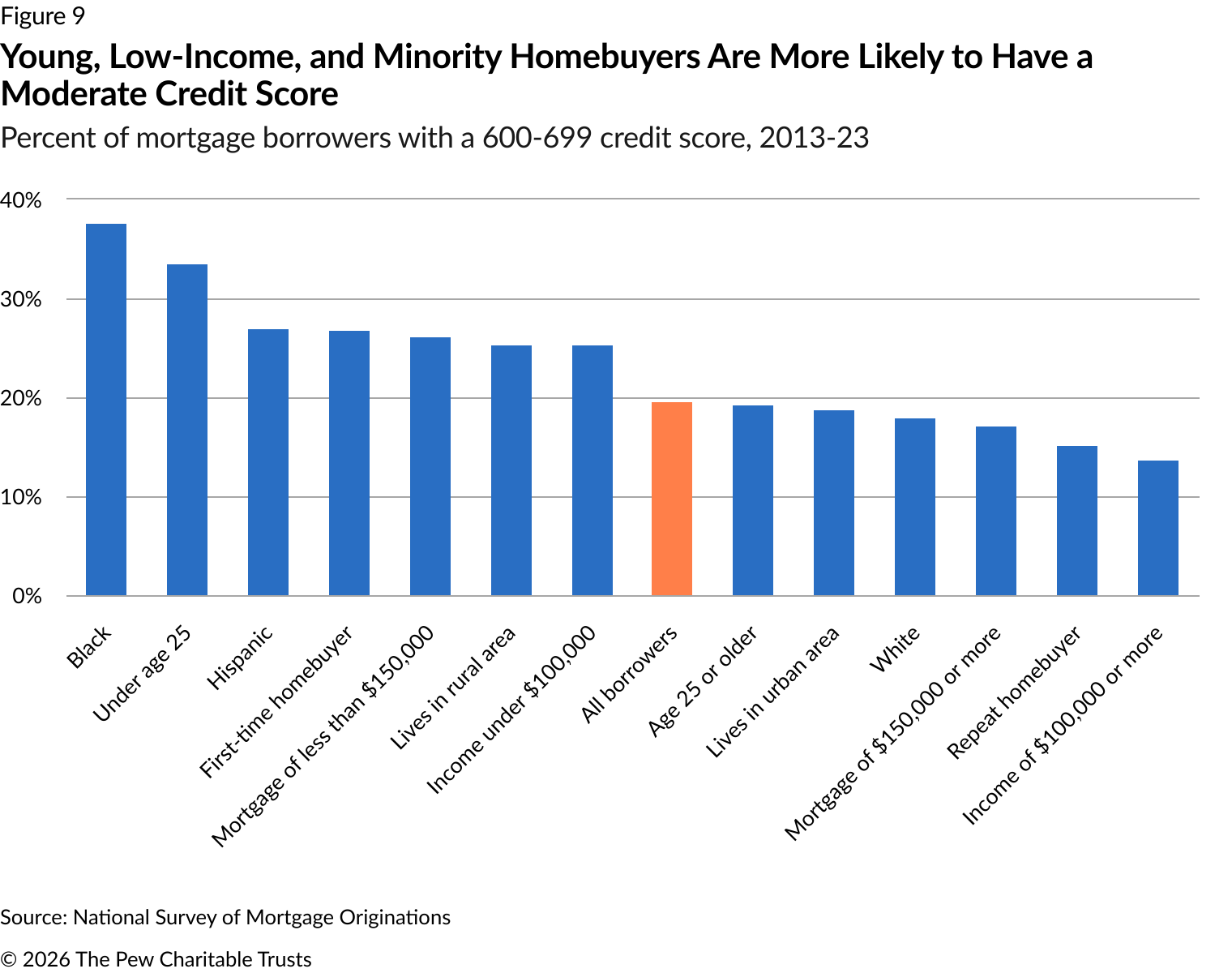
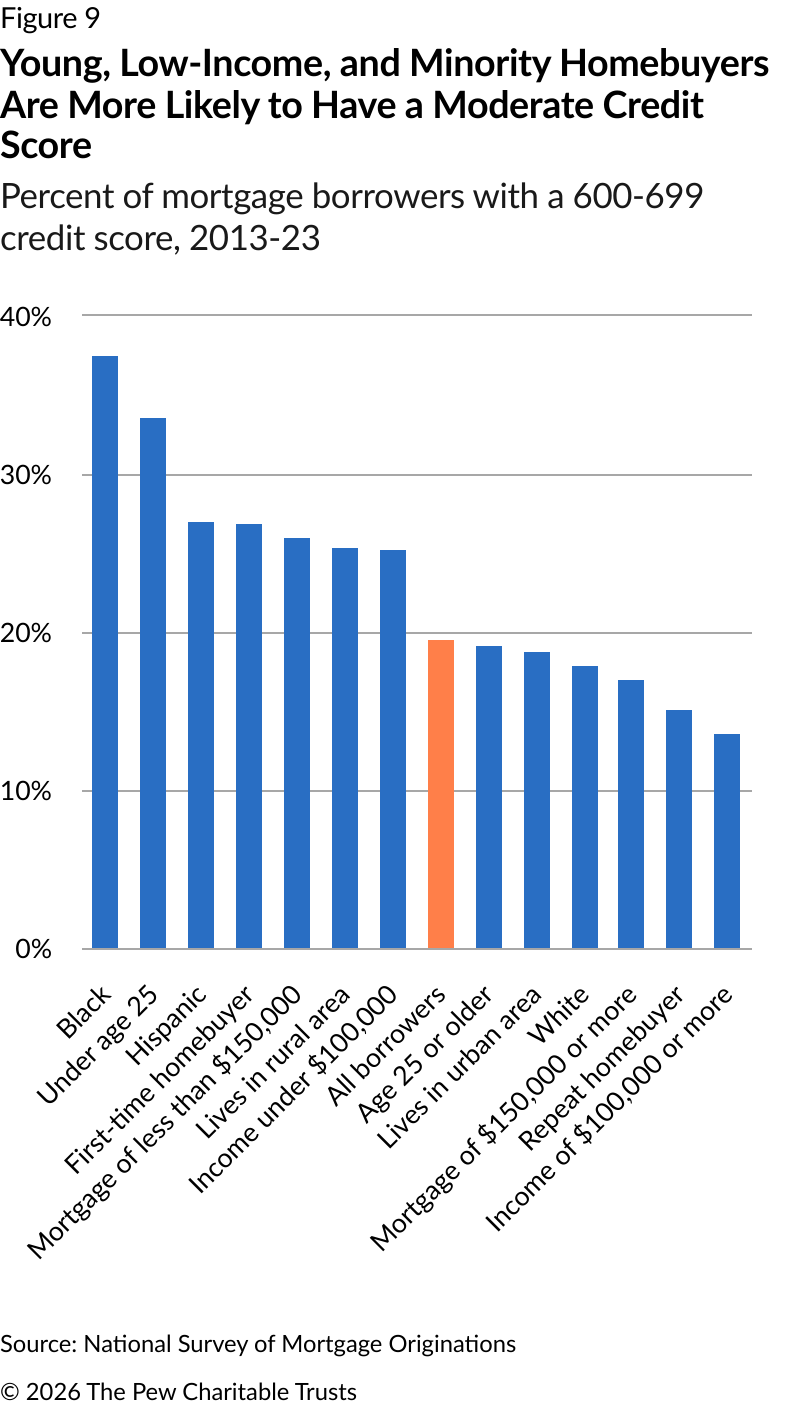
In contrast, mortgage borrowers with an annual income above $100,000, repeat buyers, and those who were taking out a larger mortgage (above $150,000) were less likely to have a credit score of 600 to 699. Only 13.6% of borrowers with an income of $100,000 or more, 15.1% of repeat homebuyers, and 17.0% of borrowers seeking a mortgage over $150,000 had a credit score of 600 to 699. These borrowers typically benefit from factors that contribute to a stronger credit profile, such as a longer credit history, higher savings, and accumulated home equity.
When policymakers tighten credit standards, they disproportionately affect the very people whom public policy often aims to help: young adults just entering the housing market, lower-income families, rural communities, and Black and Hispanic households. Although some of these potential borrowers might not be financially prepared to take out a mortgage, others are excluded because of a thin or nontraditional credit history, or because the federal government’s credit standards are historically high. While tighter standards have made the mortgage market safer, they have also made it harder for some qualified individuals to achieve homeownership.
What are the risks of expanding mortgage access?
Historically tight credit standards have made it more difficult for many Americans to get a mortgage, but these same standards have helped make the mortgage market safer—for individual borrowers, lenders, the federal government, and the broader financial system. Mortgage underwriting relies on credit scores and credit history precisely because they are strong predictors of mortgage repayment; borrowers with lower scores are statistically more likely to experience serious delinquency and to default.
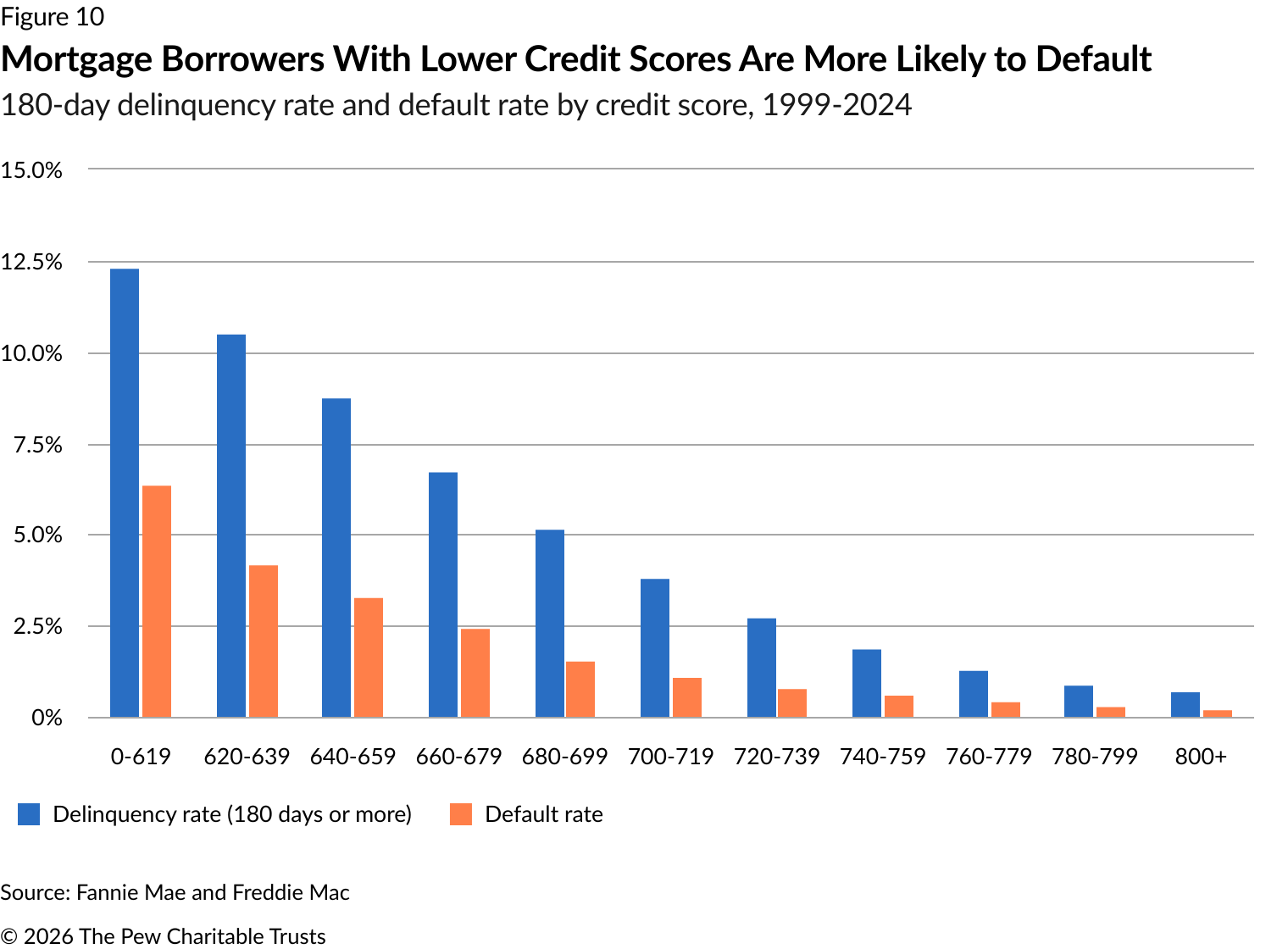
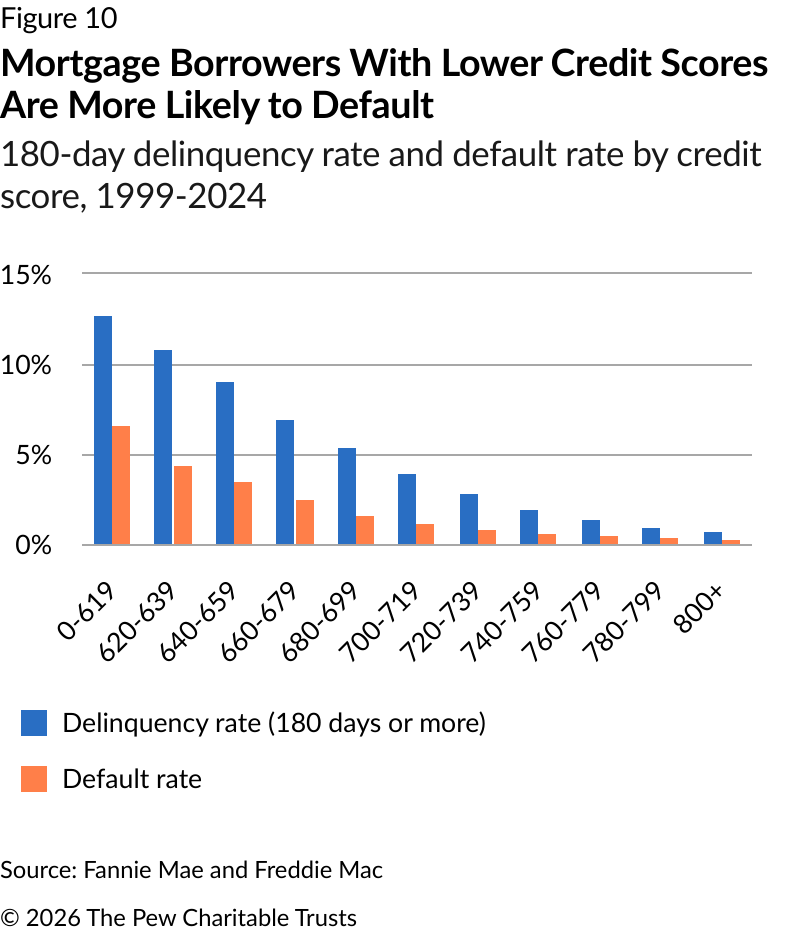
Loan performance data compiled by Fannie Mae and Freddie Mac illustrates this trend clearly. Among mortgage borrowers with a credit score of 619 or lower who took out a loan purchased by Fannie Mae or Freddie Mac from 1999 to 2024, 12.7% were at some point at least 180 days delinquent, and 6.5% eventually defaulted on their loan. (See Figure 10.) By contrast, only 1.3% of borrowers with a credit score of 760 to 779—the median range for new loans purchased by Fannie Mae and Freddie Mac in 2024—experienced a 180-day delinquency, and just 0.4% went into default. Expanding mortgage access to lower-credit-score borrowers would certainly increase the expected number of negative credit events, including foreclosures.
Mortgage default imposes significant costs on borrowers, lenders, and the federal government.20 For borrowers, foreclosure means losing their home and, frequently, some of the equity they have accumulated: Distressed sales typically occur at a significant discount to market value, and legal fees and other costs are subtracted from any proceeds before the borrower recovers anything. Beyond the loss of the home itself, foreclosure also causes severe and lasting damage to a borrower’s credit score, making it difficult to obtain credit for up to seven years.
Lenders also bear costs when borrowers default. For loans held in portfolio—those the bank has kept on its books, and for which it still collects payment—a default means the loss of an important revenue stream and, in a foreclosure, high administrative and transaction costs. For loans sold to Fannie Mae or Freddie Mac, lenders face a different, but related, risk: If a defaulted loan is found to have been improperly underwritten, the GSE that purchased the loan can require the originator to repurchase it, transferring the loss back to the lender.21
With loans that were properly underwritten and sold to one of the GSEs, the federal government bears the cost of a mortgage default. Fannie Mae and Freddie Mac charge guarantee fees to lenders in exchange for buying mortgages and taking on the associated financial risk. Revenue from these fees enables Fannie Mae and Freddie Mac to absorb the cost of individual defaults. But when defaults become widespread, the buffer can be overwhelmed, as was the case during the 2008 financial crisis, when GSE conservatorship cost taxpayers roughly $190 billion.22
Whether those costs are incurred depends heavily on home equity. Foreclosure tends to require two things at once: a financial shock that makes payments unaffordable, and a loan balance that exceeds the home’s value. A borrower who falls behind but still has equity can usually sell the home, repay the loan, and avoid foreclosure—sparing the borrower, the lender, and the government most of the costs of default. Since home prices have been steadily growing since the Great Recession, relatively few borrowers are currently underwater: As of March 2026, about 1.7% of borrowers had a loan that exceeded the value of their home.23 However, a sustained drop in home prices would probably cause defaults to increase, even if borrower characteristics remained the same.
Defaults are less common than they used to be
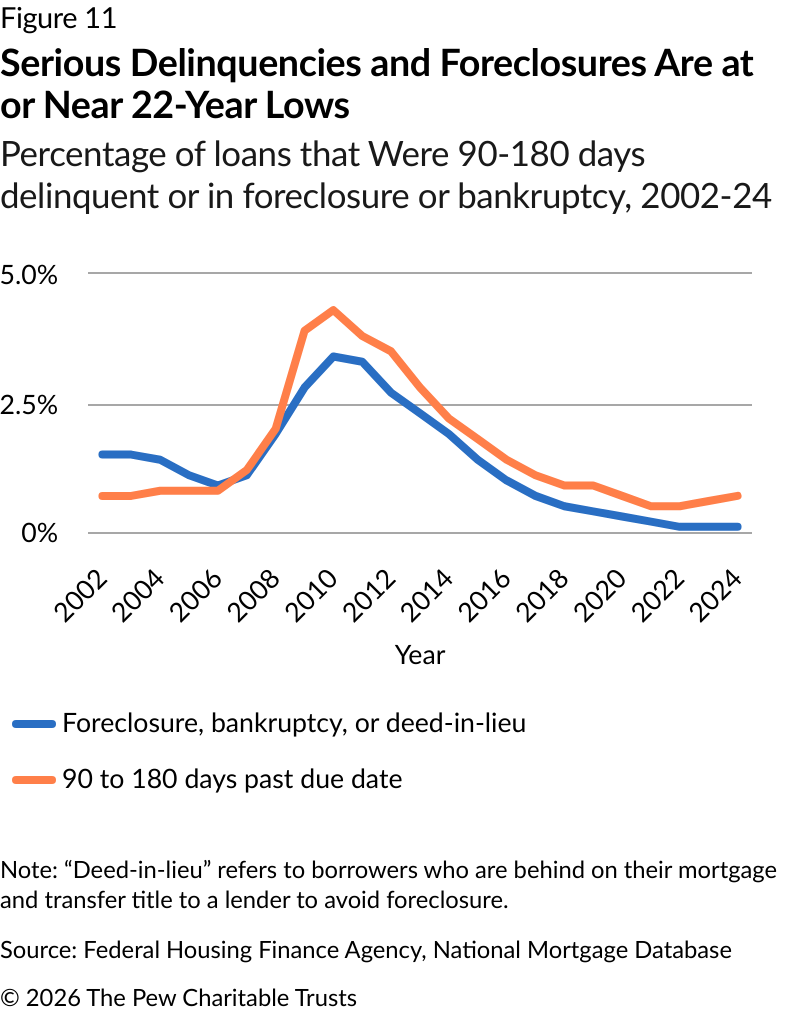
Despite the risks of expanding mortgage access, there is reason to believe that today’s mortgage borrowers are more resilient than the borrowers of the mid-2000s. In 2024, just 0.7% of mortgages were 90 days or more delinquent—roughly the same rate as in 2002, the earliest year for which data on the entire mortgage market is available. Only 0.1% of mortgages were in foreclosure in 2024. (See Figure 11.) Likewise, the 30-day delinquency rate for loans originated by commercial banks was lower in 2024 than it was in most of the 1990s, indicating that lending today is as safe as or safer than it has been in the past.24
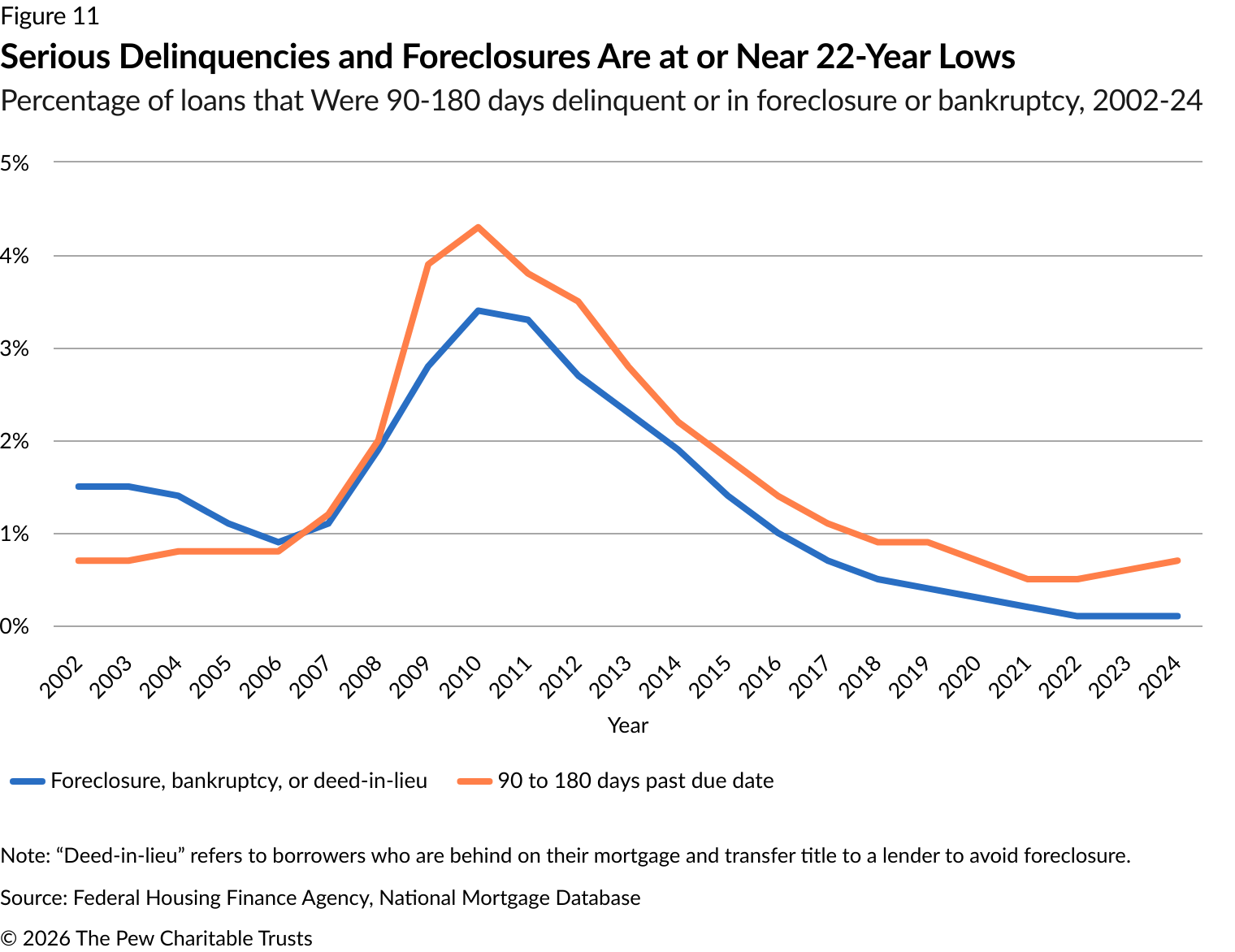
One important difference between 2002 and 2024 is that relatively few delinquent borrowers defaulted on their loans in 2024. Federal policymakers have built a more robust loss mitigation framework since the Great Recession, giving lenders, loan servicers, and federal agencies a range of tools to help delinquent borrowers avoid foreclosure. The most important of these tools are forbearance, which temporarily suspends or reduces mortgage payments to allow borrowers time to recover from a financial hardship; loan modification, which permanently changes the interest rate or loan term to make payments more sustainable; and payment deferral, which moves past-due amounts to the end of the loan rather than requiring immediate repayment.25
Before the 2008 financial crisis, these tools existed but were applied inconsistently, with no standardized framework for evaluating borrowers to see whether they might be able to recover from delinquency and avoid foreclosure. The Great Recession prompted a significant institutional response that ultimately embedded loss mitigation requirements into federal loan servicing regulations, meaning that servicers are now legally required to evaluate delinquent borrowers for available options before initiating foreclosure.26
These loss mitigation tools—bolstered by new forbearance protections contained in the Coronavirus Aid, Relief, and Economic Security Act of 2020—helped many borrowers avoid foreclosure during the COVID-19 pandemic.27 Mortgage delinquencies rose, especially for borrowers who took out loans from 2015 to 2019, but foreclosures remained rare because the new tools gave borrowers time and flexibility to catch up on their loans. According to one analysis, the majority of borrowers who used these programs were current on their mortgages by March 2023, having resolved their delinquency through a repayment plan, deferral, or loan modification.28 The COVID-era case study demonstrates that even a large one-time increase in delinquencies will not necessarily doom the financial system.
Loss mitigation programs work well for borrowers with moderate credit scores. Comprehensive data on home purchase loans from Fannie Mae and Freddie Mac shows that the rate of default among borrowers with credit scores of 620 to 700 has fallen sharply since 2000. And fewer borrowers who are seriously delinquent end up in foreclosure. In the five-year period from 2000 to 2004, 55% of homebuyers who were 90 or more days delinquent defaulted on their loans. (See Table 1.) After policymakers strengthened mortgage loss mitigation programs, that number fell dramatically—to 5% in the five-year period from 2015 to 2019 and just 4% from 2020 to 2024.
Fannie Mae and Freddie Mac Loan Performance: 620-699 Credit Scores
Year of loan origination
| 2000-2004 | 2005-2009 | 2010-2014 | 2015-2019 | 2020-2024 | |
|---|---|---|---|---|---|
| Total loans | 1,860,800 | 911,306 | 555,431 | 1,317,421 | 1,200,505 |
| Ever been 180 days delinquent | 79,503 | 151,164 | 26,529 | 117,690 | 40,638 |
| Ever defaulted | 43,878 | 92,192 | 3,851 | 5,806 | 1,556 |
| Delinquency rate | 4.3% | 16.6% | 4.8% | 8.9% | 3.4% |
| Default rate | 2.4% | 10.1% | 0.7% | 0.4% | 0.1% |
| Share of delinquencies that lead to default | 55% | 61% | 15% | 5% | 4% |
Sources: Fannie Mae and Freddie Mac
Policymakers should be wary of allowing homebuyers to become burdened with large amounts of debt that they will struggle to repay. However, the delinquency rate among buyers with moderate credit scores has actually been lower in recent years than it was before the Great Recession, aside from a brief spike during the COVID-19 pandemic, when 8.9% of borrowers who had taken out a loan from 2015 to 2019 were delinquent. And, thanks to strong loss mitigation programs, mortgage defaults are now rare even when delinquencies rise. As a result, expanding the number of mortgages available to moderate-score borrowers is unlikely to cause serious harm to homebuyers, lenders, or the U.S. economy.
How can policymakers help borrowers with moderate credit scores safely get a home loan?
After the Great Recession, federal policymakers took several steps to make mortgage lending safer. They imposed new restrictions on loan terms and the fees that lenders could charge borrowers, stepped up enforcement actions against lenders who used shoddy underwriting practices, and created a strong incentive for lenders to offer mortgages only to the most financially stable borrowers, as determined by their credit histories and credit scores. These steps made mortgage lending safer for borrowers, lenders, and the federal government, but they also made it difficult or impossible for millions of Americans to get a mortgage.
Policymakers interested in shifting this dynamic—and making it easier for young people, racial minorities, low-income households, and rural Americans to safely attain homeownership—should consider making adjustments to mortgage underwriting standards. Future research from Pew’s housing policy initiative will explore what specific policy changes might help achieve these goals. But, in general, policymakers should keep several principles in mind.
1. Overly tight credit standards prevent qualified borrowers from getting a mortgage. Conversations about mortgage policy often focus on how to minimize the risk of providing credit without considering how a reduction in the availability of credit might affect potential borrowers. The credit tightening that occurred after the Great Recession meaningfully reduced access for borrowers with credit scores from 600 to 699. Those with scores in this range are more likely to be Black or Hispanic, under 25, first-time homebuyers, low-income individuals, or people who live in rural areas.
Reassessing risk tolerance does not imply a return to the excesses that led to the foreclosure crisis and Great Recession. Mortgage delinquency rates are currently near their pre-recession levels, and default rates are substantially lower because of improved loss mitigation policies. Those improvements extend to borrowers with a moderate credit score. For loans acquired by Fannie Mae or Freddie Mac, just 4% to 5% of delinquent borrowers with credit scores of 620 to 700 defaulted on their loans from 2015 to 2024. The mortgage market is fundamentally safer than it was in the early 2000s, when an estimated 55% of delinquent borrowers went into default.
Policymakers should reevaluate whether certain programmatic thresholds, pricing frameworks, and underwriting tolerances are more rigid than necessary, given the stability of today’s mortgage market. Easing restrictions would enable more Americans to access mortgages and achieve homeownership.
2. Continue to modernize how risk is measured. Traditional underwriting models rely heavily on conventional credit histories and static snapshots of a potential borrower’s financial characteristics. In recent years, federal policymakers have taken steps to broaden how creditworthiness is assessed. For example, Fannie Mae and Freddie Mac’s automated underwriting systems now allow lenders to incorporate rental payment history and trended credit data that looks at a borrower’s financial situation over time.29 Likewise, the Federal Housing Finance Agency has validated the use of more modern credit scoring models—including FICO 10T and VantageScore 4.0—that incorporate alternative data (such as rent and utility payments), take a longer-term view of a consumer’s finances, and ultimately expand the number of Americans with credit scores.30
These initiatives have marginally expanded credit access to borrowers with a thin credit file or a nontraditional financial situation.31 But to meaningfully tilt the balance toward greater mortgage access, more improvements are necessary. One promising area is cash flow underwriting, which uses bank account transaction data to assess a borrower’s income and financial stability directly, rather than relying on tax returns or credit reports.32 For self-employed borrowers, gig workers, and others whose financial situations are poorly captured by traditional documentation, this approach could improve credit assessment for populations that current models systematically underserve.
3. Increase transparency about how credit standards operate. The boundaries of credit access are often established by computerized automated underwriting systems such as Desktop Underwriter, Loan Product Advisor, and TOTAL Scorecard. The parameters embedded within these systems determine whether borrowers receive automated approval or whether they must go through slower, more costly manual review. Yet, as influential as these ubiquitous automated systems are, how exactly they work is not publicly known—in contrast to private credit scoring companies like FICO, which publicly disclose the broad categories of information their scores consider and the approximate weight assigned to each.33
Limitations in publicly available data further constrain oversight. The Home Mortgage Disclosure Act requires lenders to collect and report borrower credit scores, but the Federal Financial Institutions Examination Council withholds that information from its public database, creating an information gap that limits the ability of researchers to assess how credit standards affect different communities. Likewise, the National Mortgage Database reports credit score data in only five categories, which makes it difficult to determine precisely which groups have gained or lost mortgage access over time. Adding granular detail to credit score reporting would enable researchers to more carefully determine the relationship between credit risk and credit access.
Clearer disclosures of the risk factors and weights used by automated underwriting systems to evaluate borrowers and expanded data reporting would help strengthen accountability and allow researchers and policymakers to more precisely understand the balance between federal standards and underwriting outcomes.
Conclusion
In the last 20 years, the federal government’s mortgage lending policies have prioritized minimizing risk over expanding access to homeownership. Updates to federal lending standards, pricing frameworks, bank capital requirements, automated underwriting systems, and enforcement regimes have created a mortgage market that tolerates less risk than at any time in the past 30 years. These changes have driven down delinquencies and defaults, but they have also prevented many young people, low- and moderate-income households, racial minorities, and rural Americans from obtaining safe and affordable home financing.
Policymakers who want to expand homeownership opportunities could consider targeted approaches that improve mortgage availability for financially ready applicants, especially those with credit scores of 600 to 699. They could also consider improving transparency by providing more and better publicly available information about how loans are underwritten. Policymakers could also examine ways to encourage innovation in credit scoring models, and possibly transition to entirely new mortgage underwriting approaches that more accurately assess the risk of making a loan to an individual applicant. The goal of these policies would not be to open the floodgates of easy credit, but to widen the doorway just enough for more creditworthy Americans to step through.
Acknowledgments
This brief was researched and written by Adam Staveski, a principal associate with the Pew Charitable Trusts’ housing policy initiative. The author thanks Pew colleagues Seva Rodnyansky, Tara Roche, Alex Horowitz, Travis Plunkett, and Rachel Brittin for providing communications, creative, editorial, and research support for this work.
Endnotes
- “Median Sales Price of Houses Sold for the United States,” Federal Reserve Bank of St. Louis, 2026, https://fred.stlouisfed.org/series/MSPUS.
- “Housing Finance at a Glance,” Urban Institute, 2026, https://www.urban.org/sites/default/files/2026-05/May%20v4%20mn_0.pdf.
- § 1026.1 Authority, Purpose, Coverage, Organization, Enforcement, and Liability,Consumer Financial Protection Bureau (2026), https://www.consumerfinance.gov/rules-policy/regulations/1026/1/. 12 CFR Part 1026—Truth in Lending (Regulation Z), Consumer Financial Protection Bureau (2026), https://www.consumerfinance.gov/rules-policy/regulations/1026/. 12 CFR Part 1022—Fair Credit Reporting (Regulation V)” Consumer Financial Protection Bureau (2026), https://www.consumerfinance.gov/rules-policy/regulations/1022/.
- Fannie Mae, Loan-Level Price Adjustment Matrix (2026), https://singlefamily.fanniemae.com/media/9391/display.
- U.S. Department of Housing and Urban Development, FHA Single-Family Policy Handbook (2024), https://www.hud.gov/sites/dfiles/OCHCO/documents/40001-hsgh-update15-052024.pdf.
- Laurie Goodman Jim Parrott, Mark Zandi, “How the Basel Re-Proposal Will Impact the Mortgage Market,” Moody’s Analytics, 2026, https://www.howhousingmatters.org/sites/default/files/2026-06/How_the_Basel_Re-Proposal_Will_Impact_the_Mortgage_Market.pdf.
- Jim Parrott and Laurie Goodman, “If FHA Wants to Bring Lenders Back, It Will Need to Clarify Their False Claims Act Liability,” The Urban Institute, 2019, https://www.urban.org/urban-wire/if-fha-wants-bring-lenders-back-it-will-need-clarify-their-false-claims-act-liability.
- Laurie Goodman, “Quantifying the Tightness of Mortgage Credit and Assessing Policy Actions,” Urban Institute, 2017, https://www.urban.org/sites/default/files/publication/88826/quantifying_tightness_of_credit.pdf. Steven Laufer and Andrew Paciorek, “The Effects of Mortgage Credit Availability: Evidence From Minimum Credit Score Lending Rules,” Federal Reserve Board of Governors, 2016, https://www.federalreserve.gov/econresdata/feds/2016/files/2016098pap.pdf.
- Christopher L. Foote, Lara Loewenstein, and Paul Willen, “Technological Innovation in Mortgage Underwriting and the Growth in Credit, 1985–2015,” Federal Reserve Bank of Boston, 2022, https://papers.ssrn.com/sol3/papers.cfm?abstract_id=3498728. Geetesh Bhardwaj and Rajdeep Sengupta, “Credit Scoring and Loan Default,” Federal Reserve Bank of Kansas City, 2015, https://www.kansascityfed.org/documents/7727/rwp15-02.pdf.
- Christopher L. Foote, Lara Loewenstein, and Paul Willen, “Technological Innovation in Mortgage Underwriting.”
- Stephanie Johnson and Nitzan Tzur-Ilan, “Automated Underwriting and Housing Market Dynamics,” Federal Reserve Bank of Dallas, 2025, https://www.dallasfed.org/~/media/documents/research/papers/2025/wp2506r1.pdf.
- Morris A. Davis, William D. Larson, Stephen D. Oliner, and Benjamin R. Smith, “A Quarter Century of Mortgage Risk,” Federal Housing Finance Agency, 2022, https://www.fhfa.gov/document/wp1902.pdf.
- “Housing Credit Availability Index,” The Urban Institute, https://www.urban.org/policy-centers/housing-finance-policy-center/projects/housing-credit-availability-index.
- W. Scott Frame, Kristopher Gerardi, Daniel Sexton, and Joseph Tracy, “Ability to Repay a Mortgage: Assessing the Relationship Between Default, Debt-to-Income,” Federal Reserve Bank of Dallas, https://www.dallasfed.org/research/economics/2020/0324.
- “Survey of Consumer Expectations,” Federal Reserve Bank of New York, 2026, https://www.newyorkfed.org/microeconomics/sce#/.
- Laurie Goodman, Jun Zhu, and Bing Bai, “Overly Tight Credit Killed 1.1 Million Mortgages in 2015,” The Urban Institute, 2016, https://www.urban.org/urban-wire/overly-tight-credit-killed-11-million-mortgages-2015.
- Jessica Dickler, “Credit Scores Hit an All-Time High Even Though Households Are Falling Deeper in Debt,” CNBC, 2023, https://www.cnbc.com/2023/10/30/credit-scores-hit-an-all-time-high-despite-rising-debt.html.
- “How Long Does Information Stay on My Credit Report?,” Consumer Financial Protection Bureau, https://www.consumerfinance.gov/ask-cfpb/how-long-does-information-stay-on-my-credit-report-en-323/.
- Ying Lei Toh, “Addressing Traditional Credit Scores as a Barrier to Accessing Affordable Credit,” Federal Reserve Bank of Kansas City, 2024, https://www.kansascityfed.org/Economic%20Review/documents/9602/EconomicReviewV108N3Toh.pdf.
- Rebecca Diamond, Adam Guren, and Rose Tan, “The Effect of Foreclosures on Homeowners, Tenants, and Landlords,” National Bureau of Economic Research Working Paper Series (2025): https://www.nber.org/system/files/working_papers/w27358/w27358.pdf.
- Jun Zhu, Laurie Goodman, and Michael Neal, “Gse Repurchase Activity and Its Chilling Effect on the Market,” The Urban Institute, 2023, https://www.urban.org/sites/default/files/2023-11/GSE%20Repurchase%20Activity%20and%20its%20Chilling%20Effect%20on%20the%20Market.pdf.
- “A Failure to Act: How a Decade Without GSE Reform Has Once Again Put Taxpayers at Risk,” hearing before the Committee on Financial Services, U.S. House Of Representatives (2018), https://financialservices.house.gov/uploadedfiles/115-115.pdf.
- “Mortgage Monitor Report: May 2026,” ICE Mortgage and Housing Market Research, 2026, https://mortgagetech.ice.com/publicdocs/mortgage/IMT-ICE_Mortgage_Monitor_May_2026-80N1MtVYtGs.pdf.
-
“Delinquency Rate on Single-Family Residential Mortgages, Booked in Domestic Offices, All Commercial Banks,”
Federal Reserve Bank of St. Louis, 2026, https://fred.stlouisfed.org/series/DRSFRMACBS. - “The Future of Loss Mitigation,” Mortgage Bankers Association, 2023, https://www.mba.org/docs/default-source/policy/white-papers/24855-mba-future-of-loss-mitigation-paper-wb-march-2023.pdf?sfvrsn=53901567_1. Jun Zhu and Laurie Goodman, “Improvements in the Loss Mitigation Toolkit Can Allow for Enhanced Access to Credit,” The Urban Institute, 2024, https://www.urban.org/research/publication/improvements-loss-mitigation-toolkit-can-allow-enhanced-access-credit.
- Mortgage Servicing and Selected Policy Issues (2025), https://www.congress.gov/crs_external_products/R/HTML/R48713.html#_Toc209177033.
- Laurie Goodman and Jun Zhu, “Preventing Foreclosures: What Has Been Done? What Is to Come?,” The Urban Institute, 2024, https://www.urban.org/sites/default/files/2024-07/Preventing%20Foreclosures_0.pdf.
- Patrick Lapid and Greta Li, “Office of Research Blog: How Are Mortgages with a Covid-Related Forbearance Performing in 2023?,” Consumer Financial Protection Bureau, 2023, https://www.consumerfinance.gov/archive/blog/office-of-research-blog-how-are-mortgages-with-covid-related-forbearance-performing-in-2023/
- “Credit Assessment With Loan Product Advisor,” Freddie Mac (2026), https://guide.freddiemac.com/app/guide/section/5201.1#e. “FAQs: Positive Rent Payment History in Desktop Underwriter,” Fannie Mae, https://singlefamily.fanniemae.com/originating-underwriting/faqs-positive-rent-payment-history-desktop-underwriter. “Trended Credit Data and Desktop Underwriter (DU),” Fannie Mae, 2022, https://singlefamily.fanniemae.com/media/4641/display. “Trended Credit Data and March 2024 LPA Release,” Freddie Mac, https://sf.freddiemac.com/articles/news/trended-credit-data-and-march-2024-lpa-release.
- “Credit Scores,” Federal Housing Finance Agency, https://www.fhfa.gov/policy/credit-scores.
- Federal Reserve Board, “Alternative Data: Expanding Access to Credit” (2025), https://www.federalreserve.gov/publications/files/consumer-community-context-20251017.pdf.
- Daniel Pang, “Incorporating Two Alternative Types of Data Into Mortgage Underwriting Could Make the Process More Equitable,” The Urban Institute, 2023, https://www.urban.org/urban-wire/incorporating-two-alternative-types-data-mortgage-underwriting-could-make-process-more.
- “Basic Facts About FICO Scores,” FICO, https://www.fico.com/en/resource-access/download/4292.
People


