Transit Funding Uncertain as Federal Infrastructure Law Expires
Decreased support could complicate long-term planning, shift costs onto state and local budgets

This is the second piece in a three-part series exploring the end of the IIJA and what’s next for states.
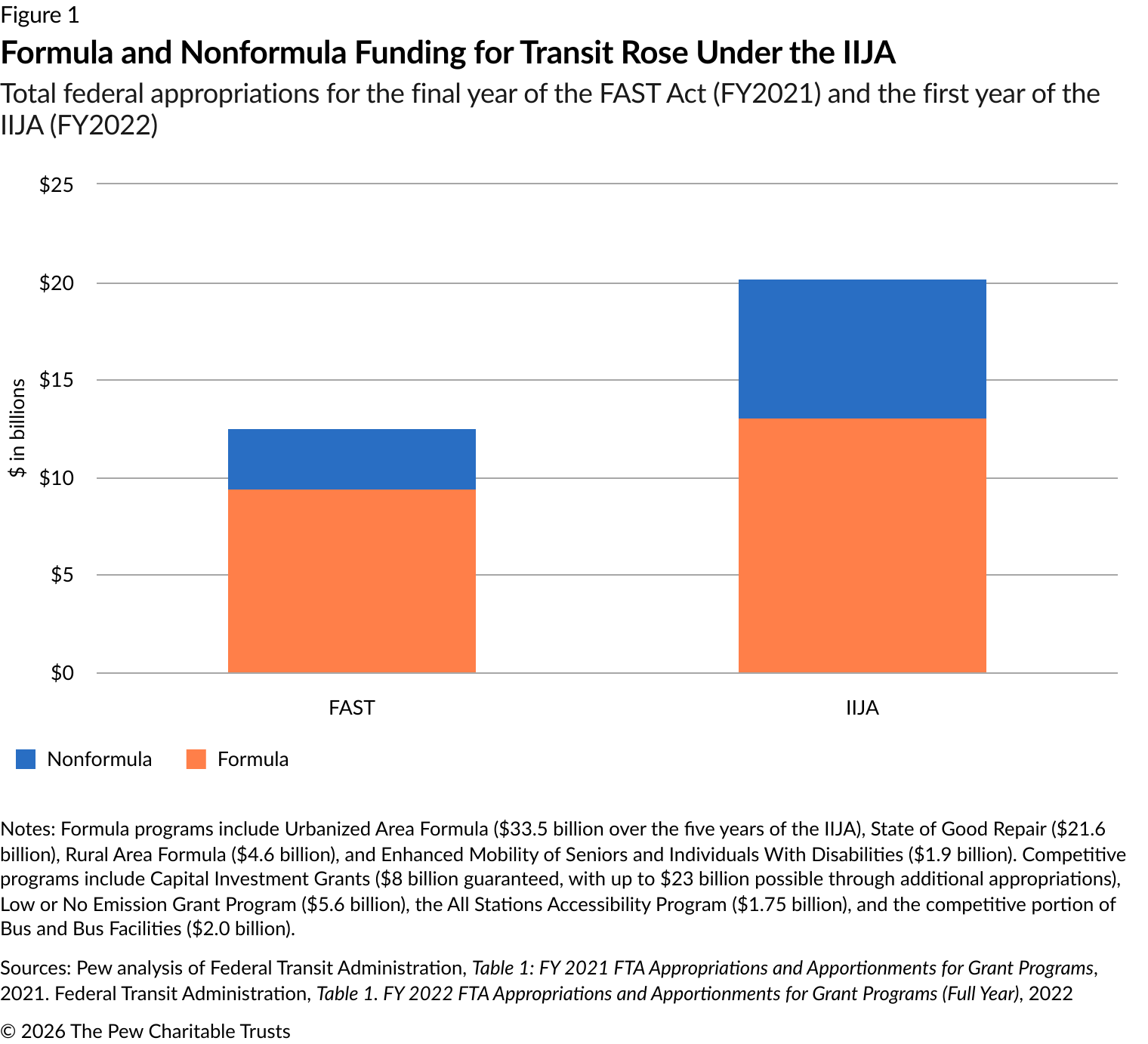
The 2021 Infrastructure Investment and Jobs Act (IIJA) increased annual federal transit funding by roughly two-thirds, from about $12.8 billion to $21.4 billion a year through 2026, including significant resources for major repair backlogs, modernizing bus and rail fleets, and improving station accessibility. But now, the IIJA has reached its expiration, leaving open key questions for states and localities: How much funding will Congress provide for transportation writ large and will transit, in particular, remain a priority?
The IIJA increased formula funding—which is money allocated automatically based on factors such as population and transit system size—as well as other types of funding, primarily discretionary grants that state and local governments must apply for. These nonformula funding streams more than doubled in the IIJA compared with previous laws. (See Figure 1.)
But even with this record investment, the nation’s transit repair backlog remains substantial, with the Federal Transit Administration estimating more than $140 billion in accumulated needs as of 2022.
Whether Congress chooses to maintain IIJA funding levels will determine how transit agencies address ongoing capital needs and which fiscal responsibilities fall to state and local governments. For example, compared with the IIJA, the current proposal in the U.S. House of Representatives would reduce funding for public transit by 14% over five years and shift more transit funding to annual appropriations rather than guaranteed funding, making federal support much less predictable. These pressures would compound the low fare revenue that is already straining transit budgets.
IIJA’s impact on transit investments
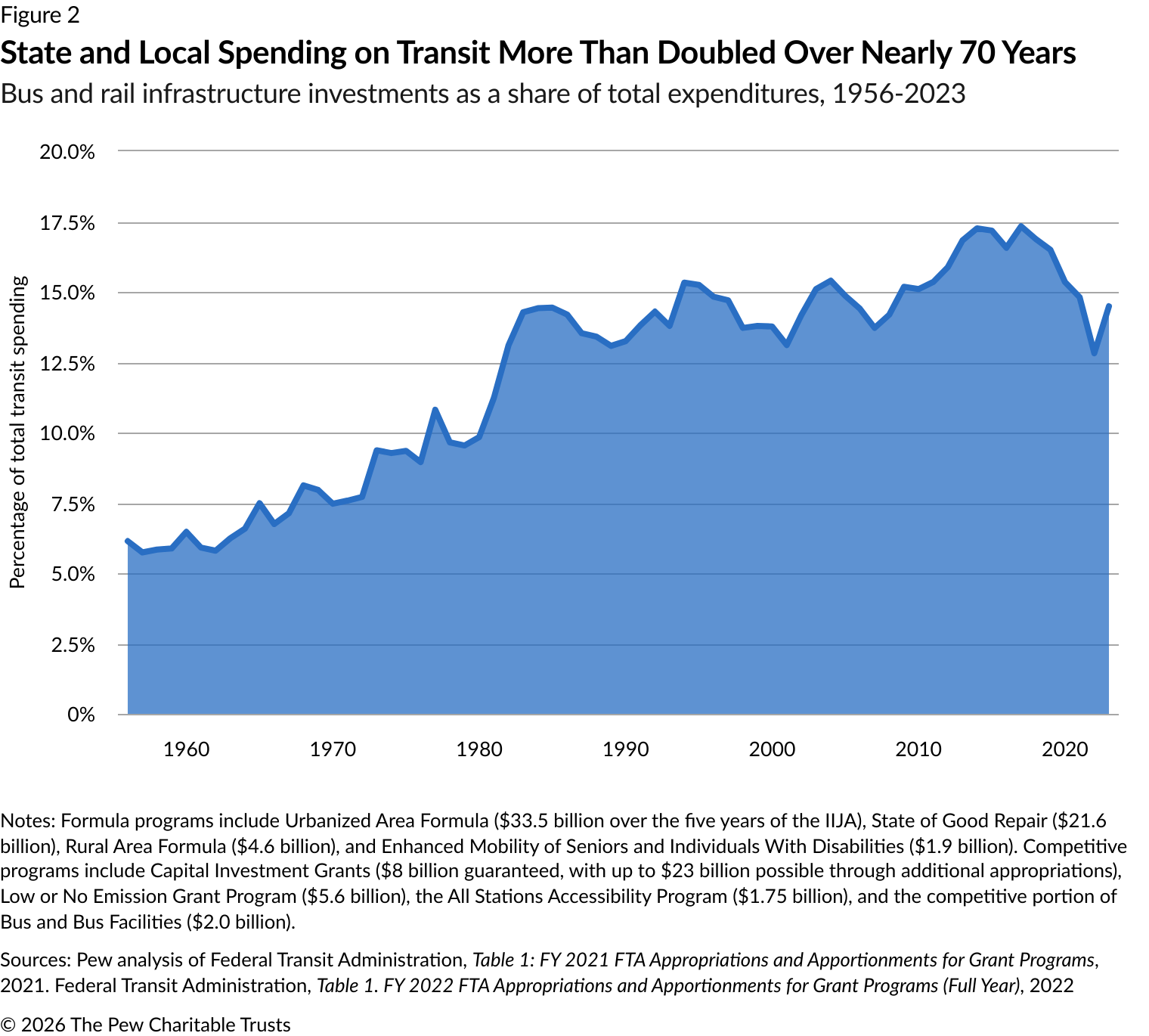
Despite the IIJA investments’ significant scope and scale, they ultimately were just a temporary boost rather than a permanent change to the federal funding baseline. Over the past 70 years, states and localities have become increasingly responsible for transit funding; their contributions have more than doubled since 1956. (See Figure 2.) Nevertheless, a return to pre-IIJA funding levels would still force state and local governments to rethink their strategies to address deferred maintenance.
The IIJA also created entirely new categories of federal transit support, including for bus electrification and rail upgrades. And because these needs had previously received little or no dedicated federal funding, the end of IIJA investments means state and local budgets will probably have to once again assume these costs.
The risk of decreased funds under the Building Unrivaled Infrastructure and Long-Term Development for America's 250th (BUILD America 250) Act—the proposed surface transportation funding bill under consideration in the U.S. House of Representatives—takes two forms. First, some competitive grants that the infrastructure law created or significantly expanded could disappear. Second, the loss of guaranteed funding and a return to pre-IIJA-style annual appropriations would eliminate the funding certainty provided by the IIJA.
The potential end of some competitive grants presents a similar challenge for other priorities. These programs support transit network modernization, accessibility, and electrification upgrades that might otherwise be unaffordable by providing agencies with additional resources beyond what they receive through formula funding. For example, the Low or No Emission Grant Program—which would be eliminated under BUILD America 250—provided about $1.1 billion annually over five years for fleet and bus electrification. Other key discretionary grant programs, including the Capital Improvement Grant program, are also likely to see significant cuts under the bill. If enacted, these changes could force states and transit agencies to identify other funding sources, scale back projects, or forgo them altogether.
One of the most consequential potential changes, however, is the loss of guaranteed advance appropriations. Under the IIJA, passenger rail programs received $13.2 billion annually in guaranteed funding. And although BUILD America 250 would provide a similar amount—roughly $12.9 billion annually—that funding would be subject to an annual appropriations process, creating more uncertainty and making long-term capital planning more challenging for states and localities.
And these consequences will not fall evenly throughout the country. Large urban transit agencies and systems generally receive federal formula funds directly rather than through state departments of transportation, leaving them to manage reductions in federal funding on their own. Rural systems, on the other hand, often have small customer bases and few options for generating additional revenue or accessing financing, and so they rely particularly heavily on—and are highly vulnerable to changes in—government support.
Challenges with IIJA implementation
Federal support has always favored capital investments over day-to-day transit operational costs. For example, in 2019, federal funds covered just 7.9% of operating costs versus 32.3% of capital spending. Further, federal rules restrict large transit agencies from using formula funds to cover operating deficits, and grants aimed at urban areas are largely confined to capital and planning purposes, with narrow exceptions for smaller bus operators. As a result, IIJA has had a significant impact on capital projects, but the effect on transit agencies’ ability to address deferred maintenance backlogs has been more limited.
As IIJA winds down and Congress considers the next round of federal transportation funding, states, local governments, and transit agencies face an uncertain future. Policymakers across levels of government need to be ready to adjust to changes in federal support and identify a sustainable path to addressing replacement, repair, and maintenance of transit assets.
Eli Gullett and Ora Halpern are senior associates and Fatima Yousofi is a senior officer with The Pew Charitable Trusts’ state fiscal policy project.
People


