The End of Supplemental Federal Water Funding Puts New Pressure on State and Local Governments
Reverting to levels that predate 2021 law could widen infrastructure investment gaps

This is the first piece in a three-part series exploring the end of the IIJA and what’s next for states.
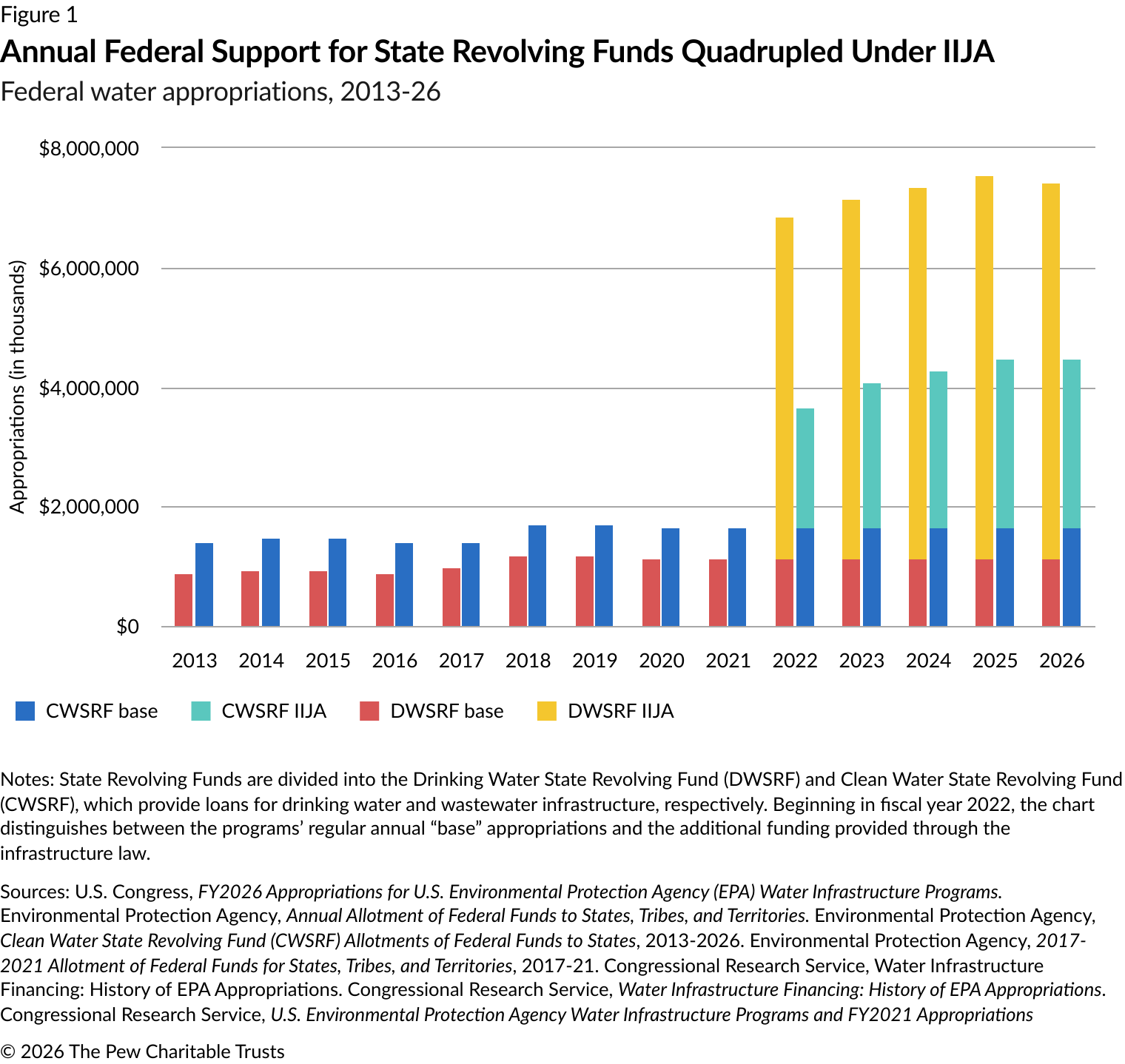
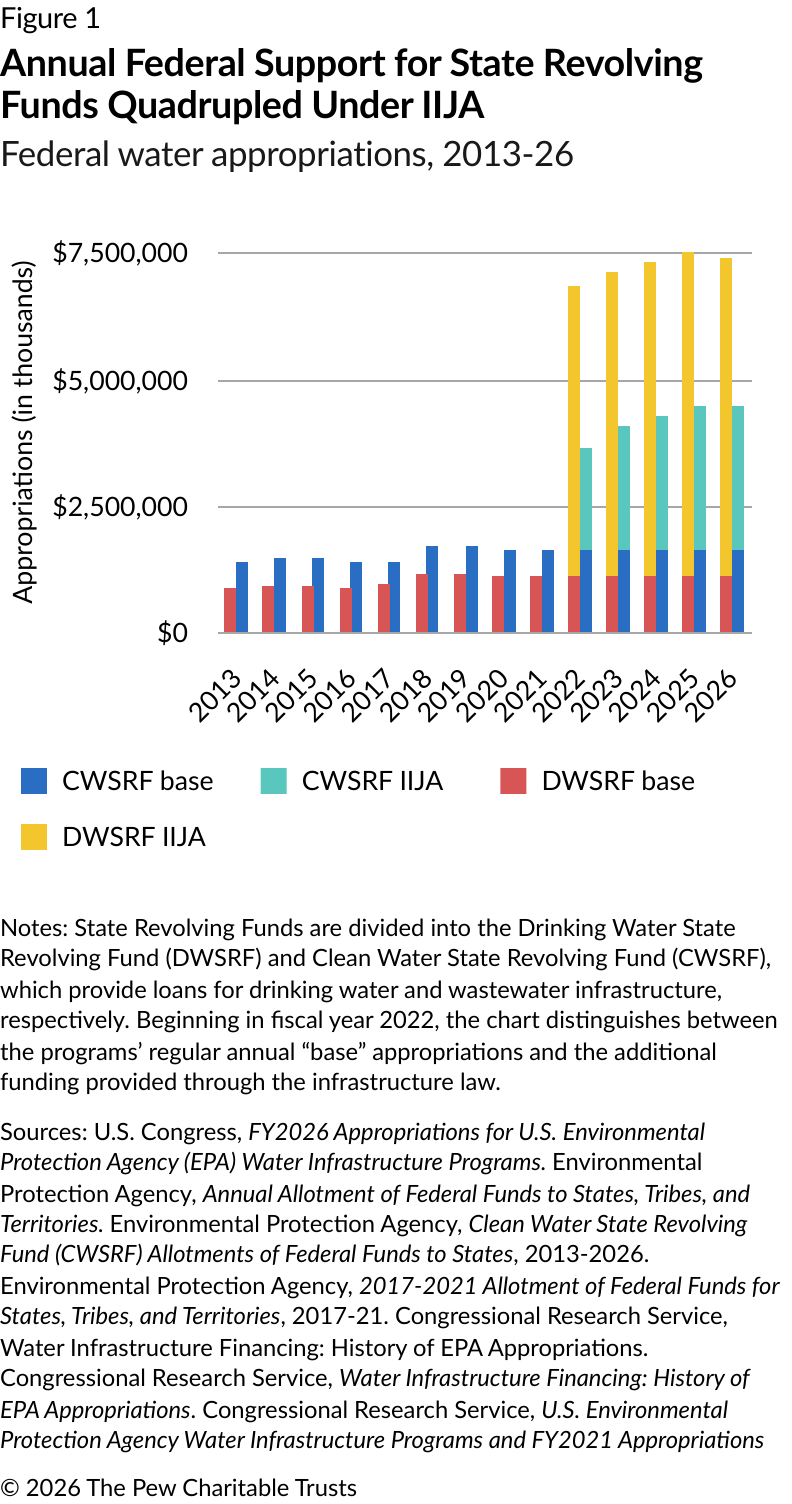
The 2021 Infrastructure Investment and Jobs Act (IIJA) marked a historic increase in federal spending for water infrastructure , providing $55 billion from fiscal year 2022 through fiscal 2026. Most of these investments—$43.4 billion—came in the form of supplemental funding to the State Revolving Funds (SRFs), effectively quadrupling annual SRF funding over the five years. (See Figure 1.)
However, the IIJA authorization for supplemental SRF funding ended in September, and federal water investments are expected to decline significantly.
At the same time, underlying infrastructure needs are substantial and growing, and in the coming months and years, state and local governments could face tough choices about whether and how to fund maintenance and upgrades of critical water systems.
Water infrastructure needs expected to rise
Though significant, the temporary increase in federal SRF appropriations was not nearly enough even to resolve existing deferred maintenance. In fact, IIJA funding addressed only about 5% of the nation’s estimated needs. And surveys published by the U.S. Environmental Protection Agency in 2023 and 2024 estimate a combined $1.2 trillion in drinking water and wastewater investment needs over 20 years. Other analyses place the figure even higher: $2.1 to $2.4 trillion over 25 years for drinking water alone.
Further, aging water infrastructure already contributes to frequent failures that impose additional costs on states. The U.S. experienced roughly 300,000 water main breaks and an estimated $7.6 billion in water loss from pipe leaks in 2018 and 2019, respectively.
According to one study, if federal investments reverted to pre-IIJA levels, the gap between projected water infrastructure needs and available funding could exceed $2.5 trillion over 20 years, potentially forcing states to prioritize a smaller share of projects. This in turn could delay critical upgrades, increase maintenance backlogs, and leave water systems even more prone to costly failures.
Effects on state and local budgets
Even with the influx of federal funding through the IIJA, states and localities have still been responsible for nearly all water infrastructure costs. For instance, federal spending accounted for only about 4% of total public investment in water infrastructure in 2023.
Despite this limited reach, however, the IIJA funds did expand funding for key communities and projects. The law required that a significant portion of funds be provided as forgivable loans or grants, and early data suggests that, as a result, a larger share of SRF assistance reached disadvantaged communities than before the IIJA. As this funding expires, SRF assistance will be less likely to include grants and principal forgiveness and instead be more reliant on standard loans, which can be less affordable for communities with limited resources to repay.
But even communities that can take on additional debt may still face challenges after the IIJA expires. Less low-cost federal financing may lead utilities to rely more on higher-cost borrowing, such as municipal bonds, or rate increases to pay for infrastructure projects. And those higher financing prices will probably be compounded by rising construction, labor, and operating costs, which have already outpaced utilities’ ability to meet expenses through existing revenue streams: Only 43% of water utility professionals report being able to cover costs through rates and user fees alone.
At the same time, affordability pressures are also increasing for utility customers. One analysis found that, if water utilities must rely on rate increases alone to fund infrastructure needs, more than 20% of U.S. households could end up spending over 2.5% of their income on water bills by 2050.
IIJA expiration coincides with other fiscal pressures
These funding challenges for states and localities are complicated by a range of other economic factors.
Congress’ continued allocation of some SRF appropriations to earmarks—which direct funds toward grants rather than revolving loans—constrains states’ ability to recycle limited funds to support future projects. And unlike dedicated grants that help disadvantaged communities, earmarks pull resources from the regular revolving loan pool, reducing the dollars available for statewide priorities. A recent analysis suggests that over 20 years, these earmarks could cost SRFs $19.4 billion, enough to finance roughly 5,700 projects.
In addition, utilities are facing increasingly critical but costly regulatory and environmental demands. For example, the EPA’s 2024 drinking water standards for per- and polyfluoroalkyl substances, a key public health protection, are likely to require roughly $1.5 billion a year for treatment infrastructure, monitoring, and compliance. Similarly, lead service line replacement mandates could cost as much as $90 billion. Although the IIJA dedicated funding to help utilities meet these various requirements, those resources, which were only a first step toward paying for necessary upgrades, are expiring just as investment needs are ramping up.
Further, utilities face increasing risks from extreme weather events, aging infrastructure, and cybersecurity threats, all of which necessitate additional investment in system resilience and adaptation. For example, an early estimate suggests that adapting drinking water and wastewater systems to climate impacts could cost $448 billion to $944 billion through 2050.
The IIJA represented a significant expansion of federal water infrastructure investment, but such one-time funding increases are not sufficient to address the sector’s long-term needs and decades of deferred maintenance. Although the influx of IIJA money to SRFs accelerated progress on certain projects and enabled communities to address some of their most urgent challenges, significant needs remain.
Without additional federal investments, states and localities will have limited ability to address those needs, especially amid rising project costs and competing fiscal demands.
Mollie Mills is an officer and Aleena Oberthur is a project director with The Pew Charitable Trusts’ state fiscal policy project.
People