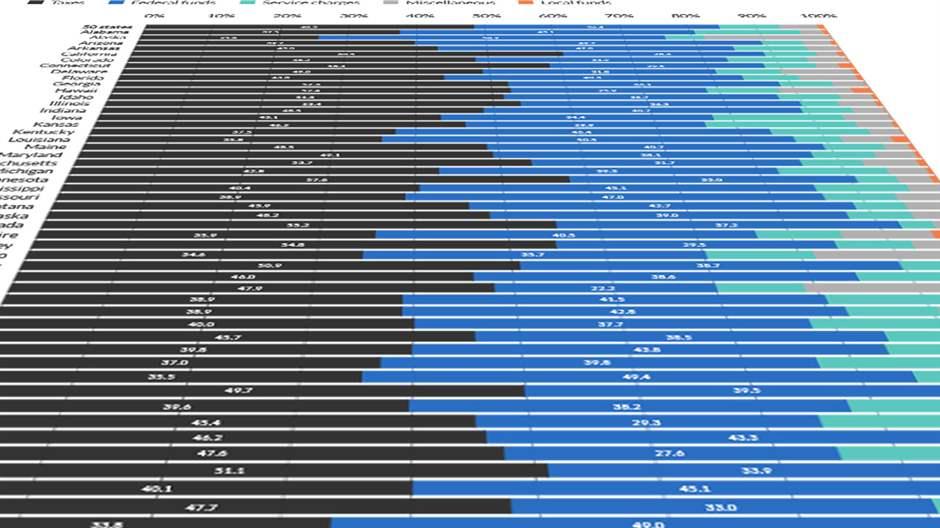
Tax collections typically make up almost half of state government revenue. In fiscal year 2025, nearly two-thirds of states’ combined total tax collections came from levies on personal income (33.7%) and general sales of goods and services (30.9%).
Broad-based personal income taxes were the largest source of tax dollars in 25 of the 41 states that impose them, with the highest share in Oregon (63.7%) and the lowest in North Dakota (7.7%). General sales taxes were the largest tax revenue source in 20 of the 45 states that collect them. Florida was most reliant on this source, which accounted for 62.9% of the state’s tax revenue. Five states collected the largest share of their fiscal 2025 tax revenue from sources other than personal income or general sales taxes: severance taxes in Alaska, New Mexico, and North Dakota; corporate income taxes in New Hampshire; and property taxes in Vermont. Property taxes are collected on the local level in Vermont, but a portion of the revenue is redirected to the State Education Fund.
Mix of Tax Sources by State, FY 2025
Select revenue sources below to highlight them and re-sort the chart:
Personal income
General sales
Selective sales
Corporate income
License
Other
Property
Severance
0%25%50%75%100%0%25%50%75%100%
Notes: New Hampshire’s personal income tax differs from the broad-based personal income taxes levied in other states because it taxes only certain dividend and interest income. Tennessee had a similar tax in place, but it was phased out as of Jan. 1, 2021. Ohio does not impose a corporate income tax; revenue reported to the U.S. Census Bureau under this category reflects collections from the state’s pass-through entity and trust withholding tax, which was partially phased out in 2016. South Dakota does not impose a corporate income tax; revenue reported to the U.S. Census Bureau under this category reflects collections from the state’s bank franchise tax. Oregon does not impose a general sales tax; revenue reported to the U.S. Census Bureau under this category reflects collections from the state’s corporate activity tax, which became effective Jan. 1, 2020. Washington did not impose an individual income tax as of 2025; revenue reported to the U.S. Census Bureau under this category for fiscal year 2025 reflects collections from the state’s capital gains tax, which became effective Jan. 1, 2022. Property taxes reflected in the Annual Survey of State Government Collections include only revenue that flows through the state level. Kansas collected more in selective sales taxes than in corporate income taxes; Kentucky collected more in severance taxes than in other taxes; and Oregon collected more in property taxes than in severance taxes, but in each of these cases, the shares appear equal because of rounding.
Source: U.S. Census Bureau’s 2025 Annual Survey of State Government Tax Collections