Managing the High Volume of Contracts in Philadelphia
Streamlining the contract process to better serve city residents

Philadelphians receive a wide array of services directly from their city government: when they visit their local library branch, for example. Or when their trash is picked up. Or when they’re transported by paramedics to a hospital.

However, many essential city services are delivered by nonprofit organizations and private businesses. Some entities make it possible to run vaccination clinics. Others support food pantries or assist child welfare agencies overseeing the foster care system. Still others provide direct outreach to people experiencing homelessness. In short, these extra-governmental groups and businesses expand the government’s capacity to serve the people of Philadelphia.
The process by which local government reaches an agreement with outside organizations to deliver services to the public is called procurement.
This brief examines budget items classified as Class 200 expenses—contractual agreements between the city and a vendor to provide a service (as opposed to providing a type of good or product). For the most part, these contracts deal with services provided directly to city residents, often by nonprofit groups. The city of Philadelphia spends around $3.8 billion annually on the procurement of professional services.
A report1 by The Pew Charitable Trusts and Bennett Midland, a civic consulting firm with deep expertise working with cities on procurement reform, found that, as with other cities throughout the country, Philadelphia faces a core challenge in its contracting process: Contracts are rarely executed or “conformed” prior to the contract’s start date. Without a conformed contract, the city cannot pay for work performed, delaying the flow of funding, straining vendor operations, and putting essential services for residents at risk. Between July 2020 and January 2025, only 10% of the city’s professional services contracts were conformed on time.
The primary factor affecting the city’s ability to conform contracts on time is the sheer volume of contracts that Philadelphia processes—nearly 2,300 professional services agreements each year.
Nonprofit Provider Task Force
In 2024, Philadelphia passed legislation to eliminate an exemption that had allowed some departments to bypass competitive bidding requirements for contracts with nonprofit entities. After the bill’s passage, contracts were no longer eligible to be directly awarded to nonprofits but were to be selected as part of a request for proposal (RFP) process, as is often the case with such agreements.
Councilmember Katherine Gilmore Richardson, who sponsored the legislation, convened the Nonprofit Provider Task Force following its adoption. The task force identified several key challenges facing nonprofit providers working with city government, including inconsistent oversight, lack of clear communication on the timing of contracts, and confusion regarding the use of the amendment process for some contracts. In its final report to City Council in December 2024, it also highlighted challenges with the conformance process itself, noting that “vendors are unsure why contracts without any major changes take so long to process, which delays their ability to provide services, increases costs, and creates liability issues for the city and the vendor.”2 Task force participants also emphasized that the city’s stated policy does not permit them to provide services without a conformed contract in place, but the nature of the services they provide can make it difficult to discontinue services that are already being provided.
Why is the volume so high?
One key finding of the Pew/Bennett Midland report was that the system is being strained by the “overwhelming number of contracts each year.” The city of Philadelphia conformed approximately 2,300 professional services agreements annually between July 2019 and January 2025. These agreements were held by departments throughout the city supporting a variety of services for residents. A major reason for the high volume of agreements is the large number of renewals that the city processes each year.
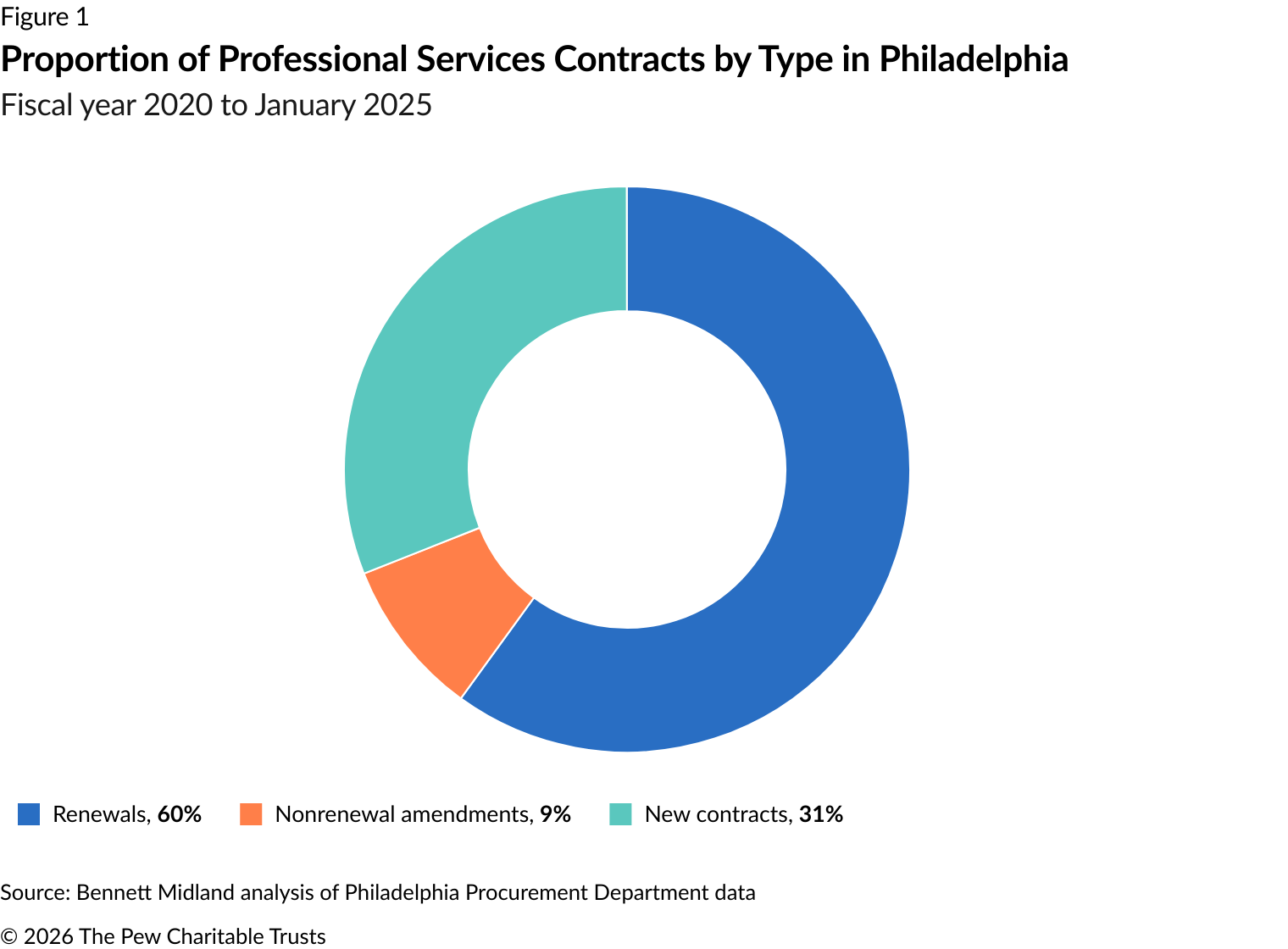
From fiscal year 2020 through January 2025, 60% of professional services agreements were one-year renewals, often with minimal or no changes to the terms, conditions, or scope of the agreements. An additional 31% of agreements were new contracts, and 9% were nonrenewal amendments. (See Figure 1.)
The high volume of annual renewals, many occurring at around the same time, can be a challenge for staff with limited capacity to process them all. In the fall of 2024, Mayor Cherelle Parker implemented the Collaboration Lab, bringing cross-departmental staff together to resolve conformance issues in a shared space and allowing staff the time to focus exclusively on procurement and conformance. Over five weeks, the city conformed a backlog of more than 550 contracts. Just as the task force noted in its report, the Collaboration Lab emphasized the high volume of agreements as a key cause of the delays in processing the contracts.
While the Collaboration Lab required an exceptional amount of time and energy from all who participated (which should not be necessary in the future, as the city tackles structural challenges associated with the procurement system), it also represents a display of how successful the city can be in creating opportunities for staff across departments to work closely and problem-solve together.
In announcing the Collaboration Lab initiative, Mayor Parker said: “This chronic problem of the city paying its bills on a timely basis didn’t originate on our watch, but hear me on this: We are going to fix it.”
Agreement duration
Per the city’s Home Rule Charter,3 City Council must approve all contracts that are in force for more than one year. In part because of this requirement, most professional services agreements with the city are structured as a “1+4” agreement, meaning the vendor signs a one-year agreement with the option of up to four one-year-long renewals. Under this arrangement, vendors can assume that they have a contract with the city for five years without undergoing a new competitive bidding process, presuming that they meet the agreement’s requirements. However, each renewal requires the vendor to resubmit documentation, obtain new signatures, and undertake conformance—essentially repeating the same time-consuming process each year. Changes to the agreements are often minor or nonexistent from year to year. Nevertheless, each annual amendment requires multiple departments to undertake the same time-consuming vetting and conformance process that they completed the first time.
Other cities approach their agreement process differently from Philadelphia. For instance, Chicago and Houston do not specify any contract length requirements in their charters. Other cities, such as Los Angeles and Pittsburgh, have a limit of three years rather than the one-year limit in Philadelphia. Still others, like San Francisco, have a limit of up to 10 years. At the state level, the commonwealth of Pennsylvania has no maximum contract lengths, although agreements longer than five years require approval by the Department of General Services. (See Table 1.)
Table 1
Contract Lengths in Philadelphia and Comparison Jurisdictions
| Jurisdiction | Maximum contract length (without legislative approval) |
|---|---|
| Chicago | Unspecified (many RFPs have a three-year base) |
| Pennsylvania | No maximum agreement (contracts exceeding five years must be approved by the Department of General Services) |
| Houston | Unspecified |
| Los Angeles | Three years |
| New York City | Three years, six years, or nine years (depending on the type of agreement) |
| Philadelphia | One year |
| Pittsburgh | Three years |
| San Francisco | 10 years |
Sources: City code and charters from each of the cities and the commonwealth of Pennsylvania
In Philadelphia, contracts covering a period longer than one year and up to five years must be submitted to City Council for approval. Historically, the city’s mayors have one-year agreements, citing the efficiency of managing the “1+4” contracts instead of sending individual contracts to City Council for approval.
Given the challenges created by the current system, Pew and Bennett Midland recommend reducing the number of contracts that undergo the full conformance process annually. The recommendations are that Philadelphia’s leaders:
- Revise the Home Rule Charter to enable departments to enter into multiyear agreements without City Council approval. This change would have an immediate effect on reducing the number of contracts moving through conformance, since 60% of agreements annually are one-year renewal amendments with minimal changes. It would eliminate more than 200 days of conformance across the total life of each contract.
- Enable and expand unitary contracts across departments to replace multiple agreements with the same vendor with a single agreement. These types of agreements would both reduce the volume of contracts each year and allow participating departments to make purchase orders from the existing contract, rather than undertaking a completely new contract process.
Conformance timelines
Recognizing the challenge created by delayed agreements, Philadelphia has already streamlined its contracting process and reduced the number of agreements that must undergo full conformance. In 2018, the city introduced the expedited amendment agreement (XAA), which reduces the number of steps required for renewal of each one-year amendment—the median conformance time is currently 50 days. The city has instituted an even more streamlined process for micro-purchases of less than $41,000 and small-order purchases (SOPs) of less than $94,000, or $124,999 for registered local business enterprises. As a result, small-order purchases have a median conformance timeline of just 33 days and micro-purchases just 29 days.

Nevertheless, Pew and Bennett Midland found that the city underutilized the XAA, SOP, and micro-purchase mechanisms. Across the analysis period, these expedited pathways were used less often than warranted. When the city made small-order purchases, for example, they were used for only 22% (425) of the 1,973 eligible agreements, meaning that those agreements unnecessarily underwent the longer, more onerous conformance process. Often, this was largely attributed to departments not knowing that these faster processes were available to them.
Given the delays in conformance timelines, Pew and Bennett Midland encourage streamlining Philadelphia’s conformance process. Among the recommendations:
- Revise city regulations governing oversight, approvals, and the threshold limit for micro-purchases and small-order purchases.
- Establish and publish conformance timelines for different contracting processes that would be available to both the city and vendors.
- Develop dashboards to support leaders, departmental conformance staff, fiscal staff, and the procurement department as they manage the conformance process.
Reassessing start dates
Most professional services agreements are tied to the beginning of the fiscal year. Departments often select this period so that contract start dates align with the city’s budget calendar. During the period examined, 54% of conformed agreements (6,805) had a start date during the first quarter of the fiscal year (July 1 through Sept. 30). And of those contracts with a first-quarter start date, only 6% (427) were conformed on time. City staff repeatedly spoke about the challenges caused by the uneven volume of agreements moving through conformance each spring, reporting that they “dread” that time of year.

The budget is passed by City Council and signed by the mayor in June of each year, meaning that the year’s funds are available for encumbrances (in other words, that the funds can be allocated, or promised, to the contract by the department). Agreements that deviate from this cycle demand more time from staff, who have to plan how to allocate these expenses across fiscal years.
Table 2
Percentage of Professional Services Contracts Conformed on Time by Quarter
Fiscal year 2020 to January 2025
| Start date | Total number of contracts | Percentage of contracts conformed on time |
|---|---|---|
| First quarter | 6,805 | 6% |
| Second quarter | 1,761 | 13% |
| Third quarter | 2,135 | 19% |
| Fourth quarter | 1,774 | 15% |
Note: Six contracts were not included since they did not have a recorded contract effective date.
Sources: City code and charters from each of the cities and the commonwealth of Pennsylvania
If a contract is not conformed by its start date, the vendor cannot be paid. For any agreement in its first year, this can be fairly straightforward: A nonprofit does not yet have staff assigned to the tasks and duties covered under the contract and can often defer hiring or delay initiating the work. However, for renewing agreements, nonprofit organizations often have staff in place to perform the work, are already engaging regularly with clients, or have assigned duties based on the planned five-year timeline.
Nonprofits may need to take out lines of credit (not reimbursable by the city) to continue providing services until the contract is conformed and signed. The Nonprofit Provider Task Force report noted that forcing providers to draw on lines of credit creates “additional costs that cannot be recouped. … Effectively, this means nonprofits are losing money and underinvesting in staff and infrastructure by working with the city to provide crucial services.”4
Since missed start dates are often the norm with city agreements, Pew and Bennett Midland recommend easing the challenges of doing business with the city’s vendor partners. Recommendations include:
- Implementing start dates that don’t fall at the beginning of the fiscal year to avoid the large number of agreements being reviewed simultaneously by city staff each summer.
- Providing a standardized approach and coordinating approvals for all agreements that begin at the start of the fiscal year.
- Establishing and publishing conformance timelines for different contracting processes.
Conclusion
The large volume of contracts that Philadelphia conforms each year jeopardizes the sustainability of vendors providing services to the city and overburdens government staff tasked with managing those agreements. The resulting backlog in processing these contracts puts the services provided by these entities at risk, negatively affecting the Philadelphians who rely on them.

Based on their analysis of Philadelphia’s conformance process, Pew and Bennett Midland recommend limiting the volume of contracts moving through the system, which would allow city government to process all agreements more efficiently.
Pew, Bennett Midland, and other philanthropic organizations—including dedicated financial support from the William Penn Foundation, the Scattergood Foundation, and the United Way of Southeastern Pennsylvania and Southern New Jersey—plan to continue working with city government through 2026 to implement the December 2025 report’s recommendations to support nonprofit vendors that work with city government and provide services to Philadelphia residents.
Acknowledgments
This issue brief was researched, written, and edited by Katie Martin from The Pew Charitable Trusts’ Philadelphia research and policy initiative, with support from Jennifer Clendening, a manager at Pew, and Jun Ho Phue, a senior associate with the initiative. The research was undertaken in collaboration with Bennett Midland LLC. And the piece was edited by Erika Compart and Tricia Olszewski.
Folasade Olanipekun-Lewis, vice president of operating and community partnerships at the Vantage Group, and Nick Hand, senior analytics consultant at Voyatek, served as external reviewers for this publication.
This analysis does not necessarily reflect the opinions of either of these individuals or their institutions.
Endnotes
- Bennett Midland, “City of Philadelphia Professional Services Conformance Reform,” The Pew Charitable Trusts, 2025, https://www.pew.org/en/research-and-analysis/white-papers/2025/12/how-philadelphias-professional-services-contracts-can-be-improved.
- Philadelphia City Council Nonprofit Provider Task Force, “Nonprofit Provider Task Force Report,” news release, Dec. 31, 2024, https://phlcouncil.com/katherinegilmorerichardson/non-profit-provider-task-force/.
- Philadelphia Home Rule Charter, Philadelphia, 1951, https://codelibrary.amlegal.com/codes/philadelphia/latest/philadelphia_pa/0-0-0-262986.
- Philadelphia City Council Nonprofit Provider Task Force, “Nonprofit Provider Task Force Report.”
People


