In the Wilds of South America, Conservation Comes From Unlikely Sources
From ranches to forest settlements, local stewardship is shaping the future of the Chaco-Pantanal region

The Pantanal is a spongy basin of grasslands, marsh, and tropical forest where accumulated rainfall can linger for months, seeping slowly into the ground or inching downslope toward the Paraguay River. As the world’s largest tropical wetland, it covers 68,000 square miles (176,000 square kilometers)—an area almost 16 times larger than the Everglades—in south-central Brazil, Bolivia, and Paraguay.
The Pew Charitable Trusts is working to advance conservation of this region and the neighboring Gran Chaco dry forest—an even larger area composed of woodlands, savannas, and wetlands that spans Bolivia, Argentina, and Paraguay. Gran Chaco is the continent’s second-largest forest behind the Amazon and covers 250,000 square miles (647,500 square kilometers).

The Chaco-Pantanal faces mounting threats from increased development and a rapidly shifting climate, and experts say time is short to implement changes to help preserve this stunning, meditative landscape.
A Pew team recently visited the region, its SUV rattling down the potholed dirt track of the Transpantaneira Highway, south of Poconé, Brazil, where the scenery suggests a massive national park: Curtains of vegetation meld into endless acres of forest, grassland, and the still, glassy waters of the marsh while an array of colorful birds swoop above.
However, this is not a protected area; it’s ranchland. Some 90% of the Pantanal is privately owned cattle ranches, which itself is remarkable. Aside from the challenge of transporting livestock into and out of this region, ranchers must navigate a December-through-March rainy season, often marked by intense flooding, and a sometimes more perilous fire season.Together, the Pantanal and Gran Chaco form a contiguous habitat that’s a major source of fresh water for South Americans, a thriving zone of biodiversity, and an immense carbon sink, sequestering huge amounts of carbon dioxide. The abundance and concentration in variety of flora and fauna here—nearly 7,000 plant types and more than 2,100 animal species—rival those of the Amazon.
The Pantanal boasts one of the highest densities of jaguars in Latin America—roughly one per 2,965 acres—and more than 10 million caiman, the largest population in the world.
The Pantanal and Gran Chaco are also home to dozens of Indigenous peoples who faced centuries of conflict and displacement before gaining recognition as rightful landowners. In 2017 these groups formed the Indigenous Autonomous Government of the Charagua Iyambae Territory, which is formally recognized by the Bolivian government and has become a leader in regional conservation.



Overhanging all of this is a shifting climate, which is causing drastic fluctuations in rainfall during wet months and soaring temperatures and raging wildfires in the dry season. In fact, the 2019 fire in Gran Chaco was horrific, burning millions of acres and affecting every community and settlement in the region. And fires spanning the Chaco-Pantanal in 2020, 2023, and 2024 left the region reeling, part of a worrisome trend.
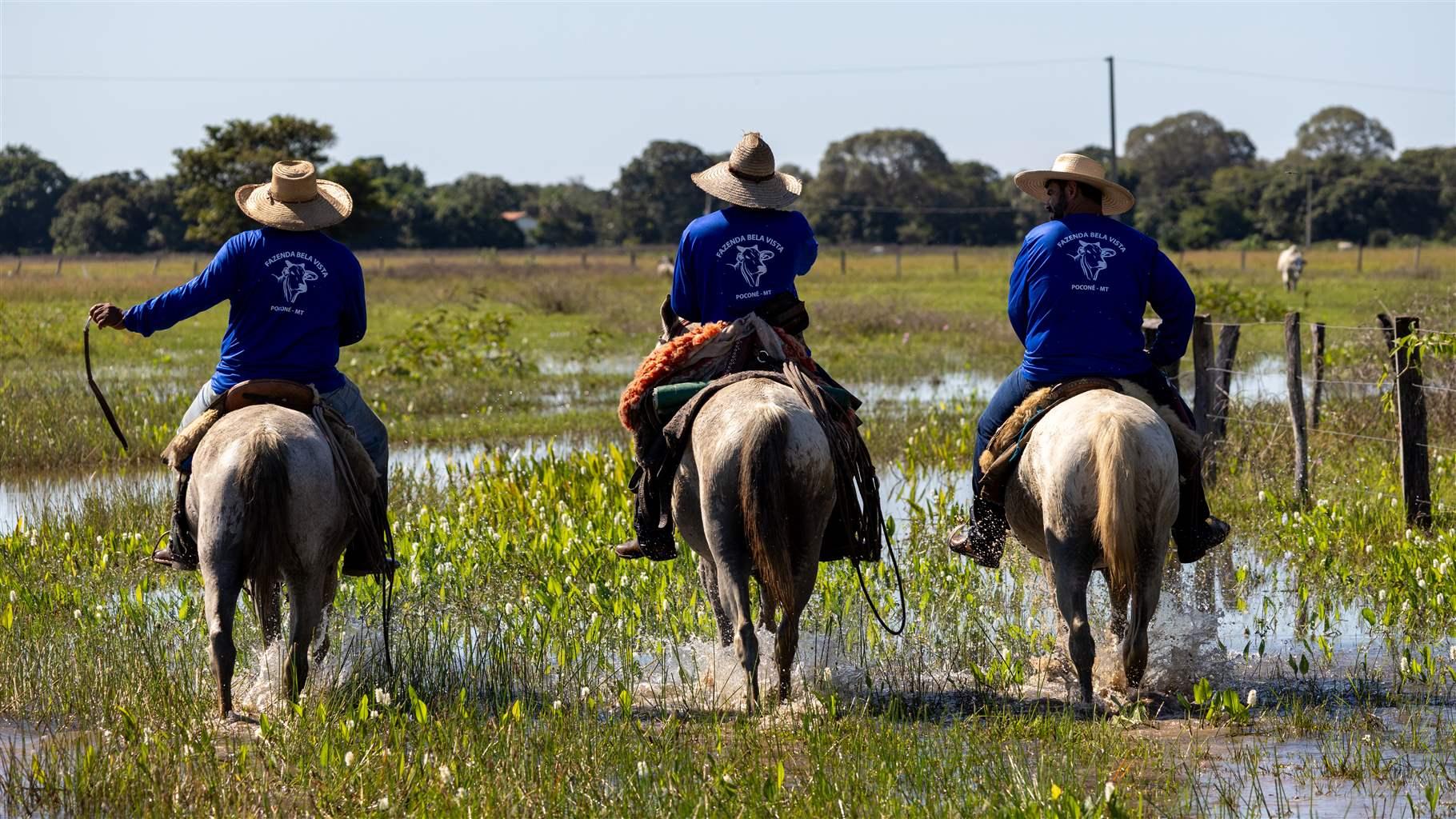
On a baking Pantanal morning the Pew team follows a dirt track through dense forest to Fazenda Bela Vista, a 12,000-hectare (29,653-acre) ranch where owner Márcio Granja Souza Vieira and his wife, Rudce Fátima Dorileo, manage 3,000 head of cattle.
Over a breakfast of fresh fruit and grilled meat, Vieira says the ranch has been in operation, with different owners, for 150 years.
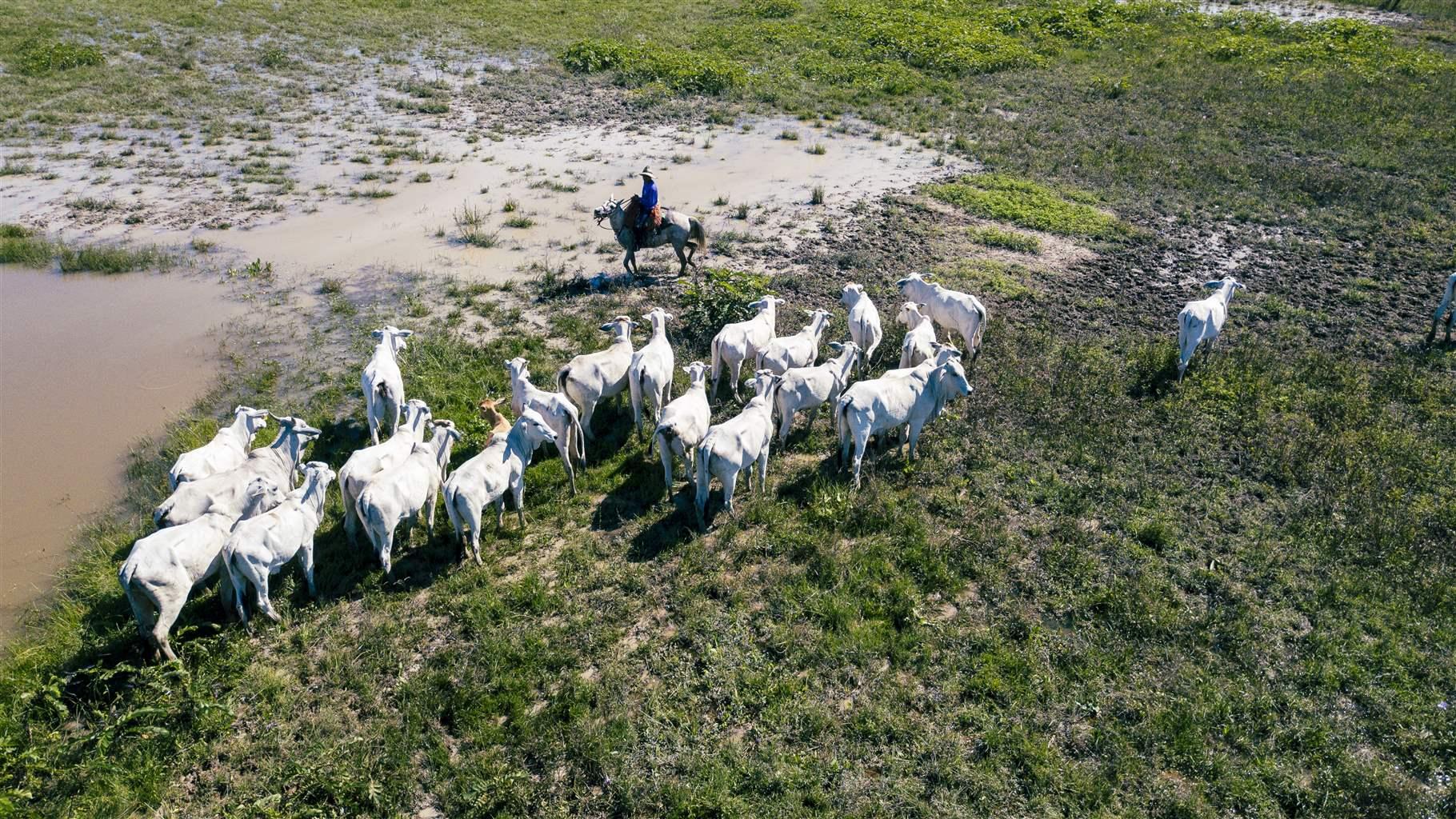
Since 2019, Bela Vista has been one of more than 90 ranches in Fazenda Pantaneira Sustentável (Sustainable Pantanal Farms, or FPS), a program that is advancing sustainable cattle ranching throughout the Pantanal in numerous ways, including promoting low-impact grazing, which spreads cattle out across pastures. This is one reason that 80% of the region’s native vegetation has survived.

There are other steps that FPS ranchers take to safeguard native wildlife habitat—for example, they don’t use chemicals—and they exchange knowledge to strengthen their commitment to conservation while maintaining their livelihoods. By providing technical support, fire prevention strategies, and access to sustainable production chains, the program is emerging as a model for how cattle ranching and ecosystem protection can advance together.
For Vieira, the conservation makes good business sense.
“FPS has been very good for us, both in managing our cattle and our pasture,” he says. “We are learning through this program, and it’s helping us all.”
Like most Pantanal ranchers, Vieira focuses on raising calves, which he then sells to feedlots in Cuiabá, Campo Grande, or Corumbá, where they’re fattened up for slaughter.


Within this business model lies a significant issue: The roughly 5,000 jaguars that reside in the Pantanal—one of the highest concentrations on Earth—won’t hesitate to take livestock, and young cows are the easiest pickings. In fact, ranchers here typically lose 5% of their herds to jaguar attacks annually.
This has generated controversy in the ranching community: Some ranchers are willing to endure the losses for the sake of biodiversity, while others are inclined to shoot the cats on sight—despite laws protecting them. Like apex predators anywhere, the jaguars in the Chaco-Pantanal help to keep the ecosystem—and populations of their prey—in balance, and here they are also the centerpiece in a burgeoning wildlife tourism industry.



After a couple of false alarms—a jaguar that fishermen had seen on the south bank has since moseyed off—Tortato maneuvers the boat up a small tributary. “There!” he exclaims, siting a jaguar that is preening her head above the surface as she finishes the 150-foot swim across the creek. She pulls herself onto the shore, that iconic gold-and-black fur striking against the lime-green reeds, and moves unhurriedly into the forest.
Tortato says that in the June-to-September high season, 20 or more boats often crowd in for views of a cat, each vessel carrying a half-dozen paying customers. And even when the jaguars are scarce, the Pantanal’s other wildlife shines: giant river otters, caimans, capybaras, and capuchin monkeys, along with a dizzying array of bird species.
The nature here can seem so grand as to be invincible. But Tortato recounts working in the field in 2020 following a catastrophic fire season.
“The soundscape was silent—no birds, nothing. I’m thinking, ‘The Pantanal as we know it is over.’ But I was also tracking a jaguar we had rescued and released, and I found an anaconda carcass, one he had killed. And I thought, ‘OK, he’s assuming his role in the ecosystem again.’ That showed me the resilience of the Pantanal. We aren’t back to full health, but it’s continued to recover.”
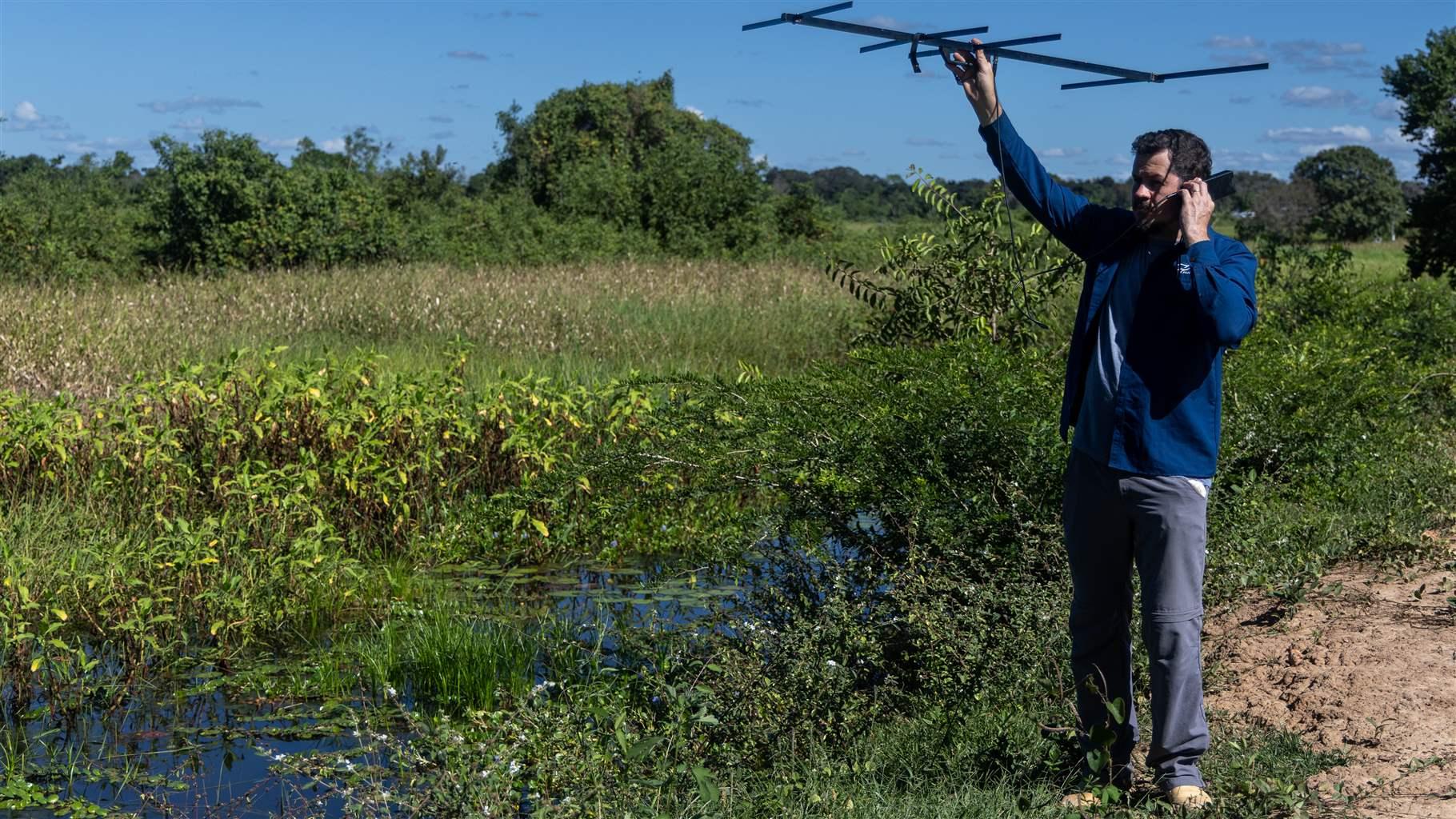
To the untrained eye, the ecosystem appears to be thriving—a good thing, but even with a full recovery, this park won’t save the region’s biodiversity: Encontro Das Águas occupies only a sliver of the Pantanal, which is why the main effort is to bring as many ranchers as possible into the conservation community.
In addition to working with ranchers, conservation efforts in the Pantanal must include effectively managing and expanding existing protected areas and designating new ones. Because even though these areas account for only a small slice of the Pantanal now, they provide exceptional wildlife habitat and are therefore key to the health of the broader ecosystem.


Still, the big focus is working with private landowners to improve conservation efforts. “If we lose the ranchers, the parks will mean nothing,” says Andre Restel, a researcher with Pontes Pantaneiras, a Brazil-based conservation coalition. “Now we have 4% of the land area covered by FPS ranches; the goal is to have 15% by 2035.”
And because the Pantanal and Gran Chaco are one contiguous habitat, what happens to jaguars in one region could affect biodiversity in the other. At the same time, each biome is distinct.
“When you step into the Chaco, the music changes, the ways of life, the cultural expressions—it’s all unique,” says Natalia Araujo, a manager with Pew’s Chaco-Pantanal conservation project in Bolivia. “This creates an incredible connection between the natural ecosystem and the locals.”
In 2019, the Indigenous Autonomous Government of the Charagua district established the 1.27 million-hectare (3.1 million-acre) Ñembi Guasu conservation area, about 255 miles southeast of Santa Cruz. Ñembi Guasu sits among a few national parks—including Kaa-Iya in Bolivia and Defensores del Chaco in Paraguay—to form the largest protected area in the Chaco, at nearly 9 million hectares (22 million acres).


Alejandro Arambiza Segundo directs the Ñembi Guasu protected area, managing a half dozen Indigenous rangers. “My job here is to spread the word [to our communities] about the management plan, what to do and what not to do, so that they don't make any fires, and we don't burn our forest,” Arambiza says.


He’s referring to illegal settlers who, in their quest for viable ranchland, often use fire to clear vast areas—fires that can rage out of control. This is similar to what has happened with illegal farmers and loggers in the Amazon, and the effects on the ecosystem can be devastating.
To counter this threat, Pew joined with local and international partners to train a firefighting force, made up largely of Indigenous rangers, which the Indigenous Autonomous Government calls the guardians of the forest.


The massive 2019 fire, Arambiza says, trapped animals, incinerated their food, and fouled their water. “All this is lost when there is fire. Fire spreads quickly, and the animals cannot run away. But [our area] was not burned because the guardians of the forest were already trained to face the fires. Our ancestors have been taking care of this area since ancient times.”
The Indigenous communities of the Chaco sustain themselves in a variety of ways, including hunting, fishing, and farming and by selling wood carvings and weavings. They practice respect for nature, for example by using mostly deadfall for their woodwork.

An hour-long flight takes the Pew team to the southern reaches of the Pantanal, Aquidauana—a subregion of wetlands, sandy savannas, and dense stands of forest—to see rancher Teresa Bracher, who owns Fazenda Fazendinha.
“When I was a girl growing up on my father’s farm, I had a dream of one day having my own,” says Bracher. “A place where all the animals roamed free in wild nature.” Bracher, whose husband ran a bank in Brazil, represents another model of conservation here: leveraging personal wealth to protect substantial chunks of land and support community development.
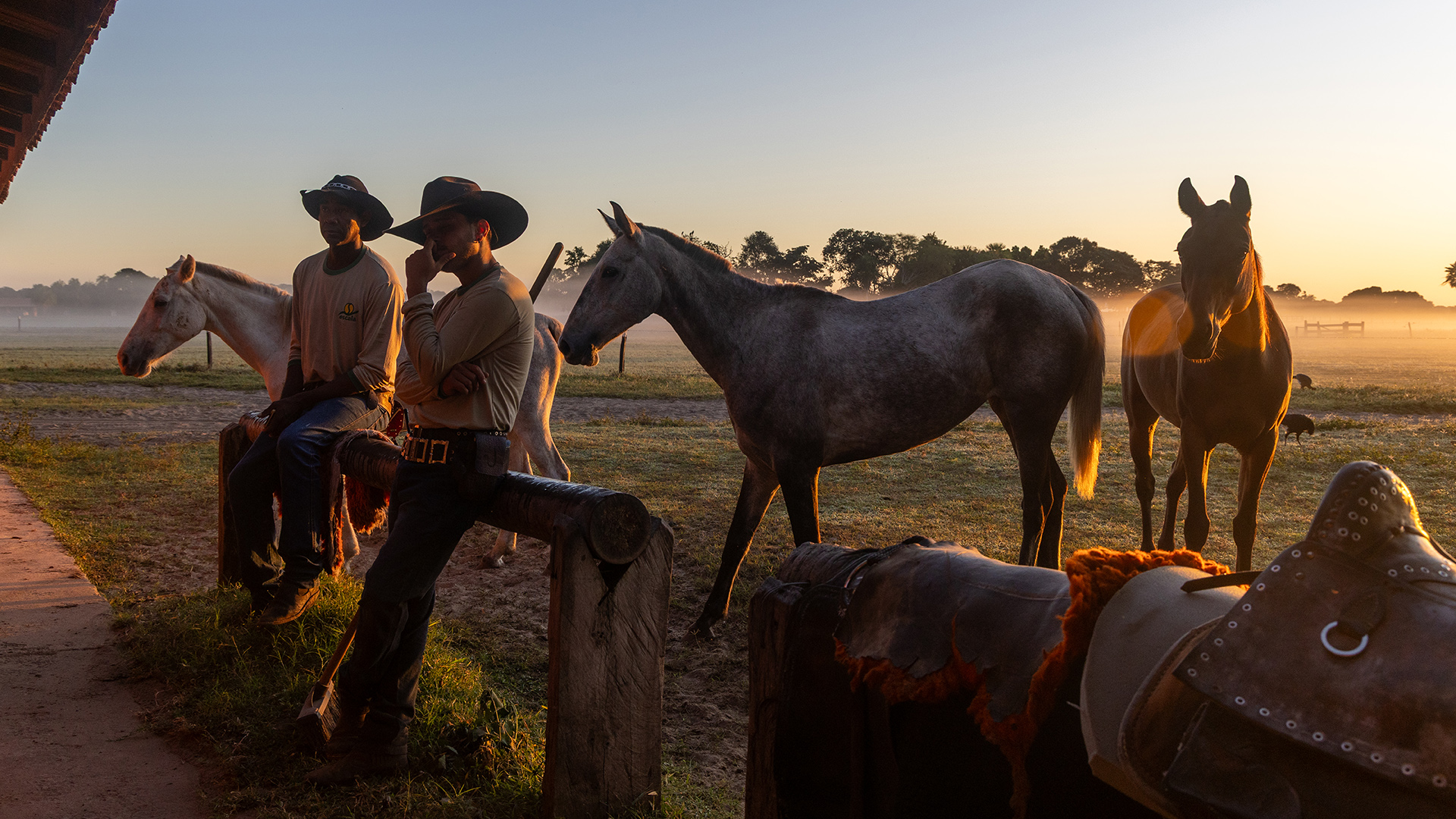
Bracher owns other ranches in the Pantanal, and Fazendinha is her childhood dream come true. As dawn breaks over the red terracotta roofs and tiled courtyards of the ranch, dozens of cows move like apparitions through the mist. A family of capybaras ambles from a nearby lake and a half-dozen toucans alight in a sprawling neem tree, their bizarre beaks electrified in the morning sun.
Bracher knows that for conservation to work, the people of the Pantanal must see a viable future here, which is why she also founded and directs Acaia Pantanal, a nonprofit dedicated to social and human development in the region. Among other initiatives, the organization built a 60-student boarding school within an hour’s drive—a sorely needed service in such a remote region where the ranchers work dawn to dusk, leaving little time to educate their children on their own.

The challenge is similar in the Gran Chaco, where the Indigenous Autonomous Government must show locals—and the national government—that the long-term benefits of a sustainable, well-protected environment far outweigh the potential short-term gain of slash-and-burn settlements.

Fazenda Barranco Alto, an FPS-member ranch and tourist lodge on a bluff above the Rio Negro, near the southern edge of the Pantanal, shows what success can look like here. As dawn breaks over the property, a dozen caballeros (ranch hands) run through yoga poses in a pavilion before setting about their work. An hour later a family from Sao Paulo, on their third vacation to the lodge, heads out for a day of kayaking and horseback riding. And seemingly without pause, owner Camilla Schweizer bustles about, shifting her unflinching enthusiasm from cattle wrangling to small-business management to what she calls “contemplative tourism.”


“We find ways for guests to immerse themselves in nature and see what nature has to show us, not the other way around,” Schweizer says as two hyacinth macaws swoop above, their blue feathers dazzling.
“I've seen the changes—the droughts and fires—and that's why I give my life for this place today. By joining forces with the ranchers, the government, everybody, we will succeed in protecting it all, but it's a race against time. And we have to run very, very fast.”