Renewable Energy Sets Global Record
New analysis shows that total generation from solar, wind, and other clean sources surpasses coal for the first time in modern history

Renewable energy, including solar and wind, has grown at a remarkable pace for more than two decades. These resources are critical to the unprecedented energy demand across the United States and around the world. A new study released by Ember, a leading energy analysis firm in the U.K., shows that in 2025—for the first time in modern history—renewables surpassed a key threshold in the global energy mix by producing more power than coal did.
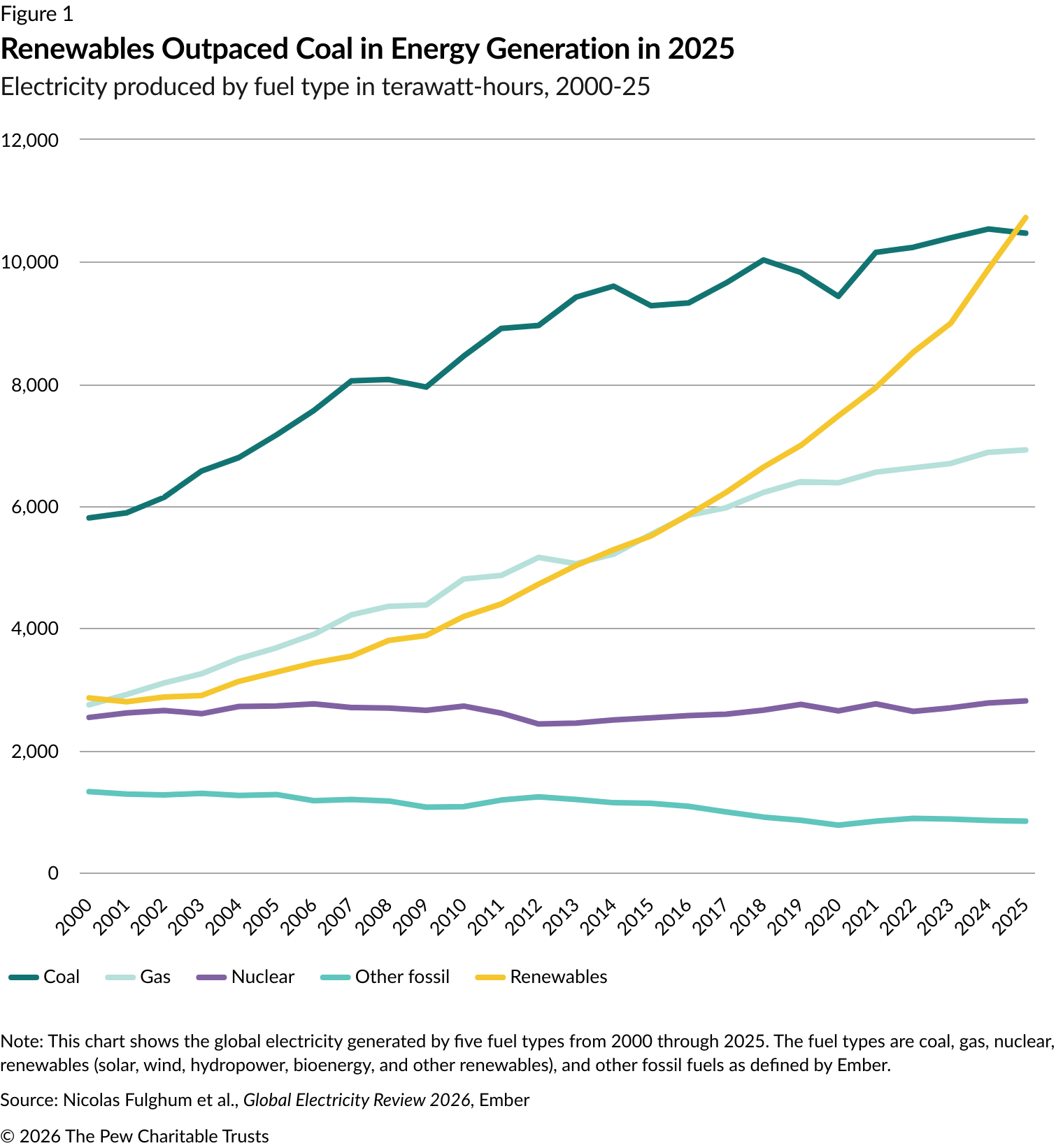
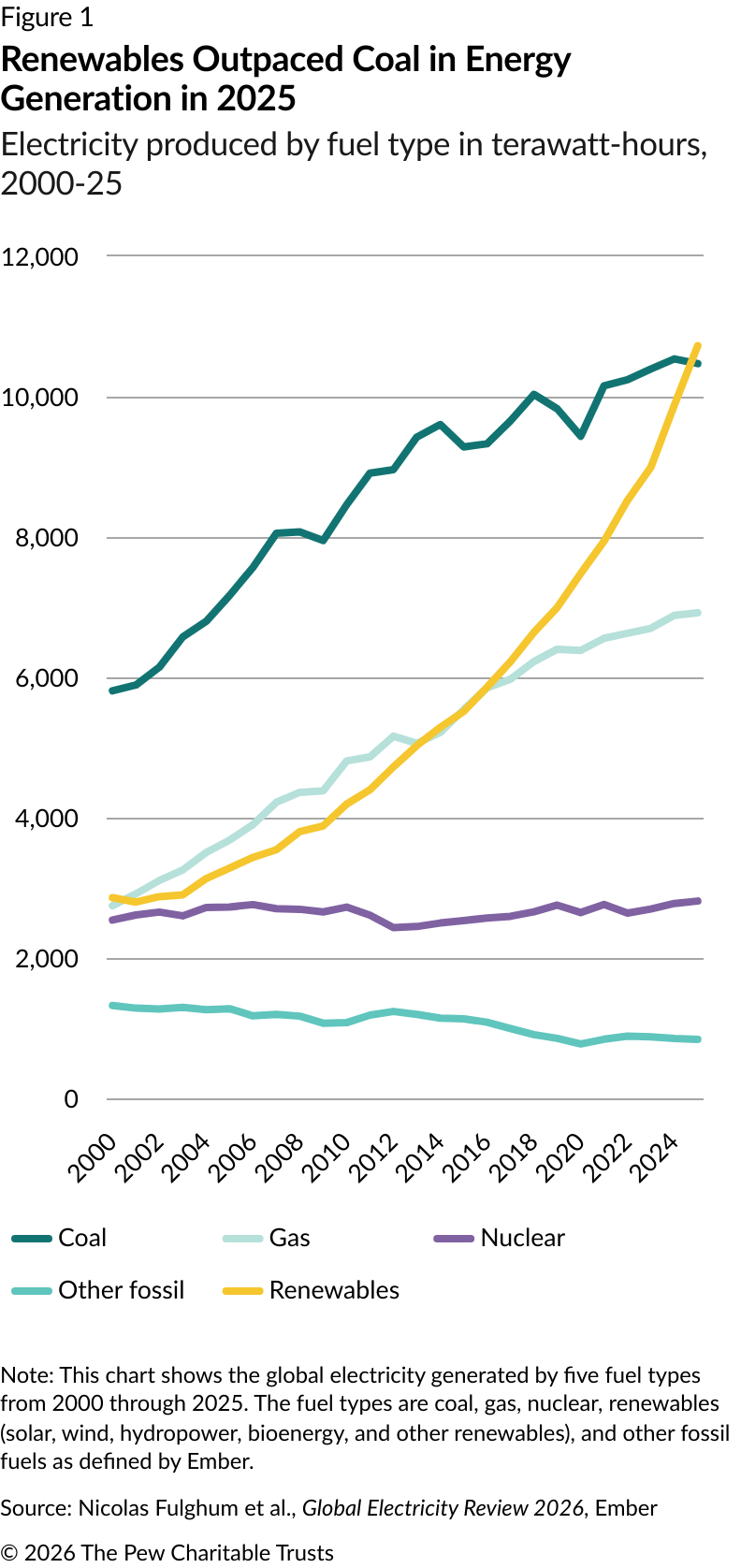
Despite being on a rapid growth trajectory, renewables have lagged behind coal and natural gas in total annual energy generation in recent decades. But “Global Electricity Review 2026,” the report by Ember, shows that after surpassing natural gas in the mid-2010s, renewable power accelerated further and in 2025 overtook coal as the single largest source of electricity on the planet.
Here are five key takeaways from the report:
- Renewables are generating more electricity than coal for the first time in more than 100 years.
Traditional energy sources such as coal have long been the leading producers of electricity. For a brief period in 1919, hydroelectric power surpassed coal, but that change was quickly reversed as the industrial sector expanded. Since then, coal has dominated electricity production, generating about 40% of the world’s total electricity every year. New trends developed in the early 2000s, however, with growth in natural gas and early wind and solar projects. By 2025, renewables represented the single largest source of electrical power, producing more than a third of total output. All signs point to renewables gaining even greater prominence. - Renewables surpassed fossil fuels across most regions in the world.
Renewables achieved their growth on a global scale. Electricity generated from renewables outpaced energy from fossil fuels in every region except Asia. And even in Asia, generation from fossils fell in China and India—two of the largest economies—by 56 and 52 terawatt-hours (TWh), respectively.This change in electricity generation is altering the grid in major economies around the world. In 2025, Chile and Australia installed enough large-scale battery storage to shift, or save, more than 50% of new solar generation for use in the evening, when demand rises and solar production declines. These modifications are reducing power prices and the frequency of curtailment, which is the intentional reduction of power from wind or solar farms to balance the grid. - Renewables met all electricity demand growth.
In 2025, global energy demand increased by 849 TWh, and power generation from clean sources increased by 887 TWh. This expansion of renewable energy contributed to a 0.04% decline—slight, but encouraging—in greenhouse gas from the power sector. This decrease was driven primarily by a surge in solar installations, which met 75% of all new demand for power, and a sharp increase in battery deployment as costs for these technologies have continued to fall. - Nuclear energy increased on par with gas generation.
Clean firm energy sources—those that provide reliable, around-the-clock power—help fill gaps when wind and solar output varies and continue to play a central role in global electricity generation. Nuclear power increased by 35 TWh and produced 9% of the world’s electricity last year, and a future pipeline of 70 reactors under construction in 15 countries stands to further boost the share of total generation. Some regions have much higher nuclear power adoption than others. For example, the United States is home to the world’s largest nuclear fleet, but France receives the highest share of its electricity—nearly 70%—from nuclear power. Of the 70 reactors currently in the development pipeline, 39 are located in China. - Geothermal power has room to grow.
Despite growing attention, particularly in the United States and elsewhere in North America, geothermal power still represents a relatively small share of global electricity generation. In the Ember report, geothermal was grouped with “other low-carbon” power sources, reflecting its historically limited deployment but not a lack of future potential. Recent advances in enhanced geothermal systems, closed-loop geothermal technologies, and superhot rock research are demonstrating the sector’s emerging capabilities. The success of early commercial projects in the United States and the recent initial public offering of a geothermal developer suggest that advanced geothermal could play a larger role in delivering reliable, carbon-free power while leveraging existing drilling expertise and energy infrastructure.
These trends highlight a rapidly changing energy system—one in which the use of renewables is growing and reliability is increasingly managed through storage and complementary sources.
John Begala and Brian Watts are officers with The Pew Charitable Trusts’ energy modernization project.
People