Philadelphia’s Homicides at Historic Lows
Last year’s total was among the lowest on record since the 1960s
Editor's Note: Based on year-end data published by the Philadelphia Police Department on January 1, 2026, there were 222 homicides recorded in Philadelphia in 2025. That's 17% lower than in 2024 and the lowest total recorded since 1966.
In cities across the country, homicide rates have dropped below pre-pandemic levels. In Philadelphia, homicides have not only fallen below pre-pandemic levels, 2024 had the fourth-lowest total number of homicides in the past 55 years. And 2025 is trending even better. The Pew Charitable Trusts analyzed publicly available data to provide a clearer understanding of the criminal homicide trends in Philadelphia and how they compare with other cities across the nation.
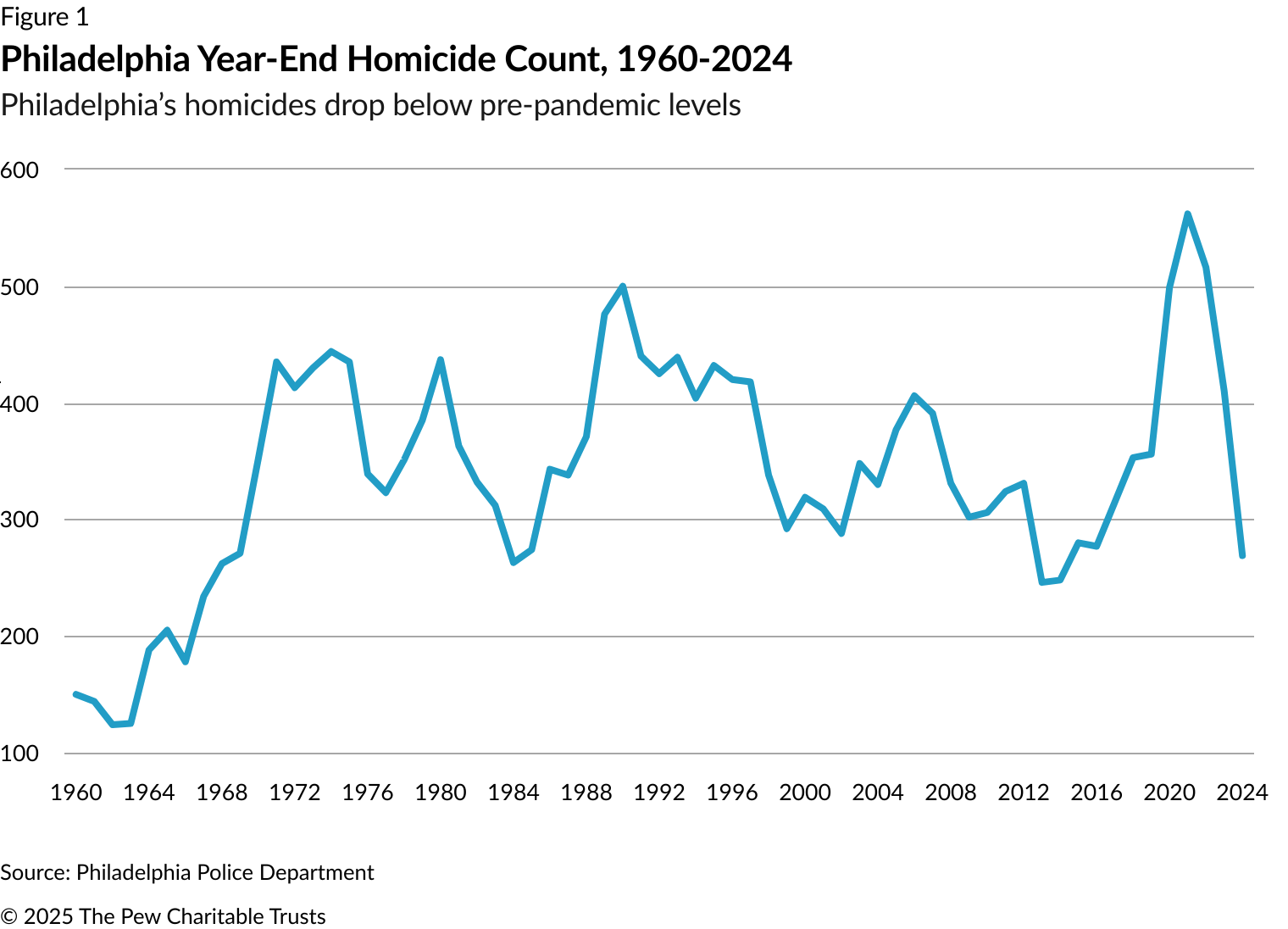
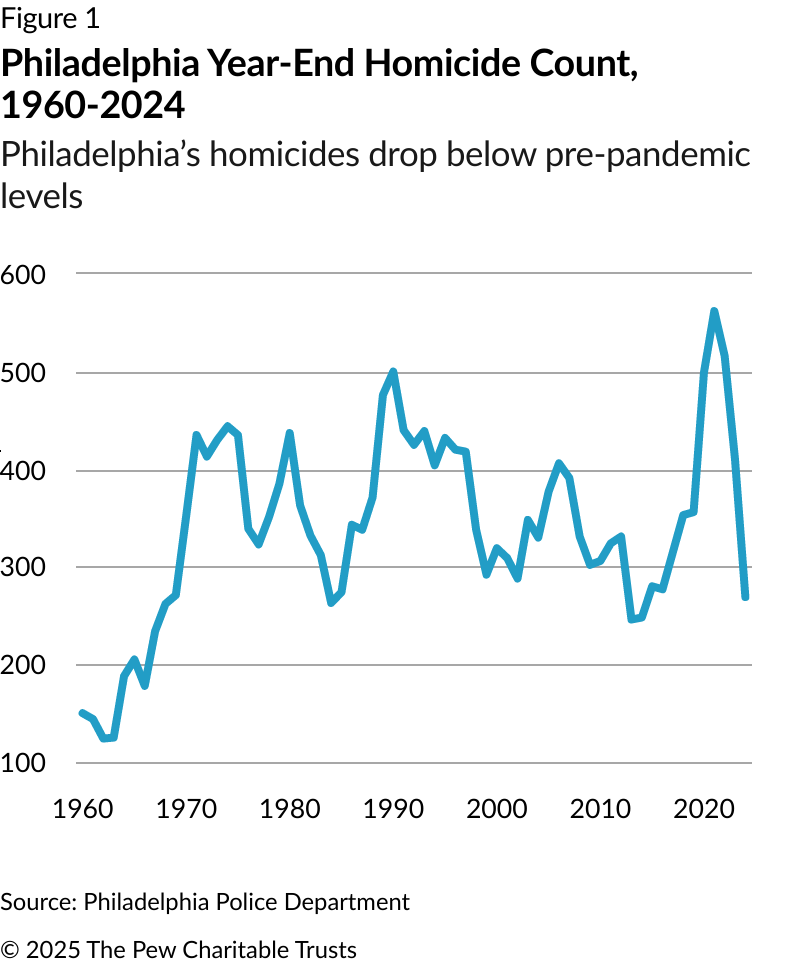
The pandemic-era homicide spike in 2021 resulted in the single worst year of homicides recorded in the city’s history, with 562 lives lost. But since 2023, homicides have plummeted. They fell by 35% from 2023 to 2024, marking the largest single-year homicide decline in 60 years. The 2024 total was both 52% lower than the 2021 peak, and 28% below 2019 levels. That progress has continued into 2025; as of Dec. 1, homicides are down 16% compared with the same time last year, and down 38% compared with the same date in 2019. (Note: The authors attempted to include only criminal homicides, or murder, however, some incidents may have been misclassified.)
The figures above are based on homicide numbers and have not been adjusted for changes in the city’s population. Philadelphia’s resident population has fallen some 20% since 1960. But even taking that resident decline into account, the city’s per-capita homicide rate remains the lowest it’s been since 2014. Using per-capita homicide rates allows a comparison with other cities, both larger and smaller. Higher homicide counts would be expected in bigger cities, for example, so the rates allow for an apples-to-apples comparison.
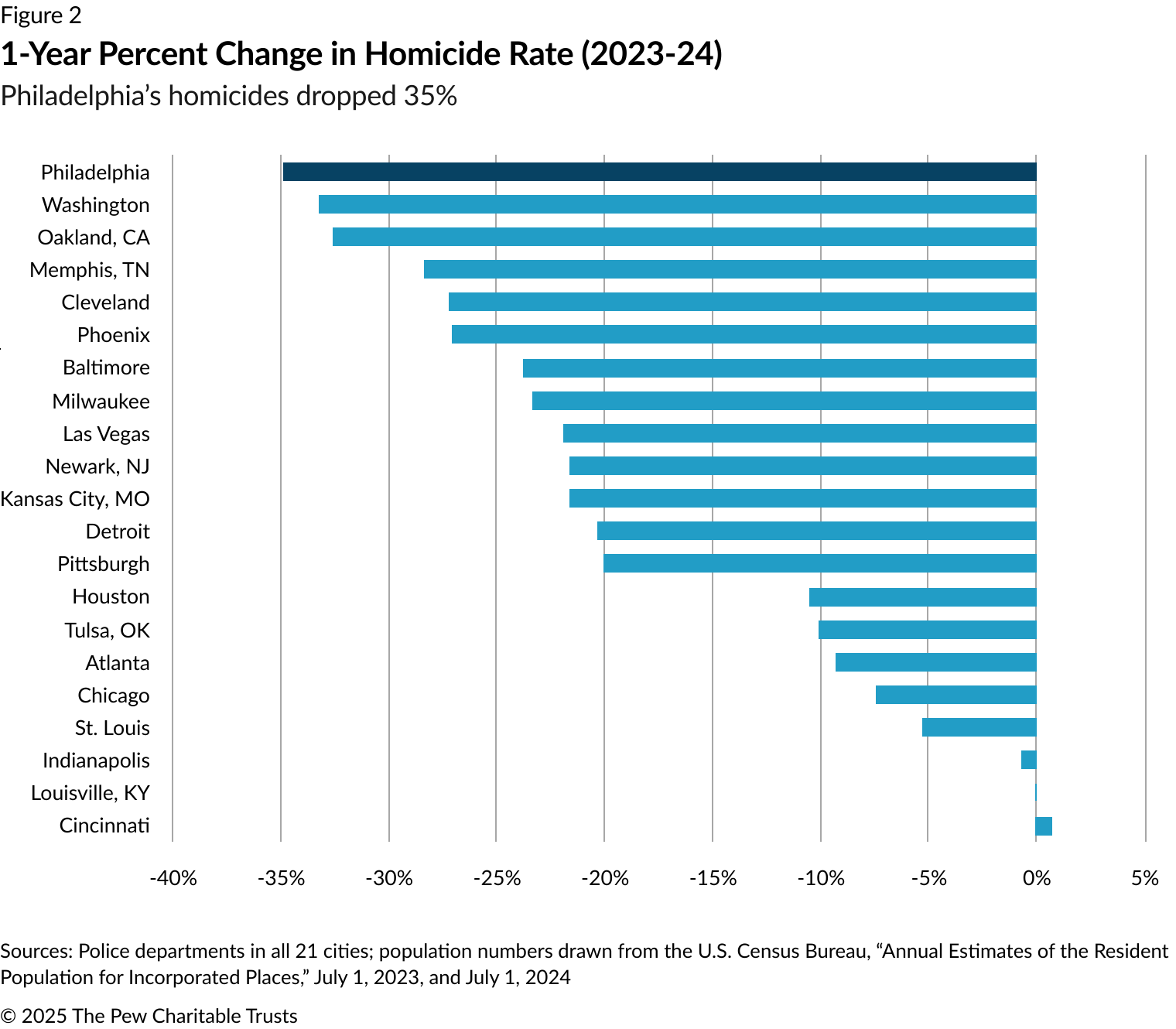
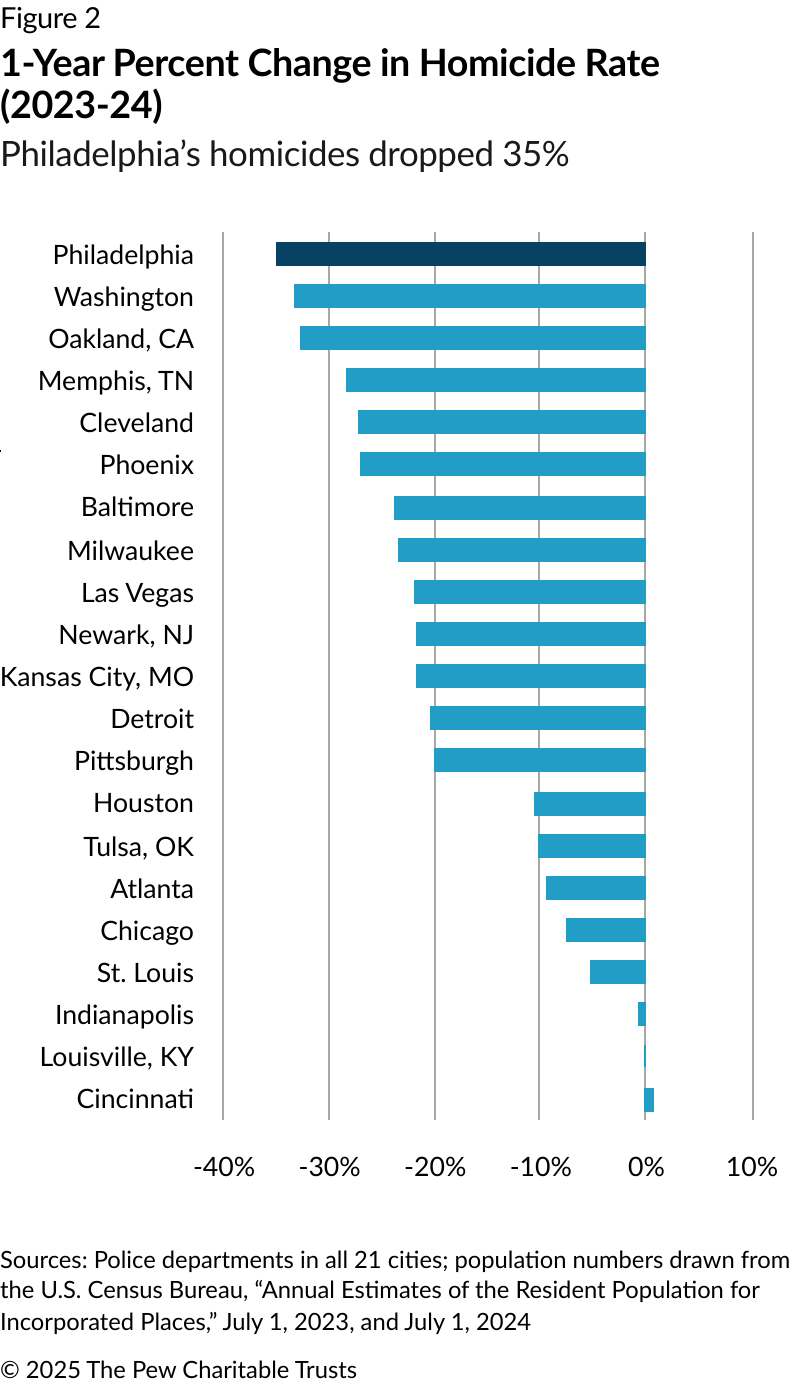
Pew examined Philadelphia and 20 other cities with the highest criminal homicide rates in 2024, using publicly available data. Almost all the cities reviewed show homicides trending downward. Among them, Philadelphia had the steepest drop in homicides from 2023 to 2024, with a 35% decrease.
And residents’ perceptions seem to be catching up with reality. When comparing a Pew survey conducted in 2025 with an earlier one from 2022, when homicides were spiking, a higher number of respondents reported feeling “completely” or “pretty” safe when out in their neighborhood at night (56%, up from 44%). In addition, fewer residents reported that gun violence had a major negative impact on the quality of life in their neighborhood (26%, down from 42%). Still, approximately half of Philadelphians (53%) reported hearing gunshots in their neighborhood during the past year (down from 65% in 2022).
And while it’s true that homicides have declined and residents are starting to notice, some people and places in Philadelphia continue to face tremendous risk. In Philadelphia, 92% of shooting victims from 2022 to 2024 were Black or Hispanic, 86% were male, and 88% were adults (the average age was 29). In 2024, Black residents were almost 13 times as likely to be the victim of a shooting than White residents. Violence is highly concentrated in certain neighborhoods, much as it is in other cities. From 2022 to 2024, 38% of shooting incidents occurred in just 12 (out of 159) neighborhoods, pictured below.

The greatest number of gun violence victimization occurred in North, West, and Southwest Philadelphia, areas which also have the lowest median household income, lowest quality of life indicators, and highest concentration of vacant land and buildings, per Pew’s 2025 State of the City report. So, while homicides are down citywide, men of color and residents in disadvantaged neighborhoods continue to face an outsized risk of violence.
In 2024, Philadelphia had one of the lowest homicide counts on record and, year to date, 2025 has been even safer. This progress should be acknowledged and applauded, however, the work is far from done. In a recent speech at City Hall, Police Commissioner Kevin Bethel said, “Together we can build a safer, stronger, more prosperous future if we do this right.” The sentiment was shared in an interview with Chief Public Safety Director Adam Geer did with the station 6abc earlier this year, “Anytime we’re being intentional and thoughtful about our approach, we’re going to have more success.”
Looking ahead to 2026, the city of Philadelphia can use data to guide and integrate its violence reduction resources, focus efforts on the people and places at highest risk, and build on and sustain this success moving forward.
Meaghan McDonald is the senior officer for community violence for The Pew Charitable Trusts’ safety and justice portfolio. Jasmine Olivier-McGregor and Maridarlyn Gonzalez are officers for Pew’s Philadelphia research and policy initiative.
People


