Preapproved Building Plans Help Cities Improve Housing Affordability
Drawings cleared in advance save time and costs for municipalities and builders
Overview
A growing number of mostly small and midsize cities struggling with new housing production have begun providing preapproved building plans to developers as part of a broader effort to lower the cost of building new homes in their communities. A preapproved plan is a reusable set of design specifications and blueprints that has already been approved by a local government agency and is available for builders to use either free or for a nominal fee. One key goal of these programs is to shorten the preconstruction approval process. Delays caused by the permitting process are one driver of the high cost of new housing development—before construction even begins. Across the United States, research has found that cities with high degrees of housing regulation take 2½ times longer to approve projects than less regulated cities.1 Discretionary processes to approve new apartment buildings, such as requiring special permissions, or mandating public, city staff, or expert review or involvement further delay the construction of multifamily housing.2
Long approval timelines can reduce housing production and increase costs for buyers and renters.3 In Washington state, for example, one study estimates that each month of delay in the permitting process increases the cost of building by 1%, or about $4,400.4 Other studies found that approval delays increased prices in Seattle by $30,000 per unit and in New York City by $50,000 per mid-rise unit.5 Sometimes, delays in the permitting process lead to the cancellation of projects, because the added costs, or increases in the cost of financing or materials, make them financially unfeasible. Other projects are never launched.
Added costs can also price out consumers, because developers might pass them on and increase the eventual price of both for-rent and for-sale homes. One study estimates that for every additional $1,000 that a home costs, more than 115,000 households can no longer afford that home.6 Preapproved plans essentially frontload the plan approval process, eliminating its case-by-case and discretionary components.7 This innovation can shorten preconstruction timelines by months without compromising safety, especially in places that have streamlined their building permit processes. Preapproved plans can also lower builders’ costs because they spend less on architects and designers to draw plans and rework them to obtain permits.
Policymakers across the United States have begun to realize that they can reduce housing costs by making it easier to build in their communities. Interest in preapproved building plans has grown, as evidenced by their increased adoption among municipalities, as well as several state laws that require local governments to offer preapproved plans. However, local planning departments and state policymakers who are curious about bringing preapproved plans to their own cities could benefit if more information were available, including the costs and benefits of preapproved plans and best practices from the most successful programs.
As of 2026, about 40 U.S. jurisdictions have some form of preapproved building plan program, and the state of California has mandated preapproved plans for accessory dwelling units (ADUs), which are additional units built in the yard of, or attached to an existing home. (See Appendix A for the list.) This report gathers existing evidence about preapproved building plans and presents findings from 27 interviews with 16 municipal officials and 11 building professionals about their experiences with preapproved building plans. These interviews were conducted by researchers from The Pew Charitable Trusts during the second half of 2025 and in early 2026.
Key findings:
- Preapproved plans are a policy tool to reduce delay and cost in housing production by standardizing some elements of design and aligning plans to what is allowable under local land-use and building code regulations.
- Preapproved plans have primarily been adopted at the local level but are gaining political momentum at the state and federal level. Four states have passed legislation related to preapproved building plans, three of them in 2025. Two U.S. senators have introduced a federal bill authorizing a pilot grant program.
- Most preapproved plan catalogs focus on delivering smaller buildings, such as ADUs, as well as single-family homes and duplexes. A few more expansive local programs also offer multifamily plans, usually for buildings with six or occasionally eight units and even one up to 12 units.
- Preapproved building plans are still a nascent policy tool. Outside of California, which has required preapproved plans for ADUs since 2025, fewer than 50 cities and counties had published anything related to preapproved plans that researchers could find. Among the local officials who were interviewed, most had implemented their programs only within the past few years. This recency explains why there is no published broad quantitative data measuring specific outcomes of preapproved building plan programs.
- Homebuilders benefit from meaningfully reduced approval times and fewer delays, especially in cities with streamlined permitting, and direct cost savings on architecture and engineering services.
- Cities benefit through improved land utilization, with more homes on less land, and more infill projects—homes in already developed areas that can use existing infrastructure.
- Preapproved plans can facilitate organizational streamlining for cities’ planning departments and require less staff time spent by municipal employees reviewing plans. Cities are also providing support for new and smaller developers, who are more likely than large developers to build individual homes on vacant lots in already developed neighborhoods.
- In places with the most successful preapproved building plan programs, a meaningful number of new homes have been built. Those places include South Bend, Indiana; Jackson, Michigan; Hawaii County, Hawaii; Seattle; and Claremore, Oklahoma.
- Preapproved plans reduce builders’ overall development costs by about 1%-2%. This amounts to $5,000-$10,000 on a $500,000 single-family home and a multiple of that amount for a small multi-unit building.
- Though these plans are promising, they are not a substitute for more sweeping reforms, such as allowing houses on small lots, eliminating parking mandates, allowing apartments on commercially zoned land, or modernizing building codes for small apartment buildings.

What are preapproved building plans?
With any type of new construction, a builder relies on detailed blueprints that show everything structural: foundation, walls, windows, doors, plumbing, heating equipment, air conditioning, and roofing, as well as many other elements. In virtually every community in the United States, before starting construction—before even digging a hole—the owner or builder must first obtain a building permit from the city or county in which the building is located. And to get a building permit, the builder must submit those detailed drawings, sometimes to more than one government department. The process can take several months, depending on the size and complexity of the building in question and the local regulations governing the process. In extreme cases, it can take more than a year.
There are five major steps on a typical construction timeline: design, financing, discretionary approval, permitting, and construction. (See Figure 1.) First, the architectural and construction plan is designed, and the project is approved and financed. The plan is then evaluated by a series of discretionary boards and commissions such as the planning commission, city council, board of adjustment, and preservation committee. Eventually it gets approved (potentially after modifications), and the project then moves to the permitting stage, in which the builder obtains necessary zoning, architectural, code, and other such permits. The length of each phase varies by location, project size, and complexity.
How does the construction timeline using preapproved building plans compare with its standard counterpart? Casey Terry, the research manager of the Greater Ohio Policy Center (GOPC), described it best: “Preapproval is an easy concept, but a lot of people don’t understand it. It’s like TSA PreCheck for ‘frequent flyer’ buildings.” Preapproved plans are intended to shorten the design and discretionary approval phases. (See Figure 1). The design phase is shortened because plans are already drawn and approved, and, depending on the program, only small changes are allowed. Discretionary approvals are avoided because the plans are already permitted. However, despite allowing for a much faster construction timeline, preapproved building plans are no less thorough or rigorously vetted than any other construction plan. They consist of design specifications and blueprints that were designed by an architect and have already undergone the same scrutiny and approval process as a comparable plan developed specifically for an owner or company. Preapproved building plans are compliant with local zoning codes and building codes.

Different cities have adopted a variety of ways to offer preapproved housing plans based on their individual markets and housing needs. There are two general types of preapproved building plans: pattern books and self-submitted plans.
Pattern books
The most common variation of a preapproved building plan program involves publication of a “pattern book”—a catalog of building plans that are either offered to developers for free or for a modest licensing fee. When a developer uses a plan from a pattern book, obtaining a building permit is a fast, simple process. In South Bend, Indiana, for example, the city requires only a land survey and a site plan showing where the house will be located. The building department responds to applications within two business days.
The idea of building homes from a catalog is not new; in the early 20th century, many traditional single-family homes and duplexes across the United States were built with plans purchased from catalogs.8 The most famous of these catalogs was from Sears, Roebuck, and Co., which shipped materials for some 70,000 homes between 1908 and 1940.9
The designs found in modern pattern books have expanded beyond those Sears catalogs to meet the needs of cities and towns; today’s pattern books reflect conscious decisions by cities and counties to make building easier while fitting within local styles and local land-use plans. The plans are drawn by architects or commissioned from design firms. Pattern books often describe where a building would be appropriate, a detailed overview of the structure’s dimensions, and a preliminary cost estimate. Pattern books are a flexible policy tool—cities of various sizes across the country, with different economies and architectural preferences, have provided plans to developers that are tailored toward their own housing and community needs.
Some implementations, called pattern zones, enable preapproved plans in a particular area of the city, similar to an overlay zoning district, which alters how land in a particular neighborhood can be used without changing the whole city’s zoning code. This neighborhood-level approach could be useful for targeting areas with high infill potential or for facilitating more “missing middle” development in neighborhoods that want to maintain their distinct architectural style. Pattern zones can also help ease future preapproved plan initiatives by serving as pilot programs that can increase familiarity with the idea for local officials, developers, and residents.
Case study: South Bend, Indiana
South Bend, one of Indiana’s most populous cities, has developed one of the best-known and most expansive preapproved building plan programs, and for good reason. Like many other Rust Belt cities, South Bend struggles with a central challenge to its housing market: a lack of investment interest from for-profit homebuilders.10 As the cost of home construction has risen because of a variety of market and public policy factors, maintaining developer interest by ensuring that projects can be profitable in an already depressed market has become an urgent priority.11 Recognizing the importance of this challenge, in 2022 the city produced its “Build South Bend Toolkit,” which introduced the city’s preapproved housing plans, along with many other resources.12
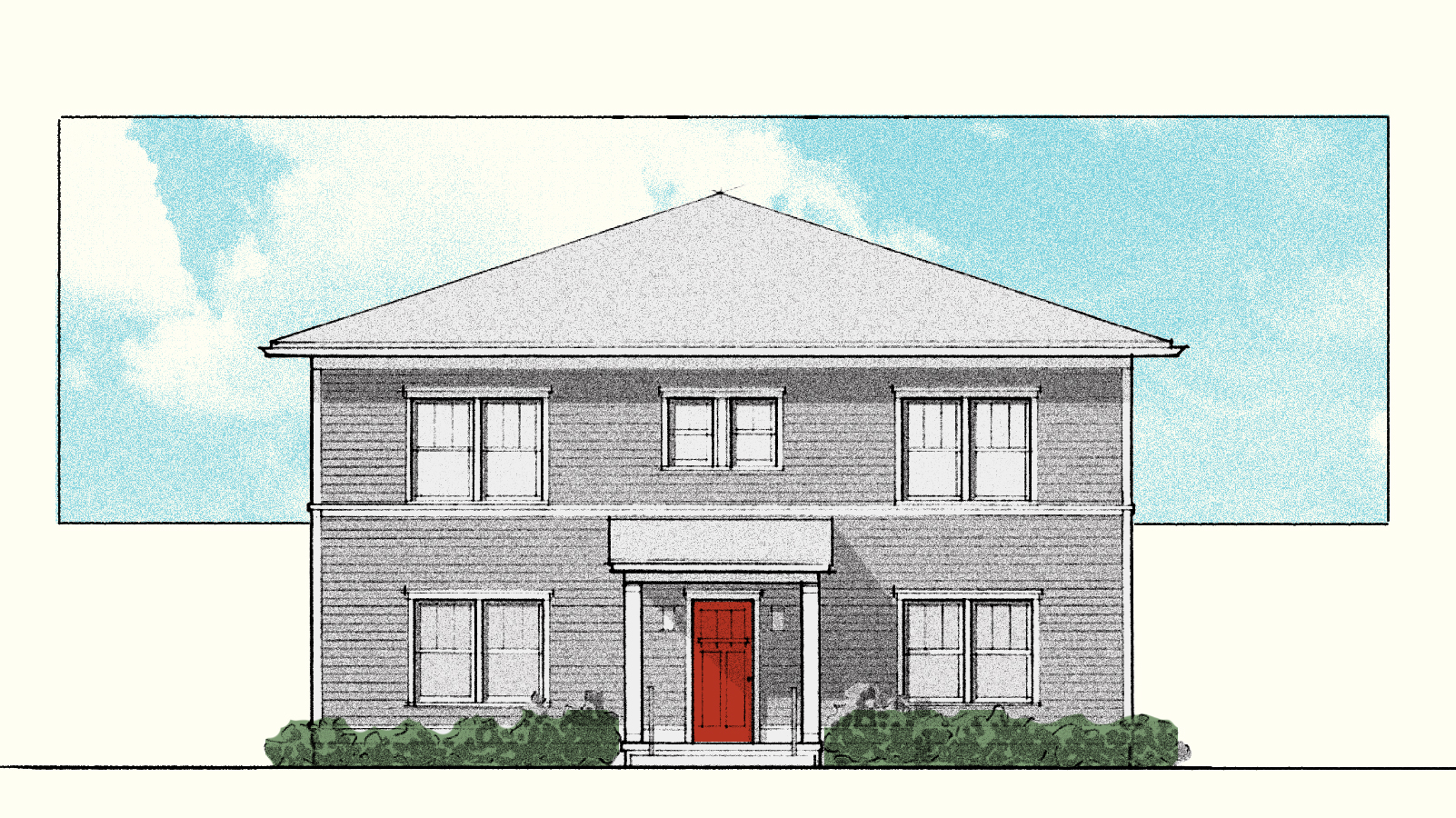
South Bend’s pattern book offers plans for nine different types of homes, including a two-bedroom, one-bath cottage designed in the typical architectural vernacular of the city.13 (See Figure 2.) The pattern book also includes one-, three-, and four-bedroom homes, two different duplexes, and a six-unit apartment building. (See Figure 3.) For each building type, South Bend’s pattern book provides several options for exterior design.


Case study: Jackson, Michigan
Jackson, like many industrial cities that were hurt by the United States’ mid-20th century economic restructuring, has had to combat both a struggling housing market and depopulation.14 The housing stock is old, and the city has a high vacancy rate. Developers were building little new housing.
In the fall of 2023, Jackson introduced its “100 Homes Program,” which aims to support homebuilding through pattern books, downpayment assistance, and other strategies.15 Homebuyers pay a base price of $178,000 for a home built using one of the city’s two preapproved housing plans. The pattern book helps lower costs, speeds up the permitting process, and supplies an affordable product desired by the community. Jackson’s program allows for flexibility within a generally standardized pattern book framework. Homebuyers can pay additional fees to add a deck or garage, or to upgrade countertops, flooring, or other finished elements.
Case study: Seattle
Seattle, home to some of the world’s largest tech companies like Amazon and Microsoft, has been one of the fastest-growing major cities in the country.16 However, while tens of thousands of people have moved to Seattle over the past two decades to seek employment, the city’s housing supply has struggled to keep up despite historically high housing production.17 Median home values and rents in most zip codes have both outpaced income growth between 2010 and 2019. A 2021 housing report further highlights that Seattle uniquely is lacking production of homes in middle-density zones, often referred to as missing middle housing. Such housing, often lower-cost townhomes or multiplexes, is an important entry point for families aspiring to be first-time homebuyers.
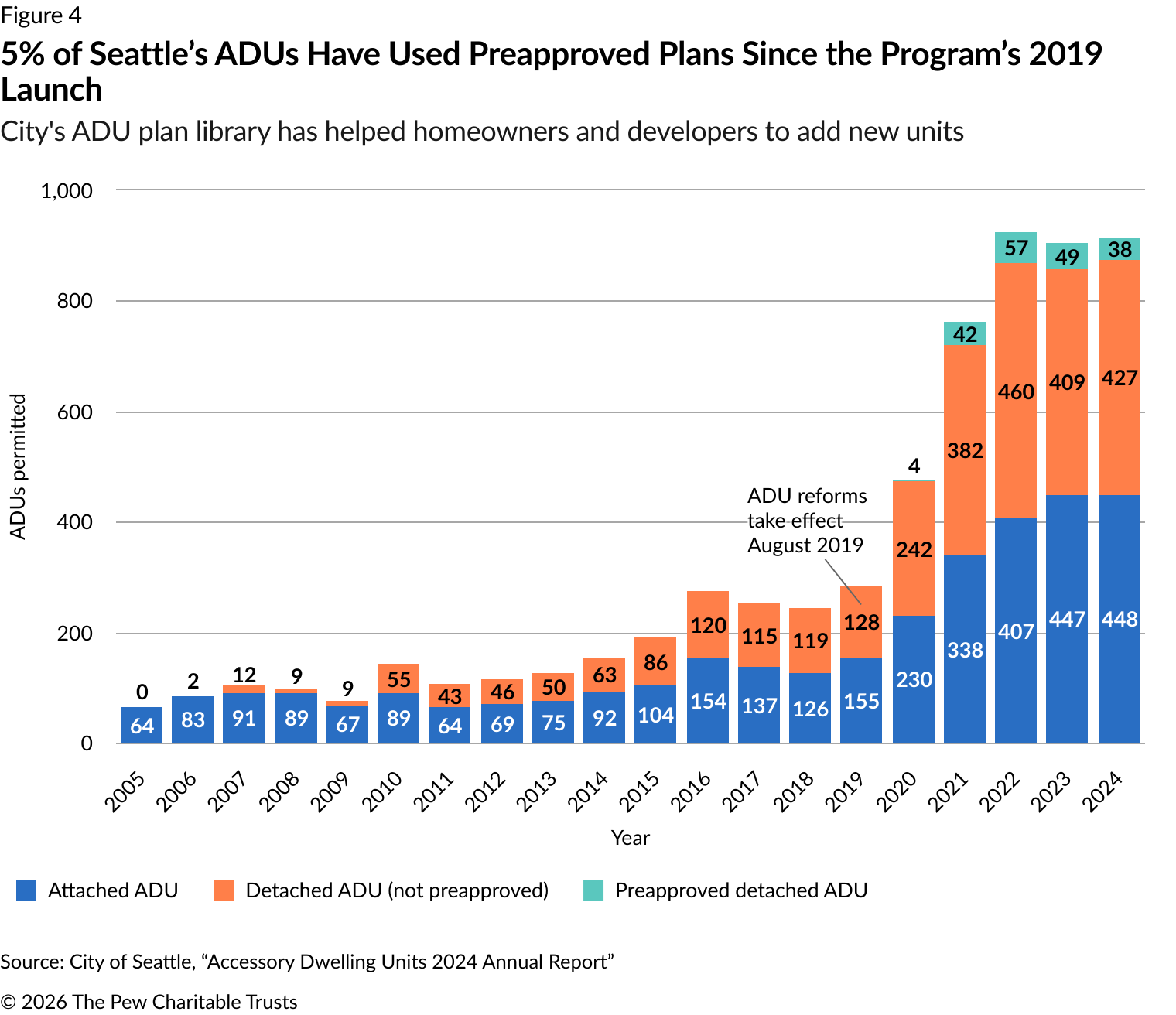
With little undeveloped land, one approach that Seattle has taken to address this missing middle gap is to incentivize the production of ADUs, which add homes in already developed low-density areas. Seattle’s efforts to stimulate ADU production have demonstrated how preapproved plans can be more effective when paired with zoning reform. After legalizing ADUs in the early 2000s, ADU production in Seattle had remained relatively low, averaging between 100 to 200 ADUs permitted per year. In 2019, the city—recognizing that increasing ADU production would help overcome its housing supply challenges—eased restrictions on building ADUs and released a gallery of seven preapproved ADU plans for public use. ADU permitting nearly doubled the following year and continued to grow until ADU production outpaced single family home production, permitting over 900 ADUs in 2024.18
Since 2019, 190 ADUs have been built through the preapproved programs (4.8% of all ADUs built over the same time period). The Seattle Office of Planning & Community Development’s annual reports highlight that the preapproved ADUs reduce approval times by a factor of 2.6. The program has been used by both homeowners and developers, connecting them to architects and designers for any additional work to get the project through all the review steps.
Case study: Port Angeles, Washington
Port Angeles, a small coastal city on Washington’s Olympic Peninsula, faced a different challenge. The regional economy depends heavily on tourism; many jobs don’t pay enough for workers to afford the city’s rising housing prices. Almost 40% of Port Angeles’ households are cost-burdened (meaning they spend more than 30% of their income on housing). Homelessness in the surrounding county doubled in 2024, reaching a 10-year high. Employers have reported that a housing shortage and low vacancy rates have made it difficult to retain employees.19
Preapproved plans are among a variety of tools that Port Angeles has used in a broader effort to combat the city’s housing shortage.20 As part of its first Housing Action Plan, released in 2019, Port Angeles made a commitment toward incentive zoning and tax exemptions to drive affordable housing development.21 In 2023, the city also enacted comprehensive zoning reform, which made it easier for developers to build missing middle housing.22 Additionally, Port Angeles released a pattern book in tandem with a fee waiver program that allowed developers to forgo anywhere from $5,000 to $20,000 in various permit, planning, and public works fees for eligible housing types—inclusive of all permit-ready plans.23 Pattern books are not themselves a panacea for insufficient housing; they are most effective when paired with complementary policies. Port Angeles’ multipronged policy approach has led to an increase in ADU production; five non-ADU projects have been built as well.
Self-submitted building plans
A different type of preapproved building plan program allows developers to submit plans they have already used for preemptive approval if they reuse those plans in the future. This type of “reuse” program reduces time and costs for subsequent homes developed using that plan. Fairfax County, Virginia, for example, allows developers to reuse a previously approved plan within three years of initial approval. Utah passed a 2025 law allowing developers to reuse “identical plans” provided they were approved during the same building code cycle.24 Memphis and Shelby County, Tennessee, recently introduced a program that allows builders to submit plans for preapproved use on future projects without needing a full plan review for each subsequent permit.25
A broader application of “reuse” involves establishing a “library” of plans, which allows builders other than the initial developer to use a preapproved plan stored in the locality’s digital library. Since 2012, Hawaii County, Hawaii—The Big Island—has allowed applicants to use plans that have previously been approved.26 The program started with single-family homes and duplexes, then expanded to apartment buildings in 2024. As of October 2024, the county had 56 different approved plans on file in its “plan library.” Memphis hopes to transition to provide a similar library of preapproved plans.27 In California, the Community Planning Collaborative developed an ADU plans gallery, providing a library of about 80 ADU plans submitted by designers for participating jurisdictions to select from and add to for their customized Plans Gallery website. Many of the available plans are preapproved by state or federal agencies, including modular and manufactured homes, in addition to standardized or readily available plans for detached site-built ADUs. In 2023, California mandated all jurisdictions to have a preapproved ADU program by 2025. Jurisdictions can purchase plans from the gallery at relatively low cost—from $7,500 to $28,000 at the outset, depending on the population size, and then a subsequent annual licensing fee.28
Self-submitted plans may be quicker and less costly for a city or county to set up than a pattern book. Because of how they are developed, however, pattern book programs often generate greater community buy-in, more localized design preferences, and greater agreement among city departments.
Researching preapproved building plans
Despite the recent growth in the number of preapproved building plan programs nationwide, little information exists about their design and effectiveness. Several recent reports profile a few programs with a focus on specific themes, such as potential cost reductions and program development.29 Other reports provide short case studies.30 Standardized plans for ADUs have received attention, especially in California, but researchers have not looked at the impact of these programs.31 Published reports have highlighted specific programs in places such as Seattle, Hawaii County, and Grand Rapids, Michigan.32 There is no authoritative list of places with preapproved building plan programs.
To compile this report, Pew researchers gathered information about existing preapproved building plan programs and interviewed local officials and practitioners to better understand these policies and their impact. To begin, researchers compiled a list of known preapproved building plan programs by reviewing existing reports and news articles, scanning program websites, and performing online searches. This preliminary research generated a list of about 40 programs in different states that covered a wide variety of building types, from ADUs to single-family homes to apartment buildings. (See Appendix A for a list of programs and links.) Next, Pew reached out to local planning and building departments that administer those programs, and asked questions about their preapproved building plan programs, the process by which they were implemented, and benefits that local officials have observed, especially related to cost or time savings. (See Appendix B for the questionnaire used in these interviews.) Interviewees also provided additional connections to designers, builders, and thought leaders with preapproved building plan experience. Altogether, Pew interviewed 16 municipal and county staff as well as 11 architects, builders, and other experts.
The benefits of preapproved building plans
The benefits of preapproved building plans primarily flow through two channels: direct benefits for builders, and diffuse benefits for cities. Homebuilders—especially newer or smaller developers—get a powerful tool to help them navigate what can be a confusing and time-consuming process, enabling them to build more homes more quickly, at a lower cost. By supporting builders through adopting preapproved plans and streamlined permitting, cities can improve the quality and diversity of their housing stock, increasing available housing options for both current and future residents. The process of implementing a preapproved plan program also offers cities an opportunity to coordinate and refine their entire permitting process, which often spreads across multiple isolated departments. Most importantly, by making it easier to build a variety of high-quality homes, especially on existing residential properties and smaller, vacant “infill” lots or other difficult-to-develop parcels, cities give potential homebuyers and renters more options, which eventually leads to those options becoming more affordable.
Most preapproved plan programs are fairly new, which makes it challenging to evaluate direct benefits to cities. Of the cities that provided information during interviews or were the subject of published reports, most were only a few years into their programs. (See Table 1.)
Nevertheless, production numbers from a few programs highlight their potential to add new homes:
- South Bend, which has a population of about 104,000, reported 223 new housing units permitted through the city’s preapproved building plan program over the past three years, about 7% of all new units permitted.33
- Claremore—a small city of about 20,000 residents near Tulsa—saw 25 new units built with preapproved plans over four years, 12% of all new units permitted.34
- Jackson enabled the use of preapproved building plans as part of its “100 Homes Program” designed to promote the construction of 100 new single-family homes on city-owned vacant land, with homes affordable at 120% of area median income (as of 2024, $101,150 for a family of four).35 These homes represent about 20% of new housing permitted in Jackson since 2023.36
- Hawaii County, which has had a preapproved building plan “library” for single-family homes and duplexes since 2012, reported 225 new units permitted from a library of 56 preapproved plans between 2021 and 2024.37 That was roughly 6% of all new single-family and two-unit homes permitted in that county from 2021 to 2024.
- Seattle has had a preapproved plan program for detached ADUs since 2020. It yielded permits for 190 new detached ADUs through the end of 2024, accounting for 9% of all detached ADUs and 5% of all newly permitted ADUs over that period.38 Permitting speeds for ADUs have decreased from 160 days to 54 days on average.
But other jurisdictions reported few users. Cupertino, California—an affluent Bay Area suburb, home to Apple Inc.—has had a preapproved building plan program for ADUs since 2019. Only three units have been built using preapproved plans. In an interview with a Pew researcher, a planning department official surmised that this lack of usage might be because the program doesn’t save developers much time, since Cupertino still requires approvals from other departments even for a preapproved plan. That official also said residents liked using their own plans.
Portland, Oregon, has had a preapproved building plan program for ADUs since 2024. Only two permit applications have been filed, and only one ADU has been built.
Table 1. Preapproved Building Plan Programs Are Relatively New and Vary in Scope
Key information for cities with preapproved building plan programs among those interviewed
|
City |
Number of designs |
Largest plan |
Program length |
Cost savings |
Time savings |
Homes built |
|---|---|---|---|---|---|---|
|
Claremore, OK |
29 |
8-unit apartment |
4 years |
$5K-$7K for single-family; |
80% reduction |
25 |
|
5 |
ADU only |
2019 |
N/A |
N/A |
3 |
|
|
30 |
3BR, 2.5 bath single-family |
<1 year |
$8K-$10K or 3%-5% |
N/A |
None |
|
|
Hawaii County, HI |
56 |
Multifamily building |
14 years |
N/A |
N/A |
225 |
|
2 |
3BR, 1.5 bath |
N/A |
2-4 weeks |
100 |
||
|
5 |
3BR, 2.5 bath fourplex |
N/A |
3-6 months |
4 duplexes |
||
|
5 |
3BR, 2 bath duplex |
3 years |
5%-20% of total construction costs |
1-2 weeks |
“Many” ADUs; 5 non-ADUs |
|
|
4 |
ADU only |
1 year |
“Several thousand” (estimated) |
N/A |
1 |
|
|
7 |
ADU only |
5 years |
N/A |
106 days |
190 ADUs |
|
|
9 |
6-unit apartment |
3 years |
$5K-$10K |
N/A |
223 |
|
|
10-unit apartment |
Forthcoming |
Estimated 7%-11% or $35K |
2-9 months |
Program hasn’t started |
Sources: Pew interviews and program websites
Benefits for builders
Time savings—and cost savings
In a typical real estate development process, a developer or homeowner acquires a piece of land, pays for a design (including blueprints), then goes to the city planning department, which reviews the design to make sure it complies with city rules and ordinances, including zoning. In some cases, more than one department (plumbing, electrical, mechanical) must review the plan. Any one of those entities can request changes or clarifications.
Delays vary by place and project type. In 2018, The Wharton School of the University of Pennsylvania released a Residential Land-Use Regulation Survey showing that the average U.S. city took 2.5 months to review a “by-right” single family project and three months to review a by-right multifamily plan.39 (See Table 2). “By-right” means the project conforms to a city’s zoning rules. “Discretionary” review is required for projects that somehow differ from existing guidelines: They are taller, for example, or involve a multifamily apartment building in a location zoned for commercial use. Discretionary plan review was slower, averaging 4.3 months for single-family homes and 4.9 months for apartment buildings. Some cities were much faster, however: The top 10% of cities reviewed by-right plans in two to four weeks and discretionary plans in six to eight weeks. Another study developed an “Approval Delay Index,” which accounted for factors such as project review, rezoning time, and subdivision approval.40 Using data from the same Wharton survey, those researchers found that these processes together took an average of 4.8 months. But the index ranged widely, averaging only 3.6 months in places with less strict land use regulations, but 8.8 months in places with more stringent rules.
Table 2. The Typical U.S. City Takes an Average of 2 or 3 Months to Approve By-Right Housing
Multifamily projects and discretionary approvals take longer
|
Approval Type |
By-right |
By-right |
Discretionary |
Discretionary |
|---|---|---|---|---|
|
Housing type |
Single family |
Multifamily |
Single family |
Multifamily |
|
Average |
2.5 months |
3.1 months |
4.3 months |
4.9 months |
|
10th percentile |
0.5 months |
1 month |
1.5 months |
2 months |
|
Median |
1 month |
2 months |
3 months |
3 months |
|
90th percentile |
5 months |
6 months |
8 months |
10 months |
|
Sample size |
2,613 |
2,584 |
2,588 |
2,578 |
Note: Results shown in months. Results reflect responses from a survey conducted in 2018.
Source: Pew analysis of data from Joseph Gyourko, Jonathan Hartley, and Jacob Krimmel, “The Local Residential Land Use Regulatory Environment Across U.S. Housing Markets: Evidence from a New Wharton Index,” 2019
Delays cost money for projects big and small.41 Costs are incurred through additional interest payments, property taxes, insurance, and utilities.42 Estimating the average cost of delays is difficult, however, because it varies wildly from project to project, depending in large part on the size (overall cost) of the project and how it’s funded.
In interviews, time savings were consistently reported to be the most important benefit that preapproved plans provide developers. Many cities reported or estimated significant reductions in the amount of time it takes for a developer to go from project application to the actual start of the building process. (See Table 1.) Officials in Claremore estimated that for ADUs and duplexes, preapproved plans led to an 80% reduction in approval time, allowing developers to get a permit within 24-48 hours.
While the phrase is a cliché, it’s no surprise that multiple interviewees said “time is money” when describing the benefit of time savings in housing development. According to the Terner Center for Housing Innovation, “Delays in processing or approval timelines can greatly increase the cost of development”;43 a study by the Home Builders Institute and the National Association of Home Builders estimates the monthly carrying expense (delay cost) for a single-family home to be $1,333.44 Less time waiting for plan approval means more housing on the market faster for homebuyers and renters.
The Colorado-based LAI Design Group, which works on construction projects across the United States, estimates that every month of delay due to regulatory hurdles costs a developer 1%-3% of a project’s value.45 This loss doesn’t just come from hard costs or interest on borrowed money, but from logistical complications as well. Delays can cause developers to “lose contractor availability, leasing windows, investor confidence, and sometimes even anchor tenants,” the firm said. Because housing markets are seasonal, missing a crucial window during a seller’s market or a peak rental period can mean working in a very different financial climate than anticipated when the project was initiated. Developers might also encounter labor repricing, where contracts are renegotiated to reflect changing market conditions, and materials cost increases that can affect a project’s financial viability.
Preapproved building plan programs also help cities create an environment that’s conducive to development, thus encouraging developers to build in their community. One staff member who worked for the planning department in Jackson told Pew researchers that developers in nearby towns were frustrated with a permitting process that took upwards of five months and were excited by the prospect of working in Jackson, with its shortened process due to preapproved plans.
Direct cost savings
Developers who use plans from a pattern book also benefit from direct cost savings, since they don’t have to pay an architect to design their building. The National Association of Home Builders estimated that the cost of architecture and engineering made up about 1.5% ($6,480) of the national average total construction cost ($428,215) of a single-family home in 2024.46
Several housing industry professionals interviewed for this report provided educated guesses at the direct cost savings from using a preapproved plan. A developer in Fayetteville, Arkansas, estimated that “design costs are roughly around 3%-5% of a project,” so a developer could save up to $12,500 on a $250,000 project from not having to pay an architect. Similarly, an administrator in Tulsa, Oklahoma’s forthcoming preapproved plan program expects savings of 7%-11% on a single-family home. A report from the Niskanen Center estimates that soft costs, the indirect or non-physical project expenses can account for 20%-30% of a project’s total costs.47
In other markets, such as Claremore and South Bend, officials gave more modest savings estimates of $5,000 to $10,000. A report on Yavapai County, Arizona, estimated $10,800 in savings.48 Although those estimates can vary, having a usable preapproved plan clearly cuts direct costs, in addition to the timing benefits described above.
Access to bank financing
A few housing industry professionals suggested that preapproved plans might make it easier for builders to access financing for their projects. If a developer uses a preapproved plan, lenders have more confidence that projects will not get caught up in a protracted approval process, which could add unexpected costs. Even in cities that have liberalized their zoning practices, some interviewees expressed concern that builders might still struggle to complete projects because of difficulties in accessing financing.
Britin Bostick, long range planning/special projects manager for Fayetteville, Arkansas, said, “It’s actually pretty challenging for individuals and families to get financing for anything other than traditional single-family homes here in Fayetteville. Even ADUs are difficult to finance.” Because Fayetteville’s preapproved plans were designed with community input and an emphasis on matching the character of the city’s neighborhoods, she said, lenders could be more confident in financing projects because the city could limit neighborhood opposition, overcoming a common barrier to investment.
Kalamazoo’s deputy city manager, Rebekah Kik, said the city built models with community partners, put buildings up for sale, and included pro forma financial statements with its published plans in part to help builders obtain financing: “That way the bank would see … we’ve got four of those built. Here’s where they’re located. Here’s how much they sold for. Here's the pro forma. You can take that to the bank.”
Benefits for cities
The benefits to cities and their citizens are difficult to measure in monetary terms, but they are real and tangible. For residents, benefits include better land utilization, revitalized neighborhoods, and improved housing quality. Cities have used these programs to streamline processes and drive organizational efficiency while growing a cadre of emerging developers to build homes for the local market.
Increased new housing supply in neighborhoods that have seen less development
Many of the cities that allow preapproved building plans have targeted their programs to specific neighborhoods that have experienced very little housing construction—single-family, multifamily, or ADUs. These neighborhood-specific building plans are sometimes called “pattern zones.” South Bend, for example, includes a design for a two- or three-bedroom “narrow house” that is just 20-feet wide—perfect for a smaller vacant lot where a private developer might not ordinarily build. Jackson, Michigan’s 100 Homes Program aims explicitly to promote construction on already-vacant residential lots owned by the city.
Preapproved plans help revitalize neighborhoods through incentivizing the development of infill housing. Even the modest cost reductions from the use of preapproved plans can help make new construction financially viable in lower-demand areas where construction costs are nearly as high as new home values. The GOPC, which focuses on revitalization in Ohio, describes preapproved plans as a key tool for fostering new development.49 In response to pushback from developers who were skeptical of the viability of building homes on these narrow, historically vacant lots, cities like Zanesville, Ohio, viewed preapproved plans as a proof of concept that such infill housing was doable. Casey Terry, the research manager at GOPC, explained that “they started developing the program because they were hearing that the lots were too small to build on and they wanted to show that that was not the case … They developed this program to be like, ‘Yep, you can build this house here and it's already pre-reviewed for expedited permitting.’”
Much as preapproved building plan programs have targeted neighborhoods that have seen less development, some have aimed to improve their city’s supply of missing middle housing. These housing types were popular in U.S. cities during the late 19th and early 20th centuries, but developers are not building them as frequently today. Missing middle homes increase density (and provide lower-cost homes), while fitting into lower-density residential neighborhoods. Increasing this supply was another commonly cited reason by city officials for the appeal of preapproved plans. Thus, Roanoke, Virginia, includes duplexes with one and two bedrooms in its preapproved plan library.50 Zanesville has plans for both a side-by-side townhome and a stacked duplex.51 South Bend publishes plans for townhouses, stacked and side-by-side duplexes, and a six-unit apartment building. Claremore includes an eight-unit building in its pattern book. Bryan, Texas’ Midtown neighborhood pattern zone includes duplexes, rooming houses, and small apartment buildings with up to 12 units.52 Oregon’s state law also includes preapproved plans up to 12 units.
Projects on narrow lots that otherwise would not be economically viable for developers become more attractive sites for development when cities essentially provide an incentive to build there with preapproved plans for buildings that perfectly fit those small lot sizes. But vacant lots are not just an inefficient use of land. They cost cities real money, both in lost tax revenue and direct costs. A builder in Jackson, for example, noted that the city must pay about $300 a year to maintain a single vacant lot.
In places that would have added few or no new homes without a preapproved plan program, this could also boost the city’s tax base. For example, in Jackson, which saw little recent development prior to its 100 Homes program, these new homes could yield an estimated $257,000 per year in property taxes, a not insignificant sum for a city of that size.53
Improved quality of housing stock
Kalamazoo’s Rebekah Kik said the major benefit of preapproved building plans for her city—even more than the cost and time savings—was that the city’s program improved the overall quality of housing that was being built. In the past, she said, cash-strapped nonprofit builders resorted to using plans that didn’t work well: “The sizes are never quite right. The porches are not scaled correctly. The proportion of the building does not match.” Conversely, the plans that Kalamazoo put together require quality materials and are created by architects and designers to better fit the kinds of homes that residents of Kalamazoo actually want to live in. Kalamazoo also worked to include residents in the design process by holding workshops to better understand their visual preferences.
Describing one of Kalamazoo’s plans, Kik said, “Our house is proportionally [similar] to the other homes around it. Our house is more walkable, looks like the neighborhood, feels like it fits into the city. Our neighbors and our community have said yes to this home, and I think that that quality beats everything else that could be done in this space.”
Kalamazoo has placed an emphasis on homes built by nonprofit developers such as Habitat for Humanity and Kalamazoo Neighborhood Housing Services, Inc. (part of NeighborWorks America). It was important for Kalamazoo to provide the quality of plans that nonprofits might not otherwise be able to afford.
Organizational efficiency/streamlining
Multiple experts in different cities reported that the development of preapproved plans had helped the city streamline internal operations to reduce permitting and approval timelines in general, and not just for projects that used preapproved plans. This organizational efficiency has come from reducing isolation of the various city departments that are involved in urban design—aligning planning, engineering, and utility standards, clarifying how approvals work, and reimagining other processes.
Edward Erfurt, chief technical advisor at Strong Towns, a nonprofit focused on developing and promoting effective urban design policies, said organizational efficiency is especially important for understaffed municipal planning departments: “For me, at city hall, [preapproved plans] saved the staff time … Every city hall will tell you there are not enough staff. It’s really hard to find building officials.” Erfurt cited a report from the International City/County Management Association that cited an aging workforce with a wave of potential retirements for local governments.54 Sean Suder, founder of ZoneCo, a consultancy focused on zoning reform implementation, explained that preapproved plans are “saving staff time … [by] not having to review a different plan every single time. That familiarity and that pattern [are] being used to make staff resources more efficient.” He also explained that preapproved plans can help ease tension between staff and communities: “That predictability of outcome is really important because that takes a lot of the pressure off the staff from having to make decisions about developments that might upset neighborhoods and neighbors.”
Departments are often isolated from one another, forcing staff members to communicate to make sure that plans comply with each department’s specifications. In some jurisdictions, one department needs to approve a plan before another will even look at it. “In most of the cities I’ve talked to, there is not a single decision-maker,” said Erfurt. “We heard time and time again in our talks with [infill] developers that in towns with decentralized planning structures, additional requirements from subsequent departments killed their projects.”
When Memphis, Tennessee, put together a preapproved building plan program, it presented an opportunity for internal organizational housekeeping, said John Zeanah, the city’s chief of development and infrastructure. Staff members in departments that were often isolated from one another had to communicate with each other to make sure plans complied with each department’s specifications. Rather than force developers to communicate separately with the building code department, the zoning department, and the safety and utilities departments, the city created what Zeanah called a “one-stop shop” for developers trying to navigate what can often be an opaque and labyrinthine approval process.
Some cities created a preapproved building plan program during, or as a result of, a comprehensive update of their zoning plans. Such updates involve long-term decision-making and planning for future development, often with input from a variety of local stakeholders. Cities such as South Bend have used these opportunities for feedback to formulate and vet their pattern books, and to advertise them to key stakeholders.
Recent research from British Columbia highlights the value of preapproved designs combined with other permitting process reforms. When comparing Kelowna and Coquitlam—similarly sized cities that had rezoned single-family lots to allow triplexes and fourplexes—researchers found that Kelowna issued permits much faster than Coquitlam with buildings that fit the city’s preapproved building plan program.55 But Kelowna reduced permitting times even for buildings that did not use preapproved plans, which researchers found increased the probability of three- and four-unit developments on rezoned lots, compared with Coquitlam, which did not speed up development.
Additionally, unlike with a subsidy or a tax credit, the benefits of investing in preapproved plans are more easily extended to other locations and residential buildings. Once a city has paid the initial cost of design to an architect, those designs can be used by as many developers as are interested, with no marginal cost to the city. In contrast, a tax credit costs the city a certain amount of forgone revenue for every project.
Support for nonprofit developers and small builders
When asked who the target audience was for their city’s preapproved building plans, many planning department leaders said they would be most useful for small, newer, or nonprofit builders. That is true because most large, established developers have their own building plans, which they frequently reuse, especially for greenfield construction on the outer edges of metropolitan areas. Large builders also have designated employees who are experienced at navigating the approvals process. Small builders or homeowners looking to develop a small property or build an ADU for the first time are less likely to have money for an architect or to know how to avoid common pitfalls in a complicated permitting process, which can drag along for months.
Small developers are important to this process for several reasons. For one, the majority of builders qualify as small businesses—there are far more small builders than large ones.56 And as South Bend officials told Pew’s researchers, smaller, local developers are often the only ones interested in small, infill projects that develop vacant parcels and add housing options to existing neighborhoods. Additionally, once small developers overcome the growing pains of learning how to build homes, they can grow into larger developers of housing in the communities where they learned to work and have roots.
Best practices and the road to implementation
While publishing a set of preapproved building plans is likely a positive step for any city, that’s not enough to guarantee a program’s success—in other words, to get homes built. Programs such as Portland, Oregon’s “Certified House Plans” concept, for example, were introduced but never used to build much housing. This research identified several strategies and practices that successful preapproved building plan programs shared. City officials worked hard to communicate and collaborate with local communities, for example, and kept their stock of plans updated to reflect changes in building codes, zoning regulations, and even local preferences. Together, these “best practices” make the long-term success of a program more likely.
Community engagement
Community outreach is an essential ingredient of a successful preapproved building plan program. But while many policy initiatives to allow more homes run into opposition from vocal residents, planning department officials overwhelmingly reported that residents were either neutral or positive about the prospect of homes using preapproved plans being built in their neighborhood. Britin Bostick, head of Fayetteville’s Long Range Planning team, noted that residents asked, “‘But when is it coming to my neighborhood? I would love to see these [homes] built in my neighborhood.’ Planning meetings aren’t usually known for people asking for more housing in their own neighborhood (or even back yard). Hearing that from residents was a pleasant surprise.”
Successful preapproved building plan programs used several shared tactics to garner community buy-in. The first was engaging residents to determine what kinds of housing—the aesthetics—they wanted to see. Leaders of multiple preapproved building plan programs emphasized that their designs are often based on the historical architecture of their cities, meant to look appropriate within their surroundings.
Successful programs also engaged in effective communication with residents about the types of housing (e.g., duplex, townhome, ADU) that they could expect to see. Rebekah Kik from Kalamazoo compared the housing from preapproved plans with that of traditional development, noting that “with an unknown design, they’re not sure what they’re going to get or what quality of housing they’re going to get next to them. But with these homes, they’ve been to the ribbon cuttings, they’ve walked through the homes, they know what they look like.” Sean Suder, founder of ZoneCo, explained how preapproved plans can help people visualize what a concept like “missing middle” could look like in their community: “For a lot of places on the East Coast, especially in New England, [“missing middle” is] the two family [unit] up and down on top of each other … In other parts of the country, it might be side by side, or it may be indistinguishable from a single family [home] … so [“missing middle”] can take on different looks in different parts of the country.”
Flexibility and variations in available designs
But fitting into the surrounding neighborhood does not mean all new homes look alike. Successful preapproved building plan programs allow for flexibility and variations in available designs, to accommodate a variety of locations and neighborhoods. South Bend’s pattern book, for example, includes a wide range of plans and building types, from a one bedroom carriage house to a multifamily apartment. Brandi Campbell Wood, a principal with the Community Planning Collaborative, a provider of plans for California cities, said one reason “why plan programs don’t work is that they have three plans and everyone’s like, ‘That doesn’t fit on my property. I want something different. That’s not going to work.’” Having some flexibility and a way to fit homes on different lot sizes and shapes expands the usability of preapproved plans. Hawaii County reevaluated its program after a decade and made plans available for multifamily buildings as of 2024.
Flexibility assists with revitalization, especially in places with many vacant lots. Cory Mays, grant administrator for Jackson’s Department of Community Development, stressed the importance of allowing for enough design flexibility so that when there is “a block where there’s six empty lots or eight empty lots, it’s not eight of the same home in a row.”
Planning for the future
Successful preapproved building plan programs are not static. City officials anticipate and plan for the future, budgeting for the adaptation of old plans and the adoption of new ones as laws, regulations, and tastes change.
One potential roadblock highlighted by Campbell Wood is that plans will likely require revision after they have been developed due to updated state building code cycles: “What we discovered time and time again,” she said, “is that there would be a big push to do [preapproved plans]. [Cities] would spend a lot of money to issue [a request for proposals]. They’d hire an architect. They would get three plans, maybe, and then they wouldn’t get updated when code changes happen. No one would utilize them and they would sit on a shelf.”
In addition to adapting to code changes, programs should also have enough flexibility to capture both what people want now and what future residents might want as a city’s land use needs change; a city can always add or remove plans from its library.
Engaging external stakeholders for support
Starting a preapproved building plan program takes time and, depending on how it’s designed, funding. But small cities are often short on both staff and money. Matthew Petty, the CEO of Pattern Zones Co., a consultancy that helps cities implement preapproved building plan programs, estimated “there are probably around 150 municipalities that can [implement a preapproved plans program] without any form of [outside] support.” That leaves thousands of other U.S. cities that could benefit from offering preapproved building plans but lack the staff time or funding to develop a program.
States could help eliminate this bottleneck, as they are in a much better position than small cities to hire an architect—which can cost tens of thousands of dollars—to prepare building plans.
There are multiple ways a state-led—as opposed to city-led—approach could work: States could first commission plans at the state level, then make them available to local governments, or they could invite architects to submit plans that the state would choose from to develop a library of preapproved plans that could be used by cities. Several states and counties have already moved toward non-city-led approaches. (See Table 3.) Rather than have each city develop its own building plans, Oregon has made preapproved housing plans available to all of its cities.57 In California, the Community Planning Collaborative makes its state-approved ADU plans available to all cities in the state, driven by the mandate that all California cities and counties have a preapproved ADU plans program by the start of 2025.58 Vermont is piloting its program in three municipalities before scaling statewide.
At the municipal level, too, cities have realized that there’s no need to reinvent the wheel—every city does not need its own exclusive pattern book. Eugene, Oregon, for example, has made its building plans available to other cities in Oregon.59 Multiple planning officials from Oregon who were interviewed for this research reported using Eugene’s plans or consulting with the city planning department.
Grants can also help provide funding for the development of a preapproved building plan program. Jackson used a combination of state funding and money from the American Rescue Plan Act to support its 100 Homes Program.60 Port Angeles used a Housing Action Plan Implementation Grant from Washington state’s commerce department.61 Colorado’s recently passed Accessory Dwelling Units bill, H.B. 1152, allocated $10 million in grant funding to support cities such as Brighton in their efforts to increase ADU production using programs like preapproved plans.62
Cities can also consider looking toward corporate or philanthropic partners to support their program development. Tempe, Arizona, used an AARP Community Challenge Grant to design a library of ADU Standard Plans that are currently in the process of preapproval.63
In addition to offering financial resources, nonprofits can serve as valuable providers of technical assistance for smaller cities looking to get their programs off the ground. The GOPC is organizing a cohort of Ohio cities that are in the process of implementing preapproved plan programs. The nonprofit will facilitate meetings every 6 to 8 weeks to enable peer learning, troubleshoot implementation issues, and help build more robust preapproved plan programs more quickly.
Clarity with architects and designers in the preapproved plan process
Cities and states often work with architects and designers, not just on housing plans but also on the structure and implementation of preapproved building plan programs. One common method often encouraged by designers is for cities to purchase the designs and then make them available for free to users. On the other hand, charging modest licensing fees might be a more cost-effective alternative, especially for small cities, because it could help offset the initial cost of purchasing plans, thus reducing the use of municipal funds. Jennifer Krouse from Liberty House Plans, a private vendor used by a number of municipalities, encourages the latter model. “The typical approach,” she said, “is for a municipality to purchase an unlimited use license. That is the least productive way to go about it and the most expensive and involves the biggest upfront bet. … The most cost-effective way to proceed is to put plans offered online, not for free—they get put on a platform like Liberty House Plans, where a license has to be purchased per use.” She notes that unlimited use licenses are more expensive upfront and require cities to invest more public funds on plans, which is a risk when the uptake of these plans is uncertain.
Cities also need to consider whether building types in their pattern book require an architectural stamp or a licensed architect.64 Requirements vary by state, by size and type of buildings. In implementation, cities may also need to think about details relating to one architect using or stamping another architect’s drawing. Who bears the inherent risk in designing and constructing a building should also be weighed, regarding professional liability, construction defects, or other insurance considerations.
Utilization incentives
Cities have focused on utilization as a key measure of program success. To encourage utilization, some provide incentives for those who use preapproved plans. Claremore offers flexibility on setbacks—allowing a shorter distance from the building to the lot line. A developer in Jackson reported that the city waived tap fees—one-time charges to connect to municipal water and sewer infrastructure; Claremore is considering a similar waiver. South Bend provides a reimbursement of $20,000 to connect a lot to the city’s sewer system. Port Angeles provides a fee waiver on approval, permit, and public works reviews for users of preapproved plans. Hawaii County provides expedited reviews from its public works department—within six days—if the owner or builder is using a preapproved plan.
Incentives for using preapproved plans can also help neighborhoods become more comfortable with upzonings, zoning reforms that relax restrictions on the kinds of buildings allowed in a specific area. If there is uncertainty about the outcomes of missing middle housing, these incentives can reduce any fear and anxiety there might be.
Preapproved plans have generated recent legislative interest
State and federal lawmakers in both the U.S. and Canada have recognized the potential for preapproved building plans to help control housing costs and speed up approvals. At the national level, Senator Lisa Blunt Rochester (D-DE) and Senator Bernie Moreno (R-OH) introduced the Accelerating Home Building Act, with companion legislation in the U.S. House of Representatives; this bill, which was included in the 21st Century ROAD to Housing Act, would establish a pilot grant program through the Department of Housing and Urban Development that would support the creation of preapproved building plan pattern books, with a particular focus on “missing middle” and infill housing.65 Similarly, multiple states have passed or introduced bills either requiring cities to offer preapproved housing plans or bills that create statewide preapproved plans that cities can then opt in to adopting. All of these bills have received significant bipartisan support. (See Table 3.)
- California was the first to act statewide, requiring all local governments to create programs allowing preapproved ADU plans by 2025.
- Arizona passed legislation in 2025 that requires local governments to establish preapproved building plan programs. The legislation had bipartisan backing and support from the League of Arizona Cities and Towns.
- Oregon and Maine passed laws in 2025 that would provide preapproved plans for municipalities to use; Connecticut legislators introduced a similar bill.
- Vermont’s Agency of Commerce and Community Development is developing its 802 Homes Catalog, in conjunction with developer trainings. Expected plans include single-family homes, ADUs, townhomes, and multifamily buildings up to four units.66
- Washington state, Tennessee, New York, Pennsylvania, and Hawaii introduced preapproved-plan bills in early 2026.
- Also in 2025, the Canada Mortgage and Housing Corporation released a catalog of over 50 standardized home plans, designed to meet regional building codes. There are home plans for each province; the catalog includes ADUs, single-family homes, and small multifamily buildings with up to four units.67
The flurry of recent activity among local, state, and federal governments suggests a widespread desire to simplify the building process and reduce building delays. Although federal and state bills have been introduced and passed, at the local level preapproved building plan programs have generally been adopted through local housing department actions and not through city council votes.
Table 3. Catalog of Preapproved Housing Bills
|
State |
Bill Status |
Senate Vote Split |
House Vote Split |
Bill Text |
||
|---|---|---|---|---|---|---|
|
Yea |
Nay |
Yea |
Nay |
|||
|
Passed July 1, 2025 |
28 (13D, 15R) |
1 (R) |
44 (27D, 17R) |
12 (R) |
Requires municipalities to establish standard preapproved plans for 1- to 3-unit homes and ADUs. |
|
|
Passed Oct. 11, 2023 |
39 (31 D, 8R) |
0 |
75 (62D, 13R) |
0 |
Requires municipalities to offer preapproved ADU plans by Jan. 1, 2025. |
|
|
Passed May 13, 2024 |
20 (18D, 2R) |
15 (5D, 10R) |
47 (45D, 2R) |
17 (1D, 16R) |
Established an ADU Grant Program to assist municipalities’ efforts to increase ADU production, including developing preapproved building plans. |
|
|
Tabled May 5, 2025 |
N/A |
N/A |
N/A |
N/A |
Establishes a program that assists municipalities in developing preapproved building plans. |
|
|
Introduced Jan. 26, 2026, referred to Ways and Means committee |
N/A |
N/A |
N/A |
N/A |
Study bill that forms a working group to explore preapproved components and housing designs using off-site construction, and preapproved plan sets for common housing types. |
|
|
Passed June 8, 2025 |
Unanimous (Consent Calendar) |
N/A |
Allocates funding for state to develop a pattern book of plans that municipalities may adopt as preapproved building types. |
|||
|
Introduced Jan. 7, 2026, referred to Assembly Governmental Operations Committee |
N/A |
N/A |
N/A |
N/A |
Requires local governments to provide free preapproved construction documents for each type of dwelling that’s permitted to be constructed. |
|
|
Passed Aug. 7, 2025 |
28 (17D, 11R) |
2 (1D, 1R) |
50 (32D, 18R) |
2 (D) |
Provides preapproved building plans that municipalities can use. |
|
|
Introduced April 14, 2026, referred to Urban Affairs and Housing Committee |
N/A |
N/A |
N/A |
N/A |
Requires the Department of Labor and Industry to designate a process for building permit applicants to receive a municipality’s approval when using drawings and specifications created by the department. |
|
|
Introduced Feb. 2, 2026, referred to Senate Calendar Committee |
N/A |
N/A |
N/A |
N/A |
Encourages municipalities to draft and adopt a pattern book for medium-density housing. |
|
|
Under development |
N/A |
N/A |
N/A |
N/A |
Establishes pattern book with 10 preapproved plans for 1- to 4-unit homes and ADUs. Focus will be on adapting plans for off-site construction. |
|
|
Introduced 2026—No action was taken in Senate Committee on Ways & Means Feb. 9, 2026 |
N/A |
N/A |
N/A |
N/A |
Establishes a process to solicit and publish preapproved plans for single-family homes, ADUs, and multi-family homes.
Requires local governments to approve land-use applications using these permit-ready plans on qualifying lots. |
|
Preapproved plans can help enable modular housing production
As preapproved building plan programs spread and grow larger, there are ways to increase their impact.
A particularly compelling combination would be preapproved plans for modular housing. Modular housing is built in factories and meets local and state building codes. It is transported to and assembled on-site. Modular building can provide significant time savings, relative to site-built construction, for both single-family and multifamily projects because of economies of scale in purchasing, the more efficient use of skilled labor, and reduced weather delays, among other reasons. These advantages make modular housing a potentially attractive option for cities with vacant lots interested in infill lot development.
Getting modules to the building site is one of the barriers to modular infill housing. It is not always clear whether the site is accessible, because of low clearance heights or the number of utility lines that have to be temporarily dropped. This sometimes delays permitting. Preapproved plans can help assuage this uncertainty about permitting and unlock more modular infill housing.
Preapproved plans can also lower the barriers to entry for smaller builders to enter the modular housing market. Most modular housing factories must be retooled for every new design, enabling larger homebuilders, which reuse a few standard designs, to gain an advantage from using modular building techniques. However, lower volume and singular designs can make modular building less advantageous for smaller contractors. Preapproved plans would provide an avenue for smaller builders to take advantage of standardized design and factory production processes—and bolster the off-site construction pipeline in the process.
Preapproved plans using pods—factory-built pieces of a home—for bathrooms, kitchens, wall assemblies, etc., can further lower costs through standardization, factory building, and easier transportation since pods fit on standard trucks. Developing standards that enable pods from different manufacturers to be used in assembling housing would unlock further value.
Conclusion
For many cities and states, preapproved building plans are a promising, if modest, initiative to expedite permitting and reduce preconstruction costs for builders. By simplifying a time-consuming and expensive roadblock to new home construction, preapproved plans reduce overall development costs by at least several thousand dollars per home. Cities also benefit from streamlining processes and standards, which saves staff time and resources.
Pattern books and plan libraries provide valuable resources for budding developers. They also encourage better land utilization—most of the homes developed with preapproved plans are in already built-up neighborhoods or in areas with less investment in new housing and more vacant land. In addition to cost savings, developers benefit through shorter approval times, fewer delays, and better access to financing. Residents benefit by having fewer vacant lots, more housing, and more diverse housing options in their neighborhoods.
Preapproved building plans show promise as incremental tools to improve housing affordability, but they are still a nascent policy. Few large cities allow builders to use preapproved plans. Only four states have enacted legislation to expand adoption. Among the preapproved plan programs that do exist, some have been used infrequently. However, there are successful examples: New homes permitted with preapproved plans make up a meaningful share of the new units that have been permitted in Claremore, Oklahoma; Hawaii County; Jackson, Michigan; and South Bend, Indiana. As preapproved building plan programs grow and mature, future evaluations will provide additional insight.
Preapproved building plans are not a magic potion that will cure a city’s housing woes. But the benefits of these plans could be additive, working in concert with other innovations: removing other roadblocks, such as exclusionary zoning practices; updating building codes to allow for more types of housing; and adaptive reuse programs that allow for more efficient usage of land.
Because preapproved building plan programs have faced little pushback at the local level from residents, or at the state level from municipalities, they are relatively easy to implement. Preapproved plan bills have also seen strong bipartisan support from state lawmakers. The simplicity of this policy and its uncontroversial reception suggest an area for incremental progress as policymakers seek to alleviate the nation’s housing shortage and improve affordability for American families.
Appendix A: List of Jurisdictions That Allow Preapproved Building Plans
Appendix A lists 44 currently operating preapproved plan programs with online information or mentions. California’s 2023 law required cities and counties to offer preapproved plans for ADUs; Appendix A only includes California jurisdictions that offer plans for other home types beyond ADUs.
Multiple jurisdictions are currently implementing programs but have not officially opened them. As of the time of publication, these include the state of Vermont, Tulsa, Oklahoma, Spokane and Kent, Washington, and El Paso, Texas, as well as multiple Ohio cities as part of the GOPC’s efforts in that state (Akron, Cincinnati, Cleveland Heights, Dayton, Hamilton, Lima, Sandusky, Toledo).
| State | City | ADU/Carriage house | Single-family | Duplex/ triplex | Multifamily/ townhouse |
|---|---|---|---|---|---|
| Alaska | Petersburg | ✔ | |||
| Arizona | Tempe | ✔ | |||
| Yavapai County | ✔ | ||||
| Arkansas | Fayetteville | ✔ | ✔ | ✔ | ✔ |
| California | San Diego County | ✔ | ✔ | ||
| Siskiyou County | ✔ | ✔ | |||
| Florida | Groveland | ✔ | ✔ | ✔ | |
| Hawaii | Hawaii County | ✔ | ✔ | ✔ | |
| Maui County | ✔ | ||||
| Indiana | South Bend | ✔ | ✔ | ✔ | ✔ |
| Kansas | Hutchinson | ✔ | ✔ | ✔ | |
| Overland Park | ✔ | ✔ | |||
| Kentucky | Louisville | ✔ | |||
| Maine | Bangor | ✔ | ✔ | ✔ | |
| Massachusetts | Barnstable County | ✔ | ✔ | ✔ | ✔ |
| Michigan | Grand Rapids | ✔ | ✔ | ✔ | |
| Jackson | ✔ | ||||
| Kalamazoo | ✔ | ✔ | ✔ | ✔ | |
| Nebraska | Omaha | ✔ | |||
| New York | New York City | ✔ | |||
| Ohio | Zanesville | ✔ | ✔ | ||
| Oklahoma | Claremore | ✔ | ✔ | ✔ | ✔ |
| Oregon | Ashland | ✔ | |||
| Bend | ✔ | ||||
| Eugene | ✔ | ||||
| Lane County | ✔ | ||||
| Portland | ✔ | ||||
| Salem | ✔ | ||||
| Tennessee | Memphis and Shelby County | ✔ | ✔ | ✔ | |
| Texas | Bryan | ✔ | ✔ | ✔ | ✔ |
| Lewisville | ✔ | ||||
| San Antonio | ✔ | ||||
| Utah | Salt Lake City | ✔ | |||
| Virginia | Roanoke | ✔ | ✔ | ||
| Washington | Kirkland | ✔ | |||
| Kitsap County | ✔ | ||||
| Lacey | ✔ | ||||
| Leavenworth | ✔ | ||||
| Olympia | ✔ | ||||
| Port Angeles | ✔ | ✔ | |||
| Renton | ✔ | ||||
| Seattle | ✔ | ||||
| Tumwater | ✔ | ||||
| Wenatchee | ✔ | ✔ |
Appendix B: Questionnaire
Consent Questions:
- Do you consent to us using information we learn from this interview in a potential future report? We won’t mention anyone by name unless we ask you specifically for a quote.
- Do you consent to being recorded?
Implementation
-
How did you arrive at your preapproved plans concept?
- How did you decide what kinds of plans you would offer?
- Did you receive any pushback on the way to setting up PA Plans?
-
How comprehensive are the plans
- If I’m a developer – can I just pick up the plans and build to that, or will there be some components of the development process where I’d still need to hire a contractor/architect?
-
Did you have any partners that were helpful in bringing this to life?
- Did you receive Technical Assistance from any nonprofits/developers?
Evaluation
-
What gets built
- Have you seen a certain type of building be particularly popular as a PA Plan option, (e.g. duplex, modular, etc.)?
- Are there any alternative housing construction methods you’ve seen included in plans (manufactured housing, modular building, etc.)?
-
Estimate how many units have been created (per year or total)
- Has this increased over time?
- What building has the largest number of units for which you have a preapproved plan? What would prevent you from doing something bigger than that?
-
Cost reductions
- Benefits for municipal governments:
-
Do you have any data on how PA plans have saved developers costs?
-
Where do those cost savings appear?
- Cost of waiting?
- Reduced labor cost?
-
Where do those cost savings appear?
- Reduced approval time?
- Reduced staff time for municipal governments?
- Is it easier for developers to secure financing?
- What are some best practices from standing up such a program?
-
Public Reception:
- How has the reception been among the public? Has there been any pushback after the fact?
- Among developers? Has this generated interest?
-
Has there been any concern about not using preapproved plans?
- Any pushback/risk that people will only use preapproved plans and that other plans won’t be allowed?
- Would you be able to put us in touch with a developer/builder/expert that is familiar with this program?
About this report
This report was researched and written by Seva Rodnyansky and Dennis Su with Pew’s housing policy initiative. The authors thank Pew colleagues Alex Horowitz, Travis Plunkett, and Omar Antonio Martínez for providing communications, creative, editorial, and research support for this work.
Acknowledgments
This report benefited from the insights and expertise of outside reviewers Amy Tomasso, Lauren Lowery, David Driskell and Eric Kronberg. Although they have reviewed the draft, neither they nor their organizations necessarily endorse its findings or conclusions.
Editor’s note: This brief was updated on May 19, 2026, to include an updated source line for Figure 1 and acknowledge the Pew staff members who contributed to its development.
Endnotes
- Joseph Gyourko, Jonathan Hartley, and Jacob Krimmel, “The Local Residential Land Use Regulatory Environment Across U.S. Housing Markets: Evidence From a New Wharton Index,” Journal of Urban Economics 124 (2021): https://www.sciencedirect.com/science/article/pii/S009411902100019X.
- “What Is Discretionary Approval?,” Planetizen, https://www.planetizen.com/definition/discretionary-approval; “What Is Discretionary Vs. As-of-Right Real Estate Development?,” tectmind, https://tectmind.com/blog/f/what-is-discretionary-vs-as-of-right-real-estate-development?blogcategory=Zoning; Michael Manville et al., “Does Discretion Delay Development? The Impact of Approval Pathways on Multifamily Housing’s Time to Permit,” Journal of the American Planning Association 89, no. 3 (2023): 336-47, https://www.tandfonline.com/doi/full/10.1080/01944363.2022.2106291.
- Andrew Paciorek, “Supply Constraints and Housing Market Dynamics,” Journal of Urban Economics 77 (2013): 11-26, https://www.sciencedirect.com/science/article/abs/pii/S009411901300034X.
- Andrea M. Smith, “Cost of Permitting Delays in Select Jurisdictions in Washington State: How Project Delays Increase New Home Prices,” Building Industry Association of Washington—Washington Center for Housing Studies, 2022, https://housingstudies.biaw.com/reports/cost-of-permitting-delays-in-select-jurisdictions-in-washington-state.
- Theo S. Eicher, “Housing Prices and Land Use Regulations: A Study of 250 Major US Cities,” Journal of Economic Analysis 3, no. 1 (2024): https://www.anserpress.org/journal/jea/3/1/45/html.; Sean Campion et al., “Improving New York City’s Land Use Decision-Making Process,” Citizens Budget Commission, 2022, https://cbcny.org/research/improving-new-york-citys-land-use-decision-making-process.
- Na Zhao, “Nearly 75% of U.S. Households Cannot Afford a Median-Priced New Home in 2025,” National Association of Home Builders, 2025, https://www.nahb.org/-/media/NAHB/news-and-economics/docs/housing-economics-plus/special-studies/2025/special-study-households-priced-out-of-the-housing-market-march-2025.pdf?rev=557833ecb28e410c983deb86813645a8.
- Patrick Tuohey, “Pre-Approved Housing Plans: A Smarter Path to More Affordable Homes,” Better Cities Project, Feb. 19, 2025, https://better-cities.org/community-growth-housing/pre-approved-housing-plans-a-smarter-path-to-more-affordable-homes/#:~:text=By%20removing%20the%20need%20for,navigate%20a%20bureaucratic%20maze%E2%80%8B.
- Melissa Milton-Pung, “Pattern Book Homes for 21st Century Michigan,” Michigan Municipal League, 2022, https://mml.org/wp-content/uploads/2022/09/MML-Pattern-Book-Homes-9-8-22-final.pdf.
- “What Is a Sears Modern Home?,” https://www.searsarchives.claeys.co/homes/index.html.
- Stephen Averill Sherman and William Fulton, “Housing South Bend: Opportunities for Transformative Investment,” Kinder Institute for Urban Research at Rice University, 2022, https://southbendin.gov/wp-content/uploads/2022/10/KI-Research-ReportHousing-South-Bend-FINAL.pdf.
- “Cost to Construct a Home Rose Significantly Over Last Two Years,” National Association of Home Builders, Jan. 29, 2025, https://www.nahb.org/blog/2025/01/cost-of-construction-survey-2024.
- “Build South Bend,” South Bend, Indiana, https://southbendin.gov/bsb/.
- “Build South Bend: Pre-Approved Building Plan Sets,” South Bend, Indiana, https://southbendin.gov/bsb/preapprovedplans.
- “Housing Strategy & Policy Framework,” City of Jackson, Michigan, 2023, https://www.cityofjackson.org/DocumentCenter/View/12799/Jackson-Housing-Strategy-Report-FINAL.
- “100 Homes Program,” City of Jackson, https://www.cityofjackson.org/1313/100-Homes-Program.
- Daniel DeMay, “Thanks to an Influx of Tech Jobs, Seattle Is Booming—but It’s Not Easy to Deal With,” Seattle Post-Intelligencer, Oct. 23, 2015, https://www.seattlepi.com/local/article/Bursting-at-the-seams-Seattle-is-booming-but-6543852.php.
- Kevin Ramsey et al., “Market Rate Housing Needs and Supply Analysis,” City of Seattle, 2021, https://www.seattle.gov/documents/Departments/OPCD/OngoingInitiatives/HousingChoices/SeattleMarketRateHousingNeedsAndSupplyAnalysis2021.pdf.
- Daniel Beekman, “Seattle Is Now Building More ADUs Than Single Houses,” The Seattle Times, March 8, 2023, https://www.seattletimes.com/seattle-news/politics/seattle-is-now-building-more-adus-than-single-houses/.
- City of Port Angeles, “Housing Action Plan 2025 Periodic Update,” 2025, https://www.cityofpa.us/DocumentCenter/View/17330/Exhibit-A---2025-Housing-Action-Plan-Draft-Periodic-Update-?bidId=.
- “Permit-Ready Plans,” City of Port Angeles, https://cityofpa.us/1306/Permit-Ready-Plans.
- Allyson Brekke et al., “City of Port Angeles Housing Action Plan,” City of Port Angeles, 2019, https://cityofpa.us/DocumentCenter/View/17331/2019-Port-Angeles-Housing-Action-Plan.
- “Pursuing Housing for All - 2023 Port Angeles Municipal Code Amendment,” City of Port Angeles, https://www.cityofpa.us/1051/Pursuing-Housing-For-All.
- “Building Permit Fee Waiver Program,” https://www.cityofpa.us/1313/Building-Permit-Fee-Waiver-Program.
- “Local Land Use Amendments,” 2025. https://le.utah.gov/~2025/bills/static/HB0368.html
- L. Mario Moton, “Policy for Residential Plan Review for Preapproved Plan,” https://www.shelbycountytn.gov/DocumentCenter/View/43198/01-Residential-Plan-Review-Pre-Approval-Policy-FINAL-2.
- Jonathan Helton, “Seven Low-Cost Ways to Speed up Permitting in Hawaii,” Grassroot Institute of Hawaii, 2024, https://www.grassrootinstitute.org/wp-content/uploads/2023/12/241007_pb_permits.pdf.
- John Zeanah, “Today, We’re Launching Another Big Win for Housing Production in Memphis and Shelby County: Pre-Approved Plans.” 2025, https://www.linkedin.com/posts/johnzeanah_oureraofyes-buildinginnovation-memphisforward-activity-7302342031186534400--gv4/.
- “ADU Plans Gallery,” Community Planning Collaborative, https://aduaccelerator.org/plans-gallery/.
- Nani Wolf and Nicholas Julian, “From Blueprint to Reality: Harnessing the Power of Pre-Approved Housing,” National Association of Home Builders, 2024, https://www.nahb.org/-/media/NAHB/advocacy/docs/industry-issues/land-use-101/community-planning/pre-approved-housing-plans.pdf?rev=1305001032434f4897b44b99dc137816; “Pre-Approved Plans Programs,” Housing Ohio: Tools for Development, https://www.housingoh.org/pre-approved-plans-programs.
- Robert Steuteville, “Pre-Approved Path to Rebuild Neighborhoods,” Congress for the New Urbanism, May 22, 2025, https://www.cnu.org/publicsquare/2025/05/22/pre-approved-path-rebuild-neighborhoods.
- Graham Womack, “Cities Developing Free Pre-Approved ADU Plans Program,” ADU Magazine, https://adumagazine.com/cities-free-adu-plans/; Emmanuel Proussaloglou, “Architecture and the Accessory Dwelling Unit Revolution: Perspectives from Builders,” Critical Planning 27 (2024): https://escholarship.org/uc/item/6w89g5gm.
- Nick Welch et al., “Accessory Dwelling Units 2024 Annual Report,” City of Seattle, 2025, https://www.seattle.gov/documents/Departments/OPCD/OngoingInitiatives/EncouragingBackyardCottages/OPCD-ADUAnnualReport2024.pdf; Jonathan Helton, “Seven Low-Cost Ways to Speed up Permitting in Hawaii.”; Michigan Economic Development Corporation, “City of Grand Rapids and MEDC Unveil Permit-Ready Plans Toolkit to Address Housing Needs, Lower Barriers for Infill Housing Development,” news release, March 24, 2025, https://www.michiganbusiness.org/press-releases/2025/03/permit-ready-plans-toolkit/.
- Estimated total new residential units permitted in South Bend, Indiana was 3,210 from 2023 to June 2025 using building permits data through ATTOM Data Solutions.
- Estimated total new residential units permitted in Claremore, Oklahoma, was 281 from 2022 to June 2025 using building permits data through ATTOM Data Solutions.
- City of Jackson, Community Development Department, “Program Guidelines, 100 Homes Program,” 2025, https://www.cityofjackson.org/DocumentCenter/View/14095/100-Homes-Program-Guidelines-Revised-November-2025?bidId=#:~:text=C.-,Goals%20and%20Objectives,expended%20by%20December%2031%2C%202026.
- Estimated total new residential units permitted in Jackson was 488 from 2023 to June 2025 using building permits data through ATTOM Data Solutions.
- Jonathan Helton, “Seven Low-Cost Ways to Speed up Permitting in Hawaii.”
- Nick Welch et al., “Accessory Dwelling Units 2024 Annual Report.”
- Joseph Gyourko, Jonathan Hartley, and Jacob Krimmel, “The Local Residential Land Use Regulatory Environment Across U.S. Housing Markets: Evidence from a New Wharton Index.” No. 26573 (2020): https://static1.squarespace.com/static/5f75531c54380e4fb4b0f839/t/5fb2e312e1274067eb4a7005/1605559059661/Gyourko+Krimmel+Hartley+-+WRLURI2018+-+JUE+Version.pdf.
- Joseph Gyourko, Jonathan Hartley, and Jacob Krimmel, “The Local Residential Land Use Regulatory Environment Across U.S. Housing Markets: Evidence from a New Wharton Index.”
- “The Cost of Being Late: How Submittal Delays Ripple through Project Budgets,” Realty Times, Dec. 9, 2025, https://realtytimes.com/consumeradvice/ask-the-expert/item/1053392-the-cost-of-being-late-how-submittal-delays-ripple-through-project-budgets.
- The White House, “Reforming Permitting Requirements to Lower the Cost of Building New Housing and Increase Housing Affordability,” news release, Aug. 13, 2024, https://bidenwhitehouse.archives.gov/cea/written-materials/2024/08/13/reforming-permitting-requirements-to-lower-the-cost-of-building-new-housing-and-increase-housing-affordability/.
- “Terner Center Research Series: The Cost of Building Housing,” Terner Center For Housing Innovation, 2020, https://ternercenter.berkeley.edu/wp-content/uploads/2020/08/Cost_of_Building_Housing_Series_Framing.pdf.
- Eric A. Holt and Bill Ray, “The Skilled Labor Shortage and America’s Housing Crisis: How the Skilled Labor Shortage Impacts Building Costs and Cycle Times,” Home Builders Institute, 2025, https://hbi.org/wp-content/uploads/2025/05/HBI-Denver-Study.pdf.
- LAI Design Group, “The Price of Getting It Wrong in Real Estate Development,” 2025, https://www.laidesigngroup.com/the-price-of-getting-it-wrong-in-real-estate-development/#:~:text=The%20true%20cost%20of%20delay,forma%20returns%20by%2010%E2%80%9315%25.
- Eric Lynch, “Cost of Constructing a Home—2024,” National Association of Home Builders, 2025, https://www.nahb.org/-/media/NAHB/news-and-economics/docs/housing-economics-plus/special-studies/2025/special-study-cost-of-constructing-a-home-2024-january-2025.pdf?rev=00a42a1ce63b4a22a4dba9bda8af954b.
- Andrew Justus, “With Preapproved Building Plans Local, State, and Federal Policymakers Take Aim at Soft Costs,” Niskanen Center, Dec. 9, 2025, https://www.niskanencenter.org/with-preapproved-building-plans-local-state-and-federal-policymakers-take-aim-at-soft-costs/#a-catalog-of-options.
- Nani Wolf and Nicholas Julian, “From Blueprint to Reality: Harnessing the Power of Pre-Approved Housing.”
- “Pre-Approved Plans Programs.”
- “Residential Plans Library,” City of Roanoke, https://www.roanokeva.gov/1297/Residential-Plans-Library.
- “City Lot Floor Plans,” Build Zanesville, https://www.buildzanesville.com/City-Lot-Floor-Plans/.
- City of Bryan, “Midtown Area Plan,” 2020, https://docs.bryantx.gov/projects/midtown-map/Midtown-Plan.pdf.
- The tax rate in Jackson’s zip codes is 1.286%. On a $200,000 assessed value single family home, that’s $2,572 annually. For 100 homes, that’s $257,200 per year.
- C. Lewis. “Tackling the Local Government Talent Shortage.” In PM Magazine: International City/County Management Association (ICMA), 2025, https://icma.org/articles/pm-magazine/tackling-local-government-talent-shortage
- Jens von Bergmann et al., “Upzoning and Redevelopment: The Details Matter,” Journal of Housing Economics 69 (2025): https://www.sciencedirect.com/science/article/pii/S1051137725000373.
- Natalia Siniavskaia, “Most Home Builders Are Small Businesses,” National Association of Home Builders, Aug. 27, 2025, https://eyeonhousing.org/2025/08/most-home-builders-are-small-businesses/#:~:text=Under%20the%20most%20recent%20U.S.,easily%20qualify%20as%20small%20businesses.
- “Permit-Ready Plans Program,” State of Oregon, https://www.oregon.gov/bcd/permit-services/pages/permit-ready-plans.aspx.
- “Accessory Dwelling Units: Preapproved Plans,” California Government Code, Section 65852.27 (2023).
- “Pre-Approved Accessory Dwelling Unit Program,” City of Eugene, https://www.eugene-or.gov/4707/Pre-Approved-Accessory-Dwelling-Unit-Pro.
- “City of Jackson 100 Homes Program,” https://mml.org/resources-research/idea-bank/city-of-jackson-100-homes-program/.
- “Permit-Ready Plans.”
- Danielle Kreutter, “Brighton to Streamline Permitting Process for ADUs by Offering Pre-Approved Plans,” Denver7, Dec. 1, 2025, https://www.denver7.com/news/local-news/brighton-to-streamline-permitting-process-for-adus-by-offering-pre-approved-plans.
- “Accessory Dwelling Units (ADUs) Standard Plan Library,” City of Tempe, https://www.tempe.gov/government/community-development/planning/standard-plan-libraries/accessory-dwelling-units-adus-standard-plan.
- Dan Parolek and Jennifer Settle, “Top 10 Tips for Cities Considering Pre-Approved Housing Plans,” Opticos, 2024, https://opticosdesign.com/blog/top-10-tips-for-cities-considering-pre-approved-housing-plans/#:~:text=The%20first%20item%20to%20consider,licensed%20professionals%20will%20be%20involved.
- Office of Sen. Lisa Blunt Rochester, “News: Senators Blunt Rochester and Moreno Introduce Bipartisan Bill to Streamline Housing Construction,” news release, July 21, 2025, https://www.bluntrochester.senate.gov/news/press-releases/news-senators-blunt-rochester-and-moreno-introduce-bipartisan-bill-to-streamline-housing-construction/; Office of Representative Brian Fitzpatrick (R-PA),“Fitzpatrick Introduces Bipartisan Bill to Lower Housing Costs and Expand Homeownership,” news release, Nov. 5, 2025, https://fitzpatrick.house.gov/2025/11/fitzpatrick-introduces-bipartisan-bill-to-lower-housing-costs-and-expand-homeownership.
- State of Vermont, Agency of Commerce and Community Development, “802 Homes: Missing Middle Home Designs to Fast-Track Permitting and Construction,” request for proposal, 2025, https://outside.vermont.gov/agency/ACCD/ACCD_Web_Docs/ACCD/About-us/Bidding-Opportunities/Homes%20For%20All%20Phase%203%20RFP%20Final.pdf.
- “Housing Design Catalogue,” https://www.housingcatalogue.cmhc-schl.gc.ca/.
People


