Protected Areas Face Multibillion-Dollar Funding Gap
New global tracker reveals where money is going—and where it’s not
Editor’s note: This page was updated Dec. 22, 2025, to add visualizations of international investment trends.
In December 2022, world leaders agreed to an ambitious goal: protect 30% of the planet’s lands and oceans by 2030. But achieving that target, which is commonly known as “30 by 30,” and ensuring that conserved areas are managed effectively requires significant financial resources. The path from aspiration to achievement runs through sustainable finance, and although the international community is moving in the right direction, it’s not fast enough.
Now, a new report and companion data dashboard, funded in part by The Pew Charitable Trusts, reveal which developing countries are receiving international conservation funding, particularly from public and philanthropic sources, for 30 by 30 and what critical gaps remain. The findings show encouraging momentum—and serve as a reminder of the scale of investment needed to turn the global 30 by 30 aspiration into effective, lasting outcomes.
The new analysis is particularly valuable, not only for the snapshot it provides, but also for the foundation it creates for ongoing tracking and accountability. Although international funding will represent only a portion of what countries need for 30 by 30, for the first time, governments, funders, and civil society organizations have detailed, comparable data on who is funding what, where, and at what levels. This increased transparency is essential to identifying gaps and coordinating investments to meet global commitments.
Funding levels rising
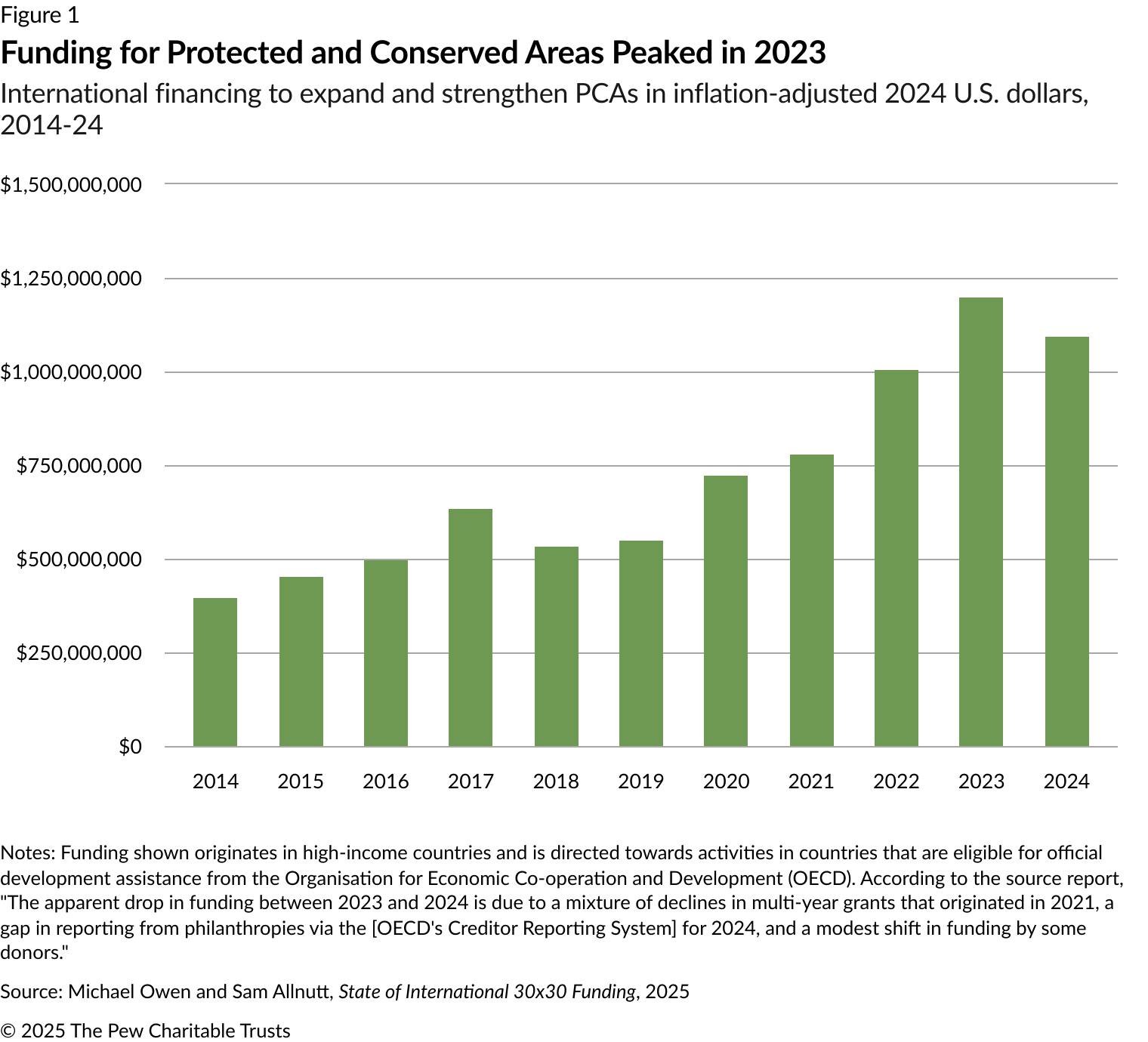
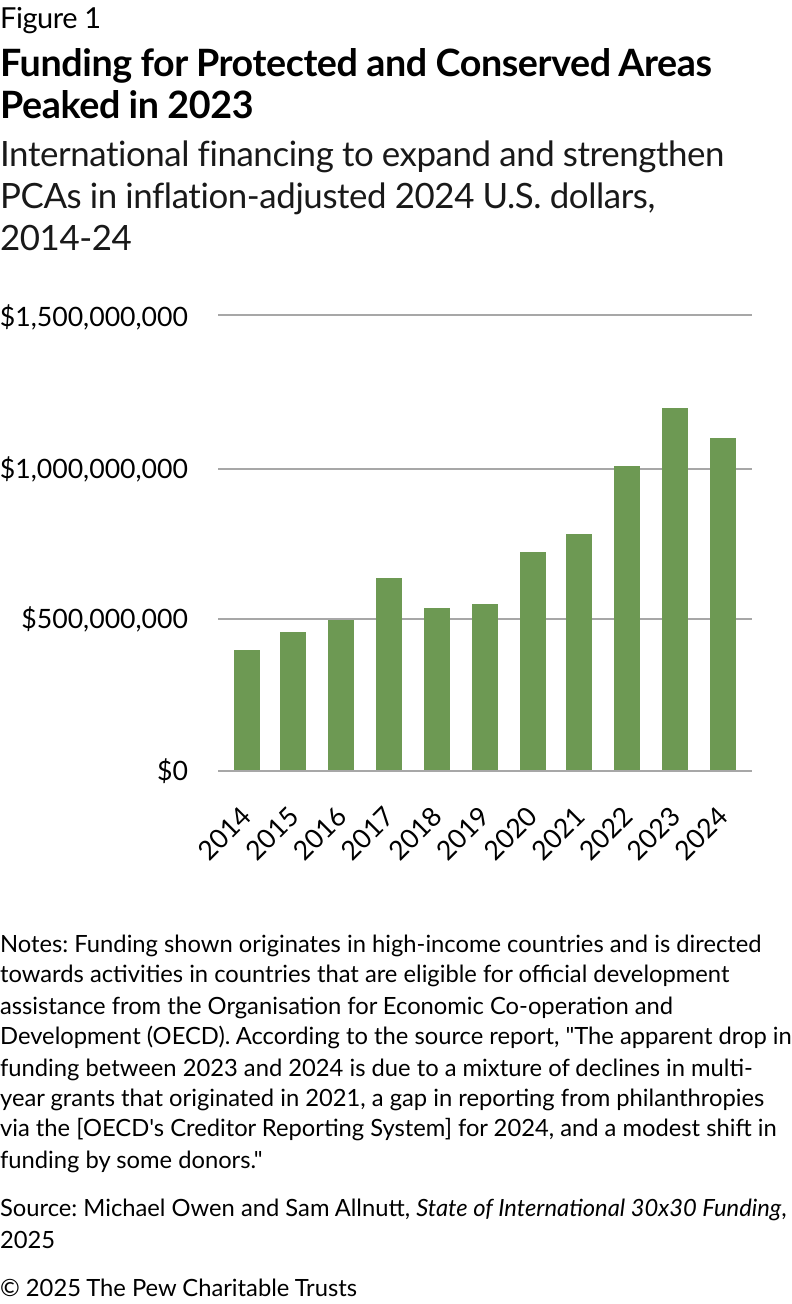
International support for protected and conserved areas (PCAs) in developing countries has nearly tripled over the past decade from around $396 million in 2014 to just over $1.1 billion in 2024. (See Figure 1.) Funding comes from three main sources: bilateral donors, such as Germany (the largest funder at $267 million annually), that provide about 44%; multilateral institutions, such as the World Bank and the Global Environment Facility (the second- and third-largest, respectively), which invest approximately 25%; and foundations and conservation organizations, which typically contribute smaller shares but are particularly important for funding areas, such as enabling science and covering the upfront costs of designating new protected areas. Although bilateral donors have accounted for the bulk of the funding growth in real dollars over the past decade, philanthropies have had the fastest growth rate among funding sources.
Ambition still outpaces action
Despite this growth, however, funding levels still fall far short of what’s needed. Target 19 of the Kunming-Montreal Global Biodiversity Framework—the international agreement of which 30 by 30 is part—commits developed countries to provide $30 billion a year in international biodiversity financing to developing countries by 2030. The new study anticipates that PCAs will account for 20% of that total—or $6 billion annually—by decade’s end. The dashboard further finds that, since 2015, annual funding has increased at an 11% annual rate. If growth continues at that same rate, international funding will miss that $6 billion target in 2030 by $4 billion—a shortfall that could mean the difference between achieving 30 by 30 or not, and between effective conservation and impotent protection. Closing this gap would require raising the growth rate to 34% annually.
Funding is highly concentrated
Just five sources—Germany, the World Bank, the Global Environment Facility, the European Union, and the United States—account for 54% of all tracked disbursements since 2022. These funders deserve huge credit for their commitments, and their support will be critical to sustaining the momentum on 30 by 30. But this concentration creates a potential vulnerability. Any political or priority shifts among this handful of entities will significantly affect global conservation capacity. Additional funders are urgently needed.
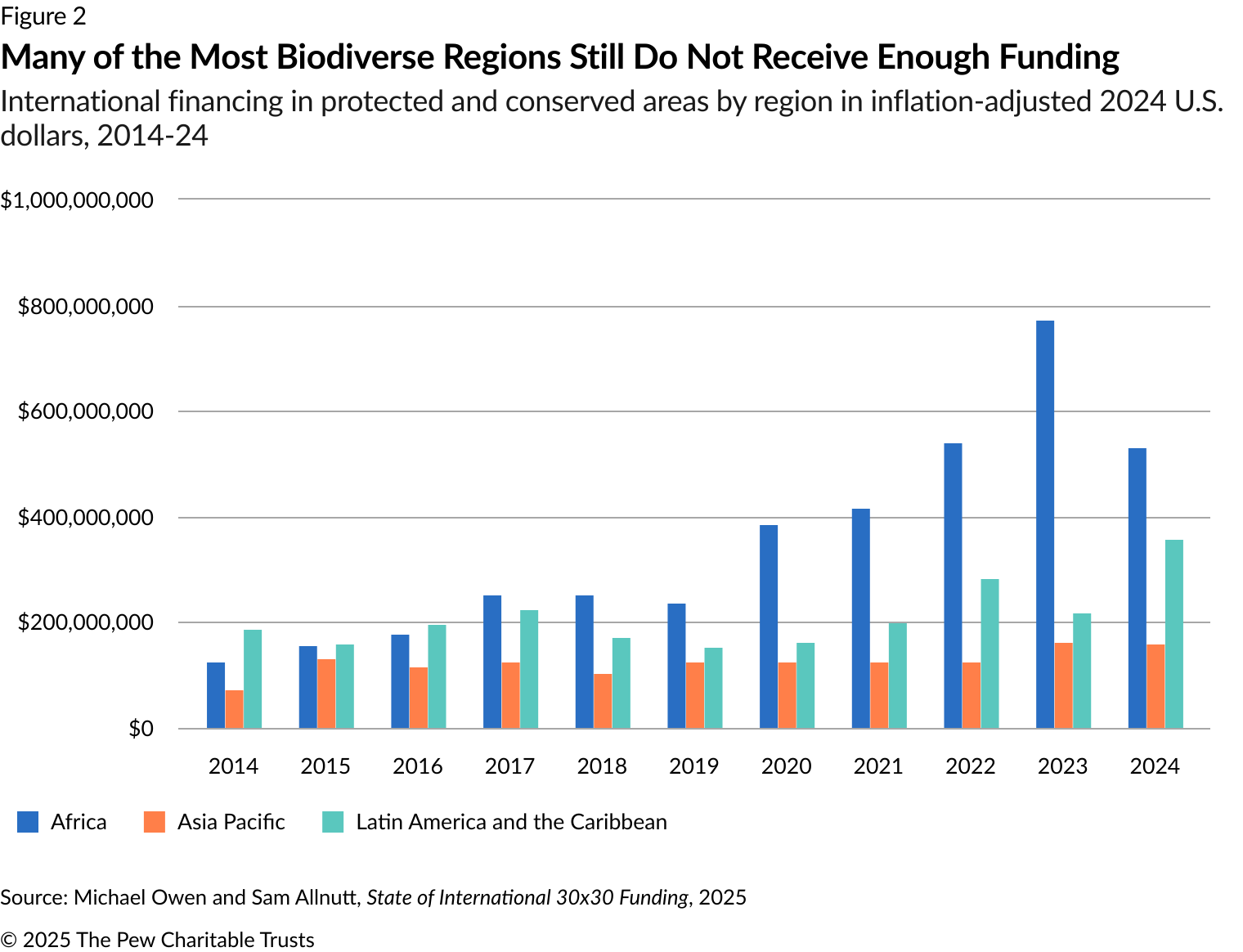
The geographic distribution of funding tells another important story. Overall, lower-income countries are receiving an expanding share of flows, which is exactly what equity and effectiveness demand. Africa now receives nearly half of all the funding tracked in the dashboard—a threefold increase since 2019 that reflects the continent’s extraordinary biodiversity and its constrained domestic conservation budgets. But other biodiverse regions, particularly in Latin America and Asia, have seen relatively flat funding despite massive needs and opportunities. (See Figure 2.) The international community must ensure funding growth across all regions.
Where the money flows—and where it doesn’t
Effective management of PCAs is crucial, and the bulk of the international funding tracked in the dashboard has been directed toward strengthening management, reaching about $900 million in 2023. However, this is still only a small proportion of the total required, as many PCAs operate far below the standards necessary to safeguard biodiversity and meet people’s needs.
However, reaching the 30% commitment will also require the creation of many new PCAs. International investment in expanding PCAs in developing countries also peaked in 2023 at $200 million, with philanthropy accounting for 58% of this funding from 2022 to 2024, but without significantly more investment by multi- and bilateral funders as well as philanthropy over the next few years, the 30 by 30 target is likely to be missed.
Marine ecosystems face a particularly acute imbalance, receiving just 14% of international funding despite representing 71% of the planet. And the funding flowing per square kilometer of marine protection has actually decreased over time, as new marine protections have been added faster than the rate that funding has increased by. Although per-area costs differ between marine and terrestrial systems, this gap signals underinvestment in ocean conservation relative to its scale and importance.
Meeting the 30 by 30 target will require several parallel efforts:
- Accelerate funding growth. Existing donors and emerging funding sources need to significantly increase their commitments—and deliver on them consistently.
- Diversify the funder base. More countries, institutions, and funding mechanisms must be brought into the conservation finance landscape.
- Leverage other resources. International funding must spur rather than replace domestic funding, including government budgets, and help countries build sustainable conservation financing systems. Domestic investment in 30 by 30—which this research did not track—must also increase dramatically.
- Support diverse models. Key area-based conservation measures—including Indigenous- and community-conserved areas—receive just 6% of funding despite their proven effectiveness and cultural importance. Increasing this investment is critical for 30 by 30 success.
Moving forward
The 30 by 30 commitment was a historic moment of global unity around nature. But commitments without commensurate financial resources risk becoming empty promises. This new analysis provides new transparency and accountability tools to help governments, funders, and advocates close the gaps and accelerate progress.
Keith Lawrence is a project director and Masha Kalinina is a senior officer with The Pew Charitable Trusts’ conservation support team.
People