Investments in Text Reminders Bring State Courts Big Gains
Reminders done well can increase court attendance and lower the cost of missed hearings

Missed court hearings represent a widespread and costly problem for courts and communities nationwide. Each year, courts hear more than 16 million criminal cases and about 38 million traffic cases, with people missing anywhere from 12% to 53% of court hearings, depending on the type of charge and the location. Those absences are largely unintentional, research shows—and reminding people that they have an upcoming court hearing, with simple, well-designed text message reminders, can significantly and cost-effectively reduce missed appearances, leading to better outcomes for all involved.
The high cost of missed court appearances
A recent Pew poll found that 37% of people who missed a court appearance said that they simply forgot about the hearing; 8% said they never received a hearing notice; and 5% said the information they did receive was confusing.
Missing a court hearing, for whatever reason, can result in bench warrants, driver’s license suspensions, and jail time. In fact, in many jurisdictions, missing court is a leading driver of arrests and jail bookings. A report examining four North Carolina counties found that missing court was the top reason for jail admissions in all four counties, even though most missed court appearances were for minor traffic cases. Similarly, research found that more people were arrested in Michigan in 2018 for missing court than for simple assault or driving under the influence of alcohol.
The consequences of a missed court appearance reach far beyond those who miss the hearing. The courts also pay a price: Missed appearances can compound case backlogs, create additional work for staff, and drain limited resources. A report from the National Center for State Courts estimates that each missed appearance in a misdemeanor case costs the average court about $15 for the five minutes it takes to figure out if a person is present and move on to the next case. An Arizona study found that jail stays for missed appearances cost Pima County taxpayers upward of $20 million in 2014. Recognizing the high cost of these missed appearances, court leaders throughout the country have begun looking for a way to respond.
Text reminders: a proven and popular way to get people to court
One simple intervention, supported by research and the public, has been shown to dramatically reduce missed court appearances: text message reminders.
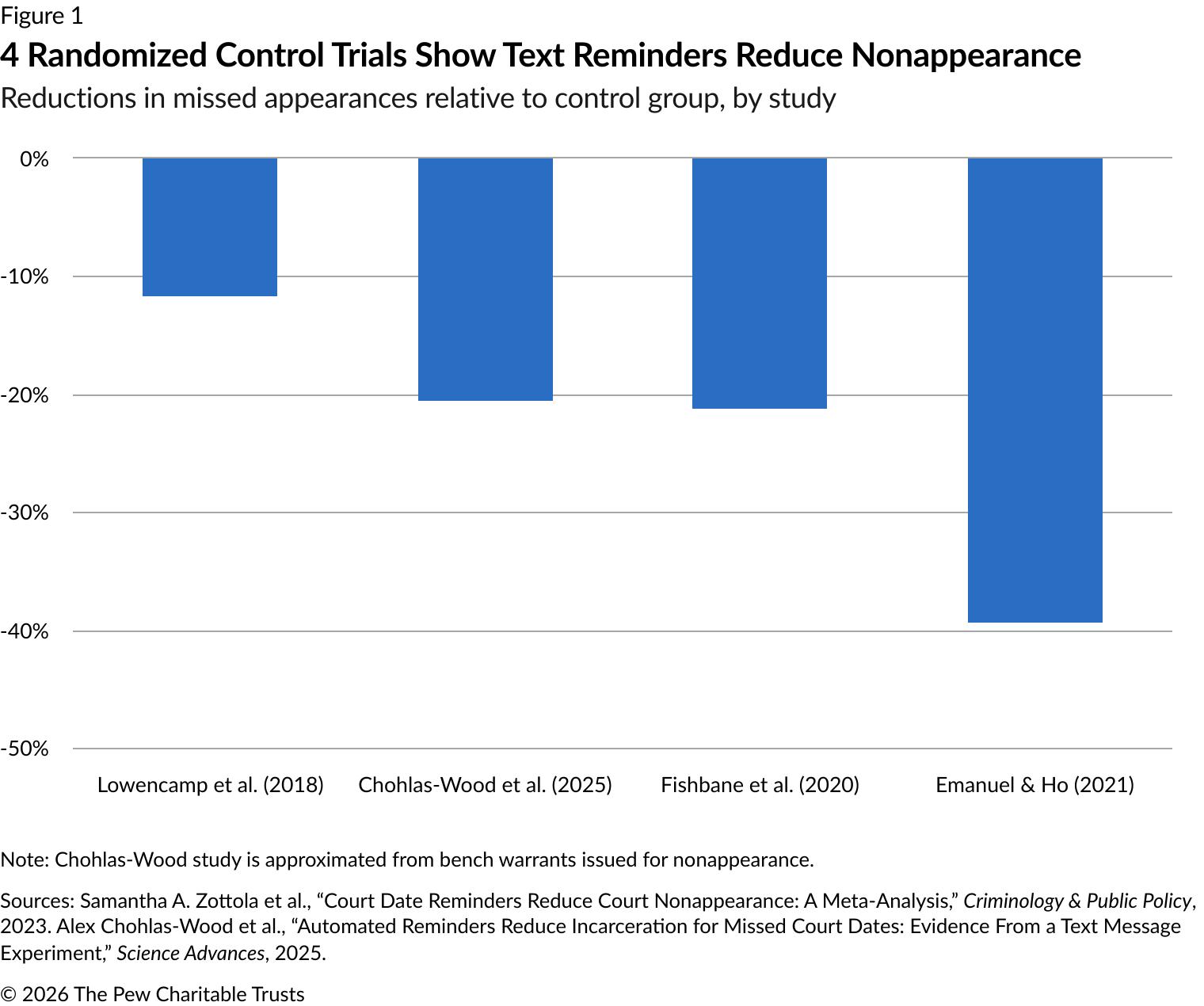
A review of research on the topic found that court reminders significantly increased court appearance rates in 11 of 12 studies, reducing missed hearings by anywhere from 12% to 53%. Four randomized controlled trials (the gold standard for research) of text message reminders found substantial benefits. And one of those studies found greater improvements for individuals with lower incomes and people of color.
Recent polling shows that court text message reminders are also popular. Seventy-one percent of U.S. adults feel positively about the prospect of their local court offering text reminders. Support for the policy extends across party lines—77% of Democrats and 66% of Republicans have a positive view of court reminders, and 94% of Democrats and 90% of Republicans either view them positively or are neutral.
Moreover, text reminders are cost-effective. Ideas42, a nonprofit organization that uses lessons from behavioral science to inform public policy, estimates that statewide court reminder programs cost less than 1 cent per text message sent and less than 50 cents per eligible case. Considering the high price of missed appearances, statewide court reminder programs could result in a sizeable return on states’ initial investments.
State Leaders Can Require Text Reminders to Improve Court Appearance
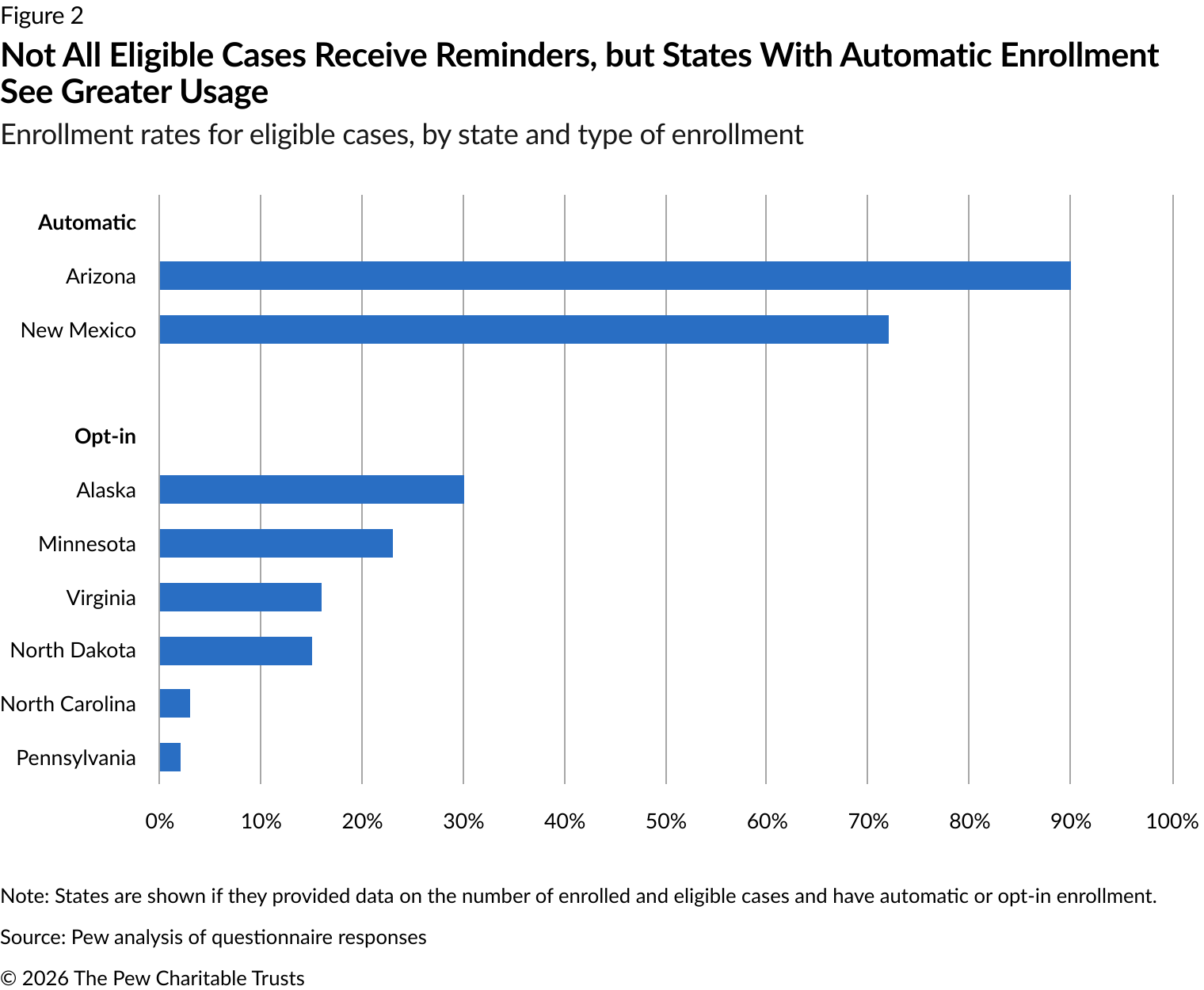
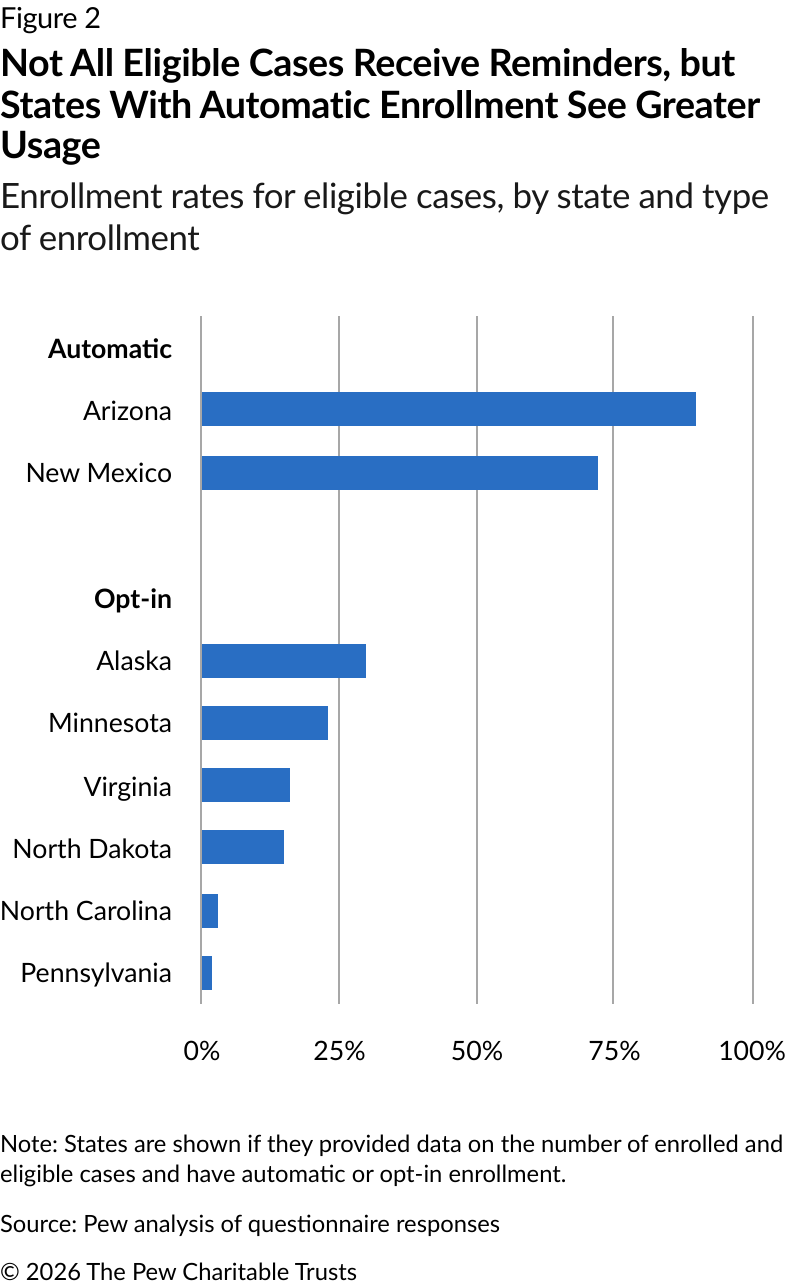
States such as Arizona and Colorado are leading the way in the adoption of effective, research-based text reminders—but Pew’s recent 50-state survey found that most states’ text reminder programs have design flaws that leave many benefits unrealized. For example, states that leave it to individuals to sign themselves up for reminders see much less participation in their programs than states that automatically enroll court users. In Arizona (an automatic enrollment state), 90% of court users with eligible cases receive court date reminders. In Pennsylvania, however, where court users must opt in to the program, only 2% of court users with eligible cases had signed up for court reminders.
Research also shows that the way reminders are worded matters. For example, a randomized control trial in New York City found that plain-language messages that encourage recipients to make a plan to attend court and inform them of the consequences of missing a hearing had a greater impact than messages that did not include both elements.
Lastly, Ideas42 recommends that text reminders are sent out seven days, three days, and one day before each hearing. At least two studies support the notion that this 7-3-1 strategy gives people enough time to make a plan to attend their hearing and addresses the threat of last-minute forgetfulness.
The evidence on this topic is clear: Text reminders for court dates effectively reduce missed appearances and save courts time and money. State leaders can build more efficient court systems that better serve court users, court staff, and taxpayers alike by adopting court reminder programs that:

Isabel Shapiro is a principal associate with Pew’s courts and communities project.
People