The Only International Treaty to Fight Illegal, Unreported and Unregulated Fishing Turns 10
Leaders from around the world reflect on the positive effects and continued potential of the Port State Measures Agreement

Fisheries are among the world’s most vital – and threatened – resources. Overfishing puts ecosystems and fish stocks at risk, and illegal, unreported and unregulated (IUU) fishing threatens the economic and food security of millions of people around the globe. IUU fishing costs the world about $23 billion each year.
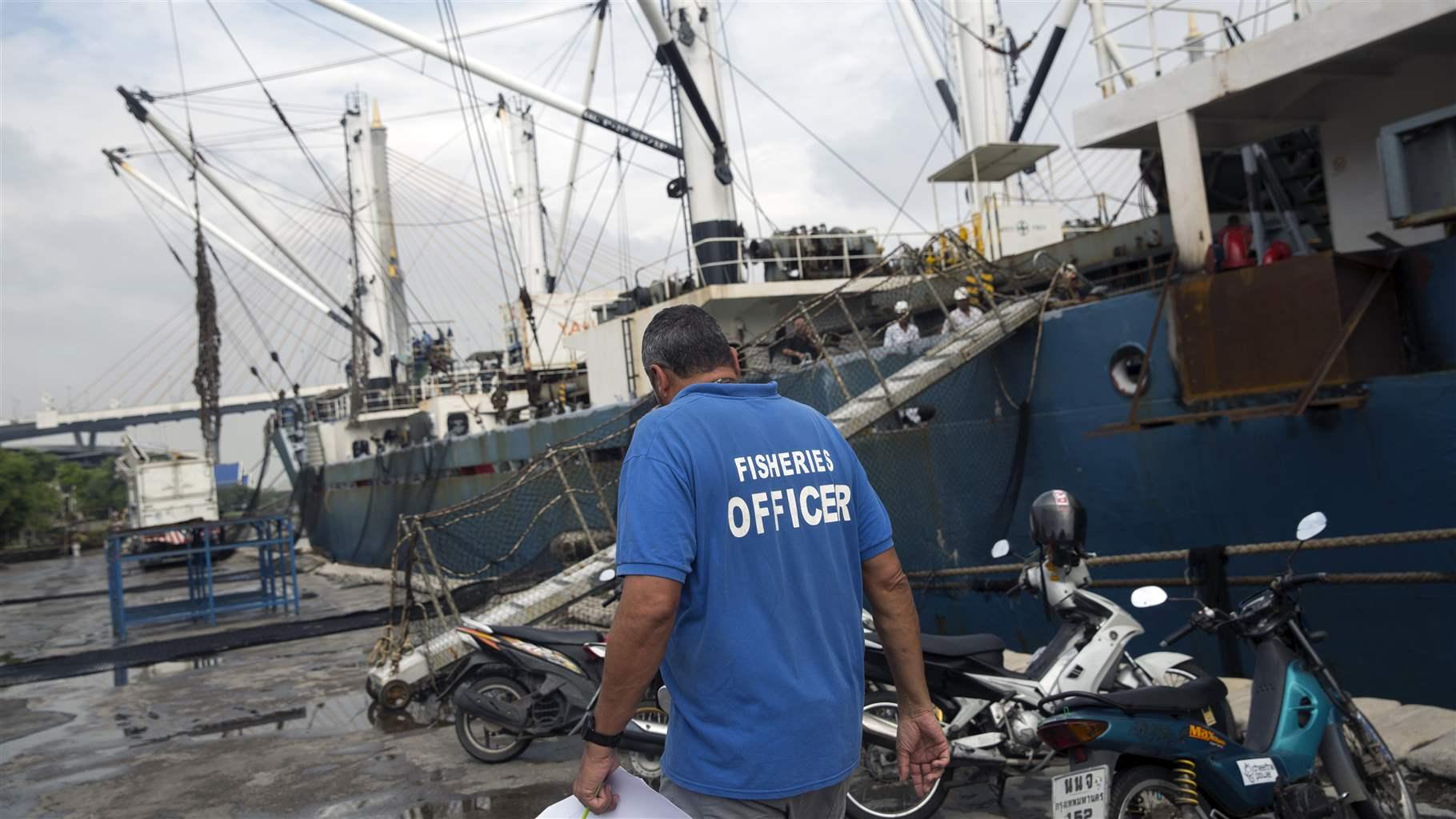
But today, on the annual International Day for the Fight Against IUU Fishing, there is much to celebrate. Ten years ago, the United Nations Food and Agriculture Organization’s Port State Measures Agreement (PSMA) entered into force. The PSMA is the only legally binding international treaty specifically designed to address IUU fishing, which it does by strengthening port controls and limiting the ability of illicit operators to offload their catch to the market.
The Pew Charitable Trusts spoke with four experts – Marisa Kashorte, director, international fisheries relations, Department of Forestry, Fisheries and the Environment South Africa; Alicia Mosteiro, technical secretary to PSMA Technical Working Group on Information Exchange, Food and Agriculture Organization of the United Nations; Meli Raicebe, fisheries officer, Fiji Fisheries Department, and chair, Western and Central Pacific Fisheries Commission Port State Measures Working Group; and Elsa Tudal, project director, Europe and international, directorate general for maritime affairs, fisheries and aquaculture of France and chair of the sixth PSMA meeting of the Parties in 2027 – about the impact of the PSMA’s first decade in force, the future of the agreement and what else the global community can do to combat IUU fishing.
This interview has been edited for clarity and length.
-
Why is ending and preventing IUU fishing so important to your country?
Raicebe: Ending and preventing IUU fishing is vital to Fiji because it directly safeguards the nation’s economic sovereignty, food security and environmental resilience. Fisheries are a primary source of income and employment for coastal communities, and IUU fishing plunders these resources, threatening the long-term viability of local jobs and livelihoods. And as a “large ocean state,” Fiji relies heavily on healthy fish stocks for nutrition. IUU fishing also undermines conservation efforts and contributes to the degradation of the marine ecosystem.
Kashorte: For South Africa, this is both an economic and developmental imperative. Our marine resources are a critical national asset, supporting livelihoods, food security and economic growth, particularly within coastal communities. But IUU fishing erodes resource sustainability, distorts markets and disadvantages legal operators. From a governance perspective, IUU fishing weakens the integrity of fisheries management systems and regional cooperation frameworks. As a coastal and port State, South Africa recognizes that effective action against IUU fishing requires strong domestic controls and coordinated international responses. The PSMA is a central instrument in closing ports to illicit activities and reinforcing accountability across the seafood industry.
-
Why did your country join the PSMA, and what has been the result?
Raicebe: Fiji’s decision was driven by the need to protect its blue economy and reinforce its status as a responsible coastal, flag and port State. Since becoming a party to the PSMA, Fiji has significantly strengthened its fisheries enforcement. There have been rigorous inspections and establishment of institutional specialized units, such as a dedicated investigation and prosecution unit to handle fisheries violations more effectively. There has also been more tailored capacity development and enhanced monitoring of fisheries.
Kashorte: South Africa’s decision was grounded in a clear recognition of the need to strengthen port-based controls as part of a broader, integrated fisheries management approach. The PSMA has been critical to enhancing South Africa’s interagency coordination, strengthening our inspection and verification processes and aligning national systems with international best practices. It has also reinforced our role within regional and global efforts to combat IUU fishing. More broadly, the PSMA is a critical pillar in advancing international action, and its continued implementation is essential to addressing emerging challenges and strengthening global fisheries governance.
-
How has the PSMA made a demonstrable change in ocean governance?
Tudal: France has made the fight against IUU fishing a central pillar of its maritime foreign policy, and it holds the chairmanship of the PSMA for 2025-27. From the French perspective, the major advances of the PSMA to date are the creation and implementation of the Global Information Exchange System, which allows member States and regional fisheries management organizations [the multinational bodies that oversee high seas fishing] to exchange real-time data on fishing inspections around the world and capacity building actions that are essential to implementing best practices.
-
What do you see as the next big steps countries can take to stop IUU fishing?
Mosteiro: These start with the PSMA itself, including scaling up implementation, especially by sharing information through the PSMA Global Information Exchange System; developing fully electronic traceability systems for catch documentation, which should align with port State measures; and setting stringent rules so that compliance with the PSMA and other relevant agreements is a requirement for fish sold on the international market. States should also take steps to tackle the related challenge of beneficial ownership [when an individual or group has a legal and monetary stake in, but not necessarily full control of, a company] of vessels involved in IUU fishing by holding individuals and companies accountable and to update penalty systems to reflect the seriousness of an infringement. -
What do you hope comes over the next 10 years of the treaty?
Tudal: Without permanent funding, the PSMA is fragile. So, France is making the sustainable functioning of the agreement a priority of its presidency. We are committed to advocate for Parties to agree a funding mechanism in 2027 to ensure the long-term viability of this important agreement and that it meets its objective to prevent, deter and eliminate IUU fishing.
Mosteiro: Three-quarters of coastal States are Parties to the PSMA, but universal adoption, including by landlocked States, which are often seafood buyers, would spur further positive change and ensure coverage across most of the world. Overall, enhanced implementation and information-sharing across countries is key to further progress. Since the PSMA entered into force, Parties have worked to improve monitoring, control, and surveillance capabilities, and their experiences can help inform implementation of other international ocean treaties, including the World Trade Organization’s Agreement on Fisheries Subsidies and the new United Nations Biodiversity Beyond National Jurisdiction Agreement [commonly called the high seas treaty].
People