Preventable Missed Court Hearings Cost Virginia More Than $3 Million Per Year
Text message reminders can save public funds by improving court communications

In jurisdictions throughout the United States, courts are implementing systems that send text messages reminding people of their upcoming court dates. Studies consistently show that failure to invest in such technology comes at a high cost for courts and the communities they serve. Each missed court appearance sets off a chain reaction that delays court proceedings, adds strain on already stretched justice system resources, and can lead to arrest and incarceration.
Research also consistently shows that simple, low-cost, and well-designed text reminders can reduce missed court dates by 20% to 40%, yet many places continue to absorb the high financial and human costs of preventable missed appearances. Virginia, for instance, uses a text reminder system that requires users to “opt in” to the service. As a result, only 16% of eligible cases are enrolled to receive reminders, and missed court dates remain far too frequent.
The Pew Charitable Trusts analyzed the Virginia Criminal Sentencing Commission’s most recent Pretrial Data Project and found that missed appearances cost the commonwealth more than $17 million in wasted staff time and resources in 2023.
Next year, the Virginia Legislature will consider House Bill 885 for the second time. Last year, H.B. 885 passed unanimously in the House but was tabled in the Senate finance committee. If enacted, the bill would require the commonwealth to shift to a text message reminder system with automatic enrollment—a change that would vastly expand the program’s reach. By conservative estimates, the program could reduce missed appearances in Virginia by 20%. A 20% reduction in the $17 million spent on missed hearings would save the commonwealth approximately $3.4 million a year.
The Office of the Executive Secretary of the Supreme Court of Virginia has estimated that such an expansion of the commonwealth’s existing system would carry a one-time cost of about $1.5 million and a recurring annual expense of $150,000. Considering the high costs of missed appearances, the return on investment would be about $2 million in the first full year following activation and more than $3 million every year after that.
Avoidable missed appearances cost law enforcement $1.6 million in 2023
According to Pew’s analysis of the 2023 Pretrial Data Project, in 14% of criminal cases in which the charged individual was not detained before trial, that person missed a court date—often resulting in arrest. The same data shows that “failure to appear” was the leading cause of custodial arrests, or arrests that result in detention rather than release on a summons. (See Table 1.) Over the course of 2023, missed court dates led to an estimated 22,954 custodial arrests throughout Virginia.
Making arrests for missed appearances uses significant police resources. Assuming each arrest took two hours on average, Virginia law enforcement officers spent approximately 45,908 hours responding to missed appearances in 2023. Those hours, based on the $72,740 average annual salary of a police officer in Virginia, cost city, county, and state departments about $1,605,000.
Table 1
Failure to Appear Is the No. 1 Reason for Custodial Arrests
Top 5 events for which bail was set in Virginia, 2023
| Rank | Offense | Statute | Share |
| 1 | Failure to appear | 18.2-456(A,6) | 8.1% |
| 2 | Probation violation (felony) | 19.2-306 | 8.0% |
| 3 | Domestic violence | 18.2-57.2(A) | 7.9% |
| 4 | Possession of a Sched I or II drug | 18.2-250(A,a) | 7.6% |
| 5 | Drunkenness in public | 18.2-388 | 5.0% |
Note: Each offense is a single Virginia crime code: Failure to appear is CON-5035-S9.
Source: Pretrial Data Project Supplemental Data, 2023
Avoidable missed appearances cost jails $15 million in 2023
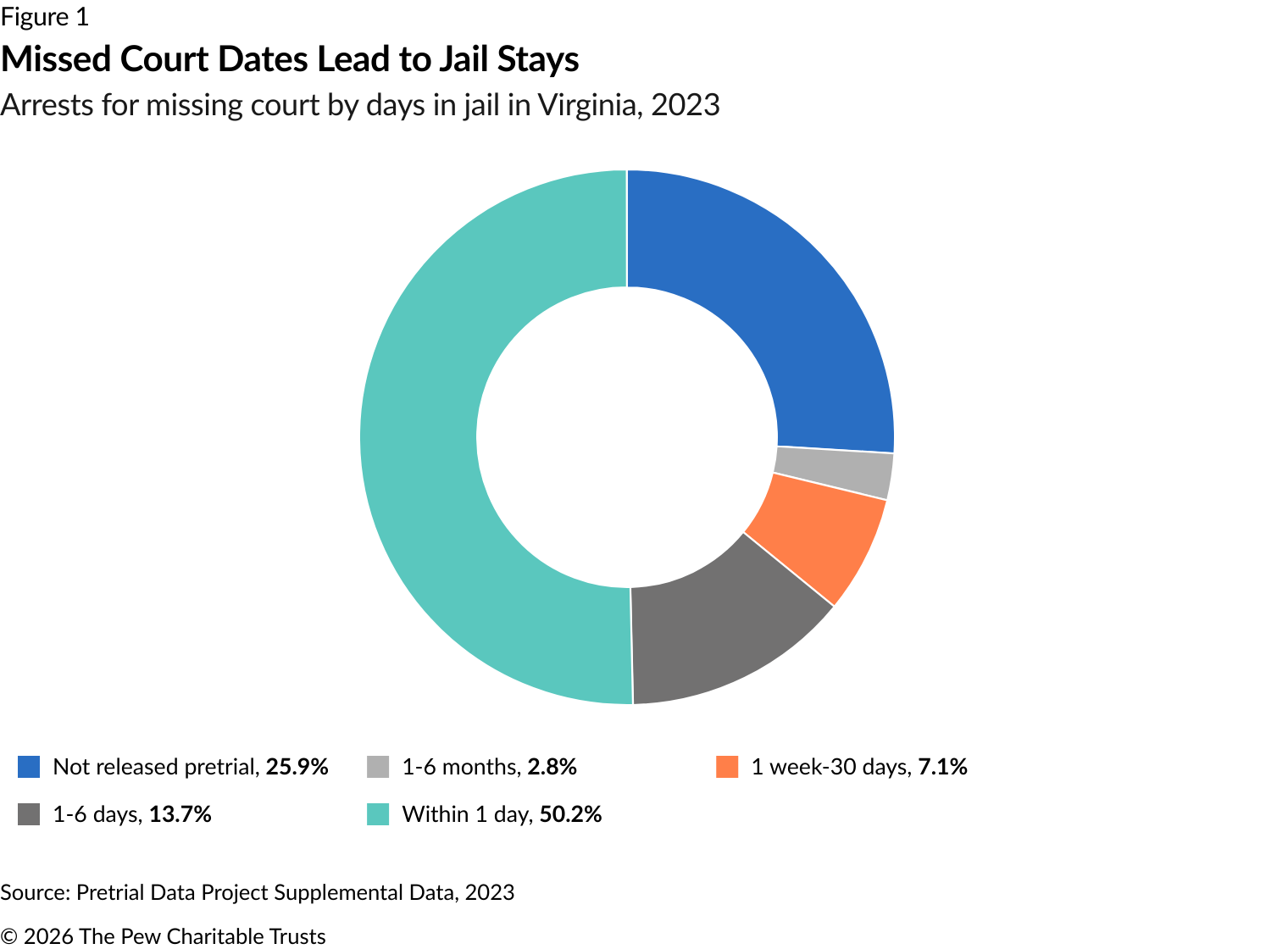
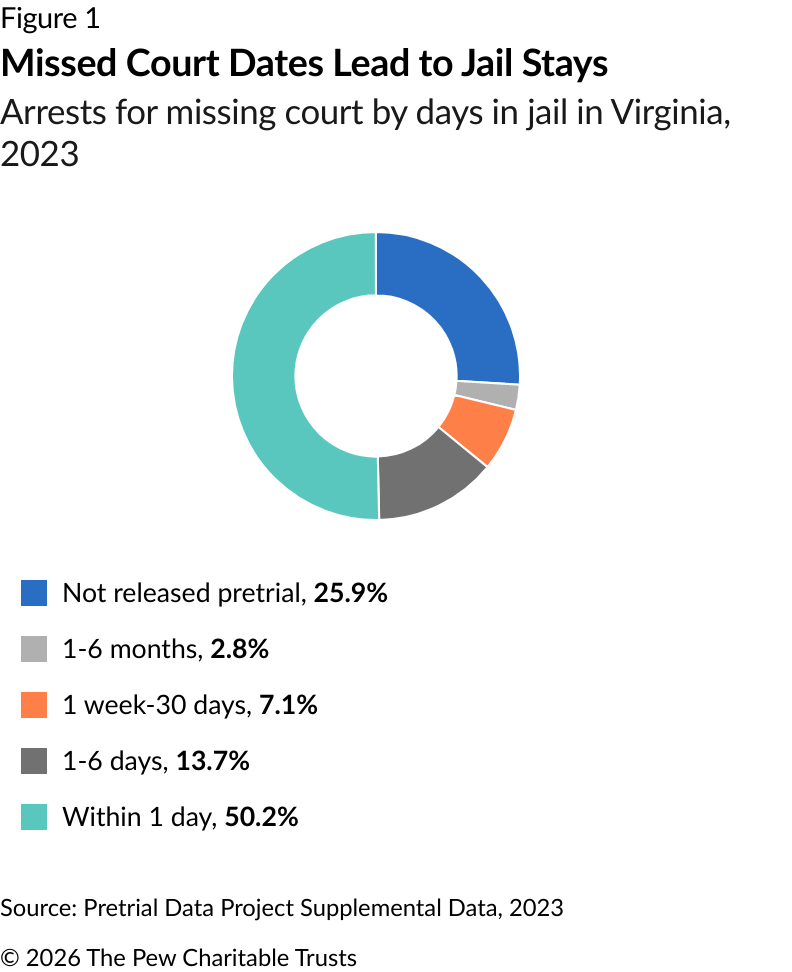
Many arrests for missed appearances lead to significant jail time. According to the 2023 data project, half of the people arrested for missing court were released the same day they were detained—but a quarter spent one night or longer in jail, and another quarter were held in custody until their cases were resolved. (See Figure 1.) For those who were released before resolution, missed appearances resulted in a combined 103,168 days in jail in 2023. (The data does not include information about length of stay for people who were not released before their cases were resolved.) Based on an average daily cost of $145 per jail bed per day in 2023, as reported by the Virginia Compensation Board, the jail time for those 75% of arrests for missed court dates cost local justice systems across the state $14,959,000 in total for the year.
Avoidable missed appearances cost local courts $635,000 in 2023
Beyond the burden of arrests and jail time, missed appearances slow down court operations and waste the time of judges, attorneys, victims, witnesses, and staff. According to unofficial criminal court data, judges in Virginia issued almost 21,000 orders for arrest for missed court hearings in 2023 and 7,500 “show cause” rulings ordering a person to appear in court. Commonwealth attorneys filed more than 7,000 new criminal charges for failure to appear.
Issuing orders, scheduling show cause hearings, and processing new criminal charges for failure to appear all require significant court staff time. In interviews with Virginia court personnel, Pew found that actions related to missed appearances take, on average, about five minutes for a judge, five minutes for an assistant commonwealth’s attorney, and 15 minutes for a clerk. Totaling those estimates, Virginia court personnel spent approximately 14,875 hours—almost 2,000 workdays—responding to missed hearings in 2023. Taking into account the average salaries of Virginia judges, assistant commonwealth’s attorneys, and clerks, those hours cost courts about $635,000.
Text message reminders can significantly reduce missed court hearings and cut costs
Multiple randomized controlled trials—the gold standard for research—have found that text message reminders reduced missed court dates by 20% to 40%. Those findings make sense: Most people don’t intend to miss court. According to a 2025 Pew poll, 37% of people who had missed court reported that they had done so simply because they forgot. Another 13% said that they missed court either because they did not receive notice or because the information they received was confusing. Effective reminders can help courts address these common reasons for missing court dates.
Virginia is one of 18 states, plus Washington, D.C., that have at least a basic court reminder program. But because its system does not feature automatic enrollment, the commonwealth is not receiving the greatest possible return on its investment. Virginia’s “opt-in” program requires people with a court case to know about the program, figure out how to enroll, and follow through on signing up. States with automatic enrollment, on the other hand, tend to have much greater success. In Arizona, for example, automatic enrollment has helped ensure that 90% of court users with eligible cases receive reminders.
Without automatic enrollment, Virginia forfeits savings in law enforcement time, jail costs, and court operations. Strengthening and expanding court reminder systems is not merely a matter of fairness and efficiency; it is a fiscally responsible investment that would pay dividends for courts, communities, and the commonwealth.
Isabel Shapiro works on The Pew Charitable Trusts’ courts and communities project.
People