New Research Shows DERs Could Avoid More Than Half a Trillion Dollars in U.S. Energy Costs
Report quantifies the benefits of deploying more distributed energy resources to meet growing demand on the grid

Energy demand is driving U.S. electricity prices to record highs. But distributed energy resources (DERs)—clean, decentralized technologies such as rooftop solar and battery storage—offer an untapped way to ease that pressure. By embracing DERs, the United States could help meet demand while bolstering the reliability of the grid and reducing costs for those who use it.

The Brattle Group, a global consulting firm with expertise in energy markets, conducted modeling for The Pew Charitable Trusts to quantify the potential impact, on both costs and emissions, of a significant acceleration in DER deployment. The research shows that if key policy and regulatory barriers are removed throughout the U.S., total DER capacity could more than quadruple to reach 524 gigawatts (GW) by 2050—bringing meaningful benefits to the U.S. grid and customers.
Key findings of the report include:
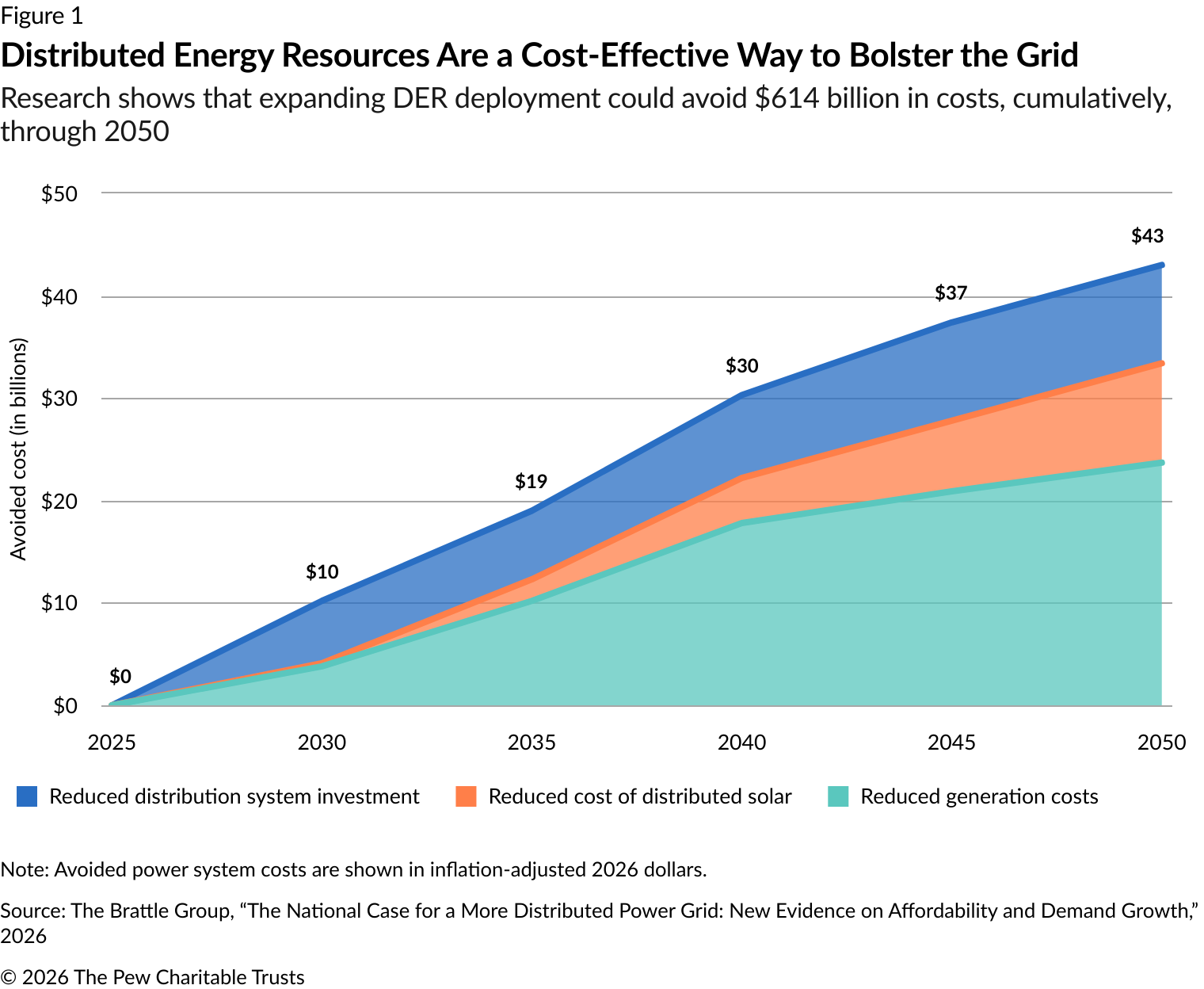
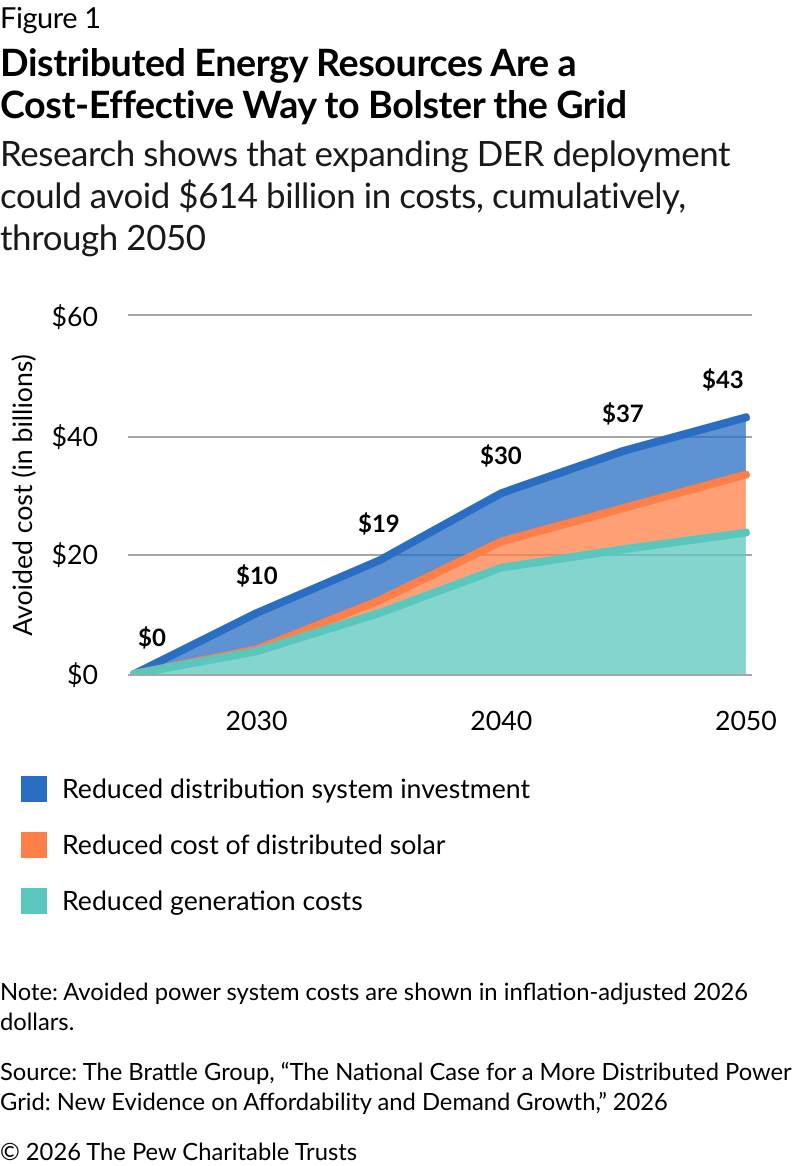
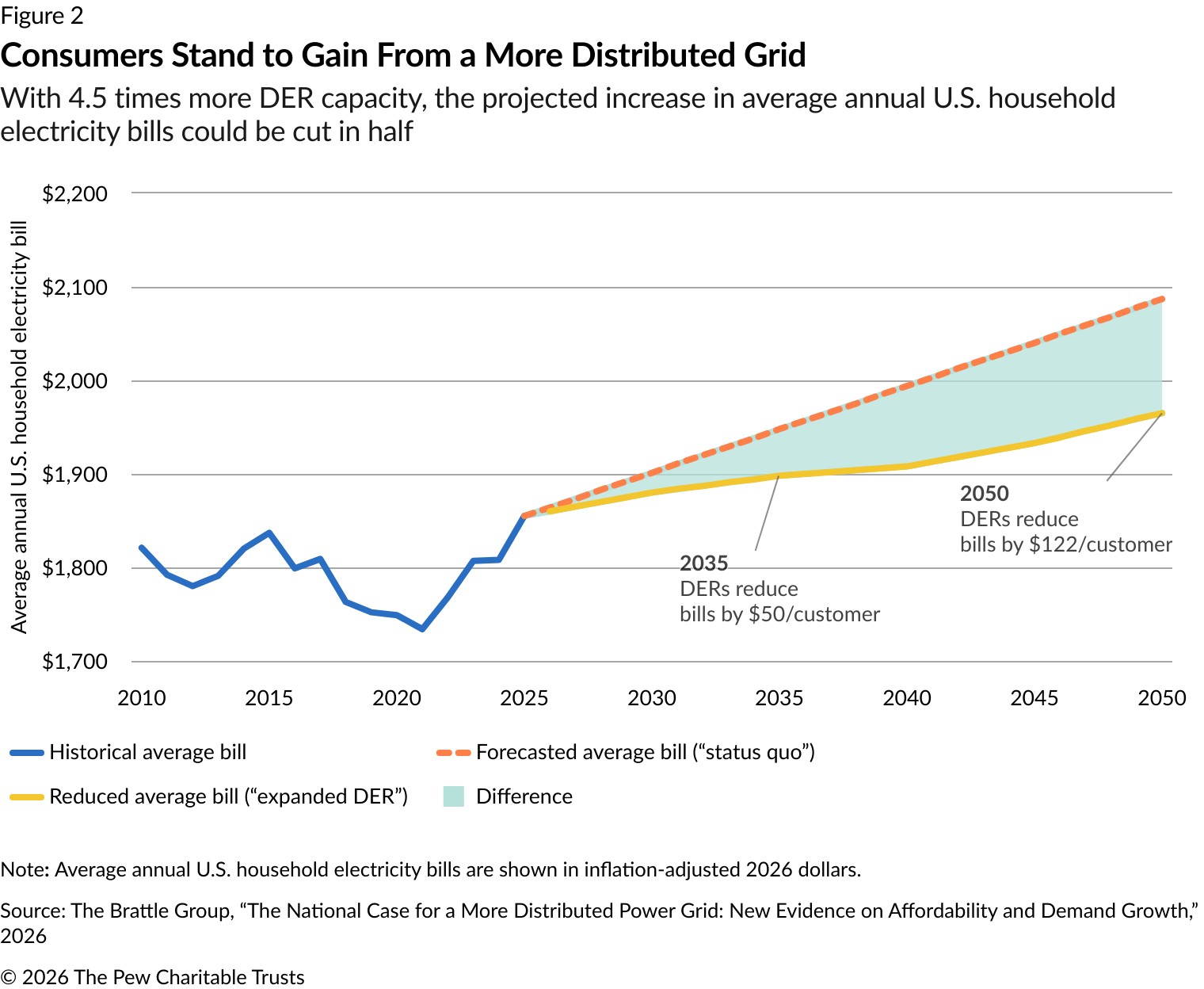
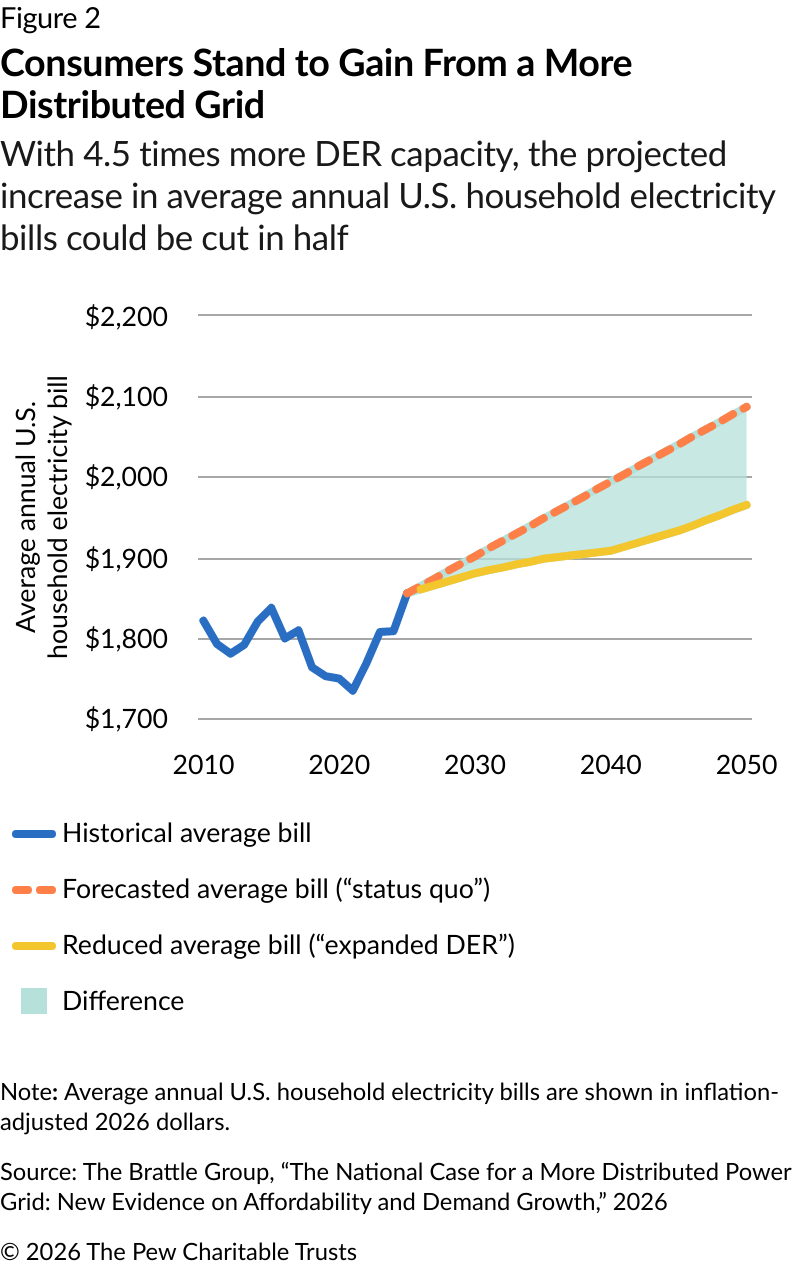
- More DERs on the grid could lower electric bills. DERs can help make electricity in the U.S. more affordable. The report found that adding 4.5 times more DER capacity could avoid $614 billion in power system costs through 2050 and cut the average projected increase in household bills by half in inflation-adjusted dollars.
- DERs mitigate the risks of infrastructure overbuild. Expanding DER deployment defers the need to build more costly energy infrastructure such as natural gas-fired power plants, which would sit idle if anticipated load increases do not materialize. DERs can reduce the risk of overinvesting in traditional infrastructure, potentially saving customers $33 billion.
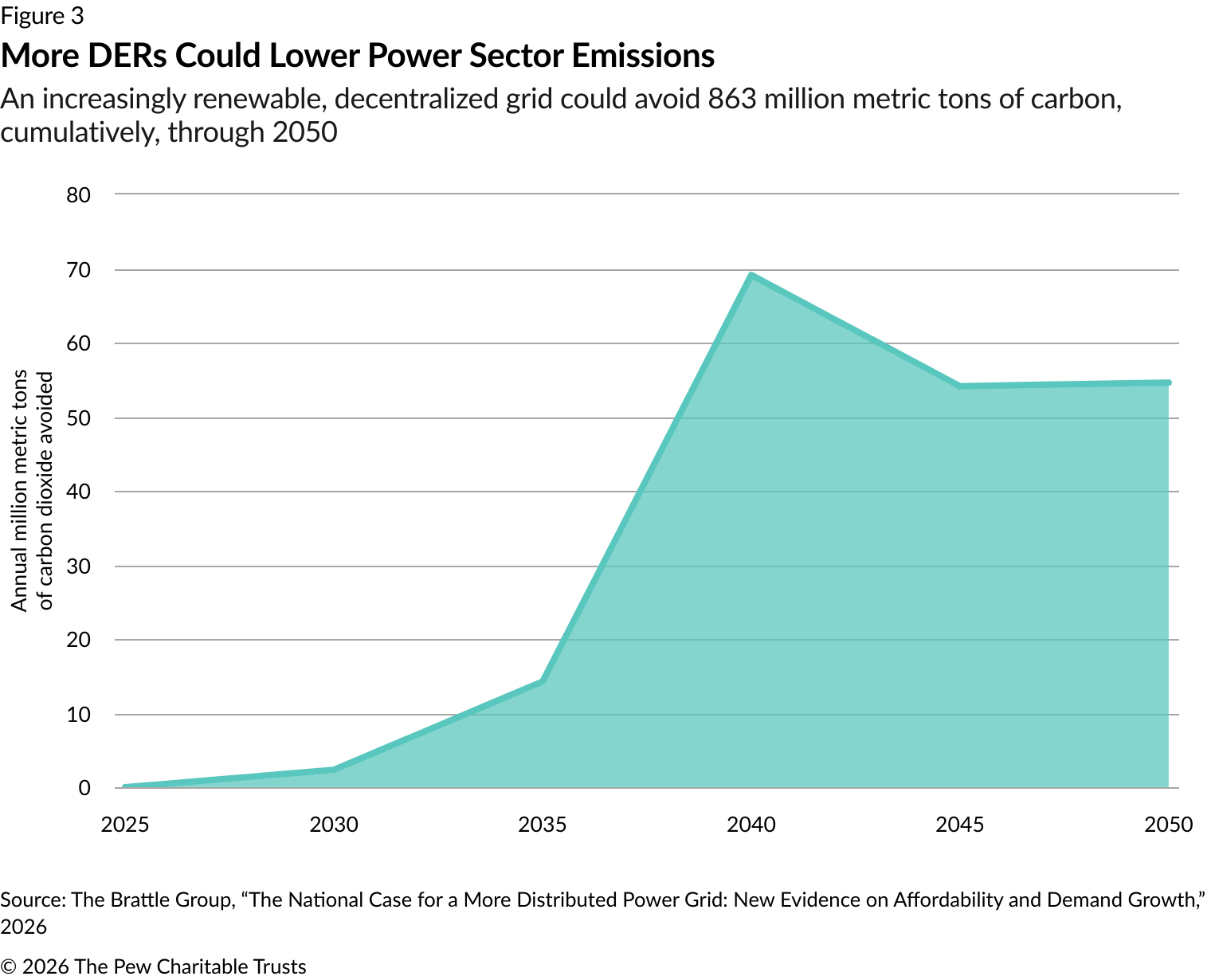
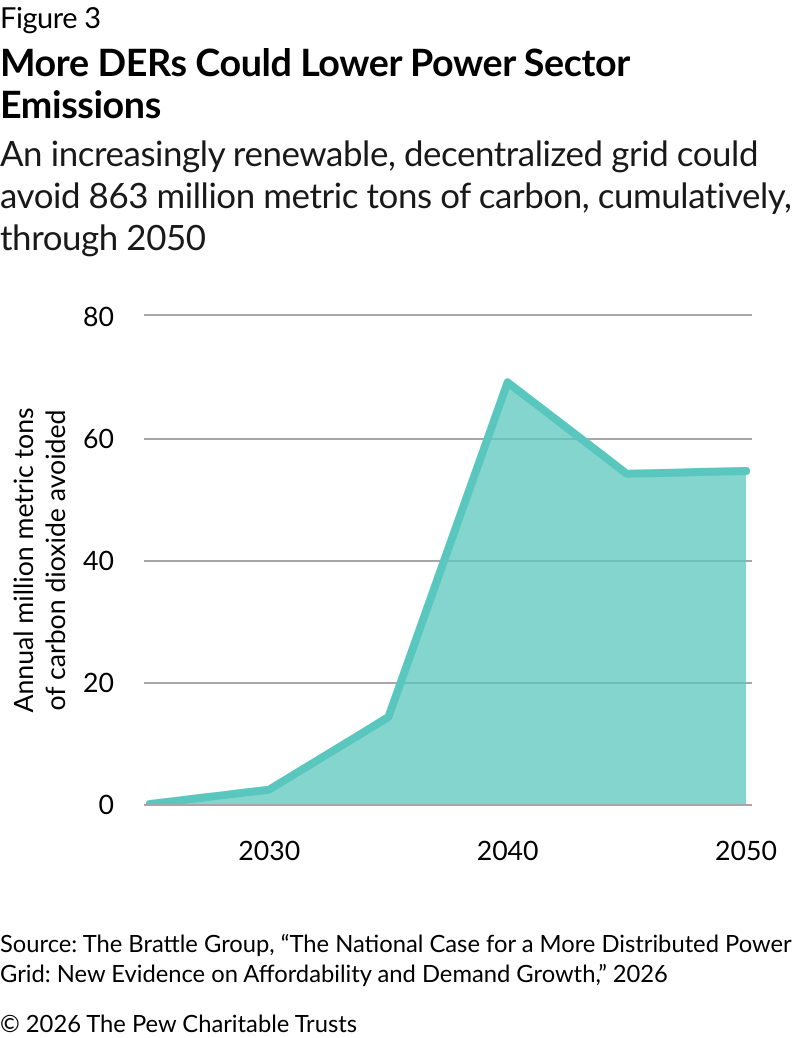
- DERs support a cleaner grid and reduce emissions. Removing policy and regulatory barriers would enable more DER capacity, which in turn could help avoid the need to add roughly 70 GW in power produced by natural gas—an amount equivalent to the capacity of about 175 gas-fired plants. Leaning into DERs at this level could avoid about 863 million metric tons of carbon, cumulatively, through 2050. Without decentralized clean resources, a pathway to achieving a carbon-free power sector would cost an additional $45 billion.
The Brattle Group study considered how removing roadblocks to DER deployment—such as inefficient local permitting and interconnection processes, or utility planning that does not incorporate DERs—would affect the grid through 2050. The study compared scenarios based on differing levels of DER deployment. The business-as-usual (“status quo”) scenario models a future U.S. power system in which current barriers to DERs persist. The “expanded DER” scenario, on the other hand, models a power system in which these barriers are eliminated and DERs are incorporated more extensively in resource planning throughout the country.
DER deployment increases affordability for customers
DERs provide several advantages over traditional energy infrastructure: They are modular, ready to deploy, and can reduce overall grid costs. The research finds that when compared with the status quo projection for 2050, the expanded DER scenario—which assumes a wide range of policy reforms—doubles capacity and avoids up to $43 billion annually in costs that otherwise would have come out of customers’ pockets.
The research finds that reforming local permitting processes, streamlining interconnection and grid access, and integrating DERs into distribution planning could result in $266 billion in cost savings, or 43% of the total avoided power system costs of the expanded DER scenario. Pew has recommended these policies in its DER policy playbook.
Those avoided costs would directly benefit customers. The research shows that with more DERs on the grid, the projected increase in the average annual U.S. household electricity bill could be reduced by half, in inflation-adjusted dollars, by 2035. The deployment of more DERs puts immediate downward pressure on electricity bills for all customers—not just those with DERs—in a lasting way.
DER deployment helps avoid overinvesting in grid infrastructure
As energy demand grows, uncertainty about how much projected load will ultimately come online creates a risk of overbuilding the energy system with costly traditional infrastructure. The Brattle Group estimates that if load growth falls short of forecasts, system planners may have overbuilt the system by 153 GW in 2035. Unlike traditional infrastructure, DERs are modular and can be scaled gradually. If DERs are better incorporated into resource planning, they could save $33 billion between 2030 and 2040 by avoiding overinvestment in new power plants for demand that does not fully materialize.
Supporting a cleaner grid
The Brattle Group study also analyzed the carbon emissions of a more distributed grid and the benefits of avoiding fossil fuels.
Enabling 4.5 times more DER capacity would reduce the need for fossil-fueled generation resources and lower U.S. power sector carbon emissions by 3%—the equivalent of roughly 863 million metric tons, cumulatively—through 2050. The report further found that incorporating DERs on the grid at this level would reduce the annual cost of achieving a carbon-free power sector in 2050 by $45 billion.
Accelerating the deployment of DERs would also help utilities avoid using more expensive fossil-fueled resources to meet demand. DERs could help eliminate the need for roughly 70 GW of projected new gas power plant generation between 2030 and 2050—a 22% reduction in forecasted additions, or the capacity of approximately 175 gas plants.
The Brattle Group report underscores the significant, untapped benefits to customers and the U.S. power system of leveraging DERs more fully across states. As energy demand and affordability pressures mount, state policymakers can unlock these benefits through more efficient local permitting, flexible interconnection, and distribution planning that optimizes DERs. With such policies in place, states can avoid unnecessary investments in infrastructure—and use today’s energy challenges to create a cleaner, more reliable, and more affordable power system.
Brian Watts works on The Pew Charitable Trusts’ energy modernization project.
People