Philadelphia’s Guiding Document at 75
A milestone anniversary in a historic year
Editor’s note: This story was updated on April 15, 2026, to reflect Philadelphia City Council’s recently approved legislation to remove a question from the May 2026 ballot that would have asked voters to approve a change to the “resign-to-run” rule.
Overview
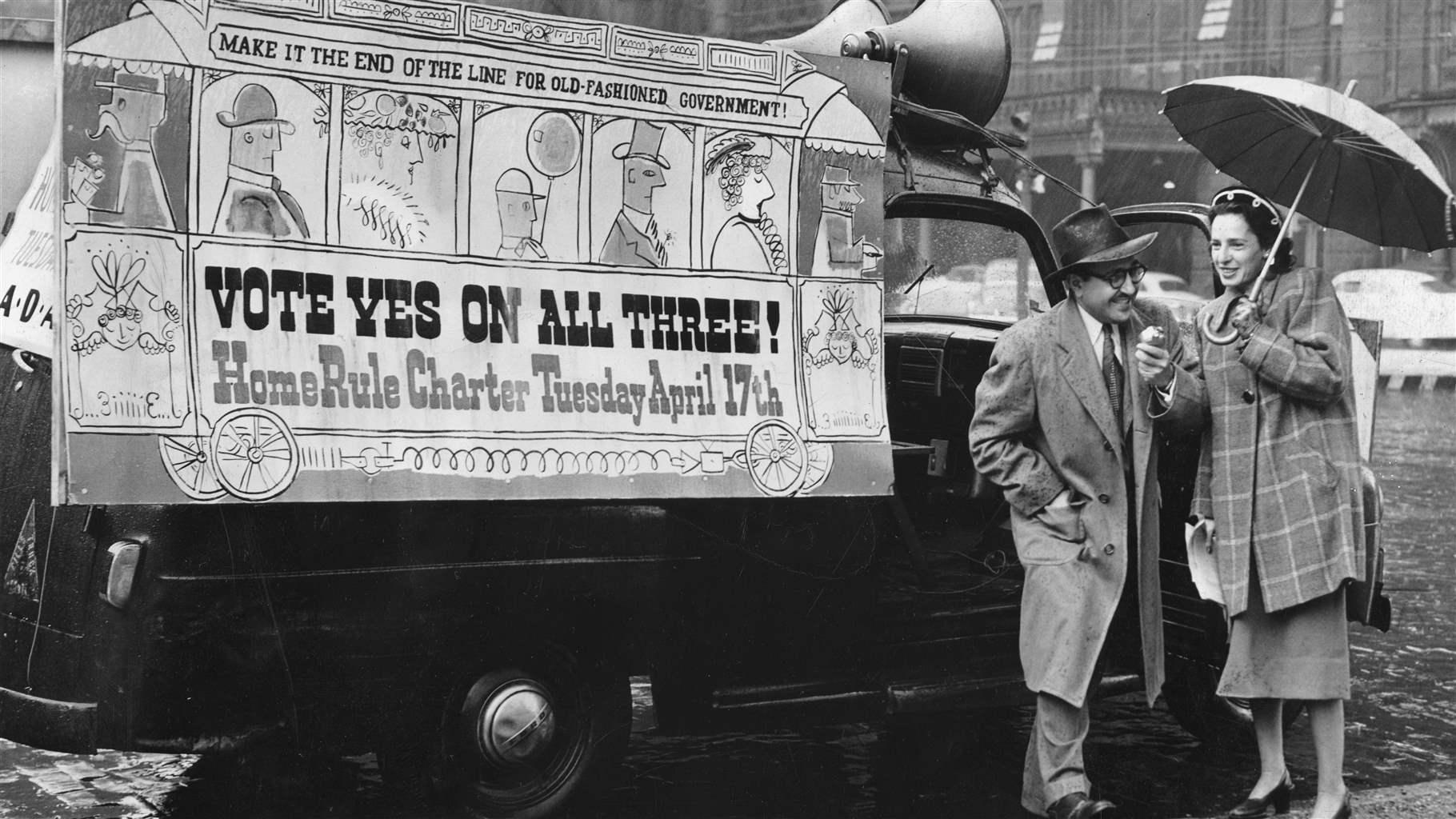
As the United States celebrates its 250th birthday this year, Philadelphia—the nation’s first capital and founding city—is marking a milestone of its own: the 75th anniversary of its Home Rule Charter. The charter, adopted on April 17, 1951, is often referred to as the city’s constitution, framing its governance structure and laying the foundation for relationships between Philadelphians and their local government.
Philadelphia’s Home Rule Charter was developed as part of the city’s “good government” effort,1 which focused on combating government corruption and patronage at a time when jurisdictions throughout the country were being allowed greater self-governance. What resulted was a robust and highly detailed document laying out how Philadelphia’s government should be run.
The charter’s 12 articles contain 72 chapters, covering everything from salary requirements for certain administrative positions to the creation of various city departments.2 Over the years, dozens of amendments have contributed to the charter’s length and prescriptive detail, adding specific rules and requirements to the government’s structure and functions.
Since its adoption, there have been differing views about whether the 75-year-old charter is an appropriate guiding document for the city.3 Some experts and scholars value its level of detail and specificity for the practical clarity it provides. Others believe that the document is too technical for a constitution and that many of its components would be more appropriately found in municipal code and ordinances. This brief explores the history of Philadelphia’s Home Rule Charter, its relationship to the operations and practices of the local government, and how the document has changed over time.

A brief history of the Home Rule Charter
The adoption of Philadelphia’s Home Rule Charter in 1951 followed decades of political volatility and efforts to improve the local government’s relationship with residents.
The city of Philadelphia as we know it today was created in 1854, when the state Legislature combined the existing city, which covered only 2 square miles, with other towns that were part of the same county. The city-county consolidation, which covered more than 130 square miles, enabled local officials to better respond to public health crises, streamline services, and support urban planning efforts.4
But consolidation also introduced challenges that led to later calls for reform. For instance, ward representation replaced earlier municipal leadership structures, with 24 ward representatives included in the new 145-person legislative body—the largest in the country at the time. During this period, party politicians established ward strongholds to dole out jobs and contracts to their supporters, which eventual reformers saw as contributing to a corrupt government patronage system.5
In 1919, the city adopted a new charter, scrapping the existing structure and replacing it with a City Council made up of 21 members across eight districts.6
But this charter ultimately had little impact on the way city government operated. The mayor had limited power over budgetary priorities and departmental appointments and was allowed to serve only one term in office. Meanwhile, the outsize power of City Council enabled an increasingly unchecked political machine that favored power over government efficiency.7 For example, lawmakers sometimes leveraged government jobs and contracts in exchange for votes and campaign donations.8
That’s the way things remained until 1949, when the state Legislature passed the First Class City Home Rule Act, granting Pennsylvania cities with populations of more than 1 million residents the power to draft and adopt home rule charters. The move was part of a national trend in which states gave local jurisdictions greater autonomy. Later that year, Philadelphia’s City Council authorized the appointment of a Charter Commission. Philadelphia was—and remains—the only municipality in the state to be granted a “first class” designation.9
The commission’s membership consisted of nine Republicans and six Democrats, reflecting the longtime Republican dominance of city politics. Its goal was to draft, with public input, a charter that would balance the power between City Council and the mayor. The commission held public meetings and hearings and invited experts from other cities to weigh in. A final draft was delivered to City Council on Feb. 14, 1951, and the charter was adopted by voters on April 17, 1951.10
J. Shane Creamer Jr., executive director of the Philadelphia Board of Ethics, said that the adoption of the Home Rule Charter was a watershed moment for the city, laying the groundwork for honest, efficient, well-run governance. The document was a model of “what a government should and could look like,” he said. “Throughout [the history of] the charter, new provisions prevented public decision-making from being unduly influenced by personal, private, or partisan political interests, as opposed to the public’s best interests.”
Creamer added that the city’s new government documents reflect “a lot of time, effort, and intentionality” by the parties that drafted the charter.

The charter’s guidance
The Home Rule Charter shifted many decision-making powers from the state to Philadelphia city and county, placing more responsibility on local government to address residents’ concerns.
The document outlines the roles of the mayor, the cabinet, all elected and appointed officials, and all municipal departments, boards, and commissions. It formally establishes the Office of the Managing Director and many other municipal departments—including law enforcement, commerce, and parks and recreation—and lays out rules and requirements for the administrative board and municipal department leaders.11
The charter also establishes a “strong mayor” form of government, meaning Philadelphia’s chief executive, as the document says, has “substantial control” of the government compared with City Council, thus “centraliz[ing] executive power.” Among the powers it gives the mayor are “the ability to appoint and dismiss department heads, prepare the city’s budget, and veto legislation.”12 A two-thirds vote by City Council is required to override a mayoral veto.13
According to the guidelines laid out in the document, the budget is drafted by the mayor, while City Council has the authority to review, amend, and approve it. The mayor collaborates with the council but ultimately, he or she has substantial control over the distribution and use of city dollars.
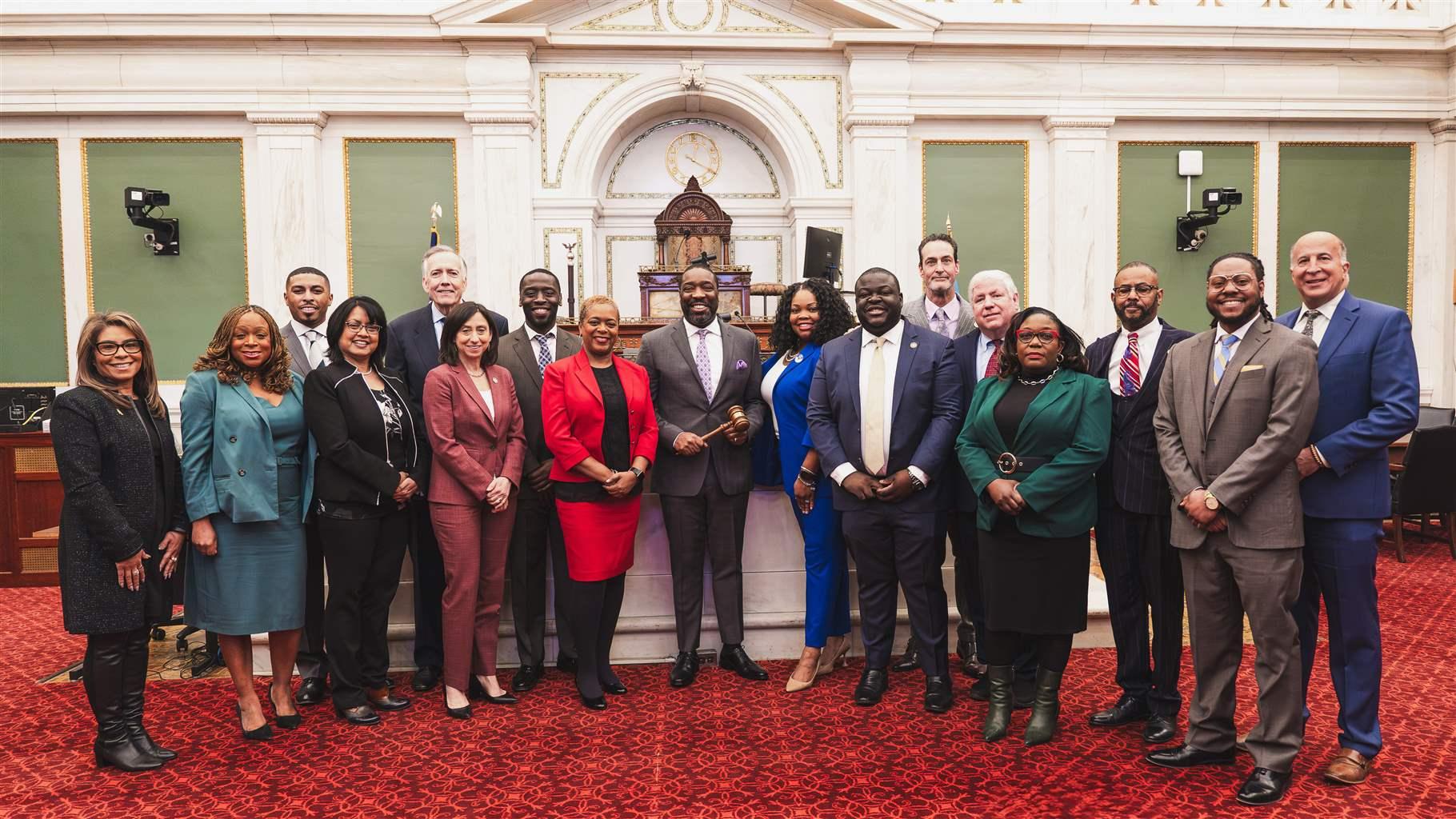
Under the charter, the council has 17 seats, one for each of 10 council districts and seven at-large seats, with no single political party allowed to occupy more than five of those seven seats. Councilmembers serve four-year terms, although a member’s term in office may be shorter if he or she is chosen in a special election.14 Furthermore, members are not subject to term limits. The mayor is limited to two consecutive four-year terms, with the ability to run again after sitting out four years. The charter also prohibits city employees from accepting positions on political campaigns and requires councilmembers and the mayor to relinquish their seats if they run for other elective office, which is sometimes referred to as the “resign-to-run” rule.15
The extensive detail and prescriptive nature of Philadelphia’s Home Rule Charter is viewed by some as serving more as an operations manual than as a constitution. “When you look at the circumstances it was responding to, the charter offered a more rule-bound, centralized system,” said Richardson Dilworth, head of Drexel University’s politics department, adding that it was all in “the spirit of the charter.”
Ken Trujillo, former city solicitor, said he appreciates the document’s scrupulous focus on the particulars of governance. “There is a real benefit to having a certain level of detail to the charter,” similar to case law, he said, to help Philadelphia’s Law Department—which acts as general legal counsel for the city government—interpret the rules when questions arise.
Some, however, have expressed concern about the charter’s length and its specificity about government operations. Among them is Barbara Adams, who served as secretary of the 1992 Independent Charter Commission tasked with the ultimately unsuccessful goal of overhauling the Home Rule Charter. The document, Adams said, is replete with items “that could more practically live in some other municipal code.” For example, she suggested that instead of charter amendments, “people could ask their representatives to submit ordinances,” which are simpler and require fewer steps to pass.
Another topic of debate is the relative advantage of longer versus shorter charters. Both approaches offer unique benefits: A longer, more specific charter can provide clarity about government operations and legal interpretations, while a briefer charter may serve as a flexible and responsive guiding document. Finding a balance between precision and adaptability is critical to effective municipal governance.
Amending the Home Rule Charter
State law ensures that Philadelphia and its residents can make changes to the local government structure through amendments to the Home Rule Charter.16
Charter amendments can institute discrete changes—for example, a specific government function, policy revision, or the removal or addition of an office or department. They can also lead to the wholesale reform of the charter, which would involve the creation of a charter commission that would recommend a long list of changes to be voted on as a package. This type of sweeping charter reform, however, has never been approved by voters in Philadelphia.
An amendment can be proposed in one of two ways:
- Residents can file a petition for a referendum to amend the charter. At least 20,000 registered electors in the municipality must sign the petition,17 which is then submitted to the Board of Elections.18
- The municipal governing body—City Council in Philadelphia’s case—can propose charter amendments by ordinance to the Board of Elections following a two-thirds council vote to adopt an enabling resolution.19
After adoption by the council, proposed amendments must be approved by voters in a primary, general, or municipal election. And state law requires that the county board of elections include a plain-language explanation of the ballot question to ensure that voters understand the proposed changes.20 The mayor has no formal role in approving resolutions for amendment but can veto any amendments approved by the council. However, the council can override that veto with a two-thirds majority vote.21
Notable charter changes
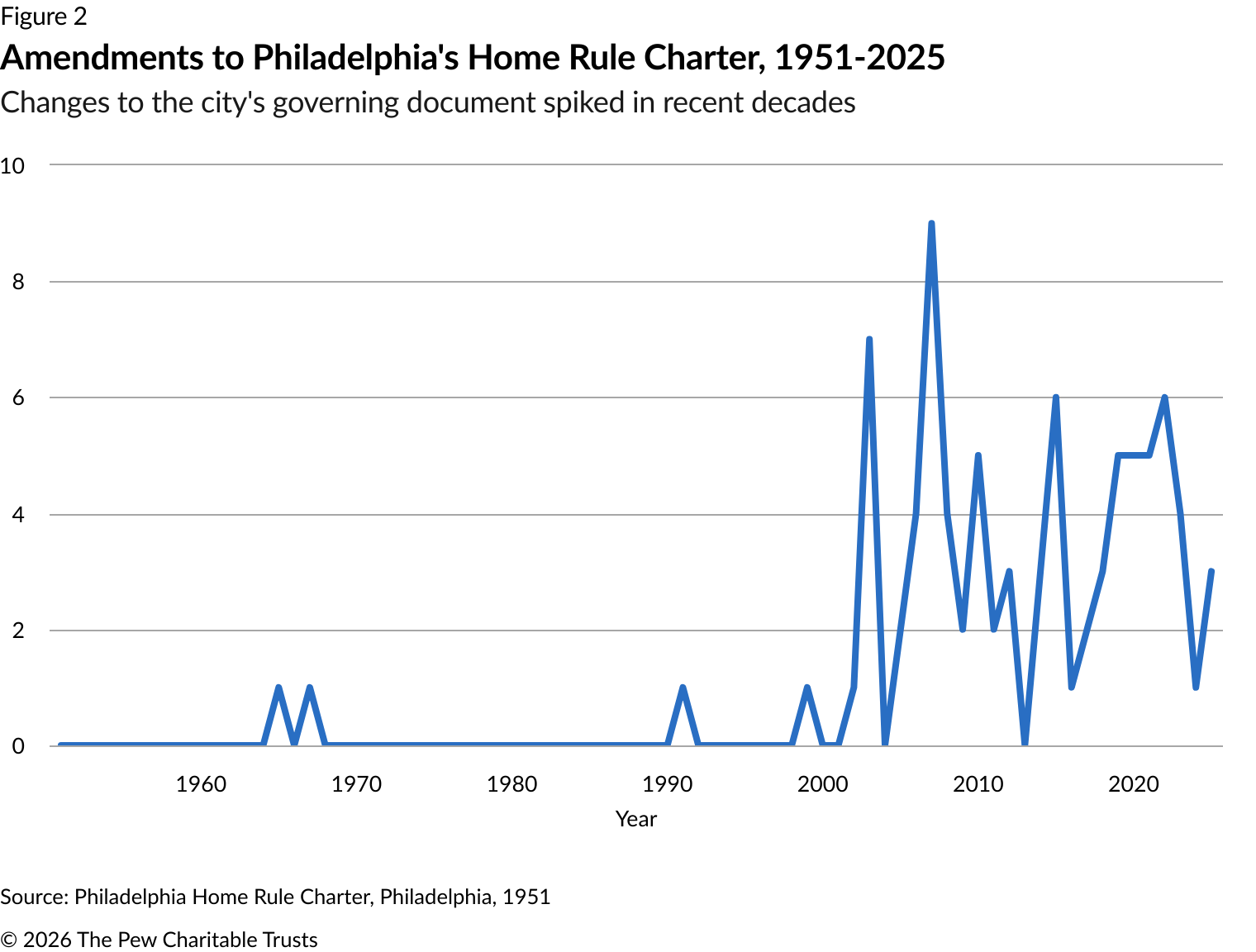
There have been more than 80 amendments to Philadelphia’s charter since 2000, two dozen of which have come in just the last five years. The amendments have covered a broad range of issues, from changes to the structure of the government, to the delivery of social services, to efforts to create greater fiscal stability.
Historically, charter changes represent an opportunity for voters to shape the document that guides how they are governed. In the five decades following its adoption, Philadelphia’s charter was amended only four times. But since the early 2000s, dozens of amendments have been passed, with one—sometimes more—moving forward almost every year.22
In 2026 alone, voters are likely to find a couple of charter amendments on their May ballots: one to enact the Philly Saves retirement program, which would automatically enroll workers without access to retirement programs into a city-sponsored program, and one to make permanent the Office of the Youth Ombudsperson. Another question, on whether to repeal the “resign-to-run” rule, was also slated for this ballot, but City Council decided in April to remove it.
The types of amendments adopted have varied significantly, from the establishment of new boards, departments, and commissions,23 to changes to specific city operations,24 to referendums simply declaring the city’s position on a given issue.25

The first amendment to the charter was in 1965, following a change in state law ending a restriction that prevented home rule charters from regulating public schools. The Proposed Supplement to the Home Rule Charter created a Home Rule School District for the city of Philadelphia, which gave the mayor the authority to appoint school district board members. Several amendments were approved in subsequent decades, among them a 1967 measure related to allowable debt and taxable property within the school district; a 1999 amendment aligning board members’ terms in office with that of the mayor—a move seen as increasing the mayor’s influence; and a 2018 amendment outlining the terms of eligibility and responsibilities for members of the Board of Education.26
Other topics, such as the need for competitive bidding when selecting contractors, have been revised on multiple occasions. The minimum amount requiring competitive bidding was increased from $2,000 to $10,000 in 1991, and again to $25,000 in 2003.27
Other charter amendments created entities that have a set deliverable or duration but can be renewed when deemed necessary. For instance, a 2002 amendment created the Philadelphia Tax Reform Commission, tasked with reviewing and suggesting changes to the city tax system, as well as to state tax guidelines as they affect the city.28 The tax commission issued its final report the following year. It has reconvened several times since then, most recently in 2024, following a City Council resolution calling for “recommendations on reforms to make [the tax structure] more inclusive, equitable, and growth oriented.”29
In recent years, several government offices were created or made permanent through amendments, including the Office of the Chief Public Safety Director (2023),30 the Office for People With Disabilities (2023),31 and the Office of the Homeless Services Ombudsperson (2025).32 Oversight commissions—including the Philadelphia Prison Community Oversight Board33 and the Office of Prison Oversight (2025)34—were also established, in an effort to increase transparency and accountability.
Some city workforce employment practices have also been modified via charter amendments. In 2021, Philadelphia residents voted to eliminate the “Rule of Two,” a practice requiring hiring managers to choose between the two candidates with the highest exam scores for any civil service position.
Additionally, charter amendments led to revisions of the Budget Stabilization Reserve (2023),35 to strengthen the city’s rainy day fund and increase the amount that could be transferred to this reserve fund from the city’s general fund. And in 2025, voters passed an amendment increasing mandatory annual appropriations for the Housing Trust Fund, to be used for building and maintaining affordable housing.36
Unsuccessful charter reform proposals
Although most charter changes were approved, Philadelphia voters have rejected three notable categories of proposed amendments over the years.
In 1978, in one of the best known and most controversial attempts at changing the city’s charter, then-Mayor Frank Rizzo sought to change the provision barring him from seeking a third consecutive term. Opposition was intense, voter turnout was high, and the amendment failed by nearly 2-to-1.37
Efforts to mount a recall vote in response to Mayor Rizzo’s failed quest for a third term led to a legal challenge in which Pennsylvania’s Supreme Court ruled that there was no constitutional authority under the charter to remove an elected official via a recall. That ruling underscored the degree to which the charter’s language must still adhere to state- and federal-level laws and protocols.38
In 1992, an independent commission was formed to review the Home Rule Charter and recommend reforms.39
“When Ed Rendell ran for mayor, he and his team felt that there were a lot of charter impediments to modernizing the city and moving it forward,” recalled Adams, the former Charter Commission secretary. “The city was also in acute financial distress at the time, and everyone wanted to know how to get out of it.”
The resulting reform package included 60 revisions, some procedural, including proposed changes to how departments and commissions would be created or abolished and how city staff could be hired and promoted. Other reforms created or abolished specific departments, commissions, and individual positions within city government. According to Adams, however, “there was no clear list of goals that could be easily measured, and no thematic story to tell explaining why the reforms would improve government and make it more efficient.”
In 1994, the commission’s amendment was ultimately rejected by voters, following strong opposition from a coalition of community groups, labor unions, and other advocates who framed the proposed rules changes as detrimental to workers.40
Then, in 2007 and 2014, two separate attempts to repeal Philadelphia’s resign-to-run rule were blocked by voters.41
In 2025, the council reintroduced legislation to amend the resign-to-run law, narrowing its limitations to allow elected officials running for state or federal offices to keep their seats; the law would still require councilmembers running for locally elected positions to resign.
Two years earlier, a 2023 proposal to exempt the Citizens Police Oversight Commission from civil service requirements—a bid to address staffing shortages within the commission—failed. The proposed amendment would have exempted members of the group from educational attainment thresholds and salary caps.42
Conclusion
In the 75 years since its adoption, Philadelphia’s Home Rule Charter has seen dramatic population shifts, civil unrest, citywide celebrations, economic downturns, and a deadly pandemic. And it has continually evolved in response to a changing world.
Though largely unaltered in the early years of its existence, the charter has seen a recent surge in the number of amendments, on a range of issues reflecting shifting public sentiment toward the functions of local government, as well as debates about efficiency, transparency, and the scope of government power. Cities throughout the country, including Philadelphia, continue to revise their charters through amendments and charter commissions, as local governance evolves in the 21st century.
In coming years, Philadelphia’s charter will probably continue to be revised as officials confront manifold challenges and opportunities ahead. These could include a shifting technology landscape, a modernizing workforce, and changing demands from Philadelphia’s residents. The future of the city’s charter system will be determined by whether and to what degree Philadelphians redefine their relationship with their local government, and how officials respond to the needs of an ever-evolving city.
Acknowledgments
This analysis was researched and written by Jennifer Clendening, Rishaun Hall, and Karim Sharif of The Pew Charitable Trusts’ Philadelphia research and policy initiative, with additional editing and interview support from Patrick Morgan, a senior officer with the initiative. It was edited by Larry Eichel, senior adviser with the initiative, and Katie Martin, the initiative’s project director, along with Tricia Olszewski and Carol Hutchinson. Ned Drummond and Dave Lam created the graphics and designed the publication.
Lauren Cristella, president and CEO of the Committee of Seventy, and Joseph P. McLaughlin Jr., director of Temple University’s Institute for Public Affairs, served as external reviewers for this publication.
This analysis does not necessarily reflect the opinions of either of these individuals or their institutions.
Endnotes
- Richardson Dilworth, Reforming Philadelphia, 1682-2022 (Philadelphia: Temple University Press, 2022).
- Philadelphia Home Rule Charter, Philadelphia, 1951, https://codelibrary.amlegal.com/codes/philadelphia/latest/philadelphia_pa/0-0-0-262986.
- Amy S. Rosenberg, “Voters Deliver a Noisy No to City Charter Change,” Philadelphia Inquirer, 1994.
- Andrew Heath, “Consolidation Act of 1854,” Rutgers University, accessed 2025, https://philadelphiaencyclopedia.org/essays/consolidation-act-of-1854/.
- Andrew Heath, “Consolidation Act of 1854.”
- Governor’s Center for Local Government Services, “City Government in Pennsylvania: Handbooks and Guides for Local Government Officials,” Commonwealth of Pennsylvania, 2017.
- Governor’s Center for Local Government Services, “City Government in Pennsylvania: Handbooks and Guides for Local Government Officials.”
- Amy Cohen, “New Book Examines Philadelphia’s Appetite for Corruption,” Hidden City, 2023, https://hiddencityphila.org/2023/11/new-book-examines-philadelphias-appetite-for-corruption/. Committee of Seventy, “The Charter: A Brief History.”
- Pennsylvania Governor’s Center for Local Government Services, “Home Rule in Pennsylvania, 12th Edition,” April 2023, https://dced.pa.gov/download/home-rule-pa-pdf/?ind=1710857603358&filename=HomeRule_2023v3.pdf&wpdmdl=57752&refresh=68c31977f12501757616503.
- Eastern Division Pennsylvania Economy League, “History and Features of Philadelphia Government,” 1992, https://www.economyleague.org/resources/history-and-features-philadelphia-government.
- Home Rule Charter, Article 5, Executive and Administrative Branch: Powers and Duties, Philadelphia, https://codelibrary.amlegal.com/codes/philadelphia/latest/philadelphia_pa/0-0-0-307242.
- LegalClarity, “How Much Power Does a Mayor Really Have?,” accessed 2025, https://legalclarity.org/how-much-power-does-a-mayor-really-have/.
- Home Rule Charter § 2-202, Submission of Ordinances to the Mayor, Philadelphia, 2006, https://codelibrary.amlegal.com/codes/philadelphia/latest/philadelphia_pa/0-0-0-263652.
- “Councilmember” is an intentionally gender-neutral term used throughout the Home Rule Charter, which was codified with a 2019 charter amendment replacing the previously used “councilmen.”
- Philadelphia, “Home Rule Charter, §10-107, Political Activities,” (1951): https://codelibrary.amlegal.com/codes/philadelphia/latest/philadelphia_pa/0-0-0-266053.
- First Class City Home Rule Act, Pennsylvania General Assembly, 1949.
- Pennsylvania Governor’s Center for Local Government Services, “Home Rule in Pennsylvania, 12th Edition.”
- 53 Ps § 13106. (First Class City Home Rule Act, § 6. Amendments to Charter), Pennsylvania, https://www.palegis.us/statutes/unconsolidated/law-information/view-statute?txtType=PDF&SessYr=1949&ActNum=0155.&SessInd=0.
- 53 Ps § 13106, Pennsylvania.
- Pennsylvania Governor’s Center for Local Government Services, “Home Rule in Pennsylvania, 12th Edition.”
- Home Rule Charter § 2-202, Philadelphia.
- Home Rule Charter, Philadelphia Law Department Preface, Philadelphia, 2025, https://codelibrary.amlegal.com/codes/philadelphia/latest/philadelphia_pa/0-0-0-262986.
- Home Rule Charter § 3-911, Zoning Board of Adjustment, Philadelphia, 2010.
- Home Rule Charter, Chapter 4: Civil Service Regulations, § 7-401, Contents, Philadelphia, 2021, https://codelibrary.amlegal.com/codes/philadelphia/latest/philadelphia_pa/0-0-0-265606#JD_HRC-7-401.
- Home Rule Charter § 8-502, Redeployment of U.S. Troops From Iraq, Philadelphia, 2007, https://codelibrary.amlegal.com/codes/philadelphia/latest/philadelphia_pa/0-0-0-265921#JD_HRC-8-502.
- Home Rule Charter, Philadelphia Law Department Preface, Philadelphia. The Pew Charitable Trusts, “Governing Urban Schools in the Future: What’s Facing Philadelphia and Pennsylvania,” 2016, https://www.pew.org/~/media/assets/2016/01/urban_school_governance_brief_final.pdf. Home Rule Charter, § 12-202, Eligibility for Board Membership, Philadelphia, https://codelibrary.amlegal.com/codes/philadelphia/latest/philadelphia_pa/0-0-0-266160.
- Home Rule Charter, § 8-200, Contracts, Philadelphia, 2003, https://codelibrary.amlegal.com/codes/philadelphia/latest/philadelphia_pa/0-0-0-265716#JD_HRC-8-200.
- Home Rule Charter, § 4-900, Powers and Duties, Philadelphia, 2002, https://codelibrary.amlegal.com/codes/philadelphia/latest/philadelphia_pa/0-0-0-264695.
- Philadelphia City Council, “Tax Reform Commission,” https://phlcouncil.com/taxreform/.
- CBS News Philadelphia Staff, “Philadelphia Residents Approve Chief Public Safety Director Position,” CBS News, May 17, 2023, https:// www.cbsnews.com/philadelphia/news/philadelphia-primary-election-ballot-questions-chief-public-safety-director/.
- Ballotpedia, “Philadelphia, Pennsylvania, Question 1, Office for People With Disabilities Amendment,” https://ballotpedia.org/Philadelphia,_Pennsylvania,_Question_1,_Office_for_People_with_Disabilities_Amendment_(November_2023).
- Home Rule Charter § 3-215, Homeless Services Ombudsperson, Philadelphia, 2025, https://codelibrary.amlegal.com/codes/philadelphia/latest/philadelphia_pa/0-0-0-307239#JD_HRC-3-215.
- Home Rule Charter § 3-216, Director of Prison Oversight, Philadelphia, 2025, https://codelibrary.amlegal.com/codes/philadelphia/latest/philadelphia_pa/0-0-0-307267#JD_HRC-3-216.
- Home Rule Charter § 3-216, Director of Prison Oversight, Philadelphia.
- Home Rule Charter § 6-110, Budget Stabilization Reserve, Philadelphia, 2023, https://codelibrary.amlegal.com/codes/philadelphia/latest/philadelphia_pa/0-0-0-265336.
- Home Rule Charter, Mandatory Annual Appropriations for the Housing Trust Fund § 2-300, The Annual Operating Budget Ordinance, Philadelphia, 2025, https://codelibrary.amlegal.com/codes/philadelphia/latest/philadelphia_pa/0-0-0-263670#JD_HRC-2-300.
- Gregory Jaynes, “Philadelphia’s Message to Rizzo: ‘Enough,’” The New York Times, Nov. 9, 1978, https://www.nytimes.com/1978/11/09/archives/philadelphias-message-to-rizzo-enough-predicted-greatest-victory.html.
- “Frank Rizzo Recall, Philadelphia, Pennsylvania (1976),” Ballotpedia, Dec. 19, 2025, https://ballotpedia.org/Frank_Rizzo_recall,_ Philadelphia,_Pennsylvania_(1976). Citizens Com. v. Board of Elections 470 Pa. 1 (1976), (1976), https://law.justia.com/cases/pennsylvania/supreme-court/1976/470-pa-1-0.html.
- Eastern Division Pennsylvania Economy League, “History and Features of Philadelphia Government.”
- Amy S. Rosenberg, “Voters Deliver a Noisy No to City Charter Change.”
- Claudia Vargas, “Phila. Voters Reject Repealing Resign-to-Run Rule,” The Philadelphia Inquirer, 2014, https://www.inquirer.com/philly/news/politics/20140521_Phila__voters_reject_repealing_resign-to-run_rule.html.
- Jordan Levy, “Should the City Loosen Requirements for Police Oversight Board Staff to Provide More Flexibility in Hiring?” Billy Penn at WHYY, May 5, 2023, https://billypenn.com/2023/05/05/philadelphia-ballot-question-police-oversight-board-staff/.
People


