The Remote Work Challenge: Lessons From 5 Cities
As office building vacancies jeopardize urban fiscal health and downtown vitality, here’s how cities and states are adapting

Overview
The COVID-19 pandemic called into question the economic vitality of U.S. cities. The rise of remote work meant employees experienced zero-minute commutes and a greater ability to balance their work and home lives. Cities, however, confronted the possibility that fewer people would choose to live and work in urban areas. For cities, this economic risk has also posed a budget risk: Cities’ primary revenue sources—property taxes, sales taxes, and income taxes—are typically influenced by the value of office buildings and the wages and spending of office workers.
In the September 2022 paper “Work From Home and the Office Real Estate Apocalypse,” three business school professors from New York raised the frightening possibility that the economic and fiscal problems of cities could be self-reinforcing, a vicious cycle they dubbed a “doom loop.” They argued that the declining value of office buildings would reduce local tax revenue; less tax revenue would force cities to cut services or raise taxes; and, as a result of these budget-balancing measures, cities would be even less appealing places to live and work, leading to even less economic activity and revenue.1
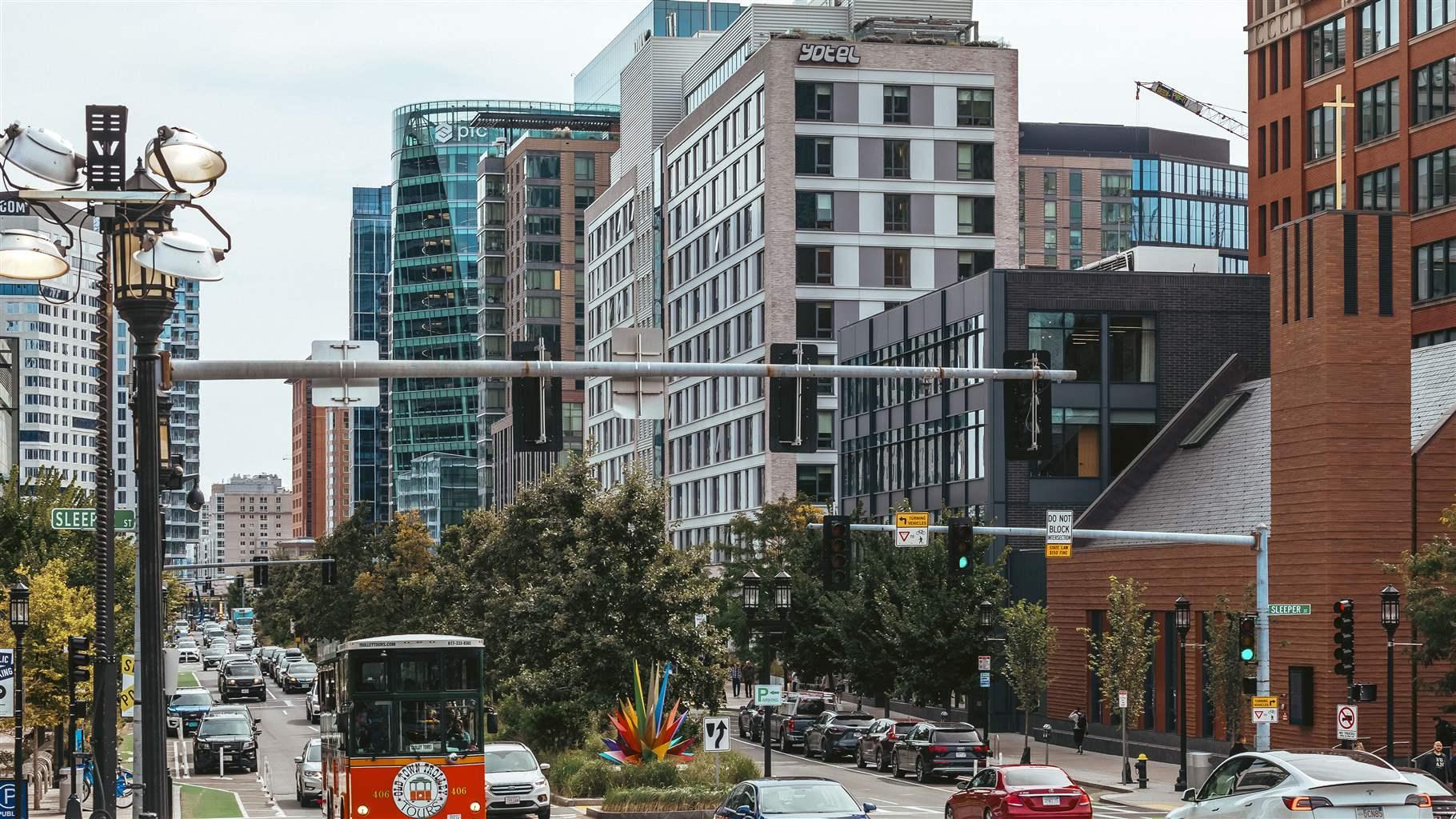
City officials, municipal analysts, researchers, and journalists have spent the intervening years determining how serious the threat really is—and which places are most vulnerable. During the pandemic, much of the immediate focus centered on a small group of cities. New York and San Francisco were of particular interest because of their obvious vulnerabilities, including large office sectors, some of the most expensive commercial real estate in the country, and rapid population loss early in the pandemic.2
In recent years, however, researchers have recognized the need for a broader perspective of how cities are faring. New York and San Francisco may not be the cities most at risk: New York’s office recovery has been particularly robust, while the artificial intelligence boom has spurred renewed optimism for San Francisco’s tech-focused economy.3 Looking beyond these cities is helpful to understand the full scope of the problem and determine whether the risks from remote work are concentrated in a few atypical cities or endanger the fiscal health of a far greater range of places.
Since 2024, the Urban-Brookings Tax Policy Center, Moody’s Ratings, and the Lincoln Institute of Land Policy have each projected the possible effects of remote work and office vacancies on revenue collections in dozens of cities.4 This report seeks to complement these quantitative analyses with a qualitative look at five cities: Atlanta, Boston, Dallas, Denver, and Milwaukee.
In each city, researchers from The Pew Charitable Trusts interviewed budget and economic development officials, local experts, and civic and business groups about the pandemic’s impact on the local economy, the effects of remote work and office vacancies on the municipal budget, and how leaders are adapting.
Each city was selected because at least some data points suggested it might be vulnerable to economic and fiscal challenges from remote work. For example, Boston and Dallas are unusually dependent on commercial property taxes (which could drop as office values decline), while Atlanta has some of the longest commute times in the country (which could discourage workers from returning to the office).5
Although these five cities are not necessarily representative of the country as a whole, their experiences help to illustrate the breadth of the impact of remote work, showing how its rise has played out in places with varied economies and tax structures, and what it could mean for the future. Researchers also interviewed national experts on office vacancies, city finances, and urban development to provide additional context.
The effects of remote work on cities have been manageable so far, but city leaders should be concerned that they are not happening in isolation: Cities are also struggling with rising costs, reduced state and federal support, and fragile economies, among other challenges.6 Even if remote work on its own is not sufficient to cause cities lasting harm, it could result in harm in combination with these other factors. Encouragingly, city leaders are not complacent—they are trying to adapt to remote work and renew downtown vitality. The outlook for cities will depend in large measure on the success of these efforts and the degree of support they receive from state and federal policymakers.
This report provides an overview of the situation nationally and then shares research findings from each of the five cities individually. Key findings show that:
- Although these cities have been affected meaningfully by remote work, none has truly entered a doom loop—at least not yet. Tax revenues have proved resilient, in part because of strength in tax streams unaffected by remote work. For example, high housing prices have boosted residential property taxes.
- Despite the modest effects on the budgets of the five cities so far, risk remains. Because reduced office values only gradually affect commercial property tax revenue, cities do not know the full impact yet.
- Downtowns are struggling with increased office vacancies and reduced foot traffic. According to multiple interviewees, the loss of office workers made downtowns feel less safe and vibrant, making them less attractive for retailers, residents, and visitors.
- Office-to-residential conversions are a key part of cities’ efforts to transform depressed downtowns into more complete neighborhoods. Leaders are focused on increasing the supply of housing downtown and creating places that will attract visitors, accessing federal programs, creating local incentives, and even buying underutilized buildings to spur conversions.
- Decisions at the state level directly affect how easily cities can adapt to post-pandemic realities. States provide funding to cities, determine which taxes they can levy and at what rates, and create programs to encourage downtown redevelopment.
The national picture
The debate over the doom loop
To date, the worst fears of urban doom loop theorists have not been realized. Revenue collections have remained surprisingly unremarkable: After the initial fiscal shock of the pandemic, city tax revenue grew in 2022 and 2023, per a National League of Cities survey.7 Although revenue collections have weakened more recently, this weakness is more reflective of the challenges common to state and local governments generally—especially weaker economic growth and the expiration of temporary federal COVID aid—and less an obvious consequence of remote work and office vacancies.8
Other measures of city vitality have bounced back from pandemic lows. Many big cities lost population initially, but almost all were growing again by 2024 (though restrictive immigration policies put further growth in doubt).9 Urban crime rates have fallen after a pandemic-era spike.10 Cities have benefited from the recovery of domestic business and leisure travel (though they face new challenges from a decline in international visitors).11 Taken as a whole, cities face fiscal and economic pressure, but there is little indication of a significant downward spiral.
“Nobody’s calling it a doom loop anymore,” Sarah Sullivant, a managing director with S&P Global Ratings who assesses cities’ creditworthiness, told Pew.12
But as Stijn Van Nieuwerburgh, a Columbia Business School professor and one of the authors of the “Office Real Estate Apocalypse” paper, pointed out: Many of the steps in the doom loop process have played out as predicted.13 Office vacancies surged to record levels and continued to reach new highs into 2025, even as some public and private sector employers require a higher number of workers to return to the office more days a week (see Figure 1).14 As a result, sale prices of office buildings across the country have plummeted. The owners of these buildings are often in financial distress, struggling to pay back loans or qualify for new ones that they can afford.15

What is surprising, Nieuwerburgh told Pew, is that the office market’s problems have not had a more obvious impact on city finances.16 There are a few possible explanations for that.
One of the most benign is that the taxes directly affected by office values—especially commercial property taxes—simply make up too small a share of overall revenue to fundamentally alter a city’s fiscal direction. Property taxes are the largest source of revenue for most cities, but many major cities also raise a substantial share of their revenue from sales taxes, income taxes, or other levies.17 These other taxes are not generally thought to be as vulnerable to the effects of remote work, although in some instances they might be— Philadelphia, for example, applies its income tax to commuters and has seen a substantial drop in wage tax revenue from nonresidents.18 Just as importantly, commercial property tax revenue is only part of overall property tax revenue and not the biggest part—in most cities, residential property tax revenues raise more.19
Not all commercial properties are office buildings, so taxes on them are a fraction of commercial property tax revenue, which is a fraction of overall property tax revenue, which is a fraction of total revenue. This increasingly smaller fraction may not be big enough to make a large difference for city budgets, especially because residential property tax revenue has surged—a byproduct of the stubbornly high home prices that have created a housing affordability crisis throughout the country.
In many cities, weakness in property tax is also at least somewhat self-correcting. If property values go down, city officials have the power to raise tax rates to compensate—and potentially collect the same amount of revenue as if values were stable. This power may be constrained by laws (state property tax limits sometimes prevent rate hikes), politics (property owners may advocate against higher rates), and economics (higher taxes can force office building owners deeper into distress). But, despite those constraints, cities adjust property tax rates more routinely than, for example, states raise income or sales tax rates.20
Several efforts to quantify the effects of office vacancies on city revenue have shown meaningful but manageable effects. A 2024 Tax Policy Center study examined 47 cities and found that in only five—Boston; Dallas; Knoxville, Tennessee; Madison, Wisconsin; and Manchester, New Hampshire—did commercial property tax revenue represent more than 20% of total revenue.21 Nonetheless, the authors concluded that, “Budget challenges related to declining commercial property tax collections will affect many local governments over the next few years.”22 A 2024 Moody’s Ratings analysis found that “most cities showed less than a 2% loss in total revenue from a sharp decline in commercial or office values” and also “have significant revenue diversity from other sources which can help them make budget adjustments over the next few years to the extent that commercial assessed values decline.”23 Similarly, a 2025 Lincoln Institute of Land Policy working paper studied 135 cities and concluded that thanks to revenue sources other than the property tax, the “overall negative impact of remote work on the revenue-raising capacity of cities averaged only 2.9%” and “that few, if any … will face a ‘doom loop.’”24
There is, however, a less benign explanation of the muted effects of remote work on city budgets: Simply not enough time has passed yet. There are several reasons why weakness in the office market would not immediately translate into weakness in municipal revenue.
First, property tax revenue will fall only after the assessed value of the properties declines, but assessments take place on varied schedules, with about half of states requiring annual assessments and others conducting them less frequently.25 Even when local officials conduct new assessments, they generally do not affect property tax bills until the following year, creating a further lag between changes in market values and what property owners pay.26 Furthermore, property tax assessments are generally based on how much income the properties generate, which may not fall immediately. For example, tenants often sign long-term leases for office space; the buildings generate less income only when the leases expire and owners are unable to lease the space for the same price.27
Finally, the biggest problems for owners occur when they are unable to pay off their mortgages or refinance. That situation would normally result in distressed sales or foreclosures, actions that would reveal—to local tax assessors and everyone else—how far the true values of the buildings have fallen. But lenders have largely been as eager as owners to avoid this outcome because they do not want to take possession of the buildings and assume the problems of owning a distressed asset. Instead, many lenders have allowed owners to delay payments or have extended loans under existing terms, a strategy known as “extend and pretend.”28
Taken together, these factors suggest it may still be too early to confidently declare the extent of the challenges for city budgets. Nieuwerburgh sees the situation differently than optimists such as Sullivant: “I’ve always thought this was going to be a slow-moving train wreck.”29
Struggling downtowns
Although local budget and revenue officials are generally downplaying the fiscal effects of office vacancies, leaders who are specifically focused on downtowns are less sanguine. When Pew spoke with staff from downtown civic groups and business improvement districts, they generally viewed remote work as having sapped the vitality of the neighborhoods they serve. They said that a significant course correction was necessary—even in cities such as Atlanta and Boston where budget officials hadn’t seen dramatic fiscal effects.30 Local leaders also made the case that downtowns still matter for cities’ economies (even with remote work, a large share of workers are located downtown), budgets (downtowns produce a significant share of city revenue), and image and culture (tourists and other visitors often congregate at museums, stadiums, theaters, and restaurants in these neighborhoods).
One thing that was clear from these interviews is that not every neighborhood with a collection of office buildings is struggling to the same degree. Instead, traditional downtowns with older office buildings constructed in the 1980s or earlier generally have higher vacancy rates, greater declines in office building values, and less foot traffic compared to newer office-centric neighborhoods—resulting in greater struggles not just for the office building owners themselves, but also for restaurants and retailers that depend on their tenants.
These neighborhoods are struggling for at least three reasons. First, as demand for office space has decreased, tenants have gravitated to newer buildings with more amenities in what observers describe as a “flight to quality.”31 Second, older downtowns were built before mixed-use development came into vogue. As a result, they often have fewer residents and therefore less alternative sources of foot traffic and business activity to fall back on as offices stop being reliable economic engines. Third, downtowns were often the epicenter of pandemic-era challenges such as increased crime and homelessness, in part because downtowns often house social service providers and public facilities such as jails and homeless shelters. “Most downtowns have those because, once they were established, nobody wanted one in their neighborhood,” A.J. Robinson, the president of Central Atlanta Progress, a nonprofit that seeks to improve the city’s downtown, told Pew.32
Multiple sources shared similar stories of traditional central business districts—which have a larger share of older, single-use office buildings—struggling relative to other local commercial neighborhoods. In Atlanta, downtown is doing worse than Midtown or Buckhead; Denver’s upper downtown is struggling compared to lower downtown; downtown Dallas is in more distress than uptown.33 Although this pattern generally predated the pandemic, the loss of office workers accentuated the struggles of older downtown areas. In Denver, the loss of office workers made streets in upper downtown feel more deserted and homelessness more visible, which led to even more reluctance for workers and visitors to return downtown, creating—on a micro scale—what the mayor described as a doom loop.34 Out of the five cities Pew studied, only Milwaukee’s leaders view their downtown as performing well, with sources citing the Milwaukee region’s short commute times (see Figure 2) and downtown residential population as factors encouraging employees to continue to work downtown and shop at neighborhood businesses.35

Almost universally, city officials think the best way to solve these problems of obsolete downtowns is to transform them from 9-to-5 business districts to more complete neighborhoods, building parks, event venues, and other public spaces that will attract visitors. That means nurturing retailers and restaurants. But most of all, it means making sure far more people can live downtown.
In this regard, office buildings are both the source of the problem and a potential solution, if underused offices are converted to housing. Recognizing this opportunity, most major cities have adopted financial incentives such as property tax abatements to encourage conversions.36 Cities and developers have also found creative ways to tap state and federal incentive programs such as tax increment financing, enterprise zone programs, and historic rehabilitation tax credits. For example, Dallas is considering expanding its downtown historic district, a move that would allow conversion projects to receive federal historic rehabilitation credits even if the buildings are not at least 50 years old, the typical standard.37 And, beyond spending money on the problem, some cities are thinking creatively about how they can offer technical help and regulatory relief to help facilitate conversions. For example, New York City has established an Office Conversion Accelerator program to help projects assess feasibility and qualify for permits, with input from multiple city agencies.38
These efforts have faced substantial economic headwinds because high interest rates and high costs for building materials have raised price tags for the projects. Nonetheless, national experts such as Nieuwerburgh and Tracy Hadden Loh, a fellow at Brookings Metro, have become more optimistic that many underutilized offices will ultimately prove suitable for conversions.39
As offices remained empty during the pandemic, much of the initial discourse focused on the practical challenges to turning an office into an apartment—such as how to fit in all the necessary kitchens, bathrooms, windows, and elevators.40 But interviewees told Pew researchers that maintaining a mix of uses in buildings—apartments, offices, hotels, and retail—can help solve some of these problems.41 Furthermore, the further office buildings fall into distress, the more conversion projects that previously seemed cost-prohibitive begin to look appealing. “There used to be the sense that there are all these office buildings that you can’t really convert,” Nieuwerburgh told Pew. “It’s too complicated. They’re too big. The floor plates are too deep. It’s too hard to bring light and air into the interior.” But, he said, “I’ve completely changed my mind on this. My new view is every office building can be converted. The only question is: How much does it cost?”42
Office-to-Dorm Conversions Present an Opportunity
Though office-to-residential conversions are often expensive, office-to-dorm conversions can cost less because they involve fewer kitchens and bathrooms, smaller units, and less plumbing work. In some cities—such as Hartford, Connecticut, and Washington, D.C.—universities have purchased vacant office buildings to convert them into traditional student dorms. Pew’s housing policy initiative and the architectural firm Gensler published research showing that office buildings could be converted into dorm-style housing available to the general public. They have estimated the conversion costs per square foot to be 25% to 35% lower than traditional office-to-residential conversions, while the number of units produced is roughly triple.43
The state role
As city governments have sought to reinvent their downtowns, state governments have mostly stayed in the background. Conversions have caught some state officials’ interest. Some have enacted their own financial incentives—California, for instance, committed $400 million in 2022, while Washington created a sales tax break for conversion construction costs in 2024.44 Others have sought to address regulatory obstacles to conversions, with state efforts ranging from allowing commercial properties to be converted into housing without going through a rezoning, to removing parking mandates that increase costs.45 However, experts who work with state economic development officials nationwide say, beyond the narrow topic of conversions, the new problems faced by downtowns are not really on officials’ radar.46
Where states do invariably have a huge role is setting the rules for city finances. States decide what taxes localities may levy and their maximum rates. Often, they dictate what services cities are responsible for providing. As a result, when cities succeed or fail financially, states almost always deserve a substantial share of the credit or blame.
No city illustrates that point better than Milwaukee. Of the five cities Pew studied, Milwaukee appears to have been least affected by office vacancies. Yet of the five, Milwaukee faced the most severe financial crisis in the post-pandemic period. Starting decades ago, the state of Wisconsin contributed to this crisis by cutting inflation-adjusted state aid to cities, limiting property tax growth, and forbidding cities to enact other broad-based taxes.47 But the state also helped solve the crisis—at least for the time being—in a 2023 deal that allowed Milwaukee to levy a sales tax, while also moving city workers into the state’s better-funded retirement system and establishing new requirements for public safety staffing.48
Elsewhere in the country, city officials have sought state help addressing the effects of office vacancies, with mixed results. For example, in 2024, state lawmakers refused to give Boston Mayor Michelle Wu permission to tax commercial properties at higher rates—her preferred response to weakening commercial revenue that is forcing homeowners to pay more to compensate.49 Furthermore, to the extent cities’ requests for help require additional state dollars, the asks may be ill timed—many states face emerging budget deficits and long-term fiscal pressures.50
History shows, however, that despite those pressures, states should take the fiscal and economic health of their cities seriously. The theory that remote work and office vacancies will cause urban doom loops remains unproven —but the idea that cities can fall into downward spirals in which fiscal and economic stress builds off itself is an established fact.51
For example, the loss of factories starting in the 1950s spurred a decades-long decline in much of the industrial Midwest: From 1950 to 2020, Buffalo, Cleveland, Detroit, Pittsburgh, and St. Louis all lost at least half of their populations.52 Cities in long-term decline not only provide fewer services and opportunities to residents, but also weaken state and regional economies and prove hugely expensive to state governments—which face depressed tax revenue and expensive turnaround efforts.53
Even many cities that have remained fiscally resilient despite the rise of remote work are beginning to face a bleaker outlook for unrelated reasons: weaknesses in the national economy; rising costs of workers, goods, and services; and reduced federal aid to cities themselves and to anchor institutions such as universities. A 2025 Pew analysis found that 20 of the 25 most populous cities in the U.S., including Dallas and Denver, have faced budget deficits recently or project them for the future.54 Several cities such as Houston and San Diego that produce long-term projections expect deficits throughout the multiyear forecast period, but for the many cities that do not produce these analyses, it’s hard to know what is ahead.55 Widespread budget challenges raise the possibility that office vacancies will not on their own tip otherwise fiscally healthy cities into long-term decline, but rather that they will be one factor among many that contribute to ongoing distress.
Many experts remain optimistic. Loh, of Brookings, generally views the risk of doom loops as “overblown”—but she also said state governments are key to avoiding the feared outcomes.56 “What’s going on with commercial property just means that cities need to be able to tailor their revenue strategy to be flexible and adapt to match it to the changing economy,” Loh told Pew. “[I]f states don’t give municipalities that flexibility, then they will just run out of money instead, and that would be a manufactured doom loop.”57
The experiences of five cities
To understand how remote work and office vacancies are affecting the budgets and economies of five cities— Atlanta, Boston, Dallas, Denver, and Milwaukee—Pew interviewed city officials and other leaders and experts. While these cities’ experiences have much in common—most are struggling with elevated office vacancies and underperforming downtowns—they also illustrate the varied impact of the rise of remote work and the varied strategies for responding.

Atlanta
 |
Population annual percent change, 2010-20 Population annual percent change, 2020-24 |
1.7% 1.1% |
 |
Remote work percentage, metropolitan area, 2024 | 18.8% |
 |
Office vacancy rate, second quarter 2025 Percentage revenue from commercial property tax, FY 2024 |
24.3% 19.8% |
 |
Mean minutes to travel to work, metropolitan area, 2024 | 32.4 |
 |
Median monthly apartment rents, October 2025 Typical home value, October 2025 Median household income, 2024 |
$1,526 $381,393 $88,165 |
|
Note: All data verified as of February 2026. Sources: U.S. Census Bureau, decennial census, annual population estimates, and American Community Survey (population change, remote work, commuting time, and household income); Colliers 2025 Q2 office market report (office vacancy rate); Pew analysis using Brookings-Urban Tax Policy Center methodology from “The Future of Commercial Real Estate and City Budgets,” 2024 (revenue from commercial property tax); Apartment List, historic rent estimates, accessed December 2024 (apartment rents); Zillow Home Value Index all homes time series, smoothed, seasonally adjusted (home values) |
||
Overall, Atlanta’s budget and economy are performing reasonably well. But the city’s downtown—which lacks both new office buildings and sufficient housing—risks being left behind. In response, civic leaders are not seeking to restore downtown to pre-pandemic prosperity, but instead to build something new: a more complete neighborhood that attracts not only tourists or office workers, but residents too.
Downtown Atlanta’s problems did not start with the pandemic. No new office buildings have been built in the neighborhood in 20 years—a period in which the metropolitan area grew by more than 1.5 million people.58 The lack of development reflects intense local competition. Besides downtown, Atlanta has two other major office and commercial districts—Midtown and Buckhead—both of which are newer than downtown.59 Plus, most people live and work in the suburbs: Less than 10% of the metro population lives in Atlanta.60
The post-pandemic period has further drawn downtown’s disadvantages into stark relief. Like other cities, Atlanta has experienced a “flight to quality,” with office tenants preferring newer buildings with more amenities—the types of buildings downtown lacks.61 As a result, downtown office buildings were more than 30% vacant in the second quarter of 2025, per Colliers, well above the Atlanta region’s vacancy rate of 24%.62
So far, though, the effects of these trends on Atlanta’s budget have been relatively muted. Atlanta has received a top AAA credit rating from Fitch Ratings, which upgraded the city in 2024.63 The city had to close a midyear budget deficit in fiscal year 2025, but police overtime costs were the primary cause of the gap—not anything tied to remote work.64 More office owners are challenging their property assessments, a warning sign for the property tax, which accounts for nearly 40% of Atlanta’s general fund revenue.65 Still, property tax revenue has continued to grow: The city’s fiscal 2026 budget anticipates $389 million in property tax revenue, up from $281 million three years earlier, buoyed by strong residential values and new construction.66
What downtown boosters say is that the city would be in even better shape if downtown had simply kept pace with other neighborhoods. And, they argue, the success of downtown still matters.67 Atlanta is the home of the world’s busiest airport, and visitors play a central role in the regional economy.68 Whether they are in town for conventions, vacations, or sporting events, most of them come downtown.69 “We’re still the postcard,” said A.J. Robinson, the president of Central Atlanta Progress. “We have the most interesting office buildings. We have the biggest athletic facilities. We have the parks. We have the state capitol. It’s the brand of Atlanta and, to some extent, Georgia.”70
To avoid having that image defined by vacant office buildings or empty streets, the city is increasingly trying to turn downtown Atlanta into a place to live. In Atlanta, more so than in many American cities, that would be a major shift. Until the 21st century, the car-centric Atlanta region had few multifamily buildings. By the time developers began to construct larger residential buildings in Atlanta, Midtown and Buckhead were the preferred neighborhoods to live in.71

Like other cities, Atlanta is seeking to address the lack of downtown housing through office-to-residential conversions. But while many cities have relied on incentives for developers, Atlanta’s first major effort was to buy a skyscraper. The structure, 2 Peachtree, was a state office building that Georgia officials had spent years trying to offload. The city paid $39 million for it in 2023, hoping that a successful conversion could prove the viability of conversions while having a catalytic impact on downtown.72 “This is revolutionary,” Mayor Andre Dickens said in 2022, when the city announced the planned purchase. “We want to bring life and vitality back to downtown because after about seven o’clock in downtown, ain’t nobody here.”73
Completed in 1966, 2 Peachtree has a prime location at the center of the city’s subway system and a noteworthy history: It was once the tallest building in the entire Southeast.74 Despite those advantages, the project has given the city a firsthand view of the difficulty of office conversions, including costly engineering challenges, complicated financing, and high construction costs.75 The city selected developers to lead the project in 2024.76 As of early 2026, Atlanta officials expected construction to begin by the end of the year.77
Building from scratch is an alternative to converting existing properties, but few downtowns have substantial tracts of undeveloped land. Atlanta is an exception. “The gulch” had long been a 50-acre hole in the middle of downtown Atlanta—40 feet below surrounding streets—that once housed extensive railyards and, more recently, parking lots.78 After decades of false starts, in 2018, the city approved up to $1.9 billion in municipal bonds to redevelop the area, the costliest incentive package in city history.79
While the funding predates the pandemic, the plan for the development—now known as Centennial Yards—has changed significantly since then. Originally, developers intended for the area to skew heavily toward office buildings, but more recent plans give far more space to build apartments, hotels, retail, and entertainment venues—what commercial real estate firm Colliers has termed “the largest mixed-use development in the Southeast.”80
Centennial Yards is not scheduled for completion until 2030, but builders are racing to finish several pieces by the summer of 2026, when downtown’s Mercedes-Benz Stadium will host eight World Cup soccer matches.81 That urgency reflects Atlanta leaders’ desire to capitalize on the visibility provided by the World Cup, but also the broad recognition that for downtown to thrive, it needs to change. “People have realized that, unless you have people living downtown and grocery stores and other amenities, you can’t have that vibrant downtown that you’re looking for,” Jerry Parrish, the chief economist at the Metro Atlanta Chamber, told Pew.82

Boston
|
Population annual percent change, 2010-20 Population annual percent change, 2020-24 |
0.9% -0.1% |
|
Remote work percentage, metropolitan area, 2024 | 16.2% |
|
Office vacancy rate, second quarter 2025 Percentage revenue from commercial property tax, FY 2024 |
24.1% 28.3% |
|
Mean minutes to travel to work, metropolitan area, 2024 | 31.9 |
|
Median monthly apartment rents, October 2025 Typical home value, October 2025 Median household income, 2024 |
$2,413 $758,702 $97,791 |
|
Note: All data verified as of February 2026. Sources: U.S. Census Bureau, decennial census, annual population estimates, and American Community Survey (population change, remote work, commuting time, and household income); Colliers 2025 Q2 office market report (office vacancy rate); Pew analysis using Brookings-Urban Tax Policy Center methodology from “The Future of Commercial Real Estate and City Budgets,” 2024 (revenue from commercial property tax); Apartment List, historic rent estimates, accessed December 2024 (apartment rents); Zillow Home Value Index all homes time series, smoothed, seasonally adjusted (home values) |
||
Perhaps no major American city relies more on property taxes in general or commercial property taxes in particular than Boston.83 More than 70% of the city’s revenue comes from property taxes, with taxes on commercial properties representing more than half of that portion.84 This fact explains why, when national experts such as the Tax Policy Center or Moody’s Ratings have assessed which cities’ revenue systems are most vulnerable to office vacancies, Boston is at or near the top of the list.85 But city officials argue that while real risks remain, this perspective understates Boston’s fiscal resilience.
The basic reason for city officials’ optimism is that while Boston depends on property tax revenue, the amount of revenue it collects is not directly tied to property values. Instead, the city has routinely increased revenue collections by 2.5% each year, the maximum amount allowed under a 1980 Massachusetts ballot measure known as “Proposition 2½.”86 If the values of existing properties go up, rates must fall to limit the revenue growth to 2.5%. (The law also allows for additional revenue growth from property taxes on new development.) If property values go down, the city can raise rates to reach the 2.5% figure. “It’s really nice to have a revenue source that can grow by a certain percentage and you can kind of count on every year,” Ashley Groffenberger, Boston’s chief financial officer, told Pew.87
This approach only works, of course, if property owners tolerate the higher bills. When the city reassessed property values for fiscal 2025, the values of existing commercial properties fell.88 To reach the maximum 2.5% increase, the city’s only options were to raise rates on commercial owners or to ask residential property owners to pay more.89 Citing her city’s housing affordability crisis, Boston Mayor Wu’s preference was to raise commercial rates.90
However, the choice was not the city’s alone. State law limits how much higher commercial rates can be than residential rates, and Boston was already at the maximum. To raise commercial rates higher, the city needed state lawmakers’ permission. Wu first requested this authorization in 2024, but with many commercial owners opposed to paying higher rates when they were struggling financially, lawmakers demurred.91 Instead, for fiscal 2025, property taxes for single-family homes increased by more than 10%.92 Wu reintroduced the proposal in 2025, but, as of the end of the year, lawmakers still had not supported it.93
The fear is that Boston homeowners will be strained by a series of similar tax increases in coming years or, if those increases prove politically unpalatable, the city may need to make substantial budget cuts. In a June 2025 report, “Ongoing Fallout From Boston’s Empty Offices,” two research groups estimated that, by fiscal 2029, inflation-adjusted commercial property values could fall by 35% to 45% from fiscal 2024 levels. Unless the city raises tax rates, this drop would reduce tax revenue over this period by roughly $1.7 billion.94 While other civic leaders dispute the details of the “Fallout” report, most agree that the values of office buildings have not stabilized yet.95 Several office buildings have recently sold well below their assessed value, and those prices suggest that future rounds of assessments will push the values lower.96

At the root of these challenges is not just a depressed market for office buildings but also state laws that restrict the revenue-raising authority of cities. Massachusetts cities cannot levy income taxes or sales taxes. They cannot raise rates for other taxes beyond state-designated maximums.97 Instead of giving cities the power to raise taxes, the state has traditionally given them state dollars in the form of unrestricted state aid. But the share of revenue Boston receives from state aid has fallen from 21.5% in fiscal 2006 to just 10.8% in fiscal 2026, as it has failed to keep up with inflation and as property tax revenue has surged.98 Governor Maura Healey has proposed allowing cities to raise smaller excise taxes on motor vehicles, hotels, and meals, but legislators have not acted on these ideas.99
Where state officials have provided more assistance is to help return vacant or underutilized office buildings to more productive uses. Since 2024, the state has pumped millions of dollars into conversions—complementing the city’s own incentive program—while also providing technical assistance to help potential projects assess feasibility and navigate regulatory barriers.100 These combined efforts have succeeded in launching the conversion process—the city reported receiving around 20 applications for conversions as of late 2025—and stand to add much-needed housing units to the city.101 But, from a revenue perspective, their effects are more ambiguous. Returning vacant space to productive uses could raise property values. Higher values may not translate into higher revenue, however, because residential properties are taxed at lower rates than commercial ones and because the city’s conversion incentive can reduce what they pay in property taxes by up to 75% for 29 years.102
Despite the challenges, Boston retains substantial fiscal and economic strengths. The city has an impressive collection of businesses in life sciences and finance, bolstered by health care and higher education institutions that, while facing their own headwinds, still undergird the local economy.103 Unlike many other cities in Massachusetts, Boston has continued to enjoy substantial real estate development, especially in South Boston’s Seaport District—important from a budget perspective because taxes on new development that are exempt from Proposition 2½ (and its 2.5% limit) have allowed for year-over-year property tax revenue growth of 4% to 6% in recent years.104
These factors help explain why, in 2025, credit rating agencies reaffirmed Boston’s top AAA credit rating for a 12th consecutive year.105 Evan Horowitz, the author of the “Fallout” report, agrees that rating is appropriate, even though he expects the city to have to make unpleasant choices in the years ahead. “They just have to make political decisions about whether they want to raise taxes or whether they want to cut services,” Horowitz told Pew. “Either way, it’s not like one of these paths leads to demise or a doom loop and the other path leads to success.”106

Dallas
|
Population annual percent change, 2010-20 Population annual percent change, 2020-24 |
0.9% 0.4% |
|
Remote work percentage, metropolitan area, 2024 | 15.6% |
|
Office vacancy rate, second quarter 2025 Percentage revenue from commercial property tax, FY 2024 |
21.5% 23.0% |
|
Mean minutes to travel to work, metropolitan area, 2024 | 28.8 |
|
Median monthly apartment rents, October 2025 Typical home value, October 2025 Median household income, 2024 |
$1,327 $300,084 $74,323 |
|
Note: All data verified as of February 2026. Sources: U.S. Census Bureau, decennial census, annual population estimates, and American Community Survey (population change, remote work, commuting time, and household income); Colliers 2025 Q2 office market report (office vacancy rate); Pew analysis using Brookings-Urban Tax Policy Center methodology from “The Future of Commercial Real Estate and City Budgets,” 2024 (revenue from commercial property tax); Apartment List, historic rent estimates, accessed December 2024 (apartment rents); Zillow Home Value Index all homes time series, smoothed, seasonally adjusted (home values) |
||
The Mercantile Bank Building, once an iconic office headquarters and the tallest building west of the Mississippi River, stood vacant for years until the city of Dallas paid private developers tens of millions of dollars to turn it into an apartment building known as The Merc.107 The year was 2005, though, not 2025. As the Mercantile Bank Building story suggests, Dallas has both a long-standing office vacancy problem and a long history of converting these offices to other purposes. The city has a proven playbook for reusing unneeded office space, one that combines private dollars and local, state, and federal incentives to return buildings to productive uses.
In some ways, Dallas is a surprising place to be concerned with office vacancies. Both public and private sector employers ordered workers back to the office sooner in Dallas than in other places.108 Predictably, office building visits in the Dallas metro area are closer to pre-pandemic levels than in most of its peers.109 But those figures obscure the reality: Dallas has an above-average office vacancy rate. As of the second quarter of 2025, per Colliers’ data, Dallas’ office vacancy rate was 21.5%, higher than the U.S. rate and that of some East Coast cities—such as New York, Philadelphia, and Washington, D.C.—where the pandemic more obviously affected work patterns.110
Dallas’ high vacancy rate reflects the effects of not just the pandemic, but also a much earlier economic disruption. In 1986, oil prices crashed, falling by more than 50%.111 Suddenly, the economy of Dallas—and all of Texas—fell into distress and the city had more office space than it needed. While the local economy eventually recovered, demand has never fully filled the offices.112
By the time Dallas was booming again, the city’s center of gravity had shifted. Uptown, adjacent to downtown but with newer offices buildings and more residents, attracted businesses. “Uptown has been a very successful portion of our city, but a lot of the tenants that were in downtown moved to uptown,” Tamara Leak, interim assistant director with Dallas’ Office of Economic Development, told Pew. “It was the shiny new toy.”113
Dallas responded by using incentives such as tax increment financing (TIF) and historic rehabilitation tax exemptions to revitalize downtown.114 As with the Mercantile Bank Building, much of the focus was on converting vacant or underutilized offices. From 2005 to 2020, the city repurposed about 40 downtown buildings. These conversions helped fundamentally change the character of downtown. In 2000, a few hundred people lived in the central business district. Today, about 15,000 do.115
But after the pandemic began, the old pattern resumed: Businesses that still needed office space preferred to look elsewhere than downtown, in neighborhoods with newer buildings.116 In response, the city is redoubling its efforts. It expanded the borders of the Downtown Connection TIF District—which unites uptown and downtown—in 2022 and increased the funding available to developers.117 Similar to incentives in other cities, Dallas’ TIF program is a strategy for concentrating redevelopment funding in 18 designated districts the city deems as needing or deserving extra help. It uses property tax growth from the districts to pay for development costs in the districts, rather than allowing the property tax revenue to flow to government coffers as it usually would.
Local leaders are also trying to expand access to other incentives. Federal and state historic rehabilitation tax credits are an appealing source of funding for conversions—developers often enjoy wide discretion to modify the interior of the buildings, even as changes to the exterior are restricted—but normally properties must be at least 50 years old.118 That age minimum does not apply if buildings contribute to the character of a historic district, however. With this exception in mind, city leaders are proposing to expand the boundaries of downtown’s historic district.119 In other words, even unloved 1980s office buildings might be eligible for generous incentives intended for historic properties. “What it speaks to is exhausting every possibility to provide additional tools outside of private equity and debt markets to try to move some of these projects forward,” Evan Sheets, vice president of planning and policy at Downtown Dallas Inc., told Pew.120
This “try everything” mentality has been present in Dallas for decades. The city and its developers were not just turning office buildings into apartments. A skyscraper, the First National Bank Tower, reopened in 2020, with apartments, a hotel, office space, restaurants, and retail.121 A historic hotel that had closed in 2001, the Statler, reopened in 2017 as a hotel, apartments, and retail space.122 Developers turned a Sears distribution center from the 1920s into affordable apartments.123 One lesson from these examples is that “office-to-everything” conversions can move forward even in instances when pure office-to-residential conversions face logistical challenges, such as interior building space that is far from windows.
All of the city incentives, of course, come with a price. Over the last 20 years, the Downtown Connection TIF District has redirected hundreds of millions of dollars in property tax revenue growth to downtown projects rather than into the city’s general coffers.124 The city’s historic rehabilitation program (separate from the state and federal credits) exempts up to 100% of city property taxes for 10 years.125 These programs have maintained strong local support, but the city’s ability to provide additional funding is increasingly in jeopardy.126
Dallas’ fiscal 2026 budget closed a library and three community pools, small signs of the city’s growing fiscal stress.127
Part of the challenge is rising costs. A November 2024 local ballot measure requires the city to hire roughly 900 new police officers and increase police pay—a vote that prompted Moody’s to put the city’s credit rating on negative watch.128 Another part of the problem is state restrictions. Under a 2019 state law, Dallas and other cities cannot increase the property tax levy—the amount of money that the city collects—by more than 3.5% year over year without voter approval.129 That means that even if property values rise rapidly, the city may not fully benefit.
The levy limits are one example of the strained relationship between Texas’ cities and state policymakers. Other examples include two pieces of legislation signed into law in 2025—S.B. 840 and S.B. 2477—that require cities to allow multifamily residential buildings in any area where commercial buildings are allowed, and reduce cities’ ability to regulate office-to-residential conversions, respectively.130 Some city officials across Texas objected to these restrictions on local zoning power, but one practical consequence could be that cities must permit office-to-residential conversions in areas where they might otherwise not have been allowed.131
Marcus Watson, chief planner in Dallas’ Office of Historic Preservation, told Pew that conversions of historic properties have slowed in recent years, in part because many of the most logical candidates have already been rehabilitated.132 But with the extra push from S.B. 840 and S.B. 2477, as well as the city’s own efforts, a new generation of conversion projects seems primed to begin.

Denver
|
Population annual percent change, 2010-20 Population annual percent change, 2020-24 |
1.8% 0.5% |
|
Remote work percentage, metropolitan area, 2024 | 22.6% |
|
Office vacancy rate, second quarter 2025 Percentage revenue from commercial property tax, FY 2024 |
19.5% 8.4% |
|
Mean minutes to travel to work, metropolitan area, 2024 | 27.7 |
|
Median monthly apartment rents, October 2025 Typical home value, October 2025 Median household income, 2024 |
$1,636 $523,582 $93,504 |
|
Note: All data verified as of February 2026. Sources: U.S. Census Bureau, decennial census, annual population estimates, and American Community Survey (population change, remote work, commuting time, and household income); Colliers 2025 Q2 office market report (office vacancy rate); Pew analysis using Brookings-Urban Tax Policy Center methodology from “The Future of Commercial Real Estate and City Budgets,” 2024 (revenue from commercial property tax); Apartment List, historic rent estimates, accessed December 2024 (apartment rents); Zillow Home Value Index all homes time series, smoothed, seasonally adjusted (home values) |
||
Its struggling older downtown with too many office buildings and too few residents and visitors make Denver’s post-pandemic problems look similar to those of many other major American cities.133 But to address the problems, Denver has something many other cities lack: money to spend transforming downtown. The city has a dedicated $570 million over the next 13 years.134 The question now is how Denver should spend those dollars to best position downtown—and the city as a whole—for the future.
The money comes from an expanded TIF district approved by downtown voters and the City Council in 2024.135 Under Colorado law, cities can create downtown development authorities to divert tax revenue growth generated in downtowns for improvements to those areas.136 Starting in 2008, Denver used this mechanism to issue bonds to redesign public spaces and facilities around Union Station, its historic train station, which serves as the hub of the regional public transportation network.137 After the city paid off these bonds, it decided to greatly expand the boundaries of the Denver Downtown Development Authority and to greatly expand its purpose: to revitalize and reinvent downtown.138
This decision to use downtown revenue growth specifically for downtown was notable because the city’s overall budget could use the money. After announcing a $200 million budget gap for fiscal 2026, in May 2025, Mayor Mike Johnston ordered many city workers to take between two and seven furlough days through the end of the year, and in August the city laid off 169 workers.139 The deficits stem from a surge in city spending on personnel and contracts, and the failure of revenue growth to keep up, as Denver’s 2010s economic and population boom has slowed.140
Remote work and the consequent struggles of downtown have contributed to the fiscal challenges. Statewide, Colorado was a pandemic-era destination for remote workers drawn by open space and outdoor activities. As of 2023, Colorado was the state with the largest share of remote workers, per U.S. Bureau of Labor Statistics data.141 But Denver and especially its downtown were the clear losers.
Office vacancy rates surged, especially in “upper downtown,” Denver’s traditional business center.142 By 2024, only half of upper downtown’s pre-pandemic workforce had returned to the office. 143 New residents didn’t fill the void: Through 2024, upper downtown had added zero housing units since 2020.144 Meanwhile, starting in 2022, a three-year renovation project of the 16th Street Mall—a mile-long stretch of shops that serves as downtown’s primary retail corridor—drove away shoppers.145 Street-level activity (referred to as “activation” by city officials) declined.146

Retail weakness downtown was a budget problem, not just an economic one. Denver gets 56% of its general revenue from sales taxes (compared to only 12% from property taxes).147 In recent years, sales tax growth has stagnated and the share of revenue produced by downtown, historically a pillar of the city’s tax collections, has shrunk.148
As downtown emptied, concerns about crime and homelessness grew, creating the risk of a vicious cycle. “Those challenges create their own doom loop,” Mayor Johnston said in 2024. “More vacancies meant less activation meant more homelessness meant more crime and meant more vacancies, meant less activation and the pattern continued.”149 By 2023, when Denver elected Johnston mayor, homelessness—especially downtown, where several encampments were located—was one of the top issues.150
Stopping the doom loop is proving expensive. Johnston’s approach was to break up the encampments and offer long-term housing instead. So the city bought and leased hotels.151 Spending on the mayor’s homelessness initiative, known as All In Mile High, totaled $57.5 million in fiscal 2025.152
In recent months, some of the city’s efforts have begun to pay off. Far fewer people are living on the streets.153 Numbers of residents and visitors downtown (excluding workers) have reached or exceed pre-pandemic levels.154 Yet downtown, especially upper downtown with its underutilized offices, remains too empty, too often. “People come downtown, then they leave,” City Council President Amanda Sandoval told Pew. “What we want to turn it into is a neighborhood, not just the central business area.”155
To build this neighborhood, the Denver Downtown Development Authority (DDDA) is the city’s big bet. What the city will do with the money is only just beginning to come into focus, in part because the law affords the DDDA exceptionally broad flexibility. The DDDA can use the money on public works such as parks or transportation projects. It can offer grants or loans to retailers or other businesses. It can help fund new development or fund reuse, such as office-to-residential conversions.156 In fact, the very first use of the dollars in April 2025 wasn’t any of these things—instead, the city used DDDA dollars to pay for additional downtown police patrols.157
Even with this flexibility, however, city officials said they have a vision for how they will use the money. Bill Mosher, Denver’s chief projects officer, told Pew that he estimates that the DDDA will spend 70% of its money on private sector projects.158 And Laura Swartz, director of communications and administration for the Department of Finance, said that the city’s goal for these projects will be to give downtown the things it currently lacks in sufficient numbers, such as mixed-income housing, child care centers, and ground-floor retail.159
Officials are confident this strategy can succeed because it already has: Although upper downtown has borne the brunt of office vacancies, lower downtown is a much more vibrant mixed-use neighborhood.160 But how quickly revitalization efforts succeed also matters for a city trying to regain its 2010s momentum. “The intent is to start to see transformative change in downtown within the next couple years,” Swartz told Pew. “This is not something that we’re comfortable letting sit for a decade.”161

Milwaukee
|
Population annual percent change, 2010-20 Population annual percent change, 2020-24 |
-0.3% -0.6% |
|
Remote work percentage, metropolitan area, 2024 | 12.9% |
|
Office vacancy rate, second quarter 2025 Percentage revenue from commercial property tax, FY 2024 |
20.2% 10.4% |
|
Mean minutes to travel to work, metropolitan area, 2024 | 23.2 |
|
Median monthly apartment rents, October 2025 Typical home value, October 2025 Median household income, 2024 |
$1,147 $210,430 $56,792 |
|
Note: All data verified as of February 2026. Sources: U.S. Census Bureau, decennial census, annual population estimates, and American Community Survey (population change, remote work, commuting time, and household income); Colliers 2025 Q2 office market report (office vacancy rate); Pew analysis using Brookings-Urban Tax Policy Center methodology from “The Future of Commercial Real Estate and City Budgets,” 2024 (revenue from commercial property tax); Apartment List, historic rent estimates, accessed December 2024 (apartment rents); Zillow Home Value Index all homes time series, smoothed, seasonally adjusted (home values) |
||
Compared to other cities, Milwaukee has experienced fairly minor effects of remote work. But that fact did not stop the city from facing a major fiscal crisis in 2023—a crisis that had little to do with pandemic-era economic changes and more to do with state government policies.
Milwaukee’s fiscal problems were decades in the making. A key issue was that the state of Wisconsin provided Milwaukee and other local governments with less money over time. For a city that lacked state authorization to levy sales and income taxes, state aid was historically Milwaukee’s largest revenue source, accounting for more than two-fifths of the city’s general revenue in 2000.162 But between 1998 and 2018, state aid to Wisconsin local governments fell by 41%, after adjusting for inflation.163
Localities responded to those cuts by raising the only revenue source they could—property taxes—to some of the highest levels in the country. But those increases helped spur a backlash that led the state to impose property tax limits, first in 2006 and then with modifications in 2011.164 The result was that Milwaukee had no way to meaningfully increase revenue: Property tax collections could only grow modestly, state aid was falling and out of city officials’ control, and many of the city’s other revenue sources were service charges such as trash collection fees that the state limited to the cost of providing the service.165
The city responded to these limits by holding spending flat and using reserves to pay for operating expenses.166 By 2023, however, the reserves were running out and costs for the city’s badly underfunded public employee pension system were set to spike dramatically.167 That year, Mayor Cavalier Johnson warned state lawmakers that Milwaukee was “on a path to catastrophic budget cuts” and would “face insolvency” once federal COVID-19 relief dollars ran out in 2025.168 Outside observers agreed. “You didn’t need to be Alan Greenspan to take a look at this and say, ‘Wow, this isn’t going to be sustainable, is it?’” said Rob Hencken, a former president of the Wisconsin Policy Forum, who was warning as early as 2009 about Milwaukee’s structural budget problems. “If your revenue just can’t grow, after a while there’s only so much you can cut.”169
The city warned of dramatic cuts—including layoffs for hundreds of police officers and firefighters—actions that both state and local leadership agreed would make Milwaukee a more dangerous place to live and work and only compound the city’s problems.170 Rather than accept that outcome, state lawmakers and city leaders negotiated a compromise that came to be known as “Act 12.”171 State leaders finally increased local aid—not just for Milwaukee, but for all municipalities—and committed to future increases. They also allowed Milwaukee to levy a sales tax. In exchange, the law dedicated much of the new revenue to state legislators’ priorities: pensions and public safety. Plus, Milwaukee’s employees would transition from the city’s pension plan to the state’s fully funded system.172
As flawed as Milwaukee’s revenue system was, the pandemic showed it did have an upside: Revenue was not at risk of shrinking if the economy contracted, just as it did not grow if the economy expanded. Even changes in property values—such as office buildings losing value—mattered little for property tax collections. If property values fell, the rates could rise to compensate, as long as the city abided by the state-imposed levy limits.173
Furthermore, the city and its central business district weathered the pandemic reasonably well. Office vacancies rose, but major employers also continued to relocate downtown. Restaurants and retailers in the neighborhood generally survived.174 And, while other places were dealing with serious homelessness challenges that impeded their efforts to revitalize downtown, Milwaukee County was observing some of the lowest rates of unsheltered homelessness (people not living in emergency shelter or transitional housing) in the country.175
Local leaders cite several factors for the city’s resilience. For one, the cost of housing is a fraction of what residents in many other major American cities face.176 These low housing costs have created less incentive for workers to move out of the city either before or after the pandemic. The downtown residential population has continued to grow—up 21% since 2010.177 As a result, foot traffic in downtown Milwaukee held up better than in many other cities, to the benefit of neighborhood businesses.178 Housing affordability also helped limit homelessness, along with implementation of a “housing first” strategy that prioritized getting roofs over people’s heads while providing necessary services.179
Additionally, Milwaukee has modest traffic congestion and notably short commutes, which meant returning to the office was less of a burden than elsewhere. Median commute times in the region are about 23 minutes.180 “In the Milwaukee region, even if you live in the suburbs, you’re only finding yourself in a 25-, 30-minute commute at the most,” Dale Kooyenga, the president and CEO of the Metropolitan Milwaukee Association of Commerce, told Pew. “You’re never in the car for two hours every day, five days a week. It’s one of the benefits of living and working here.”181

None of this means that Milwaukee is doing well, exactly. Instead, the city continues to face all of the usual problems of a former manufacturing powerhouse in a largely post-industrial economy. Despite downtown’s gains, Milwaukee as a whole has lost population for six consecutive decades and, according to Census Bureau estimates, has continued to lose population since 2020.182 The city has a poverty rate more than twice the national average and below-average incomes.183 In a place that regularly ranks as one of the most racially segregated in the country, Milwaukee’s problems simply show up much more starkly in its majority-Black neighborhoods than its downtown and office buildings.184
These underlying weaknesses help explain why, despite the reprieve provided by Act 12, Milwaukee continues to face a structural budget deficit.185 The decision to mandate that much of the new sales tax revenue go to pensions and enhanced public safety also has tempered the benefits for the city’s general budget.186 For those reasons, some leaders predict that the city and state will need to further refine their critical fiscal relationship. “Within the next 10 years if not sooner, there’s going to need to be corrective action taken at the state level to avoid what I think would be quite severe budget cuts,” Milwaukee Comptroller Bill Christianson told Pew.187
Conclusion
Despite the rise of remote work, city tax revenues have proved surprisingly resilient in the post-pandemic period, and few, if any, major American cities have entered an urban doom loop. Cities’ top-line resilience, however, belies the significant and ongoing effects of remote work. Office vacancy rates are lingering at or near record levels. The value of office buildings has declined substantially. And many downtowns still lack the foot traffic and economic vibrancy they enjoyed pre-pandemic.
Unless cities succeed in addressing these challenges, they are unlikely to be able to avoid damage to their finances indefinitely—although the magnitude of the threat remains uncertain, in part because many cities have not produced long-term analyses to assess it.
City leaders—even ones who downplay the risk of a full-fledged doom loop scenario—are seeking to adapt. Atlanta, Boston, Dallas, Denver, and Milwaukee—like their counterparts across the country—are eagerly pursuing office conversions to simultaneously return underutilized buildings to productive uses and to address serious housing shortages. Furthermore, the focus on conversions is just one piece of broader efforts to transform downtowns from 9-to-5 commuter destinations to diversified neighborhoods that welcome residents and visitors.
The best reason for optimism is that cities have adapted before. In earlier generations, many cities overcame the loss of factories or downtown retailers such as flagship department stores, one-time pillars of their economies. There is no reason to think cities cannot likewise overcome a decline in demand for office space.
The biggest reason for concern is that the success or failure of cities’ efforts is not entirely in their own hands. Instead, how easily cities adapt will hinge on the condition of the national and global economies and decisions made in Washington, D.C., and state capitals, which help determine the strength of city budgets and whether local governments have the financial resources and flexibility to perform a successful economic pivot. To date, city fiscal and economic health has not become a top priority for state and federal leaders.
Even apart from remote work, cities are entering a new period of fiscal stress. They may need help from state and national leaders to thrive.
Endnotes
View all
- Arpit Gupta, Vrinda Mittal, and Stijn Van Nieuwerburgh, “Work From Home and the Office Real Estate Apocalypse” (working paper, National Bureau of Economic Research, 2022), https://www.nber.org/papers/w30526.
- Anthony Spinelli and Lu Chen, “San Francisco Office Conversion,” Moody’s Analytics CRE, 2023, 3, https://ma.moodys.com/rs/961-KCJ-308/images/San%20Francisco%20Office%20Conversion%20Report.pdf?version=0. “The ‘Urban Doom Loop’ Threatening American Cities Like New York and San Francisco, Explained,” Kate Sammer, CNBC, Oct. 6, 2023, https://www.cnbc.com/2023/10/06/the-urban-doom-loop-threatening-cities-like-new-york-and-san-francisco.html. Stephen Newbold, “Investment a Bright Spot as Pandemic Continues to Impact Leasing,” Colliers, 2020, https://cms.colliers.com/en/download-article?itemId=d72642ef-ac8b-4a6c-9b89-fedc4d8d0b9b. Robert Gebeloff, Dana Goldstein, and Winnie Hu, “Cities Lost Population in 2021, Leading to the Slowest Year of Growth in U.S. History,” The New York Times, March 24, 2022, https://www.nytimes.com/2022/03/24/us/census-2021-population-growth.html. “Annual Estimates of the Resident Population for Incorporated Places of 20,000 or More, Ranked by July 1, 2024 Population: April 1, 2020 to July 1, 2024,” U.S. Census Bureau, 2020-24, https://www2.census.gov/programs-surveys/popest/tables/2020-2024/cities/totals/SUB-IP-EST2024-ANNRNK.xlsx.
- Howard Chernick and Andrew Reschovsky, “The Impact of the COVID-19 Pandemic on the Fiscal Health of American Central Cities” (working paper, Lincoln Institute of Land Policy, 2025), https://go.lincolninst.edu/Chernick_WP25HC2.pdf. Queenie Wong, “A New Gold Rush? How AI Is Transforming San Francisco,” Los Angeles Times, Aug. 10, 2025, https://www.latimes.com/business/story/2025-08-10/how-ai-is-changing-sf. “New York Leads U.S. Office Recovery With Record Leasing Activity,” Valerija I., CRE Daily, Oct. 15, 2025, https://www.credaily.com/briefs/new-york-leads-us-office-recovery-with-record-leasing-activity/.
- Thomas Brosy et al., “The Future of Commercial Real Estate and City Budgets,” Urban-Brookings Tax Policy Center, 2024, 5, https://taxpolicycenter.org/sites/default/files/publication/165853/the-future-of-commercial-real-estate_2024-05-01.pdf. Nicholas Lehman et al., “Stress Tests Reveal Cities Generally Secure From Office Real Estate Downturn,” Moody’s Ratings, 2024, https://ma.moodys.com/rs/961-KCJ-308/images/Sector_In-Depth-Local-Government-US-Stress-24Sep2024-PBC_1415093.pdf?version=0. Howard Chernick and Andrew Reschovsky, “The Impact of the COVID-19 Pandemic.”
- Thomas Brosy et al., “The Future of Commercial Real Estate.” “(Traffic) Congestion: Clearing or Continuing,” Pedro Oritz, Atlanta Regional Commission, Feb. 28, 2025, https://33n.atlantaregional.com/data-diversions/traffic-congestion-clearing-or-continuing.
- Big Cities Face Deficits: Should States Worry?” Josh Goodman, The Pew Charitable Trusts, Aug. 5, 2025, https://www.pew.org/en/research-and-analysis/articles/2025/08/05/big-cities-face-deficits-should-states-worry.
- Farhad Omeyr, “City Fiscal Conditions,” National League of Cities, 2024, 27, https://www.nlc.org/wp-content/uploads/2024/10/2024-City-Fiscal-Conditions-Report-WEB.pdf.
- Farhad Omeyr, “City Fiscal Conditions.”
- Jonathan Edwards, Anumita Kaur, and Kevin Uhrmacher, “Big U.S. Cities Grew in 2024, Reversing COVID-Era Population Declines,” The Washington Post, May 16, 2025, https://www.washingtonpost.com/nation/2025/05/16/census-bureau-city-population-increase/.
- “U.S. Cities Largely Saw a Drop in Violent Crime in 2024,” Associated Press, Jan. 19, 2025, https://www.politico.com/news/2025/01/19/us-cities-largely-saw-a-drop-in-violent-crime-in-2024-00199169.
- “A Downturn in International Travel to the U.S. May Last Beyond Summer, Experts Warn,” Rio Yamat, Associated Press, Sept. 1, 2025, https://apnews.com/article/international-travel-us-decline-trump-canada-fd1b3fc3225703ee3e521754a171ecfb. U.S. Travel Association, “U.S. Travel Forecast,” 2025, https://www.ustravel.org/system/files?file=2025-01/US_Travel_Forecast_Tables_Winter2025.pdf.
- Sarah Sullivant (managing director, S&P Global Ratings), conversation with The Pew Charitable Trusts, May 20, 2025.
- Stijn Van Nieuwerburgh (Earle W. Kazis and Benjamin Schore professor of real estate and professor of finance, Columbia University Business School), conversation with The Pew Charitable Trusts, Aug. 12, 2025.
- “The Office Sector’s Double Whammy,” Nick Villa, Moody’s CRE, July 8, 2025, https://www.moodyscre.com/insights/cre-trends/the-office-sectors-double-whammy/. “Placer.ai Office Index: July 2025,” Lila Margalit, The Anchor, Aug. 11, 2025, https://www.placer.ai/anchor/articles/placer-ai-office-index-july-2025.
- Stijn Van Nieuwerburgh, interview.
- Stijn Van Nieuwerburgh, interview.
- Rita Jefferson and Galen Hendricks, “How Local Governments Raise Revenue—and What It Means for Tax Equity,” Institute on Taxation and Economic Policy, 2024, https://itep.org/how-local-governments-raise-revenue-2024/.
- The Pew Charitable Trusts, “The Changing Makeup of Philadelphia’s Wage and Earnings Tax,” 2024, https://www.pew.org/en/research-and-analysis/issue-briefs/2024/10/the-changing-makeup-of-philadelphias-wage-and-earnings-tax.
- Thomas Brosy et al., “The Future of Commercial Real Estate.”
- Lincoln Institute of Land Policy and Minnesota Center for Fiscal Excellence, “50-State Property Tax Comparison Study,” 2025, 6, https://go.lincolninst.edu/50-state-property-tax-comparison-for-2024.pdf.
- Thomas Brosy et al., “The Future of Commercial Real Estate.”
- Thomas Brosy et al., “The Future of Commercial Real Estate.”
- Nicholas Lehman et al., “Stress Tests Reveal Cities Generally Secure.”
- Howard Chernick and Andrew Reschovsky, “The Impact of the COVID-19 Pandemic.”
- MOST Policy Initiative, “Property Tax Assessment Limits,” 2024, 1, https://mostpolicyinitiative.org/wp-content/uploads/2024/02/Property-Tax-Assessment-Limits.pdf.
- Farhad Omeyr, “City Fiscal Conditions.”
- Thomas Brosy et al., “The Future of Commercial Real Estate.”
- Matthew Goldstein, “Fearing Losses, Banks Are Quietly Dumping Real Estate Loans,” The New York Times, June 24, 2024, https://www.nytimes.com/2024/06/24/business/commercial-real-estate-loans.html. Stijn Van Nieuwerburgh, interview.
- Stijn Van Nieuwerburgh, interview.
- A.J. Robinson (president, Central Atlanta Progress) and Alena Green (chief of staff, Central Atlanta Progress), conversation with The Pew Charitable Trusts, April 23, 2025. Jermaine McClain (revenue director, Financial Strategy and Support Division, Department of Finance, city of Atlanta), conversation with The Pew Charitable Trusts, April 10, 2025. Michael Nichols (president, Downtown Boston Alliance), conversation with The Pew Charitable Trusts, June 6, 2025. Ashley Groffenberger (chief financial officer, city of Boston), conversation with The Pew Charitable Trusts, June 2, 2025.
- Janet Pogue McLaurin, “Why Quality in Commercial Office Space Hinges on Workplace Experience,” Gensler, Jan. 14, 2025, https://www.gensler.com/blog/flight-to-quality-commercial-office-workplace-experience.
- A.J. Robinson and Alena Green, interview.
- A.J. Robinson and Alena Green, interview. Laura Swartz (director of communications and administration, Department of Finance, city and county of Denver), conversation with The Pew Charitable Trusts, June 9, 2025. Laila Assanie (senior business economist, Federal Reserve Bank of Dallas), conversation with The Pew Charitable Trusts, June 20, 2025.
- “Looking to Union Station’s Past, Denver Hopes to Bring $500 Million to Revitalize Downtown,” Jeff Anastasio, Denver 7 ABC, May 9, 2024, https://www.denver7.com/news/local-news/looking-to-union-stations-past-denver-hopes-to-bring-500-million-to-revitalize-downtown.
- Dale Kooyenga (president and CEO, Metropolitan Milwaukee Association of Commerce), conversation with The Pew Charitable Trusts, July 16, 2025. Matt Dorner (chief executive officer, Milwaukee Downtown, Business Improvement District #21), conversation with The Pew Charitable Trusts, June 12, 2025.
- Stijn Van Nieuwerburgh, interview.
- Evan Sheets (vice president, planning and policy, Downtown Dallas Inc.), conversation with The Pew Charitable Trusts, June 4, 2025. Tracy Hadden Loh (fellow, Brookings Metro), conversation with The Pew Charitable Trusts, Aug. 8, 2025.
- “Office Conversion Accelerator Team Will Help Expedite Conversions of Office Buildings to Provide New Homes,” NYC.gov, 2025, https://www.nyc.gov/site/officeconversions/index.page.
- Stijn Van Nieuwerburgh, interview. Tracy Hadden Loh, interview.
- Emily Badger and Larry Buchanan, “Here’s How to Solve a 25-Story Rubik’s Cube,” The New York Times, March 11, 2023, https://www.nytimes.com/interactive/2023/03/11/upshot/office-conversions.html.
- Josh Humphries (former senior adviser for housing to Atlanta Mayor Andre Dickens, city of Atlanta), conversation with The Pew Charitable Trusts, June 16, 2025. Evan Sheets, interview. Stijn Van Nieuwerburgh, interview.
- Stijn Van Nieuwerburgh, interview.
- “Co-Living Could Unlock Office-to-Residential Conversions,” Alex Horowitz and Tushar Kansal, The Pew Charitable Trusts, Oct. 22, 2024, https://www.pew.org/en/research-and-analysis/articles/2024/10/22/co-living-could-unlock-office-to-residential-conversions. Washington State Legislature, Concerning Housing Affordability Tax Incentives for Existing Structures, S.B. 6175—2023-24 (2024), https://app.leg.wa.gov/BillSummary/?BillNumber=6175&Year=2023&Initiative=false.
- Robbie Sequeira, “Cities Cut Red Tape to Turn Unused Office Buildings Into Housing,” Stateline, Nov. 25, 2024, https://stateline.org/2024/11/25/cities-cut-red-tape-to-turn-unused-office-buildings-into-housing/. Washington State Legislature, S.B. 6175—2023-24.
- Texas State Legislature, An Act Relating to Certain Municipal Regulation of Conversion of Certain Office Buildings to Mixed-Use and Multifamily Residential Occupancy, S.B. 2477 (2025), https://capitol.texas.gov/tlodocs/89R/billtext/html/SB02477S.htm. Connecticut General Assembly, An Act Concerning the Conversion of Commercial Real Property for Residential Use, S.B. 1444 (2025), https://legiscan.com/CT/bill/SB01444/2025.
- Ellen Harpel (founder, Smart Incentives), conversation with The Pew Charitable Trusts, Aug. 19, 2025. Ken Poole (chief executive officer, Center for Regional Economic Competitiveness), conversation with The Pew Charitable Trusts, Aug. 26, 2025.
- Jason Stein and Rob Henken, “Nearing the Brink: An Independent, Third-Party Review of the City of Milwaukee’s Fiscal Condition,” Wisconsin Policy Forum, 2022, https://wispolicyforum.org/wp-content/uploads/2022/09/NearingTheBrink_Full-1.pdf.
- Wisconsin Policy Forum, “Compromise and Conflict: Budget Settles Most Issues, Leaves Room for Bargaining on Others,” 2023, 5-7, https://wispolicyforum.org/wp-content/uploads/2023/07/Taxpayer_23_03_BudgetFollowUp.pdf.
- “Wu’s Boston Tax Plan Appears to Die in Mass. Senate,” Chris Lisinski, NBC10 Boston, Dec. 9, 2024, https://www.nbcboston.com/news/local/boston-tax-plan-delay-massachusetts-state-senate/3572542/.
- Josh Goodman, “Big Cities Face Deficits: Should States Worry?” “Lawmakers Face Budget Crunches, Tough Decisions to Close Expected Shortfalls,” Josh Goodman, The Pew Charitable Trusts, Jan. 13, 2025, https://www.pew.org/en/research-and-analysis/articles/2025/01/13/lawmakers-face-budget-crunches-tough-decisions-to-close-expected-shortfalls.
- Alan Mallach and Lavea Brachman, “Regenerating America’s Legacy Cities,” Lincoln Institute of Land Policy, 2013, 2-7, https://go.lincolninst.edu/l/153411/2022-11-02/pqbzn7/153411/1667435640W5QsNbO0/regenerating_legacy_cities_full_0.pdf.
- Alan Mallach and Lavea Brachman, “Regenerating America’s Legacy Cities.” “Annual Estimates of the Resident Population for Incorporated Places of 20,000 or More,” U.S. Census Bureau. “Population of the 100 Largest Urban Places: 1950,” U.S. Census Bureau, June 15, 1998, https://www2.census.gov/library/working-papers/1998/demographics/pop-twps0027/tab18.txt.
- The Pew Charitable Trusts, “State Strategies to Detect Local Fiscal Distress,” 2016, 3-4, https://www.pew.org/-/media/assets/2016/09/detecting_local_distress_report.pdf.
- Josh Goodman, “Big Cities Face Deficits: Should States Worry?”
- Josh Goodman, “Big Cities Face Deficits: Should States Worry?”
- Tracy Hadden Loh, interview.
- Tracy Hadden Loh, interview.
- Tracy Hadden Loh, interview. “ACS Demographic and Housing Estimates, Atlanta-Sandy Springs-Roswell, GA Metro Area,” U.S. Census Bureau, 2024, https://data.census.gov/table/ACSDP1Y2024.DP05?q=metropolitan+area+population&t=Populations+and+People&g=310XX00US12060&y=2024. “Resident Population in Atlanta-Sandy Springs-Roswell, GA (2000-23),” Federal Reserve Bank of St. Louis, May 19, 2023, https://fred.stlouisfed.org/series/ATLPOP.
- A.J. Robinson and Alena Green, interview.
- “ACS Demographic and Housing Estimates, Atlanta-Sandy Springs-Roswell, GA Metro Area,” U.S. Census Bureau. “Resident Population in Atlanta-Sandy Springs-Roswell, GA,” Federal Reserve Bank of St. Louis. “2024: ACS 1-Year Estimates Data Profiles, Atlanta City, Georgia,” U.S. Census Bureau, 2024, https://data.census.gov/table?q=atlanta&t=Populations+and+People&y=2024.
- A.J. Robinson and Alena Green, interview.
- Colliers, “Atlanta Office Market Report 2025 Q2,” 2025, https://www.colliers.com/download-article?itemId=29b00a79-c39e-4047-8a76-fa53128c2fe2.
- Mayor’s Office of Communications, “Fitch Upgrades City of Atlanta’s IDR (Credit Rating) to ‘AAA’,” news release, Sept. 6, 2024, https:// www.atlantaga.gov/Home/Components/News/News/15186/1338.
- Riley Bunch, “Dickens Administration Aims to Wipe Out $33M Deficit Before Budget Cycle Begins,” The Atlanta Journal Constitution, May 2, 2025, https://www.ajc.com/news/atlanta-news/cuts-to-erase-city-of-atlanta-budget-deficit-already-underway/6MFDIXH3RFFHTDWA3FA734II2Q/.
- Curtis W. Broden Jr, deputy chief appraiser, commercial division, Board of Assessors, Fulton County, Georgia, email to The Pew Charitable Trusts, July 10, 2025. City of Atlanta, “Fiscal Year 2026 Proposed Budget,” 2025, 95, https://www.atlantaga.gov/home/showpublisheddocument/65298.
- City of Atlanta, “Fiscal Year 2026 Proposed Budget.”
- A.J. Robinson and Alena Green, interview.
- “World’s Busiest Airports Revealed in Final Global Rankings,” https://aci.aero/2025/07/08/worlds-busiest-airports-revealed-in-final-global-rankings/. Jerry Parrish (chief economist, Metro Atlanta Chamber), conversation with The Pew Charitable Trusts, April 21, 2025.
- A.J. Robinson and Alena Green, interview.
- A.J. Robinson and Alena Green, interview.
- A.J. Robinson and Alena Green, interview.
- Zachary Hansen, “Atlanta Finalizes 2 Peachtree Building Purchase for Housing Conversion,” The Atlanta Journal-Constitution, Feb 16, 2023, https://www.ajc.com/news/atlanta-finalizes-2-peachtree-building-purchase-for-housing-conversion/RWLAHAVPQNF6BAVZ7FYHU7O4YM/.
- Wilborn P. Nobles III, “Atlanta Buying 2 Peachtree Street Building for $39 Million for Redevelopment,” The Atlanta Journal Constitution, Oct. 21, 2022, https://www.ajc.com/news/atlanta-news/atlanta-buying-2-peachtree-street-building-for-39-million-for-redevelopment/5RHLDZYS35G7VPQV5EOJWS6B6I/.
- Tyler Wilkins, “2 Peachtree Price Tag Raised Eyebrows. City Calls Cost ‘Competitive’, ”Atlanta Business Chronicle, Dec. 2, 2024, https:// www.bizjournals.com/atlanta/news/2024/12/02/2-peachtree-downtown-redevelopment-cost-estimate.html.
- Josh Humphries, interview.
- Zachary Hansen, “Development Team Chosen to Convert 2 Peachtree Into Affordable Housing,” The Atlanta Journal Constitution, Jan. 18, 2024, https://www.ajc.com/news/atlanta-news/development-team-chosen-to-convert-2-peachtree-into-affordable-housing/667EN4M4EJH2HM3EUX3M2YZFM4/.
- Carolyn Kovar, assistant director, housing delivery, city of Atlanta, Mayor’s Office, email to The Pew Charitable Trusts, March 5, 2026.
- “Centennial Yards Atlanta,” Centennial Yards Atlanta, https://centennialyards.com/about/.
- Zachary Hansen, “The Day Has Come. Centennial Yards Has Its First New Skyscraper,” The Atlanta Journal Constitution, Sept. 4, 2025, https://www.ajc.com/business/2025/09/the-day-has-come-centennial-yards-has-its-first-new-skyscraper/.
- “This $5 Billion Project Was Going to Start With Offices. Then the Developer Had Another Idea,” Tony Wilbert, Costar Group, 2024, https://www.costar.com/article/67492240/this-5-billion-project-was-going-to-start-with-offices-then-the-developer-had-another-idea.
- Daniela Cintron, “The Future of Downtown Atlanta: Centennial Yards, South Downtown and Beyond,” Discover Atlanta, Oct. 31, 2024, https://discoveratlanta.com/stories/things-to-do/the-future-of-downtown-atlanta-centennial-yards-south-downdown-and-beyond/.
- Jerry Parrish, interview.
- Thomas Brosy et al., “The Future of Commercial Real Estate.”
- Office of the Mayor, “Annual Operating Budget Fiscal Year 2026,” City of Boston, 2025, 60, https://www.boston.gov/sites/default/files/file/2025/04/FY26%20Full%20Budget%20Document_0.pdf. Nicholas Lehman et al., “Stress Tests Reveal Cities Generally Secure.”
- Thomas Brosy et al., “The Future of Commercial Real Estate.” Nicholas Lehman et al., “Stress Tests Reveal Cities Generally Secure.”
- Ashley Groffenberger, “Boston Needs a Temporary Tax Hike on Commercial Properties,” The Boston Globe, May 30, 2024, https://www.bostonglobe.com/2024/05/30/opinion/boston-tax-hike-commercial-properties-aaa-bond/.
- Ashley Groffenberger, interview.
- Nicholas Ariniello (commissioner of assessing, city of Boston), conversation with The Pew Charitable Trusts, May 2, 2025.
- Catherine Carlock, “As Office Market Struggles, Wu Seeks Commercial Tax Rate Hike to Bolster City Budget,” The Boston Globe, March 28, 2024, https://www.bostonglobe.com/2024/03/28/business/office-market-struggles-wu-moves-hike-commercial-tax-rates-bid-bolster-city-budget/.
- City of Boston Mayor’s Office, “Mayor Wu Proposes Legislation to Protect Residential Property Owners From Increase in Taxes Caused by Declining Commercial Values,” news release, April 23, 2024, https://www.boston.gov/news/mayor-wu-proposes-legislation-protect-residential-property-owners-increase-taxes-caused.
- Ross Cristantiello, “Wu’s Tax Proposal ‘Dead’ After Collapse in Senate,” Boston Globe Media Partners, Dec. 10, 2024, https://www.boston.com/news/politics/2024/12/10/wus-tax-proposal-dead-after-collapse-in-senate/. “Wu on Death of Tax Shift Proposal: ‘The Goalpost Kept Moving’,” Tréa Lavery, MassLive, Dec. 11, 2024, https://www.masslive.com/news/2024/12/wu-on-death-of-tax-shift-proposal-the-goalpost-kept-moving.html.
- Ross Cristantiello, “Wu’s Tax Proposal ‘Dead’ After Collapse in Senate.”
- Ross Cristantiello, “Warning of 13% Spike for Homeowners, Wu Renews Push for Contentious Tax Proposal,” Boston Globe Media Partners, Dec. 3, 2025, https://www.boston.com/news/local-news/2025/12/03/warning-of-13-spike-for-homeowners-wu-renews-push-for-contentious-tax-proposal/.
- Boston Policy Institute, “Ongoing Fallout From Boston’s Empty Offices,” 2025, https://bloximages.chicago2.vip.townnews.com/statehousenews.com/content/tncms/assets/v3/editorial/0/a3/0a3a2a17-5d46-4ccb-95b2-333aafadf729/6841ddcddaa0d.pdf.pdf.
- Michael Nichols, interview.
- Boston Policy Institute, “Ongoing Fallout From Boston’s Empty Offices.” Michael Nichols, interview.
- Boston Municipal Research Bureau, “Diversifying Boston’s Revenue,” 2024, 9-12, 15-16, https://www.bmrb.org/wp-content/uploads/2024/11/SR242diversification.pdf.
- Boston Municipal Research Bureau, “Diversifying Boston’s Revenue.” Boston Municipal Research Bureau, “Mayor Recommends 4.45% Budget Increase for FY26,” 2025, 2, https://www.bmrb.org/wp-content/uploads/2025/04/RU042325.pdf.
- Commonwealth of Massachusetts, “Healey-Driscoll Administration Files Municipal Empowerment Bill to Enhance Ability of Local Leaders to Deliver High-Quality Services for Their Communities,” news release, Jan. 31, 2025, https://www.mass.gov/news/healey-driscoll-administration-files-municipal-empowerment-bill-to-enhance-ability-of-local-leaders-to-deliver-high-quality-services-for-their-communities.
- Elizabeth Gray, “How States Can Design Effective Incentives to Spur Office-to-Residential Conversions,” The Pew Charitable Trusts, 2024, https://www.pew.org/en/research-and-analysis/articles/2024/10/23/how-states-can-design-effective-incentives-to-spur-office-toresidential-conversions. “Commercial Conversion Tax Credit Initiative,” Commonwealth of Massachusetts, https://www.mass.gov/info-details/commercial-conversion-tax-credit-initiative.
- City of Boston Planning Department, “Office to Residential Conversion Program” (presentation, February 2026), https://www.bostonplans.org/getattachment/856cb52b-2555-4de3-be2e-22c333736146.
- City of Boston Planning Department, “Office to Residential Conversion Program.”
- Andrew Grace (director of economic and strategic planning, Office of Economic Opportunity and Inclusion, city of Boston), conversation with The Pew Charitable Trusts, June 6, 2025.
- Nicholas Ariniello, interview. Office of the Mayor, “Annual Operating Budget Fiscal Year 2026.”
- City of Boston, “Mayor Wu Announces City of Boston Achieves Triple-A Bond Ratings for 12th Consecutive Year,” https://www.boston.gov/news/mayor-wu-announces-city-boston-achieves-triple-bond-ratings-12th-consecutive-year.
- Evan Horowitz (executive director, Center for State Policy Analysis), conversation with The Pew Charitable Trusts, June 6, 2025.
- “Dallas Landmark Structures and Sites: Mercantile Bank Building,” Office of Historic Preservation, City of Dallas, https://dallascityhall.com/departments/sustainabledevelopment/historicpreservation/Pages/Mercantile-Bank-Building.aspx. Dave Levinthal, “Trinity Bridge, Merc Project Herald New Era for Downtown Dallas: Officials Say Upcoming Ventures Will Redefine Image,” The Dallas Morning News, Dec. 7, 2005, 1B.
- Kevin Spath (director, Office of Economic Development, city of Dallas) and Tamara Leak (assistant director, Office of Economic Development, city of Dallas), conversation with The Pew Charitable Trusts, June 24, 2025.
- “Placer.ai Office Index,” Lila Margalit, The Anchor.
- Colliers, “Colliers Q2 2025 National Office Outlook,” 2025, https://www.colliers.com/download-article?itemId=85da26ba-1f02-448e-b533-b916bd4c4736.
- “Petroleum and Other Liquids,” U.S. Energy Information Administration, 1975-2025, https://www.eia.gov/dnav/pet/hist/LeafHandler.ashx?n=pet&s=f000000__3&f=m.
- Laila Assanie, interview.
- Kevin Spath and Tamara Leak, interview.
- Evan Sheets, interview. Kate Singleton (historic preservation consultant), conversation with The Pew Charitable Trusts, Oct. 1, 2025. Kevin Spath and Tamara Leak, interview.
- Evan Sheets, conversation with The Pew Charitable Trusts, July 1, 2025.
- Kevin Spath and Tamara Leak, interview.
- Downtown Connection Tax Increment Financing District, “Project Plan and Reinvestment Zone Financing Plan,” 2025, 6, https://www.dallasecodev.org/DocumentCenter/View/5275/Downtown-Connection-TIF-District-Plan-Amended-2025.
- “FAQs,” National Park Service, National Register of Historic Places, https://www.nps.gov/subjects/nationalregister/faqs.htm. Evan Sheets, interview. Marcus Watson (chief planner, Office of Historic Preservation, city of Dallas), conversation with The Pew Charitable Trusts, Sept. 12, 2025.
- Evan Sheets, interview. Tracy Hadden Loh, interview.
- Evan Sheets, interview.
- Sarah Sedaghatzadeh, “The State’s Largest Historic Renovation in Downtown Dallas Lights Up,” DMagazine, Oct. 3, 2020, https://www.dmagazine.com/publications/d-magazine/2020/october/the-states-largest-historic-renovation-in-downtown-dallas-lights-up.
- “Exclusive Tour of Statler Hotel Renovation,” Ken Kalthoff, NBCDFW, June 1, 2017, https://www.nbcdfw.com/news/local/exclusive-tour-of-statler-hotel-renovation/24064.
- Kate Singleton, interview. Marcus Watson, interview.
- “Downtown Connection TIF District,” City of Dallas Economic Development, 2025, https://www.dallasecodev.org/416/Downtown-Connection-TIF-District.
- City of Dallas, “Historic Preservation Tax Incentive Program,” 2016, 3, https://dallascityhall.com/departments/sustainabledevelopment/historicpreservation/HP%20Documents/Tax/0_Tax%20Incentives%20-%20Information%20Packet%20for%20applicants%20-%20rev%209-7-2016.pdf.
- Marcus Watson, interview. Evan Sheets, interview.
- “Dallas Approves Biggest-Ever Budget With More Cuts Than Initially Proposed,” WFAA-TV, Sept. 18, 2025, https://www.wfaa.com/article/news/politics/dallas-budget-approved-public-safety-pools-libraries-lobbying/287-22d4af02-5356-4c25-b36c-4ced4e072d11.
- Kimberly Bizor Tolbert, “Memorandum: Moody’s Investor Service Affirms City of Dallas General Obligation ‘A1’ Rating, Revises Outlook From Stable to Negative,” City of Dallas, Nov. 15, 2024, https://dallascityhall.com/government/citymanager/Documents/FY24-25%20Memos/Moody%27s%20GO%20Rating%20Update%20Memo%20111524%20FINAL.pdf.
- Riane Roldan and Shannon Najmabadi, “Gov. Greg Abbott Signs Bill Designed to Limit Property Tax Growth,” The Texas Tribune, June 12, 2019, https://www.texastribune.org/2019/06/12/abbott-signs-property-tax-bill-sb2.
- Texas State Legislature, An Act Relating to Certain Municipal Regulation of Certain Mixed-Use and Multifamily Residential Development Projects, S.B. No. 840 (2025), https://capitol.texas.gov/tlodocs/89R/billtext/html/SB00840F.htm. Texas State Legislature, S.B. 2477.
- Joshua Fechter, “Texas Suburbs Resist New State Law Allowing More Apartments,” The Texas Tribune, Sept. 3, 2025, https://www.texastribune.org/2025/09/03/texas-legislature-apartments-housing-suburbs. Joshua Fechter, “Vacant Offices, Strip Malls May Get New Life as Housing in Texas’ Largest Cities,” The Texas Tribune, May 20, 2025, https://www.texastribune.org/2025/05/20/texas-legislature-housing-mixed-use-office. Monty Wynn, director, grassroots and legislative services, Texas Municipal League, letter to Paul Bettencourt, chairman, Senate Committee on Local Government, Texas State Senate, April 24, 2025, https://www.tml.org/DocumentCenter/View/5330/SB-2477_TML. Fawaz Bham, “Unlocking Multifamily Development and Land Use in Texas Cities,” The Texas Lawbook, Aug. 1, 2025, https://www.hunton.com/media/publication/200621_Unlocking-Multifamily-Bham.pdf.
- Marcus Watson, interview.
- City and County of Denver and Denver Downtown Development Authority, “Amended and Restated Denver Downtown Development Authority Plan of Development,” 2024, 12-13, https://www.denvergov.org/files/assets/public/v/1/economic-development/documents/dda/updated-pod/amended-ddda-plan-of-development-draft-11-7-2024.pdf.
- Kyle Harris, “Downtown Denver Is Set for $570 Million of Tax-Funded Investment in Housing, Jobs, Culture, Parks and Mobility,” Denverite, Dec. 10, 2024, https://denverite.com/2024/12/10/downtown-denver-development-authority-570-million.
- Kyle Harris, “Downtown Denver Is Set for $570 Million.”
- City and County of Denver and Denver Downtown Development Authority, “Amended and Restated Denver Downtown Development Authority Plan.”
- City and County of Denver and Denver Downtown Development Authority, “Amended and Restated Denver Downtown Development Authority Plan.”
- City and County of Denver and Denver Downtown Development Authority, “Amended and Restated Denver Downtown Development Authority Plan.”
- “Denver Mayor Announces Furloughs and Hiring Freeze as City Faces $250 Million Budget Deficit,” Katie Parkins and Brandon Richard, Denver7, May 22, 2025, https://www.denver7.com/news/front-range/denver/denver-mayor-announces-furloughs-and-hiring-freeze-as-city-faces-250-million-budget-deficit. “Denver Releases Breakdown of Layoffs by City Department,” Marilyn Moore, Marc Sallinger, and Spencer Soicher, 9News, Aug. 20, 2025, https://www.9news.com/article/news/local/local-politics/denver-laid-off-city-employees-notified/73-c7707b8a-355f-4468-9e70-10bc4140586f.
- Elliott Wenzler, “How Denver’s Budget Reached a Crisis Point: A Long Surge in Hiring, Costly Policies and Sagging Sales Tax Growth,” The Denver Post, June 9, 2025, https://www.denverpost.com/2025/06/09/denver-city-budget-crisis-mike-johnston-economy.
- “States: Persons at Work by Telework Status, 2023 Annual Averages,” U.S. Bureau of Labor Statistics, 2023, https://www.bls.gov/lau/state-telework-table.htm.
- Bill Mosher (chief projects officer, city and county of Denver), conversation with The Pew Charitable Trusts, May 29, 2025. Downtown Denver Partnership, “2024 State of Downtown Denver,” 2024, 16-17, https://edf43dbe-812d-4612-8be0-ccd2b5251c20.filesusr.com/ugd/ff2361_3deaaa249a54463db38127cd1c2b60f9.pdf.
- City and County of Denver and Denver Downtown Development Authority, “Amended and Restated Denver Downtown Development Authority Plan.”
- Laura Swartz, interview.
- Kyle Harris, “How Denver’s 16th Street Became ‘a Ghost Town’—and How the City Hopes to Resurrect It,” Denverite, May 30, 2025, https://denverite.com/2025/05/30/denver-16th-street-mall-downturn-revival.
- Kyle Harris, “Downtown Denver Went from Boom to Slump. Here’s How City Boosters and a New Mayor Are Betting That Will Change,” Denverite, June 23, 2023, https://denverite.com/2023/06/23/downtown-denver-business-economy-decline.
- City and County of Denver, “2026 Mayor’s Budget,” 2025, 69, https://www.denvergov.org/files/assets/public/v/2/finance/documents/budget/2026/final-sept_2026-proposed-budget_on-line-version_9-15-25-small.pdf.
- City and County of Denver, “2026 Mayor’s Budget.” Laura Swartz, interview.
- “Looking to Union Station’s Past, Denver Hopes to Bring $500 Million to Revitalize Downtown,” Jeff Anastasio, Denver 7 ABC.
- Ernest Luning, “Denver Voters Evenly Divided Over City’s Direction, Consider Homelessness Top Issue, New Poll Finds,” Colorado Politics, Aug. 30, 2023, https://www.coloradopolitics.com/2023/08/30/denver-voters-evenly-divided-over-citys-direction-consider-homelessness-top-issue-new-poll-finds-345c14d4-46cd-11ee-9500-3bfe30d1e4bc.
- Bennito L. Kelty, “Denver Spent $138 Million in Two Years to Rent, Lease Hotels for Homeless and Migrants,” Westword, Nov. 15, 2024, https://www.westword.com/news/how-much-money-denver-has-spent-on-hotels-for-homeless-and-migrants-22386008.
- Laura Swartz, interview.
- Samantha Batko et al., “Denver’s Progress on Reducing Unsheltered Homelessness and Encampments Offers a Promising Path for Other Cities,” Urban Institute, 2025, https://www.urban.org/urban-wire/denvers-progress-reducing-unsheltered-homelessness-and-encampments-offers-promising-path.
- Downtown Denver Partnership, “High Frequency Economic Update,” 2025, 2, https://edf43dbe-812d-4612-8be0-ccd2b5251c20.filesusr.com/ugd/f83d72_1b5907fba05447a4b833d89ab474dee0.pdf.
- Amanda Sandoval (president, Denver City Council), conversation with The Pew Charitable Trusts, June 24, 2025.
- City and County of Denver and Denver Downtown Development Authority, “Amended and Restated Denver Downtown Development Authority Plan.”
- Laura Swartz, interview.
- Bill Mosher, interview.
- Laura Swartz, interview.
- Bill Mosher, interview.
- Laura Swartz, interview.
- Jason Stein and Rob Henken, “Nearing the Brink.”
- Stephanie Murray, Jason Stein, and Rob Henken, “Dollars and Sense: Is It Time for a New Municipal Financing Framework in Wisconsin?,” Wisconsin Policy Forum, 2019, 11, https://wispolicyforum.org/wp-content/uploads/2019/02/DollarsAndSense_Full.pdf.
- Stephanie Murray, Jason Stein, and Rob Henken, “Dollars and Sense: Is It Time for a New Municipal Financing Framework in Wisconsin?”
- Rob Henken (former president, Wisconsin Policy Forum), conversation with The Pew Charitable Trusts, May 23, 2025. Bill Christianson (city comptroller, city of Milwaukee), conversation with The Pew Charitable Trusts, June 2, 2025.
- Jason Stein and Rob Henken, “Nearing the Brink.”
- Alison Dirr, “There’s a Lot of Talk of Milwaukee Going ‘Bankrupt.’ It’s More Complicated Than That,” Milwaukee Journal Sentinel, May 22, 2023, https://www.jsonline.com/story/news/local/milwaukee/2023/05/22/talk-of-milwaukee-going-bankrupt-misses-key-details/70236688007/?gnt-cfr=1&gca-cat=p&gca-uir=true&gca-epti=z114240e1117xxv114240d--47--b--47--&gca-ft=223&gca-ds=sophi.
- Testimony on Senate Bill 301, Before the Senate Committee on Shared Revenue, Elections and Consumer Protection (May 23, 2023) (statement of Cavalier Johnson, mayor, city of Milwaukee), https://docs.legis.wisconsin.gov/misc/lc/hearing_testimony_and_materials/2023/sb301/sb0301_2023_05_23.pdf.
- Rob Henken, interview. Vanessa Allen, Doug Day, and Rob Henken, “City of Milwaukee’s Fiscal Condition: Between a Rock and a Hard Place: An Independent Third-Party Analysis,” Wisconsin Policy Forum, 2009, https://wispolicyforum.org/wp-content/uploads/2022/08/City-of-Milwaukee-Finances.FINAL_.pdf.
- Testimony on Senate Bill 301, hearing. Rob Henken, interview. Dale Kooyenga, interview.
- Wisconsin Act 12 (2023), https://docs.legis.wisconsin.gov/2023/related/acts/12.
- Wisconsin Policy Forum, “Compromise and Conflict.”
- Bill Christianson, interview.
- Matt Dorner, interview. Dale Kooyenga, interview.
- Carl Smith, “Year After Year, Milwaukee Manages to Reduce Homelessness,” Governing, 2025, https://www.governing.com/urban/year-after-year-milwaukee-manages-to-reduce-homelessness
- “Zillow Major City Housing Costs,” Zillow Group Inc., 2000-2026, https://files.zillowstatic.com/research/public_csvs/zhvi/City_zhvi_uc_sfrcondo_tier_0.33_0.67_sm_sa_month.csv?t=1760115723.
- Milwaukee Downtown, “Milwaukee 2024 Annual Report,” 2024, https://www.milwaukeedowntown.com/wp-content/uploads/2025/10/MDI26337-BRC_5yearStrategicPlan_v02f.pdf.
- Milwaukee Downtown, “Milwaukee 2024 Annual Report.”
- Milwaukee Downtown, “Milwaukee 2024 Annual Report.” Matt Dorner, interview.
- “Commuting Characteristics by Sex: Milwaukee-Waukesha, WI Metro Area,” U.S. Census Bureau, 2024, https://data.census.gov/table?q=travel+time+to+work&g=310XX00US33340&y=2024.
- Dale Kooyenga, interview.
- Alison Dirr and Vanessa Swales, “Milwaukee Sees Lowest Population in 90 Years, but Hispanic and Asian Numbers Rise, 2020 Census Data Shows,” Milwaukee Journal Sentinel, Aug. 12, 2021, https://www.jsonline.com/story/news/local/milwaukee/2021/08/12/census-2020-milwaukee-population-white-black-communities-decrease/5517671001/?gnt-cfr=1&gca-cat=p&gca-uir=true&gca-epti=z116442d00----v116442d--72--b--72--&gca-ft=165&gca-ds=sophi. “Annual Estimates of the Resident Population for Incorporated Places of 20,000 or More,” U.S. Census Bureau.
- “Annual Estimates of the Resident Population for Incorporated Places of 20,000 or More,” U.S. Census Bureau.
- John R. Logan and Brian J. Stults, “Metropolitan Segregation: No Breakthrough in Sight,” 2021, 17, https://s4.ad.brown.edu/Projects/Diversity/Data/Report/report08122021.pdf. Aldore Collier, “Metcalfe Park: Inside Structural Racism’s Invisible Net,” Harvard Public Health, Oct. 3, 2022.
- Jason Stein et al., “Budget Brief: City of Milwaukee 2026 Proposed Budget,” Wisconsin Policy Forum, 2025, https://wispolicyforum.org/wp-content/uploads/2025/10/2026CityBudgetBrief.pdf.
- Jason Stein et al., “Budget Brief: City of Milwaukee 2026 Proposed Budget.”
- Bill Christianson, interview.
People


