Wildlife Crossings Save Lives, Cut Costs, and Protect Animals
Infrastructure investments can prevent dangerous, costly collisions on U.S. roadways
This fact sheet was revised Feb. 27, 2026, to provide a reference for the primary source of the cost-savings data.
Overview
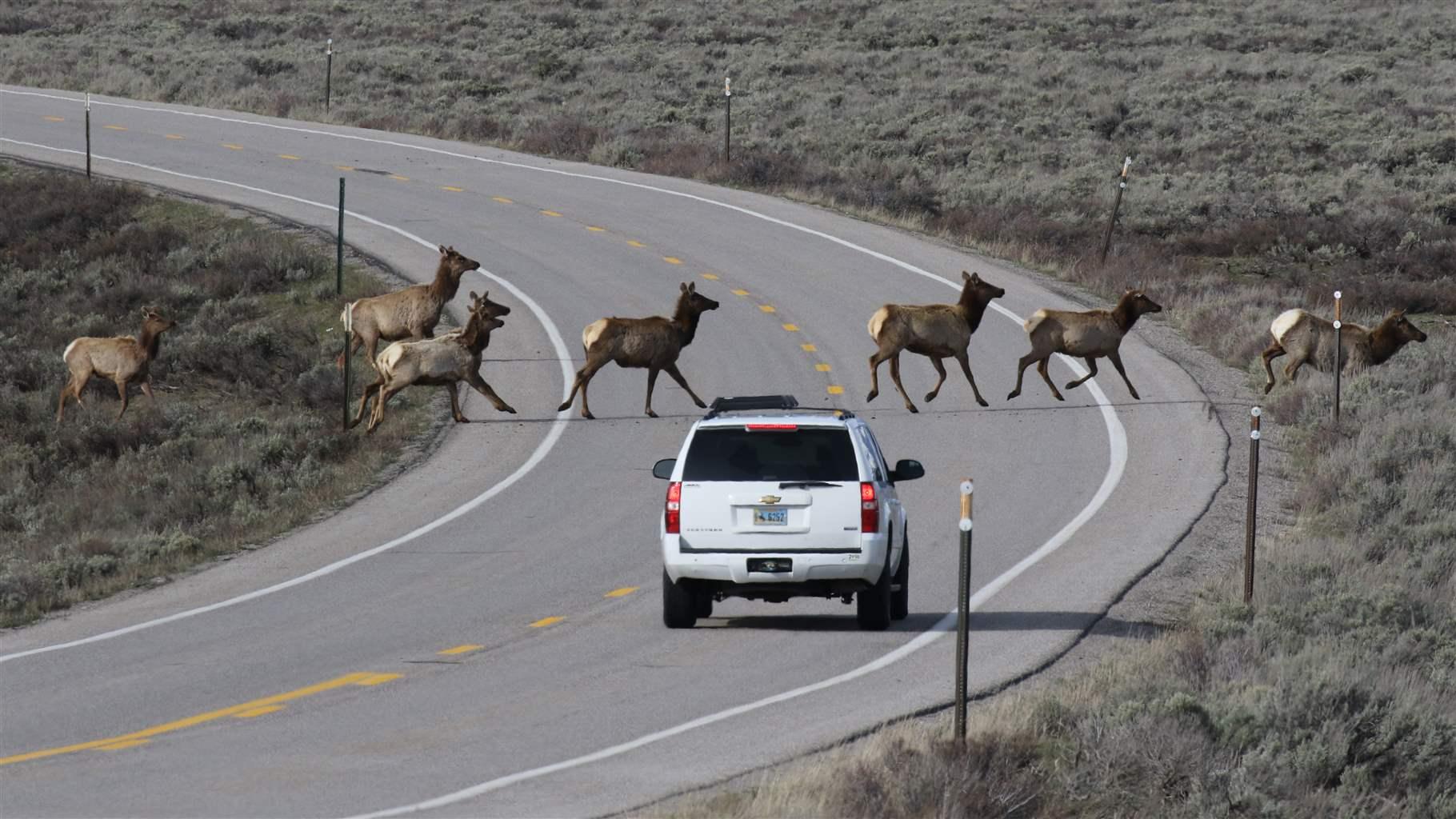
Wildlife collisions on U.S. roads are more than a nuisance—they’re a serious safety, economic, and ecological hazard. When roads sever the natural corridors that deer, elk, moose, and other migratory species rely on to move safely between habitat areas in search of food, mates, and shelter, it forces animals and drivers into dangerous conflict and cuts wildlife off from critical territory. (See Figure 1.)
Wildlife crossing structures—such as overpasses, underpasses, and fencing—that provide safe passage for migrating animals across busy roads can reduce wildlife-vehicle crashes by more than 90%.1 This infrastructure not only prevents deaths, injuries, property damage, and medical costs but also reconnects important habitat that has been fragmented by roadways. Research has found that one wildlife crossing can prevent about 1,400 accidents over a 70-year lifespan, which translates into billions of dollars in savings.2

Policies that preserve natural wildlife corridors where possible and accelerate the pace and scale of wildlife crossing construction in known collision hotspots—ideally backed by dedicated, stable revenue streams—can facilitate the long-term planning and efficient project delivery needed to ensure habitat connectivity and reduce collisions.
Benefits of crossings
The U.S. records more than 1 million wildlife–vehicle collisions each year, and that is probably an undercount because of unreported incidents.3 These crashes cost more than $10 billion annually in repairs, medical care, and lost productivity, and they cause about 200 deaths and 26,000 injuries annually.4 According to the Federal Highway Administration, wildlife crossings can deliver key benefits for drivers and wildlife, including:
Crash prevention: Wildlife crossings with fencing can cut large-mammal collisions by more than 80%—and up to 97% for certain species, including deer and elk—making them among the most effective ways to improve driver safety and wildlife connectivity.5
Cost savings: Each prevented wildlife–vehicle collision can save thousands of dollars—more than $19,000 per deer crash, $73,000 per elk, and $110,000 per moose—in vehicle, injury, and wildlife costs, making well-placed crossings a strong investment.6
Habitat connectivity: Roads, fences, and development break up landscapes and block wildlife migration, limiting animals’ access to food, water, and mates, which can cause population declines and reduce biodiversity by up to 75%.7
Communities throughout the country are investing in a range of wildlife crossings to improve public safety and protect vulnerable species. (See Figure 2.)

Progress on crossings
Fortunately, many states are stepping up to address this pressing economic, safety, and conservation issue. Lawmakers throughout the country have introduced legislation to facilitate wildlife crossing funding and construction. Additionally, many states have established new funding sources to help unlock millions of dollars of federal grants—particularly from the Wildlife Crossings Pilot Program, which was created as part of the 2021 Infrastructure Investments and Jobs Act, as well as from more than a dozen other federal programs. Continued collaboration among state and federal partners to invest in reliable funding and policy solutions can make wildlife crossings a regular part of transportation planning.
Endnotes
- Scioto Analysis, “Wildlife Crossings: A Cost-Benefit Analysis,” 2025, https://static1.squarespace.com/static/5bdb6f642714e55b84ebe507/t/67cef4c8a38e7808b71dc3ee/1741616329319/Wildlife+Crossings+CBA.pdf.
- Scioto Analysis, “Wildlife Crossings: A Cost-Benefit Analysis.”
- Patricia Cramer, “The Strategic Integration of Wildlife Mitigation Into Transportation Procedures: Final Report,” Nevada Department of Transportation, 2022, https://static1.squarespace.com/static/60baf2ed8791194056e335f8/t/63094e8335037563acd65b96/1661554311359/700-18-803+Final+Report.pdf.
- Scioto Analysis, “Wildlife Crossings: A Cost-Benefit Analysis.”
- U.S. Forest Service, “Highway Crossing Structures for Wildlife: Opportunities for Improving Driver and Animal Safety,” 2021, https://www.fs.usda.gov/psw/publications/documents/psw_gtr271/psw_gtr271.pdf.
- Marcel P. Huijser et al., “Cost-Benefit Analyses of Mitigation Measures Along Highways for Large Animal Species: An Update and an Expansion of the 2009 Model,” 2022, https://trid.trb.org/View/2122530.
- Nick M. Haddad et al., “Habitat Fragmentation and Its Lasting Impact on Earth’s Ecosystems,” Science Advances 1, no. 2 (2015): https://www.science.org/doi/10.1126/sciadv.1500052.
People