Land Contracts in Texas Come With Strong Buyer Protections, Prompting Some Sellers to Pivot Toward Other Risky Forms of Financing
An overview of Texas’ land contract market and the impact of the state’s legislative reforms

Overview
In the past two decades, tens of thousands of Texans have used land contracts, also commonly known as “contracts for deed,” to help them purchase homes, lots, and other types of real estate. Land contracts can be an attractive option for those who cannot qualify for a mortgage, whether because of poor credit, low property quality, low awareness of loan options, or the absence of traditional mortgage lenders that offer loans in the area. But land contracts can also be risky, and costly, for buyers.
In Texas, harmful sales practices involving land contracts were once so widespread that the state Legislature enacted major legislative reforms, beginning in 1989, with the majority of the changes to land contract law occurring in 1995.1 Those reforms have improved protections for land contract buyers. But some sellers have since begun shifting to other forms of seller financing to bypass those protections.
This fact sheet provides an overview of Texas’ land contract market. Researchers from The Pew Charitable Trusts analyzed county-level property transaction records in Texas from 2005 to 2024 to identify geographic regions where land contracts are most common, the size and age of homes purchased with land contracts, and how land contract use varies across different housing markets. Researchers also documented the regulations and protections established by Texas legislators over the past 30 years, which are among the strongest in the United States.
Key takeaways:
- Texas has some of the strongest land contract protections in the U.S. Requirements for the recording of contracts, seller disclosures, annual statements, foreclosure protections, and especially financial penalties for noncompliance go beyond most other states’ rules and help protect buyers’ equity.
- Land contract use in Texas is limited, but more common for the purchase of lower-cost, rural, and manufactured homes. Buyers of these homes are less likely to have access to traditional mortgages.
- Despite Texas’ legal protections, some risks persist. Concerns about high interest rates for land contracts remain an issue. And some sellers have shifted to other forms of seller financing to avoid land contract protections.
What land contracts are and why they can be risky
A land contract is a form of alternative financing in which the buyer finances the purchase of a home or other type of real estate directly from the seller, rather than by securing a mortgage from a bank or other type of lender. A land contract is one of several types of seller financing, including seller-financed mortgages and lease-purchase agreements, in which the buyer gives the seller a down payment and borrows the balance of the purchase price. The buyer makes installment payments over time at a specified interest rate until the contract is fully repaid.
Because property buyers and sellers negotiate contract and payment terms directly, seller-financing arrangements can be an accessible option for individuals who cannot qualify for a conventional mortgage. However, these agreements are not as well regulated as mortgages from a bank or other type of third-party lender. Moreover, with a land contract, the seller’s name remains on the deed to the property until the buyer makes a final payment. As a result, buyers assume many of the responsibilities of homeownership—such as maintenance, repairs, and paying property taxes—without the legal protections enjoyed by mortgage borrowers.
Land contracts can also contain onerous terms, such as high interest rates, expensive late fees, and balloon payments (a large, one-time payment at the end of the contract term). And because they are less regulated than mortgages, land contracts are not always recorded in county deed records, which can leave buyers without clear proof of ownership. This lack of regulation also emboldens some sellers to engage in harmful behavior, such as persistently filing for foreclosure when a buyer misses a payment. Together, these factors can set buyers up for failure. More than 30 years ago, these issues led Texas to begin instituting reforms designed to improve legal protections for land contract buyers.
The history of land contracts in Texas
Deceptive and harmful land contracts were a recognized problem in Texas as long ago as the 1980s, particularly in the state’s unincorporated—and almost entirely unregulated—“colonia” settlements along the southern border with Mexico.2 Colonia is Spanish for “neighborhood” or “community”; colonias are primarily composed of residents who are Hispanic (predominantly U.S. citizens with Hispanic heritage) with low or very low incomes.3 Because of a growing need for affordable housing, limited access to safe financing options, and a lack of oversight of these developments, buyers in colonias relied heavily on land contracts to purchase real estate.4 However, the lots and homes they purchased were often in poor condition or had little or no infrastructure—in some cases, not even potable water and adequate sewage or wastewater systems. Additionally, many sellers shared little information about the title and conditions of the land or home, leaving buyers vulnerable to harmful practices.5
Land contracts became so problematic in the colonias that the Texas Legislature overhauled the Texas Property Code in 1995 to protect buyers and, in the words of the Supreme Court of Texas, “address serious abuses in the acquisition of homes in the colonias.”6 This legislation had an immediate effect on land contract users, predominantly by requiring sellers to record contracts in county deed records.7 In some counties, the number of recorded land contracts more than doubled from 1995 to 2001, and usage of unrecorded contracts declined. Recording land contracts is crucial for buyers because it documents their purchase. Without this proof, buyers are at greater risk of losing their home in a dispute, or if the seller resells the home. And they may not be able to access loans or grants for repairs or if a natural disaster occurs.
The Texas Legislature passed additional amendments to the property code in 2001, 2005, and 2015, eliminating loopholes and strengthening protections for land contract buyers. Those protections included contract disclosure requirements, missed-payment and foreclosure protections, annual statements (to ensure seller accountability), and financial penalties for land contract sellers who violate these rules. However, this legislation did not extend to other forms of seller financing, a gap that has given sellers an incentive to shift to other types of alternative financing arrangements.
Facts about Texas’ land contract market
Thousands of Texans use land contracts, but usage has decreased. From 2005 to 2024, county governments in Texas recorded 28,879 land contracts—the seventh most of any state. Of those contracts, 24,953 (86%) were used to purchase residential property, while the remainder financed vacant land, businesses, or farms. (See Figure 1.) The number of recorded contracts peaked at 2,657 in 2005 and declined to a low of 452 in 2019. From 2020 to 2023, usage of land contracts rose markedly, which is consistent with an increase in land contract recordings in other states. Texas counties recorded 1,659 land contracts in 2024.


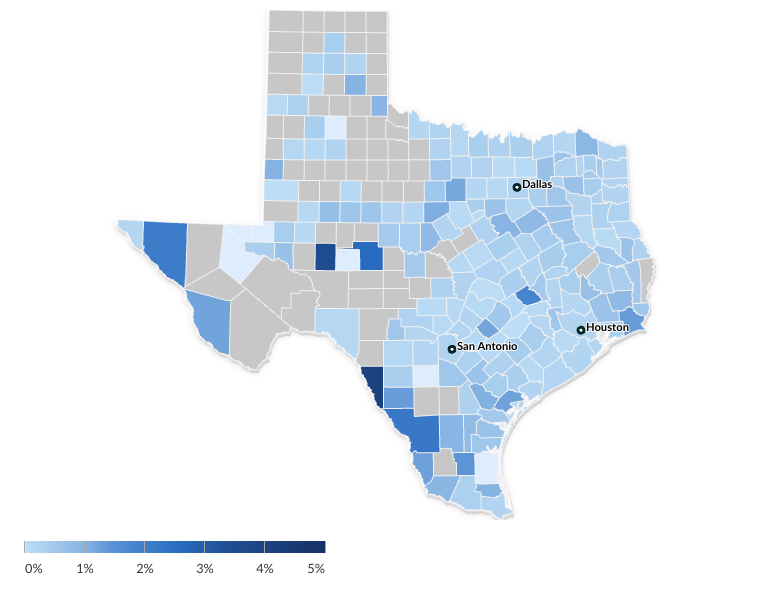
Land contracts are used more often in rural counties than in heavily populated areas. Although a majority of land contracts were recorded in Texas’ most populous counties, they accounted for a larger portion of home sales in the state’s smaller, more rural counties. (See Figure 2.) Statewide, 14% of land contracts were used to purchase homes in rural areas, even though rural homes made up only 7% of home sales between 2005 and 2024.
Buyers more frequently use land contracts to acquire homes that are valued lower than those acquired with mortgages. From 2005 to 2024, the median inflation-adjusted assessed value of a home purchased with a land contract was $101,476, less than half the statewide median assessed value of all homes in Texas ($225,855). Among all purchases in which the home was assessed at less than $150,000, almost 0.5% used a land contract to finance that purchase (out of 2,756,032 total transactions) from 2005 to 2024. Although that is a small percentage, it is seven times greater than the share of homes valued above $150,000 that were purchased with a land contract (0.07%) in the same 20-year period. Among all sales where land contracts were used to purchase homes, 77% had an assessed value below $150,000.
Manufactured home buyers in Texas use land contracts more frequently than buyers of traditional houses. From 2005 to 2024, 293,581 manufactured homes were sold in Texas. Approximately 1.1% of manufactured home buyers (3,118) used a land contract to purchase their home. Although that is a small percentage, it is substantially higher than the proportion of buyers who used a land contract to acquire a traditional site-built home (0.23%). Among all residential land contracts, 12% were used to purchase a manufactured home.
Land contracts were often used to purchase smaller, older homes. The median construction year of a home purchased with a land contract in Texas during the study period was 1971—22 years older than the median for all homes sold in the state from 2005 to 2024. And the median size of a home purchased with a land contract was just 1,376 square feet, compared with a median of 2,005 square feet for all homes sold in Texas during the same period.
Facts about Texas’ land contract laws
Texas law requires disclosures by the seller prior to a sale using a land contract. Since 1995, the Texas Property Code has required sellers to provide a substantial amount of information to buyers before a contract is signed.8 The seller must provide a current survey or plat of the property; disclose any encumbrances on the land that affect title to the real property, with supporting documents; and provide the buyer with a written report on the condition of the property, which must be signed by both parties prior to the sale.9 In addition, the seller must provide a tax certificate (a document that verifies a property’s tax status) and information about any existing insurance on the property. The contract must also disclose late payment charges, break down the total principal and interest to be paid, and inform buyers that prepayment penalties are not allowed. If contract negotiations were conducted primarily in a language other than English, the seller must provide a copy of all written documents in that language.10
Contracts must be recorded. As amended in 1995, the property code mandates that land contracts must be recorded.11 A 2015 amendment specified that recording must occur within 30 days of execution. This requirement is an important safeguard for land contract buyers because when contracts are not recorded in public records, a buyer might not be able to prove ownership, which puts the buyer’s financial interest in the property at risk.
Sellers must provide an annual statement documenting the status of the contract, including amounts owed.12 Since 1995, the Texas Property Code has required sellers to provide an annual statement that shows how much the buyer has already paid, the remaining balance owed, and the number of payments remaining. In addition, sellers must disclose whether they have received insurance proceeds and how the proceeds were spent (in the event of property damage), and whether the seller has changed the insurance coverage, along with a current copy of the policy. These annual statements help provide transparency and accountability for sellers and help land contract buyers ensure that contract terms are enforced.
Land contract buyers do not automatically lose their investment when a payment is missed. Since 2001, the Texas Property Code has stipulated that a land contract buyer must be allowed at least 60 days to make up any missed payment regardless of the amount of principal paid or the number of payments the buyer has made, if the contract is recorded.13 Buyers with an unrecorded contract have at least 30 days if they have made fewer than 48 payments or paid less than 40% of the total amount owed, and 60 days if they have made at least 48 payments or paid 40% or more of the total amount owed. Additionally, whether the contract is recorded or unrecorded, buyers who have either made 48 monthly payments or paid 40% of the total debt are entitled to a foreclosure process, which gives the buyer an opportunity to recover any equity in the home that remains after the property has been sold and the seller has been reimbursed for amounts owed and expenses. Only after default is the seller allowed to pursue a nonjudicial foreclosure process, which in Texas allows a seller to terminate the buyer’s right to use the property without first filing a civil lawsuit.14 In Texas, nonjudicial foreclosure is generally the standard method for terminating a buyer’s rights, and only select situations, including land contracts, require court involvement as the default.15 These rules protect buyers by providing an opportunity to recover from a missed payment and protect their investment in the property.
Texas laws impose financial penalties on sellers who fail to comply with land contract regulations. When the Texas Legislature amended the state’s property code in 2001, it also imposed fines on sellers who do not record a contract within 30 days, provide an annual statement, transfer title after receiving final payment, or convert the contract into a deed after receiving final payment (which officially transfers legal ownership of the property from the seller to the buyer).16 Sellers’ financial penalties range from a one-time charge of $100 to as much as $500 a day for each day a seller does not comply with the law. The Texas Property Code was further amended in 2005 to distinguish between sellers who conduct no more than one transaction in a 12-month period and those who conduct two or more, imposing more severe penalties on the latter. These financial penalties help ensure that Texas’ buyer protections are obeyed.
Buyers are protected from forfeiture of the property by Texas law, which treats a land contract as equivalent to a deed.17 A 2015 amendment to the Texas Property Code ensures that land contracts are treated like a deed upon being recorded. This rule effectively bans sellers from seizing a property, protecting buyers from being evicted without proper notice and due process. Texas is one of only two states to have this kind of protection for buyers—a legislative ban of forfeiture (cancellation of the contract and seizure of the property) for recorded land contracts.18 Instead, as noted above, a seller must go through the foreclosure process if a buyer fails to make payments.
The impact of Texas’ legislative reform
Research on land contract usage in Texas has found that the state’s legislative reforms have in some ways succeeded in protecting land contract buyers, particularly low-income buyers in the colonias.19 The clearest evidence of this success is that the number of recorded contracts has increased significantly, and the number of unrecorded contracts has been reduced.
However, there are other concerns, such as high interest rates, that were not addressed by Texas’ reforms. Land contracts often charge interest rates significantly higher than traditional mortgages, typically ranging from 12% to 18%, with rates occasionally as high as 20%.20 This use of high interest rates and late fees, as well as aggressive filing for foreclosure, continues to be a problem with land contracts and other types of seller financing even after reforms.21
Additionally, because that legislation regulated only land contracts, some sellers have shifted away from land contracts to other types of seller-backed financing to circumvent regulations governing land contracts. These alternative arrangements differ from land contracts in that sellers transfer the property deed either to the buyer (a seller-financed mortgage) or to a neutral third party (a deed of trust) upon the signing of an agreement by buyer and seller.22 In this respect, these financing arrangements are an improvement over land contracts because the deed, and thus proof of ownership, is transferred by the seller immediately at closing. However, because they are seller financed, these agreements do not carry the same legal protections as a mortgage from a traditional lender. Thus, as with land contracts, some sellers use these alternative financing agreements to charge higher fees and higher interest rates than traditional mortgage lenders, which can leave the buyer vulnerable to default and rapid repossession.23 As a result of this shift, some Texas homebuyers are continuing to experience harmful outcomes, such as foreclosure rates much higher than the national average.24
Conclusion
Texas law is in many ways a model of how states can protect buyers who use land contracts. Texas’ experience shows that strong safeguards can make land contracts a safer pathway to homeownership for buyers who lack access to traditional mortgages. Recording requirements, mandatory disclosures, annual statements, and limits on forfeiture help ensure that buyers can safely access homeownership and build equity with clear, enforceable terms. At the same time, recent trends underscore the limits of these protections and the need for further reforms to curb onerous terms such as high interest rates and penalties for missed payments in land contracts and other forms of seller financing. Policymakers in Texas, as well as other states, can look to Texas’ land contract legislation as a guiding example for improving transparency and protecting buyers in the market for affordable, seller-financed homes.
Acknowledgments
This fact sheet benefited from the insights and expertise of outside reviewers Amir Befroui and Heather Way. Although they have reviewed the draft, neither they nor their organizations necessarily endorse its findings or conclusions.
Endnotes
- Peter M. Ward, Heather Way, and Lucille Wood, “Protecting Homebuyers in Low-Income Communities: Evaluating the Success of Texas Legislative Reforms in the Informal Homeownership Market,” Law & Social Inquiry 41 (2015).
- Noah J. Durst and Peter M. Ward, “Colonia Housing Conditions in Model Subdivisions: A Déjà Vu for Policy Makers,” Housing Policy Debate 26, no. 2 (2016): 316-33, https://doi.org/10.1080/10511482.2015.1068826.
- “Background on the Colonias,” Texas Department of Housing and Community Affairs, https://www.tdhca.texas.gov/background-colonias.
- Noah J. Durst and Peter M. Ward, “Colonia Housing Conditions in Model Subdivisions.”
- Peter M. Ward, Heather Way, and Lucille Wood, “The Contract for Deed Prevalence Project: A Final Report to the Texas Department of Housing and Community Affairs (TDHCA),” 2012, https://law.utexas.edu/faculty/hway/stand-alone-executive-summary.pdf.
- Flores v. Millennium Interests, Ltd., 185 S.W.3d 427, (Tex. 2005).
- Peter M. Ward, Heather Way, and Lucille Wood, “Protecting Homebuyers in Low-Income Communities.”
- Note that the 1995 amendments were initially limited to the counties along the Texas-Mexico border (the colonias) and then later extended to all Texas counties in 2001.
- National Consumer Law Center, “Summary of State Land Contract Statutes,” 2021, https://www.pew.org/-/media/assets/2022/02/summary-of-state-land-contract-statutes.pdf
- Prop. Code Section 5.068, https://texas.public.law/statutes/tex._prop._code_section_5.068.
- National Consumer Law Center, “Summary of State Land Contract Statutes.”
- TX Prop § 5.077, https://statutes.capitol.texas.gov/?tab=1&code=PR&chapter=PR.5&artSec=5.077.
- “Contract for Deed,” Texas Law Help, https://texaslawhelp.org/article/contract-for-deed.
- “Foreclosure: A Guide to Texas and Federal Laws on Foreclosure,” Texas State Law Library, https://guides.sll.texas.gov/foreclosure/the-foreclosure-process.
- “Is Texas a Non-Judicial Foreclosure State?,” LegalClarity, https://legalclarity.org/is-texas-a-non-judicial-foreclosure-state/.
- “Statutory Damages Available When Sellers Bungle Contract for Deed.” Trey Wilson, San Antonio Real Estate Lawyer.
- Tx Prop § 5.079, https://statutes.capitol.texas.gov/?tab=1&code=PR&chapter=PR.5&artSec=5.079.
- Jeremiah Battle Jr. et al., “Toxic Transactions: How Land Installment Contracts Once Again Threaten Communities of Color,” National Consumer Law Center, 2016, https://nclc.org/images/pdf/pr-reports/report-land-contracts.pdf.
- Peter M. Ward, Heather Way, and Lucille Wood, “Protecting Homebuyers in Low-Income Communities.”
- Peter M. Ward, Heather Way, and Lucille Wood, “The Contract for Deed Prevalence Project: A Final Report to the Texas Department of Housing and Community Affairs (TDHCA).”
- Peter M. Ward, Heather Way, and Lucille Wood, “Protecting Homebuyers in Low-Income Communities.”
- Peter M. Ward, Heather Way, and Lucille Wood, “Protecting Homebuyers in Low-Income Communities.”
- Peter M. Ward, Heather Way, and Lucille Wood, “Protecting Homebuyers in Low-Income Communities.”
- “Civil Rights Division Secures $68m Settlement in Predatory Land Sales and Lending Lawsuit,” U.S. Department of Justice, Office of Public Affairs, https://www.justice.gov/opa/pr/civil-rights-division-secures-68m-settlement-predatory-land-sales-and-lending-lawsuit. Paul Cobler et al., “DOJ Sues Colony Ridge, Calling It a ‘Bait-and-Switch’ Sales Scheme Targeting Latino Buyers,” Houston Landing, Dec. 20, 2023, https://www.houstonlanding.org/doj-sues-colony-ridge-calling-it-an-illegal-land-sales-scheme-targeting-latino-buyers/.
People