How States Are Tackling the Challenges of Managing Federal Funds
Recommendations and strategies to help fiscal leaders better deal with a vital, complex, and shifting source of revenue

Overview
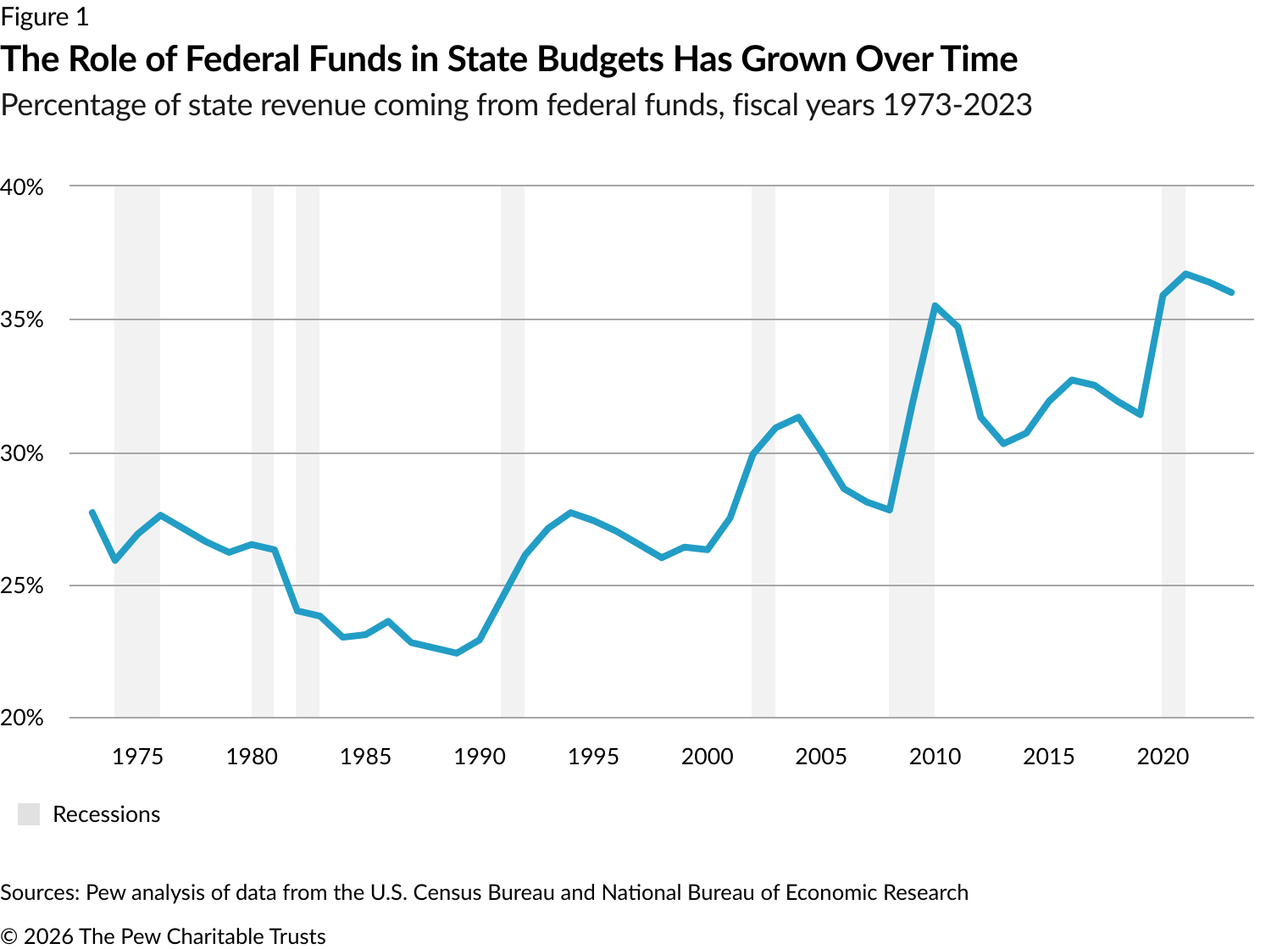
Grants from the federal government represent a significant but often overlooked part of state budgets. In state fiscal year 2023, federal funds were the second-largest source of state revenue, after tax collections, accounting for 36% of the 50 states’ combined total revenue.1
States use federal funds to provide goods and services for a range of activities, but these sources often come in boom-bust cycles and with complex stipulations for use, reporting requirements, and cash-flow challenges. In contrast, when states impose and collect their own taxes and fees, there can exist broader discretion for the use of that funding. Recent changes in federal priorities—including funding pauses and spending reductions for specific programs, such as Medicaid—have introduced a tremendous amount of uncertainty about the future role of the federal government in supporting state-operated programs and activities.2 These changes emphasize how important it is for policymakers to understand available funding sources, what they pay for, how to use it to advance state priorities, and how to reduce the effects of funding volatility on state budgets.

The Pew Charitable Trusts undertook this study to explore these challenges and uncover promising state practices for managing this complex revenue stream.3 The report is based on Pew’s original research, which included a focus group with elected officials and legislative staff; a 50-state scan of budget documents and websites; and 26 interviews with executive and legislative budget officials from 12 states. (See Appendix A: Methodology.)
Pew identified three central challenges that state officials confront as they seek to manage federal funding:
- Federal funding levels can be difficult to project.
- Applying for and managing federal grants is complicated.
- It is difficult to strategically direct federal funds to key state priorities.
By better understanding these challenges, fiscal leaders can implement strategies to ensure critical service continuity while maintaining fiscal stability and advancing state-identified policy and service priorities. Pew identified a series of recommendations for policymakers and fiscal officials to consider:
- Create a transparent system to understand federal funding and what it pays for.
- Target state resources to invest in the people and systems needed to administer federal funds.
- Coordinate and use funds strategically to maximize the impact of federal resources and ensure that they advance state priorities.
Why federal funds matter
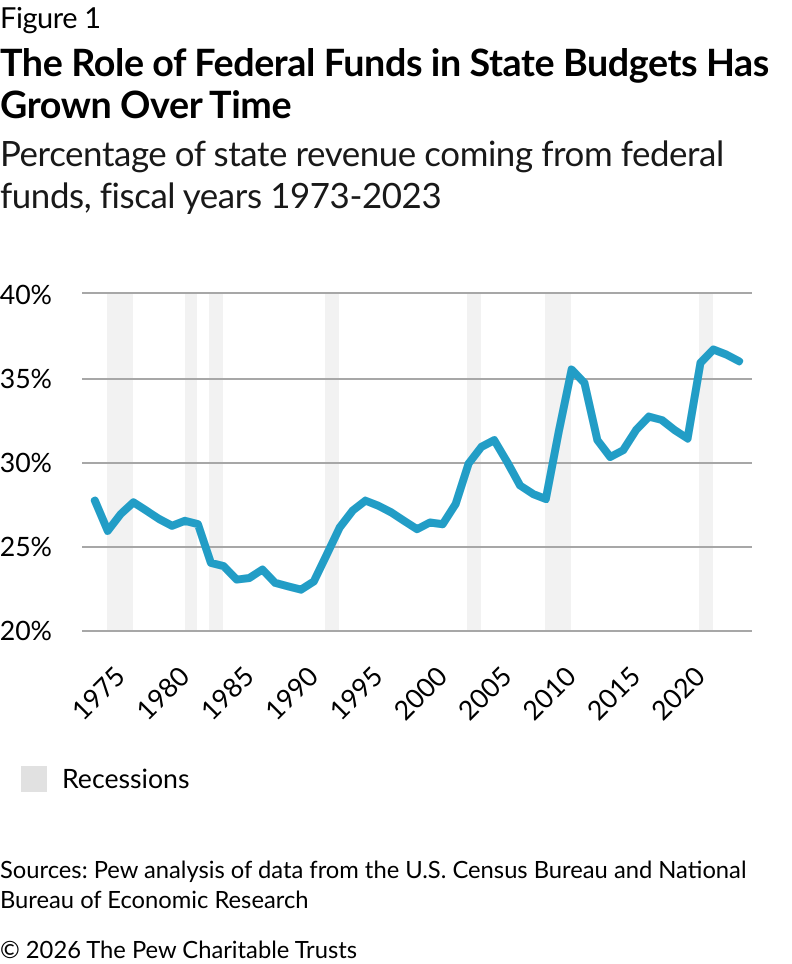
An enormous amount of state revenue comes from federal funds, which made up 36% of the 50 states’ total revenue in 2023, the most recent year for which Census Bureau data is available.4 Over the past 50 years, the federal share of state revenue has ranged from about one-fourth to one-third, but it has generally trended upward; the fiscal 2023 share was 2.7 percentage points higher than the 15-year average of 33.3% and 7.9 percentage points higher than the 50-year average of 28.4% from fiscal 1974 to 2023. (See Figure 1.)5 The share of revenue from federal funds in fiscal 2023 ranged widely across states—from a low of 24.1% in Hawaii to a high of 50.1% in Louisiana.6
States rely primarily on tax revenue and federal dollars to fund programs and services. The impact of federal funds on state budgets is significant; in fiscal 2023, federal funds were the largest source of revenue in 13 states, with much of that money supporting health care, education, and transportation.7
As such, federal funding to states shapes large swaths of American life. These funds, for example, provide educational services for children with disabilities and help to keep the nation’s roads in a state of good repair through various transportation programs.8 Medicaid and the Children’s Health Insurance Program, which provide health coverage for vulnerable adults and children, have a vast reach: They helped to provide health care for more than 20% of Americans in 2024, including 80% of children in families with incomes below the federal poverty line.9
Federal funding flows to state governments primarily through grants that support specific programs such as health care, education, transportation, and infrastructure. Some funding comes through categorical grants, such as Medicaid, that are narrowly applied to specific programs.10 Block grants, such as those awarded through the Community Development Block Grant Program, are more flexible.11 States use these funds to support activities in many different policy areas that greatly affect people’s lives. Medicaid dollars play an outsize role: In 2024, Medicaid funding from the federal government comprised an average of 69% of each state’s total federal funds.12
Federal funds also flow to states for one-time purposes, including aid for emergencies and competitive grants. The amounts can be significant; in response to the COVID-19 pandemic, the federal government sent more than $800 billion to states through multiple pieces of legislation.13 In response to emergencies, one-time funding can target specific states in response to specific disasters, such as the multibillion federal response to Hurricane Katrina in 2005 or the Maui wildfires in 2023.14 This support, though it technically is one-time funding, can have reverberating effects on a state’s budget and economy for years.
State challenges in handling federal funds
The complex nature of federal funding streams presents specific challenges for state officials to manage. In order to comprehensively understand these challenges, Pew identified three themes through background research and interviews with officials from 12 states. (See Figure 2.) Tackling these challenges effectively can help state officials ensure fiscal stability, maximize resources for constituents, and advance state policy priorities.

Challenge 1: Federal funding levels can be difficult to project
For state budget officials, the challenges predicting federal revenue are twofold: First, because federal funding comes from many different sources, it can be hard to develop a comprehensive understanding of what states have at their disposal, which can lead to less informed decision-making; and second, federal decisions regarding these funds can be hard to predict and can drive volatility.
Subchallenge: Fragmented and complex funding sources complicate understanding of future federal funding
Grants can have different, and at times unclear, timelines, which can affect a state’s ability to plan for using the funds. Funding amounts that are tied to specific formulas can also change, which makes it difficult for policymakers and budget officials to accurately budget for these programs.
Many funds recur year after year at predictable levels, but some do not. This is a reality of federal—and other—funding sources that makes it difficult to plan for, budget, and use. But good planning is critical in ensuring that a state uses taxpayer dollars wisely. Over time, imprudent use of nonrecurring revenue makes it difficult for a state to achieve a structurally balanced budget and puts it at risk for long-term deficits.
Many policymakers and budget experts, including the nonprofit Government Finance Officers Association and all three major U.S. credit rating agencies, agree that identifying nonrecurring funding streams in a state budget is important for ensuring a balanced budget.15 Despite this understanding, there is no universal guideline for how states should manage or even define nonrecurring funds.16 Although some states do take steps to formally distinguish one-time funding sources from revenue they expect to be ongoing, others rely on informal practices for tracking.17 Either way, identifying which funds are recurring and which are time-limited is the first step toward grasping the amount and scope of what is available to policymakers.
What states are doing
Identifying and managing recurring and nonrecurring funds in budget processes. Clear identification of funding sources can mitigate risks and allow policymakers to make informed decisions about both one-time and ongoing funding. (See Figure 3.)

States also benefit from identifying changes to recurring sources of funds in budget documents. For example, when states received enhanced funding for Medicaid during the COVID-19 pandemic, some states chose to identify the additional funding as nonrecurring to ensure structural balance when the additional funding, which was time-limited, expired.18
Planning for programs that are funded by nonrecurring sources. If state officials know that federal support is one-time, or that it is ending, they can plan how to wind down relevant programs. In Idaho, for example, state agencies that apply for one-time federal dollars must submit to the state an exit strategy letter detailing how they will end grant activities once the funds expire.19 If an agency does not submit a plan that doesn’t rely on state money, the state might not give approval to accept the grant.
If a state deems a program to be worth continuing, policymakers can also find an alternative source of funding when one-time federal funding ends. For example, in Hawaii, the state ran a federally funded program that created internships within state government, giving experience to early-career professionals who might later become top candidates for full-time state positions. When federal funding for the program ended, the Hawaii Legislature decided to continue the program using money from the state’s general fund.
Providing details to decision-makers about the programs and services that federal funding pays for. Keeping policymakers informed about how federal funds are used and whether they’re sustainable is key to good governance.20 States approach this task in different ways. In Massachusetts, the Executive Office for Administration and Finance maintains detailed internal data on specific program transactions, using reporting codes to easily identify whether funds come from the federal government or the state’s coffers. The data undergoes a rigorous quality control process at multiple stages to ensure that it is accurate. The office produces reports that summarize total spending for specific programs and outstanding obligations, which allows for both the quick synthesis of complex data and the ability to review specific spending items for each program. In California and Vermont, the Legislative Analyst’s Office and the Joint Fiscal Office, respectively, keep lawmakers informed about what federal funds pay for, creating reports and presentations on topics such as their distribution by agencies and direct payments to individuals.21
Subchallenge: Federal decisions can drive funding volatility and are hard to predict
Political decisions can affect the federal budget process, but forecasting those outcomes can be difficult. Decisions at the federal level can affect states in several ways, including unexpected additional funding, such as grants between budget cycles that require oversight and management, changes in policy priorities, and a lack of consistency in the budget process—which can lead to across-the-board cuts, budgeting by continuing resolution, or the threat of federal shutdowns.22
For example, an interviewee indicated that when there is a potential federal shutdown, the governor’s budget office must dedicate substantial amounts of time to understanding how a lapse in funding will affect state employees and services. Similarly, a different interviewee indicated that annual fluctuations in federal fund levels and the introduction of new federal programs are key challenges to budgeting federal funds.
Shifting federal priorities have led to increased uncertainty about federal funding to states. Since the start of President Donald Trump’s second term, the executive branch and Congress have both publicly indicated a desire to substantially roll back federal funding to states, and they have taken actions to reduce federal spending.23 As a result of the budget and spending bill that was passed in July 2025—which materially alters funding of key programs such as Medicaid and SNAP—state officials expect changes to how the federal government supports state- and jointly operated programs.24
What states are doing
Managing unexpected increases in federal funds. Some states plan conservatively for what expected funding levels might be and create rules and processes of approval for unexpected funding. In Minnesota, for example, budget officials presume a continuance of past levels of federal funding until there is a demonstrated pattern of higher funding, thus decreasing the risk of overestimating future federal support. To mitigate the risk of volatile Medicaid funding, Utah established a Medicaid Growth Reduction and Budget Stabilization Account.25 In years when Medicaid costs are lower than anticipated, the surplus is saved in this account.26 Utah law limits spending from this account to pay for Medicaid expenses that exceed estimates, ultimately providing year-to-year stability.
Some states have also established procedures to take advantage of new federal funds that become available between state budget cycles, balancing the need for flexibility and speed with concerns about oversight and avoiding unfunded future commitments. Some manage this process through commissions or another authority to grant permission to use unexpected funds; North Dakota’s Emergency Commission has this authority when the North Dakota Legislature is not in session.27 Utah created a hierarchy of approval, depending on funding levels; high-impact requests (such as grants over $1 million) must be approved by both the governor and Utah Legislature, while smaller requests can be approved, when the Legislature is not in session, by the governor’s office, the Legislature’s Executive Appropriations Committee, or another relevant state office.28 States can also use temporary approval bodies to direct how unexpected funds can be deployed in extraordinary circumstances, such as when states received historic levels of federal aid during the COVID-19 pandemic.29
Managing the unexpected loss of federal funds. Sometimes state officials must also cope with the unexpected loss of funds, which requires sacrifices or trade-offs. Some states, such as Vermont and Utah, have created and publicly published plans in the face of a looming federal government shutdown.30 Others, such as Alaska and New Hampshire, have responded to past scenarios by instructing agencies to conduct impact assessments of a potential federal government shutdown.31

Other states have made proactive efforts to better assess their risk exposure and respond strategically to funding changes. New Mexico, for example, established a Federal Funding Stabilization Subcommittee in early 2025 to track shifts in the federal-state fiscal relationship and make recommendations; that body assumed the task of understanding the implications of policy changes made under the federal government’s July 2025 tax and spending bill.32 Vermont created a task force to prepare for the federal transition.33 That task force concluded its work with a report warning that the state’s reliance on federal transfers makes it “clear that ongoing attention will be needed to prepare for and mitigate emerging challenges to Vermont’s economy.”34 In neighboring Massachusetts, the Executive Office for Administration and Finance engaged in listening sessions with nongovernmental organizations such as labor groups and nonprofit social services organizations to understand how federal funds affect their operations and services. The office publicly documented how federal action was affecting the flow of funds to Massachusetts.35
In the face of prospective funding losses, some states made anticipatory budget decisions. For example, in April 2025 the Idaho Legislature passed a bill requiring legislative approval to use state funds to replace appropriations that were contingent on anticipated federal funding.36 The Montana Legislature passed contingency funding in its 2027 biennial budget for additional meetings of the state’s Legislative Finance Committee to analyze and prepare for changes to the state budget from federal action.37 Massachusetts’ budget set aside an $800 million surplus that may be used to respond to “an economic downturn or cuts in federal support for Medicaid, food security, and other critical programming.”38
Other states developed additional federal fund tracking tools. Colorado added a new section to its federal funds tracker website that details federal funding losses resulting from President Trump’s policy changes, including information by agency and by county.39 In anticipation of the change in administration, Maryland hired a consultant to help develop a federal policy tracking tool that is now in use across state agencies.40
Proactive planning for a possible reduction or loss of funding. Some states have formal steps within their budget processes to proactively consider scenarios in which the state loses federal funding. Both Tennessee and Alabama, for instance, require agencies to consider funding reduction scenarios when they receive federal funds; they must plan for the possibility of federal funds being reduced by 5%, 25%, or even 100% for Tennessee agencies.41 And in Utah, if a federal grant amount comprises more than 10% of a state agency’s budget or over $2 million, the agency must complete a contingency planning exercise in case federal funding is unexpectedly reduced.42
Challenge 2: Applying for and managing federal grants is complicated
State officials must identify and apply for competitive grants, comply with various regulations, have processes to disburse grant funds, and complete reporting requirements.43 To get the most impact from federal grants, states must have the proper tools, expertise, and personnel, which can be particularly burdensome for smaller agencies or local governments that often have fewer resources.
Subchallenge: The federal grant process requires appropriate capacity to navigate
Sometimes, state officials want to maximize the funds they receive from competitive grants to fund programs for constituents, but struggle with having the capacity to navigate the often complex and burdensome process.44 According to Tracy Gruber, the executive director of the Utah Department of Health and Human Services, “a lot of our staff are needed just to apply for, oversee, and manage and report on federal grants.” Other officials said the lack of capacity to apply for grants made them unable to realize potential revenue.
Once state officials identify relevant grants, the specific agency or department must have the staff to navigate sometimes widely varying application requirements. Since different states, local governments, and nongovernmental organizations are competing for the same limited number of grants, having a proper workforce is critical.
Tracking which grants the state is pursuing poses another challenge. In testimony before Congress, a Government Accountability Office official said the wide range of sometimes duplicative federal grants from different agencies makes navigating the federal grant space difficult.45 Users of grants.gov—the website where federal agencies post grants, and where agencies submit applications— often report difficulties navigating and using the site.46
For both formula and competitive programs, states must complete monitoring and reporting requirements for the funding they receive. After a grant is obtained, Gruber told Pew researchers, “it’s very hard to quantify what the administrative burden is once you’ve got the money and how much emphasis is going to, how much time are you going to need to invest in reporting requirements.”
What states are doing
Tracking available grants through centralized systems and communicating those with state agencies. Officials have different strategies for tracking available federal grants and communicating about grants across state agencies. For some, a centralized entity or system can help in this process. Hawaii’s Department of Budget and Finance uses the nonprofit U.S. Digital Response platform (usdigitalresponse.org) to search for available grants. Delaware’s Office of Management and Budget notifies agencies of relevant opportunities found through federal announcements, grants approved by Delaware State Clearinghouse Committee, or third-party sources such as Federal Funds Information for States (ffis.org). Other states, such as Ohio and Massachusetts, use specific software; Massachusetts’ Federal Fund Infrastructure Office established a clearinghouse for the federal grant process.
Training or hiring staff to apply for and manage grants. Applying for and managing grants requires knowledgeable staff. In Ohio, the Ohio Grants Partnership, which is part of state government, provides grant resources on its website and holds an annual grants summit to provide training in grants management to staff.47 Illinois partnered with the University of Illinois Springfield to develop its Learning Management System, with course offerings that provide training through the life cycle of a grant.48
Hawaii convened a federal funds summit in July 2024 as part of the governor’s Investing in Hawaii’s Future Initiative. The three-day summit provided training sessions to state grant teams on topics such as management of the grant application process, grants management best practices, and how to avoid issues in the reporting and auditing processes. Sabrina Nasir, the deputy director for Hawaii’s Department of Budget and Finance, described the variety of sessions: “Some of them were very technical, [while] some of them were really conceptual. Some of them were ... Grants 101, and then some dug a lot deeper.”
Centralizing appropriate elements of the grant process to streamline management. Because grants management requires specialized skills, states can increase efficiency by centralizing some functions. Rhode Island, for example, has a statewide grants management system that provides agencies a single point of access for grant information.49 Rhode Island’s system offers pre- and post-award management of federal grants to subrecipients, a database of past award standardized applications, and a standardized closeout process.50 Illinois’ Grant Accountability and Transparency Unit within the Governor's Office of Management and Budget uses software that streamlines the monitoring process and reduces the need to address duplicative requests from subrecipients.51
States such as Hawaii and Ohio have centralized offices that serve as a resource for federal grant management. The Ohio Grants Partnership provides a forum where grant managers can collaborate on challenges and solutions. The office also has software to identify gaps in agency capacity, flagging grants that the state is not pursuing and then investigating why an agency has not applied. Hawaii’s Office of Federal Awards Management, housed in the Department of Budget and Finance, develops policies and communicates information about policies and systems to state agencies, while relying on agencies to actually implement grants.52
In Utah, the Governor’s Office of Planning and Budget hosts a web portal that displays select federal funding opportunities, including eligibility requirements and project categories, and provides links to external grant writing resources.53 The office also encourages smaller agencies to partner with larger agencies that already have a grant management infrastructure in place.
Subchallenge: Local governments often lack resources to manage federal grants
States annually transfer billions of dollars to local governments to administer programs that serve constituents; at times, those governments also receive grants directly from the federal government.54 Many localities lack the staff or technological systems to support navigation of the grant application process or to handle the administrative burden of monitoring and managing federal grants.55 This challenge is especially pronounced for governments with only part-time employees and limited resources.56
These issues can be compounded when one-time funds for emergencies require fast deployment. When local governments received billions of dollars through the Coronavirus State and Local Fiscal Recovery Funds program, states were required to provide assistance to those with fewer than 50,000 constituents.57 Carla Cassell-Carter, former director of budget development and planning in Delaware’s Office of Management and Budget, said, “With the rapid … funding and limited knowledge of the newly created federal programs and policies, a lot of subrecipients struggled with what was required and how to best manage the funds as they moved forward with the grant.” Stacie Massey, deputy director at the Ohio Office of Budget and Management, highlights the importance of local support: “I don’t think we had ever expected to be so much a local government resource. But it has been great because that’s really at the heart; it’s the boots on the ground getting the work done.”
A lack of administrative capacity can be particularly challenging for smaller, underserved communities and can prevent them from receiving as much federal funding as larger, more affluent communities.58 Smaller local governments, Tribes, and local governments facing financial hardship often do not have the resources or capacity to be competitive for federal grants.59
What states are doing
Providing grants training and support. The Ohio Grants Partnership provides grant training for local governments and community grant recipients through regular webinars and an annual grants summit. The partnership also distributes a monthly newsletter, The Ohio Connects, to highlight available grants for the local communities and provides informal assistance, by connecting them with state agencies to answer questions or reviewing grant applications.
Grant Ready Kentucky, a nonprofit founded in 2022 to assist rural and low-capacity communities with access to federal funding opportunities, provides both training and direct grant writing support for organizations.60 It strives to help nonprofit organizations and local governments benefit from immediate funding opportunities, while helping to build long-term capacity in Kentucky.61
In Massachusetts, the executive order that established the Federal Funds and Infrastructure Office also charged the office with helping local governments maximize their receipt of federal funds.62 On its website, the infrastructure office featured deadlines for upcoming municipal- and Tribal-eligible federal grants, application resources, and contact information for questions.63 The office continues to inform local governments about the federal grant process through monthly programs and meetings of the Massachusetts Federal Funds Partnership. It has also established new technical assistance grant programs for municipal infrastructure projects.64
Michigan and Kansas created local grant support programs in response to passage of the Infrastructure Investment and Jobs Act in 2021.65 The Michigan Infrastructure Office Technical Assistance Center helped local governments, planning organizations, and Tribes identify and apply for grants, as well as matching funds.66 Kansas set up the Kansas Infrastructure Hub, with region-specific technical assistance providers to assist Tribes, local governments, nonprofits, and state agencies throughout the grant life cycle.67
Where possible, using federal funds to support local communities. Quentin Palfrey, director of the Massachusetts Federal Funds and Infrastructure Office, discussed how federal infrastructure funding allowed the state to “really supercharge the technical assistance capability that we have to support cities, towns, and Tribes, and environmental justice communities, and particularly focusing that on underserved communities.” Jennifer Edmonds, Michigan’s chief COVID-19 accountability officer, discussed how pandemic relief funding gave the state a similar opportunity. “Because we had more funding, we could reach a deeper bench and reach more folks that maybe aren’t always the most competitive applicant for funds,” she said. “[We tried] to make a real intentional effort to reach those disproportionately impacted communities, those disadvantaged communities who don’t always have the access to resources.”
Working with local and regional associations to maximize effectiveness. Some states, such as Utah and North Carolina, partner with regional organizations to support local grant capacity. In Utah, the state government partnered with the Utah League of Cities and Towns and the Utah Association of Counties to conduct trainings to help counties and cities improve grant management and understand audit risks.68 North Carolina’s General Assembly appropriated $30 million in State Fiscal Recovery Funds for local technical assistance through the Office of State Budget and Management’s Pandemic Recovery Office; several regional associations used these funds to provide support to local governments receiving Local Fiscal Recovery Funds.69 That support included technical assistance, spending plans, and grant training events.70
Regional groups have also helped states identify gaps in local capacity. In Massachusetts, the state government convened focus groups with the help of the Massachusetts Municipal Association to identify challenges that local communities faced in acquiring and distributing pandemic funds, which helped guide the state’s future efforts to support governments and organizations.
Subchallenge: Large sums of one-time federal funds require additional management capacity
State governments sometimes receive additional federal support in response to emergencies or national priorities, which requires states to quickly build increased temporary management capacity.71 In some cases, the federal government provides direct assistance, such as disaster response and recovery efforts. In others, the federal government sends money in response to economic downturns—such as temporary increases in the federal share of Medicaid costs during the COVID-19 pandemic. Having sufficient administrative capacity can help state officials manage these one-time funds.
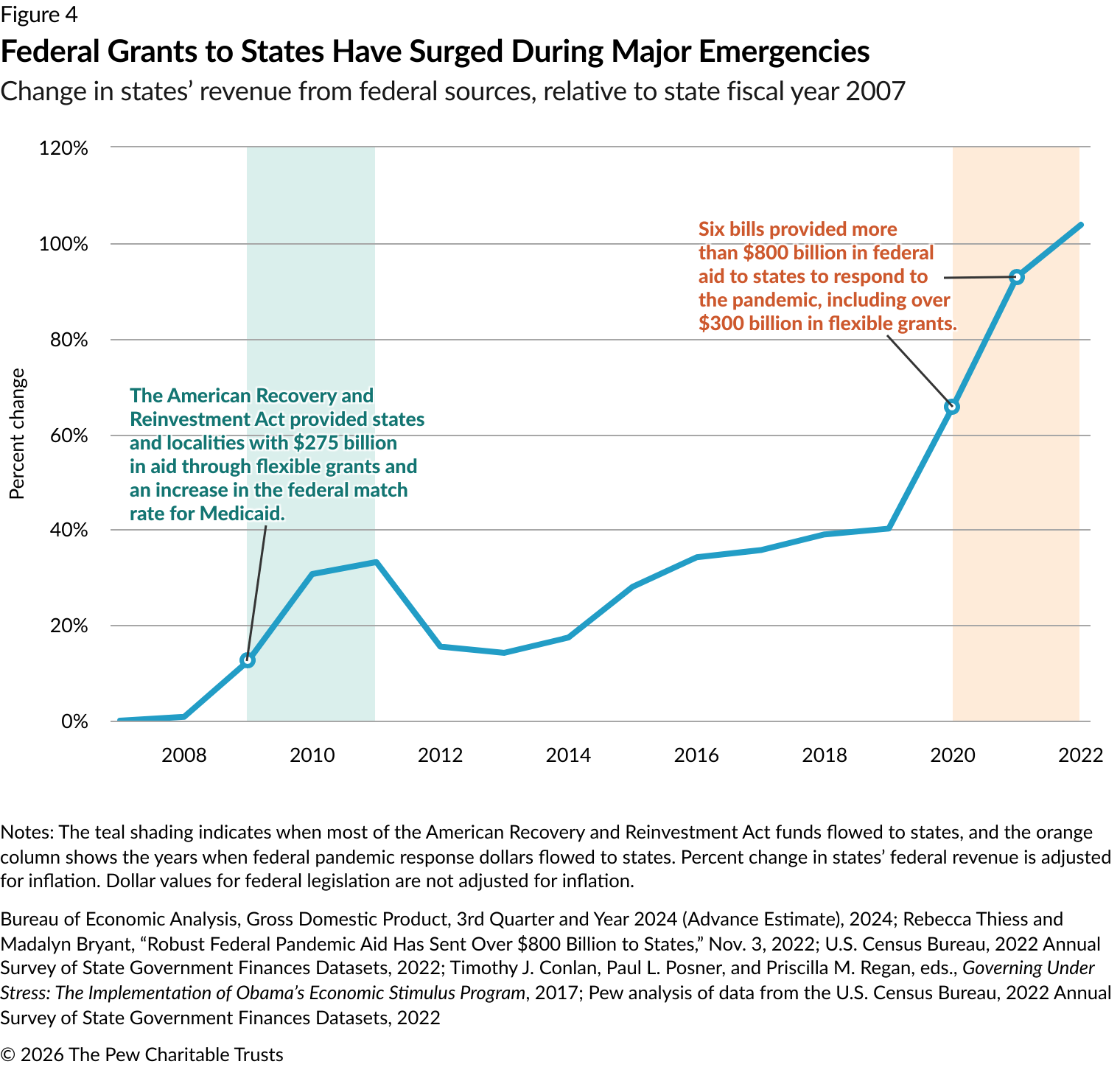
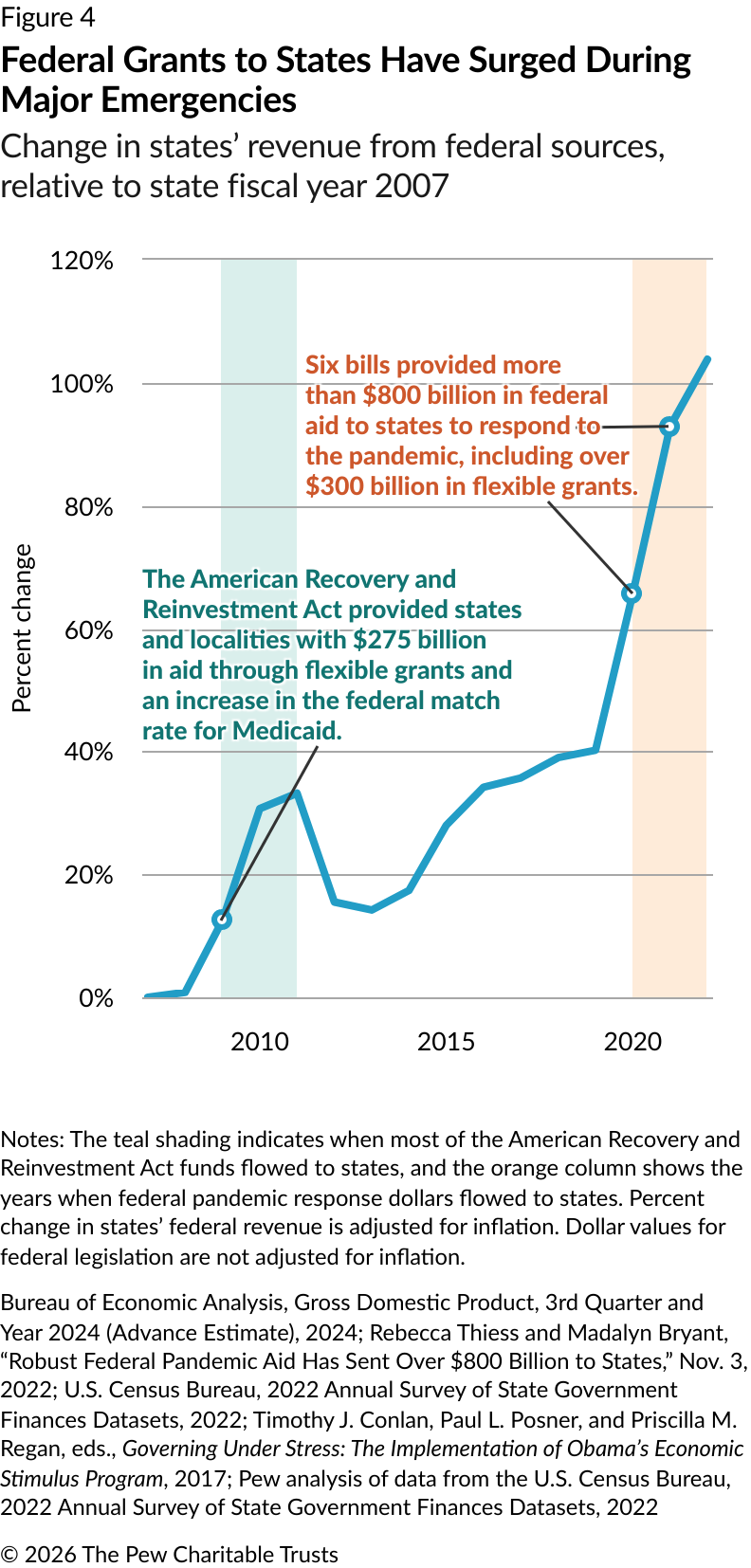
Both the Great Recession of 2007-09 and the pandemic led to enormous increases in federal grants to states. (See Figure 4.) Reallocating staff or creating new capacity can help officials distribute and manage resources quickly and effectively. When the American Recovery and Reinvestment Act of 2009 (ARRA) sent $275 billion to state and local governments during the Great Recession, those with a greater capacity to accept federal funds and disburse it efficiently were able to spend ARRA dollars faster and thus implement programs more quickly—getting help to people when they most needed it.72 Similarly, research has indicated a link between financial administrative capacity and the proportion of Coronavirus Relief Fund aid that was spent early in response to COVID-19.73 The Government Accountability Office found that staff members experienced in managing federal relief funds were able to help states “more effectively plan, use, and report on COVID-relief funds.”74 If states don’t have—or can’t quickly build—the administrative capacity to manage one-time aid, they risk delaying use of these funds to respond to the corresponding emergency.
What states are doing
In addition to the examples described below, Pew’s April 2025 issue brief, “Lessons From the Pandemic Can Help States Manage Federal Funding,” provides information about state efforts to manage the large influx of pandemic funds.75
Leveraging the skills and knowledge of a centralized team. A number of states, including Delaware, Hawaii, and New Jersey, relied heavily on centralized teams during the COVID-19 pandemic to maximize the distribution and impact of aid.76 For example, Delaware used its experienced grant management team within the Office of Management and Budget to handle COVID-19 relief funds and distribute pandemic dollars in response to the most urgent needs within communities.
Using contractors, building skills, and adjusting staff capacity to meet needs. States such as Delaware, Michigan, and Utah brought in contractors, hired compliance firms, or increased the hiring and training of existing staff to increase their capacity to manage extra grants.
Rhode Island’s Pandemic Recovery Office started with a team of consultants disbursing COVID-19 relief funds and over time replaced contractors with temporary internal staff. In New Hampshire, the Governor’s Office for Emergency Relief and Recovery was initially created as a short-term solution to handle funds from the Coronavirus Aid, Relief, and Economic Security Act.77 The office started out with staff borrowed from agencies around New Hampshire but transitioned to full-time staff as an influx of money from the American Rescue Plan Act of 2021 extended the need for such an office.
Challenge 3: It is difficult to strategically direct federal funds to key state priorities
Federal dollars come from many different funding streams and support disparate state activities, often making it difficult to obtain and use funds strategically. In addition, state agencies, which can pursue a variety of federal funding opportunities on their own, have different functions and long-term goals; a challenge for state officials is to coordinate federal funding in a way that advances agency ambitions and aligns with state priorities. To maximize federal funds, states can benefit from strategically allocating resources.
Subchallenge: Silos that separate agencies and levels of government hinder communication
Divisions between agencies and levels and branches of government can exacerbate strategic challenges.78 Applying for federal grants ad hoc, without appropriate interagency coordination, can lead to misalignment. A clerk for a state legislative committee said that there are times when it would be helpful for certain agencies to “[consult] with agencies who may be better suited to conduct the work.”
What states are doing
Communicating state priorities and how they relate to federal funding. Clear communication about priorities by state leaders helps align goals across agencies and levels of government. In Hawaii, Governor Josh Green (D) created a statewide initiative, Investing in Hawaii’s Future, to focus on collaboration between and among federal, state, and community partners in the pursuit of federal funding to support state priorities including “climate, agriculture, transportation, mental health, housing, environmental health, and human services.”79 In response to increased federal funding for infrastructure, Governor Maura Healey (D) of Massachusetts signed an executive order in 2023 directing agencies and offices in the executive branch to pursue competitive funds.80 Areas to prioritize were clearly spelled out in the governor’s order, including “infrastructure, jobs, economic competitiveness, affordable housing, clean energy, decarbonization, climate resilience, equity, and workforce development.”81 For the distribution of pandemic relief funds, Massachusetts specified its strategic goal of distributing funds equitably and established a Federal Funds Equity & Accountability Review Panel to target disproportionately affected communities.82
To publicize his spending priorities in 2021, Utah Governor Spencer Cox (R) released the first iteration of “One Utah Roadmap,” which contained six priority areas and specific action items for agencies to further the governor’s goals.83 Tracy Gruber, the executive director of the Utah Department of Health and Human Services, said that state officials should invest the time to clarify priorities “so that you’re not chasing the funding that you shouldn’t be chasing.”
Creating opportunities for interagency cooperation. Because federal funds are received and administered by separate state agencies—whose leaders and staff do not always talk to one another—some states have searched for opportunities to break down silos and foster communication. Hawaii and Minnesota, for example, have convened small working groups of relevant agency employees to foster collaboration, while Massachusetts has an advisory council that fosters collaboration on federal funding opportunities.
As part of its larger “Investing in Hawaii’s Future” initiative, Hawaii organized “pods” to collaborate on federal funds. Stakeholders in each policy area get together and share information about grants they are pursuing and have received. Like Hawaii’s pods, Minnesota’s “interagency workgroups” convene officials from different policy areas to discuss budget proposals and track metrics. Although these work groups do not focus specifically on federal funding, Nick Lardinois, director of budget policy and analysis for Minnesota Management and Budget, said that they are good resources for agencies to “get connected with each other and become familiar with each other.” Similarly, the Federal Funds and Infrastructure Office in Massachusetts established an advisory council to provide a formal setting for collaboration on federal funding opportunities among state agencies. The advisory council provides a forum for both government and quasi-government officials to communicate. Massachusetts state officials can also flag opportunities for cross-agency coordination. The infrastructure office has a clearinghouse that keeps track whenever a state agency or a partner such as a regional planning agency applies for a grant. Hawaii legislative staff also play a role in coordination to break down silos. According to the clerk for a state legislative committee, legislative offices can observe when projects are cross-departmental and identify opportunities for collaboration.
Collaborating with federal and local governments to secure and manage federal funds. For example, in 2024, Hawaii held the Investing in Hawaii’s Future Summit, which provided an opportunity for state and federal counterparts to connect and collaborate around accessing and using federal funds. According cohost Ed Sniffen, director of the Hawaii Department of Transportation, “At the summit, our local grants teams were able to engage directly with federal partners, address our specific needs, and discover new opportunities that align with our state’s vision. This dialogue is essential as we work together to bring transformative projects to life across Hawaii.”84
Minnesota makes efforts to collaborate with Tribal governments and instituted a consultation process that seeks feedback on budget proposals through Tribal liaisons and monthly Tribal-state relations trainings.85
Subchallenge: Planning for matching requirements requires coordination
Many state officials are interested in efforts to maximize federal funding opportunities; these efforts can require states to invest their own resources, not only for staff capacity, but also to fulfill any match requirements that the federal programs may have. With limited resources, officials must determine if a matching grant is worth expending own-source funds. And lack of coordination can keep agencies from using collective resources to meet matching fund requirements; Allen Knudson, a legislative budget analyst in North Dakota, reported that, before the North Dakota Legislature instituted a reporting system, agencies would on occasion unexpectedly ask the Legislature for matching funds.
What states are doing
Creating systems that can support seeking and acquiring federal funds. Some states have made a concerted effort to work toward maximizing the amount of funding they receive from the federal government. Kansas, for instance, created the Build Kansas Fund in 2023 to provide matching funds for public or private organizations seeking grants through the Infrastructure Investment and Jobs Act (IIJA).86 The North Carolina Office of State Budget and Management launched a Technical Assistance and Matching Program to help the state maximize federal funding from the IIJA, the Inflation Reduction Act, and the Chips and Science Act with both technical assistance and $5 million in matching funds.87
Other states have created less specific matching funds. Massachusetts, for example, created a match fund from interest earned on the balance in the Commonwealth Stabilization (“Rainy Day”) Fund. This fund could provide up to $750 million to pursue federal grant opportunities, including the satisfaction of nonfederal cost share requirements.88 Although the fund is not limited to a specific area of funding or legislation, the law creating the fund specifically mentions recent federal infrastructure spending.89 This fund enables agencies to confidently apply for grants that require a match and align with state priorities. In 2023, Kentucky created a similar program to help communities and nonprofits meet federal matching requirements.90 The Kentucky GRANT match program provides up to $200 million to help these groups meet local match requirements for economic development and tourism projects.91
Pew’s Recommendations
Given the unique challenges that federal funds pose to states, policymakers should consider taking a proactive and comprehensive approach to the management of federal funds. Pew has identified three overarching recommendations for state officials:
Recommendation 1: Create a transparent system to understand federal funding and what it pays for.
States benefit from understanding their federal funding streams. Clear tracking and documentation of federal funding sources, including both regular and one-time funds, help officials understand which funds are supporting which programs. This knowledge is key to both immediate and longer-term planning efforts. Having a clear understanding of federal funds—their scope, size, timelines, and guidelines for use—can take various forms and may be done by legislative or executive staff, depending on the structure of a state’s government. But no matter how it is done, a comprehensive understanding of federal funding helps a state manage the inherent uncertainty and volatility that inevitably comes with this important source of funding for state budgets.
As a part of this effort, states should:
- Clearly track and document federal funding in budget documents. State officials can achieve this goal in several ways, such as incorporating one-time and recurring funds into the state’s annual or biennial budgeting process. The National Conference of State Legislatures suggests that developing this type of clarity in budgeting through a “clear set of rules and establish[ed] norms and precedents” can strengthen state processes and guide future legislators to continue to account for one-time and recurring funds.92 States can also provide lawmakers with specific training or materials that clearly delineate federally funded state programs and the parameters of that federal funding.
- Have a plan to assess the impact of federal funding shifts in times of volatility. With clear budget documents, states can reduce fiscal risks by encouraging planning—either by limiting the use of one-time funding for one-time purposes or by creating a plan in which the state spends one-time funds for ongoing purposes. States might also have plans in place for funding increases and decreases or use forecasting strategies to handle federal uncertainty. Because funding volatility can be both politically or economically motivated, planning for changes brought by both economic downturns and federal politics can be helpful in light of the enormous role federal funds play in state budgets.
Recommendation 2: Target state resources to invest in the people and systems needed to administer federal funds.
It is critical for states to have the people and systems in place to administer federal funding to maximize both the amount of funding they receive and its potential impact. It can be difficult to build and maintain administrative capacity across government, especially for smaller agencies or when states receive additional one-time funding. States should assess gaps in administrative capacity and work to fill them.
As part of this effort, states should:
- Centralize tasks or invest in personnel and tools to help administer federal funds if agency capacity is insufficient. States should assess which agencies would most benefit from centralized expertise and what types of activities—such as tracking and communication, training, building a workforce, and leveraging technology—would lend themselves to that approach. When centralization does not seem to fit, states should work to hire and train individuals to administer federal funding. States should pay particularly close attention to fluctuations in administrative needs during one-time events, such as an economic crisis or a natural disaster, that bring large influxes of one-time federal funding.
- Provide support to local governments to improve grant management capacity and reach underserved communities. By supporting and enhancing the ability of local governments to manage federal grants, state policymakers can help to assure that federal funds benefit their state and its residents.
Recommendation 3: Coordinate and use funds strategically to maximize the impact of federal resources to advance state priorities.
State officials can struggle to direct federal grants to support high-priority state goals, which requires coordination, insight, and planning. Directing this funding strategically, however, is important, as it can help minimize inefficiency and maximize impact in key areas. As state officials work together to identify priorities, they should also work to ensure effective communication across departments and levels of government to steer resources toward state policy priorities and services.
As part of this effort, states should:
- Create processes for coordination and communication across agencies and levels of government. States should ensure that there is regular and productive communication across levels of government on federal funding. That can be achieved through interagency working groups, coordinating committees, or officials in central offices communicating about opportunities for collaboration. States can also coordinate around making matching funding available to advance state priorities, in instances where maximizing federal funding is desired to support state programs and activities.
Conclusion
The unprecedented increase in federal dollars that resulted from the COVID-19 pandemic, coupled with recent efforts to scale back funding to states, has put a spotlight on the key role that federal funding plays in state budgets every year. Although every state has its own procedures for seeking and managing these dollars, officials face three common challenges: Federal funding levels are hard to predict; they are complex and administratively intensive to manage; and they are difficult to coordinate and direct strategically.
By examining these challenges and the variety of ways in which states are successfully navigating them, Pew has identified three key recommendations for state legislators and budget officials, to help them better prepare for a range of potential fiscal, economic, and political scenarios.
Appendix A: Methodology
In preparation for this work, Pew engaged a focus group with state legislative staff and elected state representatives on issues and opportunities surrounding federal funds management. Researchers also completed a 50-state scan of federal funds management practices using state budget documents and state budget websites. Researchers collected information from each state, including procedures for 1) appropriating nonrecurring federal funds; 2) tracking federal funds; and 3) distributing federal pandemic response funds. Researchers analyzed state resources such as federal funds reports, state definitions of budget terms, and information from centralized grants offices.
To better understand how states manage federal funding in practice and what issues are most pressing for state policymakers, Pew selected a subset of states—Delaware, Hawaii, Massachusetts, Michigan, Minnesota, New Hampshire, New Jersey, North Carolina, North Dakota, Ohio, Rhode Island, and Utah—for more in-depth research about managing federal funds and distributing federal pandemic response dollars. Researchers selected these states based on their distinctive approaches to tracking and managing federal funding, as uncovered in the 50-state scan. Those approaches included a federal funds clearinghouse, a centralized federal funds office, centralized distribution and tracking of federal pandemic response dollars, an annual federal funds report, or rigorous definitions of federal funding terminology. Additionally, researchers factored regional and political diversity into the selection process.
Between July 2024 and September 2024, researchers completed 24 interviews with state budget officials, legislative staff, elected officials, agency heads, and pandemic response directors in the 12 selected states. These interviews lasted approximately one hour. Interviewers prepared three question guides, with questions specific to different roles in the government. Generally, interview guides included questions on budget processes, collaboration between branches of government, transparency of fund use, maximization of funds, and equity considerations. Interviewers provided questions to interviewees prior to the interview upon request. To offer additional perspectives, multiple officials from one office participated in the same interview when relevant. When an official was unable to participate in an interview, researchers offered to provide questions via email. Two officials submitted answers in writing, resulting in 26 total interview responses. See below for interview participants; note that this list does not include those who preferred to remain anonymous.
Transcribed interviews and written responses were then analyzed with NVivo software to organize themes and develop findings from the interviews. Some quotes have been edited for clarity.
Limitations: The interview portion of this study was limited to a subset of 12 states; therefore, specific findings may not be generalizable throughout the country. In selected states, Pew did not do a comprehensive analysis of state spending. This report also does not discuss ways the federal government could mitigate these challenges for states, instead focusing solely on state solutions. These limitations represent opportunities for future research. Some findings are based on the information shared by individual interviewees and may not be independently verifiable.
List of study participants:
- Delaware Department of Justice—Andrea Godfrey
- Delaware Office of Management and Budget—Carla Cassell-Carter, Kyle Pritchard
- Hawaii Department of Budget and Finance—Mark Anderson, Sabrina Nasir
- Massachusetts Executive Office for Administration and Finance—Andra Deaconn
- Massachusetts Executive Office of Energy and Environmental Affairs—Wallace Gathoni
- Massachusetts Federal Funds and Infrastructure Office—Quentin Palfrey
- Michigan COVID-19 Office of Accountability—Jennifer Edmonds
- Michigan Senate Fiscal Agency—John Maxwell
- Minnesota Department of Transportation—Josh Knatterud-Hubinger
- Minnesota Management and Budget Office—Ahna Minge, Nick Lardinois
- New Hampshire Governor's Office for Emergency Relief and Recovery—Lisa Cota-Robles
- New Jersey Office of Management and Budget—Tariq Shabazz
- North Carolina General Assembly—Jennifer Hoffmann, John Poteat, Stephen Bailey, Timothy Dale
- North Carolina Office of State Budget and Management—Lanier McRee, Stephanie McGarrah
- North Dakota Joint Budget Section Committee—Allen Knudson
- Ohio Office of Budget and Management—Stacie Massey
- Rhode Island Pandemic Recovery Office—Paul Dion
- Utah Department of Health and Human Services—Tracy Gruber
- Utah Governor’s Office of Economic Opportunity—Jim Grover
- Utah Governor’s Office of Planning and Budget— Sophia DiCaro
Appendix B: Overview of Federal Funds Challenges and How Certain States Approach Them
| Challenge 1: Federal funding levels can be difficult to project | ||
|---|---|---|
| Subchallenge | What states are doing | State examples featured |
| Fragmented and complex funding sources complicate understanding of future federal funding | Identifying and managing recurring and nonrecurring funds in budget processes | Hawaii, Maine, Utah, Vermont |
| Planning for programs that are funded by nonrecurring sources | Hawaii, Idaho | |
| Providing details to decision-makers about the programs and services that federal funding pays for | California, Massachusetts, Vermont | |
| Federal decisions can drive funding volatility and are hard to predict | Managing unexpected increases in federal funds | Minnesota, Utah, North Dakota |
| Managing the unexpected loss of federal funds | Alaska, Colorado, Idaho, Maryland, Massachusetts, Montana, New Hampshire, New Mexico, Utah, Vermont | |
| Proactive planning for a possible reduction or loss of funding | Alabama, Tennessee, Utah | |
| Challenge 2: Applying for and managing federal grants is complicated | ||
| Subchallenge | What states are doing | State examples featured |
| The federal grant process requires appropriate capacity to navigate | Tracking available grants through centralized systems and communicating those with state agencies | Delaware, Hawaii, Massachusetts, Ohio |
| Training or hiring staff to apply for and manage grants | Hawaii, Illinois, Ohio | |
| Centralizing appropriate elements of the grant process to streamline management | Hawaii, Illinois, Ohio, Rhode Island, Utah | |
| Local governments often lack resources to manage federal grants | Providing grants training and support | Kansas, Kentucky, Massachusetts, Michigan, Ohio |
| Where possible, using federal funds to support local communities | Massachusetts, Michigan | |
| Working with local and regional associations to maximize effectiveness | Massachusetts, North Carolina, Utah | |
| Large sums of one-time federal funds require additional management capacity | Leveraging the skills and knowledge of a centralized team | Delaware, Hawaii, New Jersey |
| Using contractors, building skills, and adjusting staff capacity to meet needs | Delaware, Michigan, New Hampshire, Rhode Island, Utah | |
| Challenge 3: It is difficult to strategically direct federal funds to key state priorities | ||
| Subchallenge | What states are doing | State examples featured |
| Silos that separate agencies and levels of government hinder communication | Communicating state priorities and how they relate to federal funding | Hawaii, Massachusetts, Utah |
| Creating opportunities for interagency cooperation | Hawaii, Massachusetts, Minnesota | |
| Collaborating with federal and local governments to secure and manage federal funds | Hawaii, Minnesota | |
| Planning for matching requirements involves coordination | Creating systems that can support seeking and acquiring federal funds | Kansas, Massachusetts, North Carolina, Kentucky |
About this report
This report was researched and written by Rebecca Theiss, manager, and Kate Watkins, senior associate, with The Pew Charitable Trusts’ managing fiscal risks team, with contributions from Laura Pontari, who served as lead researcher and co-author; Peter Muller; Maureen Hilton; Jimmy Einsiedler; and Samuel Pittman. It was edited by Sara Dube, director, and Colin Foard, project director, with additional review by Kil Huh, senior vice president, government performance, and Mary Murphy, senior director, fiscal and economic policy. The development of this study was supported by Alan van der Hilst. Briana Okebalama, Jennifer V. Doctors, Tricia Olszewski, Catherine An, and Jolene Nieves Byzon contributed editorial, design, and communications support.
Acknowledgments
The researchers thank independent expert Juliette Tennert for advice and input on this research and the state officials who shared their time and knowledge during the interviews that form the basis of the study. Neither the independent expert nor the government officials necessarily endorse the report’s findings or conclusions.
This report benefited from the insights and expertise of outside reviewers Beverly Bunch, professor emerita, School of Public Management and Policy, University of Illinois Springfield; and Amanda Kass, assistant professor, School of Public Service, DePaul University. Although they have reviewed the report, neither they nor their organizations necessarily endorse its findings or conclusions.
Endnotes
- Samuel Pittman, Rebecca Thiess, and Justin Theal, "Federal Share of State Budgets Remains High, but Uncertainties Lie Ahead," The Pew Charitable Trusts, June 16, 2025, https://www.pew.org/en/research-and-analysis/articles/2025/06/16/federal-share-of-state-budgets-remains-high-but-uncertainties-lie-ahead.
- National Conference of State Legislatures, "NCSL Updates on Federal Funding Pause," Feb. 10, 2025, https://www.ncsl.org/resources/details/ncsl-updates-on-federal-funding-pause. "Allocating CBO's Estimates of Federal Medicaid Spending Reductions Across the States: Enacted Reconciliation Package," KFF, 2025, https://www.kff.org/medicaid/allocating-cbos-estimates-of-federal-medicaid-spending-reductions-across-the-states-enacted-reconciliation-package. 119th Congress, H.R.1—an Act to Provide for Reconciliation Pursuant to Title II of H. Con. Res. 14, https://www.congress.gov/bill/119th-congress/house-bill/1/text. National Governors Association, "Budgets and Programs in Balance: Understanding the Fiscal Impact of Federal Policy Across State and Territory Systems," May 21, 2025, https://www.nga.org/advocacy-communications/budgets-and-programs-in-balance-understanding-the-fiscal-impact-of-federal-policy-across-state-and-territory-systems.
- Due to research constraints, this report does not discuss ways the federal government can mitigate these challenges for states.
- "Where States Get Their Money: FY 2023," The Pew Charitable Trusts, June 2, 2025, https://www.pew.org/en/research-and-analysis/data-visualizations/2025/06/where-states-get-their-money-fy-2023.
- Samuel Pittman, Rebecca Thiess, and Justin Theal, "Federal Share of State Budgets Remains High," The Pew Charitable Trusts.
- Samuel Pittman, Rebecca Thiess, and Justin Theal, "Federal Share of State Budgets Remains High," The Pew Charitable Trusts.
- "Where States Get Their Money: FY 2023," The Pew Charitable Trusts. "How Federal Funding Flows to State Governments, by Policy Area," Rebecca Thiess and Justin Theal, The Pew Charitable Trusts, March 5, 2025, https://www.pew.org/nb/research-and-analysis/articles/2025/03/05/how-federal-funding-flows-to-state-governments-by-policy-area.
- U.S. Department of Justice, "Justice Department Awards Over $4.4 Billion to Support Community Safety," news release, Sept. 28, 2023, https://www.justice.gov/archives/opa/pr/justice-department-awards-over-44-billion-support-community-safety. "Special Education—Grants to States (Aln: 84.027)," U.S. Department of Education, July 23, 2025, https://www.ed.gov/grants-and-programs/formula-grants/formula-grants-special-populations/special-education-grants-states-aln-84027#home. U.S. Department of Justice, "FHWA Delivers Largest Federal Highway Apportionment in Decades as Part of Bipartisan Infrastructure Law Funding," news release, Dec. 15, 2021, https://www.transportation.gov/briefing-room/fhwa-delivers-largest-federal-highway-apportionment-decades-part-bipartisan.
- "10 Things to Know About Medicaid," Alice Burns et al., KFF, Feb. 18, 2025, https://www.kff.org/medicaid/10-things-to-know-about-medicaid. "Health Insurance Coverage of Children 0-18 Living in Poverty (Under 100% FPL)," KFF, 2023, https://www.kff.org/state-health-policy-data/state-indicator/health-insurance-coverage-children-under-100-fpl/.
- Adam Levin, "Federal Grants to State and Local Governments: Trends and Issues," Congressional Research Service, https://www.congress.gov/crs-product/R40638.
- Adam Levin, "Federal Grants to State and Local Governments: Trends and Issues."
- "How Federal Funding Flows to State Governments," Rebecca Thiess and Justin Theal, The Pew Charitable Trusts.
- "Robust Federal Pandemic Aid Has Sent Over $800 Billion to States," Rebecca Thiess and Madalyn Bryant, The Pew Charitable Trusts, Nov. 3, 2022, https://www.pewtrusts.org/en/research-and-analysis/articles/2022/11/03/robust-federal-pandemic-aid-has-sent-over-$800-billion-to-states.
- Daniel Hoople, "Cost of Hurricane Katrina Relief and Rebuilding," Louisiana State Law Center, 2013, https://sites.law.lsu.edu/coast/2015/07/cost-of-hurricane-katrina-relief-and-rebuilding. Maui Recovers, "One Year Later, Maui Wildfire Recovery Continues with Nearly $3 Billion in Federal Support," Aug. 6, 2024.
- "Achieving a Structurally Balanced Budget," Government Finance Officers Association. The Pew Charitable Trusts, "State Strategies for Maintaining a Balanced Budget," 2018, https://www.pew.org/-/media/assets/2018/06/sfh_non-recurring_revenue.pdf. U.S. Public Finance State Governments and Territories Rating Criteria, Fitch Ratings, 2025, https://www.fitchratings.com/research/us-public-finance/us-public-finance-state-governments-territories-rating-criteria-04-02-2025. Rating Methodology US States and Territories, Moody's Ratings, 2024, https://ma.moodys.com/rs/961-KCJ-308/images/PBM_1401432.pdf.
- The Pew Charitable Trusts, "State Strategies for Maintaining a Balanced Budget."
- The Pew Charitable Trusts, "State Strategies for Maintaining a Balanced Budget."
- Email correspondence with Jessica Himes, Tennessee Office of Legislative Budget Analysis. Tennessee, "The Budget," 2021–2022, https://www.tn.gov/content/dam/tn/finance/budget/documents/budget-archive/budget-documents/2022BudgetDocumentVol1.pdf.
- "Federal Funds Overview," Alex J. Adams, Idaho Division of Financial Management, https://legislature.idaho.gov/wp-content/uploads/sessioninfo/2021/interim/211118_cof_ADAMS_Federal%20Funds%20Presentation.pdf.
- National Conference of State Legislatures, "One-Time vs. Recurring Revenues and Expenditures," 2025, https://www.ncsl.org/fiscal/one-time-vs-recurring-revenues-and-expenditures.
- California Legislative Analyst's Office, "Federal Spending in California" (presentation, Assembly Budget Subcommittee No. 7 on Accountability and Oversight, Feb. 20, 2025), https://lao.ca.gov/handouts/state_admin/2025/Federal-Spending-in-California-022025.pdf. Emily Byrne, "Overview of Federal Funds in the Vermont Budget" (presentation, Joint Fiscal Committee, Jan. 31, 2025), https://ljfo.vermont.gov/assets/Meetings/Joint-Fiscal-Committee/2025-01-31/Overview_of_Federal_Funds_in_the_Vermont_Budget_1.31.2025.pdf.
- "5 Insights to Help States Navigate a Federal Shutdown," Rebecca Thiess, Peter Muller, and Justin Theal, Mar. 11, 2025, https://www.pew.org/en/research-and-analysis/articles/2024/01/10/5-insights-to-help-states-navigate-a-federal-shutdown.
- Brad Plumer and Nicholas Nehamas, "Trump's Funding Freeze Raises a New Question: Is the Government's Word Good?" The New York Times, 2025. 119th Congress, H.R.1—an Act to Provide for Reconciliation Pursuant to Title II of H. Con. Res. 14.
- 119th Congress, H.R.1—an Act to Provide for Reconciliation Pursuant to Title II of H. Con. Res. 14.
- Utah State Legislature, 63j-1-315, "Medicaid Growth Reduction and Budget Stabilization Account—Transfers of Medicaid Growth Savings—Base Budget Adjustments" (2025), https://le.utah.gov/xcode/Title63J/Chapter1/63J-1-S315.html.
- Utah State Legislature, "Medicaid Growth Reduction and Budget Stabilization Account."
- "Emergency Commission," North Dakota Secretary of State, https://www.sos.nd.gov/services/emergency-commission.
- Utah State Legislature, 63j-7-203, "Legislative Review and Approval of Certain Grant Requests" (2008), https://le.utah.gov/xcode/Title63J/Chapter7/C63J-7-S203_1800010118000101.pdf.
- The Pew Charitable Trusts, "Lessons From the Pandemic Can Help States Manage Federal Funding," 2025, https://www.pew.org/en/research-and-analysis/issue-briefs/2025/04/lessons-from-the-pandemic-can-help-states-manage-federal-funding.
- Vermont Legislative Joint Fiscal Office, "Impacts of a Federal Government Shutdown: March 2025 Update," 2025, https://ljfo.vermont.gov/assets/Uploads/GENERAL-381398-v1-Impacts_of_federal_Shutdown_-_March_2025-v2.pdf. "Situation Update on Federal Government Shutdown," Utah Governor's Office of Planning and Budget, 2023, https://x.com/UtahGOPB/status/1707830418555515096.
- Office of Governor Mike Dunleavy, "Governor Dunleavy Prepares the State of Alaska for Potential of Federal Government Shutdown," news release, Sept. 26, 2023, https://gov.alaska.gov/governor-dunleavy-prepares-the-state-of-alaska-for-potential-of-federal-government-shutdown. Office of Governor Chris Sununu, "State Prepared for Federal Government Shutdown," news release, Sept. 29, 2023, https://web.archive.org/web/20241012102407/https://www.governor.nh.gov/news-and-media/state-prepared-federal-government-shutdown.
- "Federal Funding Stabilization Subcommittee," New Mexico Legislature, 2025, https://www.nmlegis.gov/committee/Interim_Committee?CommitteeCode=ZFFSS.
- "Task Force on the Federal Transition (2025)," Vermont Office of the State Treasurer, https://www.vermonttreasurer.gov/task-force-federal-transition-2025.
- In state fiscal year 2023, federal grants accounted for 36.7% of Vermont's total revenue. Vermont Office of the Treasurer, "Treasurer Pieciak's Task Force on the Federal Transition Releases Final Report," news release, July 17, 2025, https://www.vermonttreasurer.gov/press-releases/treasurer-pieciaks-task-force-federal-transition-releases-final-report. "Federal Share of State Budgets Remains High," Samuel Pittman, Rebecca Thiess, and Justin Theal, The Pew Charitable Trusts.
- Massachusetts Federal Funds & Infrastructure Office, "State Listening Sessions on Federal Funds Impacts," 2025. Office of the Governor of the Commonwealth of Massachusetts, "Impact of Trump Administration and Congressional Cuts on Massachusetts," 2025.
- Idaho Senate, Relates to the Appropriation to the Department of Health and Welfare for Fiscal Year 2026, ID S1206 (2025), https://www.billtrack50.com/billdetail/1879479.
- Idaho Senate, Relates to the Appropriation. Montana Legislature, House Bill 2: General Appropriations Act (2025), https://projects.montanafreepress.org/capitol-tracker-2025/bills/hb-2. "As Federal Funding Landscape Shifts, States Brace for Fiscal Impact," Liz Farmer and Peter Muller, The Pew Charitable Trusts, May 15, 2025, https://www.pew.org/es/research-and-analysis/articles/2025/05/15/as-federal-funding-landscape-shifts-states-brace-for-fiscal-impact.
- Office of the Governor of the Commonwealth of Massachusetts, letter, July 4, 2025, https://www.mass.gov/doc/fy26-budget-filing-letter-from-the-governor-and-lt-governor/download.
- "Federal Funding Cuts to Colorado," Colorado, https://federalfunds.colorado.gov/federal-funding-cuts-to-colorado.
- Liz Farmer and Peter Muller, "As Federal Funding Landscape Shifts," The Pew Charitable Trusts.
- Tennessee Department of Finance & Administration, "Federal Receipts Reporting and Plan of Potential 5%, 25%, and 100% Federal Estimate Reductions," 2024, https://www.tn.gov/content/dam/tn/finance/budget/documents/budget-archive/federalaidreports/2023%20TN%20Report%20of%20Federal%20Aid%20Receipts.pdf. "Annual Reporting of Federal Funds," Alabama Department of Finance, https://budget.alabama.gov/annual_reporting_of_federal_funds.
- Federal Funds Contingency Planning, H.B. 59, Utah State Legislature, 2024, https://le.utah.gov/~2024/bills/static/HB0059.html.
- "The Grant Lifecycle," Grants.gov, https://www.grants.gov/learn-grants/grants-101/the-grant-lifecycle. U.S. Government Accountability Office, "Grants Management: Observations on Challenges with Access, Use, and Oversight," 2023, https://www.gao.gov/products/gao-23-106797.
- U.S. Government Accountability Office, "Communities Rely on Federal Grants, but May Have Challenges Accessing Them," 2023, https://www.gao.gov/blog/communities-rely-federal-grants-may-have-challenges-accessing-them.
- U.S. Government Accountability Office, "Communities Rely on Federal Grants, but May Have Challenges Accessing Them."
- "Our Existing Research," Grants.gov, https://web.archive.org/web/20250413035734/https://simpler.grants.gov/research.
- "For State Agencies," The Ohio Grants Partnership, https://grants.ohio.gov/training-and-resources/for-state-agencies.
- "GATA Learning Management System (LMS)," Illinois, https://gata.illinois.gov/training.html. "For State Agencies," The Ohio Grants Partnership.
- "Grant Management System (GMS)," Rhode Island Office of Accounts and Controls, https://controller.admin.ri.gov/grants-management/grant-management-system-gms.
- "Grant Management System (GMS)," Rhode Island Office of Accounts and Controls. "Streamlining Grant Management for Rhode Island State Agencies," https://government.wittobriens.com/cge/case-studies/streamlining-grant-management-for-rhode-island-state-agencies.
- "GATA Is Good Government," Illinois, https://gata.illinois.gov/content/dam/soi/en/web/gata/documents/resource-library/gata-is-good-government-brief.pdf. "GATA Vision," Illinois, https://gata.illinois.gov/about/gata-vision.html. Governor's Office of Management and Budget (GOMB), "2024 Annual Report," 2025, https://gata.illinois.gov/content/dam/soi/en/web/gata/documents/annual-reports/GATA%20Annual%20Report%202024%20-%20FINAL.pdf.
- State of Hawaii Office of Federal Awards Management, "Functional Statement," https://federalawards.hawaii.gov/wp-content/uploads/2023/01/Functional-Statement-OFAM-12.27.22.pdf.
- "Planning & Funding Resources," Utah Governor's Office of Budget and Planning, https://gopb.utah.gov/funding-resources.
- Adam Levin, "Federal Grants to State and Local Governments: Trends and Issues." Urban Institute, "State and Local Backgrounders," https://www.urban.org/policy-centers/cross-center-initiatives/state-and-local-finance-initiative/state-and-local-backgrounders/state-and-local-expenditures.
- U.S. Government Accountability Office, "Communities Rely on Federal Grants, but May Have Challenges Accessing Them."
- U.S. Government Accountability Office, "Communities Rely on Federal Grants, but May Have Challenges Accessing Them."
- National Association of Counties, "From Recovery to Revitalization: How Local Leaders Are Unlocking the Potential of the American Rescue Plan," 2023, https://www.naco.org/resources/recovery-revitalization-how-local-leaders-are-unlocking-potential-american-rescue-plan. "Coronavirus State and Local Fiscal Recovery Funds for Non-Entitlement Units of Local Government," U.S. Department of the Treasury, https://home.treasury.gov/policy-issues/coronavirus/assistance-for-state-local-and-tribal-governments/state-and-local-fiscal-recovery-fund/non-entitlement-units.
- Brian K. Collins and Brian J. Gerber, "Redistributive Policy and Devolution: Is State Administration a Road Block (Grant) to Equitable Access to Federal Funds?" Journal of Public Administration Research and Theory 16, no. 4 (2006), 613–32, https://academic.oup.com/jpart/article-abstract/16/4/613/923274?redirectedFrom=PDF.
- U.S. Government Accountability Office, "Municipalities in Fiscal Crisis: Federal Agencies Monitored Grants and Assisted Grantees, but More Could Be Done to Share Lessons Learned," 2015, https://www.gao.gov/products/gao-15-222. Jeff Arkin, "Grants Management: Observations on Challenges with Access, Use, and Oversight" (presentation, Testimony Before the Committee on Homeland Security and Governmental Affairs, U.S. Senate, May 2, 2023), https://www.hsgac.senate.gov/wp-content/uploads/Testimony-Arkin-2023-05-02.pdf.
- "Grant Ready Kentucky to Help Communities Access Federal Grant Funding," Kentucky Association of Counties, March 4, 2025, https://kaco.org/articles/grant-ready-kentucky-to-help-communities-access-federal-grant-funding. "About," Grant Ready Kentucky, LinkedIn, https://www.linkedin.com/company/grant-ready-kentucky/about.
- "Grant Ready Kentucky to Help Communities," Kentucky Association of Counties.
- Massachusetts Office of the Governor, Executive Order No. 624: Establishing the Federal Funds and Infrastructure Office and the Advisory Council on Federal Funds and Infrastructure, No. 624 (2023), https://www.mass.gov/executive-orders/no-624-establishing-the-federal-funds-and-infrastructure-office-and-the-advisory-council-on-federal-funds-and-infrastructure.
- "Federal Funds Information for Local Governments," Massachusetts Federal Funds & Infrastructure Office, https://web.archive.org/web/20240628181006/https://www.mass.gov/info-details/federal-funds-information-for-local-governments.
- Massachusetts Federal Funds & Infrastructure Office, "Federal Funds Information for Local Governments."
- "MIO Technical Assistance Center," Michigan Office of the Governor, https://www.michigan.gov/whitmer/issues/michigan-infrastructure-office/michigan-infrastructure-technical-assistance-center. "About Us," Kansas Infrastructure Hub, https://www.kshub.gov/about-the-hub/about-us.
- "MIO Technical Assistance Center," Michigan Office of the Governor.
- "About Us," Kansas Infrastructure Hub. "Technical Assistance Team," Kansas Infrastructure Hub, https://www.kshub.gov/technical-assistance/technical-assistance-team.
- Local and regional associations and leagues come in a variety of forms. National associations and leagues, such as the National Association of State Budget Officers and the Government Finance Officers Association, have local or state affiliates. Other organizations are not tied to a national network and are based wholly within the state.
- North Carolina, General Assembly Session Law 2021-180 (2021), https://www.ncleg.gov/Sessions/2021/Bills/Senate/PDF/S105v8.pdf.
- "American Rescue Plan Act (ARPA) Technical Assistance," North Carolina Association of County Commissioners, https://www.ncacc.org/services-for-counties/ncacc-strategic-member-services/american-rescue-plan. North Carolina League of Municipalities, Sept. 8, 2022, https://x.com/NCLeague/status/1567880504900206600.
- The Pew Charitable Trusts, "How the Federal Government and States Coordinate in Times of Recession," 2019, https://www.pew.org/en/research-and-analysis/fact-sheets/2019/09/how-the-federal-government-and-states-coordinate-in-times-of-recession.
- Alan J. Abramson et al., Governing Under Stress (2017), https://www.google.com/books/edition/Governing_under_Stress/eWjEDQAAQBAJ?hl=en&gbpv=0. Sean Nicholson-Crotty, Sanya Carley, and Eric J. Fisher, "Capacity, Guidance, and the Implementation of the American Recovery and Reinvestment Act," Public Administration Review (2015), https://www.jstor.org/stable/24758032.
- Iuliia Shybalkina, "Getting a Grant Is Just the First Step: Administrative Capacity and Successful Grant Implementation," The American Review of Public Administration 54, no. 3 (2023), https://journals.sagepub.com/doi/10.1177/02750740231206823.
- U.S. Government Accountability Office, "COVID-19 Relief Funds: State Experiences Could Inform Future Federal Relief Funding," 2023, https://www.gao.gov/products/gao-24-106152.
- The Pew Charitable Trusts, "Lessons From the Pandemic Can Help States Manage Federal Funding."
- State of Hawaii Office of Federal Awards Management, "Functional Statement." New Jersey Office of the Governor, Executive Order No. 166 (2020), https://nj.gov/infobank/eo/056murphy/pdf/EO-166.pdf.
- New Hampshire Governor's Office for Emergency Relief and Recovery, "American Rescue Plan Transparency Map," https://www.goferr.nh.gov.
- The U.S. Advisory Commission on Intergovernmental Relations, a federal agency established in 1959, once worked to promote coordination between levels of government. But that agency was disbanded in 1996, leaving gaps in collaboration and coordination that must be filled at the state and local level. The Advisory Commission on Intergovernmental Relations, "Welcome to the U.S. Advisory Commission on Intergovernmental Relations' Home Page." "Federal Entity Ceased Operations," National Archives.
- "Federal Funds," Office of Hawaii Governor Josh Green, https://governor.hawaii.gov/federal-funds.
- Massachusetts Office of the Governor, Executive Order No. 624.
- Massachusetts Office of the Governor, Executive Order No. 624.
- "Federal Funds Equity & Accountability Review Panel," Massachusetts Executive Office of Administration and Finance, https://www.mass.gov/federal-funds-equity-accountability-review-panel.
- "Gov. Cox and Lt. Gov. Henderson Release One Utah Roadmap Update," Office of Governor Spencer Cox, Oct. 20, 2021, https://governor.utah.gov/press/gov-cox-and-lt-gov-henderson-release-one-utah-roadmap-update.
- Office of Governor Josh Green, "Governor Green and the Department of Transportation Host Federal Funds Summit," news release, Aug. 30, 2024, https://governor.hawaii.gov/main/governor-green-and-the-department-of-transportation-host-federal-funds-summit.
- "Tribal-State Relations Training," Minnesota Department of Transportation, https://www.dot.state.mn.us/tribaltraining/class.html.
- "Build Kansas Fund Program Guidance," Kansas Infrastructure Hub, July 23, 2025, https://www.kshub.gov/home/showpublisheddocument/72/638670915801900000. "Build Kansas Fund Overview," Kansas Infrastructure Hub, https://www.kshub.gov/build-kansas-fund/build-kansas-fund-overview.
- Kristin Walker, "State Technical Assistance and Matching Program (STAMP) Legislative Report as Required by S.L. 2023-134 Section 23.2(C)," 2023, https://webservices.ncleg.gov/ViewDocSiteFile/83420.
- "Massachusetts Federal Grant Matching Funds," Massachusetts Executive Office of Administration and Finance, https://www.mass.gov/info-details/massachusetts-federal-grant-matching-funds.
- "Massachusetts Federal Grant Matching Funds," Massachusetts Executive Office of Administration and Finance.
- Office of the Governor of Kentucky, "Gov. Beshear: Team Kentucky Partners With Nonprofit Grant Ready Kentucky to Help Communities Access Federal Grant Funding," news release, March 3, 2025, https://www.kentucky.gov/Pages/Activity-stream.aspx?n=GovernorBeshear&prId=2423.
- Office of the Governor of Kentucky, "Gov. Beshear: Team Kentucky Partners With Nonprofit."
- National Conference of State Legislatures, "One-Time vs. Recurring Revenues and Expenditures."
People