New Mapping Tool Can Help South Carolina Prepare for Sea-Level Rise
Innovative platform offers model for other states
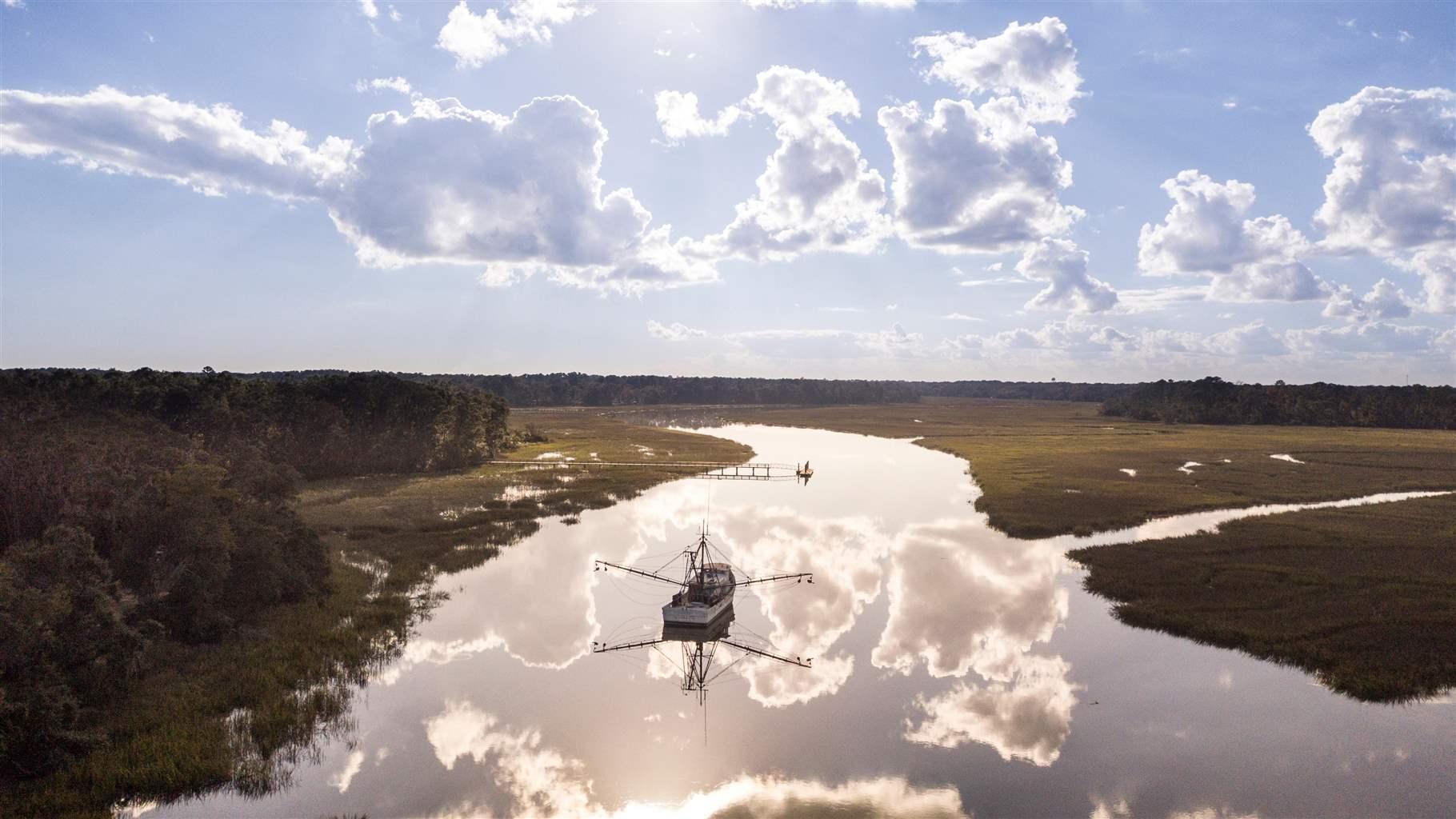
In Beaufort County, South Carolina, conservation is not abstract. Rather, it’s a deeply held ethos that supports long-standing local stewardship and a willingness to invest in making communities more resilient to rising seas, according to Juliana Zadik, the county’s environmental long-range planner and a native South Carolinian.
“What I think really drives a lot of people is that they live here because they love this landscape, and so they generally support efforts to conserve it,” Zadik said.

This pragmatism led to the development of a new mapping tool designed to help communities, planners, and conservationists track salt marsh migration and prepare for sea-level rise. The effort—which is funded by the National Fish and Wildlife Foundation—benefited from input from 50 community organizations and six National Estuarine Research Reserves (NERRs) from New Hampshire to Florida, including South Carolina’s Ashepoo-Combahee-Edisto (ACE) Basin NERR.
The NERRs are a network of 30 coastal sites in 23 states and Puerto Rico that help inform communities at risk of flooding, support fisheries and wildlife, conduct research, and provide educational and recreational opportunities. The ACE Basin NERR spans nearly 120,000 acres in one of the largest undeveloped estuaries on the Eastern Seaboard, encompassing Beaufort and three neighboring counties.
The motivations behind the project aren’t lofty; they’re existential. The Lowcountry is a patchwork of beautiful yet vulnerable tidal marshes, uplands, barrier islands, and oyster reefs, where rising seas, stronger storms, and saltwater intrusion threaten infrastructure and communities.
Among the many effects of sea-level rise is marsh migration. As wetlands, particularly salt marshes, become inundated, they may push inland with the encroaching waters. This migration is vital to the survival of these habitats and the species that depend on them, as well as to maintaining the benefits they provide, including nurseries for commercial and recreational fish species, flood buffering, storm protection, and water purification. But it also presents land management and planning challenges.
“Marsh migration is going to be the bellwether of where the water will be coming in,” Zadik said, describing how tidal wetlands naturally retreat landward as seas advance. Nearly half of Beaufort County is salt marsh.
Collaboration Among Reserves Helps Communities See Results

Julie Binz, manager of the ACE Basin NERR at the South Carolina Department of Natural Resources (SCDNR), recalls a conversation with a colleague at New Hampshire’s Great Bay NERR about learning from the efforts of a team of six East Coast NERRs—led by Narragansett Bay in Rhode Island, with funding from the National Fish and Wildlife Foundation—to create digital tools to help project sea-level rise and plan for and identify marsh migration areas in each reserve.
Drawing on lessons learned from the Narragansett Bay and Great Bay project over more than a decade spent creating their salt marsh tools, the ACE Basin Reserve leapfrogged over years of trial and error, completing its tools in just two years. This rapid progress reflects the power of the NERR system. Reserves across the country collect and share standardized data, tools, and best practices that are applicable across locations, allowing reserves to adopt proven methods, rather than starting from scratch. A 2021 study found that every dollar invested in the reserve system generates at least $6 in ecological and economic benefits.
ACE Basin’s work may reward other reserves and similar coastal conservation entities with even faster results. “The reserves’ work across the system are similar, so we can replicate what New Hampshire and Rhode Island did,” Binz said.
This work will be applicable beyond the NERR system as well, including for the South Atlantic Salt Marsh Initiative (SASMI), a partnership aimed at protecting, restoring, and conserving 1 million acres of salt marsh from North Carolina to Florida.
Mapping tool transforms conceptual into concrete
Created under the leadership of the SCDNR and the ACE Basin NERR, the mapping tool translates theoretical projections into actionable data. “We can help visualize where the waters are predicted to be in relation to developable land, so that we can have smarter development where problems will be in the future,” Binz said.
Key benefits of the tool include:
- Infrastructure siting and preemptive disaster planning. Local officials will be able to use the tool to determine where to avoid building future roads, wastewater facilities, or other critical infrastructure, helping to reduce costly relocations or modifications.
- Identification of priority conservation purchases. Land trusts and agencies can focus on acquiring lands from willing sellers that are probable marsh migration corridors, ensuring that the habitats can thrive and minimizing future flooding threats to developed areas.
- Communication and buy-in. The tool includes a public-facing component that explains the tangible benefits of salt marsh conservation, including supporting tourism, recreation, and coastal commerce, and how planning and investments can protect communities. And because local leaders and public interest groups provided input on the tool, it produces outputs that align with local on-the-ground planning needs, which can also foster community trust and support.
Officials from the ACE Basin NERR expect other reserves will apply the lessons learned during the development of the new platform to create their own mapping tools, which eventually could support larger efforts, such as SASMI.
How the maps are built and organized

The tool creates maps that integrate data from the National Oceanic and Atmospheric Administration on projected sea-level rise in 2050 and 2090 with other local data such as land cover. Community partners adopted the two years as benchmarks because they’re widely used in climate science and policy frameworks. The result? A detailed, targeted forecast of where salt marsh is likely to migrate, and which existing and contemplated community assets lie in its path.
The tool is organized into distinct outputs developed for different audiences:
- For SCDNR staff, it identifies areas at risk of conversion to salt marsh, supporting land acquisition and conservation efforts.
- For conservation organizations and land trusts, it offers a series of complementary layers of data to help guide purchasing and stewardship decisions.
- For the public, it offers an easy-to-understand story map, which explains how salt marshes benefit communities and why they migrate.
Through these platforms, the mapping tool transforms sea-level rise from a theoretical threat into practical guidance, helping communities make more informed decisions. Beyond its immediate use in South Carolina, the tool also offers a replicable model for other regions where tides and sea-level rise are a constant presence, enabling planning that can safeguard the nation’s coastal communities well into the future.
Lora Clarke is a senior officer and Tom Wheatley is a project director with The Pew Charitable Trusts’ U.S. conservation project.
People


/16x9_m.jpg?mw=1820&hash=4C8AC0442DCF39C08321E82F1DA91C38)

