‘Nature’s Perfect Plant’: Jamaica’s Minister of Water, Environment, and Climate Change on How Mangroves Are Key Ecosystems
Matthew Samuda discusses conserving coastal wetlands, enacting environmental policies, and more
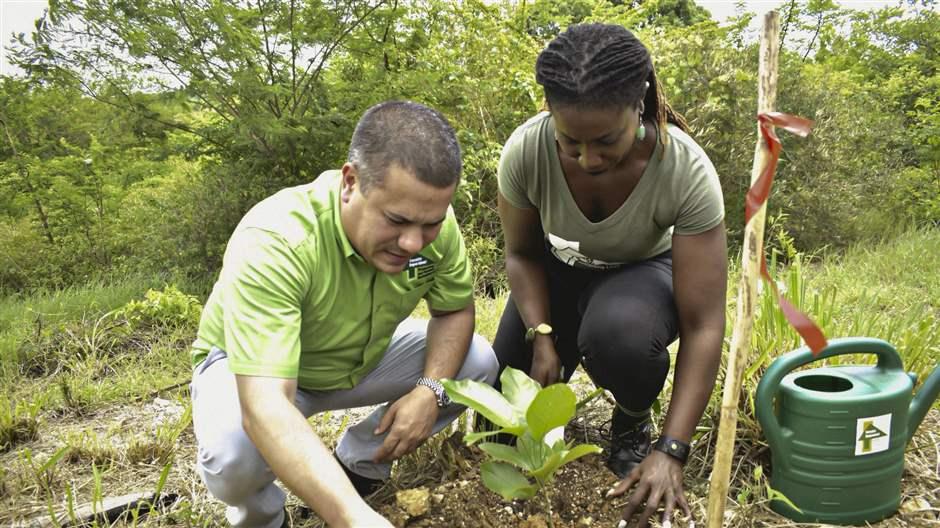
When Category 5 Hurricane Melissa ravaged Jamaica in October 2025, it reinforced the urgency of focusing on nature-made solutions to protect lives and livelihoods. Coastal wetlands—salt marshes, seagrass meadows, and mangroves—are nature’s front-line ecosystems. They buffer coastlines, serve as nurseries for fish species, and sequester large amounts of carbon, reducing the effects of climate change.
The Pew Charitable Trusts recently spoke with Matthew Samuda, Jamaica’s minister of water, environment, and climate change, to discuss how he is working to ensure that these vital “blue carbon” ecosystems are conserved for generations to come.
He has been an enthusiastic environmentalist since childhood, actively participating in restoring Jamaica’s forests and coastlines. This passion for nature has been a constant focus of his work, which spans decades of community involvement and public service.
This interview has been edited for clarity and length.
-
What is the importance of mangroves and seagrass to Jamaica?
Jamaica is a nature-positive country. We’ve not always branded ourselves or positioned ourselves as such, but Jamaica has always referred to itself as the land of wood and water. The natural resources that we have and the environment that we’ve been blessed with are a core part of who we are. As I’ve been moving through discussions with our varying environmental stakeholders, I’ve started referring to Jamaica as the land of forests and wetlands.
When one contemplates Jamaica’s geography, let’s start with the mangroves. Mangroves cover about 12,000 hectares [about 30,000 acres]. They are our first line of defense against nature itself.
Jamaica’s south coast is pretty low-lying: 70% of our population lives within 5 kilometers [about 3 miles] of the sea. And for the sort of coastal defenses you need in the modern hurricane era, in the era of climate change, you’d never be able to afford the hard infrastructure that would be required to create that sort of coastal defense.
Mangroves are the walls we have protecting the citizens who, for the most part, live on the south coast in Jamaica in very close proximity to the ocean. Mangroves have also functioned not just to provide ecosystem services, but in many ways have been the base for the economy in many of our towns because they’ve functioned as fish nurseries.
Most of our fishing industry, which is very labor-intensive and involves thousands of families, has benefited from healthy mangroves. Even in recent climatic incidents that we have experienced, whether Hurricane Beryl, Tropical Storm Rafael, or Hurricane Melissa, people are alive today because mangroves functioned as a buffer in many spaces.
-
How has that influenced the country’s conservation approach?
With all of these benefits, mangroves and seagrasses were included in Jamaica’s NDC for the first time in 2025. [Nationally determined contributions, or NDCs, are the commitments that individual countries make under the Paris Agreement to reduce emissions and the impacts of climate change.]
There is a growing sophistication and understanding among the general population about exactly what climate change is, what causes it, and what helps you to manage it. There is a greater understanding and acceptance, not just within Jamaican society but society generally, that climate change is a serious problem.
It’s real. It affects us, not just in the big, major theatric ways that you’ll see on the news when you have a hurricane, but it also affects us in the daily deterioration of the quality of life. In trying to manage that and trying to not just survive but to create a space where people can thrive, people have looked at financial solutions, the infrastructure solutions, and nature-based solutions.
-
So how do mangroves and seagrasses play into that?
The reality is that seagrass captures quite a lot of carbon. Mangroves are also very good for carbon capture.
Jamaica doesn’t want to have this valuable resource and not make very firm commitments to the globe in terms of how it will preserve it. We’ve already been very clear that we will protect more than 60% of our mangrove forests.
-
What was science’s role in helping you make those commitments? How did the collaboration with the University of the West Indies (UWI) Centre for Marine Sciences help in creating a national seagrass map, updating the national mangrove map, and completing a carbon assessment for both ecosystems?
Jamaica, and the Caribbean as a region, has been blessed in an academic sense. Our institutions have studied everything. They’ve worked hard in assessing not just Jamaica, but also the region’s natural resources. And their guidance has been immeasurable throughout our independent history. As you move into the era of dealing with climate change, we’re going to have to call on that academic experience far more than we used to.
It has to be woven into policymaking, into project planning, and into future-proofing against changes that are indeed coming. We’re very happy to engage with the UWI Centre for Marine Sciences. Its work has helped us with seagrass mapping, with mangrove mapping, and with understanding which species are likely to be most climate-resilient.
So it is incumbent on us to rely on our publicly funded universities to not just train the next generation, but to also give us the knowledge that allows us to feed into policy. And I think the Centre for Marine Sciences’ work has fed into a number of policies and a number of decisions related to protected areas generally.
-
Why is it important to protect the mangroves?
Mangroves are almost like nature’s perfect plant. It exists between the oceans and terrestrial mass. It flirts with fresh water and saltwater. It protects fish and also helps pollination rates with bees. It’s a unique plant. It ticks so many boxes. Increasing and improving the quality of our mangrove cover improves coastal defenses; it improves fish sanctuaries and fish nurseries.
-
How did mangroves help protect Jamaica from Hurricane Melissa’s damage?
It was a storm that broke records and that surpassed the capacity of gauges to measure wind pressure and wind speed.
When you look at the destruction, you understand that without the protection provided by the mangroves, the death count would have been significantly higher. There’s no doubt in my mind that the mangrove forest of that area [between Black River and Parottee in St. Elizabeth, the area behind the eye of the storm] saved thousands of lives.
Seeing the impact and seeing the debris that was caught in the mangroves and seeing some structures that were almost right behind the mangrove forest that survived, you know it could be so much worse.
-
You’re clearly passionate about environmental issues. What motivates you?
Jamaica has a very robust after-school program. As much as we have our challenges in the education sector, I think most of our older schools have lots of clubs and societies and things that kids participate in.
When I was at the primary school age, I engaged heavily with our environmental club, so we had tree-planting programs and beach cleanups and those sorts of things.
Similarly, in high school, I was further exposed to it. And when I joined the youth political arm of my political party, they had an environmental committee, and that’s where I started politically. So my political journey started doing environmental work.
-
What’s the most rewarding aspect of your position in this line of work?
You always want validation that a policy decision has a benefit. A recent waste characterization study in Jamaica showed significant reductions in plastic bags and Styrofoam in our waste. That came after a ban—which I had pushed through the nation’s Senate—became law in 2019. Seeing that policy decision actually start to have an impact is great.
It’s always good when you go back to an area where you did a tree planting exercise, and what was a shrub is now a healthy sapling growing well. The best time to plant a tree was yesterday. The next-best time is today.
-
What’s the most challenging aspect of your job, of your work?
You always have challenges getting society to buy in. Environmental protection has an economic cost, but it’s thought of as a cost by many citizens as opposed to an investment in future stability. Getting the understanding that this isn’t a cost, it’s an investment, is often difficult because governments in democratic societies serve for a limited period of time.
Your electorate wants short-term results. It’s about that balance, for people to understand that when you do protect thousands of acres in one space, it’s for the water supply 20 years from now.
I think that understanding, and driving that understanding, is perhaps the greatest challenge that most political leaders in the environmental space have.
-
What is your hope for Jamaica’s environmental future if you were to look ahead, say, 25 years?
My job is to provide cleaner air and cleaner water, reduce pollution, and ensure that the country’s natural assets are preserved. That’s the core of any environment minister’s job. You want to see your policy come to life. You have the opportunity for restoration of some of the natural assets that formed a part of the lore of Jamaica. You have technology and a new scientific understanding of the restoration of coral reefs. There are projects that will restore natural hydrological flow to some mangrove forests and some wetlands and other spaces.
-
Is Jamaica a leader in the Caribbean in the environmental realm?
I believe we are. Nobody wants to blow their own horn, but I can’t think of an environmental forum or a multilateral process that the government of Jamaica is not actively involved in.
I think our focus now is ensuring that we’re walking the walk, because, like every country, you have the development and the environmental preservation tension that can arise. You have a deep need to significantly increase your per-capita GDP and continue to reduce poverty rates, etc., while spending heavily and investing heavily in environmental works.
People


