For Wisconsin Homebuyers, Land Contracts Offer Opportunity—And Risks
Increasingly popular financing method lacks some protections that are standard with mortgages

Overview
Every year, thousands of Wisconsinites use an alternative form of financing called land contracts to purchase homes. Unlike other loan types, which rely on a third-party lender, with a land contract, the buyer gives a down payment and then makes regular payments directly to the home seller. Land contracts can be an accessible option for buyers who cannot qualify for a conventional mortgage. But land contracts do not come with the consumer protections that are standard with a mortgage.1
Despite the lack of protections, the popularity of land contracts has grown in Wisconsin over the past decade, reflecting both consumer demand for homeownership and the challenge many state residents face in accessing traditional credit. To better understand the prevalence and distribution of land contracts in Wisconsin, The Pew Charitable Trusts analyzed property record data from 2005 to 2024.
What are land contracts?
A land contract is a type of alternative financing that allows a buyer to purchase a home (or land) directly from the seller, rather than with the assistance of an outside lender.2 Land contracts are used in just 2% of all home sales in Wisconsin, but the buyers who use them are exposed to outsized risks. In many cases, land contracts lack clear and transparent contract terms, contain risky features like balloon payments (a loan payment structure that leaves a large, one-time payment at the end of the contract term), fail to protect borrowers’ equity when they do not make payments, and require homebuyers to take on many of the responsibilities of home ownership without the financial benefits.
Wisconsin’s current regulations are insufficient to safeguard buyers who use land contracts. This regulatory gap leaves buyers to rely completely on the terms determined by sellers, which can vary widely and may not always be in the buyer’s best interest. Additionally, Wisconsin’s lack of protections can result in harmful outcomes for borrowers, including foreclosure under an extremely fast timeline. These risks have already resulted in real consequences for some in Wisconsin; for example, at least 20 buyers in Washburn County have been misled by contracts that required them to make payments to a seller without actually accruing any equity in the property.3
Facts about Wisconsin’s land contract market
Land contracts are common in Wisconsin compared to other states. In the 20-year period from 2005 to 2024, 57,500 land contracts were recorded in Wisconsin’s 72 counties—the fourth-most among all states. Of those land contracts, 29,150 were used to purchase residential property, while the other 28,350 contracts were used for nonresidential purposes (to acquire agriculture or vacant land, or a business). (See Figure 1.) The highest number of recorded contracts was 3,821, in 2005; the lowest total (1,426 contracts) was recorded in 2016. Usage of land contracts has risen from 2016 levels and has been relatively stable since 2021, with an average of 3,058 contracts recorded annually between 2021 and 2024.
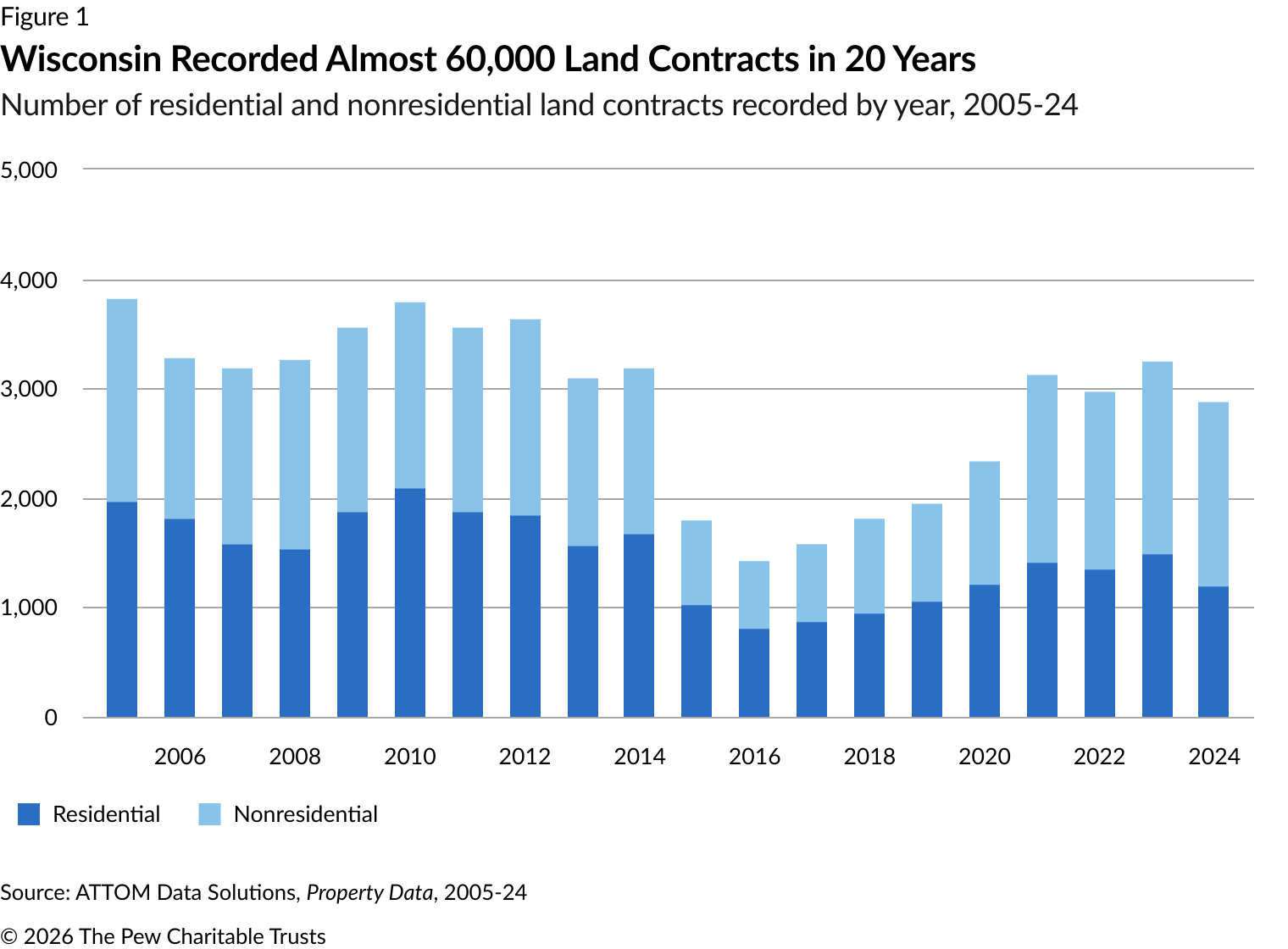
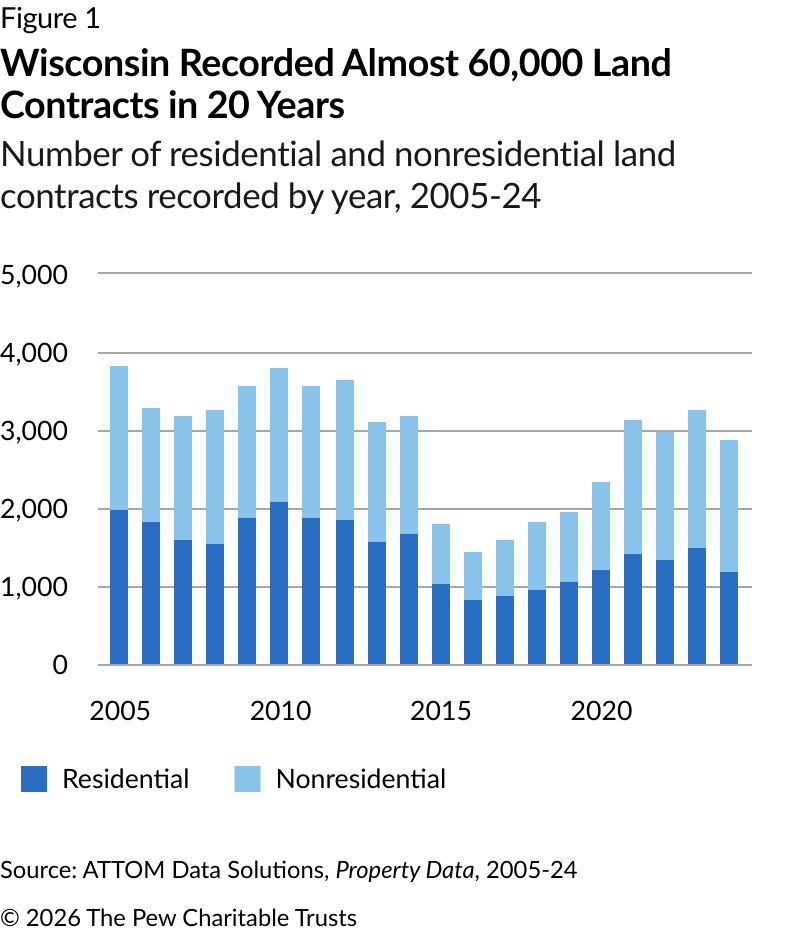
Land contracts are increasingly used for nonresidential properties. In the 20-year period assessed for this report, the greatest use of land contracts for residential properties occurred in 2010 (2,088 residential contracts, about 55% of the total). Since 2016, land contracts have been increasingly used for nonresidential purposes; in 2024, only 41% of land contracts were used to purchase a residence.
Most land contract buyers are individuals. A large majority of land contract buyers (78%) in this 20-year period were individuals. Statewide, only 22% of land contracts involved a corporate buyer. For residential contracts, only 15% involved corporate buyers.
The greatest number of land contracts were in the counties that contain Wisconsin’s two largest cities. Of the 29,150 residential land contracts registered in Wisconsin over 20 years, the highest totals were in the two counties with the highest populations: Milwaukee County, home to the city of Milwaukee (2,215 contracts), and Dane County, which includes Madison (2,015 contracts). (See Figure 2.) Together, these counties registered more than 14% of all residential land contracts in the state.
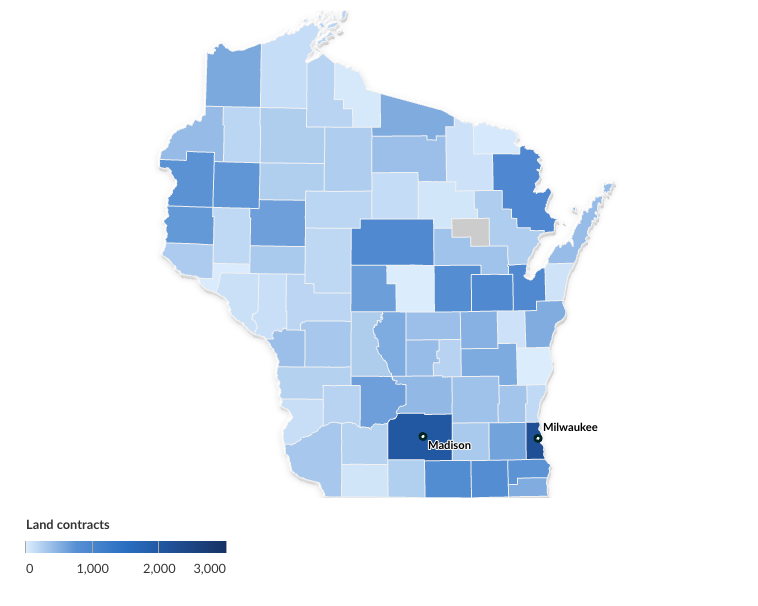
Land contracts are used to purchase residential property about half of the time statewide, but more frequently in Milwaukee County. Statewide, about 51% of land contracts were used to purchase a residential property between 2005 and 2024. Dane County, with 2,015 registered land contracts, was close to the statewide average, with about 52% of contracts being used to purchase a residential property. In contrast, 68% of all land contracts in Milwaukee County were used for residential properties, higher than Dane County and the statewide average.
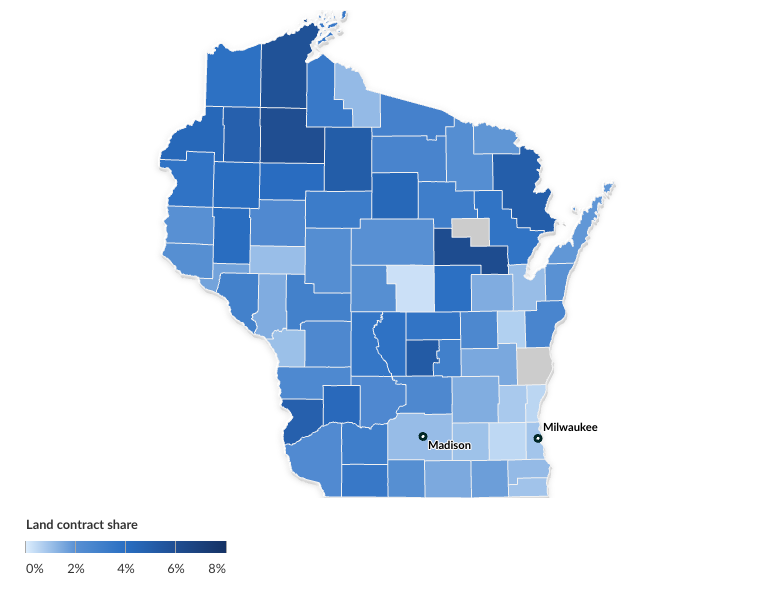
Land contracts are more prevalent in rural home purchases. Although a greater number of residential land contracts were registered in Wisconsin’s most populous counties, land contracts funded a larger proportion of total home sales in less populated, rural counties. (See Figure 3.) For example, in both Bayfield and Sawyer counties—which have populations of about 16,000 and 18,000, respectively—land contracts accounted for 6% of all home sales in the 20-year period covered by this research.4 In contrast, land contracts funded just 1% of sales in Dane and Milwaukee counties.
Land contracts are often used to purchase low-cost homes. The inflation-adjusted median sales price of a home purchased with a land contract was $177,280 (in 2024 dollars). That is much lower than the statewide median of $271,163 (for all home sales). This trend holds for counties too—both rural and urban. For example, in rural Sawyer County, the median sales price of a home purchased with a land contract was $155,783 compared to the county median of $250,910. Similarly, in Dane County (which has a higher population and income), the median sale price of a home with a land contract was $373,830, versus the county median of $408,890.
Land contracts are common in counties where vacation homes are prevalent. In many of Wisconsin’s counties with a greater number of seasonal, secondary, or vacation homes, land contracts are more common. For example, in Adams County—which includes part of the Wisconsin Dells tourist area—38% of the housing stock is used for seasonal or vacation homes; land contract sales accounted for nearly 4% of all home sales (double the 2% statewide average) from 2005 to 2024. (See Figure 3.) Statewide, land contracts are somewhat more prevalent in counties with higher shares of vacation homes, and this relationship is statistically significant.5
Wisconsin has few legal protections for land contract buyers
Wisconsin law does not require sellers to record land contracts in the county register.6 Contracts are still enforceable between the buyer and seller, and sellers may record the contracts with the county if they choose, but the lack of a requirement puts buyers at significant risk. When land contracts are not recorded in the public deed records, a third party who purchases the land without notice of the land contract may prevail over the rights of a contract buyer. Not recording land contracts may also leave homeowners unable to prove their ownership, which can make them ineligible for protections such as title insurance and further put their financial interest at risk.7
Wisconsin allows quicker foreclosure procedures for land contracts than traditional mortgages. This can result in the loss of a home for borrowers who might have been able to catch up on payments. By law, traditional mortgages contain several important consumer protections for buyers—for example, a months-long period for buyers who fall behind to catch up on payments. In stark contrast, Wisconsin allows what’s called “strict foreclosure” for land contracts.
With a standard foreclosure, federal rules require sellers to wait until at least 120 days (about four missed payments) before proceeding with a foreclosure.8 With a mortgage, Wisconsin law also requires a five-week to 12-month “redemption” period during which the buyer can pay the full balance owed and retain ownership.9
In contrast, Wisconsin law permits “strict foreclosure” of land contract transactions, which is much faster and allows a seller to take back the property rather than selling the home through a public auction.10 The court can then set a post-foreclosure redemption period as short as seven working days. With less time to pay off the balance owed, strict foreclosure can leave land contract buyers vulnerable to losing their home in a shorter period of time.
The lack of a public auction sale requirement for foreclosed properties that were bought using land contracts is significant: These sales often help defaulting parties with standard mortgages recoup some of the payments they’ve made on properties but contract buyers have no prospect of receiving any surplus proceeds, even if they have made payments on the property for decades and owe only a small fraction of what the home is worth.
Balloon payments are common. In Wisconsin as in other states, balloon payments are a common feature of land contracts.11 Most land contracts are intentionally structured to leave the buyer with a large, one-time payment at the end of the contract period—a so-called “balloon.” That problem is structural: In order to make loans affordable, sellers calculate monthly payments based on a longer repayment period (amortization) than the actual contract. For most buyers, the only solution is to get a bank mortgage before or when the contract ends.
But because land contract buyers do not have their monthly payments reported to the credit bureaus, banks are very unlikely to issue refinancing to the buyer before the balloon payment comes due. With conventional mortgages, borrowers do not face this issue because balloon payments are far less common (less than 1% of those mortgages).12
Conclusion
In Wisconsin, land contracts continue to serve as an alternative path to homeownership for those who may struggle to access traditional forms of credit, especially in rural or low-cost areas. However, the limited buyer protections of land contracts may leave many who use them exposed to legal and financial risks. For this reason, policymakers can help protect homebuyers by requiring public recordation of land contracts, harmonize foreclosure processes between land contract and mortgage holders, and void balloon payments.
Endnotes
- Ann Carpenter, Taz George, and Lisa Nelson, “The American Dream or Just an Illusion? Understanding Land Contract Trends in the Midwest Pre- and Post-Crisis,” Joint Center for Housing Studies of Harvard University, 2019, https://www.jchs.harvard.edu/sites/default/files/media/imp/harvard_jchs_housing_tenure_symposium_carpenter_george_nelson.pdf.
- Adam Staveski, Linlin Liang, and Tara Roche, “Land Contracts Pose 5 Major Risks for Homebuyers,” The Pew Charitable Trusts, 2024, https://www.pew.org/en/research-and-analysis/issue-briefs/2024/07/land-contracts-pose-5-major-risks-for-homebuyers.
- “Washburn County Brings Civil Action Against Hayward Man Regarding Land Contract Transactions,” Dryden Wire, April 4, 2022, https://drydenwire.com/news/washburn-county-brings-civil-action-against-hayward-man-regarding-land-contract-transactions/. Terrell Boetcher, “Federal Grand Jury Charges Hayward Man With Bankruptcy Fraud,” Sawyer County Record, April 17, 2024, https://www.apg-wi.com/sawyer_county_record/federal-grand-jury-charges-hayward-man-with-bankruptcy-fraud/article_41f8ced0-fb30-11ee-9b66-a33398edf6a0.html.
- “Bayfield County, WI,” U.S. Census Bureau, Census Reporter, 2019-2023 five-year estimates, https://censusreporter.org/profiles/05000US55007-bayfield-county-wi/. “Sawyer County, WI,” U.S. Census Bureau, Census Reporter, 2019-2023 five-year estimates, https://censusreporter.org/profiles/05000US55113-sawyer-county-wi/.
- The p-value is 0.0000091, which is highly statistically significant.
- Wisconsin State Legislature, 2022 Wisconsin Statutes & Annotations Chapter 706—Conveyances of Real Property; Recording; Titles. 706.05—Formal Requisites for Record, WI Stat § 706.05 (2022), https://law.justia.com/codes/wisconsin/2022/chapter-706/section-706-05/?utm_source.
- Adam Staveski, Linlin Liang, and Tara Roche, “Land Contracts Pose 5 Major Risks for Homebuyers.”
- § 1024.41 Loss Mitigation Procedures, 12 CFR Part 1024.41, Consumer Financial Protection Bureau, https://www.consumerfinance.gov/rules-policy/regulations/1024/41/.
- Mark Richard Cummisford, “Advising Clients Facing Foreclosure,” Wisconsin Lawyer, Dec. 4, 2007, https://www.wisbar.org/NEWSPUBLICATIONS/WISCONSINLAWYER/PAGES/Article.aspx?Volume=80&Issue=12&ArticleID=1206.
- “Land Contracts,” Wisconsin Law Help, March 25, 2025, https://www.wislawhelp.org/page/510/land-contracts. Wisconsin State Legislature, Wisconsin Statutes & Annotations Chapter 846—Real Estate Foreclosure. 846.30—Redemption Period for Land Contracts, WI Stat § 846.30 (2024), https://docs.legis.wisconsin.gov/statutes/statutes/846/30.
- “Land Contracts in Wisconsin: Key Terms and Legal Considerations,” Legal Clarity, March 2, 2025, https://legalclarity.org/land-contracts-in-wisconsin-key-terms-and-legal-considerations/.
- Adam Staveski, Linlin Liang, and Tara Roche, “Land Contracts Pose 5 Major Risks for Homebuyers.”
People


