States Can Help Upgrade Aging Local Water Infrastructure
Effective management of federally funded, state-run revolving funds improves lending efficiency, capacity

Overview
The United States’ water infrastructure is aging. Federal surveys conducted in 2021 and 2022 found that the country’s drinking and clean water systems will need more than $1.2 trillion in repairs, maintenance, and upgrades over the next two decades.1 The bulk of this investment will be financed at the local level through higher water rates, which have not kept pace with rising operations and maintenance costs.2
The balance of needed funding for water infrastructure projects will come from other federal or state programs, the largest of which are the federally funded, state-run Clean Water and Drinking Water State Revolving Funds (SRFs), which provide financial assistance to local governments and utilities. However, SRF implementation differs significantly across states, with varying degrees of effectiveness. Some states have struggled to routinely allocate all their SRF dollars, while others have consistently maximized the appropriated money.3 Improving SRF use will be key as states and localities address the nation’s water infrastructure needs in the coming years.
In this brief, The Pew Charitable Trusts examines promising state approaches to using SRF programs to help support local water infrastructure. No single approach can deliver successful SRF management for all states. Instead, the examples in this study reflect a range of governance structures, leverage strategies, preconstruction financing options, asset management planning, and water system regionalization that policymakers can consider to help ensure that localities have the resources they need to maintain and upgrade critical water infrastructure.
What are state revolving funds?
Federal lawmakers created the Clean Water State Revolving Fund (CWSRF) in 1987 and the Drinking Water State Revolving Fund (DWSRF) in 1996, through amendments to the Clean Water and Safe Drinking Water acts, replacing the costly and administratively burdensome one-time construction grants that had been the source of federal water funding.4 The Environmental Protection Agency (EPA) administers the SRFs and provides grants to states, with funding appropriated by Congress.
The EPA requires states to provide a 20% match for the federal funding and can then issue below-market loans with flexible repayment terms or make grants to utilities for eligible projects. States also must use a portion of their appropriations for additional subsidies to disadvantaged communities—which can be offered as principal forgiveness loans, negative interest loans, or grants—that give the target communities access to affordable financing that would otherwise be out of reach.5 States can use the proceeds from loan repayment—plus any interest—to fund additional projects, creating a perpetual (or, “revolving”) funding source.6
Additionally, because states administer their own SRFs and have some control over which projects get funded, they can prioritize specific local needs, such as aging pipes and water mains in Northeast states and flood-resilient pump stations in the Southeast.
Joint administration of SRFs can create efficiencies
Because SRF programs must address the operational and financial sides of infrastructure projects, sharing administrative responsibilities for water SRFs across agencies can help states better tap expertise and improve efficiency. For instance, natural resources or environment departments have proficiency in permitting and environmental reviews, while state finance authorities or bond banks bring experience issuing loans and managing funds. However, for such joint administration to be effective, agencies must work together to avoid adding complexity or creating delays.
States vary in how they administer SRFs. More than half of DWSRF programs and nearly half of CWSRF programs are jointly administered by a combination of state departments or agencies. Additionally, several states house their SRF programs in their departments of environment, agriculture, or health; infrastructure finance authorities; or water resources or water development boards.
For example, Iowa’s SRF programs are jointly administered by the Iowa Finance Authority—which provides financial assistance and program administration for housing, community development, and infrastructure projects—and the Department of Natural Resources, which manages the state’s natural resources, including water. The department focuses on the front end of the SRF process—permitting, compliance, and environmental reviews—while the Finance Authority manages the back-end processes, such as administering loans, issuing municipal bonds to secure additional money for projects, and managing program funds.7
Similarly, Vermont’s SRF programs have been jointly administered since the 1990s by the state’s Department of Environmental Conservation—which reviews project eligibility and oversees the construction components of the program—and the Vermont Municipal Bond Bank, which manages loan agreements.8 The two institutions recently expanded their partnership to include other initiatives, such as flood relief and climate resiliency programs.9
“Leveraging” can boost available SRF dollars
The combination of federal grants, the required state match, and loan repayments successfully create a perpetual funding source for SRF programs and the local water projects they support. But the EPA also allows— and even encourages—states to leverage their SRF assets as collateral for bond issuances to expand their lending capacity.10 This can be a helpful strategy for states that have more demand for projects than they can fund with federal and state resources alone.11
Leveraging is a relatively cost-effective way for SRFs to increase their resources. States generally leverage SRFs through the municipal bond market, where they can borrow at low rates.12 Additionally, SRFs have their own credit ratings, which are often higher than state credit ratings, so the funds can borrow at lower costs than the state as a whole. Moreover, because the bond repayments are made directly from SRF accounts, SRF bond issuances typically do not affect state budgets and often do not require legislative or voter approval, making them a quick and efficient way to raise funds.13
Despite these advantages, leveraging SRFs does present some challenges, so states should be reasonably sure that demand for SRF resources will remain high enough in future years to support continued need for leveraging.14 In particular, the process of issuing bonds and deploying the additional resources they yield is administratively burdensome and requires that SRFs have the necessary staff to manage the increase in loans and financial responsibility. And without effective management, leveraging can negatively affect SRF assets or bond ratings. These challenges are especially pronounced in states with many small water systems, which can face increased financial risk because they often do not have the ability to raise user rates to the levels needed to support loan repayments.15
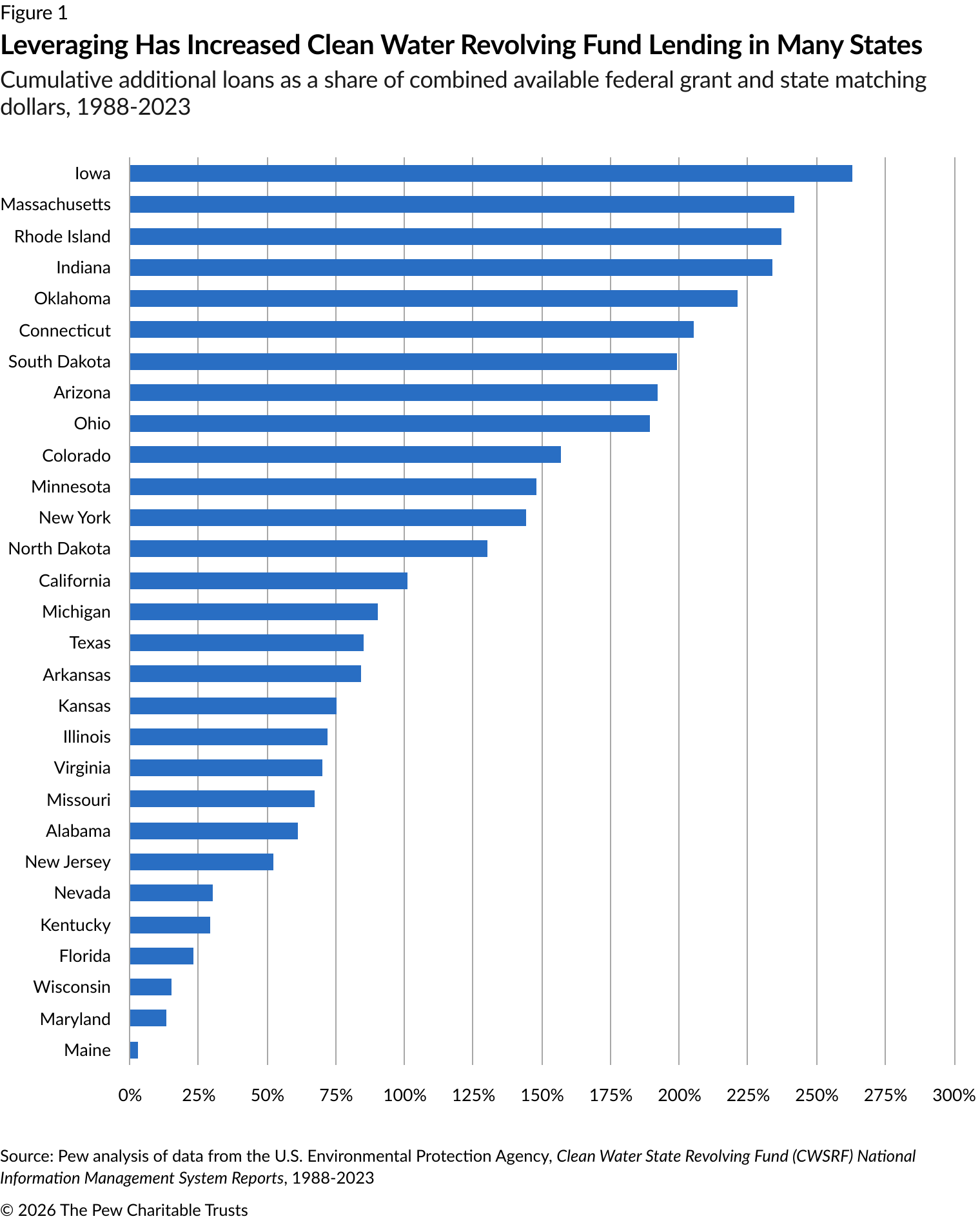
Still, well-managed leveraging can substantially increase lending capacity. Federal data as of 2023 showed that through leveraging, 14 states had more than doubled the CWSRF dollars they had available for lending, compared with the amount provided by federal grants and state matching funds, and nine other states had increased their lending ability by 50% to 100%.16
However, because of the administrative and other challenges as well as individual funding needs, only a handful of states use leveraging to any significant degree. Just 12 states issue 75% of SRF leveraged bonds, led by New York, Massachusetts, and Ohio.17
In fiscal year 2020, for example, Ohio financed 270 projects with $743 million. By contrast, Pennsylvania— a state that has a similar population and receives comparable federal grants but does not leverage—helped fund only 124 projects valued at $317.6 million that year.18
Massachusetts heavily leverages its SRFs, which has allowed it to finance projects that it otherwise could not. As of 2023, leveraging had enabled the state’s SRF administrators to multiply just $3.1 billion in federal and state SRF dollars into loans for about $8.6 billion in infrastructure projects.19
Preconstruction financing can help localities get “shovel-ready”
Many states require projects to be “shovel-ready”—that is, having completed engineering reports, permits, design documents, and cost estimates—to receive SRF financial assistance. These preconstruction activities are expensive and require a degree of technical expertise that many communities or utilities lack. One study estimates that the average cost of applying for water infrastructure financial assistance in California is about $17,000.20 And these financial and technical barriers can lead to inequitable distribution of SRF resources.
Such preconstruction efforts are eligible for SRF assistance under federal law, and although the EPA does not require states to support those activities, some states do offer financing to communities that are unable to complete the work without assistance.21 This funding is provided up front, unlike SRF grants that generally reimburse utilities for work they have already finished and paid for. Preconstruction loans or grants also typically have simpler application and evaluation processes and are more accessible than SRF construction loans.22
As of 2022, 31 states used DWSRFs and 24 used CWSRFs for preconstruction work. The eligible activities varied by state but usually included technical documentation, such as engineering analyses, design plans, and environmental assessments. Some states provided this assistance only to disadvantaged communities, while others offered it more broadly.23
Iowa boasts a well-utilized preconstruction loan program. Since 2005, the state has funded 760 drinking water and wastewater projects worth $300 million with its SRF Planning and Design Loans, which can be used for preconstruction activities such as engineering reports or environmental studies, for future SRF-financed water projects. The loans are available with no interest or payments due for up to three years, have no maximum amount, and can be rolled into an SRF construction loan once the planning process is complete.24 These flexible and affordable loans help utilities get their projects to the shovel-ready stage and eventually qualify for construction financing.
Asset management planning helps localities better understand needs
Some states are using their SRFs to help local water systems engage in asset management planning to better understand and prepare for their short- and long-term infrastructure needs. Through these efforts, utilities develop comprehensive asset management plans, which may include lists of assets, with their age and condition; operations and asset maintenance procedures, with schedules and costs for regular, preventative, and delayed maintenance; and expected future capital improvements and their anticipated costs.25
Asset management plans are essential tools that enable water systems to gain a robust understanding of their current and future expenses and strengthen their financial planning and long-term sustainability.26 These plans have become more common since passage of the America’s Water Infrastructure Act of 2018, which requires states to incorporate asset management into their water capacity development strategies.27
All states encourage asset management practices in some form—47 provide funding assistance for asset management planning; 42 have relevant regulations or statutes; and every state provides technical, training, or outreach assistance.28
For example, the Indiana SRF program requires that water and wastewater utilities seeking funding or financing engage in asset management planning and that their plans include at least a system map, asset inventory and assessment, infrastructure inspection and maintenance plan, and fiscal plan to ensure adequate maintenance, repair, and replacement funding.29 The program also offers grant support to help utilities develop their plans and, as of 2021, had provided $600,000 to 24 local utilities for these efforts.30
Similarly, New Hampshire’s CWSRF program encourages wastewater systems to create asset management plans by offering full loan forgiveness up to $30,000 for each approved phase of asset management-related projects. As of 2021, the state’s CWSRF had dedicated approximately $2.6 million to asset management-related projects and expected to provide $2 million more. The fund’s asset management program has proved successful, with more than half of the state’s communities with sewer systems engaging in some asset management planning.31
In addition, 23 states prioritize asset management-related projects, making them more likely to receive SRF assistance than proposals without such elements.32 Illinois, for instance, awards priority to drinking water systems that are developing an asset management plan.33 And some states encourage utilities or localities to develop targeted asset management plans that address emerging risks, such as extreme weather.34 For example, the Maine CWSRF offers loan principal forgiveness to wastewater systems as an incentive to develop asset management plans that specifically assess system exposure to climate effects and outline strategies to address any vulnerabilities through resilient infrastructure.35
Regionalization and consolidation can help struggling small systems
More than half of the nation’s 50,000 community water systems serve fewer than 500 people, and these small utilities—which have median yearly revenue of only $25,000—can struggle to maintain efficiency and financial stability.36 These systems are commonly located in communities facing compounding socioeconomic challenges, such as low income levels and population decline.37 And they often create administrative challenges for state and federal regulators, because many struggle to consistently maintain the technical, managerial, and financial capacity needed to comply with safe drinking water laws and regulations.38 Kentucky, for example, reports that only 20.5% of its community water systems have adequate capacity to meet Safe Drinking Water Act requirements.39
Small systems can enhance their long-term viability, reduce costs, and improve efficiency by consolidating or “regionalizing”—that is, partnering—with similar utilities to share contracts, staff, and finances. However, utilities must also consider the potential challenges of these approaches, particularly political complexity in small communities where customers may feel that they lack influence over larger, less local water systems and fear rate hikes or underrepresentation.40
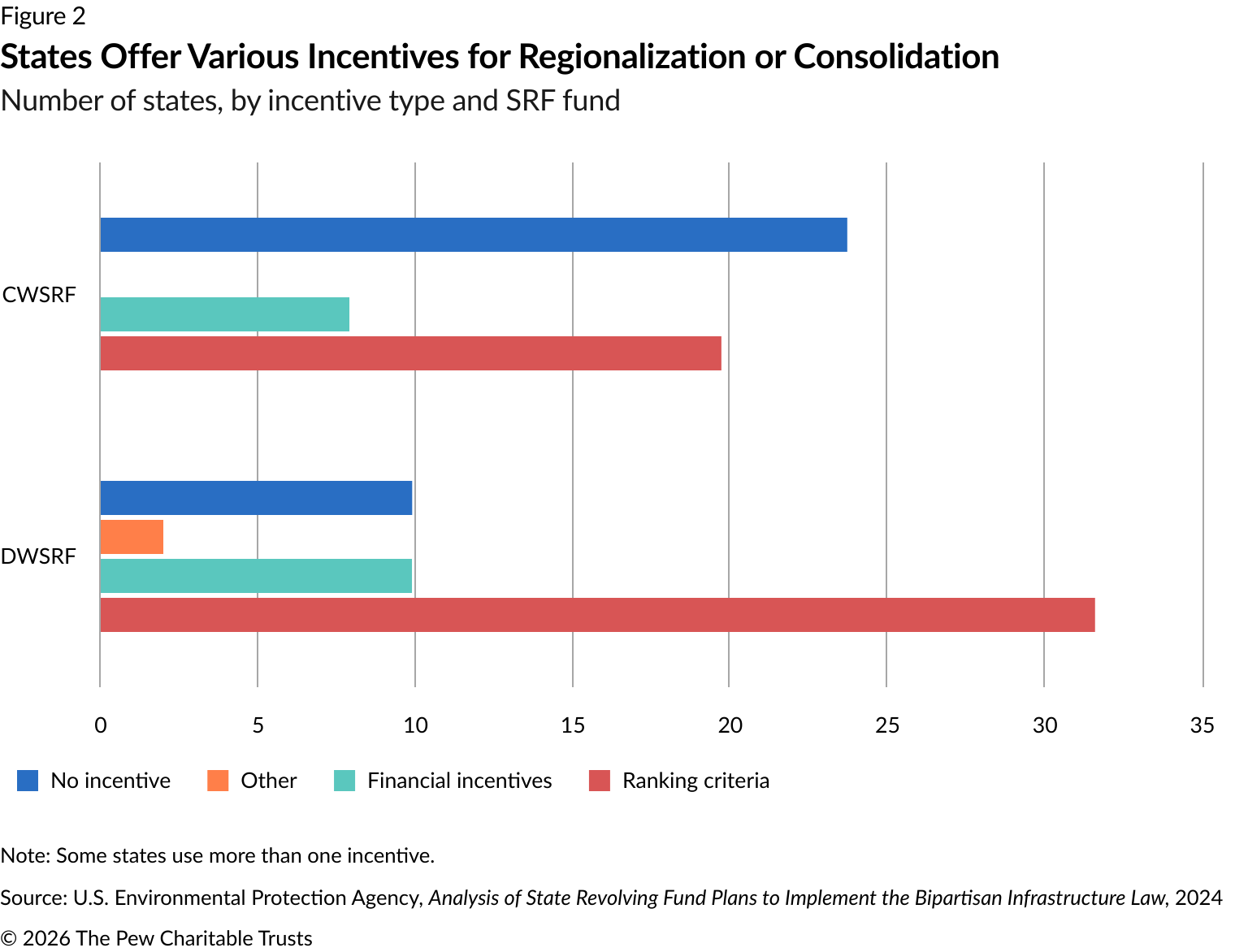
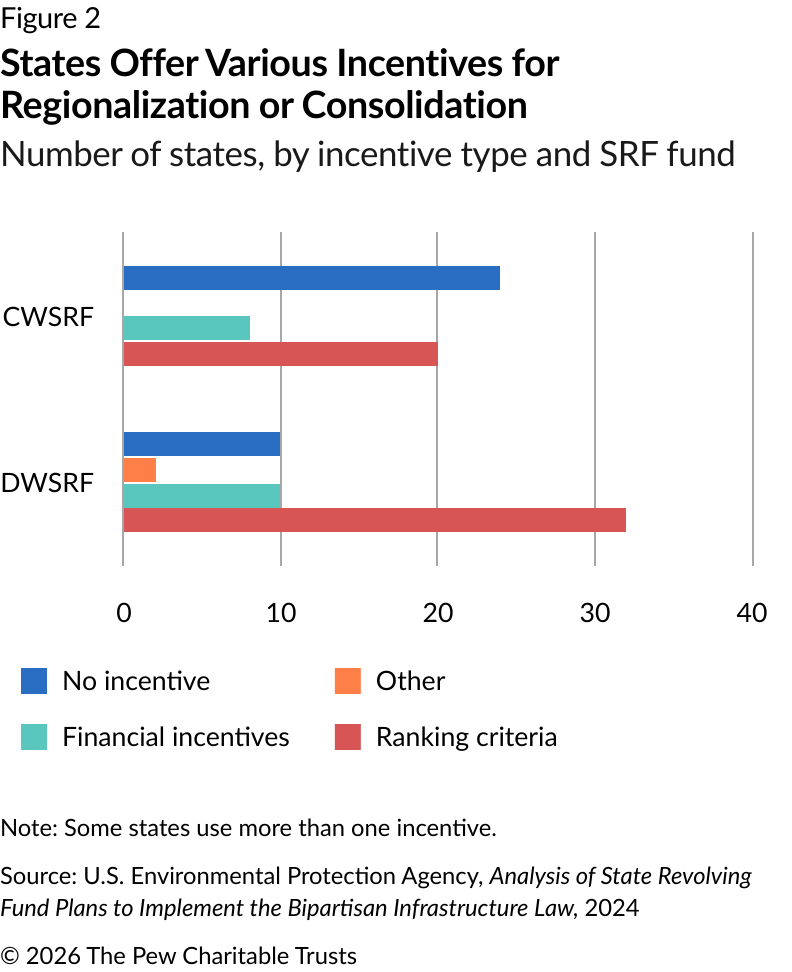
In light of the potential benefits—and despite the possible complications—the EPA encourages SRF programs to promote regionalization or consolidation among local systems.41 As of 2022, 38 DWSRF programs and 28 CWSRF programs encouraged this type of collaboration, most commonly by awarding extra points to collaborative projects, which makes them more likely to be funded. A few states have used direct financial incentives, such as favorable interest rates or principal forgiveness.42
For example, in 2024, as part of the state’s push for rural water regionalization, the Ohio EPA offered about $50 million in discounted no-interest loans to support relevant projects.43 And in Missouri, the Department of Natural Resources has offered a CWSRF Regionalization Incentive Grant since 2019, which covers all costs related to eligible projects, including planning and construction. The grant is part of the department’s Regionalization and Consolidation Initiative, which aims to help 25% of the state’s wastewater facilities regionalize or consolidate by 2039. As of January 2024, the initiative had reached more than a quarter of its goal.44
Conclusion
SRFs are a valuable tool for funding and financing vital water infrastructure projects, but they must be managed effectively to maximize federal and state resources. At the same time, because water infrastructure is locally owned and operated, and many systems lack the technical and administrative capacity to take full advantage of SRF offerings, states need to ensure that funding is accessible to all systems with eligible needs, regardless of size or expertise.
States wrestling with high demand for investment in maintenance and new projects for water infrastructure should consider adopting strategies that grow the funds available through their SRFs, ensure that those resources reach the systems with the highest needs, and support local asset management and planning practices. By doing so, states can not only expand access to these critical funding and financing mechanisms but also support the long-term infrastructure sustainability of local water systems.
About this brief
This brief was written by Aleena Oberthur and Mollie Mills of The Pew Charitable Trusts’ state fiscal policy project. Rachel Bush, Carol Hutchinson, Jennifer V. Doctors, Elijah Gullett, Sarah Jones, Edwin Rodriguez, Fatima Yousofi, and Mabel Yu provided research, communications, editorial, and design support.
Acknowledgments
This report benefited from the insights and expertise of Michael Gaughan, executive director of the Vermont Bond Bank. Although he reviewed the brief, neither he nor his organization necessarily endorses its findings or conclusions.
Endnotes
- “Water System Upgrades Could Require More Than $1 Trillion Over Next 20 Years,” Mollie Mills and Aleena Oberthur, The Pew Charitable Trusts, Sept. 5, 2024, https://www.pew.org/en/research-and-analysis/articles/2024/09/05/water-system-upgrades-could-require-more-than-$1-trillion-over-next-20-years.
- U.S. Environmental Protection Agency, “Water Affordability Needs Assessment: Report to Congress,” 2024, https://www.epa.gov/system/files/documents/2024-12/water-affordability-needs-assessment.pdf.
- Katy Hansen et al., “Uncommitted State Revolving Funds,” Nicholas Institute for Environmental Policy Solutions at Duke University and The Environmental Policy Innovation Center, 2022, https://nicholasinstitute.duke.edu/sites/default/files/publications/Uncommitted-State-Revolving-Funds_2.pdf.
- Jonathan L. Ramseur and Mary Tiemann, “Water Infrastructure Financing: History of EPA Appropriations,” Congressional Research Service, 2019, https://www.congress.gov/crs-product/96-647.
- “About the Clean Water State Revolving Fund (CWSRF),” U.S. Environmental Protection Agency, Feb. 24, 2026, https://www.epa.gov/cwsrf/about-clean-water-state-revolving-fund-cwsrf. “How the Drinking Water State Revolving Fund Works,” U.S. Environmental Protection Agency, Aug. 20, 2025, https://www.epa.gov/dwsrf/how-drinking-water-state-revolving-fund-works.
- “About the Clean Water State Revolving Fund,” U.S. Environmental Protection Agency. “How the Drinking Water State Revolving Fund Works,” U.S. Environmental Protection Agency.
- “About SRF,” Iowa Economic Development and Finance Authority, https://opportunityiowa.gov/community/water-quality/about-srf.
- “State Revolving Funds,” Vermont Bond Bank, https://www.vtbondbank.org/state-revolving-funds.
- Vermont Bond Bank, “Annual Report,” 2024, https://www.vtbondbank.org/sites/default/files/2025-04/VBB_AnnualReport_2024%20_FINAL_small.pdf.
- U.S. Environmental Protection Agency, “SRF Fund Management Handbook,” 2018, https://www.epa.gov/sites/default/files/2018-04/documents/fund_management_handbook_2018final.pdf.
- U.S. Environmental Protection Agency, “SRF Fund Management Handbook.”
- “Increasing State Revolving Fund Capacity Through Leveraging,” Katy Hansen, Sridhar Vedachalam, and John Ryan, Water Finance and Management, July 9, 2021, https://waterfm.com/increasing-state-revolving-fund-capacity-through-leveraging.
- Rob Moore and Maddie Atkins, “Go Back to the Well: States and the Federal Government Are Neglecting a Key Funding Source for Water Infrastructure,” Natural Resources Defense Council, 2018, https://www.nrdc.org/sites/default/files/state-revolving-fund-water-infrastructure-ip.pdf.
- U.S. Environmental Protection Agency, “SRF Fund Management Handbook.”
- U.S. Government Accountability Office, “Alternative Drinking Water Systems: Use by Very Small Communities, Related Cost Savings, and Technical Assistance Provided by EPA and USDA,” 2020, https://www.gao.gov/assets/gao-20-217r.pdf.
- “Clean Water State Revolving Fund (CWSRF) National Information Management System Reports,” U.S. Environmental Protection Agency, https://www.epa.gov/cwsrf/clean-water-state-revolving-fund-cwsrf-national-information-management-system-reports.
- “Increasing State Revolving Fund Capacity,” Water Finance and Management, Katy Hansen, Sridhar Vedachalam, and John Ryan.
- “Increasing State Revolving Fund Capacity,” Water Finance and Management, Katy Hansen, Sridhar Vedachalam, and John Ryan.
- Massachusetts Clean Water Trust, “Annual Report for State Fiscal Year (SFY) 2023,” 2023, https://www.mass.gov/doc/2023-srf-annual-report/download.
- SRF State Advocates Forum, “Technical Assistance Fact Sheet,” 2023, https://srfadvocatesforum.org/wp-content/uploads/2023/01/TechnicalAssistance_factsheet_formatted.pdf.
- U.S. Environmental Protection Agency, “Drinking Water State Revolving Fund Eligibility Handbook,” 2017, https://www.epa.gov/sites/default/files/2019-10/documents/dwsrf_eligibility_handbook_june_13_2017_updated_508_versioni.pdf. U.S. Environmental Protection Agency, “Overview of Clean Water State Revolving Fund Eligibilities,” 2016, https://www.epa.gov/sites/default/files/2016-07/documents/overview_of_cwsrf_eligibilities_may_2016.pdf.
- Justin Williams and Cal Garrett, “Cultivating Equitable Water Access: A Review of the Role State Governments Play in Providing Technical Assistance to Water Utilities,” Metropolitan Planning Council, 2024, https://metroplanning.org/wp-content/uploads/2024/12/CultivatingEquitableWaterAccess_MPC.pdf.
- U.S. Environmental Protection Agency, “Analysis of State Revolving Fund Plans to Implement the Bipartisan Infrastructure Law: A Review of State Revolving Fund Federal Fiscal Year 2022 Intended Use Plans,” 2024, https://www.epa.gov/system/files/documents/2024-10/analysis-of-srf-plans.final-508.pdf.
- “Planning & Design Loan Program,” Iowa Economic Development and Finance Authority, https://opportunityiowa.gov/community/water-quality/srf-programs/planning-design-loan-program.
- U.S. Environmental Protection Agency, “Asset Management Plans and the Clean Water State Revolving Fund,” 2021, https://www.epa.gov/sites/default/files/2021-02/documents/asset_management_plans_and_the_clean_water_state_revolving_fund.pdf.
- U.S. Environmental Protection Agency, “Asset Management Plans.”
- “America’s Water Infrastructure Act of 2018 (AWIA),” U.S. Environmental Protection Agency, March 2, 2026, https://www.epa.gov/ground-water-and-drinking-water/americas-water-infrastructure-act-2018-awia.
- U.S. Environmental Protection Agency Office of Water, “State Asset Management Initiatives,” 2024, https://www.epa.gov/system/files/documents/2024-01/2024-state-asset-management-initiatives-document_508.pdf.
- Indiana Finance Authority, “Asset Management Program Guidance for the Indiana State Revolving Fund Loan Program,” 2024, https://www.in.gov/ifa/srf/files/Guidance-Packet-update-07-18-2024.pdf.
- U.S. Environmental Protection Agency, “Asset Management Plans.”
- U.S. Environmental Protection Agency, “Asset Management Plans.”
- U.S. Environmental Protection Agency Office of Water, “State Asset Management Initiatives,” 2019, https://www.epa.gov/sites/default/files/2019-03/documents/asset_management_initiatives_document_508.pdf.
- U.S. Environmental Protection Agency Office of Water, “State Asset Management Initiatives.” Illinois Environmental Protection Agency and Illinois Department of Public Health, “2023 Triennial Report to the Governor on the Efficacy of the Capacity Development Strategy and Progress in Improving the Technical, Managerial, and Financial Capacity of Public Water Systems in the State of Illinois for Fiscal Years 2021-2023,” 2023, https://www.epa.gov/system/files/documents/2023-12/il-2023-three-year-report-to-governor.pdf.
- “Clean Water State Revolving Fund Program,” U.S. Environmental Protection Agency, Aug. 4, 2025, https://www.epa.gov/climate-change-water-sector/clean-water-state-revolving-fund-program.
- Maine Department of Environmental Protection, “Clean Water State Revolving Fund (CWSRF) Requirements and Guidance Climate Adaptation Plan (CAP),” 2025, https://www.maine.gov/dep/water/grants/SRF/2025/Attachment%203%20-%20CAP%20Requirements%20&%20Guidance%20Feb%202025%20%28Assessiblity%29_accessible.pdf.
- Environmental Financial Advisory Board, “Financing Strategies to Promote System Regionalization,” 2019, https://www.epa.gov/sites/default/files/2019-12/documents/funding_strategies_to_promote_system_regionalization_april_25_2019.pdf.
- Elena H. Humphreys and Mary Tiemann, “Safe Drinking Water Act (SDWA): A Summary of the Act and Its Major Requirements,” Congressional Research Service, 2021, https://www.congress.gov/crs_external_products/RL/HTML/RL31243.web.html.
- Environmental Financial Advisory Board, “Financing Strategies to Promote System Regionalization.”
- Kentucky Department for Environmental Protection Division of Water, “2023 Triennial Report to the Governor, Federal Fiscal Years 2021-2023: Drinking Water Capacity Development Program for Kentucky Public Drinking Water Systems,” 2023, https://www.epa.gov/system/files/documents/2023-11/ky-capacity-development-triennial-report-2023.pdf.
- “Water System Consolidation: Pros, Cons, and Potential Solutions,” Metro Consulting Associates, Nov. 4, 2021, https://metroca.net/news-ideas/blog/water-system-consolidation-pros-cons-and-potential-solutions/.
- U.S. Environmental Protection Agency, “Analysis of State Revolving Fund Plans.”
- U.S. Environmental Protection Agency, “Analysis of State Revolving Fund Plans.”
- Ohio Environmental Protection Agency Division of Environmental and Financial Assistance, “Water Pollution Control Loan Fund: Program Year 2024 Program Management Plan,” 2024, https://dam.assets.ohio.gov/image/upload/epa.ohio.gov/Portals/29/documents/ofa/WPCLF-PMP-2024.pdf.
- “Clean Water Regionalization,” Missouri Department of Natural Resources, https://dnr.mo.gov/water/what-were-doing/initiatives/clean-water-regionalization.
People


