The Housing Shortage Is a Major Driver of Poverty
New research identifies states where solving the housing shortage would significantly reduce poverty

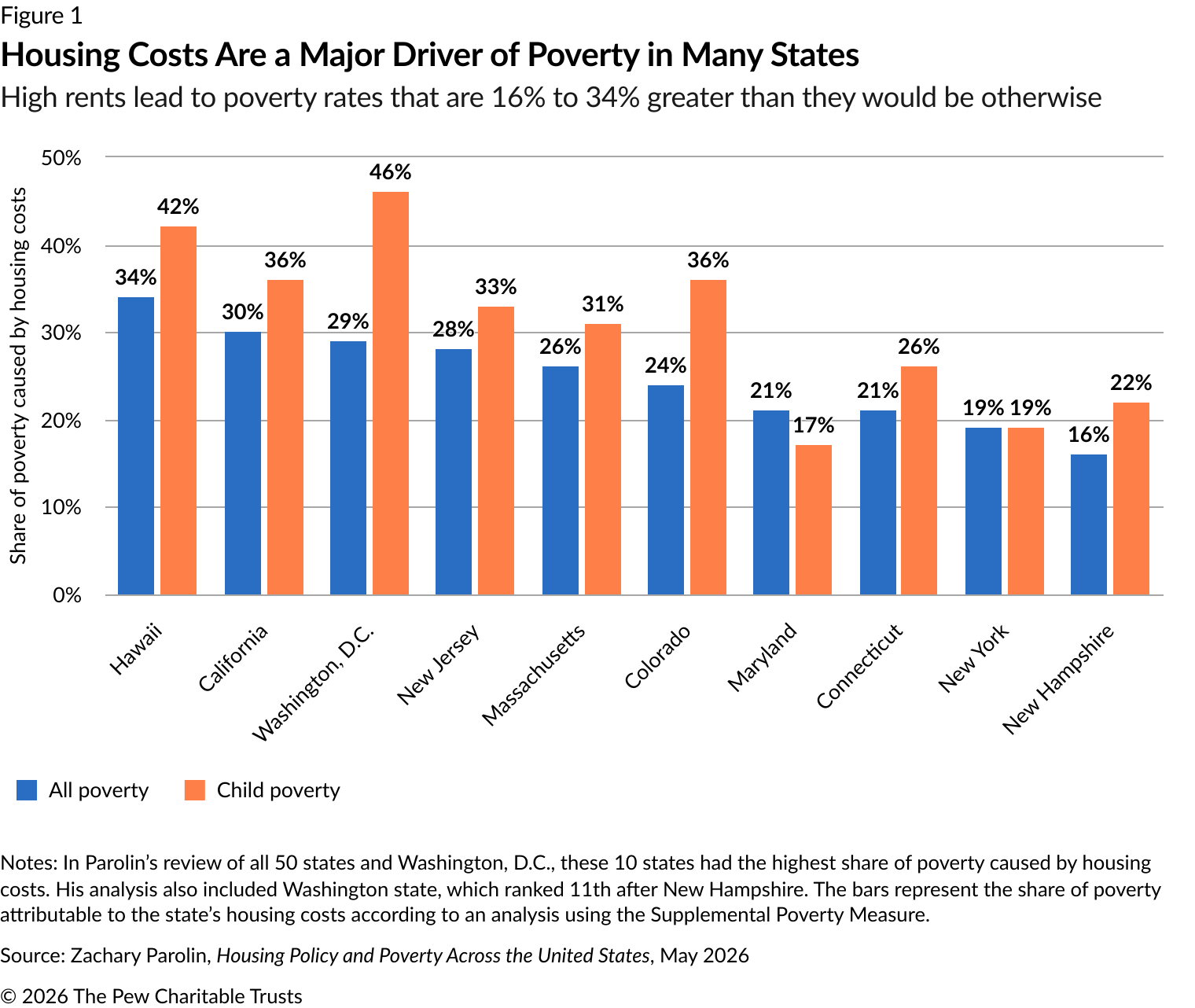
Housing costs are usually the largest item in a household’s budget and can determine a family’s financial stability. In the United States, a housing shortage estimated at 4 million to 7 million homes has driven rents so far above historical norms that these costs have become a significant cause of poverty. Zachary Parolin, a professor at the University of Oxford in England, examined 2023 housing costs in the U.S. and identified the states (counting Washington, D.C., among them) where the greatest share of poverty is attributable to high rent. They are Hawaii, California, D.C., New Jersey, Massachusetts, Colorado, Maryland, Connecticut, New York, and New Hampshire.
This analysis by The Pew Charitable Trusts explores Parolin’s work and examines the ways housing supply and costs affect poverty. As cities and states move to address high housing costs and increase supply through changes to zoning codes, building codes, and permitting processes, a key question is who will benefit from those changes. Parolin’s research, building on his earlier work focused on California and published by the Niskanen Center, bolsters evidence that housing costs have a direct impact on poverty and that policies to enable more housing will help reduce poverty and benefit low-income households in particular.
Key takeaways:
- In Hawaii, California, D.C., New Jersey, Massachusetts, Colorado, Maryland, Connecticut, New York, and New Hampshire, 16% to 34% of poverty is attributable to above-average housing costs.
- High housing costs are offsetting some of the anti-poverty effects of measures such as the Supplemental Nutrition Assistance Program (SNAP), which provides food assistance to low-income households.
- Removing regulatory barriers to housing increases supply and lowers rents.
- In the states examined in this analysis, a drop of approximately 20% in inflation-adjusted rents—as happened in Austin, Texas, and Minneapolis after those cities made reforms—could reduce poverty by 18% to 26% and child poverty by 21% to 38%.
The link between poverty and housing costs
Poverty reduction policies often focus on increasing household resources through programs such as SNAP, the child tax credit, and the earned income tax credit or by raising the minimum wage. However, those and similar measures do not address the cost of basic goods and services. The cost of housing has rapidly risen in the United States, where half of all renters spend at least 30% of their paychecks on this essential need.
To identify the states where housing costs caused the greatest share of poverty, Parolin referred to housing-cost adjustments to the U.S. Census Bureau’s Supplemental Poverty Measure (SPM), which is widely considered a more accurate measure of poverty than the Official Poverty Measure (OPM). While the OPM accounts only for minimum food costs against pre-tax income, the SPM considers a family unit’s income, any state and federal benefits that the household receives, and—importantly—variation in local housing costs. When housing costs in a given area increase relative to the national average, more income is needed to stay above the poverty line in that area, and poverty is likely to rise.
After determining the states where housing costs contribute to the greatest share of poverty, Parolin recalculated the poverty threshold—the income level established by the SPM and used to define poverty—under a hypothetical scenario in which local rents fell by 20% while other household costs remained unchanged. Comparing the thresholds before and after the rent reduction, Parolin estimated, in dollar terms, the amount by which lower rents would reduce the poverty threshold.
In the states Parolin studied, rising housing costs offset more than half of the increase in SNAP benefits from 1989 to 2023. In New Jersey, increased rents effectively consumed 84% of the increase in SNAP funds the state received. Even when incomes rise, households remain at risk of poverty if housing costs increase at a greater rate—making housing a critical issue for policymakers to address.
Drivers of high housing costs
A major driver of housing costs is the overall supply of homes relative to demand—when demand outpaces supply, competition drives up prices. If there are more homes for sale than there are potential buyers, that is a “buyer’s market,” and home prices tend to drop. If there are fewer homes for sale than there are potential buyers, it is a “seller’s market,” and prices tend to rise. Rents work the same way, with the availability rate or vacancy rate heavily influencing prices.
Extensive research has also documented that regulatory barriers, such as restrictive land-use regulations, building codes, and parking mandates, also drive up housing costs, both by making it difficult to add new homes and by increasing the cost of housing that is built. The effects of policies that impede new housing—especially apartments and townhouses—have included increased homelessness, displacement, pollution, slowed economic growth, and reduced geographic mobility.
Effective solutions exist for the housing shortage that has caused rents to skyrocket. In cities including Austin; Minneapolis; Houston; Raleigh, North Carolina; and New Rochelle, New York, policymakers have updated their zoning codes and permitting processes and taken other steps to allow and finance more homes—and they have seen affordability improve. After reforms, inflation-adjusted rents have fallen by approximately 20% in Austin and Minneapolis. Renters in those two cities are saving more than $4,000 annually over what they would have paid if their rents had risen at the average national rate. Figure 2 shows the percentage of residents who would climb above the poverty threshold if inflation-adjusted rents fell by 20%, which states can help achieve by facilitating more housing construction.
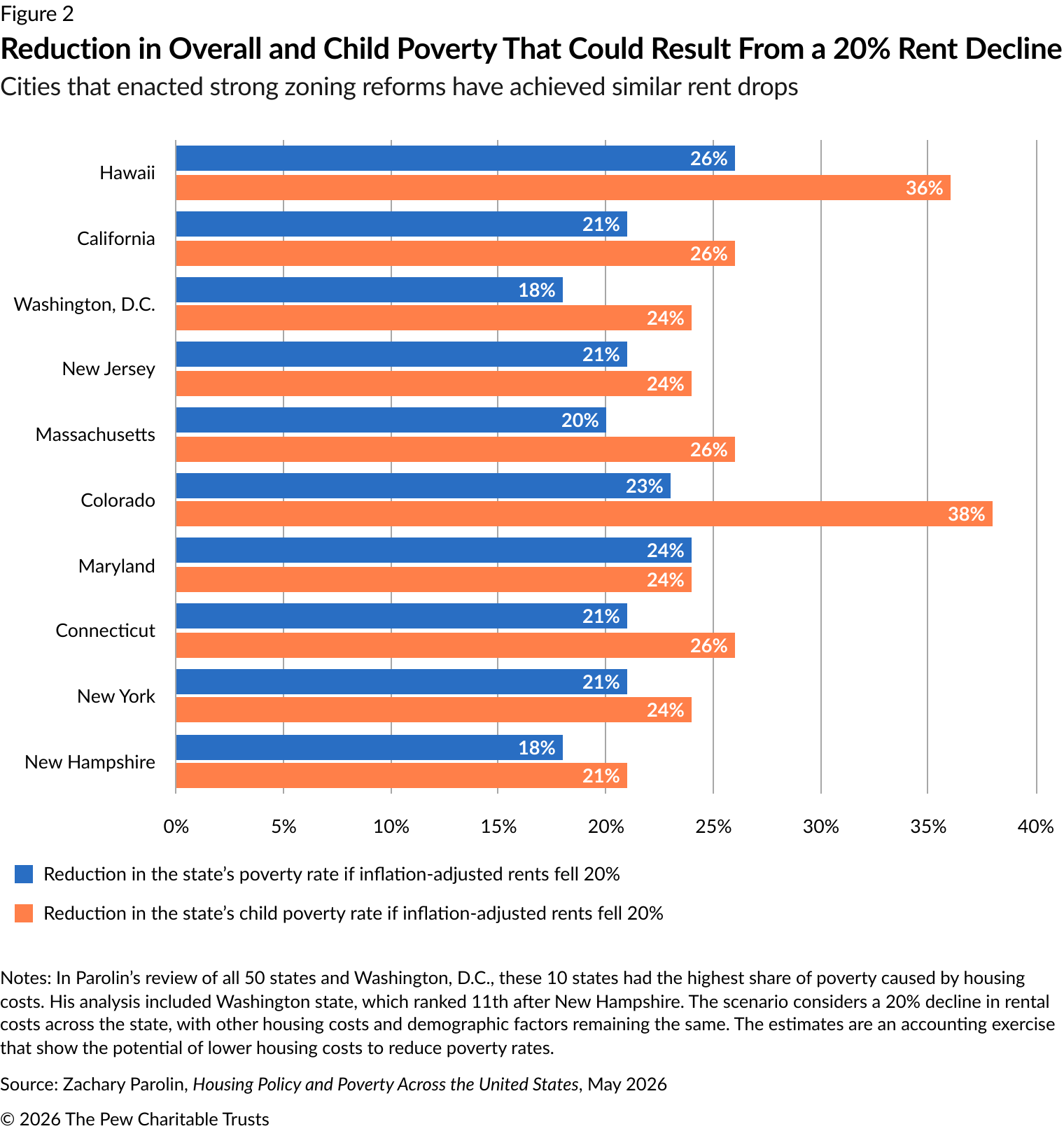
According to Parolin’s findings, a 20% rent decline across a given state could result in an overall poverty reduction of 18% to 26%. The reduction in child poverty would be even greater, ranging from 21% to 38%.
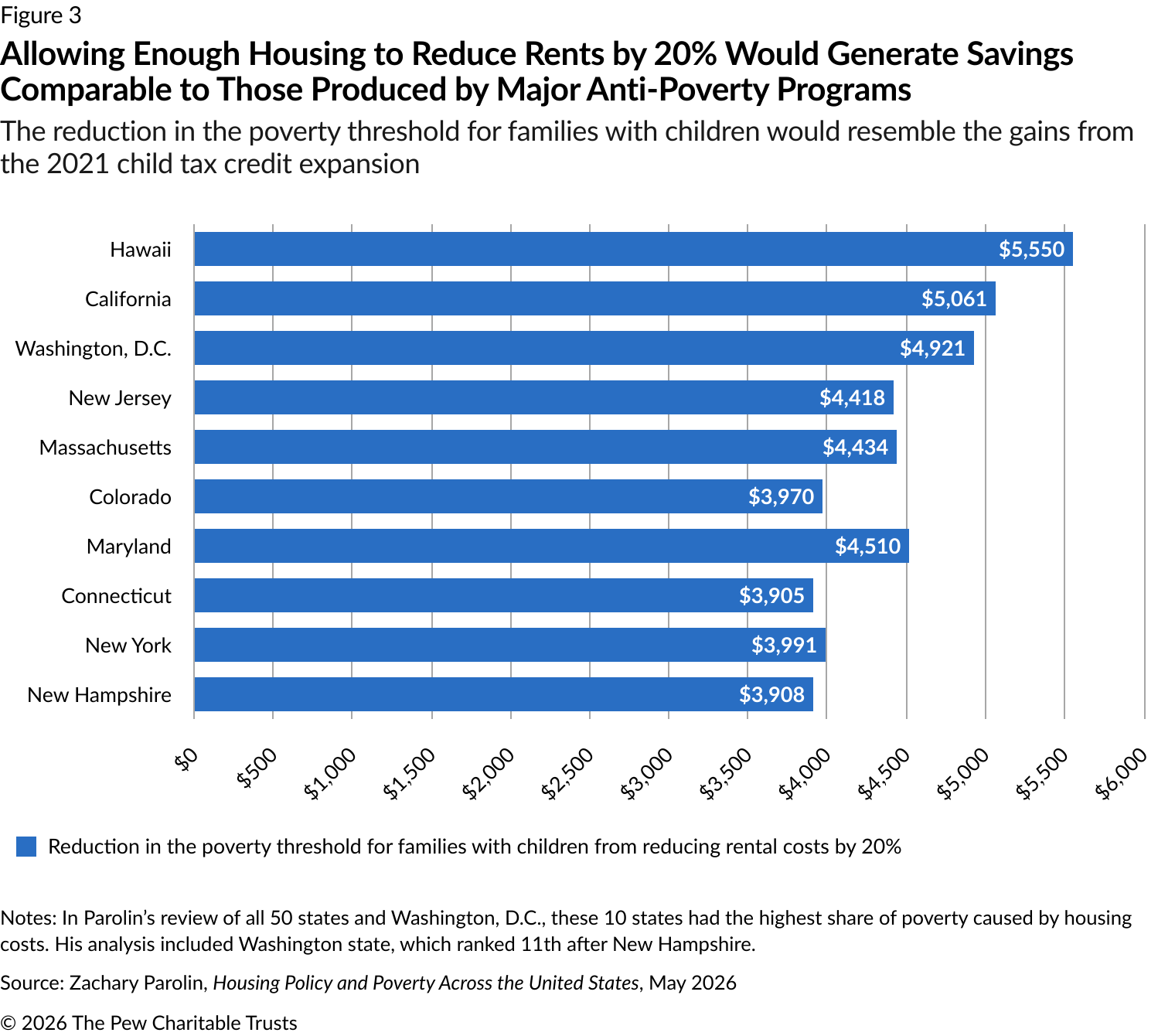
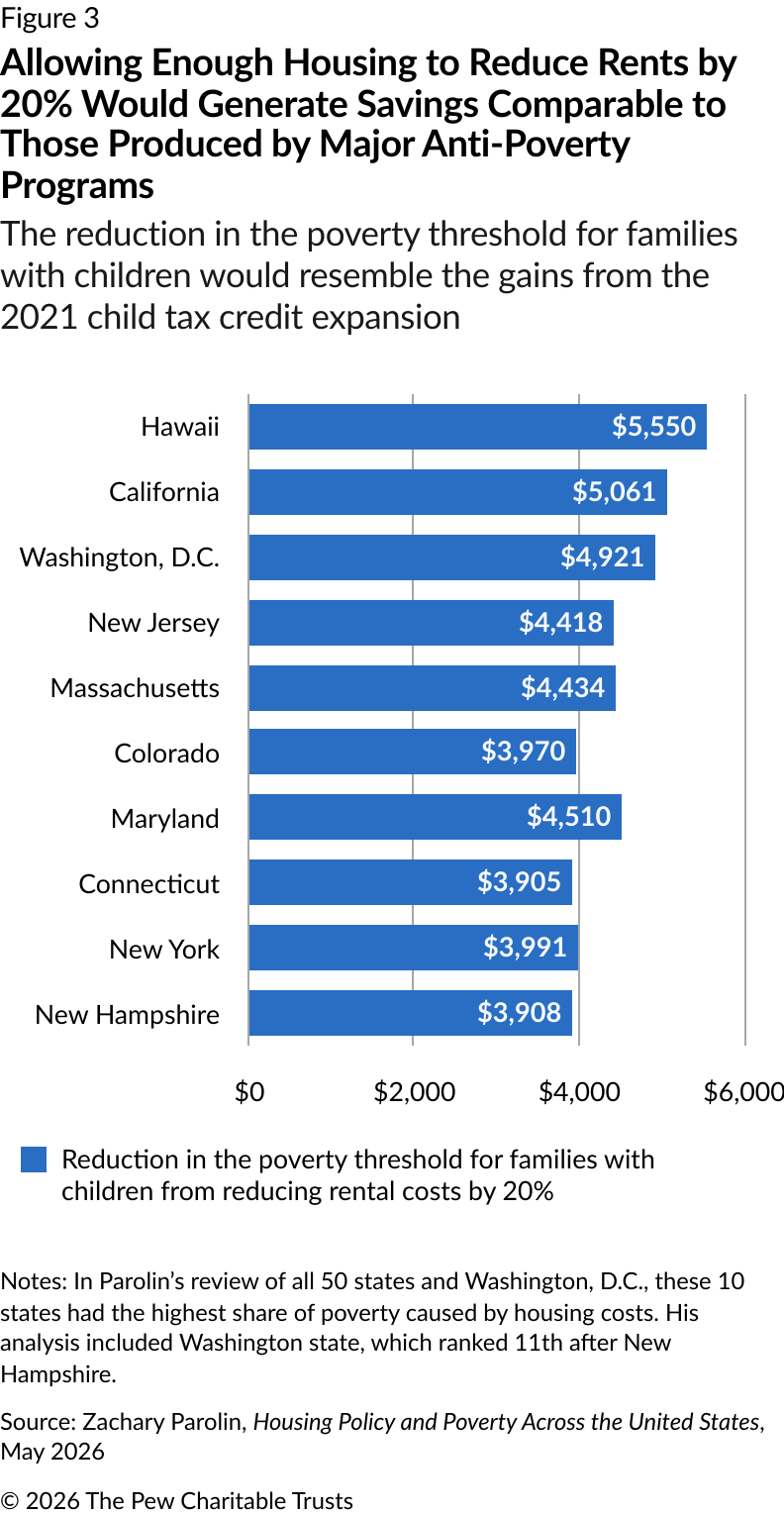
In all 10 states, the reduction in the poverty threshold that would result from a 20% rent decline would mirror the gains generated for many households by the 2021 child tax credit expansion. The credit was worth $2,000 per child in 2020 but increased to $3,600 per child under age 6 in 2021 and $3,000 for children 6 or older. The temporary child tax credit expansion led to a major decline in child poverty while it was in effect. By comparison, a 20% rent decline would reduce average poverty thresholds in all 10 states for families with children, with amounts ranging from $3,905 in Connecticut to $5,550 in Hawaii. (See Figure 3.)
Even with rent reductions, however, the lowest-income households will require subsidies to afford housing, and spending on programs such as Housing Choice Vouchers and the low-income housing tax credit will remain crucial. But the large poverty reductions identified in Parolin’s research do not require either taxpayer dollars or philanthropic giving. This type of cost reduction is vital to ensure that money from social safety net programs is not absorbed or lost in rising housing costs and that it is available to those households that need it most.
Rent reductions of the sort measured in Austin and Minneapolis can be achieved by enabling the private sector to build more homes. Policy reforms that make it easier to add housing—especially efficient and lower-cost housing such as apartments and townhouses—in high-demand areas can provide large poverty-reduction effects, on par with those of major federal programs.
As pro-housing policies to address restrictive zoning codes, building codes, and permitting processes have taken root in more states and cities, the question has arisen of whether those efforts benefit poor and working-class families or only middle-class and affluent ones. Parolin’s research helps answer the question: Lowering rents by adding more housing would help reduce poverty in states where housing is an especially large driver of cost-of-living expenses.
Recent research by other scholars has found that new housing sets off “moving chains”: When residents move into new housing, their previous homes become available, allowing other residents to trade up into housing options that better meet their needs, and low-income tenants do not need to compete with more affluent families for homes. Separate analyses have found that residents of older, more affordable apartments and those in low-income neighborhoods see the largest rent declines when there is a surge of new housing. Parolin’s study takes those results a step further, finding that adding enough housing to push down rents would reduce poverty as well.
Alex Horowitz is a project director, Linlin Liang is a principal associate, and Liz Clifford is a senior associate with Pew’s housing policy initiative.
People


