Gen Z Likes Philadelphia but Feels Frustrated by Low Pay, Limited Jobs
Young adults discuss careers, workplace attitudes, and whether to stay in the city

Overview
Young adults ages 18-29—members of Generation Z—represent a sizable share of today’s labor force and tomorrow’s economic mobility for families and communities. Therefore, it’s important for employers, educators, and policymakers in cities like Philadelphia—which many young adults tend to leave as they age—to understand this cohort’s career goals and workplace expectations.
In a series of focus groups in fall 2025 in Philadelphia, organized by The Pew Charitable Trusts, Gen Z residents talked about jobs, careers, and whether they feel like they can stay and pursue their chosen fields in the city. They offered a variety of views that could help city and business leaders better understand this cohort’s opinions on factors such as workplace practices, remote work, neighborhood safety, and commuting—and potentially help keep them in the city.

Gen Z Philadelphians’ views were similar to those of their peers nationally while also being specific to Philadelphia: They want more opportunities in fields outside the city’s dominant healthcare sector; they have mixed views on the value of college—another dominant sector in the city; and many express affection for Philadelphia and chagrin about having to leave to pursue their careers.
“I would prefer to be here longer term,” said a college-educated woman in the focus groups who works in bioengineering. “But once I advance beyond the role I am in currently, there aren’t going to be a lot more opportunities for me here. It may be a route in which I can leave for the next step and then come back.”
Generation Z is the moniker that marketing and other researchers have given to individuals born between 1997 and 2012, making them between ages 12 and 28 in 20251.The research firm SSRS conducted 10 focus group sessions involving 54 Philadelphia residents ages 18-29—roughly mirroring the adult portion of Gen Z—on Pew’s behalf over Zoom in August and September 2025.
Roughly half of participants were ages 18-24, and half were 25-29; the majority had attained or were pursuing a bachelor’s degree; almost all were employed full time or part time, although not always in their desired field; and the majority were female and identified as belonging to a racial or ethnic group other than White. Each was offered an honorarium for taking part in a 90-minute virtual meeting led by a professional facilitator. (See the methodology for full details.)
A focus group is a useful way for researchers to learn why people feel a particular way, rather than how many hold a particular view. For that reason, this report focuses on the reasons for participants’ sentiments and provides statistical context in some instances. Following are some key takeaways:
- High-quality jobs must offer flexibility, good pay, and career advancement. Gen Z Philadelphians cited four core attributes of a high-quality job: high or competitive pay; work-life balance and boundaries; employer-sponsored health benefits; and opportunities for skill building and career advancement. They also listed a dozen less important attributes.
- Philadelphia is better for some careers than others. The participants said jobs in the city seem to be more plentiful in some sectors (healthcare and law) than in others (tech, finance, and the arts). They also complained that pay is lower in Philadelphia than in other East Coast cities—and less than what previous generations could earn.
- Gen Zers are keen on learning and networking but mixed on college. The participants put a high value on acquiring skills and social capital from work experience, mentors, training programs, self-guided learning, and graduate degrees but were mixed on bachelor’s degrees. They felt that networking and connections, often found in college, are the surest path to jobs in Philadelphia.
- Commuting and safety are concerns but not deal-breakers. Participants lamented unreliable SEPTA service and unsafe neighborhoods but didn’t always consider them reasons not to work in Philadelphia—with the exception of long commutes and pricey parking, which directly undercut what many hold dearest: work-life balance and pay.
- Gen Zers stay for family, friends, and affordability. Apart from pay and career paths, Gen Zers felt that Philly mostly offers what they want: quality of life, personal interests, friends and family, and affordability relative to other big cities. Some felt a strong pull toward Philly’s suburban areas, especially because of children and city taxes.
Like each generation before them, members of Gen Z have distinct attitudes about jobs and a work ethic influenced by their own life experiences and those of their parents (often Gen Xers or Baby Boomers). The oldest Gen Zers were in their early teens in the aftermath of the 2007-09 Great Recession, which hurt the livelihoods and nest eggs of many American families, including Gen Z’s parents2. And during the 2020-21 COVID-19 pandemic, many Gen Zers’ first jobs most likely involved mask mandates and modest wages for infection-prone work. It is work-related attitudes formed by these experiences and many others that Pew sought to understand and describe for the benefit of civic, educational, and governmental leaders in and around Philadelphia.
A distinct role in the labor force
Now launching and building their careers, Gen Zers will eventually account for most of the prime-age labor force (ages 25-54) that typically anchors regional and national economies.
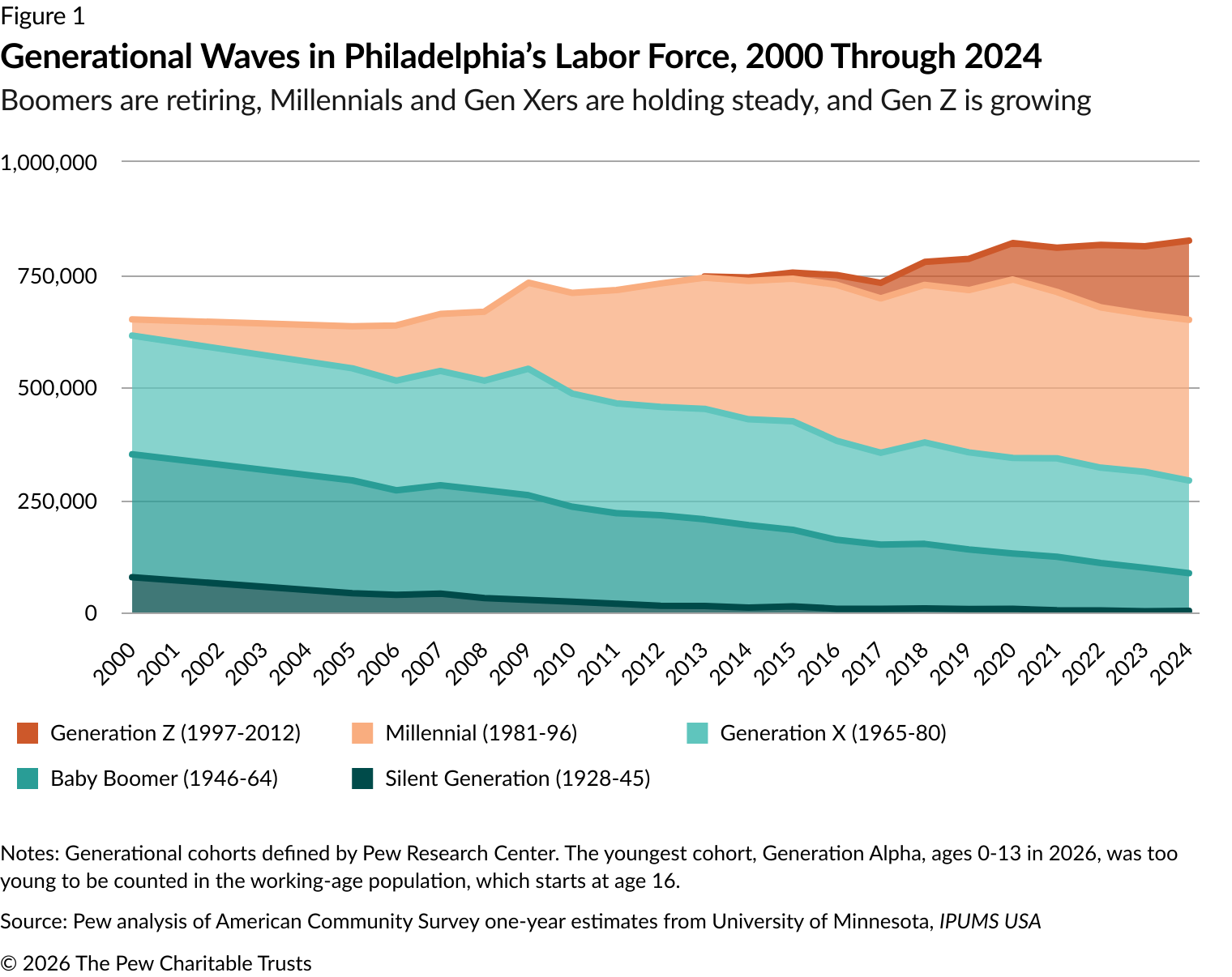
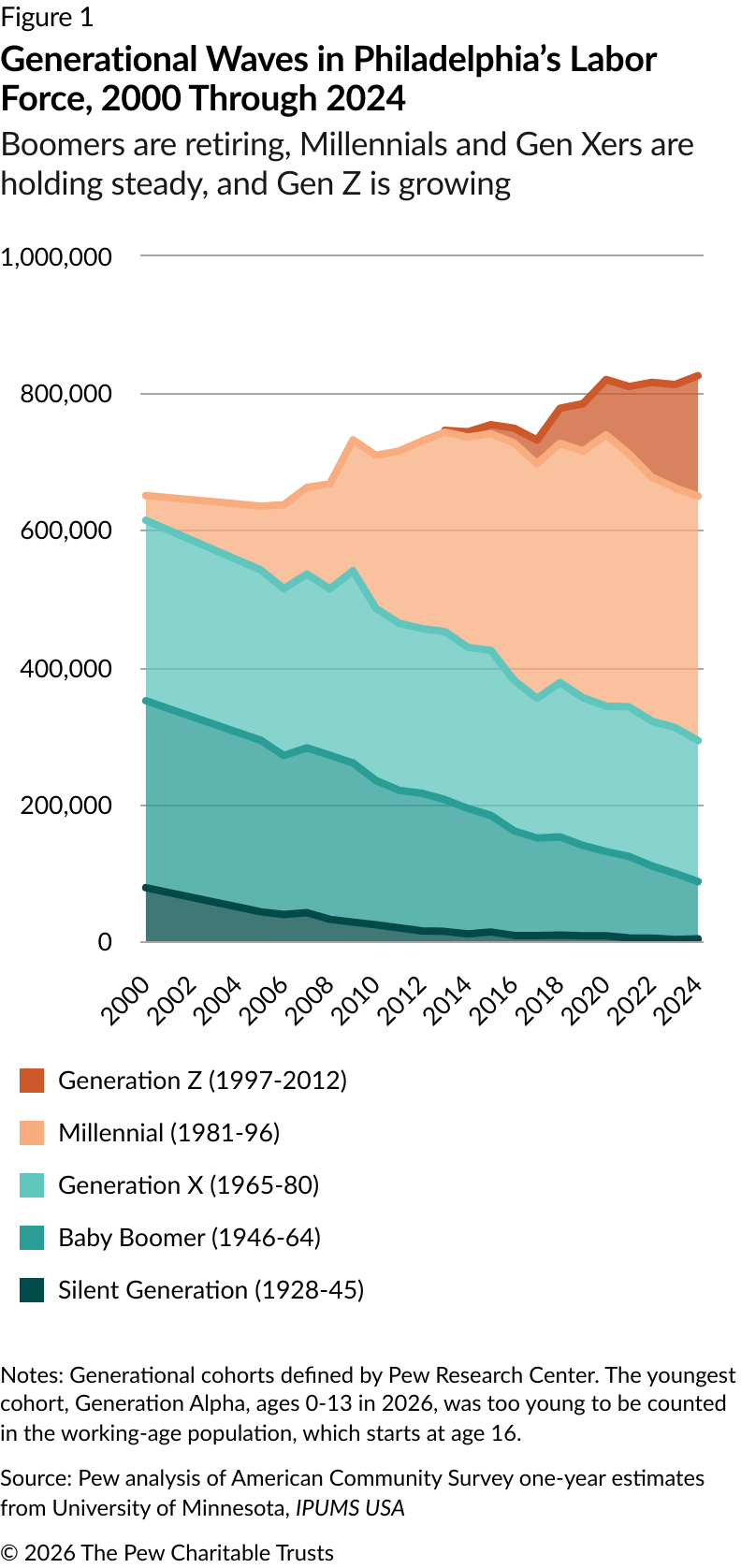
Similar to Gen Xers, members of Gen Z are fewer in number than Millennials and Baby Boomers. (See the methodology for definitions.) That plays out in the labor force: The 18-to-29-year-old share of Philadelphia’s civilian labor force already was down to around 26% in 2024 from 31% in 2010, according to U.S. Census Bureau data. Over the same period, the share of workers 55 and older has grown.3
At the same time, however, the 29-and-younger group has been a top source of new residents moving into Philadelphia from elsewhere. On average each year over the 2020-24 period, 16,000 more 18-to-29-year-olds moved into the city than moved out, according to Pew’s analysis of census data.4 That translated into 1.6 arrivals for every departure among those young adults. Many come to Philadelphia to attend college, drawn to its large number of postsecondary educational institutions.
But young adults’ net movement reverses for various reasons after around age 30, when there are an average of 1.3 people moving out for each person moving in per year. Many go to surrounding suburban areas, often in pursuit of job opportunities, according to pre-pandemic data and polling.5 The net migration reverses again, with people moving back into the city, after age 65—but in smaller numbers of mostly nonworking “empty nesters.”
In 2024 (the latest year for which data was available), an estimated 176,000 Gen Z city residents in the labor force were working or looking for work in Greater Philadelphia and beyond—a number that is likely to keep growing. (See Figure 1.)
Whatever its ultimate size, Gen Z’s key role in the labor force raises questions about how the city and the region could retain more of these highly educated, career-building, taxpaying residents—often in competition with other cities and metro areas.6
High-quality jobs must offer flexibility, good pay, and career advancement
Asked to describe a “high-quality” job in Philadelphia, Gen Z Philadelphians agreed most often on four attributes: high or competitive pay; work-life balance and boundaries; opportunities for career development and skills training; and employer-sponsored health benefits.

They listed many other attributes, too, though with less uniformity. Those included paid time off, social or moral “purpose” and meaning in the work, a supportive manager, a hybrid or remote work schedule, retirement benefits, a short commute, and flexible work hours. (See the methodology for the full list.) Their preferences largely mirrored those found in national surveys of members of Gen Z and other cohorts.7
The participants also agreed that a job is different from a career, which they said reflects a deeper personal goal and may take years to build. A few framed a career as a passion, calling, or purpose, implying that they could make different choices or trade-offs for it.
“A job is more of a dead end, kind of just paying the bills. A career is something fulfilling, something where you know you’re making a difference, at least for you.”
—Female, age 25-29, no college degree, seeking work in behavioral health
All told, focus group participants’ attributes of a high-quality job (top four detailed below) reflected a general desire for clear parameters around work and certainty for career and economic advancement.
Pay and compensation
The participants defined high pay or compensation as an amount that would give them and their families financial security and enable the personal life they wanted. Most talked about money as the means to an end, not the end itself, which appeared to fit with their prioritizing of work-life balance. Some also said high pay could compensate for a shortfall in the other attributes.
“Pay can kind of make up for the other things. If your retirement [benefits package] isn’t as good but you’re making enough to save on your own, then it doesn’t really matter that your retirement [package] isn’t that good. If you’re making a lot already right now, the growth opportunities aren’t as important. Pay can get rid of most of the problems that other areas lacking can cause.”
—Male, 18-24, college degree, working in human resources
Work vs. personal life
Gen Z Philadelphians were emphatic that high-quality jobs should allow for “balance” and “boundaries” between work and personal life. Several also mentioned “flexibility” in work schedules for personal needs as long as work gets done as expected. (See definitions in Table 1.)
“It is important to be able to see yourself outside of work and be able to live a meaningful life outside of that, as well as the reality that jobs are not rising to the cost of living. … I think Gen Z is definitely high on that: If there’s no work-life balance, they’re not going to be in for the ride at all.”
—Female, 25-29, college degree, seeking work in environmental policy
“When I was younger, I would put in a lot of effort [because] I’m getting paid just as much as everybody else and I want to be the superstar at the job. But being a superstar gets you nothing at the end of the day. So that’s something I learned later on in life, that my attention span, my time, is … short, and I’ll leave somewhere quick.”
—Male, 25-29, no college degree, working in behavioral health
“I don’t live to work. I work to live. So there needs to be that distinction between the two.”
—Male, 25-29, college degree, seeking work in data analytics
Table 1
Gen Z Definitions of Work vs. Personal Life
| Work-life balance | Flexibility | Work-life boundaries |
|---|---|---|
|
The ratio of time spent in a day or week working for pay vs. engaging in personal activity for themselves, such as recreation, appointments, relationships, hobbies, etc. |
The ability to deviate from a set daily or weekly schedule while still delivering the required work product and total hours. It allows workers to determine which hours they have to themselves. |
A delineation of employers’ claims on workers’ personal time, marked by not asking employees to work more hours than previously agreed or scheduled. |
|
“I would like a job where I can do my 9 to 5 and go home and have a family and have my own things going on, have hobbies.” —Female, 18-24, college degree, unemployed |
“I can go and get dinner and then log back on at night to do what I need, which is flexible hours for me. If I had a dentist appointment, I can go and do that, and if I have to work at midnight, then I work at midnight.” —Female, 18-24, college degree, working in accounting |
“I work my hours, and do not ask me to think about work outside of them.” —Male, 18-24, college, working in human resources “When I’m off, I’m off. I don’t want anybody to contact me.” —Female, 18-24, college degree, seeking work in communications |
Source: Focus group sessions, August and September 2025
While insistent on work-life balance, some participants acknowledged that it can conflict with their other top attribute, high pay. That’s a trade-off that research shows most American workers accept, to varying degrees.8 Some Gen Z Philadelphians were willing to accept that financial trade-off, too, although more grudgingly than they believed their elders would.
“An ideal job, it would have high pay and work-life balance. I know that having a livable wage is essential, [but] having high pay is better.”
—Female, 18-24, college degree, looking for work in sociology
Career advancement
The participants, especially younger ones and those without a college degree, said a high-quality job must include opportunities for skill-building and connections to further their careers. Many expressed bitterness about employers who gave inadequate training, limiting opportunities for growth. One participant went so far as to describe such practices as a “Philadelphia” trait.
“Most of the time, they just throw you in the field. They don’t even help. … I’m telling you, no structure. … Stop throwing people to the wolves, man.”
—Male, 18-24, no college degree, working in behavioral health
“People [are] selfish in Philly; they don’t want to see people grow.”
—Female, 25-29, no college degree, unemployed
Healthcare benefits
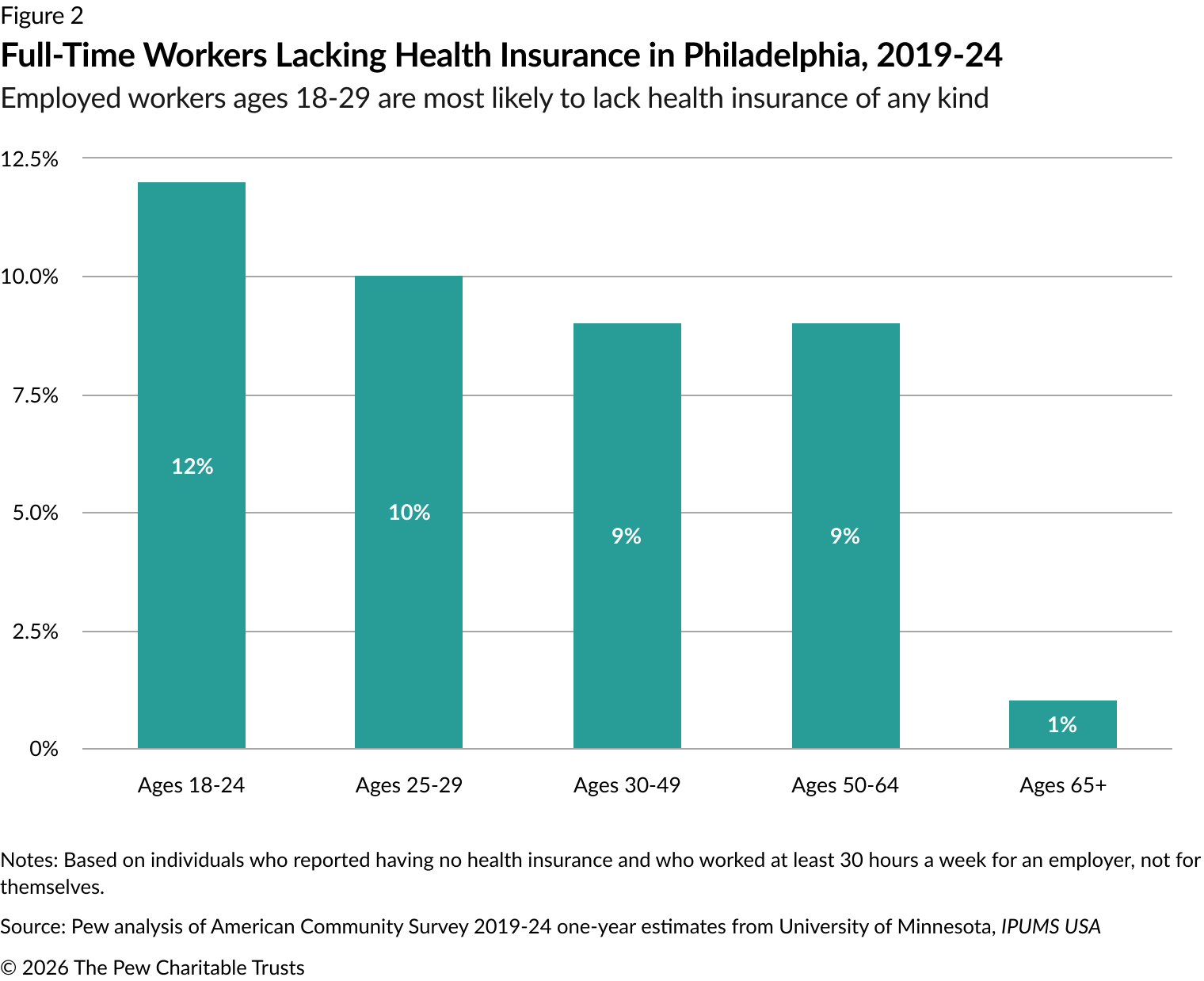
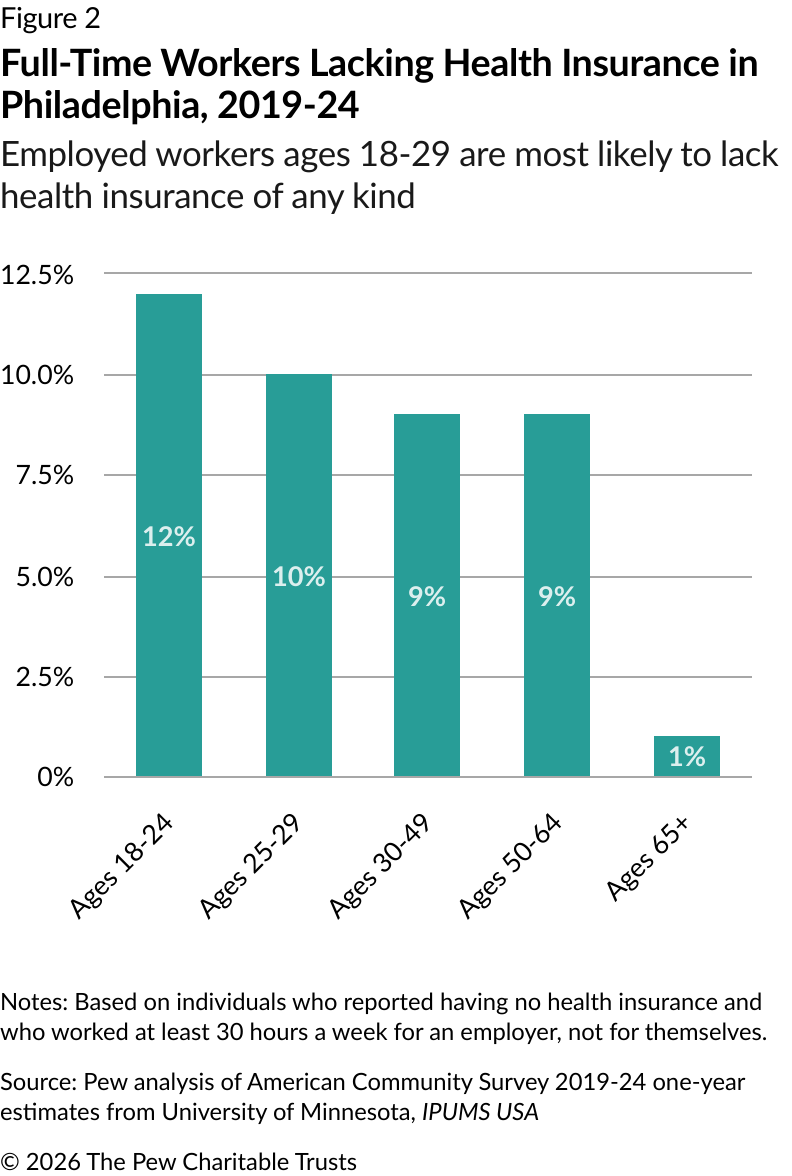
Employer-sponsored health insurance was participants’ fourth core element of a high-quality job. That aligns squarely with recent nationwide polling which found that 18-to-29-year-olds are more insistent than older cohorts on healthcare coverage from a private employer or public system.9 For Philadelphia residents, it may also reflect the fact that this cohort, many of whom came of age during the COVID pandemic, is the least likely to have any health coverage, including from a full-time job or through family members. (See Figure 2.)
Interestingly, there were mixed feelings about a retirement savings benefit, such as a 401(k) plan or pension plan.10 Participants who pointedly downplayed a retirement benefit gave three reasons: inability to spare any of their pay; unattractive employer plans; and high confidence in their own ability to save or invest for retirement. The latter is in line with surveys finding that Gen Zers tend to get involved in investing at an earlier point in their lives than older cohorts have.11
Philadelphia is better for some careers than others
Focus group participants who were pursuing careers in one of Philadelphia’s biggest industry sectors—healthcare—were largely satisfied with and even excited about the number of available jobs in the city. For them, career goals are attainable without leaving the area.
“Philadelphia is unprecedented in the number of hospital systems it has. I work with them every day, and I’m like, ‘I should have gone to med school after all. I would’ve had some really good opportunities here.’”
—Female, 18-24, college degree, working in social services
Hospitals and doctors’ offices, along with home-health aides, assisted living, and many other types of “care” services—known collectively as the healthcare and social assistance sector—provide the biggest share of jobs for 18-to-29-year-old Philadelphia residents. Around 20% of young adult residents in 2024 worked in the sector. Philly’s next biggest employment sector for 18-to-29-year-olds was educational services, at 14% (tied with accommodations and food). Combined, the so-called “eds and meds” sectors provide a higher share of jobs for young adults in Philadelphia than they do in most of the other Northeast cities and the country overall. (See Figure 3.)
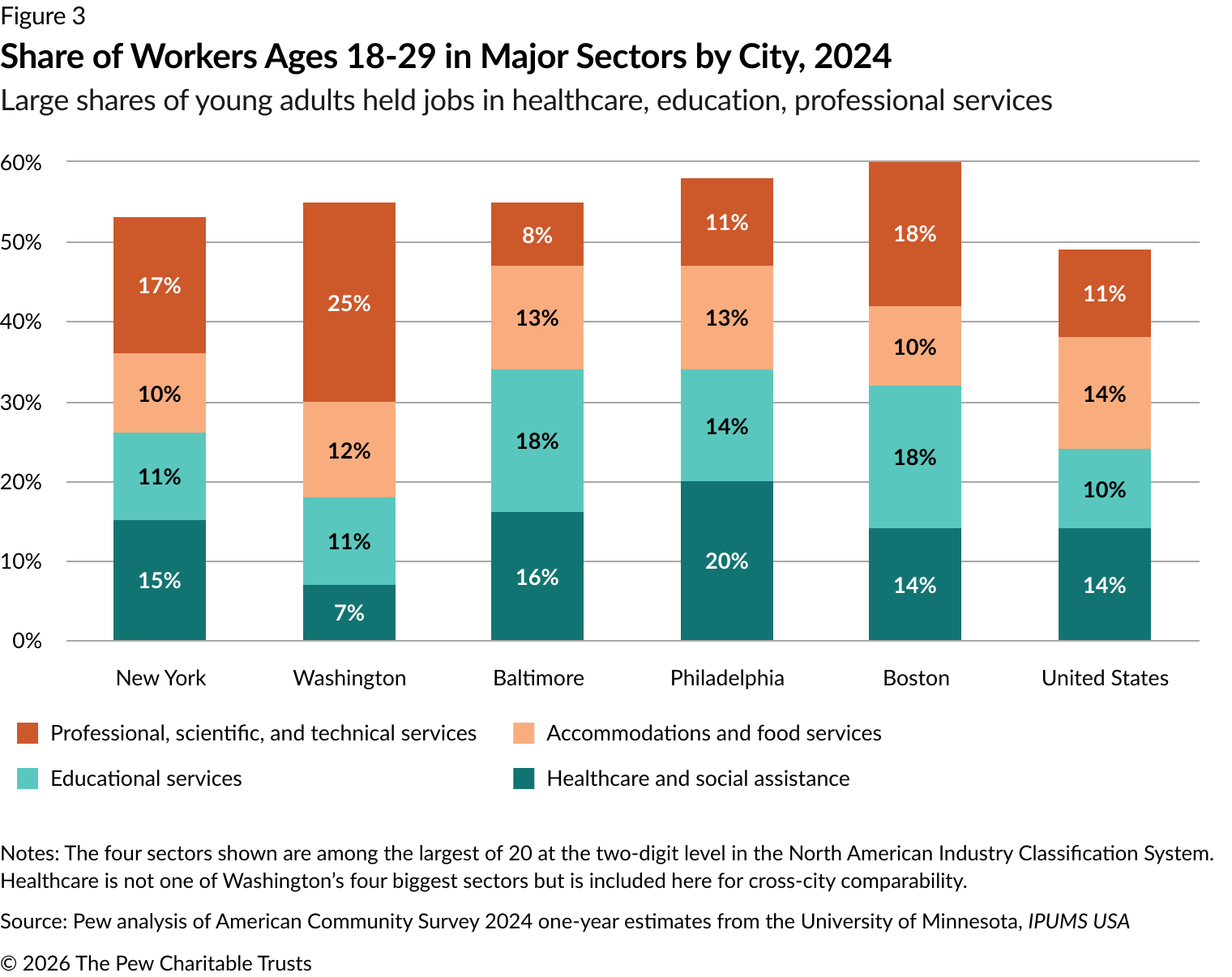
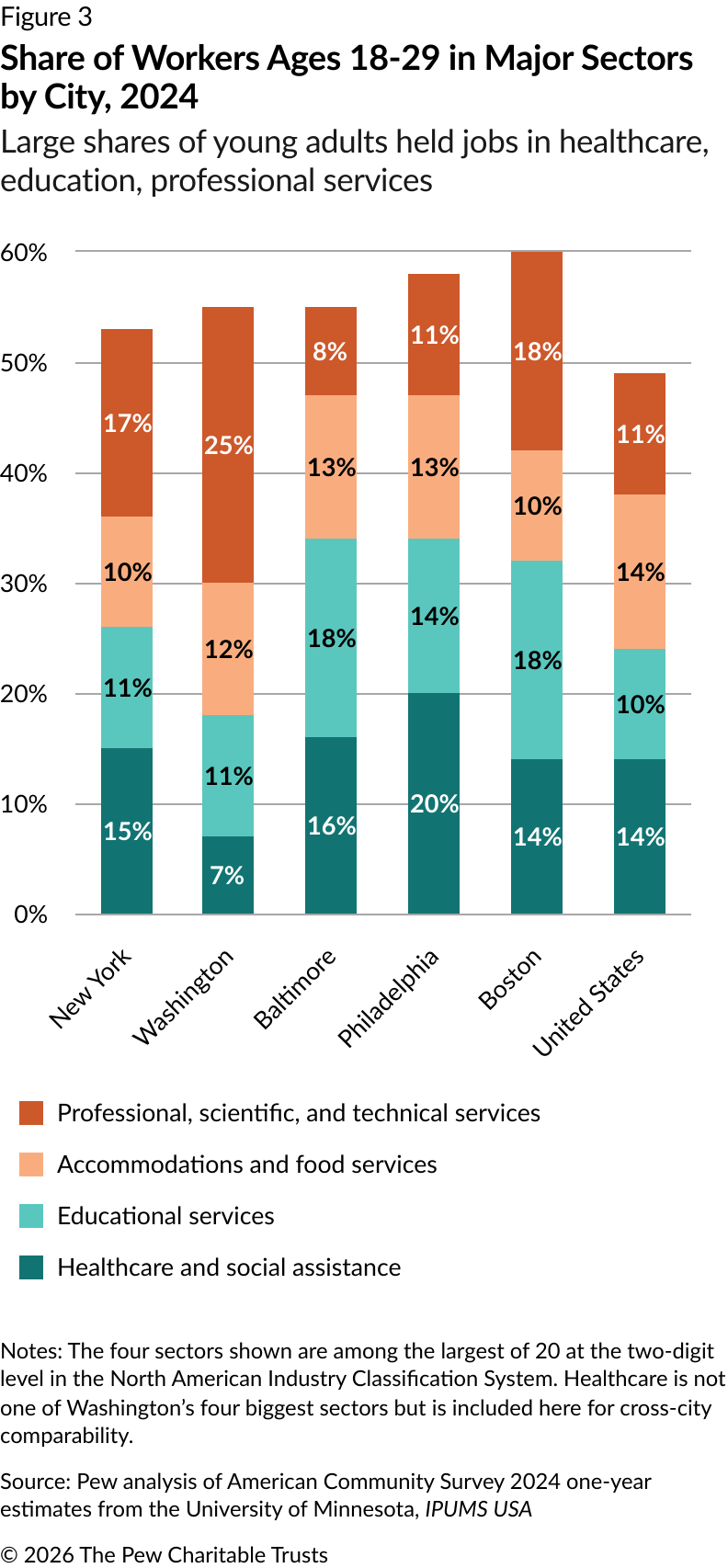
Other participants felt similarly about certain niches of law and engineering. Those fields belong to the city’s fourth-biggest sector for young adults: professional, technical, and scientific services. Around 11% of them worked in that sector in 2024, similar to the national average.
“From what I’ve seen with civil engineering, there are a lot of these perfect jobs in Center City. That’s where a lot of these companies have offices and headquarters. And so I’ve seen, not only me, but a lot of my classmates are getting jobs in Center City.”
—Male, 18-24, no college degree, working in traffic engineering
Participants pursuing other fields had a different take. Many felt that employers outside the healthcare sector in Philadelphia often don’t make many job openings available or accessible to young adults. In their experience, it takes personal connections to land a high-quality job.
“In Philly, I feel like sometimes it’s hard to find a high-quality job, especially something that fits this [quality job] list, because sometimes you have to know people who know people. Just having connections is how you find these high-quality jobs.”
—Female, 18-24, no college degree, seeking to work in fashion
Gen Z participants who aspired to work in finance, technology, and the arts, for example, saw New York or Washington, D.C., as superior to Philadelphia in terms of career-pathway job options—a reminder that Philly’s prime East Coast location cuts both ways when it comes to labor attraction and retention.
“[As an] actress, … I feel like I would have to go to New York or something for that and get signed to an agency, and we don’t have a lot of those in Philly.”
—Female, 25-29, no college degree, wanting to work in healthcare or acting
In a compromise between leaving or staying for a particular field, some participants were open to commuting from Philadelphia to Washington, Baltimore, or New York—a well-trodden practice known as super-commuting. But most drew the line at commuting for longer than an hour, even for a dream career. Still others talked about moving away for a period, then coming back at a higher level after attaining career success elsewhere.
“Philly isn’t, in my opinion, the best place for banking, especially with New York being so close. That’s where a lot of entry-level jobs are. … Going to New York to have a lower-paying entry-level job to get experience to come back to Philly—that kind of feels like what a lot of people my age are struggling with.”
—Female, 18-24, college degree, wanting to work in economics
Pay and cost of living
Aside from particular sectors, participants complained that jobs in Philadelphia pay less than similar jobs in other big East Coast cities do, although they acknowledged that housing and living costs were also lower in Philly, a belief supported by cost comparison data.12 Some participants also said young adults today earn too little to buy homes like their predecessors could, which census data affirms.13 Either way, participants faulted employers who they say fail to take into account Philadelphia’s cost of living or disdain young adults for complaining about making ends meet.
“I think it was easier for older generations to be loyal to companies because they could survive easier on what they were making. So employers should understand that if we try and negotiate for a raise, we’re not being greedy. We just straight up need it because the cost of houses has risen by crazy percentages in relation to wages, and also [the cost of] everything is just insane nowadays.”
—Male, 25-29, college degree, working in engineering
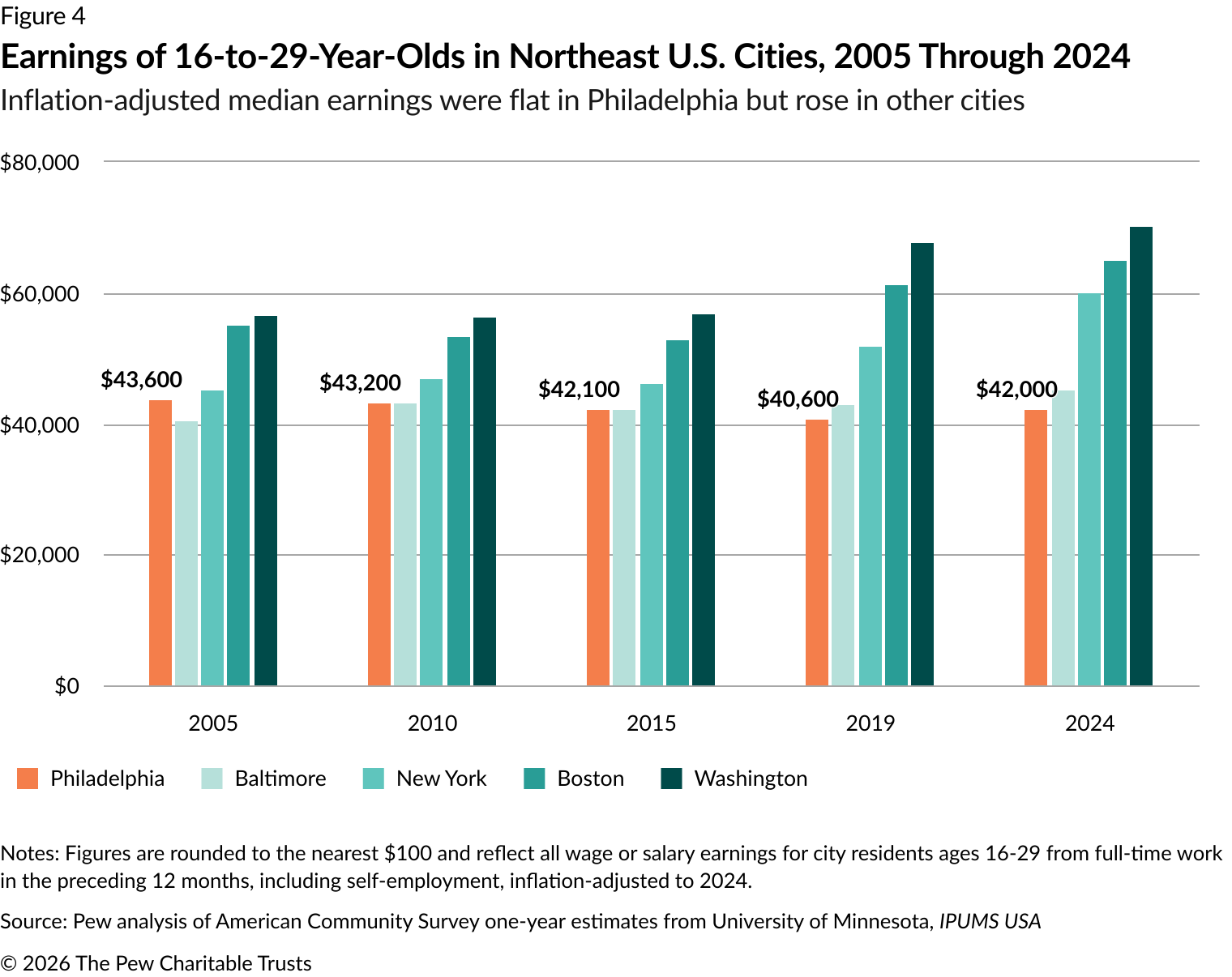
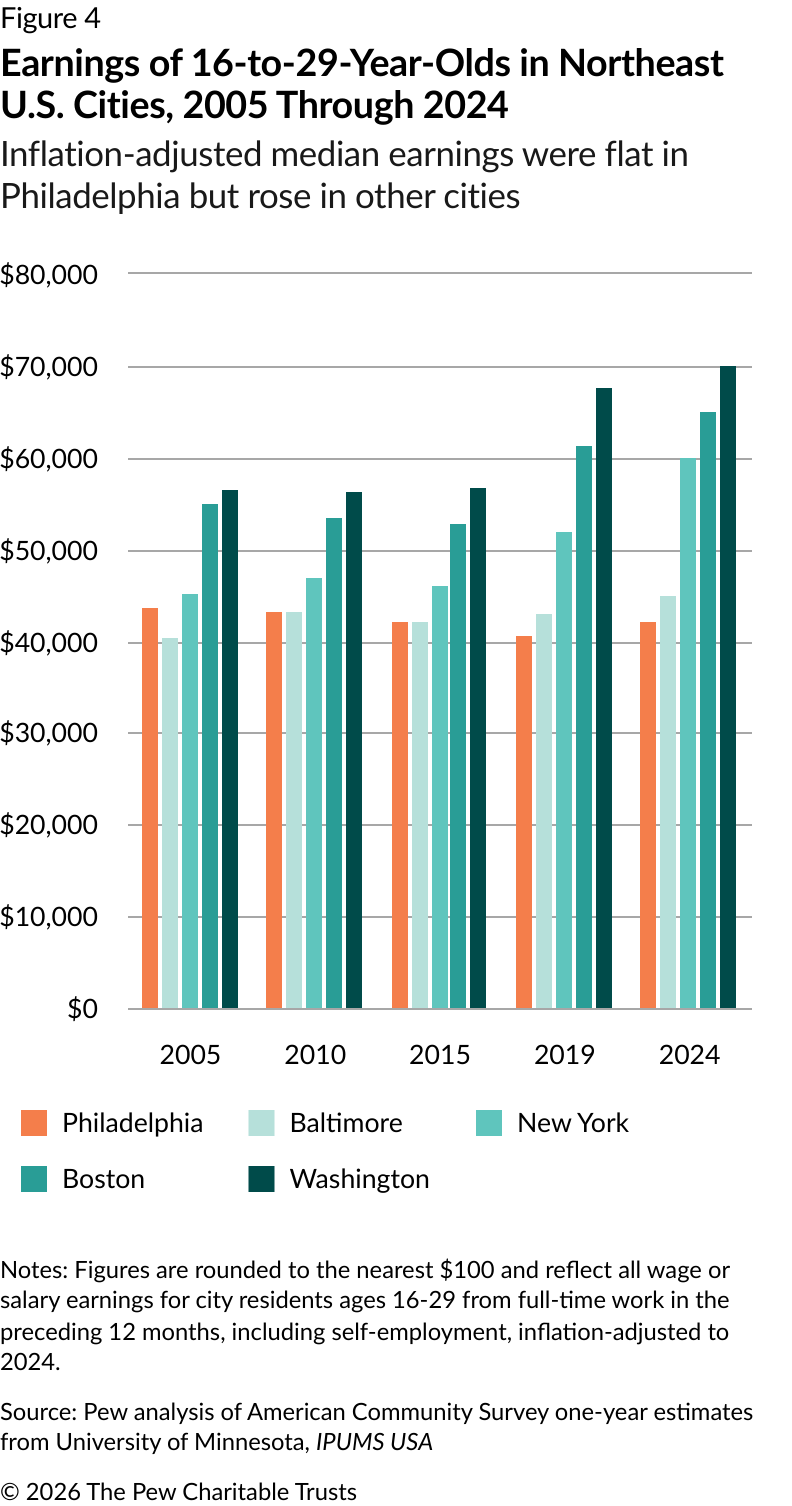
Federal data shows that the median earnings for 16-to-29-year-olds in Philadelphia in 2024 were lower than in Boston, Washington, New York, and Baltimore. (See Figure 4.) And that gap has widened since 2005, when Philly’s median earnings were closer to those of the other cities, adjusted for inflation. (Philadelphia also has had lower overall incomes, lower minimum wage, and lower educational attainment than in those cities.)14 At the same time, however, Philadelphia’s cost of living in 2025 was lower than in those other cities, and that difference also was smaller in 2005, according to data from the Council for Community and Economic Research.15 Put another way, the pay for Philly’s 16-to-29-year-olds hasn’t risen with inflation like it has in other East Coast cities, but its cost of living compared with theirs hasn’t increased as much, either.
Gen Zers are keen on learning and networking but mixed on college
All focus group participants were eager to improve their marketable skills and professional networks to help get jobs in their desired fields, the latter sometimes known as social capital. But they were mixed on the most fruitful and cost-effective route among the plethora of options in Philadelphia and remotely: on-the-job learning, formal training programs, mentorships, self-guided or AI-enhanced learning, specialized certificates, and traditional associate, bachelor’s, and graduate degrees.
For context, the 25-29 age group has the highest college attainment rate of all age cohorts in Philadelphia, although it is lower than in some of the other Northeast cities. In the 2020-24 period, 54% of this group had a bachelor’s degree or higher, compared with 33% of all older residents. Those young adults were a little less likely than the older adults to have an associate degree or some college experience (18% vs. 23%), according to census data.16
Despite their college experience—or perhaps because of it—Gen Z participants didn’t necessarily believe that college gave them what they needed for career advancement, based on a specific set of “hard” and “soft” skills they associated with a high-quality job. (See Table 2.)
Table 2
Gen Z’s List of Skills Sought to Advance Careers and Earnings
| Technical (“hard”) skills | Interpersonal (“soft”) skills |
|---|---|
|
|
Source: Focus group sessions, August and September 2025
Gen Z participants who held at least a bachelor’s degree tended to wish they had more “hard” technical proficiencies, which they felt could make them more competitive in their fields (for example, skills in new software or coding or in emerging tools such as artificial intelligence). While some learned hard skills in college, they said an internship or a connection that led to a job in Philadelphia were the top benefits that college offered them.
“I got my first internship just by hanging out with a former [professor]. I feel like nobody took advantage of his office hours, and I showed up. … I was able to build on that and get an internship, worked on a campaign that he gave me an opportunity for, and then that led to X, Y, Z.”
—Male, 25-29, college degree, working in public service
“I am trying to learn how to use this online platform called REDCap. I’ve had multiple jobs I was looking at, and they request it. … [In] the fields that I’m looking to go into, and also the one that I’m in, it’s something that’s preferable.”17
—Female, 18-24, college degree, searching for her niche
The college graduates mostly felt that a bachelor’s degree was valuable, although not necessarily for “hard” skills or in relation to the time and money it cost. Those who felt it was positive often cited job-related connections they made and exposure they got to other people in their chosen fields. A few said that a bachelor’s degree isn’t sufficient in their fields anymore and that they need graduate degrees. Those who were lukewarm about their bachelor’s degree said they should have sought different skills or, in one case, skipped college and gone straight into the job market.
“Everyone that I know … felt that they had to go on to graduate school in order to get a job in their field. And I think that’s important to note, which I would say was also my experience. … It’s not that they have to have [a graduate degree]. I think that it’s just a very competitive job market and you just can’t compete unless you have one.”
—Female, 25-29, college degree, working in law and policy

“I realize now college was a big waste of time and a lot of money for absolutely nothing. I could have learned a lot of the skills outside of college. … I went to a public university, but still it was a lot of money.”
—Male, 18-24, college degree, working in urban planning
By contrast, those who did not have college degrees said they now were looking for more “soft” skills and professional connections that they believed college might have provided. Those without college degrees also often felt that employers should help workers with networking, mentoring, and particular skills needed for advancement.
“I would like to continue to grow in a leadership position. … I want to learn how to be my boss, which would be how to delegate to other managers. And I do feel like I could figure it out eventually, but that seems like a clear gap in experience that would prevent me from stepping into a role like that.”
—Male, 25-29, no college degree, wanting to work in marketing
“My uncle did Job Corps. … Job Corps is good. I just chose a trade school because my cousin, he actually works for them, so that’s my way in. Knowing someone will get you in the doors as well. That’s always good, knowing somebody.”
—Male, 18-24, no college degree, wanting to work in medical security
Some participants felt that job programs are not so accessible for young adults in Philadelphia. Asked whether the city has resources or programs to help Gen Zers find or pursue their career paths, some participants lamented that programs are often limited to teens and very young adults.
“I thought about going back and getting a trade in something, but then all the programs are [for ages] 18-25. And it’s like, ‘Oh, I just missed the cut.’ So, by that age, you would have to go back and pay for it yourself. … Those are hard because they’re all designed for kids.”
—Male, 25-29, no college degree, working in behavioral health
Among participants without college degrees—and a few with them—there was a perception that employers in Philadelphia unfairly prefer candidates with college degrees or fail to provide training without considering a person’s willingness to work hard. Several recalled that their parents had lacked college degrees and still “worked their way up” with an employer’s support—although other participants countered that such career advancement is less common today.
“I feel like, back when my parents were younger, it was a little more trusting. [Employers] would hire you based off your work ethic. Even if you don’t have experience in the field, they’re willing to train you.”
—Male, 25-29, no college degree, working in concert production
“You need to have experience, you also have to have higher education, and you have to go from a big-name school because also it’s harder. And that just kind of results in … people with more experience come from other markets. They have the experience, they have the education, they just take jobs.”
—Female, 18-24, college degree, unemployed
Asked whether Philadelphia is a place where they could acquire the skills they sought—either traditional degrees from colleges and universities, or so-called microcredentials or nondegree credentials from specialized programs—the participants said yes, but with conditions.
“I do know [of programs] for people younger than me. Because I’m currently in college, I don’t think I’ve seen a lot of those kinds of programs around Philly for people of college age, second, third year. But for people in high school and about to graduate from high school, I know that those programs exist.”
—Female, 18-24, no college degree, wanting to work in technology
“If there were more programs where I could go back to school, maybe older people or younger people would want to come back. I could go back to school and I’m just going to move to Philly for the next three years and do my school over there. So maybe something like that would help out too.”
—Female, 25-29, no college degree, looking for work
Commuting and safety are concerns but not deal-breakers
The journey to work and the level of workplace safety were significant factors for some Gen Z participants when deciding on the jobs they would accept and—most critically for Philadelphia and its surrounding areas—where they prefer to live and work.
Gen Z commuters use slightly different modes of transportation than older commuters in Philadelphia do: According to census data for 2020-24, Philadelphians ages 18-29 in the labor force were more likely than older commuters to take public transit (25% vs. 19%) and walk or bike (16% vs. 9%), and less likely to drive their own vehicles (57% vs. 69%).18
Nearly all of the focus group participants agreed that shorter commutes would leave more time for personal needs and sleep, and would put them in a better mindset at work; they saw longer journeys as costly in terms of both time and money.
“I would honestly dread anything longer than 30 minutes. The longer the commute, the more money comes out of your check. … I just don’t want to burn a bunch of my day getting to work before I’m even doing work.”
—Male, 25-29, college degree, wanting to work in cybersecurity
The regional public transit system—which includes SEPTA, PATCO, and NJ Transit—was one of the amenities that attracted some of the Gen Zers, who cited its reputation as a reason they moved here from other places. That sentiment lined up with some studies that rank SEPTA, the biggest local system, among the best nationwide.19 (At the time of the focus groups, SEPTA was warning of a severe cutback in services due to funding shortfalls.)
“I actually specifically moved to Philly because of the transit here; I wanted to live somewhere that I didn’t have to have a car.”
—Female, 25-29, college degree, working in law and policy
“For me, I don’t drive, so having a job that is easily accessible by public transportation is pretty important to me. I work in Center City, so I can pretty much live anywhere in the city and get there fairly easily.”
—Male, 18-24, college degree, working in human resources
When it came to safety in Philadelphia and particular neighborhoods, the participants expressed a variety of opinions depending on their personal experience and gender, as well as their job type and work schedule. Some said they would not pass up a high-quality job in a neighborhood that was perceived as unsafe. Other participants said the opposite, that they would hesitate to take a job in a neighborhood that is unfamiliar or known to be unsafe. Still others said the key is staying vigilant about the surroundings and times of day or night that they work.
“You just have to be aware. And I think, for city people, that’s pretty easy to do. … It wouldn’t change or anything for me, especially if the money is there. You just have to be cognizant and aware and know what times you’re supposed to be in and out and not stay past the streetlights turning on, honestly.”
—Female, 18-24, college degree, wanting to work in law
In contrast, participants also said that workplace safety is employers’ responsibility, particularly in higher-risk areas and around work hours. Some participants said a desirable, high-quality job is one where the employer provides a safe environment or safe-commuting benefits during off-hours.
“I leave the office pretty late sometimes, and one of the benefits my company will have is, if we have to leave after 9 p.m. or 10 p.m., then they’ll pay for an Uber. If the company has things like that, where they can ensure safety, that is something I’d consider.”
—Female, 18-24, college degree, working in accounting
“I think that a job should provide some sort of security. I don’t think that the location really matters if the job is providing a secure office or workplace.”
—Female, 25-29, no college degree, wanting to work in healthcare or acting
Gen Zers stay for family, friends, and affordability
While Philadelphia does not have the level of pay and variety of high-quality jobs that some Gen Z workers want, the city and region do have this: familiarity, friends, family (for some), and affordability compared with other big cities. It also has sports, music, history, social life, and a prime East Coast location. Those were not small selling points for a generation that insists on work-life balance.
“It’s where I’m from, it’s all I know, so I’m comfortable with it. If the perfect job is here, why would I leave?”
—Female, 25-29, college degree, wanting to work in anthropology
“I like Philadelphia, I know Philadelphians, I love Philadelphians. Go, Birds! I just feel like I don’t want to have my first real ‘big girl’ job be somewhere that I don’t know.”
—Female, 18-24, college degree, looking for work in communications
“I’m very happy in Philly. If anything, I would say [I’d stay for the] affordability, compared to other cities. I have a friend in New York who works in urban planning, one year in the workforce, got a $20,000 raise, and he can still barely make ends meet because the rents there are insane.”
—Male, 25-29, college degree, wanting to work in higher education
“I moved to Philly, mostly because I wanted to move to the Northeast. I wanted to move to a walkable city. I wanted to move to an affordable city, and I was considering D.C. and New York, and I was like, ‘Too expensive. Not for me.’ I visited Philly, and I fell in love with the people, the food, the culture, the sports.”
—Female, 18-24, college degree, working in social services
“I want to stay here, only because I’ve lived here all my life and I know everyone here.”
—Female, 18-24, no college degree, working in tobacco enforcement
Other participants were still looking to leave the city for better career opportunities, higher pay, or easier commutes. Notably, some potential movers with families were thinking of Philadelphia’s surrounding suburban areas, where they expected to find lower taxes or safer schools than in the city—all similar to reasons that those leaving the city have cited in other research.20
“Having to pay that city wage tax, I don’t want to have to do that again. I’d rather work outside the city and not pay a big wage tax.”
—Female, 25-29, college degree, unemployed
“I don’t think anybody wants to settle down here. I just want to work [in Philadelphia] because there’s a high-paying job downtown and then get out to the suburbs once you hit 30 or something. [There, it’s] safer. Better schools. All the advantage of a suburb over a city.”
—Male, 25-29, college degree, working in engineering

The calculus of taking a job outside Philadelphia has become more nuanced since the COVID pandemic, when remote or hybrid work became common and viable. Many Gen Z workers haven’t known a time when remote jobs were unusual. As early-career workers, the focus group participants tended to prefer flexible or hybrid hours, and not fully remote work, which they said limits their opportunities for learning and connecting with colleagues for career advancement.
“I’ve found a lot of the remote positions just to lack some of the things we talked about in terms of mentorship and making it easy to meet people. And I think those relationships really matter moving forward, even if you’re just building skills and you’re going to take it somewhere else. So I don’t think it needs to be [full-time remote].”
—Male, 18-24, college degree, working in environmental law
Census data seems to affirm that sentiment. Philadelphia workers ages 18-29 were just as likely, statistically, as workers ages 30 and older to report working at home (21% vs. 23%) in the 2020-24 period. (Census data does not distinguish between fully remote vs. hybrid.)
One of the questions for civic leaders is about the likelihood that Gen Z’s net inflow to Philadelphia will flip to net outflow when cohort members are in their 30s and older—if past migration patterns continue. Can civic, workforce, and government leaders expand their own purview from the city to the wider metro area, essentially following residents’ lead as they move within the region? In recent years, public sector and private sector organizations in the five-county Southeastern Pennsylvania region have mounted a new collective effort to adopt shared workforce and economic development strategies, rather than to compete with one another. The strategy aims ultimately to increase the number and accessibility of high-quality jobs anywhere in the region, including for young adults.21
Conclusion
A series of focus groups with 18-to-29-year-old Philadelphia residents—members of Gen Z, who numbered around 176,000 in the city’s labor force in 2024—offered some clues for city and regional leaders who want to retain more of this educated labor force into their 30s and beyond.

Gen Z likes the region’s culture, activities, and relative affordability but is also frustrated with its lower pay compared with other Northeastern cities and fewer career opportunities outside the “eds and meds” industry, signaling workers’ need for clearer connections to less prominent sectors.
Members of this cohort are eager to develop technical and interpersonal skills, and especially to expand their networking and professional connections to build careers—either within or outside of college. That may be an area where the region’s educational, civic, and business leaders could help.
Commuting time, transit reliability, and neighborhood and workplace safety can influence Gen Zers’ work and life decisions. In particular, employers could make a difference by investing in safe environments or safe-commuting benefits for employees during off-hours.
Some Gen Zers anticipate leaving the city in their 30s, either temporarily or permanently, even if it’s just to move to surrounding suburban areas. That sentiment validates the efforts of local officials and civic leaders who are trying to vault the city-suburban divide and build a new regional economic collaborative to retain this next generation of prime working-age residents.
Acknowledgments
Jennifer Kebea, president of Campus Philly, and Paula Fomby, the Edmund J. and Louise W. Kahn Term Professor in the Social Sciences at the University of Pennsylvania, served as external reviewers.
This report does not necessarily reflect the opinions of these reviewers or their institutions.
Endnotes
- This report uses a definition of Generation Z and other generational cohorts created by Pew Research Center. See the methodology section of this report. See also “Defining Generations: Where Millennials End and Generation Z Begins,” Michael Dimock, Pew Research Center, Jan. 17, 2019, https://www.pewresearch.org/short-reads/2019/01/17/where-millennials-end-and-generation-z-begins/.
- Alan L. Gustman, Thomas L. Steinmeier, and Nahid Tabatabai, “Perspectives: How Did the Recession of 2007–2009 Affect the Wealth and Retirement of the Near Retirement Age Population in the Health and Retirement Study?” Social Security Bulletin 72, no. 4 (2012): https://www.ssa.gov/policy/docs/ssb/v72n4/v72n4p47.html.
- Pew analysis of data from “IPUMS USA,” University of Minnesota, https://usa.ipums.org/usa/. See also The Pew Charitable Trusts, “35% of Older Philadelphians Live Below or Near the Poverty Line,” 2025, https://www.pew.org/en/research-and-analysis/issue-briefs/2025/06/35-percent-of-older-philadelphians-live-below-or-near-the-poverty-line.
- Pew analysis of data from “American Community Survey, Table B07001: Geographical Mobility in the Past Year by Age for Current Residence in the United States,” U.S. Census Bureau, 2010-24 one-year estimates, https://data.census.gov/table/ACSDT1Y2024.B07001?q=B07001, and “American Community Survey, Table B07401: Geographical Mobility in the Past Year by Age for Residence 1 Year Ago in the United States,” U.S. Census Bureau, 2010-24 one-year estimates, https://data.census.gov/table/ACSDT1Y2010.B07401. See also The Pew Charitable Trusts, “A Portrait of Philadelphia Migration,” 2016,https://www.pew.org/en/research-and-analysis/issue-briefs/2016/07/a-portrait-of-philadelphia-migration.
- The Pew Charitable Trusts, “Who’s Leaving Philadelphia—and Why,” 2019, https://www.pew.org/en/research-and-analysis/issue-briefs/2019/09/whos-leaving-philadelphia-and-why.
- “Best Cities for Gen Z in 2025 & Beyond: Which Areas Are Most Livable for Young People?” Lucian Alixandrescu, CommercialCafe, Oct. 6, 2025, https://www.commercialcafe.com/blog/best-places-to-live-gen-z/.
- Aaron De Smet et al., “Gen What? Debunking Age-Based Myths About Worker Preferences,” McKinsey & Company, 2023, https://www.mckinsey.com/capabilities/people-and-organizational-performance/our-insights/gen-what-debunking-age-based-myths-about-worker-preferences.
- Claudia Goldin, “A Grand Gender Convergence: Its Last Chapter,” American Economic Review 104, no. 4 (2014): 1091-1119, https://www.aeaweb.org/articles?id=10.1257/aer.104.4.1091. See also Peter Kuhn and Fernando Lozano, “The Expanding Workweek? Understanding Trends in Long Work Hours Among U.S. Men, 1979-2004” (working paper, National Bureau of Economic Research, 2008), https://www.nber.org/papers/w11895.
- “Most Americans Say Government Has a Responsibility to Ensure Health Care Coverage,” Andrew Daniller, Pew Research Center, Dec. 10, 2025, https://www.pewresearch.org/short-reads/2025/12/10/most-americans-say-government-has-a-responsibility-to-ensure-health-care-coverage/.
- In May 2026, after the focus groups were finished, Philadelphia held a ballot vote on whether to create a new kind of retirement benefit system, known as an auto-IRA system. The focus groups were not asked about the proposed system.
- Dean Frankle, Stephanie Guild, and Natalya Guseva, “2024 Global Retail Investor Outlook,” World Economic Forum, Boston Consulting Group, and Robinhood Markets, 2025, 20-21, https://www.weforum.org/publications/global-retail-investor-outlook-2025/. See also Rachel Wolfe, “Gen Z, Locked Out of Home Buying, Puts Its Money in the Market,” The Wall Street Journal, Feb. 15, 2026, https://www.wsj.com/personal-finance/gen-z-investments-home-ownership-ec0bbe98.
- “Cost of Living Comparison Calculator,” Mia Taylor, Bankrate, 2026, https://www.bankrate.com/personal-finance/cost-of-living-calculator/.
- Dana Anderson, “More Gen Zers Are Buying Homes. But It’s a Trickle, Not a Flood,” 2026, https://www.redfin.com/news/homeownership-rate-by-generation-2025.
- Pew analysis of data from “IPUMS USA,” University of Minnesota. The wage comparison for Gen Z, which includes many teens, is also affected by differences in the legal minimum wage in each city, which in 2026 was lower in Pennsylvania ($7.25) than in Maryland ($15), Massachusetts ($15), New York ($17), and Washington, D.C. ($17.95). See “Consolidated Minimum Wage Table,” U.S. Department of Labor, 2026, https://www.dol.gov/agencies/whd/mw-consolidated.
- Pew analysis of data from “Cost of Living Index,” The Council for Community and Economic Research, 2026, https://www.coli.org/.
- Pew analysis of data from “IPUMS USA,” University of Minnesota. This measurement starts at age 25, which makes it inappropriate for Gen Z as a group, which includes many individuals under 25.
- Research Electronic Data Capture (REDCap, https://project-redcap.org) is a web-based platform for building and managing online surveys and databases.
- Pew analysis of data from “IPUMS USA,” University of Minnesota.
- There are many, often divergent rankings of metropolitan transit systems by quality, accessibility, cost, and other factors. SEPTA ranks high in many of them. For example, see “The 10 U.S. Cities With the Best Public Transportation, Ranked,” Jamie Forbes, Redfin, Feb. 13, 2024, https://www.redfin.com/blog/us-cities-with-the-best-public-transportation/.
- The Pew Charitable Trusts, “Who’s Leaving Philadelphia—and Why.”
- Glencora Haskins, Rachel Barker, and Marek Gootman, “Southeastern Pennsylvania Market Assessment for Growing Opportunity Industries and Economic Mobility,” Brookings Institution, 2025, https://www.brookings.edu/articles/southeastern-pennsylvania-market-assessment-for-growing-opportunity-industries-and-economic-mobility/.
People


