Accessory Dwelling Units Can Meaningfully Boost Housing Supply
As cities increasingly adopt and amend ADU laws, focus should shift to policy design

Overview
Cities across the United States are grappling with a persistent housing shortage that has pushed up rents and home prices. In response, state and local policymakers have increasingly turned to accessory dwelling units (ADUs)—small, self-contained homes on the same lot as a primary residence, usually a single-family house—to add homes in already developed neighborhoods. ADUs add housing without substantially changing the form or character of a neighborhood, which makes legalization a popular policy option for city planners and the public alike.1
However, legalizing ADUs is not the same as building them. Even where cities have adopted ADU ordinances, many of those laws contain provisions—such as owner-occupancy mandates, parking minimums, and discretionary permit requirements—that make construction slow, expensive, or outright infeasible.2 But evidence on the extent to which these provisions restrict production remains thin. Existing studies assess the impact of changes to ADU laws in a handful of cities, often concentrated in California or the Pacific Northwest, or they catalog the provisions of ADU laws without trying to link those provisions to outcomes, such as the number of permits issued or ADUs built.3 Neither approach gives policymakers a complete understanding of how many ADUs a new ordinance is likely to produce.
This report aims to fill that gap. Researchers from The Pew Charitable Trusts reviewed the zoning and development codes of all 346 U.S. cities with at least 100,000 residents, searching for provisions that prior research has identified as barriers to construction. Researchers also examined state laws governing ADUs and assessed how the combination of state and local laws affected the frequency with which cities issued ADU building permits. To complement that quantitative analysis, Pew partnered with researchers at Lehigh University’s Small Cities Lab, who conducted in-depth interviews with planning staff in 11 cities to understand how ADU ordinances are developed and revised in practice.
The central finding is that ordinance design matters enormously. Cities with permissive ordinances issued permits for exponentially more ADUs than those with restrictive ordinances or without a law. These gaps were not solely a byproduct of geography or local development conditions. Instead, they demonstrated that the content of an ADU law materially affects the number of accessory dwelling units that ultimately are built.
Key findings of this report include:
- Roughly 4 in 5 cities with a population of 100,000 or more have laws that allow property owners to build an ADU. In the latter half of the 20th century, municipal zoning codes often heavily restricted or prohibited ADUs. Today, however, 276 of the 346 cities analyzed (80%) allow owners to build an ADU on the same lot as a single-family home, and to rent or sell that unit to an unrelated individual.
- Nearly half of all ADU ordinances contain restrictive provisions that limit ADU development. Of the 276 major cities that have an ADU ordinance, 118 (43%) impose at least one significant restriction that limits ADU construction. Forty-nine cities do not allow ADUs in their main single-family zoning districts; 27 allow ADUs only with a special use permit; 71 require the property owner to live on site; and 81 require parking to be provided in most cases. (Some cities impose more than one type of restriction.) By contrast, 158 major cities have “permissive” ADU ordinances that contain none of those limits.
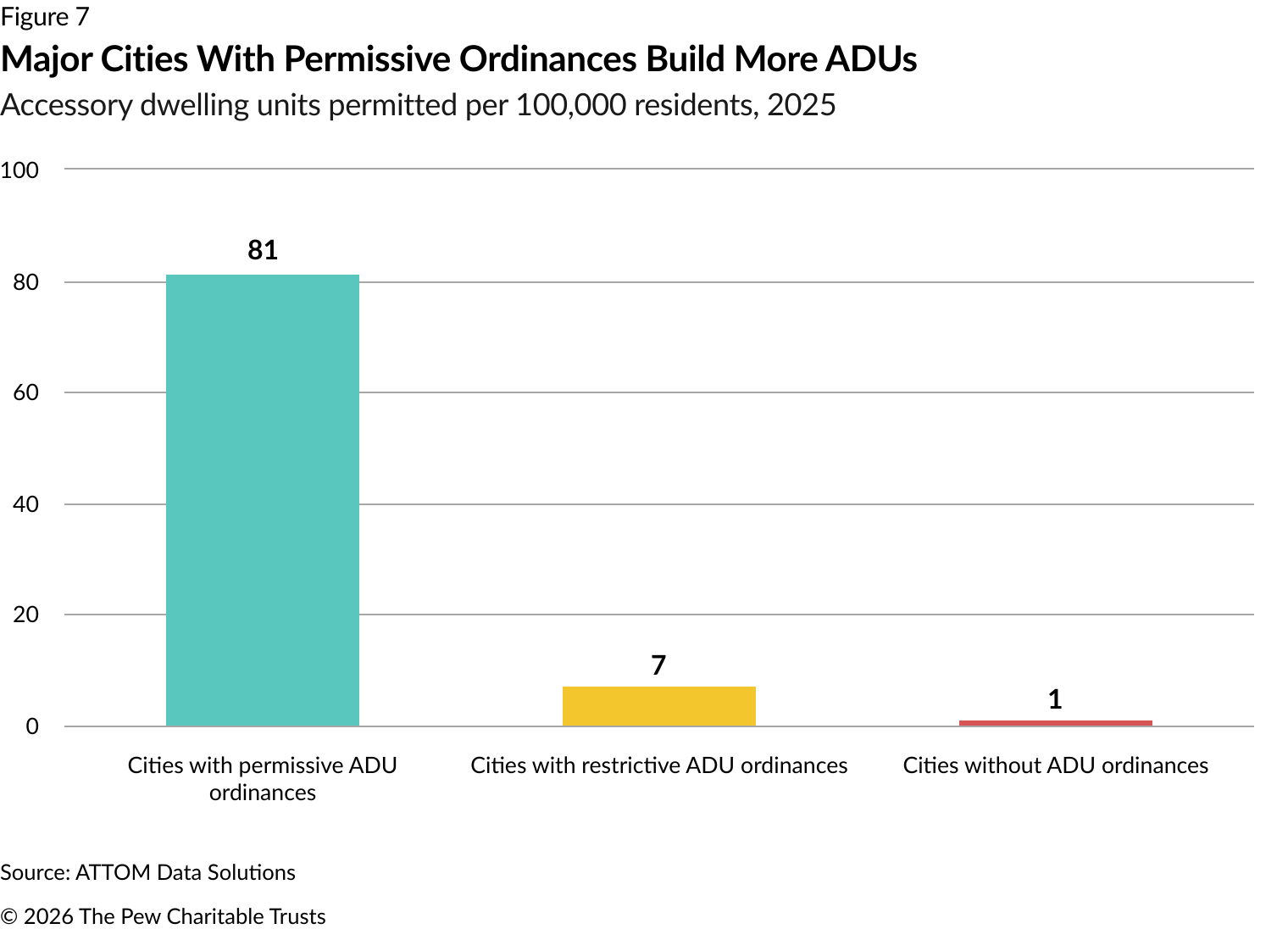
- In cities with more permissive ADU laws, more ADUs are built. Cities with permissive ADU ordinances issued 81 ADU permits per 100,000 residents in 2025, more than 11 times the rate of cities with restrictive ordinances and more than 75 times the rate of cities without an ADU ordinance. Those results are heavily influenced by California, which builds far more ADUs than any other state; cities outside California with permissive ordinances issued 26 ADU permits per 100,000 residents in 2025, more than three times the rate of cities with restrictive laws and more than 23 times the rate of cities without an ADU law.
- States increasingly require cities to adopt permissive ADU laws. As of August 2026, 22 states had passed “preemption” laws that either legalize ADUs statewide or broadly enable homeowners to build ADUs on their properties. State preemption laws are a primary driver of permissive ADU laws nationwide: Of the 158 cities with permissive ordinances, 131 (83%) are in states that require localities to adopt laws with minimal restrictions.
- ADU policy is iterative, and laws tend to become more permissive over time. Since 2016, at least 266 of the 346 major cities analyzed for this report have adopted or revised their ADU ordinance. Interviews with planning officials indicate that cities often initially adopt laws with significant restrictions in response to anticipated concerns about parking, neighborhood character, and absentee landlords. Cities remove these restrictions when those concerns fail to materialize.
Today, legalization is no longer the binding constraint to ADU development in most large American cities. Instead, policymakers should focus on removing common restrictions that make building an ADU difficult and expensive. Besides updating local zoning codes, policymakers might also consider expanding financing options, creating preapproved ADU building plans, and otherwise providing support to property owners who want to add ADUs. Doing so would expand housing options, lower costs, and help create vibrant neighborhoods in cities and towns across the country.
What are accessory dwelling units, and how do they expand housing supply?
Accessory dwelling units are small, self‑contained units located on the same lot as a single-family home or, less often, a multi-unit building such as a duplex or triplex, or a commercial building.4 ADUs can be created within an existing structure, such as a basement or garage, added onto an existing home, or constructed as a new, detached unit, usually in a rear or side yard. (See Figure 1.) ADUs are sometimes referred to as “in‑law units,” “backyard cottages,” or “granny flats,” but no matter the name, they share a common feature: They add a second (or occasionally a third) independent housing unit to a property that would otherwise contain a single home.

Historically, ADUs were a common feature of residential development in many U.S. cities. In the early and mid‑20th century, homeowners across the country frequently added secondary units to accommodate extended family members, generate rental income, or respond to local housing demand. Over time, however, many cities revised their zoning codes to prohibit or severely restrict such units, particularly in neighborhoods zoned for single‑family homes. By the late 20th century, ADUs were illegal in large portions of most cities, limiting the ability of property owners to add housing to single-family residential lots.
Recently, amid growing concerns about housing affordability, many policymakers have reconsidered these restrictions. ADUs have attracted attention in part because they expand housing supply incrementally without altering the overall look and feel of the neighborhoods in which they are built. And, unlike larger multifamily apartments, ADUs are built on already‑developed land, require little or no new infrastructure, and can be added by individual property owners rather than large developers.5 For these reasons, many local and state officials view ADUs as a form of “gentle density” that aligns with community preferences while helping to address a shortage of housing.6
State and local governments can pass laws to promote ADU construction
As interest in ADUs has grown, state and local policymakers have increasingly passed laws to expand their use. Traditionally, individual cities and towns have been responsible for land use and zoning rules in the United States. Many local governments have acted independently to legalize ADUs or remove barriers to development. Some have turned to model ordinances, such as the one developed by AARP, so they could quickly adopt ADU legislation.7 Others have sought to streamline development and encourage construction by providing preapproved building plans or homeowner handbooks.8
But in recent years, states have taken an increasingly active role in shaping local land use policy. As of August 2026, 22 states had adopted ADU “preemption” laws, which override local regulations and require municipalities to allow ADUs under specified conditions. This list of states includes 17 that require municipalities to allow ADUs “by right”—with no zoning variance or special permission required—in areas zoned for single‑family housing.9 Although these state laws vary widely, they all make it easier for property owners to build ADUs, even when local governments impose restrictions on how and where these homes can be built.
To better understand how laws regulating the development of ADUs have changed over time, researchers from The Pew Charitable Trusts analyzed the zoning and development codes of the 346 most populous cities in the U.S. (those with a population of 100,000 or more), examined state preemption laws, and consulted existing research on how local laws and state preemption laws affect ADU development. Researchers determined whether each city allowed ADUs; whether it imposed restrictive provisions that limited development; when the city passed or updated its law; and whether a state preemption law affected local ADU policy.10
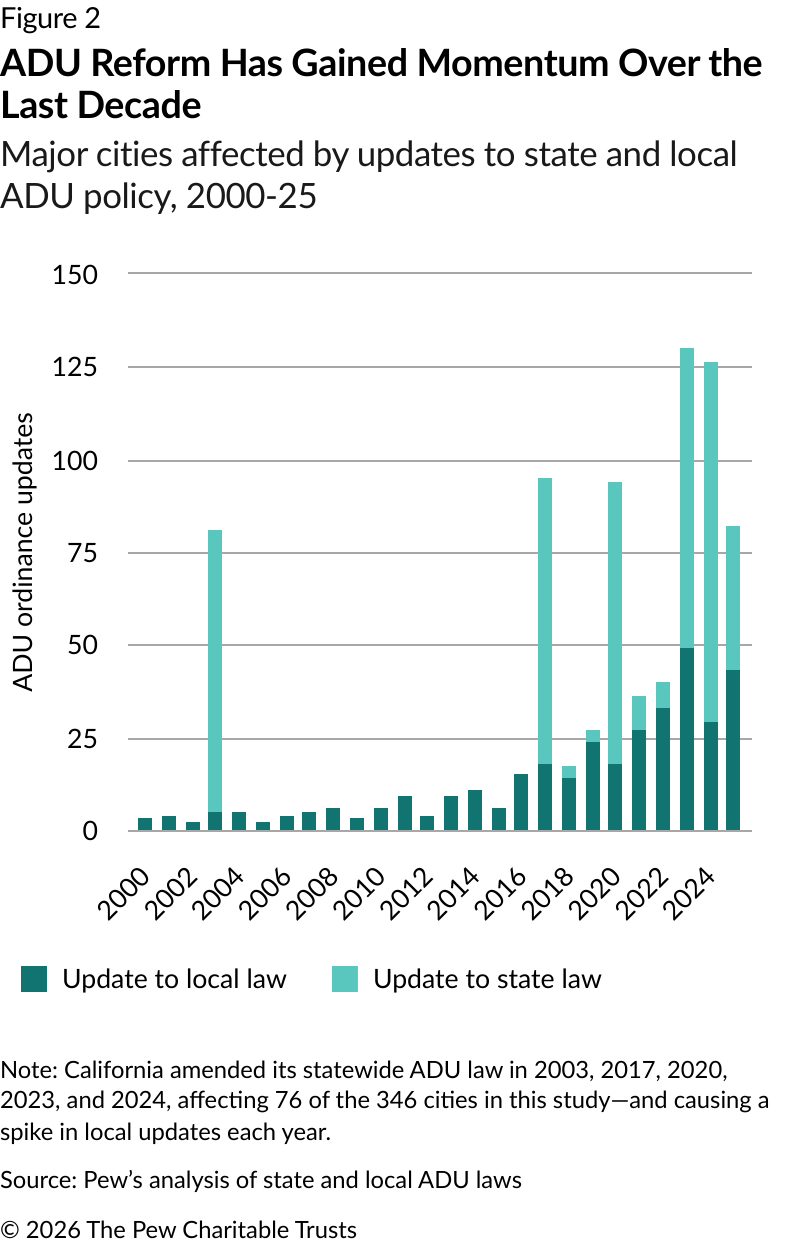
In the last 10 years, cities and states have increasingly adopted new ADU policies or revised their existing policies. In almost every year from 2000 to 2013, fewer than 10 major cities passed ADU ordinances. (The exception was in 2003, when California updated its statewide ADU law, affecting 76 cities in this study.) But since 2020, at least 30 cities have adopted or revised their ADU ordinances every year, with the total number of revisions growing steadily. (See Figure 2.) Some cities updated ADU laws several times after they were initially adopted. A vast majority of these changes made it easier for property owners to build ADUs, though there are a handful of examples of cities making their laws more restrictive.11
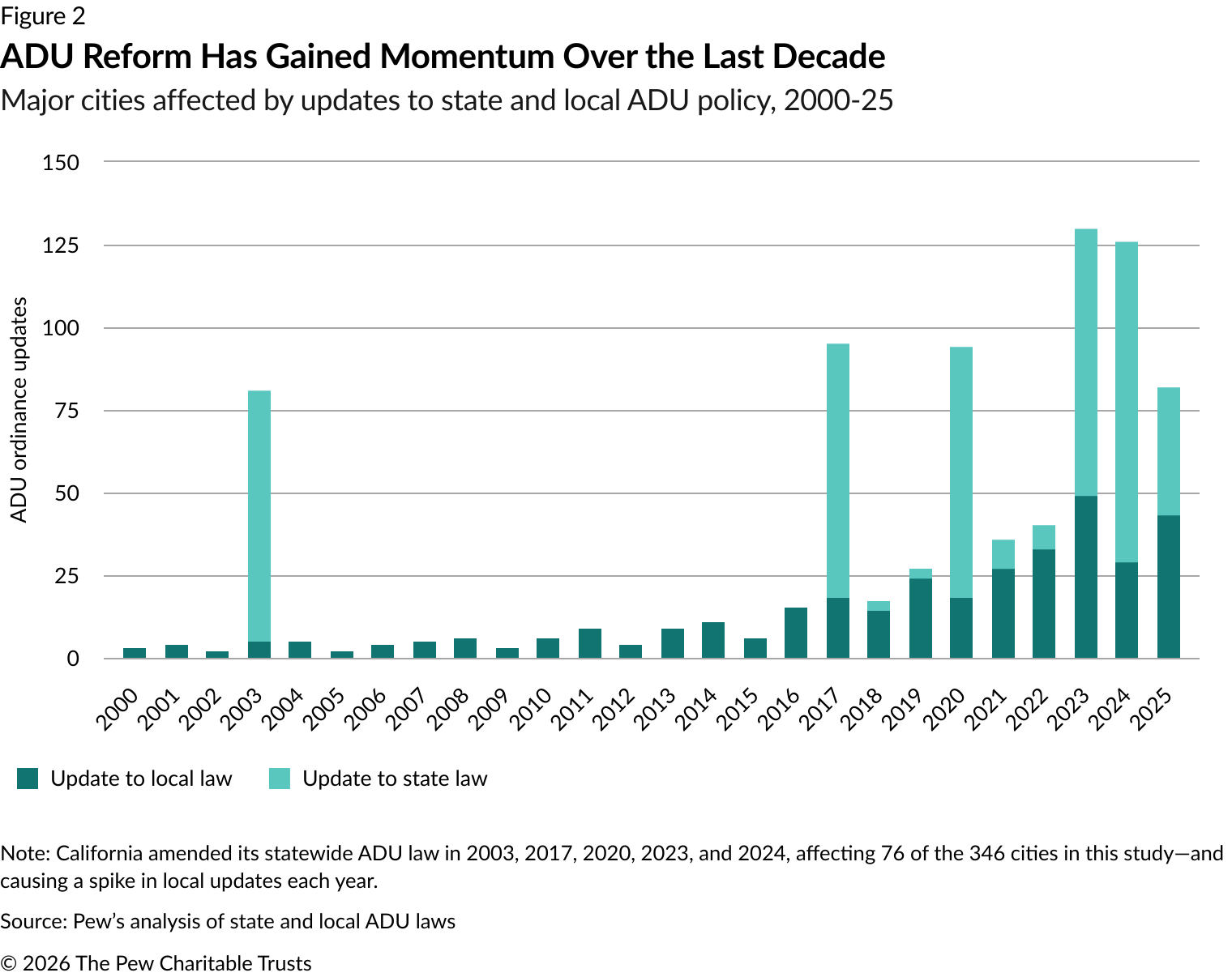
This recent flurry of ADU legislation partly reflects increased attention from state legislatures. Since 2020, 22 states containing 172 of the 346 cities in this study have passed or updated a statewide preemption law. This total includes Idaho, North Carolina, Virginia, and West Virginia, which passed their first ADU laws in 2026. Those laws had not yet gone into effect when Pew completed its legislative analysis in April 2026. Kansas also passed a law in 2026 that requires localities to use “by-right” administrative reviews for residential projects—including ADUs, where they are already allowed. However, because that law does not require local governments to legalize ADUs, Kansas is excluded from this analysis.
How many large cities have ordinances that enable ADU construction?
Pew’s research shows that ADU ordinances are now common in major American cities: Of the 346 cities analyzed for this report, 276—80%—have laws that allow at least some property owners to build an accessory dwelling unit on the same lot as a single‑family home. The remaining 70 cities (20%) either prohibit ADUs from being rented or sold to an unrelated individual or lack a formal ordinance authorizing their construction and use. In cities without an ordinance, property owners can usually still build an ADU. However, doing so often requires a zoning variance, additional fees, and public hearings, all of which make ADU development more challenging.
But even cities that allow ADUs often impose requirements that limit their development. These requirements include restrictions on where, what type of, and how many ADUs can be built, how ADU permits are issued, who can live in them, how much parking is needed, their size, limits on design, and others. To capture these differences, researchers collected information about four common restrictive provisions—each of which has been found in prior research to increase the cost, time, or uncertainty associated with construction:12
- Restrictions on where ADUs can be built. Among the 276 cities with an ADU ordinance, 49 (18%) do not allow ADUs in their main single-family zoning districts. Because ADUs are most compatible with single-family neighborhoods, restricting them to certain neighborhoods, or only to areas zoned for multifamily development, sharply reduces the area on which they can legally be built, limiting development.
- Special permits. Some cities require property owners to obtain a special permit to build an ADU, rather than allowing them “by right” (with a standard building permit, which requires no hearings, variances, or discretionary approvals). Twenty-seven cities (10%) only allow ADUs by special permit, while the remainder allow ADUs by right in the areas where they are legal. Discretionary review adds time and cost to the building process. And because approval is not guaranteed, the resulting uncertainty can deter property owners from undertaking projects.13
- Owner occupancy. Some cities require the property owner to live in either the main dwelling or the ADU as a condition of development. Seventy-one cities with ADU ordinances (26%) have this requirement, which ties ADU use to the owner’s (or future owners’) continued residence on the property—a restriction that research shows hurts the financial viability of ADU development by limiting rental income and making financing more complicated.14 Owner-occupancy requirements also limit an owner’s ability to sell the property by excluding those who would want to rent out both units.
- Parking requirements. Some cities require property owners to provide off-street parking for ADU residents. Researchers identified 81 cities (29%) that require parking to be provided in at least some cases. A dedicated parking space or garage can cost thousands of dollars. On small or irregular lots, this requirement can make it physically impossible to build an ADU.15
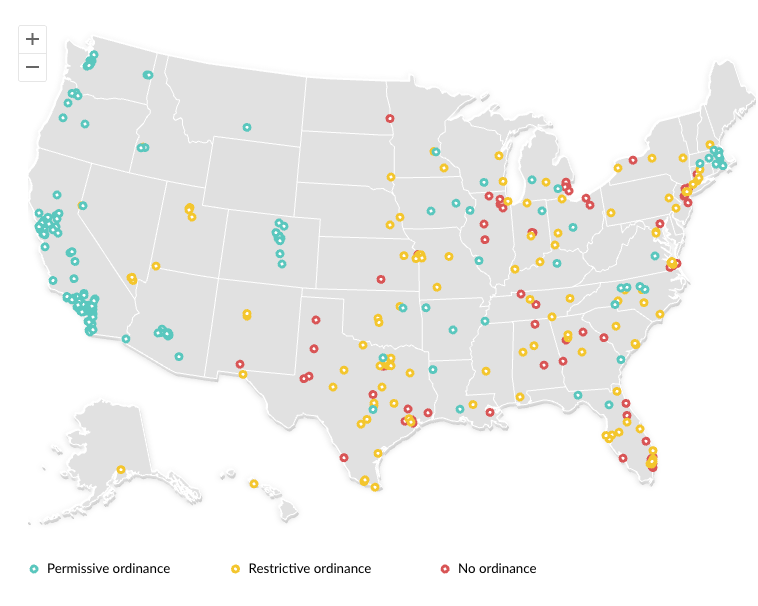
To distinguish between types of ADU regulation, researchers categorized cities as having either “permissive” or “restrictive” ordinances based on whether the city’s ADU law contained one or more of the above-listed provisions. Cities with “permissive” ordinances allowed ADUs in their main single-family zoning districts, did not require special permits or variances, and did not impose owner-occupancy or parking requirements. Cities were coded as having “restrictive” ordinances if their laws included any of those restrictions. Overall, Pew counted 158 cities (46%) with “permissive” ADU ordinances, 118 (34%) with “restrictive” ordinances, and 70 (20%) with no ordinance or with an ordinance that explicitly prohibited ADU construction. (See Figure 3.)

The permissiveness of city ordinances is closely associated with geography. (See Figure 4.) Cities in the West are substantially more likely to have permissive ADU policies, driven primarily by statewide reforms in Arizona, California, Colorado, Oregon, and Washington—all states with notable housing shortages, high rents, and high home prices. ADU ordinances tend to be more restrictive in other parts of the country, especially in places where it is easier for developers to build other types of new housing. For example, cities in Texas and Florida are especially likely to have a restrictive ADU law or to have no ADU law. Both states also have high rates of single-family home construction.
More-populous cities are also more likely to have enacted an ADU ordinance than smaller cities. Among cities located in states without a preemption law, 85% of those with a population over 300,000 (39 of 46) have an ADU ordinance, compared with 59% of cities with 100,000 to 300,000 residents (89 out of 150). Similarly, about 75% of principal cities (the largest city in a metropolitan area) have adopted an ADU ordinance, compared with 52% of non-principal cities and large suburbs.
In a separate study of municipal ADU ordinances conducted from 2024 to 2025, Lehigh University’s Small Cities Lab also found that restrictive provisions are common in municipal ADU ordinances. Looking at a nonrepresentative sample of 290 towns and cities with a population between 25,000 and 500,000 that had an ADU ordinance, Lehigh researchers found that 79% of ADU ordinances contained at least one of three restrictive provisions: 50% imposed an owner-occupancy requirement; 58% required off-street parking; and 33% required a special permitting process. (Some ordinances had more than one type of restriction.) The Lehigh study also found that cities with fewer than 40,000 residents had more restrictive ADU ordinances, on average, than cities with a population above 150,000.
State ADU laws have a major impact on local development standards
State law is one of the most important factors driving local ADU policy in the nation’s most populous cities. When Pew completed its review of municipal ADU ordinances in April 2026, 18 states had passed preemption laws that broadly enabled homeowners to add ADUs to their properties. Since then, four more states—Idaho, North Carolina, Virginia, and West Virginia—have passed preemption laws to allow ADU construction.
Using a similar methodology as was applied to municipal laws, Pew researchers categorized every state preemption law according to its permissiveness. A state law was categorized as “strong” if it required local governments to allow ADUs by right in areas where single-family homes are allowed and banned them from imposing owner-occupancy or parking requirements in most cases. A law was categorized as “weak” if it required cities to give homeowners a legal pathway to build an ADU but allowed local ADU laws to contain any of those restrictions. Additionally, Connecticut’s law was categorized as “weak” because it contains a provision that allows local governments to opt out of the statewide mandate.
Of the 18 states that had enacted preemption laws by April 2026, 10 were classified as strong laws with minimal restrictions and eight were classified as weak laws that allowed local governments to impose one or more obstacles to ADU development. (See Figure 5.) (Since then, Idaho has passed a strong state preemption law; North Carolina, Virginia, and West Virginia have passed weak laws.)

In states with strong preemption laws, cities are legally required to have permissive ADU policies. Overall, among the 158 major cities with permissive ADU ordinances, 131 (83%) were required by state law to have permissive policies, though some cities had adopted permissive policies before the state mandate went into effect. (See Table 1.) For example, Seattle amended its ADU law in 2019 to remove owner-occupancy and off-street parking requirements and allow property owners to build two ADUs per lot—provisions that were not required by Washington state law until 2023. But in most cases, state law acted as a catalyst that forced cities to make their ADU laws more permissive.
Table 1
State Preemption Often Requires Cities to Adopt Permissive ADU Laws
Permissiveness of city and state ADU ordinances in April 2026
| State has a strong preemption law | State has a weak preemption law | State has no preemption law | All cities | |
|---|---|---|---|---|
| City has a permissive ADU ordinance | 131 | 2 | 25 | 158 |
| City has a restrictive ADU ordinance | 0 | 15 | 103 | 118 |
| City does not have an ADU ordinance | 0 | 2 | 68 | 70 |
| All U.S. cities with 100,000 or more residents | 131 | 19 | 196 | 346 |
Note: Strong state preemption laws require local governments to allow ADUs by right (with a standard building permit, which requires no hearings, variances, or discretionary approvals) in all single-family zones. Strong preemption laws also prohibit local governments from imposing owner-occupancy and off-street parking requirements in most cases. Weak preemption laws do not include one or more of these key features.
Source: Pew’s analysis of state and local ADU laws
Cities with permissive ordinances build more ADUs than cities with restrictive laws
As states and cities have adopted more numerous and more permissive ADU policies, construction has risen in tandem. To better understand the magnitude of this effect, Pew researchers used national building permits data to estimate the number of ADUs built nationwide from 2000 to 2025. (For more information about how ADU permits were identified, see Appendix B.) Not every building permit leads to the development of a new housing unit, but permits are a good proxy for construction: More than 90% lead to the start of new housing construction within two months.16
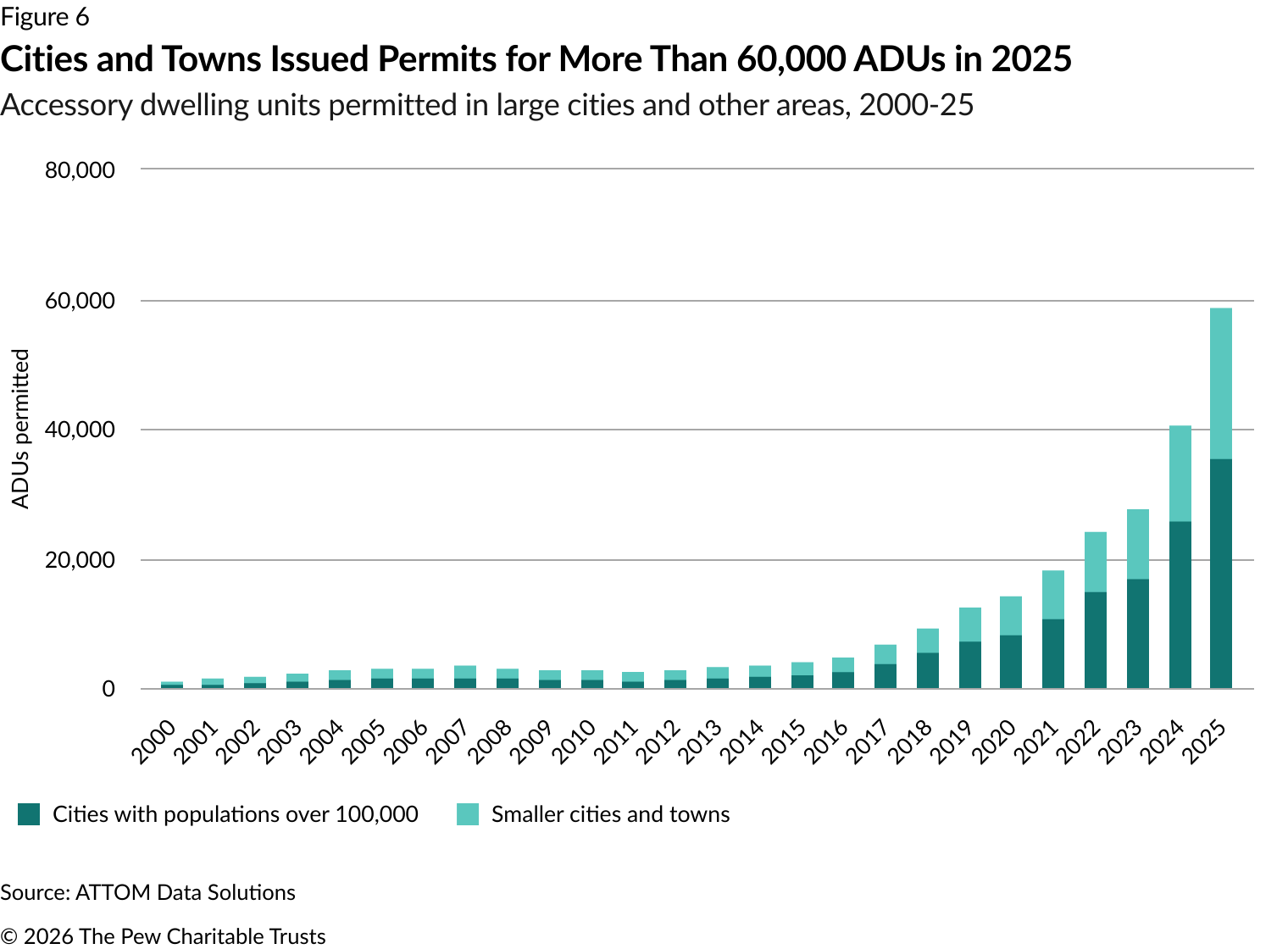
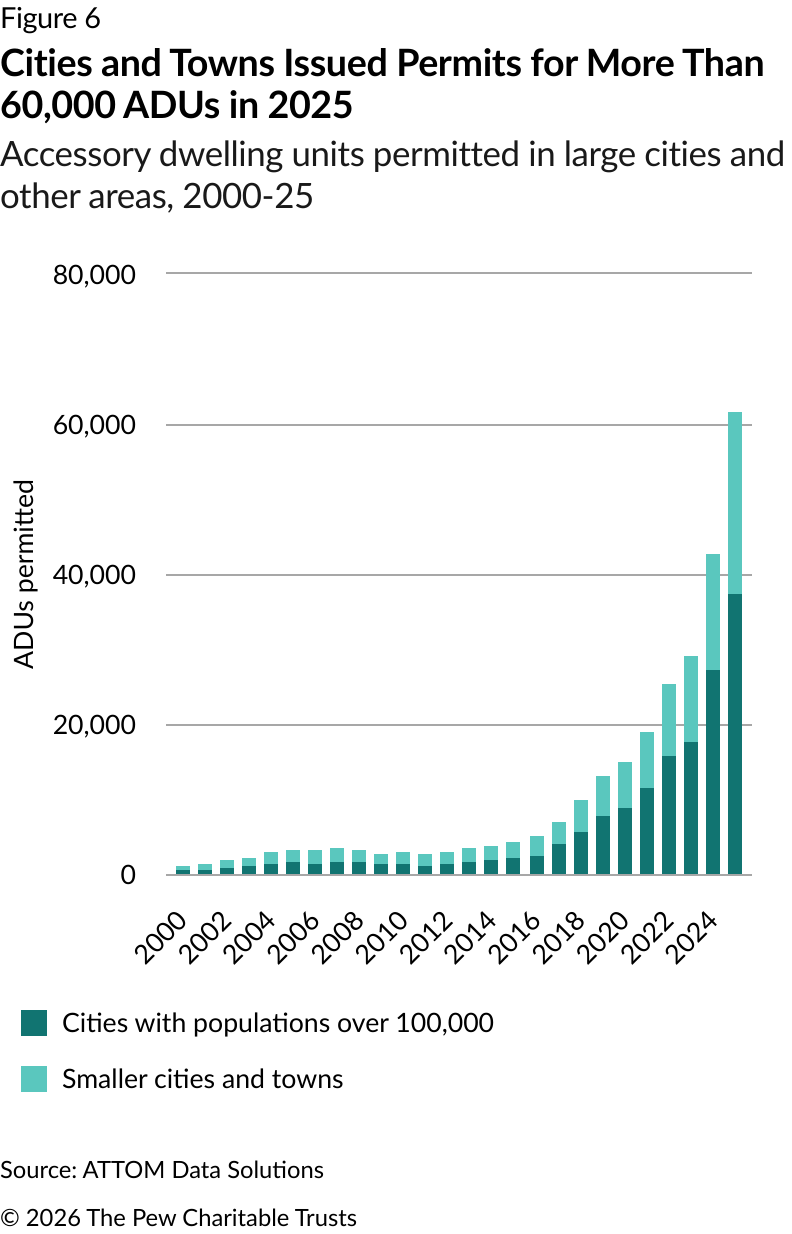
During this 26-year period, cities and towns issued permits for roughly 273,000 ADUs. Fewer than 5,000 permits for ADUs were issued each year from 2000 to 2016. However, the number of ADUs permitted each year has increased substantially in the last decade, from 4,962 permits in 2016 to 61,655 in 2025—more than a twelvefold increase. (See Figure 6.) Cities with a population above 100,000 have driven this growth. In 2025, the 346 cities included in Pew’s research accounted for 37,455 of the 61,655 ADU permits issued nationally (61%). In contrast, those major cities accounted for a 42% share of nationwide ADU permits in 2000 and a 51% share in 2016.
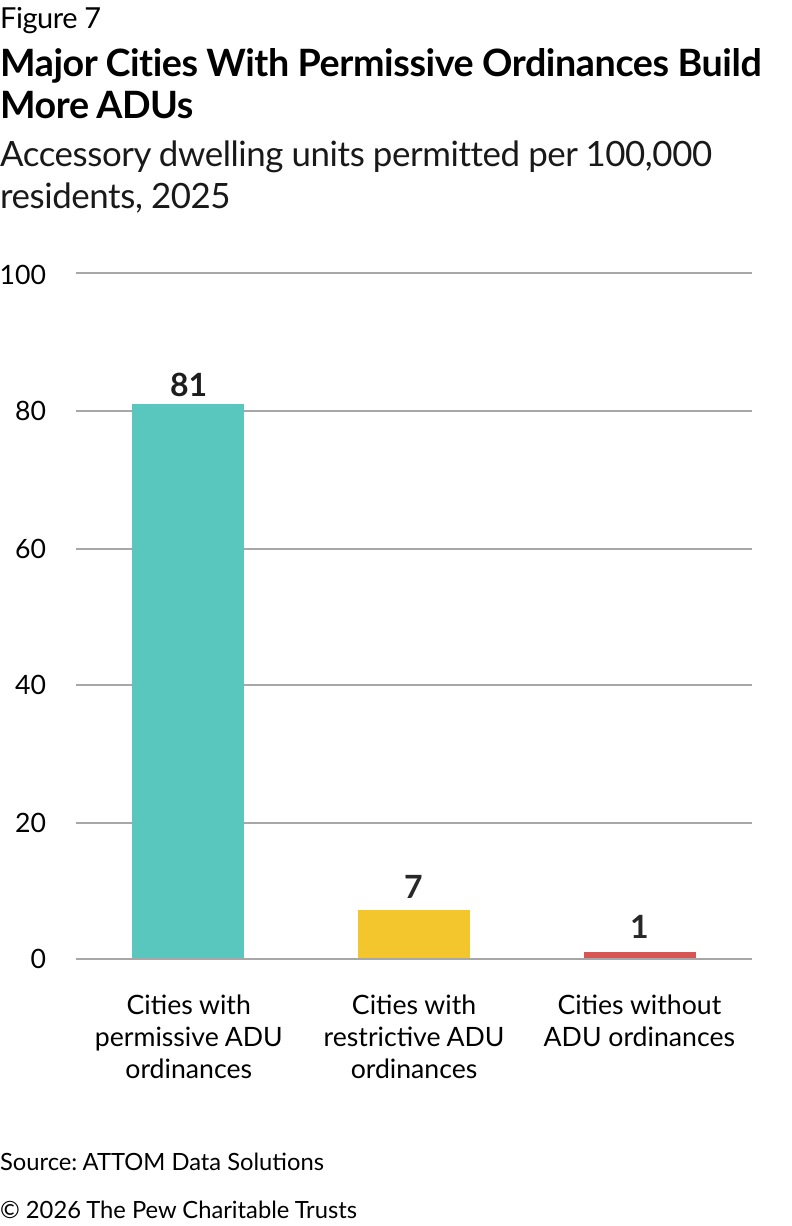
Among major cities, ADU permitting rates were highest in places that had permissive ADU ordinances. In 2025, cities with permissive ordinances issued 81 ADU permits per 100,000 residents—a rate that was more than 11 times as high as cities with restrictive ordinances and more than 75 times as high as cities without an ADU ordinance. (See Figure 7.) Cities with permissive ordinances issued relatively more ADU permits per 100,000 residents even though the total amount of development in each group of cities was broadly similar: Cities with permissive ordinances (428 units allowed per 100,000 population), restrictive ordinances (421 per 100,000), and no ADU ordinance (426 per 100,000) all approved other types of housing at similar rates.
As major cities increasingly embrace ADUs, these units now make up a significant share of total construction. To better understand the proportion of new housing units that are ADUs, Pew researchers divided the number of ADUs permitted in 2025 by the total number of units for which building permits were issued and the total number of permits for single-family homes. In cities with permissive ordinances, ADUs made up 19% of all new units for which permits were granted and 45.1% of units permitted in one- and two-unit buildings. In contrast, ADUs made up just 1.7% of all permitted units in major cities with restrictive ordinances and 0.3% of total units permitted in cities without an ADU ordinance. (See Table 2.)
Table 2
Major Cities With Permissive ADU Ordinances Build More ADUs Than Cities With Restrictive Ordinances
Approved building permits by type of structure and permissiveness of local ADU law, 2025
| Type of ADU ordinance |
Units permitted (all structures) |
Units permitted (1- and 2-unit structures) |
Units permitted (ADUs) | ADUs as a share of total permitted units | ADUs as a share of 1- and 2-unit permits |
|---|---|---|---|---|---|
| City has a permissive ADU ordinance | 178,621 | 75,482 | 34,013 | 19.0% | 45.1% |
| City has a restrictive ADU ordinance | 193,698 | 84,080 | 3,298 | 1.7% | 3.9% |
| City does not have an ADU ordinance | 56,972 | 32,094 | 144 | 0.3% | 0.4% |
| TOTAL (346 cities) | 429,291 | 191,656 | 37,455 | 8.7% | 19.5% |
Note: Not all major cities report building permit data. Forty of the 346 cities included in this analysis had no data on ADU permits. Three did not report data on total units permitted and/or units permitted in one- and two-unit structures.
Sources: Data for units permitted in all structures and one- and two-unit structures comes from the U.S. Census Bureau’s Building Permits Survey. Data for ADU permits comes from ATTOM Data Solutions.
Many of the results in this analysis were driven by the policy environment in California, which has a strong state preemption law and contains 76 of the 346 cities examined for this report. To ensure that the key findings hold true outside California, Pew researchers conducted additional analyses with those 76 cities excluded. Cities with permissive ordinances outside California issued permits for 26 ADUs per 100,000 residents in 2025, more than three times as many as cities with restrictive ordinances and more than 23 times as many as cities without an ordinance. (See Appendix Figure A5.)
In cities outside California with permissive ordinances, ADUs accounted for 4.5% of all units for which permits were issued in 2025 and 11.2% of single-family units. In contrast, ADUs made up 1.7% of total units and 3.9% of single-family units permitted in cities with a restrictive ordinance and 0.3% of all units and 0.4% of single-family units permitted in cities without an ADU ordinance. (See Appendix Table A1.)
Insights into the development of ADU ordinances
To understand why and how cities adopt and develop ADU ordinances, researchers at Lehigh University’s Small Cities Lab conducted interviews with planning staff in 11 cities that have an ADU ordinance. Eight have a population of more than 100,000 and were included in Pew’s research (Ann Arbor, Michigan; Boise, Idaho; Chicago; New Haven, Connecticut; Raleigh, North Carolina; Savannah, Georgia; Seattle; and Spokane, Washington). Three are smaller cities, with fewer than 100,000 residents (Amherst, Massachusetts; Appleton, Wisconsin; and Minnetonka, Minnesota). Six major themes emerged from the Lehigh researchers’ interviews and the information they collected.
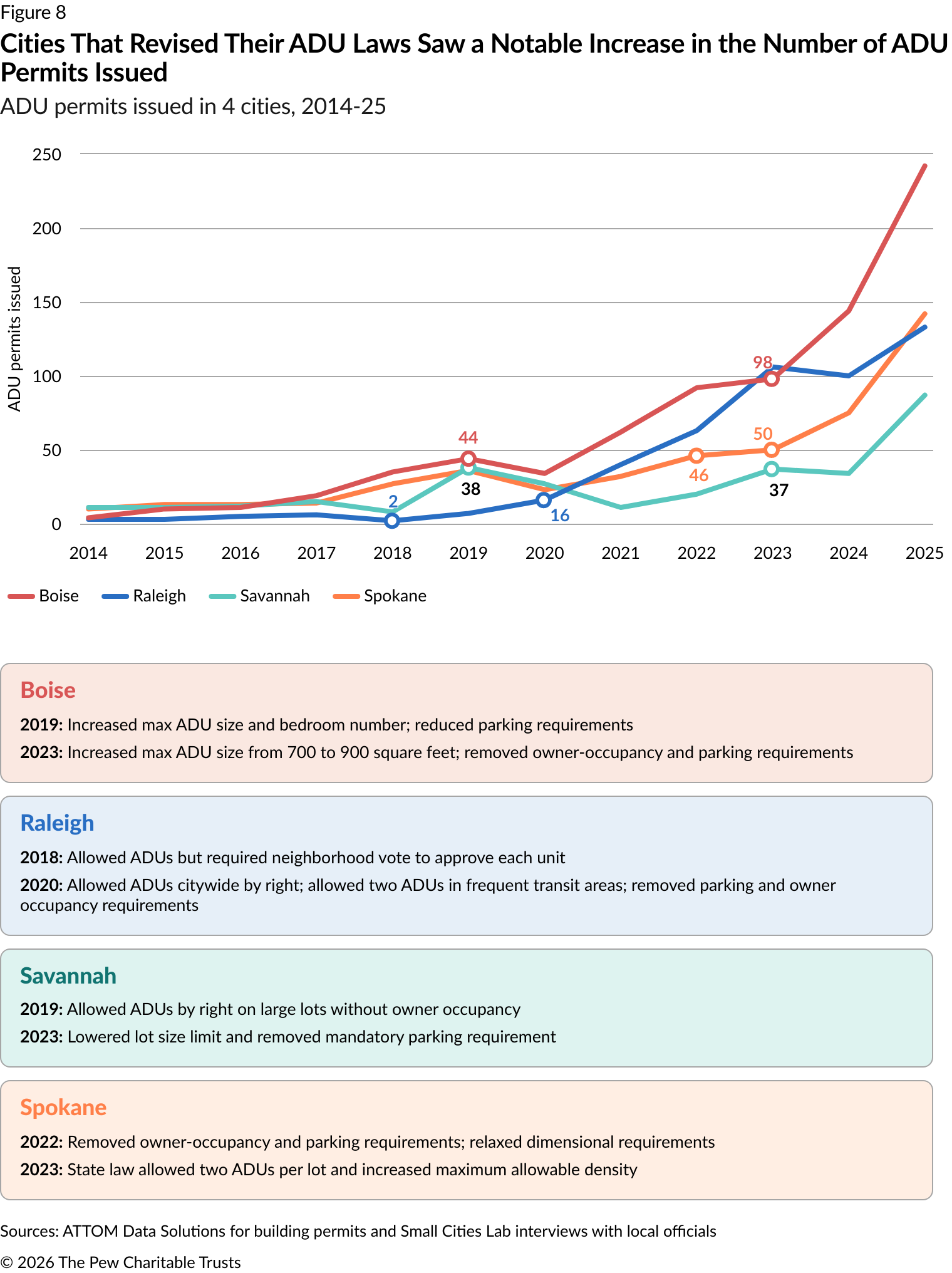
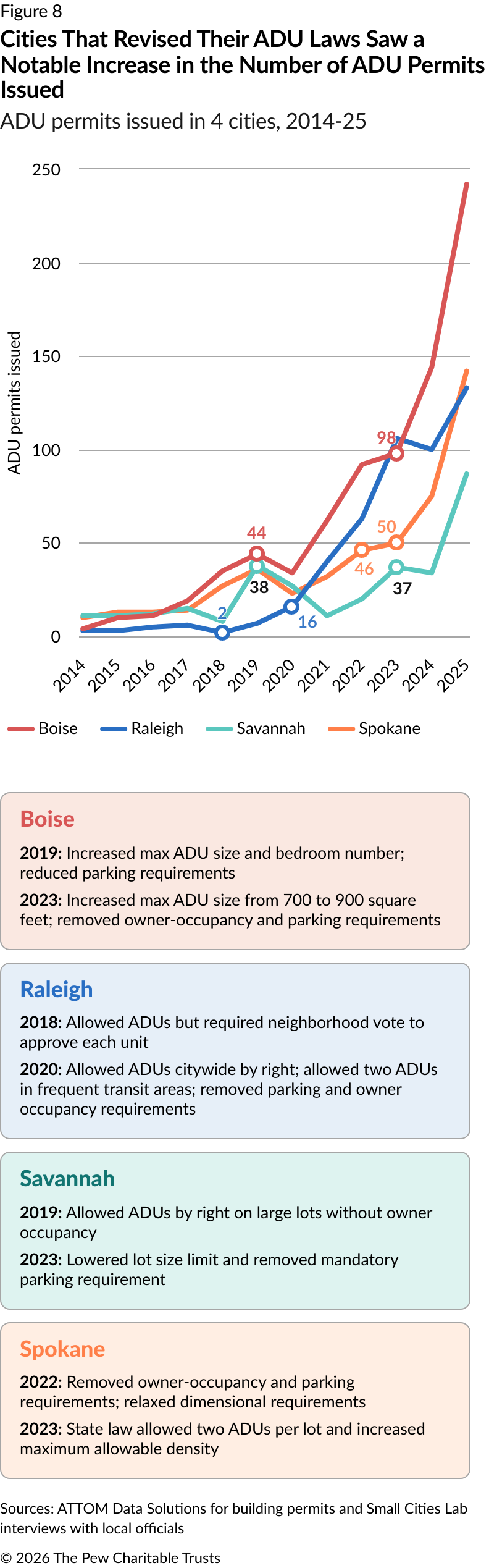
ADU production increased rapidly in cities that removed restrictive provisions from their ADU laws. In four of the cities assessed by the Lehigh team (Boise, Raleigh, Savannah, and Spokane), localities lifted restrictions on the development of ADUs and saw a permitting boom. In Boise, the number of ADU permits issued annually increased fivefold from 2019 to 2025 as the city eased owner-occupancy, parking, and unit size requirements. (See Figure 8.) In Raleigh, permits soared from near zero in 2018 to more than 100 in 2025 after the city began allowing ADUs in all neighborhoods that were zoned for single-family homes. In Spokane, a relaxation of density limits in 2023 led to a spike in ADU permits. And Savannah saw a similar increase in ADU permits when it relaxed lot size requirements. Although the specific reforms varied by city, relaxing restrictions consistently boosted the number of ADU permits issued.
When drafting ADU laws, officials must strike a balance between the desire to expand housing supply and the need to address community concerns. Cities often pass ADU ordinances with significant restrictions in response to residents’ concerns about neighborhood character, absentee landlords, road congestion, and other factors. Off-street parking requirements, for example, are seen as a way to reduce competition for street parking. Owner-occupancy rules address concerns that an absentee landlord will not maintain a property as carefully as a resident owner.
Such restrictions come at a cost. In densely populated cities, an off-street parking space can cost tens of thousands of dollars or take up additional land in the yard, affecting the feasibility of ADU development. Owner-occupancy requirements make it more difficult for owners to obtain financing, and they limit the number who can afford to add an ADU. Both requirements are associated with the issuance of fewer ADU permits, which limits the potential for ADUs to expand housing supply and lower costs.
With experience, cities tend to remove restrictions. For example, Seattle removed its owner-occupancy requirement in 2019 and later adopted rules that make it easier to sell ADUs as separate units. According to one city planner, most ADUs built in Seattle since 2019 have still been owner-occupied—possibly because the local market makes it more profitable to build and sell an ADU than to rent it out. Ann Arbor eliminated its off-street parking requirement for ADUs in 2021. According to one city official, the change reflected a recognition that this requirement was preventing ADUs from being built and that most city residents lived within a quarter mile of public transit, making mandatory off-street parking unnecessary.
Values-based framing helps build political support for policies that promote ADU construction. Cities that have been most successful at building public support for ADU reform consistently moved the conversation away from technical zoning language and toward community priorities and values. One planner from Boise said: “In the times where we’ve had conversations about ‘Do you want one parking spot or two, three stories or four?’—that does not go as well as when we say, ‘Do you want a place for your child to live in when they come back from college?’” Policymakers in Savannah took a similar approach, grounding discussion of ADU reform in the city’s historic carriage house tradition and helping residents see accessory dwellings as a natural extension of familiar urban patterns, rather than an unwelcome imposition.
ADUs can serve as a gateway to broader zoning reform. In Ann Arbor, Raleigh, and Spokane, the adoption of an ADU ordinance was the first step toward more ambitious changes: transit-oriented development, construction of small multifamily buildings, and a comprehensive overhaul of city zoning policy. Planners in multiple cities described ADUs as palatable enough to build initial political support but consequential enough to shift residents’ perceptions about what kinds of change were acceptable. A Raleigh planner described ADUs as a natural first step toward broader reform of housing policy: “I think policymakers and those running for office saw [ADUs] as low-hanging fruit. They thought, ‘If there’s one way to get housing on the ground that’s not controversial, perhaps it’s ADUs.’” Previous qualitative research on ADU policy reported similar sentiments.17
Even in cities like Appleton and New Haven, where few ADUs have been built, the process of debating and adopting an ADU ordinance opened broader conversations about housing policy reform that would otherwise have been difficult to initiate. These conversations included discussions of so-called “missing middle” housing—medium-density types of housing, such as duplexes, townhouses, and small multifamily buildings, which add housing units but still fit into the fabric of existing neighborhoods.
High costs and a lack of implementation support limit development, even where regulations are permissive. Several city planners interviewed by Lehigh researchers identified construction costs as a major barrier to ADU development. In New Haven, one architect noted, an ADU “only really works in the richest neighborhoods” because the cost of construction often exceeds the projected economic return. In Ann Arbor, one planning official said, “I think the biggest obstacle to creating these would be financial. That’s what I hear a lot of times from our [residents].”
In response, some cities have taken steps to reduce costs or streamline development. Boise and Raleigh developed preapproved ADU building plans that speed up development and reduce design costs. In partnership with Yale University, New Haven developed a website that helps homeowners and developers understand parcel eligibility, approval processes, financial options, and design requirements. New Haven is also considering a technical assistance and grant program to make building ADUs economically feasible for property owners who are not wealthy.
As a growing number of states enact preemption laws, cities must adjust. In Amherst, New Haven, Seattle, and Spokane, policymakers had to revise local ADU laws to conform with a statewide preemption law. In some cases, it was easy for cities to adjust. For example, Seattle’s ADU laws were already mostly aligned with Washington’s state preemption law, which was originally enacted in 1993 and significantly strengthened in 2023.18
But in cities where ADU laws lagged state mandates or that had limited planning staff, updating local law proved to be more challenging. In Amherst—a college town where concerns about absentee landlords and student rentals shape housing policy—planning officials responded to Massachusetts’ 2025 state preemption law by creating two separate ADU categories. The first complies with state law, allowing units up to 900 square feet by right with no owner-occupancy requirement. The second preserves the town’s prior approach: Owners who agree to live on-site may build up to 1,200 square feet. Because state law barred Amherst from simply requiring owner-occupancy, officials retained it as a voluntary condition attached to a size bonus, on the theory that resident owners are better positioned to manage tenant behavior. The workaround let policymakers respond to local priorities, but administering two permitting tracks requires additional staff time and cost.
Implications for public policy
The findings of this report provide several clear lessons for state and local policymakers seeking to use accessory dwelling units as a meaningful tool to add new housing in their community.
Removing restrictive provisions from ADU ordinances can boost production. Cities without owner-occupancy requirements, parking mandates, zoning restrictions, and discretionary permit processes build significantly more ADUs than cities with one or more of those restrictions. In 2025, cities with permissive ordinances issued ADU permits at more than 11 times the rate of cities with restrictive ordinances and more than 75 times the rate of cities with no ADU ordinance.
Interviews with city officials reinforce this finding. Boise, Raleigh, Savannah, and Spokane all amended their ADU ordinance multiple times between 2019 and 2023, each time removing or relaxing restrictions on development. Each city saw measurable increase in the number of ADU permits issued, often within a year. In interviews, city officials reported that these restrictions had at times been adopted reflexively, and the community concerns that motivated them—such as absentee landlords, neighborhood character, and parking congestion—did not come to fruition.
State preemption laws push local governments to adopt permissive ADU ordinances. State preemption is a reliable and scalable mechanism for producing effective ADU policy: Of the 158 cities in this analysis that had permissive ADU ordinances as of April 2026, 131 are in states that bar local governments from imposing common development restrictions. The remaining 27 cities adopted permissive ADU ordinances without a state mandate, demonstrating that local innovation is possible in the absence of state intervention.
Preemption can also serve as a highly effective floor rather than a ceiling. Amherst, for example, allows ADUs up to 300 feet larger than Massachusetts’ minimum if the property owner lives on site. This example shows that states can prevent cities from implementing restrictive provisions while giving them the flexibility to tailor their ordinances to local needs and conditions.
The relaxation of ADU laws can catalyze broader housing reform. Many cities that initially adopted cautious, restrictive ADU policies revised them as permit data came in, as evidence about the effect of restrictive provisions accumulated, and as the political environment shifted. Lehigh’s research suggests that the adoption of an ADU law can also open the door to broader housing and zoning reform. In Ann Arbor, Raleigh, and Spokane, for example, ADU ordinances were the first step toward the adoption of other policies designed to produce more housing, such as transit-oriented development, expansion of multifamily housing development, and comprehensive zoning overhauls. Beyond the number of housing units they produce, ADUs can thus serve as a catalyst for the type of housing market reform that most American cities require to expand housing supply and lower costs.
Conclusion
This report offers the most comprehensive analysis to date of the adoption and design of ADU ordinances in the United States’ most populous cities. The data compiled for this report reveals a clear and consistent pattern: Cities that allow ADUs by right in all single-family zones, without owner-occupancy requirements and parking mandates, build ADUs at rates far exceeding those of cities with no ADU ordinance or with a restrictive ADU law. State preemption laws have been an effective mechanism for producing permissive ordinances at scale, while cities acting without state guidance have tended toward caution—and have issued fewer ADU permits.
ADU production has grown dramatically over the past decade, rising from a negligible share of new construction to more than 61,000 units in 2025 alone. This growth has been driven by iterative ADU reform. Cities that adopted ADU ordinances relatively early have continued to make their laws more permissive, which has enabled more production. Armed with evidence about the benefits—and lack of drawbacks—of permissive ADU laws, a growing number of cities have adopted ordinances. As of April 2026, 80% of cities with a population over 100,000 had adopted an ADU ordinance in some form.
Taken together, these findings suggest that ADUs are a valuable mechanism for sustainably adding homes in single-family neighborhoods and addressing the persistent housing shortage that affects cities large and small throughout the U.S.
About this report
This report was primarily researched and written by principal associate Adam Staveski and research manager Seva Rodnyansky of The Pew Charitable Trusts’ housing policy initiative. Additional authors included, Wes Hiatt, assistant professor of architecture at Lehigh University and co-director of Lehigh’s Small Cities Lab; Karen Beck Pooley, professor of practice in Lehigh University’s Department of Political Science and co-director of the Small Cities Lab; and Heidi Kline, a project assistant at the Small Cities Lab. Pew colleagues Zach Bernstein, Helen Choi, Carol Hutchinson, Alex Horowitz, Omar Antonio Martinez, Chelsie Pennello, and Alan van der Hilst contributed research, editorial, design, and communications support.
Acknowledgments
This report benefited from the insights and expertise of outside reviewers Nicholas Marantz, associate professor, Department of Urban Planning and Public Policy, University of California, Irvine; Dan Hardcastle, founder and CEO, BuildTrust; Tim Murphy, director of infrastructure, housing, Arnold Ventures; and Emily Hamilton, senior research fellow, Mercatus Center, George Mason University. Although they reviewed the report, neither they nor their organizations necessarily endorse its findings or conclusions.
Appendix A: Methodology for coding municipal ADU ordinances
Sample construction
The sample consists of all 346 U.S. cities with a population greater than 100,000, as measured by the U.S. Census Bureau’s annual population estimates from May 2025.19 (The Census Bureau has since released updated population estimates, which show that some cities included in this study now have fewer than 100,000 residents.) For each city, researchers from The Pew Charitable Trusts recorded two primary pieces of information: 1) whether the municipal code contains language regulating accessory dwelling units (ADUs) and 2) the major provisions of that ordinance, if one exists. Municipal codes change frequently; the information in this report is current as of April 2026.
Variable definitions
For each city, researchers coded five variables describing the presence and content of each ADU ordinance.
ADU ordinance. A city was coded as having an ADU ordinance if its municipal code contains text regulating “accessory dwelling units,” “carriage houses,” “backyard cottages,” “ancillary dwelling units,” or similar terms. Cities that nominally permit ADUs but prohibit them from being rented—or restrict occupancy to family members of the primary homeowner—were coded as not having an ordinance, on the grounds that such provisions limit the housing-supply function that ADU policy is generally designed to enable.
Permitted in all residential zones. This variable reflects whether ADUs are generally allowed in single-family residential zones within the city. The convention of naming single-family zoning districts varies across jurisdictions, but researchers generally used the “R-1” zone (or its local equivalent) as a bellwether: Cities that permitted ADUs in their primary single-family zone were coded as not having zone restrictions, absent contrary evidence. Cities allowing ADUs only through pilot programs or in specific neighborhoods were coded as having zone restrictions.
Permitted by right. This variable indicates whether, in places where ADUs are allowed, they may be built as a matter of right, like single-family homes, or whether they require a special or conditional permit.
Owner occupancy. This variable captures whether a city’s ordinance requires the property owner to occupy a home on the lot (either the principal dwelling or the ADU). If the ordinance did not contain language about this topic, researchers coded the ordinance as not requiring owner occupancy.
Parking requirement. This variable indicates whether the ordinance requires one or more dedicated parking spaces for the ADU. It includes both on-street and off-street parking requirements.
Coding procedure
For each city, researchers located the municipal code of ordinances. Within each code, researchers searched for “accessory dwelling unit” or similar terms using the code’s built-in search functionality. For cities using idiosyncratic terminology, researchers additionally ran a general web search asking “what are ADUs called in [city name]?” to identify local naming conventions.
If no relevant section was found, or if ADUs were permitted only under conditions that precluded rental occupancy (as described above), the city was coded “No” on the ADU Ordinance variable and the remaining variables were left blank. If an ordinance was identified, researchers proceeded to code the four substantive variables.
State preemption laws were treated as the baseline for the local code review. Researchers consulted the Mercatus Center’s taxonomy of state ADU laws to identify which cities were governed by state preemption laws.20 Where a city’s local ordinance was less permissive than applicable state law, researchers coded according to the binding state-law standard, on the assumption that state law supersedes local law. Where local ordinances exceeded the floor set by state preemption, researchers coded the more permissive local rule.
Appendix B: Methodology for identifying ADU permits
Data source
Building permit data was purchased from ATTOM Data Solutions, which compiles permit records from jurisdictions nationwide. The sample covers permits issued between 2000 and 2025. Data coverage was not universal: Of the 346 cities included in this report, 306 (88%) had ADU permit data available from ATTOM. The remaining 40 cities either had no ADU permits on record or were not covered in ATTOM’s database. Among the 276 cities identified as having an ADU ordinance, 260 had ADU permit data available through ATTOM.
Identifying ADU permits
ADU permits were identified using ATTOM’s proprietary ADU classification variable. ATTOM does not document the precise methodology underlying this variable, but the company relies on matching text within a permit’s “Description” and “Type” fields to flag those associated with accessory dwelling units.
As a robustness check, researchers developed an independent text-based classification using the permit’s “Description” and “Type” fields. The classifier flagged permits containing terms and acronyms associated with ADUs—including “accessory dwelling unit,” “ADU,” “DADU (detached accessory dwelling unit),” “JADU (junior accessory dwelling unit),” “accessory apartment,” “secondary dwelling unit,” “carriage house,” “laneway house,” “backyard cottage,” “garden cottage,” “basement apartment,” “garage apartment,” “granny flat,” “mother-in-law unit,” “ohana unit,” and related regional terms—while excluding permits containing negating phrases such as “not to be used as an ADU” or “not a carriage house.” Pew’s classification and the ATTOM classification produced highly similar results, but the analyses in this report rely on the ATTOM variable.
Sample construction
Two filters were applied to construct the analytic sample. First, the data was restricted to permits with an active or completed status, excluding those that were voided, withdrawn, expired, rejected, or revoked so that the sample reflects permits that were actually issued. Second, because a single ADU can generate multiple permit records over the course of construction (for example, separate permits for foundation, framing, and final inspection), permits were grouped at the property level using ATTOM’s unique parcel identifier (ATTOMID) and deduplicated. Each property contributes at most one ADU to the count, regardless of how many permit records it generated.
ADU data comparisons
The methodology described above identified projects approved to build about 273,000 accessory dwelling units. Other research has used different methodologies and data sources to estimate the number of ADUs or related permits. Shovels, a provider of building permits data, estimates that 2.8 million ADU permits were issued from 1980 to October 2025. However, a single ADU project often requires multiple permits, so the number of units produced would be much smaller than 2.8 million.21 Freddie Mac estimated in 2020 that 1.4 million ADUs exist in the U.S., based on an analysis of real estate listings. However, many of these units were built prior to 2000, the first year of Pew’s analysis for this report.22
All of these estimates only encompass formal ADUs, where some type of public record exists. They exclude informal ADU units for which permits were not filed; researchers looking at ADUs in San Jose, California, estimated that there are three to four ADUs in that city for every permitted ADU.23
Pew’s estimates, based on data from ATTOM, align well with data on ADU permits published elsewhere. The California Department of Housing and Community Development (CA HCD), for example, maintains building permit records for ADUs in California.24 AccessoryDwellings.org and the related BuildinganADU.com maintain data on Washington state and Oregon, gathered from public sources.25 In California, ATTOM’s tally of the number of ADU units permitted in 2025 (43,135) is similar to the state-reported figure (41,546).26 In Washington state, ATTOM’s data shows 2,413 ADU permits issued in 2025, which is similar to the 2,082 ADU permits reported by the Washington State Office of Financial Management.27
ADU policy impacts outside California
California contains 76 of the 346 cities in this analysis and has issued permits for more ADUs than any other state. It has also amended its ADU laws repeatedly, the result being that every California city in this study qualifies as having a permissive ordinance. Because California accounts for a substantial share of both the permissive-ordinance group and national ADU production, its inclusion raises an important question: Does the observed association between permissive ADU ordinances and more ADU permits reflect a broad pattern or simply California’s outsized presence in the data?
To test this question, researchers repeated the analyses with all 76 California cities excluded. Large cities outside California issued permits for 5,528 ADUs in 2025. The pattern in these cities mirrored the national pattern: Cities with permissive ADU ordinances issued permits at more than three times the rate of cities with restrictive ordinances and more than 23 times the rate of cities with no ordinance at all. (See Figure A5.) ADUs also account for a larger share of new residential construction in permissive cities outside California than in restrictive cities and cities without an ordinance. (See Table A1.)
The magnitude of the effect is smaller outside California than in the full sample, which is expected given that California's cities combine permissive rules with the highest housing costs in the country—conditions that make ADU construction financially attractive. But the direction of the effect is unchanged and the gaps remain large. Permissive ordinances are associated with substantially more ADU production regardless of whether California is included, indicating that the fundamental relationship documented in this report is not an artifact created by construction activity in a single large state.
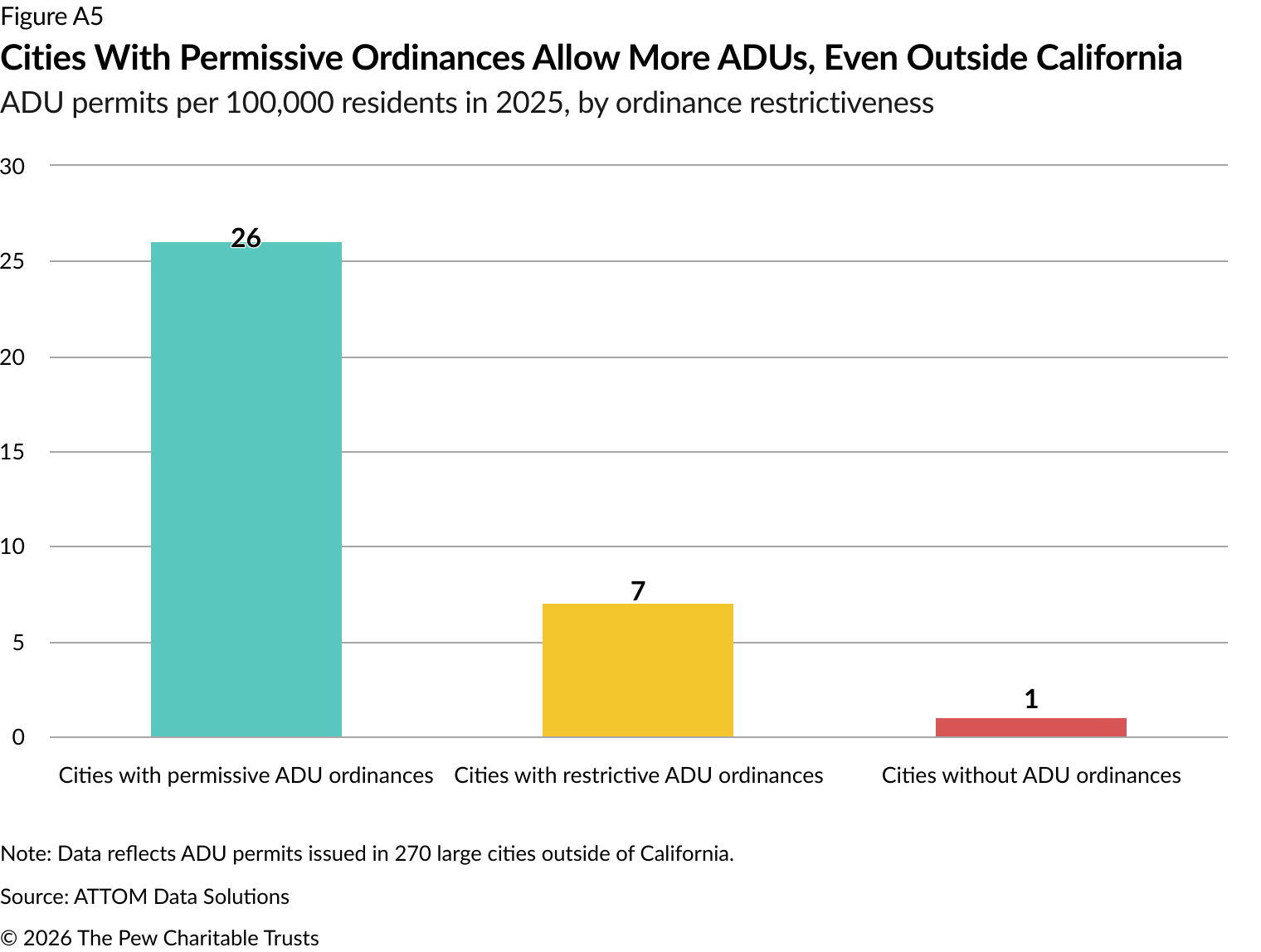
Table A1
ADUs Make Up a Larger Share of Total Permits in Cities With Permissive Ordinances, Even Outside California
ADUs as a share of total and single-family building permits, 2025
| Type of ADU ordinance |
Units permitted (all structures) |
Units permitted (1- and 2-unit structures) |
Units permitted (ADUs) | ADUs as a share of total permits | ADUs as a share of 1- and 2-unit permits |
|---|---|---|---|---|---|
| City has a permissive ADU ordinance | 121,902 | 49,557 | 5,528 | 4.5% | 11.2% |
| City has a restrictive ADU ordinance | 193,698 | 84,080 | 3,298 | 1.7% | 3.9% |
| City does not have an ADU ordinance | 56,972 | 32,094 | 144 | 0.3% | 0.4% |
| TOTAL (270 cities) | 372,572 | 165,731 | 8,970 | 2.4% | 5.4% |
Note: Not all major cities report the same data on building permits. Forty of the 270 cities included in this analysis had no data on ADU permits. Three did not report data on total units permitted and/or units permitted in one- and two-unit structures.
Source: Data for units permitted in all structures and one- and two-unit structures comes from the U.S. Census Bureau’s Building Permits Survey. Data for ADU permits comes from ATTOM Data Solutions.
Endnotes
- “Survey Finds Large Majorities Favor Policies to Enable More Housing,” Alex Horowitz and Tushar Kansal, The Pew Charitable Trusts, Nov. 30, 2023, https://www.pew.org/en/research-and-analysis/articles/2023/11/30/survey-finds-large-majorities-favor-policies-to-enable-more-housing.
- Emily Hamilton and Kol Peterson, “A Taxonomy of State Accessory Dwelling Unit Laws 2025,” Mercatus Center at George Mason University, 2025, https://www.mercatus.org/research/policy-briefs/taxonomy-state-accessory-dwelling-unit-laws-2025.
- Nicholas J. Marantz, Christopher S. Elmendorf, and Youjin B. Kim, “Where Will Accessory Dwelling Units Sprout Up When a State Lets Them Grow? Evidence From California,” Cityscape: A Journal of Policy Development and Research 25, no. 2 (2023): https://www.huduser.gov/portal/periodicals/cityscape/vol25num2/ch5.pdf. M. Nolan Gray, “California ADU Reform: A Retrospective,” California YIMBY Education Fund, 2024, https://cayimby.org/wp-content/uploads/2024/01/CAY-ADU_Report-2024-v4.pdf. American Enterprise Institute, “Accessory Dwelling Units (ADUs),” 2022, https://www.aei.org/wp-content/uploads/2022/03/ADU-study-FINAL-3.8.22.pdf.
- BuildinganADU.com, “What Is an ADU: Accessory Dwelling Units Explained,” https://www.buildinganadu.com/what-is-an-adu.
- Tobias Peter, “Housing Abundance With Light-Touch Density,” American Enterprise Institute, 2024, https://www.aei.org/wp-content/uploads/2024/03/Yimbytown-Light-touch-Density-final.pdf?x97961.
- Jake Wegmann, Karen Chapple, and Andrew Wofford, “Legislating Gentle Density From Above? Learning From the Divergent Outcomes of Three Small-Lot Densification Modes in California,” Journal of the American Planning Association 92, no. 2 (2026): 209-20, 10.1080/01944363.2025.2563532, https://doi.org/10.1080/01944363.2025.2563532.
- AARP, “ Accessory Dwelling Units: Model State Act and Local Ordinance,” 2021, https://www.aarp.org/content/dam/aarp/livable-communities/housing/2021/AARP%20ADU%20Model%20State%20Act%20and%20Local%20Ordinance-0212021-08.pdf.
- The Pew Charitable Trusts, “Preapproved Building Plans Help Cities Improve Housing Affordability,” 2026, https://www.pew.org/en/research-and-analysis/reports/2026/05/preapproved-building-plans-help-cities-improve-housing-affordability.
- Emily Hamilton and Kol Peterson, “A Taxonomy of State Accessory Dwelling Unit Laws 2025.” West Virginia Legislature, Prohibiting Certain Restrictions on Regulation of Accessory Dwelling Units, Senate Bill 659 (2026), https://legiscan.com/WV/text/SB659/id/3387439. Legislature of the State of Idaho, An Act Relating to Accessory Dwelling Units, Senate Bill 1354 (2026), https://legislature.idaho.gov/wp-content/uploads/sessioninfo/2026/legislation/S1354E1.pdf. General Assembly of North Carolina, An Act to Provide Further Regulatiory Relief to the Citizens of North Carolina, Senate Bill 445 (2026), https://webservices.ncleg.gov/ViewBillDocument/2025/10318/0/S445-PCCS15499-RI-4.
- For this report, state preemption laws are assumed to be the law of the land, regardless of whether local ordinances comply with state law.
- Ahmad Abu-Khalaf, “Making It Happen: Scaling Accessory Dwelling Units,” Enterprise Community Partners, 2023, https://www.enterprisecommunity.org/sites/default/files/2023-10/2023-ADU-Issue-Brief-Scaling-Affordable-Housing-Solutions.pdf.
- Emily Hamilton and Kol Peterson, “A Taxonomy of State Accessory Dwelling Unit Laws 2025.” “Accessory Dwelling Units,” National Zoning Atlas, https://www.zoningatlas.org/adus.
- Ahmad Abu-Khalaf, “New Reflections on Affordable Housing Design, Policy, and Production: Overcoming Barriers to Bringing Accessory Dwelling Unit Development to Scale,” Enterprise Community Partners, 2020, https://www.enterprisecommunity.org/sites/default/files/2021-06/overcoming-barriers-to-bringing-adu-development-to-scale.pdf.
- “3 Hurdles to Building Accessory Dwelling Units,” National Association of Home Builders, Oct. 15, 2025, https://www.nahb.org/blog/2025/10/building-accessory-dwelling-units.
- Donald C. Shoup, “The Trouble With Minimum Parking Requirements,” Transportation Research Part A 33 (1999): 549-74, http://shoup.bol.ucla.edu/Trouble.pdf.
- “Housing Starts and Building Permits,” National Association of Home Builders, https://www.nahb.org/news-and-economics/housing-economics/national-statistics/starts-and-permits.
- Jenny Schuetz and Eve Devens, “ADUs Could Expand the Affordable Housing Toolkit—If Local Governments Can Work Through Some Growing Pains,” Brookings Institution, 2024, https://www.brookings.edu/articles/adus-could-expand-the-affordable-housing-toolkit-if-local-governments-can-work-through-some-growing-pains/.
- “Accessory Dwelling Units (ADUs),” Washington State Department of Commerce, https://www.commerce.wa.gov/growth-management/housing-planning/adus/.
- U.S. Census Bureau, “Population Growth Reported Across Cities and Towns in All U.S. Regions,” https://www.census.gov/newsroom/press-releases/2025/vintage-2024-popest.html.
- Emily Hamilton and Kol Peterson, “A Taxonomy of State Accessory Dwelling Unit Laws 2025.”
- Morgan Friberg, “America’s ADU Boom: What 2.8 Million Permits Reveal About the Housing Solution,” Shovels, Oct. 27, 2025, https://www.shovels.ai/blog/adu-boom-2.8M-permits/.
- Sam Khater and Kristine Yao, “Granny Flats, Garage Apartments, In-Law Suites: Identifying Accessory Dwelling Units From Real Estate Listing Descriptions Using Text Mining,” Freddie Mac, July 16, 2020, https://www.freddiemac.com/research/insight/20200716-identifying-accessory-dwelling-units-from-real-estate.
- Nathanael Jo et al., “Not (Officially) in My Backyard: Characterizing Informal Accessory Dwelling Units and Informing Housing Policy With Remote Sensing,” Journal of the American Planning Association 91, no. 1 (2024): 30-45, 10.1080/01944363.2024.2345730, https://doi.org/10.1080/01944363.2024.2345730.
- “Housing Element Annual Progress Report (APR) Data by Jurisdiction and Year, Table A2,” California Department of Housing and Community Development, https://data.ca.gov/dataset/housing-element-annual-progress-report-apr-data-by-jurisdiction-and-year/resource/fe505d9b-8c36-42ba-ba30-08bc4f34e022.
- “The Big ADU West Coast Dataset,” Kol Peterson, Accessory Dwellings, https://accessorydwellings.org/2024/01/12/the-big-adu-west-coast-dataset/.
- “Housing Element Annual Progress Report (APR) Data by Jurisdiction and Year,” 2026, https://data.ca.gov/dataset/housing-element-annual-progress-report-apr-data-by-jurisdiction-and-year.
- “2026 Affordable Housing Progress Update,” Washington State Department of Commerce, 2026, https://app.leg.wa.gov/ReportsToTheLegislature/Home/GetPDF?fileName=2026%20AHAB%20Annual%20Report_FINAL_0c724a3e-ceb4-4440-b3df-288d257a59b4.pdf.
People


