Philadelphia’s Budget Forecasts Call for More Intentional Planning
How the city’s fiscal reserves will change over the next 5 years—and how it can respond

With pandemic relief funding now expired and deficits projected, Philadelphia is in a period of transition that will require some strategic and deliberate planning. But by centering its planning on the impact that these deficits could have on the budget, the city can be more intentional about its path forward—and better positioned to weather even the roughest forecasts.
Threats to future federal funds. General economic uncertainties. Increased demand for city services. There is no shortage of financial obstacles that Philadelphia and other cities will face in the coming years. Some can be foreseen and planned for, while others may appear abruptly and with significant impacts, as the Great Recession and the pandemic did. In these instances, the city must tap into its savings, or reserves, to address unexpected disruptions or shortages and continue delivering the services that residents need.

Even without a major disruptive event on the horizon, the city expects to rely on reserves in the coming years to achieve a balanced budget, which its Home Rule Charter requires. Over the span of the fiscal 2027-31 five-year plan, expenditures are projected to remain relatively stable after recent years of significant growth. Revenue is projected to grow rapidly during this period but remain lower than expenditures in all years except fiscal 2031, resulting in anticipated operating deficits for four of the five years.
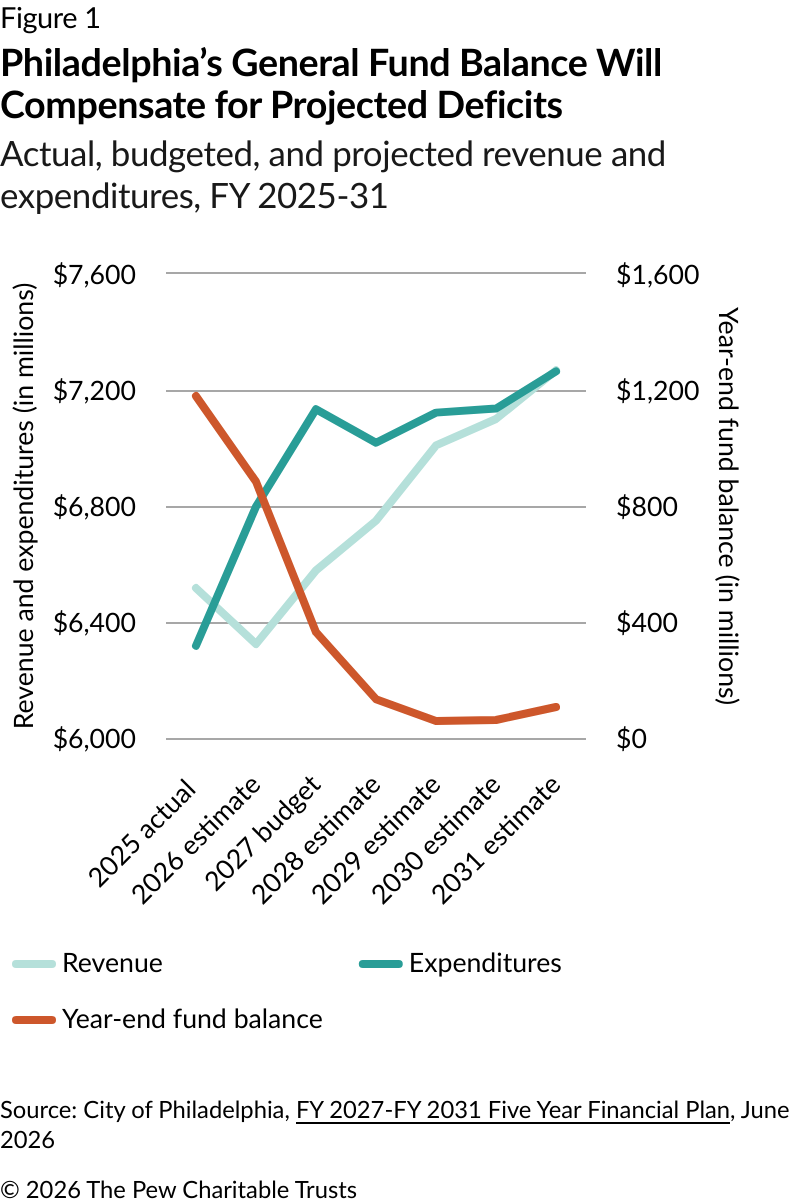
This multiyear deficit is the result of several overlapping factors—including increased fixed or inflexible costs (such as employee benefits), significant funding needed for schools, heightened demand for services in response to persistent poverty, and threatened federal funding—combined with a volatile tax base, which could hinder revenue growth. To cover this multiyear shortfall, the city will tap its general fund balance, taking it from a historic high of $1.18 billion in fiscal 2025 to a projected $107 million in fiscal 2031, a 91% decrease over six years. (See Figure 1.)
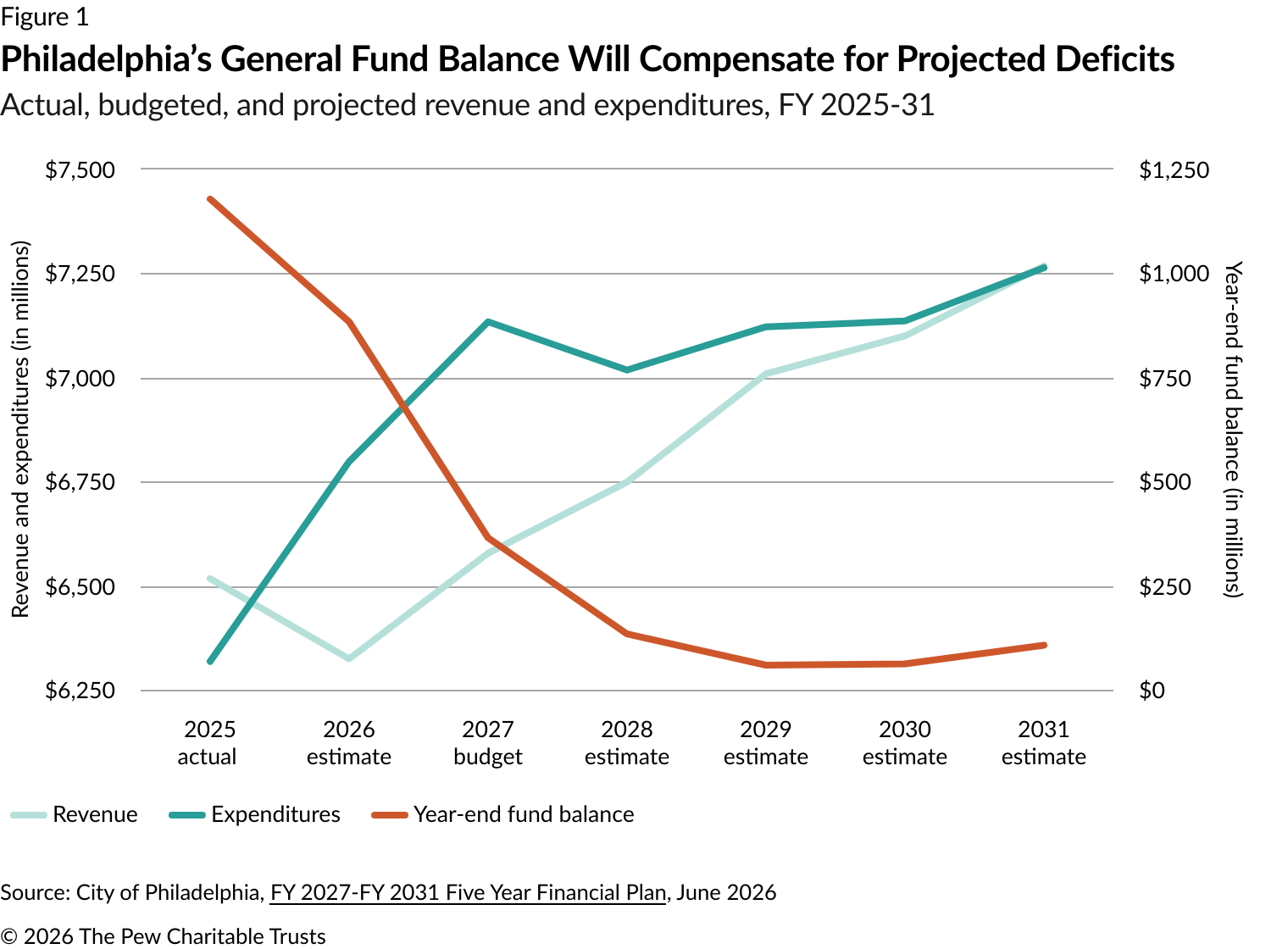
This deficit had been in sight for years, but it was offset by the $1.4 billion in American Rescue Plan Act (ARPA) funding that the city received to fill pandemic-related budget gaps. With ARPA funds supplementing general fund revenue from fiscal 2021 to fiscal 2025, the city had more time to plan for the challenges looming ahead: namely, year-over-year deficits that will significantly affect its general fund balance.
This balance is a helpful indicator of a city’s financial health, as funds are generally unrestricted for use. However, it does not provide a complete picture of the city’s reserves. Philadelphia has also contributed to a Budget Stabilization Reserve (BSR) fund, or rainy day fund, in recent years. The use of BSR funds is more restricted, requiring City Council approval in the face of a significant budget disruption, such as lower-than-projected revenue or emergency service delivery needs.

In the current five-year plan, Philadelphia anticipates making deposits into the BSR in fiscal 2027 and 2028, reaching a balance of just under $345 million that is expected to remain constant through fiscal 2031.
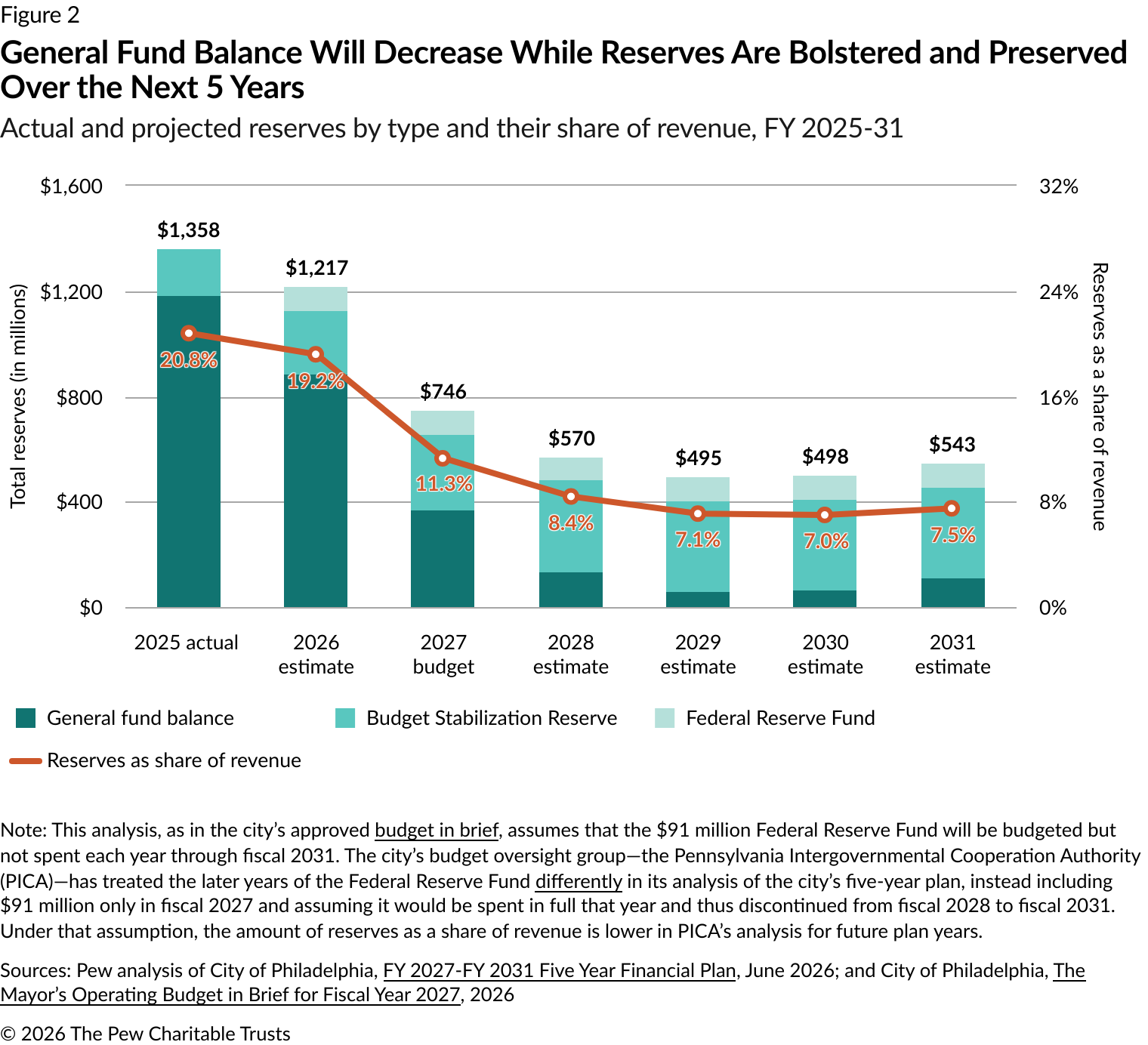
In addition to these funds, the city established a Federal Reserve Fund of $95 million in fiscal 2026 to offset threats to federal funding levels. In fiscal 2027, which began in July, the fund was reestablished at $91 million. In the city’s fiscal 2027 budget in brief, that $91 million is projected to be set aside each year of the five-year plan.
Deposits into the BSR and the Federal Reserve Fund are counted as expenditures in the general fund budget; thus, in building up its reserves, Philadelphia is increasing the size of its operating deficit. So as the general fund balance shrinks, a portion of that decrease is directly increasing other reserves.
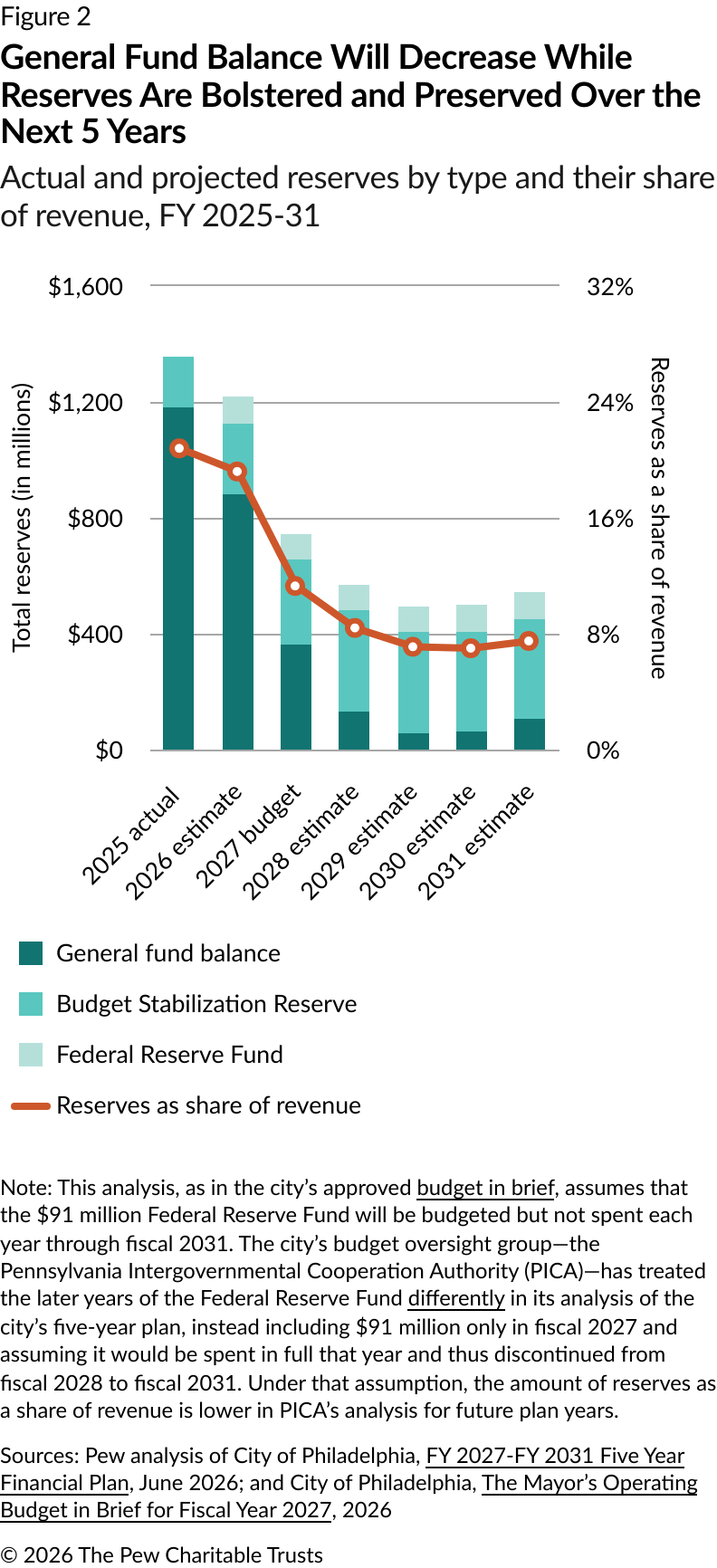
Meanwhile, the city projects a total reserve level of $543.2 million in fiscal 2031, which would reflect a 60% decrease in reserves from fiscal 2025. Nonetheless, the total reserve level would still meet the city’s goal for reserves to be 6% to 8% of total revenue. (See Figure 2.)
The city regularly outperforms the fiscal indicators it sets for itself. Thus, the actual fiscal situation in the plan’s later years may be better than current forecasts indicate. The five-year plan includes projections, which often change over time.
Philadelphia has made significant progress in improving its fiscal health in recent decades in a cycle of interconnected yet distinct actions, such as improving its pension funding levels; working with the Pennsylvania Intergovernmental Cooperation Authority (commonly referred to as PICA) to create balanced five-year plans each year since the early 1990s; and committing to build up reserves when possible.
Still, Philadelphia faces challenges. As expenditures continue to grow amid constrained revenue flows, reserve funds are a critical way for the city to prepare for funding disruptions, both anticipated and unanticipated.
The city can take this opportunity to be even more intentional about its financial future by carefully considering the forecasts and finding ways to temper their potential impacts on operations.
Alix Sullivan helps lead research for The Pew Charitable Trusts’ work on Philadelphia’s fiscal health and government performance.
People


