Who Leads Philadelphia’s Nonprofits? A Closer Look
The leadership landscape in this vital economic sector

The nonprofit sector makes up a significant portion of Philadelphia’s economy, employing about 30% of the city’s nongovernmental workers and generating $48.5 billion in annual revenue—more than a third of the city’s gross domestic product, according to research by The Pew Charitable Trusts. Nonprofit groups encompass a variety of fields and come in a wide range of sizes, from large hospital systems and universities to child welfare organizations and small community arts centers. In this third article in a series examining Philadelphia nonprofit organizations’ employment trends and revenue sources, Pew is taking a closer look at the leadership landscape in the city’s nonprofit sector.

Research from the Nonprofit Finance Fund found that when the demographics of nonprofit leaders mirror those of their local populations, it can enhance the delivery of services to their communities. Leaders in these circumstances “are often able to take the temperature and understand how policy should be crafted so that it is supportive of people on the ground,” said Kelly Woodland, executive director of the United Way of Greater Philadelphia and Southern New Jersey’s Center for Leadership Equity.
“You can’t solve problems in echo chambers,” he added. “You need folks who reflect the communities being served.”
Nonprofits organizations’ importance to the local economy notwithstanding, the data needed to fully understand Philadelphia’s nonprofit sector is incomplete at best. Partial data on employment, revenue, and employee demographics in the sector is available from some organizations through self-reporting, but such information is not shared by all organizations. Nevertheless, the existing data on the racial, ethnic, and gender makeup of the individuals who head nonprofits does shed light on this vital sector.
This analysis aims to provide factual information on the demographics of nonprofit leaders in the city, using data from Candid, an organization that collects and disseminates information about nonprofits. Pew used Candid's data about Philadelphia and six peer U.S. cities, in addition to using Candid’s nonprofit demographic data. The comparison cities analyzed—Baltimore, Boston, Chicago, Cleveland, Detroit, and Pittsburgh—were selected because they are frequently cited in Pew’s Philadelphia research, including in its annual “State of the City” report.

Nonprofit leaders are defined in the existing data as professionals who head the organizations—typically executive directors, CEOs, or presidents—but not those who serve in advisory roles, such as board members.
Approximately 10% of nonprofit organizations in each of these cities have provided some level of demographic data to Candid since 2019. In Philadelphia, that included slightly fewer than 700, or 11.6%, of the nearly 5,800 nonprofits in the data set for the city. A detailed methodology for this data and analysis is available here.
Nearly one-third of Philadelphia’s nonprofit leaders were Black
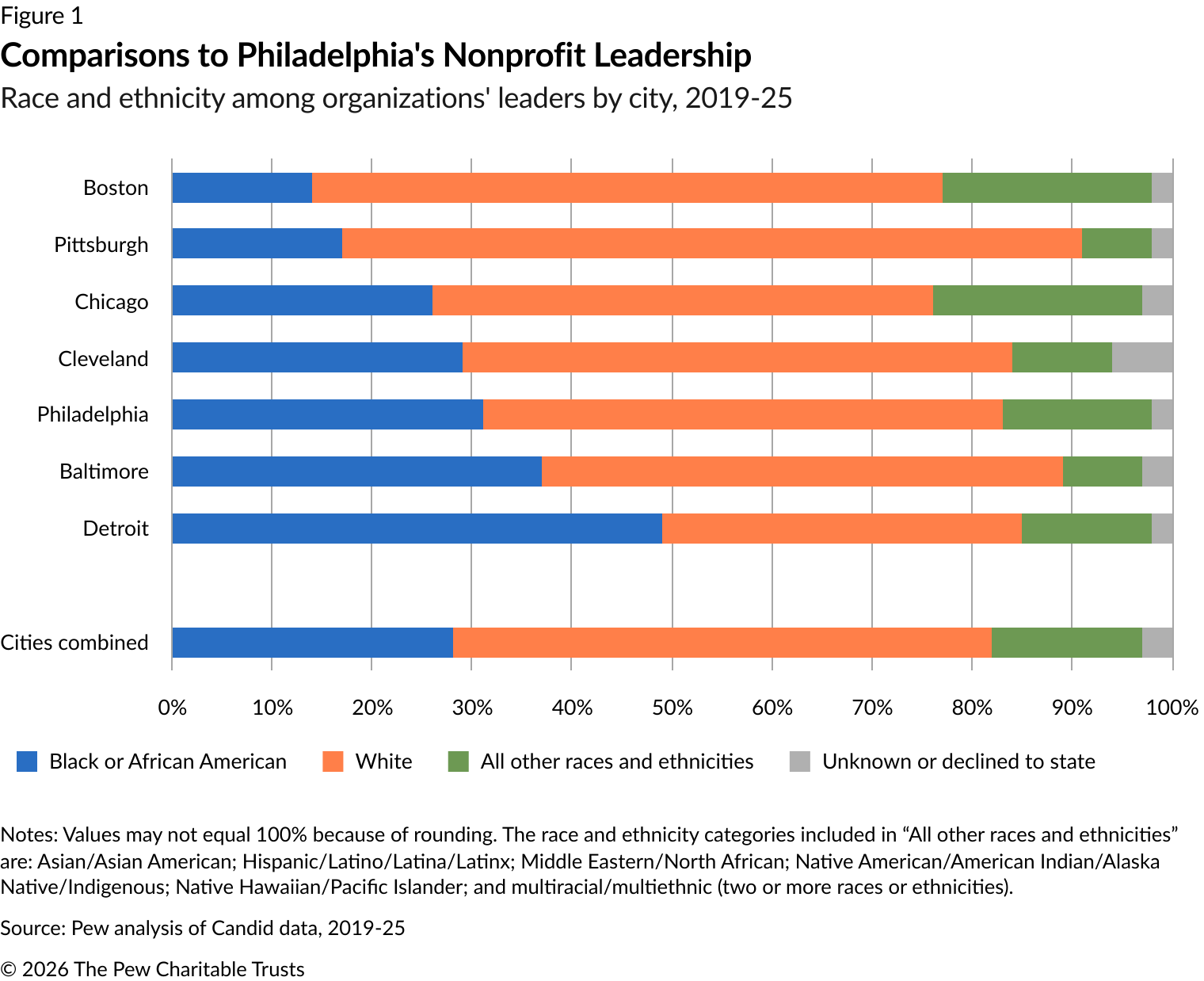
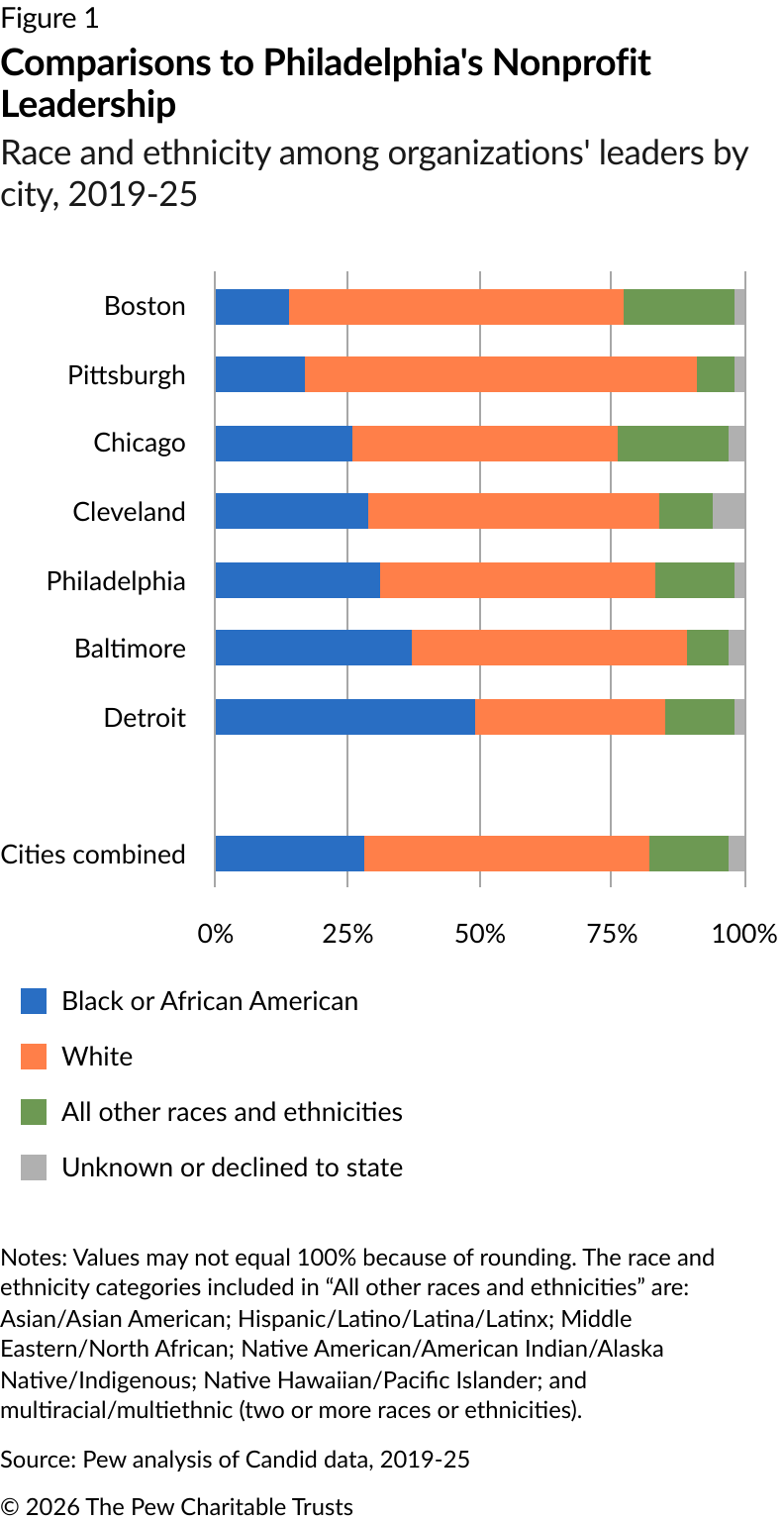
In Philadelphia, 31% of reported nonprofit leaders were Black or African American; 52% were White; 15% were another racial or ethnic group, or multiracial or multiethnic; and for 3%, race and ethnicity were unknown, or the respondents declined to provide that information. (The percentage totals may exceed 100% because of rounding.) Overall, 38% of Philadelphia residents are Black or African American, and 33% are White. Among the comparison cities, Philadelphia had the third-largest share of Black or African American nonprofit leaders, behind Detroit (49%) and Baltimore (37%). Boston and Chicago had the highest percentage of nonprofit leadership by members of races and ethnicities other than Black or White, at about 1 in 5 leaders. (See Figure 1.)
Women in leadership outnumber men
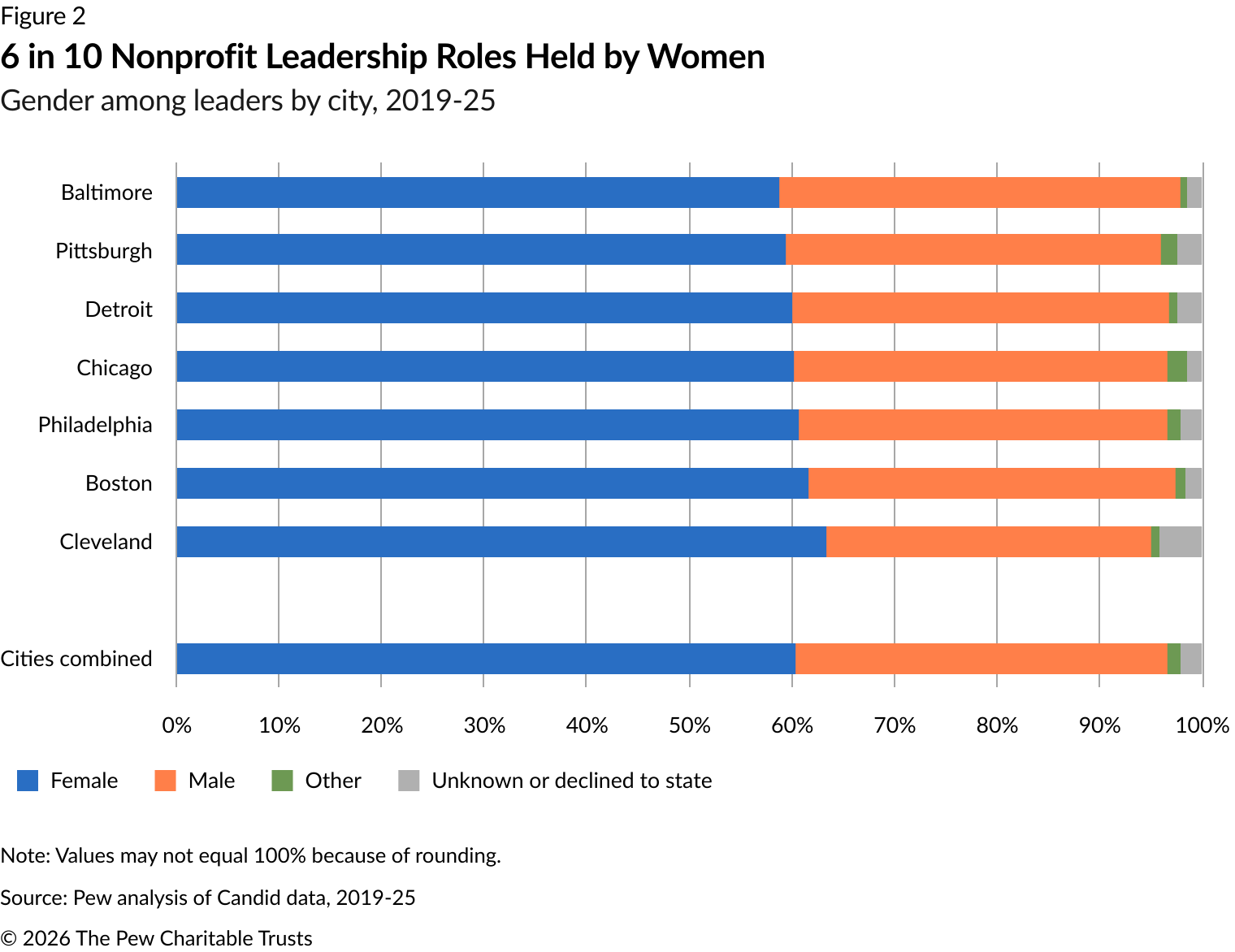
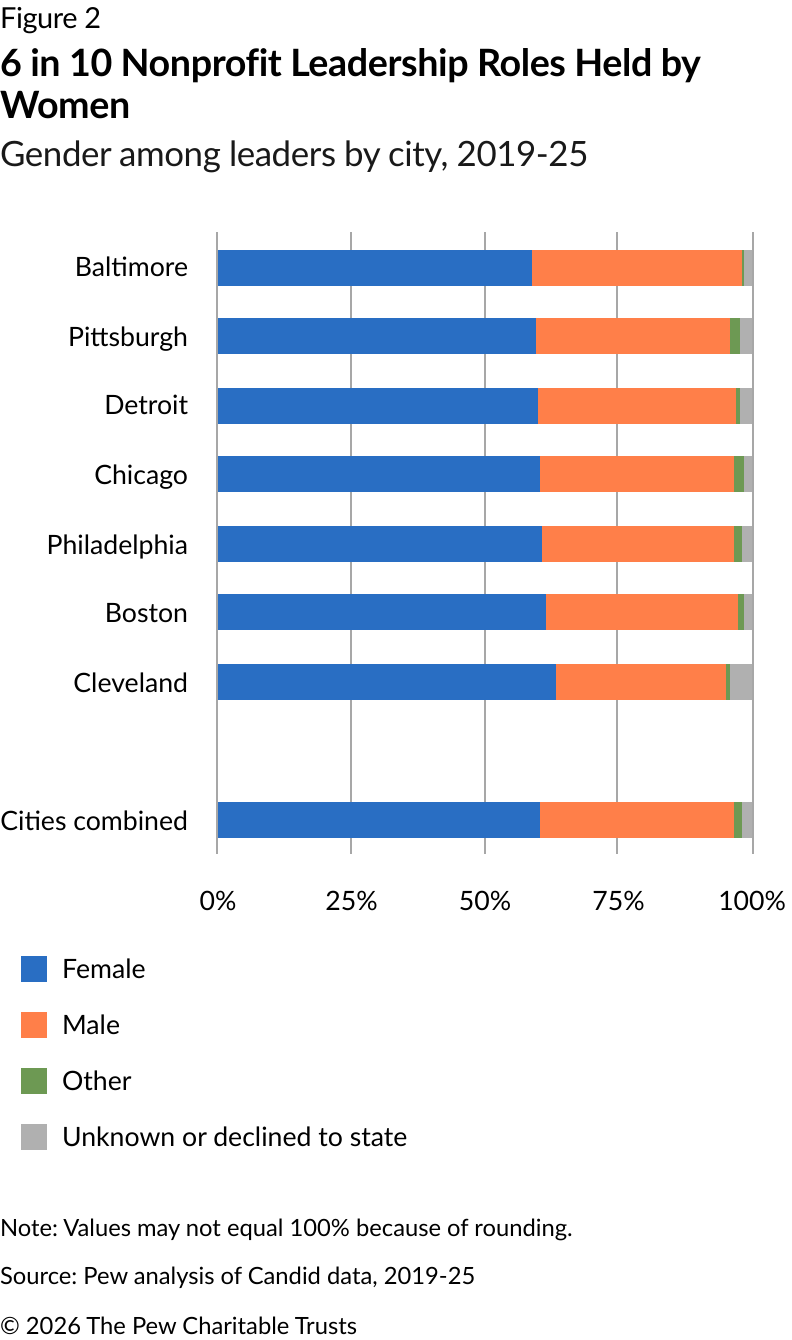
In all of the cities analyzed, roughly 60% of nonprofit leaders were women. Baltimore had the lowest share of female leaders at nonprofits, at 59%, and Cleveland was highest, at 63%. In Philadelphia, the share was 61%. (See Figure 2.) By comparison, previous Pew research on private business ownership found that the rate of female ownership among all businesses citywide was 42%.
Stark differences in pay for nonprofit leaders, depending on the city
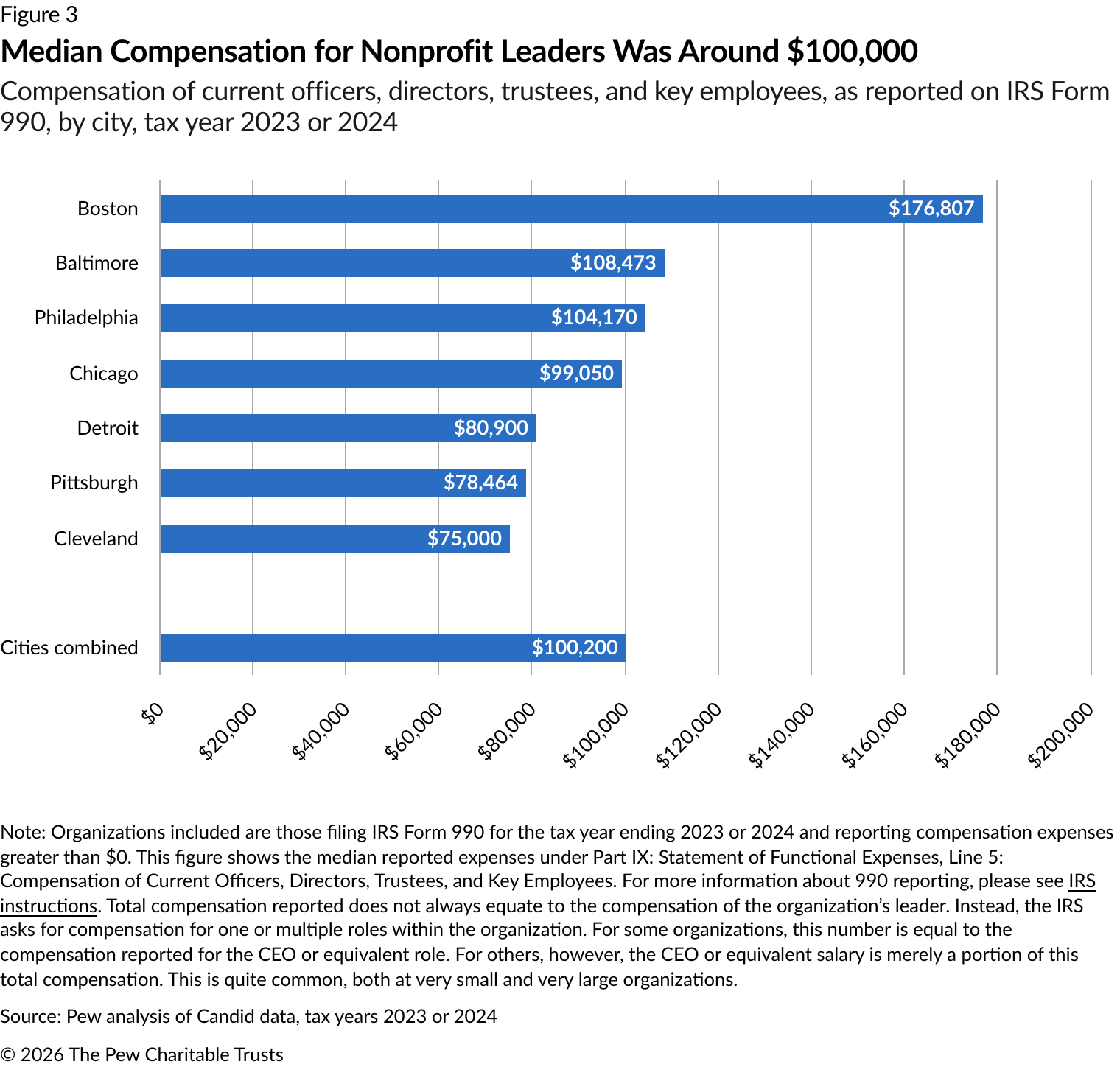
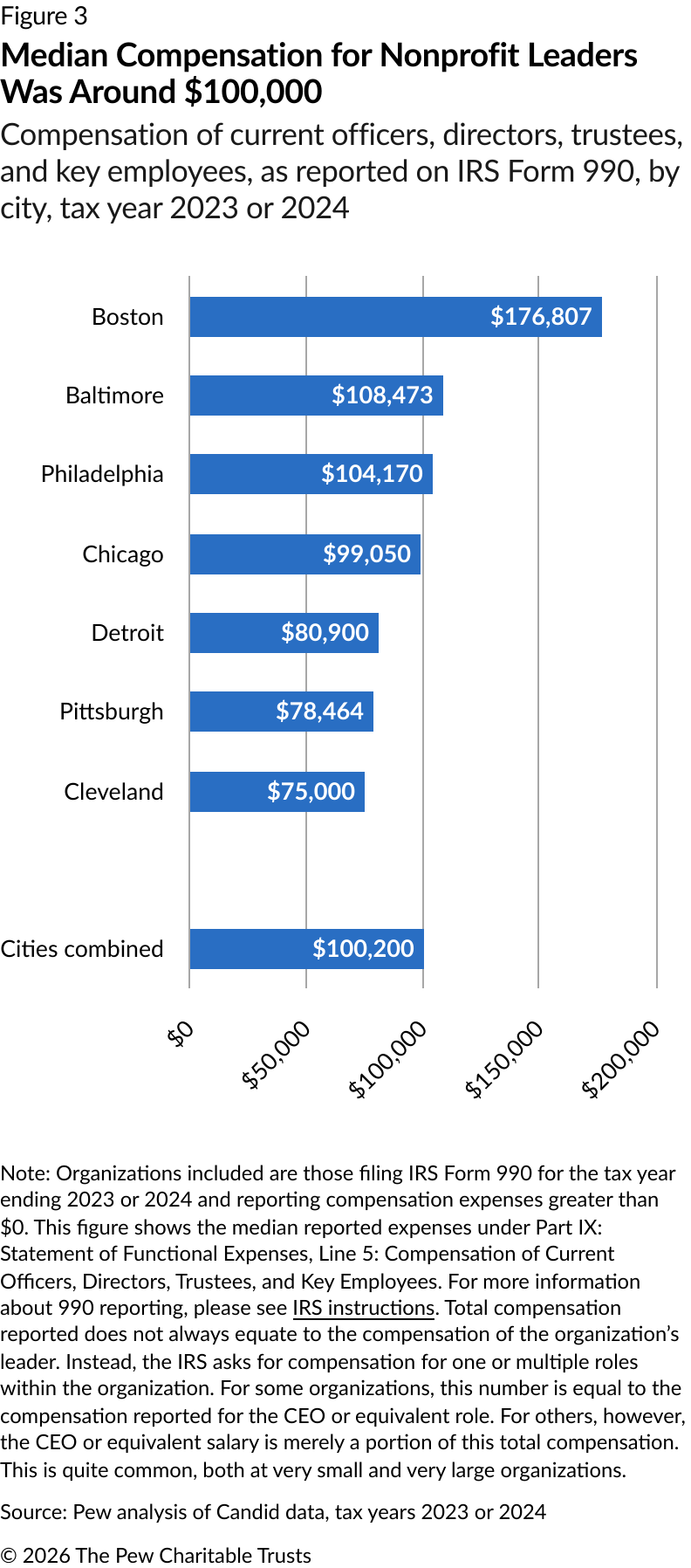
When considering leadership broadly (i.e., not solely the executive director or equivalent), nonprofits filing IRS form 990 must report total compensation for top staff, including “current officers, directors, trustees, and key employees.” In this section of Pew’s analysis, the reporting is referred to as “leadership compensation,” although the expense reported on this line may be associated with multiple high-level employees of an organization, rather than only the compensation of an executive director or equivalent role.
The median compensation for nonprofit leaders, which accounts for salary and benefits, was around $100,000, although there was considerable variation among cities, with Boston having the highest median compensation, at $176,807, and Cleveland having the lowest, at $75,000.
Philadelphia’s median leadership compensation was $104,170, behind Boston and Baltimore. (See Figure 3.) Among the cities examined, Baltimore, Philadelphia, and Boston had the highest shares of nonprofit employment citywide. Differing cost of living, competition for talent, and other factors may affect the salaries offered in each locality.
Ongoing research could yield more insights
Of the seven cities examined in this analysis, Philadelphia is in the upper half for Black or African American representation in leadership at nonprofit organizations and leadership compensation. And it is on par with other cities for female representation among leadership.
Data about nonprofit employees, including demographic characteristics such as race and gender, remains limited, although more information has become available in recent years.
Because organizations voluntarily report the data, it is not necessarily representative of the nonprofit sector as whole. However, it does provide a snapshot of the demographic realities at some organizations in Philadelphia, Baltimore, Boston, Chicago, Cleveland, Detroit, and Pittsburgh. And as research continues on nonprofit organizations and their roles in the communities they serve, demographic data for nonprofit leadership is likely to become more robust.
Alix Sullivan works on The Pew Charitable Trusts’ Philadelphia research and policy initiative.
People


